Friday, December 25, 2020

Covid Christmas 2020

 Melinda Palacio 


In the midst of a pandemic and fresh lockdowns, I managed to make a new friend. Earlier in the week, I was walking my dog around the block. Sometimes, we take short walks in the morning. It’s Christmas week and I sure wasn’t feeling in the mood for any big celebrations, especially since I cannot be with friends and family. The neighbors at the bottom of the hill were feeling generous and have been leaving a big bucket of tangerines and oranges for people to take. Their inviting sign always prompted me to pocket an orange or two. After tasting how sweet they are, I admit I take the dog for an extra lap just to pocket another tangerine. They either have a lot of fruit or I’m the only one who takes them. While pocketing the sunny beauties, a woman startles me and Pandora, my puppy lunges towards her. I apologize profusely but she is very kind and forgiving and loves dogs. Pandora only wants to say hello. We start talking and we are walking in the same direction. She lives up the hill from me in a tucked away cul de sac. She enjoys birding around the neighborhood and somewhere along our masked conversation, I mention that I play guitar  and ukulele. She tells me she has two ukuleles and wants to learn how to play them. I offered to give her lessons. Yesterday, on Christmas Eve, I dropped by to give her some cookies. She brings out her ukuleles to show me and while I’m tuning them, she goes inside and pulls out a soft Martin guitar case and asks if I want the guitar because she wants to get rid unnecessary things. It’s a travel guitar, what’s known as parlor size and called a Little Martin. It’s adorable. I’ve always wanted a small parlor size guitar. I assume she wants to sell it and ask how much she wants for it. She says she just wants to get rid of it. We settle on an exchange for ukulele lessons. 


I arrive home and more gifts have arrived by mail, including a beautiful pair of handmade earrings.


It’s Christmas and I have made the tiniest efforts of the season. A small effort we can make is a donation to al otro lado in support of Nancy Sanchez’s participation in a benefit concert, Artists to reunite families. Nancy Sanchez’s latest record, La Gran Civilizacíon recently won Latin Alternative Album of the year. If we are asked to quarantine and isolate from our loved ones in order to stop the spread of corona virus, imagine what a forced separation of children and families at the border must be like. I can only hope that the Christmas star and conjunction of planets this year will also bring the miracle of justice to families who have been separated at the border. 

Covid or no covid, it’s December 25, Merry Christmas. 


Al Otro Lado Link here


https://secure.givelively.org/donate/al-otro-lado-inc/artists-to-reunite-families?ref=f2e2951f-fa1b-4bf0-b7ea-73f8aaa9259d&fbclid=IwAR30ZrmokqKc4lZ8wpylMQKicTbwXNx3X02o0UQAvHvCwlTstCVsYXNu6uk


Thursday, December 24, 2020

A Barely Revised Neighborhood Christmas Eve Story

 Note: Some readers may recall this story from last year. I thought it was worth a revisit.


                                              The Nuart Theater today, gone is the Lucky-U

     All my father (RIP) could remember about the poem published in the now defunct Los Angeles Herald Examiner was that it began, “T’was the night before Christmas and all through the….” That’s about as much of the poem as anyone in the neighborhood could remember, but the incident rang as loudly as the bells at St. Sebastian Church, about a half-mile away. 

     Indeed, it had been the night before Christmas, and on Santa Monica boulevard (the old Highway 66 that started in Chicago, Illinois and ended at Palisades Park in Santa Monica) was a notorious beer joint known as the Lucky-U, where the heartiest, and mostly, Chicano spirit-enthusiasts spent many a day and night, after work, and on weekends.

     Since the Lucky-U was located two blocks from the Veterans Administration, many disabled WWII and Korean veterans lined their wheelchairs along Santa Monica boulevard, where the Lucky-U competed with a couple of other bars, one famously known as the Vet’s Bar.

     Seeing as it was barely ten years since many of these men had returned home from battles in the Pacific and Europe, some fresh from Korea, they numbed their ailing bodies and minds in the local beer joints. Of course, the government denied war had anything to do with their mental maladies, including all manner of substance abuse, family disruptions, unemployment, and absentee fathers. Even those who didn’t go to war, had a difficult time understanding many of their relatives and neighborhood friends would not be coming home. At the time, there was no Dr. Phil or Oprah to help out.

     Inside the dark, musty room, the Lucky-U reeked of booze and spicy food. After 5:00 PM, the end of the work day for many of them, it was rare to find an empty stool at the bar. The men played pool, sat at the few tables scattered about, but most stood around, drinks in their hands, laughing and talking boisterously.

     All of the men knew each other, had been raised on Los Angeles’ Westside, and, many were, in fact, related, their parents, refugees of the 1910 Mexican Revolution. Behind the bar, was a kitchen of sorts, serving an assortment of Mexican quick-meals, burritos and tacos. Some claimed the weekend menudo the best in town, or it was just an excuse to arrive early for the first drinks of the day. Everybody knew the owner and bartenders, so it was what Sly Stone would come to call “a family affair.”

     Actually, a few men claimed to have seen Door’s lead singer Jim Morrison knocking back a few brews; though, nobody, at the time, knew who the long-haired kid was. Morrison verified his presence in the Lucky-U to one of his biographers, years later.

     Getting back to the story, I will only use the protagonist’s first name, Joe, seeing as his children and relations might still live in the area, which is highly unlikely, since increased taxes and property values have driven out the old paisano families, as John Steinbeck might refer to them. Yet, Facebook is a mighty weapon, and who knows how many friends may read this, remember the name, and pass it on to unsuspecting family members.

     As noted, t’was the night before Christmas, the bar had closed before midnight, seeing as even serious drinkers needed to make it home to their families on such a blessed day, our savior’s birth. Apparently, Joe had something else in mind.

     He hid in the bathroom and waited for the bartender to call out he was locking the doors. There wasn’t much need to search the premises. Who would want to stay in the Lucky-U after it closed, anyway?

     So trusting was the owner, he left the cash register full of money until opening the following day when he would empty the till and collect the prior night’s earnings. My father once told me, “Who would rob the Lucky-U? It was like a second home,” a displeasing admission to many wives and children in town.

     Eventually, Joe came out of the bathroom. He called to make sure everyone was, in fact, gone. He walked straight to the cash register, opened the till, and started cramming the bills into his pockets.

     Joe was a long-time Lucky-U customer and not a thief, by nature. Surely, he thought long and hard about the course of action on which he was embarking. He considered the Lucky-U’s owner a friend, who was known to give patrons credit to partake in the establishment’s delights.

     Joe must have had good reason to abscond with the cash. Here is where the story gets a little murky regarding his motives. He might have been out of work and didn’t want to return home broke and with no gift on Christmas eve for his kids. Maybe he had bills to pay and found himself more desperate than ever. Or maybe he saw an opportunity, and he took advantage of it. This, he never confessed to his friends, but either way, he now had his pockets lined with enough money to do whatever needed to be done.

     As he made his way to the back door, which led to a dark alley, the neon lights of the Nu-Art Theater glowing across the boulevard, a thought came to him. Why not just one drink, on-the-house, before making his getaway? One drink, how could that hurt? Booze always tastes better when it’s free.

     Sure enough, he sat down and poured himself a drink. Once he finished, he figured it was time to leave, but then, he thought, hey! Why not one more? He had his money and one free drink. That should suffice. But now, with his whistle wet, the desire for another became overwhelming. So, he took advantage of the open bar and poured himself another. Well, you know what happened from here. He couldn’t stop, and he just kept pouring and drinking.

     The next morning when the owner opened to collect the prior evening’s “take”, he found Joe slumped across the bar. Of course, the owner was confused as to how Joe had gotten in, seeing as there was no apparent break-in. Complete confusion, until he looked down and saw dollars spilled on the floor beneath Joe’s bar stool, and greenbacks of various denominations peeking out of Joe’s pockets.

     I can only surmise how the Hearst newspaper reporter learned about the break-in. The owner must have called the police, as the precinct was just down the street behind the old library, to report the robbery, which generated buzz from an otherwise listless Christmas Eve news desk, sending the reluctant reporter from his warm cozy desk in downtown Los Angeles out to the Westside to check-out the minor criminal infraction.

     After conducting rudimentary interviews with people at the scene, the Herald’s reporter, his creative juices flowing, decided against writing a mundane piece about a neighborhood drunk serendipitously breaking into a local bar, chose instead to  memorialize Joe’s escapade in verse, borrowing the elements of prosody from a Christmas poem published anonymously in 1823 which began, “Twas the night before Christmas/ and all through the….”

Wednesday, December 23, 2020

Tía Chucha’s End of the Year Fundraiser


A message from our Executive Team!


Tia Chucha's Centro Cultural has been transforming community in the Northeast San Fernando Valley and beyond through ancestral knowledge, the arts, literacy, and creative engagement for the last 20 years. We thank you for your support and look forward to many more years with you!


To support our mission and our big move donate here


https://www.tiachucha.org/donate


The Northeast San Fernando Valley has a population of about 500,000 – the size of the city of Oakland – yet it had no bookstores, art galleries, or full-fledged cultural spaces until Tía Chucha's opened its doors in 2001. Thankfully, various local organizations have for decades provided services to address the many survival needs of a large number of economically insecure families and individuals in this area. Believing that it is also everyone’s right to explore and develop their innate creative gifts, Tia Chucha’s founders set out to correct the historic absence of life-enhancing artistic and literary options for this sector of the population. Melding vision with conviction, Tia Chucha’s was created as a space to embrace the equally important artistic development of our lives as human beings.


Tia Chucha’s began as a café, bookstore and cultural space owned and run by Los Angeles Poet Laureate Luis J. Rodriguez, his wife Trini, and their brother-in-law Enrique Sanchez. In 2003 Luis, along with singer/musicologist Angelica Loa Perez and Xicano Rap artist Victor Mendoza established a next-door sister nonprofit to incorporate a full range of arts workshops. When in 2007 the cultural café and bookstore disbanded as an LLC, it donated its assets, including inventory, shelves, equipment, and more to the nonprofit to carry its mission forward. Tia Chucha’s cultural center now provides year-round on-site and off-site free or low-cost arts and literacy bilingual intergenerational programming in mural painting, music, dance, writing, visual arts, healing arts sessions (such as reiki healing) and healing/talking circles. Workshops and activities also include Mexica ("Aztec") dance, indigenous cosmology/philosophy, and two weekly open mic nights (one in Spanish, the other in English). We host author readings, film screenings, and art exhibits as well.


Tuesday, December 22, 2020

C/S Nonfiction Three For the New Year

C/S Nonfiction Three For the New Year 

Michael Sedano 

The name “Arizona” conjures up sad images of plague-time idiocy, cowardly lethal border vigilantes, curriculum destroyers, and book burners. 
smuggled books in Tucson
Books smuggled into Arizona during SB1070 law

Working diligently to counter those impressions, Arizonans at the University of Arizona Press wrapped dismal 2020 with three enlivening books to help curriculum builders everywhere. La Bloga-Tuesday is happy to share the publisher’s précis of the three.

September brought Teaching Gloria E. Anzaldúa: Pedagogy and Practice for Our Classrooms and Communities.  
Teaching Gloria Anzaldúa is a pragmatic and inspiring offering of how to apply her ideas to the classroom and community rather than simply discussing them as theory. 

The collection Is divided into three main parts, according to the ways the text has been used: Curriculum Design, Pedagogy And Practice, and Decolonizing Pedagogies . . . . offers practical advice in the form of lesson plans, activities, and other suggested resources for the classroom. Are you my first practical and inspiring ways to deploy Anzaldúa’s transformative theories with real and meaningful action. 

Teaching Gloria E. Anzaldúa (link). Margaret Cantú-Sánchez (Editor), Candace de León-Zepeda (Editor), Norma Elia Cantú (Editor). ISBN hardcover 9780816541904 


October brought two titles, first, Vanessa Fonseca-Chávez, Colonial Legacies In Chicana/O Literature And Culture: Looking Through The Kaleidoscope. 


The book exposes the ways in which colonialism is expressed in the literary and cultural production in the southwest United States, a region that has experienced at least two distinct colonial periods since the 16th century. This book is intended for readers interested in how colonial legacies are performed in the southwest United States, particularly in the context of New Mexico, Texas, and Arizona. Readers will relate to the personal narrative thread throughout the book that provides a path to understanding fragmented identities. 


October’s second from the University of Arizona Press offers a portrait of Chicana/o grass roots leadership in the 20th century, in urban California, Activist Leaders of San José, Josie Méndez-Negrete. 

Through excerpts, biographical and historical information, and analysis, Méndez-Negrete shows the contributions of thid singular community throughout the 20th century and the diversity of motivations across the generations. 

Spanning generations, we hear about the motivations of activists in the 1930s to the end of the 20th century. We hear stories of victories and struggles, successes and failures, firsthand from those who participated. 

This book is an important record of the contributions of San José in improving conditions for the Mexican American community. 

Activist leaders of San Jose: En sus propias voces link. Josie Méndez-Negrete. ISBN Hardcover 9780816542000

Monday, December 21, 2020

Solsticio de invierno por Xánath Caraza


Solsticio de invierno por Xánath Caraza


El solsticio de invierno empezó hoy, 21 de diciembre de 2020, alrededor de las 4 de la madrugada.  Hoy es el día más corto del año en el Hemisferio norte y en el Hemisferio sur, por el contrario, es el día más largo del año siendo, también, el solsticio de verano.


Para muchas culturas indígenas el solsticio de invierno era el final del ciclo agrícola y el principio de un nuevo año donde se esperaba celebrar el renacimiento del sol, la renovación de la tierra y, por consiguiente, un nuevo y próspero ciclo agrícola.  Así mismo era un momento para celebrar los días venideros que poco a poco estarían más llenos de luz hasta llegar al solsticio de verano, el día más largo del año en nuestra parte del mundo.


Hoy, para celebrar el solsticio de invierno, les comparto un poema, originalmente escrito en español, que forma parte de mi poemario Sílabas de viento / Syllables of Wind (Mammoth Publications, 2014) y Le sillabe del vento (Gilgamesh Edizioni, 2017).  Fue traducido al inglés por Sandra Kingery y al italiano por Annelisa Addolorato y Zingonia Zingone.


¡Que la poesía nos salve!


Solsticio de invierno


Quieto

Se queda el sol

En la larga noche


Cantos sordos

De aves nocturnas—

Señal de la renovación


El sol se pierde

En su eterno silencio—

La noche canta


Winter Solstice


Motionless

The sun remains

In the long night


Muffled singing

Of night birds—

Signs of renovation


The sun is lost


In its eternal silence—

The night sings


(Kansas City, fall 2012)


Solstizio d’inverno


Fermo

Rimane il sole

Nella lunga notte


Canti sordi

Di uccelli notturni—

Segnale di  rinnovamento


Il sole si perde

Nel suo eterno silenzio—

La notte canta


          (Kansas City, autunno 2012)


Friday, December 18, 2020

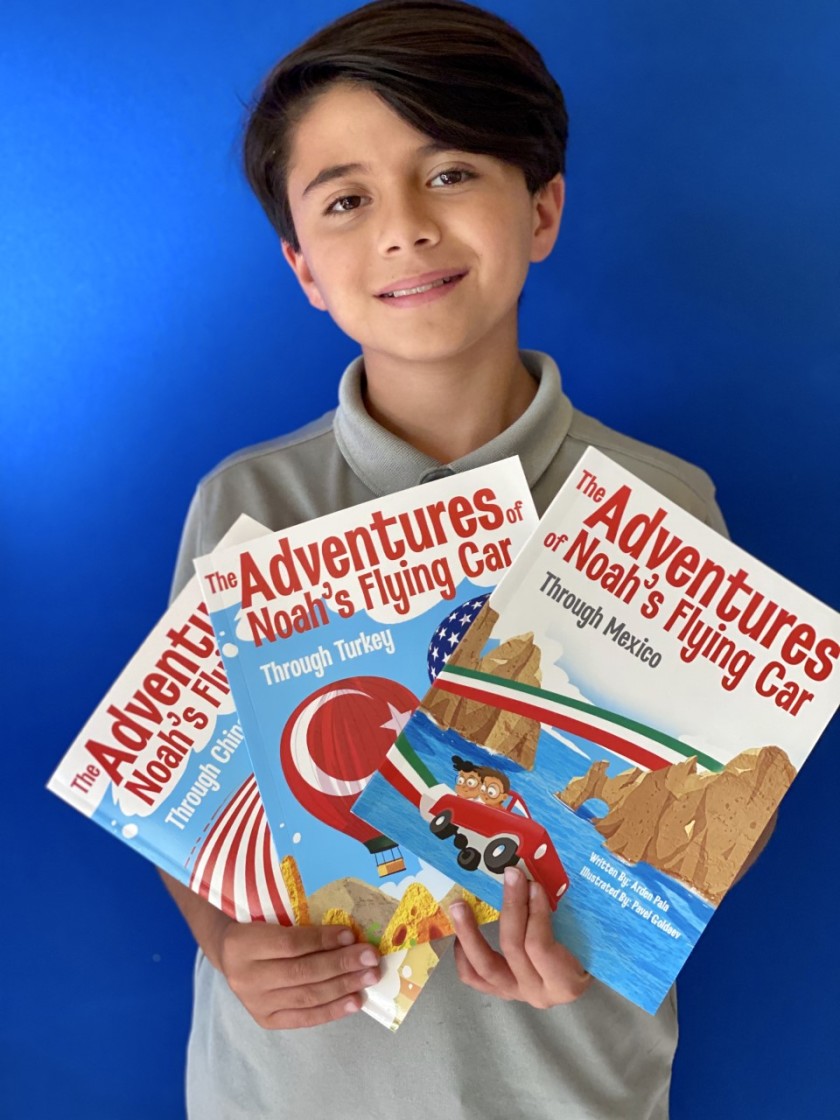
Sixth Grader's Book Proceeds Support COVID Relief Fund


Here's an inspirational story just in time for the holidays.
[from the book announcement]


Arden Pala, 
who was recently awarded “Best Child Actor” by the Los Angeles Film Awards, offers his book series to raise funds for the San Diego COVID-19 Community Response Fund. Available here.

Arden wrote The Adventures of Noah’s Flying Car series during his summer breaks and based them on trips he took with his family to Turkey, Mexico and China. 

"The main message I want to get across is that folks are all different in various ways — maybe culturally or in beliefs, religions and background and other aspects. But the uniqueness of each person should be celebrated and that ultimately brings people together. In the process, they’ll probably also find they have a lot in common."

His 24-page children’s book with illustrations by Pavel Goldaev includes descriptions of Arden’s travels through the eyes of a young boy and his friends.

The book is part of a series that explores different countries around the world — the beauty of the land, historic places, and the food as experienced by several kids traveling in a flying car. Not a bad way to travel during the pandemic, although the series started several years before.

Proceeds benefit San Diego COVID-19 Community Response Fund

The book, which raises money for the San Diego COVID-19 Community Response Fund, takes readers on an adventure swimming with dolphins in Cabo San Lucas and whale watching in Todos Santos on the way to the ancient pyramids of Chichen Itza where the kids explore a Mayan temple

“I want kids to have a fun time when they read my book. I also want kids to learn about different cultures and food,” said Arden, a sixth-grader at Francis Parker School in San Diego.

The way Arden figures it, if he shows different places in the world where kids’ families come from, they can make a connection with those places and understand a little more about the kids who come from there.

“I wrote the books to show that it’s OK to be different,” said Arden.

Arden comes from an immigrant culture himself — Turkish American — and "cultural differences and accepting each other with our differences, no matter where we come from, is something we discuss very often at home."

“I want to explain about a country in a short, fun way, so kids get to experience how exciting and cool it is,” said Arden.

Later.

______________________________

Manuel Ramos writes crime fiction.  His latest book is Angels in the Wind coming from Arte Público Press, April 2021.

Thursday, December 17, 2020

Chicanonautica: COVID-19 Kills X-Fic


by Ernest Hogan


For months I’ve been pimping the 2020 Extra-Fiction Contest from Somos en escrito, The Latino Literary Online Magazine, but now it’s my sad duty to report that, at least this year, it ain’t gonna happen. There weren’t enough entries, so it’s been canceled. Another casualty of COVID-19.


It shouldn’t be such a surprise. Even when there isn’t a pandemic paralyzing the world and disrupting our personal lives, it’s not easy being a writer from the Latinoid continuum. There aren’t many markets willing to publish us--I don’t keep saying that New York treats me like the most talented leper they have ever met for nothing--and with the virus grinding away at what’s left of civilization (do I even have to mention the election?), just writing is hard to get around to. If we aren’t just struggling to survive, there's the funk of lousy times drying up the creative juices.


Even the incredible Latinx imagination is taking some brutal hits in 2020.


Not that I personally have that problem. For me writing is the way I deal with adversity, the weapon I reach for when the going gets tough. My novel Zyx is coming along fine, getting too big--it just may be a trilogy--which maybe more salable . . .


But I know that I’m not like everybody else, and the creative work is work, hard work. Even I have trouble fitting it in around the day job and living in apocalyptic times.


The good news is they’re not giving up. The Extra-Fiction Contest will be back in 2021, which gives you plenty of time to write something. I’ve told them that if they need a judge, I’m available. And I’m still hoping to get my mind seriously blown.


Somos en escrito is still doing great stuff. Check ‘em out.


Ernest Hogan is the Father of Chicano Science Fiction. His short fiction collection Pancho Villa’s Flying Circus & Other Fictions is coming soon.