Friday, July 15, 2022

New Books

Tidbits for a literary feast.  From bad Mexicans to good witches, recent or upcoming books for your reading pleasure.

_______________________________________


Bad Mexicans:  Race, Empire, and Revolution in the Borderlands
Kelly Lytle Hernández

W.W. Norton - May 10, 2022

[from the publisher]
“Rebel historian” Kelly Lytle Hernández reframes our understanding of U.S. history in this groundbreaking narrative of revolution in the borderlands.

Bad Mexicans tells the dramatic story of the magonistas, the migrant rebels who sparked the 1910 Mexican Revolution from the United States. Led by a brilliant but ill-tempered radical named Ricardo Flores Magón, the magonistas were a motley band of journalists, miners, migrant workers, and more, who organized thousands of Mexican workers—and American dissidents—to their cause. Determined to oust Mexico’s dictator, Porfirio Díaz, who encouraged the plunder of his country by U.S. imperialists such as Guggenheim and Rockefeller, the rebels had to outrun and outsmart the swarm of U. S. authorities vested in protecting the Diaz regime. The U.S. Departments of War, State, Treasury, and Justice as well as police, sheriffs, and spies, hunted the magonistas across the country. Capturing Ricardo Flores Magón was one of the FBI’s first cases.

But the magonistas persevered. They lived in hiding, wrote in secret code, and launched armed raids into Mexico until they ignited the world’s first social revolution of the twentieth century.

Taking readers to the frontlines of the magonista uprising and the counterinsurgency campaign that failed to stop them, Kelly Lytle Hernández puts the magonista revolt at the heart of U.S. history. Long ignored by textbooks, the magonistas threatened to undo the rise of Anglo-American power, on both sides of the border, and inspired a revolution that gave birth to the Mexican-American population, making the magonistas’ story integral to modern American life.

______________________________________


The Inheritance of Orquídea Divina
Zoraida Córdova

Atria Books - Trade paperback edition July 5, 2022

[from the publisher]
The Montoyas are used to a life without explanations. They know better than to ask why the pantry never seems to run low, or why their matriarch won’t ever leave their home in Four Rivers—not for graduations, weddings, or baptisms. But when Orquídea Divina invites them to her funeral and to collect their inheritance, they hope to learn the secrets that she has held onto so tightly their whole lives. Instead, Orquídea is transformed into a ceiba tree, leaving them with more questions than answers.

Seven years later, her gifts have manifested in different ways for Marimar, Rey, and Rhiannon, granting them unexpected blessings and powers. But soon, a hidden figure begins to tear through their family tree, picking them off one by one as it seeks to destroy Orquídea’s line. Determined to save what’s left of their family and uncover the truth behind their inheritance, her descendants travel to Ecuador—to the place where Orquídea buried her secrets and broken promises and never looked back.

Alternating between Orquídea’s past and her descendants’ present, The Inheritance of Orquídea Divina is a “spellbinding tale, both timeless and fresh, that will stay with you long after you’ve turned the last page. Prepare to fall in love” (Kim Liggett, New York Times bestselling author).

________________________


The Man Who Could Move Clouds: A Memoir     
Ingrid Rojas Contreras
Doubleday - July 12, 2022

[from the publisher]
For Ingrid Rojas Contreras, magic runs in the family. Raised amid the political violence of 1980s and ’90s Colombia, in a house bustling with her mother’s fortune-telling clients, she was a hard child to surprise. Her maternal grandfather, Nono, was a renowned curandero, a community healer gifted with what the family called “the secrets”: the power to talk to the dead, tell the future, treat the sick, and move the clouds. And as the first woman to inherit “the secrets,” Rojas Contreras’ mother was just as powerful. Mami delighted in her ability to appear in two places at once, and she could cast out even the most persistent spirits with nothing more than a glass of water.

This legacy had always felt like it belonged to her mother and grandfather, until, while living in the U.S. in her twenties, Rojas Contreras suffered a head injury that left her with amnesia. As she regained partial memory, her family was excited to tell her that this had happened before: Decades ago Mami had taken a fall that left her with amnesia, too. And when she recovered, she had gained access to “the secrets.”

In 2012, spurred by a shared dream among Mami and her sisters, and her own powerful urge to relearn her family history in the aftermath of her memory loss, Rojas Contreras joins her mother on a journey to Colombia to disinter Nono’s remains. With Mami as her unpredictable, stubborn, and often hilarious guide, Rojas Contreras traces her lineage back to her Indigenous and Spanish roots, uncovering the violent and rigid colonial narrative that would eventually break her mestizo family into two camps: those who believe “the secrets” are a gift, and those who are convinced they are a curse.

Interweaving family stories more enchanting than those in any novel, resurrected Colombian history, and her own deeply personal reckonings with the bounds of reality, Rojas Contreras writes her way through the incomprehensible and into her inheritance. The result is a luminous testament to the power of storytelling as a healing art and an invitation to embrace the extraordinary.

___________________________


Silvia Moreno-Garcia
Del Ray - July 19, 2022

[from the author's website]
From the New York Times bestselling author of Mexican Gothic and Velvet Was the Night comes a dreamy reimagining of The Island of Doctor Moreau set against the backdrop of nineteenth-century Mexico.

Carlota Moreau: a young woman, growing up in a distant and luxuriant estate, safe from the conflict and strife of the Yucatán peninsula. The only daughter of either a genius, or a madman.

Montgomery Laughton: a melancholic overseer with a tragic past and a propensity for alcohol. An outcast who assists Dr. Moreau with his scientific experiments, which are financed by the Lizaldes, owners of magnificent haciendas and plentiful coffers.

The hybrids: the fruits of the Doctor’s labor, destined to blindly obey their creator and remain in the shadows. A motley group of part human, part animal monstrosities.

All of them living in a perfectly balanced and static world, which is jolted by the abrupt arrival of Eduardo Lizalde, the charming and careless son of Doctor Moreau’s patron, who will unwittingly begin a dangerous chain reaction.

For Moreau keeps secrets, Carlota has questions, and in the sweltering heat of the jungle, passions may ignite.

The Daughter of Doctor Moreau is both a dazzling historical novel and a daring science fiction journey.


____________________


Kimberly Garza
Henry Holt and Co. - August 9, 2022

[from the publisher]
Welcome to Galveston, Texas. Population 50,241.

A popular tourist destination and major shipping port, Galveston attracts millions of visitors each year. Yet of those who come to drink by the beach, few stray from the boulevards to Fish Village, the neighborhood home to individuals who for generations have powered the island.

Carly Castillo has only ever known Fish Village. Her grandmother claims that they descend from the Karankawas, an extinct indigenous Texan tribe, thereby tethering them to Galveston. But as Carly ages, she begins to imagine a life elsewhere, undefined by her family’s history. Meanwhile, her boyfriend and all-star shortstop turned seaman, Jess, treasures the salty, familiar air. He’s gotten chances to leave Galveston for bigger cities with more possibilities. But he didn’t take them then, and he sure as hell won’t now. When word spreads of a storm gathering strength offshore, building into Hurricane Ike, each Galveston resident must make a difficult decision: board up the windows and hunker down or flee inland and abandon their hard-won homes.

Moving through these characters’ lives and those of the extraordinary individuals who circle them, Kimberly Garza's The Last Karankawas weaves together a multitude of voices to present a lyrical, emotionally charged portrait of everyday survival. The result is an unforgettable exploration of familial inheritance, human resilience, and the histories we assign to ourselves, reminding us that the deepest bonds are forged not by blood, but by fire.

Later.

__________________________

Manuel Ramos lives in Denver. His latest novel, Angels in the Wind: A Mile High Noir, is a finalist for the 2022 Shamus Award in the category of Best Original Paperback P.I. Novel.


Thursday, July 14, 2022

Chicanonautica: Maya Under the Ixcanul

by Ernest Hogan

There’s this silly belief circulating among Americanos, with a “spiritual” bent, that refuses to die. Some of these folks are in awe of the “Mayans” (note: the people are the Maya, Mayan refers to things that belong to them), not just for their art, and religion, but the assumption that they escaped being exterminated by the Spanish by “disappearing” which can mean anything from leaving the planet in flying saucers, to vibrating away to a higher plain of existence. 


Meanwhile, not far from those who espouse this belief, Maya-looking people are mowing their lawns, cleaning their houses, and helping them take care of business at banks and other businesses.


Also, the Maya still live in Southern Mexico and Central America. 


There are even movies about them.


One can be seen on Kanopy, called Ixcanul, which means “volcano,” directed by Guatemalan filmmaker Jayro Bustamante.  In it you can see Maya playing Maya, and hear them speaking the Kaqchikel Mayan dialect. It is a story of how they live in modern times.


It's about the coming of age of a girl named Maria on a coffee plantation in which natural beauty and cinematic lyricism contrasts with gritty reality. Not quite the magic realism some might expect.


Maria is set to marry Igancio, a boy from her village. It’s a deal made by the parents of the couple. Unfortunately, Maria has other ideas.


She likes another boy, Pepe, who is going to the United States, which seems to be a magical place, across the desert where the snake repellent and other amazing things come from. Maria would like to go there with Pepe.


After a scene of Maria masterbating with a tree, outside a sleazy bar she has sex with Pepe and becomes pregnant, but things do not go as she had planned. Pepe isn’t interested in making the dangerous trip to the U.S. with Maria or marrying her and starting a family. The wedding with Ignacio is canceled. Her parents are mad, but agree to take care of her and the baby.


Mayan spirituality abounds, but it doesn’t work the way New Age Americanos would like it to. Rituals to abort the fetus and drive snakes out of farmland don’t work. The volcano is a god, whose presence is felt like the mist crawling up from the lava, but the modern world keeps intruding, a hypnotic rasquache mix, especially when they go to a city for the child’s birth.


Something to think about as the U.S./Mexico border once again becomes a political hot spot. Ever wonder where your coffee comes from? Or the Maya-looking young women we keep seeing in offices all over Aztlán, working at computers, keeping our unsteady civilization going . . . ?


Ernest Hogan lives and writes in Aztlán, and sees Mayan faces every day.

Wednesday, July 13, 2022

International Latino Book Award Finalistas 2022


This is the list of picture books awards. To find more information, visit https://www.latinobookawards.org


Felicidades a todos los finalistas. 


A1 CHILDREN BOOK AWARDS


The Alma Flor Ada Best Latino Focused Children’s Picture Book Award – English

-Bisa’s Carnaval, Joana Pastro, Illustrated by Carolina Coroa, Scholastic Inc.: Orchard Books; Ancestry of the author(s): Both from Brazil; The author(s) lives in: Dublin

-Child of the Flower-Song People: Luz Jiménez, Daughter of the Nahua, Gloria Amescua, Illustrated by Duncan Tonatiuh, Abrams Books For Young Readers


The Alma Flor Ada Best Latino Focused Children’s Picture Book Award – Spanish

 -¡Corre, pequeño Chaski! Una aventura en el camino Inka, Mariana Llanos, Illustrated by Mariana Ruiz Johnson, Barefoot Books; Ancestry of the author(s): Perú; The author(s) lives in: Oklahoma City

-Pura’s Cuentos: How Pura Belpré Libraries Reshaped Libraries with Her Stories, Annete Bay 

Pimentel, Illustrated by Magaly Morales, Abrams Books For Young Readers


Best Children’s Fiction Picture Book – Bilingual

-Isabel and Her Colores Go to School, Alexandra Alessandri, Illustrated by Courtney Dawson, Sleeping Bear Press; Ancestry of the author(s): US/ Colombia; The author(s) lives in: Miami, FL

-Let’s Be Friends/ Seamos Amigos, René Colato Laínez, illustrated by Nomar Perez, Holiday House, Inc.; Ancestry of the author(s): El Salvador; The author(s) lives in: Los Angeles, CA


Best Children’s Fiction Picture Book – English

-Abuelita and Me, Leonarda Carranza, illustrated by Rafael Mayani, Annick Press; Ancestry of the author(s): El Salvador; The author(s) lives in: Toronto

-May Your Life Be Deliciosa, Michael Genhart, Illustrated by Loris Lora, Abrams Books For Young Readers;

-Tía Fortuna’s New Home, Ruth Behar, Illustrated by Devon Holzwarth, Alfred A. Knopf, Random House Children’s Books; Ancestry of the author(s): Cuban/USA; The author(s) lives in: New York, NY


Mejor libro ilustrado de ficción para niños

-El monstruo más feo del mundo, Luis Amavisca, Illustrated by Erica Salcedo, nubeOCHO; Ancestry of the author(s): España ; The author(s) lives in: Málaga

-La Jirafa que no Cabía en su Cuento, Haydée Zayas Ramos, Editorial Destellos LLC; Ancestry of the author(s): Puerto Rico; The author(s) lives in: San Juan

-Pitu le Baila al Mar, Gamaliel Valle Rosa, Editorial Destellos LLC; Ancestry of the author(s): Puerto Rico; The author(s) lives in: NY city


Best Children’s Nonfiction Picture Book – English

-Alphabet & Affirmations with The Black Unicorn, Sandra Elaine Scott, Vision Your Dreams; Ancestry of the author(s): Panama/USA; The author(s) lives in: Boston

-In the Spirit of a Dream: 13 Stories of American Immigrants of Color, Aida Salazar, Illustrated by Alina Chau, Scholastic Inc.: Orchard Books; Ancestry of the author(s): Mexico; The author(s) lives in: San Francisco, CA

-One Whole Me, Illustrated by Natalia Jiménez Osorio, El Mundo Mixon Books; Ancestry of the author(s): USA/African American; The author(s) lives in: Columbus, Ohio


Best Children’s Nonfiction Picture Book – Spanish or Bilingual

-Pura’s Cuentos: How Pura Belpré Libraries Reshaped Libraries with Her Stories, Annete Bay Pimentel, Illustrated by Magaly Morales, Abrams Books For Young Readers


Best Educational Children’s Picture Book – Bilingual

-Lala and the Pond by the Rock/ Lala y el Charco de la Piedra, Susana Illera Martinez, Snow Fountain Press; Ancestry of the author(s): Columbia; The author(s) lives in: Miami, FL

-Popol Vuh Stories for Children, Denis O’Leary, Floricanto Press; Ancestry of the author(s): USA; The author(s) lives in: Los Angeles

-Pura’s Cuentos: How Pura Belpré Libraries Reshaped Libraries with Her Stories, Annete Bay Pimentel, Illustrated by Magaly Morales, Abrams Books For Young Readers


Best Educational Children’s Picture Book – English

-Child of the Flower-Song People: Luz Jiménez, Daughter of the Nahua, Gloria Amescua, Illustrated by Duncan Tonatiuh, Abrams Books For Young Readers

-We Move Together, Kelly Fritsch, Anne McGuire, Illustrated by Eduardo Trejos, AK Press; Ancestry of the author(s): Toronto, Ottawa; The author(s) lives in: Charles Weigl


Best Educational Children’s Picture Book – Spanish

-Morderse las uñas, Paula Merlán, Illustrated by Brenda Figueroa, Cuento de Luz; Ancestry of the author(s): Spain


Most Inspirational Children’s Picture Book – Bilingual

-Pura’s Cuentos: How Pura Belpré Libraries Reshaped Libraries with Her Stories, Annete Bay Pimentel, Illustrated by Magaly Morales, Abrams Books For Young Readers

-The Last Butter"y/ La última mariposa, Regina Moya & Carmen Tafolla, FlowerSong Press; Ancestry of the author(s): Mexico; The author(s) lives in: San Antonio. TX


Most Inspirational Children’s Picture Book – English

-Child of the Flower-Song People: Luz Jiménez, Daughter of the Nahua, Gloria Amescua, Illustrated by Duncan Tonatiuh, Abrams Books For Young Readers

-Courageous Camila: A story about finding your inner warrior, Naibe Reynoso and Giselle Carrillo, illustrated by María Tuti, Con Todo Press; Ancestry of the author(s): USA/Mexican- American; The author(s) lives in: Los Angeles

-The Voices of the Trees, Elisa Guerra y Fernando Reimers, illustrated by Ana RoGu, Pearson Educación; Ancestry of the author(s): Elisa Guerra: México. Fernando Reimers: Venezuela. Ana RoGu: México; The author(s) lives in: Elisa / Ana: Aguascalientes, México. Fernando: Cambridge, MA.


Most Inspirational Children’s Picture Book – Spanish

-Memoria de un abedul, Daniel Cañas, Illustrated by Blanca Millán, Cuento de Luz; Ancestry of the author(s): Spain

-Peque y yo, Alicia Acosta, Illustrated by Mercé Galí, nubeOCHO; Ancestry of the author(s): España ; The author(s) lives in: Málaga

-Tienes un color especial, Lorena Sierco Espino, Mr. Momo, Lantia Publishing Group; Ancestry of the author(s): Spain; The author(s) lives in: Barcelona


Best Learn to Read Book

-The Awesome Reading Adventures of Super Sammy and Marvelous Megan, Vanessa Caraveo, Vanessa Caraveo; Ancestry of the author(s): USA/ Mexican-American; The author(s) lives in: Harlingen, Texas


Tuesday, July 12, 2022

Respite: Patience Rewards

Michael Sedano

I used to feel pangs of guilt when I took my weekly walkabouts at the Huntington Library or Los Angeles County Arboretum. These are favorite places Barbara and I enjoyed, and for fifty years, we'd make a day of it, taking our daughter, then taking our granddaughter to the gardens.

Now, I walk alone. And enjoy it. Hence those pangs.

Alzheimer's Dementia has taken away Barbara's easy mobility, and vocabulary. Because she no longer has names for things, she doesn't see details in the environment. "Look at the butterfly," I might point, and Barbara scans the area uncomprehendingly. When she speaks, Aphasia denies Barbara intelligibility. 

Living with dementia is a lifestyle, being a caregiver is a new career with no Union to back up the worker, and no Boss except time: do it now, and what remains?

Respite: a complete absence of thinking about responsibility. 

I take my respite with a lens. Used to be--before the GOPlague--I photographed writers, principally poets, reading their own stuff in front of an audience. I want to make a perfect foto of an oral communicator. The speaker in the foto displays confidence and poise; dynamic posture; arresting eye contact; mouth and lips forming speech; body in control of the space. 

Every speaker creates moments of perfection during a presentation, except people with their noses stuck in a manuscript or iPhone screen. The photographer's challenge is listening keenly, anticipating something good, and pressing the button when it happens. Nearly Perfect will be good enough, and often, extraordinarily satisfying.
I don't know the name of this spectacular red flower with the yellow tubes--maybe a Ginger. The first time I saw the plant in blossom, my mind said "hummingbird flower!" 

The plant occupies a corner of the Garden Court, a busy to-and-fro area keeping Colibrí infrequent feeders. Today I waited fifteen minutes for a bird to swoop into the canopy. I stood still watching the feeding hummingbird drift from plant to plant, moving from shade to light, left to right, nearer and nearer the lens. 

As she tasted each of the six clusters,  I snapped off a dozen frames. Sated, she hovered a few feet from my face expecting and receiving my thanks for wondrous pictures. Not her fault the darned shade makes most of the frames unsatisfying. I know now this foto exists and that means it can be done again.
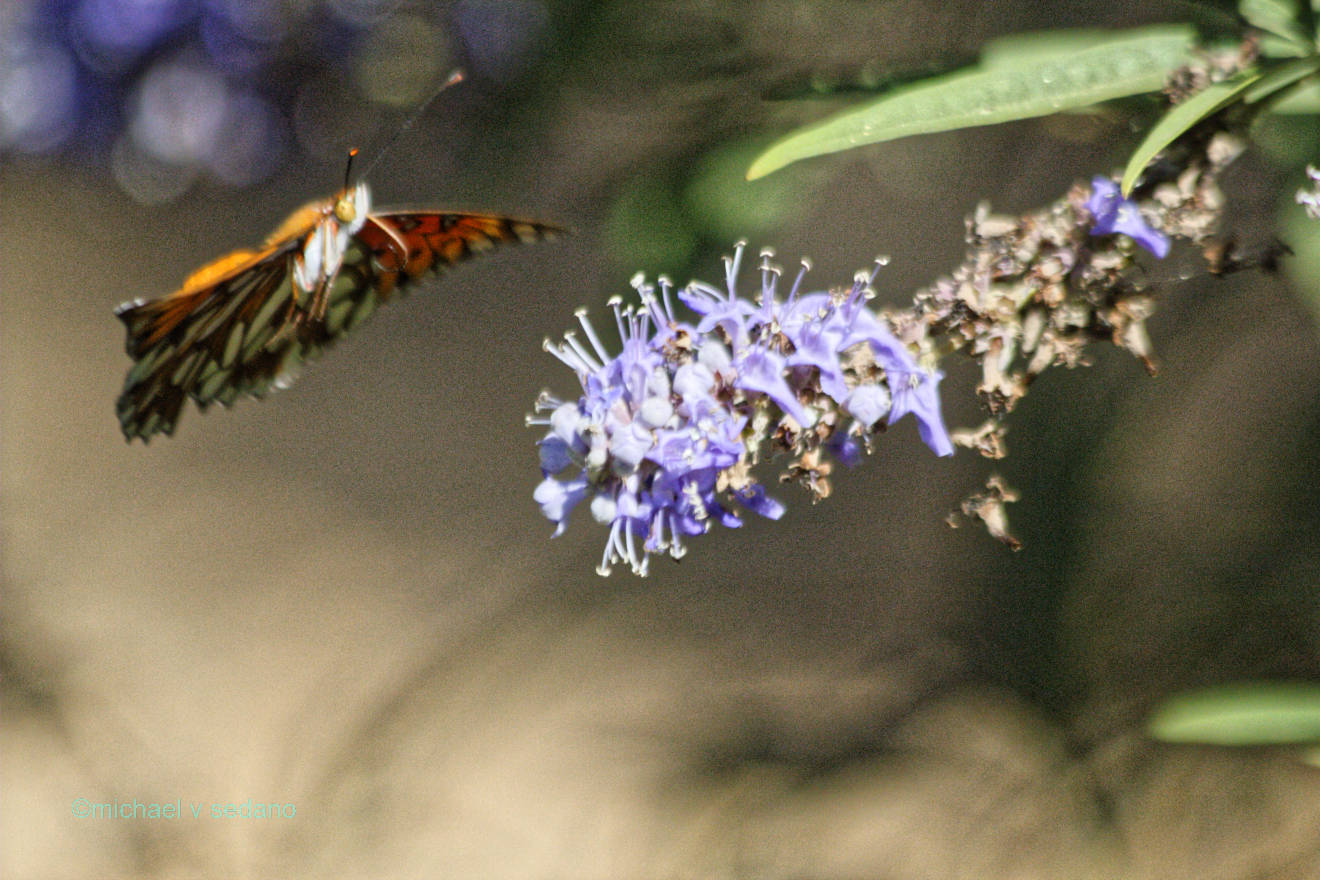
Photographing flying creatures gets increasingly challenging the smaller and closer the subject. Filling a frame with an aeriel Coast Fritillary challenges a photographer's attention span to the max. 1/4000th of a second freezes almost all motion, giving an illusion of all the time in the world to push the button. 

In actuality, the insect moves across space so rapidly that a foto like the floating frittilary at the Buddleia cluster comes close to perfection. Now the photographer recognizes it's important to step to his right half a step for a stronger image of the wings. This is a definite mira nomás!
This angle looking down at the sweeping spread of orange catches the texture of the folds and veins of the wings, as well as the richness of color in this light.

Mira nomás!
This angle looking up to the underside of the wings catches both top and bottom patterns of this beautiful butterfly. 
The Coast Frittilary challenges me to capture the silver sheen those white spots emit. In my eyes, there was silver in the wings as I pushed the button. In the camera's eye, the silver shows just as contrast and a suggestion of grey.  I don't know if that silver is photographable. I'll keep taking Frittilary fotos until I know for sure, and give up, or show off.

Insects and close-ups is the kind of photography that's puro respite. The photographer works in a crouch down low, making sure of balance and passersby. Left eye open, he keeps the whole scene in perspective, tracking approaching flyers. The right eye, staring through the lens, sees a few inches of landscape but synchronizes with the left perspective to triangulate the creature, move the lens and focus. An effective frame is filled with flying or landed insect so no blow-ups when sharing.

There's no attention space for anything but the creature and the moment. Push the button and set up another foto. Keep that attention focused on light and life, 150 or 300 frames in 2 hours and 2 miles.
I've been visiting the Caesalpinia plants since their bloom cycle began. I was a long walk distant when I saw the Black Swallowtail hovering then landing. A faster pace got me to the plantation in time for the butterfly's last browse of the flowers before it finds a zephyr and rises above the trees.

Catching a flying Swallowtail at a great distance is easy if you're not going for a close-up. For a close-up you have to get close up. Skitterish creatures, Swallowtails. The take flight if you look at them, so serendipity and fast reflexes give you an acceptable frame. Sure wish I'd been there five minutes sooner. 

So it goes.

As I walk toward the parking lot my lively pace begins to trudge and by the time I push the gas pedal the respite has passed and it's back to the world of responsibility and consequences. 

It is what it is.

Monday, July 11, 2022

"Always Running: La Vida Loca: Gang Days in L.A." author Luis J. Rodriguez sits down for a conversation with CBC host John Freeman


Join Alta Journal’s California Book Club conversation with Luis J. Rodriguez on July 21, 5:00 p.m. (Pacific) as he discusses his memoir, Always Running, with John Freeman. You may register for this virtual event by going to this link.

Event Description: “Luis J. Rodriguez is an essential writer in Los Angeles, the city’s former poet laureate. In this, his first memoir, he recounts the story of his becoming, beginning with his youthful involvement with drugs and gangs. That could have been a dead end, but for Rodriguez, art and literature became essential forces of salvation through which he was able to see, and then express, himself. Everything that has followed—among his other achievements, he is a cofounder of Tía Chucha’s Centro Cultural & Bookstore in the northeast San Fernando Valley, an essential space for readings and for classes as well as a publisher of books—is emblematic of a deep commitment to literature and language as forces for good.”

I had the opportunity to interview Luis J. Rodriguez for Alta Journal in honor of this upcoming discussion. You may read that interview here.

Don’t miss this conversation with one of our most important living authors.


Thursday, July 07, 2022

A Quick Trip to Maui

 Melinda Palacio


When I realized I couldn't share my travel article until it was published at the magazine I wrote it for, I decided to share some photographs of my trip to Maui last May. 


I arrived with all the luggage I managed to carry-on with me. I figured a week in paradise shouldn't require a whole lot of stuff. I even overpacked, but still managed not to have to pay the fee for checked baggage. 

First item, beachside/poolside cocktails and sunset viewing.


The stormy sky meant cool days for exploring the island. 

This is Julius, he cuts the coconut and turns it into a cool drink. He also makes the best banana bread on Maui. 

I thought Santa Barbara had the biggest banyion tree, but Maui wins. 

I was glad I packed my pineapple dress. It matched the pineapple ukulele I ended up buying.

I made sure to catch the sunset everyday.

I was tempted to tiptoe through the sunflowers but didn't feel as comfortable about trespassing or jumping over the ditch as other tourists. 

the quiet bay at Hono Lua has great  snorkeling. 

Maui has the most delicate sand.  

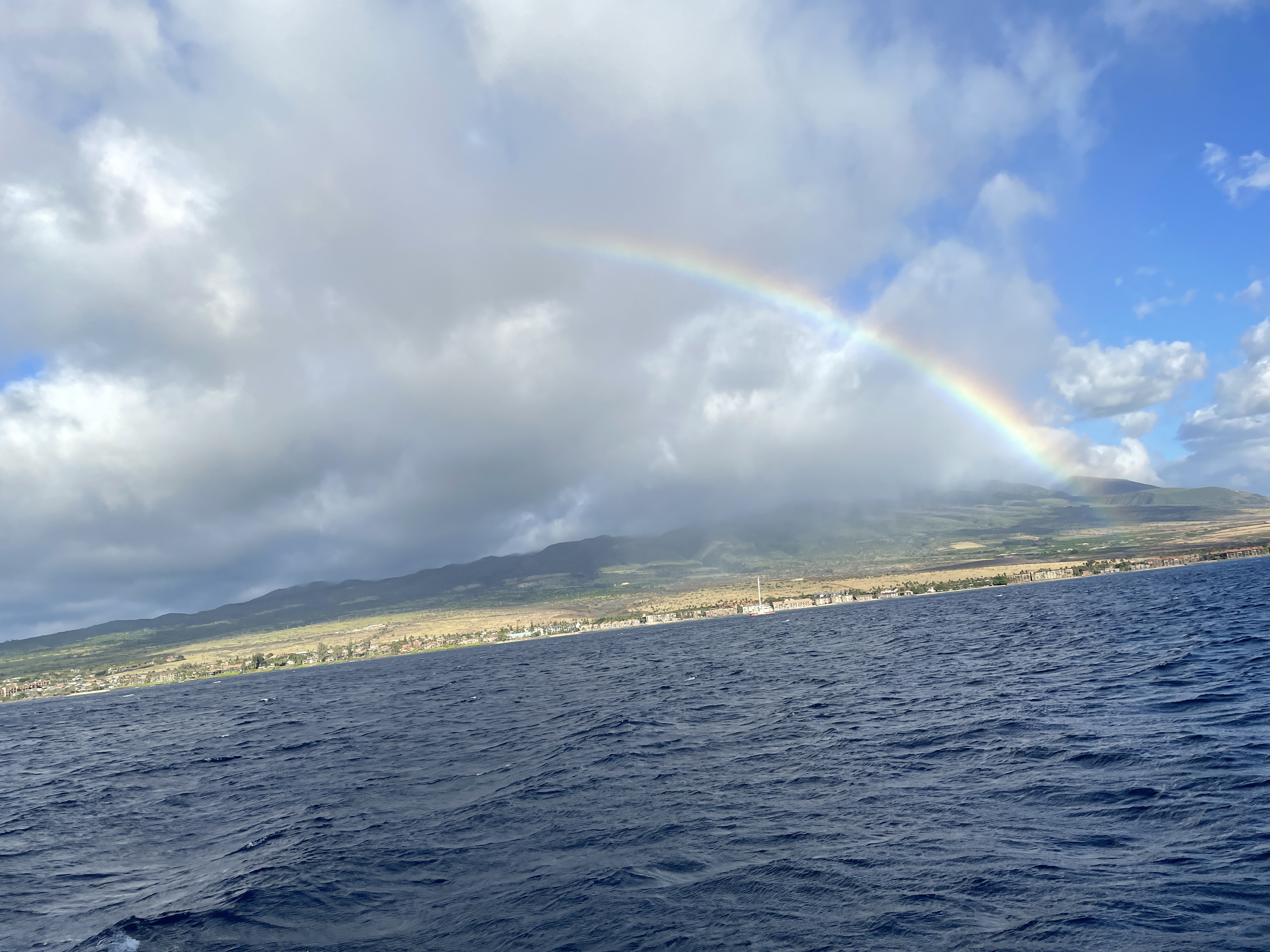
If you've heard the song about Lanai, this is what it looks like through a rainbow cloud. 

sunset in Lanai

A cruise is the best way to view the sunset. Aloha. 


A Chicano Writer or a Writer Who Is Chicano?

                                                                                  
Basilica San Diego Alejandria

by Daniel Cano 

 Sometime around 1975, I published a letter in the now defunct Los Angeles Herald Examiner in response to an article written by reporter Tony Castro. Castro was an experienced, serious journalist, who in the 90's became an editor with the Eastside Publications Group, where he invited me to write a weekly opinion piece. An avid, prolific writer, Tony's articles appeared regularly in the Herald Examiner, and other major newspapers. He was right up there with the L.A. Times' Ruben Salazar (who had already died), Frank del Olmo, and Al Martinez. 
     Coming off his successful book, Chicano Power: The Emergence of Mexican America, Tony had written something about the media always expecting Chicano writers to write about “Hispanic” topics, in other words, pigeon-holing Mexican American writers, the term bandied about in the media, back then, before “Hispanic,” “Latino,” or “Latin X” came into vogue. Most of those hard scrabble reporters had matured in smoke-filled, typewriter-clacking newsrooms, and, like all reporters, they wanted to cover the biggest, news breaking stories of the day. 
     At the time, I’d begun writing fiction. Many of my characters were Mexican and the stories’ “settings” were the areas I knew best, places I’d lived or visited. I never considered myself a Chicano writer. I didn't even know what that meant. I was just writing and trying to tell stories.
     Chicano literature was still a burgeoning field, still developing. Scholars were debating if it began with English and works published by Chicanos in the United States, or should Chicanos claim works going back to the Aztecs in Mexico, and the Spanish in the Americas. I’m still not sure that argument has been settled. 
                                                                                   
Inspired by an ancestor's journey during the Revolution
          
     I began outlining what would become my first novel, Pepe Rios, a mostly fictionalized story inspired by my paternal grandfather’s flight from his family ranch in Jalisco when he was 17 years old. His father had died, suddenly, and his older brother, Pedro, had run off to join the revolution, so my grandfather, the eldest male in the house, expected to take the role, “man of the house.” 
     According to family lore, when his older sister married, nobody asked my grandfather’s permission for her hand. Instead, the couple asked my grandfather’s mother for permission to marry, going against tradition. My grandfather took the slight personally. He felt disrespected. Impulsive? Maybe. He ran away from home and never returned. 
     Just a teenager, alone, he crossed war-torn Mexico. We don’t know much about his journey, only that it couldn't have been easy, and he ended up in the north, working dairy farms in Kansas, traveling down through the southwest, until he ended up on L.A.’s westside, the small settlement of Sawtelle, what the Mexicans called Sotel, West Los Angeles, today. 
     They say his mother walked the long distance, each day, from their ranch, Las Amapolas, to the church in San Diego Alejandria, to pray for his safety, and a hope for his return. He never returned, and he never contacted his family to let them know he’d started a new life in California. It’s hard for me to believe because he was such a loving man but, I was told, his mother died never having heard from him again. I hope somebody got that part of the story wrong. 
     I remember thinking that if my novel takes place in Mexico is it considered Chicano literature, and how would publishers view it? This begged the question: how do our old-world roots influence us as Americans descended from Mexicans, even if we’ve never been to Mexico? As a third-generation Chicano, born and educated in the U.S., in an ethnically mixed neighborhood, a U.S. Army veteran, far from fluent in Spanish, as a kid, how much did my Mexican roots contribute to my American identity?
     Where does our Chicano, Chicana identity begin, north or south of the border? For the protagonist of my novel, Pepe Rios, his Chicanismo started south of the border, but his Americanization began on the north side of the Rio Bravo, where one journey ends and another begins. 
     As the oldest in my family, I spent more time with my Mexican grandparents and relatives, both paternal and maternal, than my younger siblings. My grandparents spoke only Spanish and lived in Santa Monica, and other Los Angeles’s westside neighborhoods, among friends and relatives from their ranches and villages in Mexico. My uncles and aunts, most of them born in Mexico, arrived north at an early age, around 1920, and attended U.S. schools, spoke and wrote both Spanish and English fluently. Mexico, regardless of what I thought, pulsated through my psyche. 
     For these reasons, I decided to place my first novel in Central Mexico because it’s the region where three of my grandparents hailed, and I’d visited the area numerous times, so I’d become familiar with the land and the people. 
     I was reading Mexican writers, such as Juan Rulfo, Mariano Azuela, and Agustin Yanez, trying to understand Mexico and the Mexican mind. I read as much as I could about the 1910 Mexican Revolution, the catalyst for my family’s migration north, but I wasn't Mexican, not by a long shot, even though I’d heard so many stories of grandparents’ lives in Mexico and trek from their ranch, Mitic, in Los Altos de Jalisco. I began to think, that, yes, Chicano literature starts south of the border, in those towns and villages where our grandparents, and their ancestors, lived, for generations. 
     Yet, with all this going on in my head, I didn’t see myself as a Chicano writer, but a writer who is Chicano, and that's how I answered the Herald Examiner’s writer. If one labels him or herself as an ethnic writer, journalist, or artist, does it limit oneself to writing only about ethnic issues? Do we stereotype ourselves? African American writer and critic Ismael Reed, in an introduction to Beginning Ethnic American Literatures, argued, it doesn't really matter what we call ourselves. American ethnic writers carry a burden Caucasian writers/artists don’t carry or don’t even consider, how to portray their ethnicity in their work. 
     In the wider world of creative art, Chicanos, for example, like other ethnicities, have seen their portrayals in movies, books, and art, historically, as mostly negative, or stereotypical. Recently, I watched Under the Volcano, a movie adaptation of Malcolm Lowry’s novel, one of my favorite books. Director John Huston, he of the academy award-winning “African Queen,” followed Lowy's storyline closely. Set in 1930s Quanahuac, better known to most as Cuernavaca, Lowry told the story of an alcoholic, self-destructive English ambassador known as the “Counsul,” who brooded over his estranged beautiful spouse, and at the same time, suffered from PTSD due to his actions in WWI. Cuernavaca had become his home, yet he could barely speak Spanish, nor did he interact much with Mexicans, except for the town doctor.
     Something of a “Kurtzian” dystopia, Cuernavaca is portrayed as a rough, dusty, uncut gem, while Mexicans are seen as either stoic silent, near-mute, Indians, much the movie's stage setting, or as brute savages, waiting for the Consul to slip-up, which he does, so they can become his executioners, riddling his drunken body with bullets. The Mexicans at El Farolito, a bar rivaling Star Wars' outer space bar scene, drunks, fascists, thieves, rebels, prostitutes, even a little person, appear, not unlike freaks escaped from a carnival. To be fair, and a little more accurate, the Consul is usually so drunk that, if seen through his eyes, this is how Mexicans and Mexico appear. Yet, one still must consider, how will American audiences view Mexicans and Mexico in Huston's rendition? I'm sure Huston never stopped to think about it.
     Caucasian writers feel no compunction to “get it right,” not as far as ethnic representation goes. They just need to “get it down,” and in the “can,” as they say of movies. To Ishmael Reed's point, ethnic writers feel a responsibility to not only “get it right,” but strive to “get it down, accurately,” allowing all characters their humanity. 
     Chinua Achebe, the African scholar-author of the classic, Things Fall Apart, in a critical essay, “An Image of Africa: Racism in Conrad’s Heart of Darkness," took on Joseph Conrad’s beloved, dystopian classic, and called Conrad “thoroughly racist.” Achebe saw Heart of Darkness as inaccurate, racist, and dangerous as to how Europeans viewed Africa and Africans. It made no difference if Conrad's point was to show ignorant, selfish, greedy Europeans destroying Africa. Achebe argued, Conrad's Africans (like Huston’s Mexicans), act at a level just above animals, and Africa (like Mexico), something akin to Eliot's Wasteland. 
     Achebe quoted Conrad’s portrayal of Africans, “They howled and leaped and spun and made horrid faces, but what thrilled you, was just the thought of their humanity – like yours – the thought of your remote kinship with the wild and passion, roar. Ugly, yes, it was ugly enough.” 
     Achebe juxtaposed Conrad's white characters to Africans, as if Europeans are observing their primitive, cave-dwelling ancestors. Like many European writers who use underdeveloped countries, ethnic and indigenous communities to set their stories, even if their white characters are evil or unsavory, they often follow Conrad, and they fail to show a country's complexity or history. 
     One of Conrad's literary sins, according to Achebe, is to use all of Africa as the mere setting for the disintegration of one puny European mind, which is a reminder that ethnic artists can never completely discard their ethnicity or their culture in their work. They have neither the luxury nor the privilege.