Showing posts with label Maya. Show all posts

Thursday, March 21, 2024

Chicanonautica: Gorgeous Widescreen Mayasploitation

by Ernest Hogan

The poster with the crucified/spreadeagled woman gave me the wrong idea about The Living Idol. The style of the credits told me it was a slick, widescreen, color production from the Fifties. It also looked Mayan. Hmm . . .


Then:


Grateful acknowledgement is made to the National Institute of Anthropology and History of Mexico for cooperation in the making of this film.


Somebody spent some money on this. It was written, produced, and directed—the whole autre deal— by Albert Lewin, who also made the 1945 version of Oscar Wilde’s The Picture of Dorian Gray.


Also, René Cardona, responsible for The Brainiac, The Batwoman, Night of the Bloody Apes, Doctor of Doom, Wrestling Women Vs. the Aztec Mummy . . . (better stop, I’m getting distracted) was credited as “associate Mexican director.”


I was intrigued and amused.


It opens with scenes filmed in the Yucatán in Mayan ruins, with Mayan extras. Every shot looks like a postcard. My overactive visual cortex was happy.


Not a bad story, been done before: An ancient artifact housed an evil spirit, the presence of a girl who is the reincarnation of a virgin—though in this case, the word is carefully avoided—sacrificial victim, brings it to life . . . 


And this wasn’t a cheap quickie that Roger Corman, or even Cardona, slapped together on a minimalist budget, meeting a ridiculous deadline. It was a lavish Hollywood production with international connections. Ambitions are apparent. And that seems to be the problem.


Instead of a horror flick with a stuntman in a rubber suit playing the monster, we have a visual spectacular--what I like to call an eye-fry--with a lot of good intentions wrapped around a pulp plot, and packaged like exploitation.


I already mentioned the poster with French-Italian actress Liliane Montevecchi splayed out for sacrifice. She’s supposed to be a Maya, but when she’s in the same scene with real Mayan women in huipiles . . . 

In the beginning, she’s supposed to be in her early teens, and in love with the hero who looks near middle age. This was a common plot point in entertainment of the era. The photojournalist hero then, in an awkward attempt to avoid impropriety, goes away on assignment for a few years, giving her time to grow into an “of age” university student.


There are a lot of beautiful Mexico City scenes, but it all moves very slow.


When the idol–the red jaguar throne, from El Castillo, AKA the pyramid of Kukulkan in Chichén Itzán–comes to life, we don’t see it, we just hear it wrecking the room it’s locked in. As an adult intellectual, I understand that the director was trying to make a point–there's an entire illustrated lecture on the history of human sacrifice, suggesting that modern warfare is carrying on the tradition–but the monster kid in me feels gypped.


Still, they get away with showing more blood than in other 1957 films.


The heroine does finally assume the position of sacrifice, in a dream sequence/flashback.


Still, I found myself enjoying The Living Idol. Maybe, someday, when I'm in the right mood and have a some Escorpion Negro Black Ale, I’ll watch it again.


Ernest Hogan is the author of Guerrilla Mural of a Siren's Song: 15 Gonzo Science Fiction Stories.

Thursday, November 02, 2023

Chicanonautica: Memories of Palenque

by Ernest Hogan

They say that the social media is bad for creativity, but sometimes it delivers inspiration like a sniper’s bullet through the frontal lobes. I found an interesting news item about construction of the Maya Train uncovering a tomb. I shared it on Facebook and Twitter with a comment about my having fond memories of Palenque. Then those memories came flooding back. Talk about fun.


Hey, I should write about that! So here we are . . .


In 1982, I accompanied my sister Carol on a trip to Mexico. My Spanish was a lot better than hers, and I don’t think our parents would have let her go alone. I owe her an eternal debt for it. Whenever I go to Mexico, it changes my life . . .


We went to Mexico City, Oaxaca, and the Yucatán, visiting a lot of archaeological sites. For the sake of brevity, here, I’ll concentrate on our visit to Palenque.


We did a lot of train and bus travel. It was fantastical and Kafkaeque. I was reminded of Juan José Arreola’s story The Switchman, a magic realist piece where fake landscapes line the railways, passengers never end up where they intend to go, and often are persuaded to start colonies in some undeveloped territory.


I have been tempted to steal the idea and expand it to a galactic scale. Hell, it’s what will probably happen, if it doesn’t already exist . . .


Palenque is not just the name of the Mayan ruins. An old guy I asked for directions joked about las ruinas actually being the town. A fellow tourist told us, “You can’t get to Palenque.” It took some determination, but we made it.


The town was surreal. I’m not sure how accurate my memories are. I have an image of a street on a hill, breaking off into a cliff out of which there was a drainpipe, and a feathered serpent jaw carved into the rock. Could be confabulation. There’s something about this part of the world that makes your realism magical.


Getting to the actual ruins was a real adventure. The bus driver couldn’t have yet been in his teens. He was tinkering with the engine when we found him. He wore aviator sunglasses, an unbuttoned shirt, shorts, and sandals. A cigarette hung from his lips. He had a cynical smile that grew more intense when hit bumps on the winding, cliff-hugging road and his passengers went airborne. And he loved taking those curves fast.


The ruins of Palenque were amazing.


The Lacondon jungle—now home of the Zapatistas—surrounds them like a high, living wall. They were so thick I was sure I would get lost after a few steps. I felt that it wanted to devour me. A local man trotted into it with a rifle on his shoulder and his dogs leading the way.


Looking up I saw the edges of the jungle, like a huge open mouth. The air was full of butterflies, above to them, large dragonflies, and above them, hawks. Concrete poetry.


Palenque is famous for being the location of the pyramid with the carving that Erich Von Däniken claims depicts an ancient astronaut. I suppose it looks like that if you don’t know much about Mayan art or space travel. More likely, it’s information about the mummy that was found beneath it.


I did see things that suggest a sci-fi-ish reality:


A small, onsite museum had a skull that could have been a prop for a science fiction movie. It’s probably the result of the well-documented practice of skull shaping.


There were also disturbing carvings of humans in the arms or strange humanoid creatures. The intimacy often did not look consensual. They are similar to glyphs of the Burden of Time, but quién sabe?


Back in town we made an astounding discovery. A used comic book shop! These were Mexican comics. A lot of them were sci-fi. I recognized some as translations of American comics from the Fifties. Probably unauthorized translations.


It was run by boys about the same age–some younger–as that daredevil bus driver. I wonder what happened to them? Have they written any science fiction? Did they become Zapatistas?


Zapatista futurism. Is that a thing?


Now the Maya Train chews through the Lancondon jungle, spitting out its own future, Mayalandia, out to give Disney World a run for its money. I do wonder what it would be like to tour la ruinas in such high tech luxury. I also feel sorry for those who will not have strange adventures like mine.


Ernest Hogan, the Father of Chicano Science Fiction, has been wandering through Planet Nevada, NoCal, and Sasquatchlandia, and will be blogging about it soon. And judging the Somos en escrito Extra Fiction contest.

Thursday, July 14, 2022

Chicanonautica: Maya Under the Ixcanul

by Ernest Hogan

There’s this silly belief circulating among Americanos, with a “spiritual” bent, that refuses to die. Some of these folks are in awe of the “Mayans” (note: the people are the Maya, Mayan refers to things that belong to them), not just for their art, and religion, but the assumption that they escaped being exterminated by the Spanish by “disappearing” which can mean anything from leaving the planet in flying saucers, to vibrating away to a higher plain of existence. 


Meanwhile, not far from those who espouse this belief, Maya-looking people are mowing their lawns, cleaning their houses, and helping them take care of business at banks and other businesses.


Also, the Maya still live in Southern Mexico and Central America. 


There are even movies about them.


One can be seen on Kanopy, called Ixcanul, which means “volcano,” directed by Guatemalan filmmaker Jayro Bustamante.  In it you can see Maya playing Maya, and hear them speaking the Kaqchikel Mayan dialect. It is a story of how they live in modern times.


It's about the coming of age of a girl named Maria on a coffee plantation in which natural beauty and cinematic lyricism contrasts with gritty reality. Not quite the magic realism some might expect.


Maria is set to marry Igancio, a boy from her village. It’s a deal made by the parents of the couple. Unfortunately, Maria has other ideas.


She likes another boy, Pepe, who is going to the United States, which seems to be a magical place, across the desert where the snake repellent and other amazing things come from. Maria would like to go there with Pepe.


After a scene of Maria masterbating with a tree, outside a sleazy bar she has sex with Pepe and becomes pregnant, but things do not go as she had planned. Pepe isn’t interested in making the dangerous trip to the U.S. with Maria or marrying her and starting a family. The wedding with Ignacio is canceled. Her parents are mad, but agree to take care of her and the baby.


Mayan spirituality abounds, but it doesn’t work the way New Age Americanos would like it to. Rituals to abort the fetus and drive snakes out of farmland don’t work. The volcano is a god, whose presence is felt like the mist crawling up from the lava, but the modern world keeps intruding, a hypnotic rasquache mix, especially when they go to a city for the child’s birth.


Something to think about as the U.S./Mexico border once again becomes a political hot spot. Ever wonder where your coffee comes from? Or the Maya-looking young women we keep seeing in offices all over Aztlán, working at computers, keeping our unsteady civilization going . . . ?


Ernest Hogan lives and writes in Aztlán, and sees Mayan faces every day.

Thursday, December 16, 2021

Chicanonautica: Reveling in Mayasploitation

by Ernest Hogan

Things have been apocalyptic for a long time. How long can it go on? Forever? Maybe there’s something to the idea of cyclical time after all. What goes around . . .


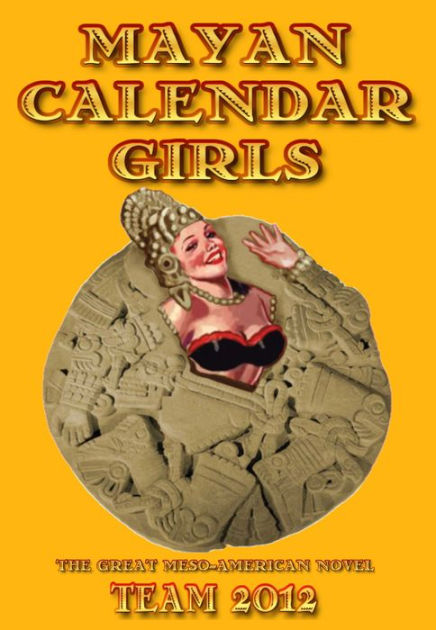
So, what do I read to take my mind off the newsfeed of doom? I keep a bloodshot eye for demented stuff like Mayan Calendar Girls: The Great Meso-American Novel by Linton Robinson, Grayson Moran, Cammy May Hunnicutt, and “Team 2012”.


Yes, it’s an oldie, from an earlier part of the 21st century when 2012 was still the future. Barack Obama, Dubya Bush, and Francis Ford Coppola do cameos. Ghosts of apocalypses past, riding again


Those suburban mystics who wonder what ever happened to the “Mayans,” while not recognizing who’s mowing their lawns and vacuuming their floors, will be seriously disturbed by this one. It's not just a Great Meso-American Novel, but a masterpiece of Mayasploitation, with plenty of sex (more than violence that should be preferable in a civilized world), drugs, and spirituality of a kind you can't find neatly packaged at Barnes & Noble. 


And it's not just the result of intense navel-staring on the parts of authors. Having been to the Yucatan, I can attest that the stranger than sci-fi stuff (yes, human/dolphin sex is a thing) that brims over on every action-packed page, in places where James Bond and Indiana Jones would fear to tread is, yeah, actually real. And just how will Mayan culture affect 21st century civilization? Probably like this, only more so . . .


To quote one of the many, crazy characters: “It’s multi-racial, multi-cultural, multi-sexual. It’s . . . you know . . . The Yucatan Lives.”


I unashamedly enjoyed it, and by the way, I don’t believe there’s such thing as a guilty pleasure. Damn the pretensions, just enjoy stuff.


My visit to Mayalandia, back before it was upgraded to the Mayan Riviera, blew my mind. My dad telling me about how when you go down south enough, the Mexican deserts give way to jungles didn’t prepare me for it. Suddenly, the tamales are wrapped in banana leaves instead of corn husks, the street names are all Mayan, and the little brown people half my size made me feel like I wasn’t in Aztlán anymore . . .


The same feeling comes back when I read this dizzying tsunami of weird details so dense it gets difficult to tell who’s doing what to whom, but then that just may be the point.


Strangely enough, it was originally an internet serial, like my own Brainpan Fallout. The cliffhanger style fits when things are fluxed up.


And it holds up amid the current global madness. Another decade, another apocalypse. New possibilities emerge in a shattered world.


Again, it gets me wondering about the Mayan influence on the future. Are they really the new Egyptians? Who will be appropriated? Who will consume? And who will be consumed? Are we products yet? Maybe I’ll finally get to use my idea about one day all the interwebs spontaneously translating into Mayan hieroglyphics . . .


Ernest Hogan is the Father of Chicano Science Fiction, and is just now learning what that means.

Thursday, May 07, 2020

Chicanonautica: Dazed and Bemused in Mayach, Mu, and Atlantis


I dug into this one expecting amusing bullshit, something to get me dazed and bemused in the quarantine. I wasn't disappointed, but I also found myself enjoying it and had my mind blown a few times. I was also inspired.


Maya/Atlantis: Queen Móo and the Egyptian Sphinx by August Le Plongeon, first published in 1896, reprinted in 1973 as part of Steinerbooks' "Spiritual Science Library," is one I had heard about and finally found while on a used bookstore crawl. The glue that bound the paperback cracked and broke as I read it. I finally had to stick it back together with duct tape. I've got a feeling that I'll be referring back to it.


Le Plongeon, who had long, pointed white beard like R. Crumb's Mr. Natural, expounds a theory that the Maya are as old as Atlantis and Mu/Lemuria and that they colonized Egypt, Babylonia, and India before recorded history. He doesn't provide much convincing evidence. The introduction had pages peppered with Mayan hieroglyphs in attempt to convince the reader that he knew how to read them. There are a lot charts comparing the Mayan language (which he, like the Mormons, makes the mistake of thinking as a single idiom, but is actually a system of related dialects) to other languages that seem impressive, but then I don't know all those languages . . .


Strangely, he never presents any Mayan text with a translation that could be compared. Not even the story of Queen Móo, which he claims he got from a series of murals, that are reproduced as drawings that look like Mayan murals, but I would have been more impressed by photographs. He and his wife spent from 1873 to 1884 in the Yucatan studying the ruins. They were the first to photograph Chichén Itzá, but didn't the take pictures of the Queen Móo murals


As someone with a lifelong obsession with pre-Columbian archaeology, I must admit that Mayan art and hieroglyphs hold a certain fascination. They get the imagination going . . .


Le Plongeon writes "This is not a book of romance or imagination; but a work—one of a series—intended to give ancient America its proper place in the universal history of the world." Then declares that "Maya—not India—is the true mother of nations." It looks like his imagination went wild on him.


But I can't dismiss it as trash reading for amusement under lockdown. As a science fiction writer and sociopolicital travesio, trickster, humble acolyte of the Smoking Mirror and the Ancient Coyote, I see some bizarre gems floating in the snake oil.


I like the idea of Mayach being the Mayan name for the Yucatan. It isn't clear where Le Plongeon got the word, but it's a nice one. He offers Egyptian meanings, because the Maya, who he says were "mighty navigators" according to the Ramayana (guess I'm going to have read it again). He refers to "The Maya colonists who carried their conceptions of cosmic evolution to India," and claims to have "traced step-by-step the journey of the Maya colonists, along the course of the Euphrates." Also, they were "worshippers of the mastodon, god of the sea, whose image adornes their palaces, sacred and public buildings."


I have to mention that there doesn't seem to be any Mayan art depicting ships of any kind.


Oh yes, he also claims that the last words that Jesus spoke on the cross were Mayan. And not just any old Mayan. "He spoke pure Maya."

Then there's the issue of the banana.


Don't take my word for it, here's David Hatcher Childress from Lost Cities of Ancient Lemuria and the Pacific: "They are said to be one of the few foods that mankind can live completely on. Yet, the only other seedless fruits, such as naval oranges and seedless grapes are genetically engineered. Someone, somewhere in the remote past, cultivated bananas into the amazing plant that it is today."


We don't know who invented the banana.


A prehistoric, seafaring Maya/Atlantis/Lemurian empire would be a likely suspect.


According to Le Plongeon, the name Maya, "was given to the banana tree, symbol of their country."

If you go far enough south in Mexico, into Mayach, tamales—that essential pre-Columbian food, are wrapped in banana leaves instead of corn husks.


All this would make Chicanos--and the all Latinx variations--the true children of "the mother of nations."

To quote Le Plongeon again: "Can it be that all these are mere coincidences? If they be, then let us present more of them."


Ernest Hogan is holed up under quarantine, but his imagination is merrily running amok.

Saturday, August 22, 2015

Which country teaches kids most about Aztecs?

Recently I had a discussion with a young Anglo boy who'd read my Cradle chapter book. I needed to know how a story filled with Azteca lore would come across to a non-mexicano. What impressed me most was his fascination with a mythology he'd never heard of. Like many USicans who have flawed or minimal awareness of the advanced civilizations that existed in Mesoamerica and the Andes.


The news that the Vatican Library had begun digitizing thousands of ancient manuscripts doesn't excite me, at least. Unless it results in thousands of Mayan and Aztec codices reaching the world's peoples. That's not likely to happen.

In 1562 in Yucatan, Bishop Diego de Landa wrote: "We found a large number of books in these characters and, as they contained nothing in which were not to be seen as superstition and lies of the devil, we burned them all, which they (the Maya) regretted to an amazing degree, and which caused them much affliction."
 
Following his creed of one-god-to-rule-them-all, Landa systemically led an inquisition eliminating the libraries, librarians, scribes and almost all fluency in reading and writing of Mayan literature.

Aztec, Náhuatl, Mexica and related works in central Mexico fared no better. From Mexicolore: "Amoxtli or amoxtin (plural) is the Náhuatl (language of the Aztecs) word for book. According to sixteenth century sources, the Aztecs had vast libraries that explored many different subjects from family histories, to religious books. The Spanish conquistadors, who conquered the city of Tenochtitlan in 1521, rejected many aspects of Aztec culture and destroyed these libraries and their contents because of their non-Christian subject matter."


There are two known, surviving pre-Hispanic Aztec codices.
The Codex Borbonicus and the Tonalamatl Aubin.

Imagine if there were only two extant, ancient Roman manuscripts. Or Chinese. Or Islamic. Or only two ancient Greek manuscripts survived all the conquests. If you can imagine the vacuum of scientific and engineering knowledge, of prose and poetry, of history and memoirs the world would have with only two Greek manuscripts, then you might be able to gauge the travesty that befell mestizo descendants of Mexico. To me, it's unfathomable, a word perfectly fitting this monumental loss.

Despite its southern neighbor, U.S. institutions have little reason to honor, respect or spread knowledge about Mesoamerican traditions, heritage or achievements. Other than as museum exhibits or fodder for a Disney-type-distorted movie by Mel Gibson

USicans learn the constellations according to Classical Europe, but nothing about Maya explorations and mapping of the heavens. Because the Maya libraries were burned.

The Greek alphabet is used in our science and math, but Maya glyphs and Náhuatl terminology have no place in U.S. culture. Partially because their science was totally removed from history. And all their astronomy charts, destroyed. Then there's just handfuls of their poetry. Music sheets? Medical journals? Ja.

So in which country are the ancient Mesoamerican cultures honored? Respected, passed on to their children and students? Mexico, that relies on pyramid-tourism to prop its economy? That might've once been true, but….

"Dinorah Lejarazú is a modern-day scribe who lives and works in Mexico City. She’s been meticulously reproducing Mexican codices by hand for many years and her work is of fine quality. Several of her codices are on permanent exhibition in the National Anthropology Museum in the capitol. You’d think she would have gained widespread recognition. Think again.


"Amazingly, there’s no acknowledgement in the Museum of Anthropology to Dinorah as the painter of the facsimile codices on display. Worse, a few years ago she donated 200 hand-drawn copies of the Codex Boturini to the Mexican Ministry of Education (SEP) for use in schools. She heard nothing more until, to her utter astonishment, a friend alerted her to a radio advert offering (her) copies of the Codex for sale (to tourists) in the Anthropology Museum shop. Upset, she immediately recovered them: they have languished ever since in a cupboard in her house.

"In Mexico every single initiative that we hear of to enrich the country’s history curriculum bites the dust for lack of institutional support. Dinorah’s negative experiences appear to be the tip of the iceberg; many Mexican schools that call themselves ‘bilingual’ turn out to be that in name only; over 100 native languages have died out since the Conquest.

"When we met Dr. Miguel León-Portilla (August 2010), he told us from his own experience of the most blatant discrimination received by indigenous communities trying to find support from government for education/language/literacy projects. Everyone we spoke to confirmed that, since the notorious education reforms of 1994, whole generations of Mexican children are growing up with virtually no awareness of the high civilizations that make up their rich past. This is shameful and a sad indictment, after 200 years of independence, of the priorities chosen by successive Mexican governments (including the present one)."

"Like ancient scribes, Dinorah remains passionate about her work. She has studied the art of the Aztec/Mexica tlacuilo or scribe. Her son is a scholar with CIESAS (a key Mexican research centre) who has researched and published important studies of ancient Mexican codices."

So which country would you least expect to be supporting the acquisition and furthering of Mesoamerica?


"Dinorah uses the finest materials to create her facsimiles--animal skins (calf today since it’s illegal to use deer skin in Mexico) that must be painstakingly scraped and then coated with stucco (very thin plaster) to ‘hold’ the ink, pigments and colors that she sources from around the world. Before starting work on a codex, Dinorah offers a simple prayer or dedicatio, and encourages Mexican school children to do the same, as a mark of respect for pre-Columbian traditional beliefs."


"She heard of Mexicolore’s work in British schools teaching Aztec/Mexica culture and with extensive use of replica codices. She asked her grandson to retrieve from a shed a suitcase-worth of over a hundred of her reproduction codex pages, all drawn in black-and-white on amate bark paper--the same ones she had offered to Mexican schools in 1992 - and donated them to Mexicolore as a resource for primary schools studying the Aztecs in England.

"In the face of this generosity and goodwill, we can’t help feeling that it’s ironic, infuriating, and disheartening to realise that, by all accounts, we are doing so much in England, with scant resources, to bring Mexico’s Aztec/Mexica past to life for thousands of children."

If you want to support Dinorah's art and even purchase her work, you can contact her through Mexicolore. If you want your kids to learn about Classical Mesoamerica, I suppose you could enroll her in British schools. Explore Mexicolore's website for info on the Aztecs; their Maya component was only recently initiated and is still being compiled. If you are a mesoamerican descendant who wants to learn and spread knowledge of your ancestors, there are books, recent ones from tejano David Bowles--The Smoking Mirror: Garza Twins; Flower, Song, Dance: Aztec and Mayan Poetry; or Mexican Bestiary. Readers of this column should suggest more.

[The description of present-day Mexico's treatment of its historical past is from Mexicolore. I have no personal knowledge or experience of what is going on. Anymore than I can vouch for Mexicolore, although I've relied on their website for much information. And none of this absolves England's colonialist history. They do need to give the Egyptian relics back to the people of Egypt. And chingos of other parts of the world.]


It is apparently up to us, the descendants of the ancient American civilizations to widen the world's knowledge about the pyramid-builders, stargazers and poets who works were burned. Through scholarly works, through fiction, with fantasy and fable, we will never do enough to erase the crimes and sins of the Spanish priests, soldier and administrators.

Pero, si no nosotros, entonces quién?
RudyG, a.k.a. speculative fiction author of some works about our mesoamerican heritage