Showing posts with label International Travel. Show all posts

Thursday, November 02, 2023

Chicanonautica: Memories of Palenque

by Ernest Hogan

They say that the social media is bad for creativity, but sometimes it delivers inspiration like a sniper’s bullet through the frontal lobes. I found an interesting news item about construction of the Maya Train uncovering a tomb. I shared it on Facebook and Twitter with a comment about my having fond memories of Palenque. Then those memories came flooding back. Talk about fun.


Hey, I should write about that! So here we are . . .


In 1982, I accompanied my sister Carol on a trip to Mexico. My Spanish was a lot better than hers, and I don’t think our parents would have let her go alone. I owe her an eternal debt for it. Whenever I go to Mexico, it changes my life . . .


We went to Mexico City, Oaxaca, and the Yucatán, visiting a lot of archaeological sites. For the sake of brevity, here, I’ll concentrate on our visit to Palenque.


We did a lot of train and bus travel. It was fantastical and Kafkaeque. I was reminded of Juan José Arreola’s story The Switchman, a magic realist piece where fake landscapes line the railways, passengers never end up where they intend to go, and often are persuaded to start colonies in some undeveloped territory.


I have been tempted to steal the idea and expand it to a galactic scale. Hell, it’s what will probably happen, if it doesn’t already exist . . .


Palenque is not just the name of the Mayan ruins. An old guy I asked for directions joked about las ruinas actually being the town. A fellow tourist told us, “You can’t get to Palenque.” It took some determination, but we made it.


The town was surreal. I’m not sure how accurate my memories are. I have an image of a street on a hill, breaking off into a cliff out of which there was a drainpipe, and a feathered serpent jaw carved into the rock. Could be confabulation. There’s something about this part of the world that makes your realism magical.


Getting to the actual ruins was a real adventure. The bus driver couldn’t have yet been in his teens. He was tinkering with the engine when we found him. He wore aviator sunglasses, an unbuttoned shirt, shorts, and sandals. A cigarette hung from his lips. He had a cynical smile that grew more intense when hit bumps on the winding, cliff-hugging road and his passengers went airborne. And he loved taking those curves fast.


The ruins of Palenque were amazing.


The Lacondon jungle—now home of the Zapatistas—surrounds them like a high, living wall. They were so thick I was sure I would get lost after a few steps. I felt that it wanted to devour me. A local man trotted into it with a rifle on his shoulder and his dogs leading the way.


Looking up I saw the edges of the jungle, like a huge open mouth. The air was full of butterflies, above to them, large dragonflies, and above them, hawks. Concrete poetry.


Palenque is famous for being the location of the pyramid with the carving that Erich Von Däniken claims depicts an ancient astronaut. I suppose it looks like that if you don’t know much about Mayan art or space travel. More likely, it’s information about the mummy that was found beneath it.


I did see things that suggest a sci-fi-ish reality:


A small, onsite museum had a skull that could have been a prop for a science fiction movie. It’s probably the result of the well-documented practice of skull shaping.
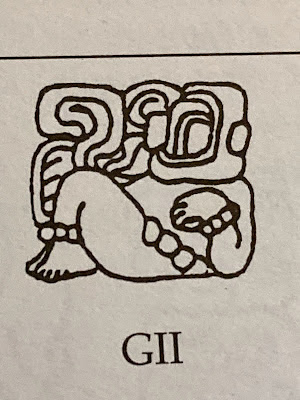

There were also disturbing carvings of humans in the arms or strange humanoid creatures. The intimacy often did not look consensual. They are similar to glyphs of the Burden of Time, but quién sabe?


Back in town we made an astounding discovery. A used comic book shop! These were Mexican comics. A lot of them were sci-fi. I recognized some as translations of American comics from the Fifties. Probably unauthorized translations.


It was run by boys about the same age–some younger–as that daredevil bus driver. I wonder what happened to them? Have they written any science fiction? Did they become Zapatistas?


Zapatista futurism. Is that a thing?


Now the Maya Train chews through the Lancondon jungle, spitting out its own future, Mayalandia, out to give Disney World a run for its money. I do wonder what it would be like to tour la ruinas in such high tech luxury. I also feel sorry for those who will not have strange adventures like mine.


Ernest Hogan, the Father of Chicano Science Fiction, has been wandering through Planet Nevada, NoCal, and Sasquatchlandia, and will be blogging about it soon. And judging the Somos en escrito Extra Fiction contest.

Friday, August 01, 2014

Beyond Boundaries: Networking and Workshopping in Lake Como, Italy, Part I

Guest post by Thelma T. Reyna


I was invited by one of my publishers to attend a national/international conference they co-sponsored at Lake Como last month. This “Abroad Writers Conference” (AWC) was designed as advanced learning for published authors from the U.S. Their “faculty” included 4 Pultizer Prize winners and 2 National Book Award recipients teaching intensive one-week workshops. Embracing this rare opportunity, I headed to Lake Como in my first overseas networking, workshopping, poetry reading experience.

Renaissance-era Como, resort hometown of George Clooney, is famously gorgeous. The event was in an 18th century villa, where we sat in one or two personalized workshops with the Pulitzer winners of our choice, or with other top national award winners. In the evenings, some of us conducted formal readings of our published work before the whole assemblage of about 50 author participants and 10 faculty, sharing the stage with America’s top writers in poetry, fiction, and nonfiction.           


                       Villa La Galleata, where we stayed and learned.
Iconic Lake Como is surrounded by lovely small                                                  
towns, with Como being the most prominent.

                                                                       
Learning and Re-Learning Poetry

My poetry workshop was with Rae Armantrout, whose book, Versed, won the Pulitzer in 2009. She had a reputation for being the most “cerebral” of the AWC poets; but, as a teacher, she blended sharp insights with down-to-earth critiques in a soft voice and unassuming demeanor. She pushed us to think harder.

There were 7 of us in this cohort. We met on a serene balcony entwined in wisteria and facing the lake, or in a formal parlor off the villa’s ballroom. We hailed from across America, and our group had a Korean-American and a Chinese-American. I was the lone Latina in the entire conference.

The camaraderie we established in one week belied our short time together. We opened our egos and ids to one another in the 10 poems each had provided for the workshop. Rae, my fellow poets, and I  slashed one another’s lines, dissected phrases, questioned purpose and voice, yet affirmed one another’s work. When several of us in our group took appointed turns onstage in the evenings to read from our publications, my workshop fellows in the audience were the loudest applauders with the broadest smiles of approval. Their support was genuine.

Our Fiction Workshop

Jane Smiley’s novel—A Thousand Acres, a modern retelling of  Shakespeare’s King Lear—won the Pulitzer in 1992. Sometimes using colorful, edgy language, Jane shared her experiences as a writer; asked us endless analytical questions about our submitted fiction; and sprinkled her advice with examples from her favorite 100 novels. The writing skills of this workshop’s authors were quite high. All had completed novel manuscripts or short story collections.

One of Jane’s main tips: The climax of your novel comes around the 90% point of your narrative. Is it what you’d meant it to be? If not, go back and adjust. With a calculator, she took our fiction, identified where 90% of each manuscript ended, and analyzed if that was indeed our climax. Sometimes it wasn’t. By the end of the week, we each had to return to the proverbial drawing board. Pieces we thought were “final” were not. Directions we’d thought our writing needed to take turned out to be wrong turns. None of us escaped unscathed. We all emerged as stronger writers, though. This is why we paid the big bucks, I suppose: to hear what we may not have wanted to hear from the folks who know most about these things.


    Our Fiction Workshop: Jane Smiley  at the head of the table;
    Thelma is second from left, foreground.

* * *
Stay Tuned for Part II on Tuesday: The second installment of this guest blog describes my poetry reading at Lake Como, where I debuted my new book. I will also briefly discuss the need for cultural diversity in international literary events. Thanks for stopping by.
* * *
Photo by Jesus Treviño

Thelma T. Reyna, Ph.D., is the author of four books, with the, a full-length collection of her selected and new poetry—Rising,Falling, All of Us—issued in summer 2014. Reyna’s short fiction, poetry, and nonfiction have appeared in anthologies, literary journals, textbooks, blogs and regional print media off and on for over 30 years.She resides in Pasadena, California.