Showing posts with label writers workshop. Show all posts

Wednesday, January 25, 2023

Macondo Workshop Application 2023


For more information and to apply visit, 

https://macondowriters.com


Workshop applications/registration for the 2023 workshop opens for everyone on January 3, 2023. All essential information is detailed in the application form which is made available on this link, https://docs.google.com/document/d/1YagBIbV03lRUvF2BmSpSaK6Drfcdt9tn/edit


We are a group of experienced writers who demonstrate a professional or master’s level of writing. The workshop gathers writers from all genres who work on geographic, cultural, economic, gender, and spiritual borders. Qualified applicants must meet both high writing standards and dedicated community involvement.


MACONDO WRITERS WORKSHOP 2023


JULY 25- JULY 39, 2023 

SAN ANTONIO, TX       


The Macondo Writers Workshop is an association of socially-engaged writers working to advance creativity, foster generosity, and serve the community. Founded in 1995 by writer Sandra Cisneros and named after the town in Gabriel García Marquez’s One Hundred Years of Solitude, the workshop gathers writers from all genres who work on geographic, cultural, economic, gender, and spiritual borders. An essential aspect of the Workshop is a global sense of community; participants recognize their place as writers in our society and the world. We are also seasoned writers who demonstrate a professional or master’s level of writing. Qualified applicants must meet both criteria. Excellent writing does not excuse poor community spirit; vice-versa, an impressive record of community involvement does not excuse poor writing. Macondo is a gift we give to one another, with willing hands and open hearts. 


THE APPLICATION DEADLINE IS FEBRUARY 19, 2023 (11:59 PM PACIFIC TIME). ACCEPTED PARTICIPANTS WILL BE NOTIFIED NO LATER THAN MARCH 31, 2023 AND PARTIAL SCHOLARSHIP APPLICATIONS WILL BE MADE AVAILABLE TO ACCEPTED PARTICIPANTS.


Tuesday, April 03, 2018

Brotherhood Endures. Writers Face Their Fears. USC Centro Faces Oblivion

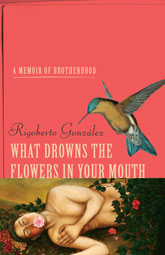
Review: Rigoberto González. What Drowns the Flowers in Your Mouth: A Memoir of Brotherhood. Madison: U Wisconsin Press, 2018. ISBN 978-0-299-31690-7 (link)

Michael Sedano


The vision on the page blinded me to the world around me and my own memories. The forgotten farmworker shack sealed against time, a dusty lump on the floor perhaps an abandoned boot, then realizing a desiccated cat that waited patiently until no one came to open the door.

Who is this poet I’ve just met, Rigoberto González, who stuns me like this? The years since 1999’s So Often the Pitcher Goes to Water Until it Breaks have filled in a partial portrait of a complete artist: poet, college professor, critic, novelist, painter, memoirist.

The pen of memoirist González brings his difficult familia to public scrutiny, in his 2018, What Drowns the Flowers in Your Mouth: A Memoir of Brotherhood.

The memoir extends Gonzalez’ reporting on intimate familia, personal, emotional matters. That the book jumps into dark matter is a product of truth, and a deliberate style.

González speaks to his hard-edged reporting in a 2007 interview (link), when the writer told La Bloga’s Daniel Olivas,

if I was going to write about my life I was going to offer it to the reader completely, not selectively, and that meant including the ugly parts too. I come from a home where humor and storytelling were the everyday expressions of love, but so too where violence and abuse were expressions of frustration and hardship.

What Drowns the Flowers in Your Mouth is published as part of University of Wisconsin’s Living Out Gay and Lesbian Autobiographies series. A four-page listing of titles appended to this volume attests to the market for targeting specific readerships.

More readers will find this interesting work where booksellers stock it among the general titles, as well as LGBTQ shelves. The audience of this book is anyone pursuing exemplars of the memoir genre. Being that memoir is the fastest-growing genre among an aging population, anyone who wants to write a memoir needs to read What Drowns the Flowers in Your Mouth.

Any writer who fears saying certain things about real events and people in their lives needs to read this book for permission.

Writers and poets facing personal hardship need to know what got this poet through it.

“It” is the ugly. Orphanhood, death, abandonment. Big brother Rigoberto is driven by instinctive manda to protect his little brother in a world of abusive abuelos. Their father comes back now and then, infecting the narrative with negativity for a few pages until he’s evicted again. This is their lot and each deals with what comes in his way.

Readers seeking equipment for living in these pages will find two strategies but no consejos. Number one is aguantando.

The father endured a life’s oppressive reality through story. That creative spark is something the author inherited from him, in the home, in the DNA. The author grew up aguantando by thinking, reading, being outspoken when the situation demanded, hiding, withdrawing into other people’s narratives when all he could do was aguantar. Then he got out, strategy two.

Little brother isn’t motivated to pursue an escape despite summers piscando la uva. He takes it. Then he drops out of school, settles into the local ambiente, marries, has kids, gets a gas station job, struggles. Aguantando.

Big brother is big time. World traveler, celebrated, paid to write, his name spoken in important places. The author’s public doesn’t see exhaustion, incessantly writing to-spec to raise cash to support his struggling brother. There’s a lesson of sorts there for every writer: when you need more money, write more and write better.

Sixteen chapters track the González family’s progress from isolated Michoacan to a wilderness settlement outside Mexicali. Side visits to the maternal Alcala family put an exclamation mark on the loveless isolation defining the two boys’ lives.

Reading What Drowns the Flowers In Your Mouth is a literary treat for its substance, detail, expression. The opening page of the penultimate chapter, “The Wondrous Flight of the Hummingbird,” says not quite all with its beautifully woven tapestry of language; poetry, irony, disillusion, sorrow, and finally acceptance.

The name of the town at the northeast shore of Lake Patzcuaro is pure onomatopoeia. Say it- Tzin-tzun-tzun-and a hummingbird zips by with each syllable. These elusive little birds are so fast they're invisible and can never be caged. In fact, the only way the people of Tzintzuntzán can attempt to capture a hummingbird is to carve one out of wood, or to sculpt one in iron. The only way for visitors to own one is to buy it. I brought two of them with me that hang from the kitchen doorway of my NYC apartment. As soon as I put them up, I realized how ridiculous this illusion was since the wings are frozen midflight and the bodies dangle from fishing lines because what I "caught" was nothing less than decorated dead weight. These are memorials to the fleeting hummingbird, a wondrous feathered creature whose population has been dwindling over the years. I saw hundreds of memorials in Tzintzuntzán, but not a single living example of what all that artistry honors. Still, it is difficult to challenge the town's name-it is the place of the hummingbirds. They are everywhere: on furniture, on pottery, and stitched near the hems of pretty little dresses.

The chapter is a valedictory letter to a little brother from big brother. Conspiculously absent here is abuelo, and no talk of their father’s abuse. Turning a blind eye to a father who weaves in and out of their lives always leaving a bad taste puts together two words in the same sentence that would seem unlikely given the history of the man we’ve had to endure, “paternal duty” and “father,” as if there can be redemption for leaving the boys to be lashed and tortured by abuelo’s cruel words and capricious control.

The book's thread about physical disability casts light upon the dark mood infecting the author's account of his boyhood. Forced by MS-like symptoms to walk with a cane, physical incapacity wears on the man’s sense of personhood, as well as denying him physical independence. Where escape had been his life’s praxis he becomes prisoner of his disability, and it’s a hard thing to aguantar.

Illness becomes the lens through which the memoirist constructs his scenes. Where a body feels pain, the mind resides in misery and shuts out the rest. The closing chapters, with their diction of reconciliation, reflect the author's growing strength and healthy prospects for an able-bodied future.

Physical debilitation progressively surrenders to a patient's determined diet and activity, and the right pills. The man sheds weight. Now eroticism grows in awareness and usefulness, he can flirt again. Reinvigorated, the artist rededicates time to being productive and joyful. It works; there is this book.


La Bloga Sponsors Face Your Fears Writers Workshop With Ana Castillo

When La Bloga learned that Ana Castillo was contemplating a west coast swing, Michael Sedano offered to host a Pasadena workshop on behalf of La Bloga. At first, the plan was to recruit a donor to underwrite the entire effort and award scholarships to all participants. That plan got hung up on technical financial details and institutional mordida.

Plan B was to sponsor a no-host workshop at the public library. Demand immediately filled the space, generating Plan C. We added a workshop at Casa Sedano. The author would be kept busy with two workshops the same day and more writers would share the experience.


Writer workshops play vital roles in literary culture. Workgroups who nurture and safely critique one another’s work are indispensable to many writers. Workshopping with a professional author is another essential element in a writer’s growth. Personal insight, Q&A, one-on-one environment, small group interaction offer ineffable benefit to one's skill.

Giving local writers access to Castillo’s workshop was the prime goal of the plan. Better writing would be up to them.

Having fun doing it was an important benefit for the residents of Casa Sedano.

This is the first writer workshop Casa Sedano hosted. We’ve welcomed Mental Menudo, Mental Cocido, Book Releases, Backyard Floricantos, Living Room Floricantos, Guest Author Readings, and now Face Your Fears Workshop for 15 writers congregating around a dining table.

For writers, conducting workshops is an extension of one’s marketing and promotional responsibilities. Preparing the workshop is a demanding job for a travel agent, supply chain manager, promotional factotum,  p.r. flack. Local arrangements for lodging and transportation place high priority demands on time budget and purse. Books and other material must ship well in advance against delays. Someone is appointed to receive and store the boxes, then arrange pickup and transfer to the workshop destination. A workshop is a major project involving details worthy of making and following a checklist.


Arranging workshop space entails institutional fees, setup against deadline, parking and transportation issues for participants.

Getting the public room at the Santa Catalina Branch of the Pasadena Public Library became a lesson in civic resources. Six phone calls to the branch, a website message, two calls to the central office, and three visits to the branch, and a check, secured the public room. An assistant city manager sent a query to the central office, a happenstance that didn’t help attitudes at the local branch.

A workshop’s enrollments and attendance are subject to caprice. Last-minute cancellations become headaches. Last-minute adds, disappointments. Even good maps and exact directions don’t get people to the place on time owing to traffic conditions and making the wrong turn someplace. Sometimes garbled information and the vagaries of cut-and-paste email lead to inconvenience.


The pair of Face Your Fears workshops were successful, according to Castillo. One disappointment for La Bloga grows from faulty memory.

Arriving at the end of the first workshop, Sedano neglected to bring his good camera and took a group foto with an iPhone. The foto failed. The second workshop, at Casa Sedano, found the Canon camera in readiness. The group portrait and a few candids capture the spirit of writers workshopping facing their fears.


USC Chicano Centro On the Verge
Michael Sedano

I arrived at USC in 1972 with the time-honored stereotype of the “University of Spoiled Children” whose campus perched at the edge of black and raza Los Angeles, but whose black enrollment consisted mostly in world-class athletes. I was on the G.I. Bill and the only Chicano in my graduate program. Down the hall from the Speech Department in Founders Hall, English grad school student Mary Ann Pacheco was promulgating plans that eventuated in El Centro Chicano.


Pacheco and a cohort had a plan that blossomed spectacularly to USC's lasting benefit: they integrated the campus.

Frank Sifuentes was employed as a recruiter and he brought in 102 first-year, mostly first-generation-college raza kids from East Los, Boyle Heights, and eastward. A building at the main campus entry gained a set of murals and a name, El Centro Chicano. In one fell swoop, raza gained an inescapable presence at USC.

Fast forward to last Friday in the confined corridor that serves as today's El Centro Chicano. Mary Ann Pacheco visited a “Power Pan Dulce.” The small gathering represented a cross-section of classes, frosh to grad school. The meeting mirrored the tardeadas the original centro hosted, serving light dessert instead of free buffet.


Pacheco shared unique stories of private confrontations with powerful Deans, threats to yank financial aid over activism, a university president’s curiosity and support, and the suspicions young raza entertained that the old guy with the camera was FBI or a narc.

Now, diversity renews the “battle of the name” that grudgingly settled on “Chicano” out of a welter of terms like Mexican American or Mexican-American, Spanish or Spanish-American. At USC, there’s a move afoot to change to some other name.


An upcoming  “Power Pan Dulce” will discuss the idea, or perhaps a proposal, to change El Centro Chicano's name. There's probably a movida bubbling to surface a new handle. As I bade adios to Billy Vela, the director, I reminded him that just because you discuss a topic doesn’t mean you have to change the name.

USC El Centro Chicano alumni and benefactors may wish to contact Vela via his website (link) to voice an opinion. How do “League of United Latin American USC Students,” LULAUSCS, or, “Cardinal, Gold, and Brown Trojans,” sound?

 –x suffix words have gained popularity, Pacheco observes, saying she finds “Chicanx” pretentious. She goes with the flow and switches to the dialect of her setting, tolerating "hispanic" if that is lingua franca to her audience.

The actively retired English professor reminds that the word “Chicano” is not an historical artifact but inheres a strategy of emergence and peoplehood.  Read Suarez' El Hoyo, Pacheco recommends, to gain a feel for the term.

USC’s public mind and historical memory have forgotten much, and may be on the verge of abandoning a source of power, acting subversively against themselves.

I urge El Centro Chicano’s gente to keep the name El Centro Chicano, to seek instead ways to renew El Centro's founding energy. Fight on.

Willie Herrón mural adorns the side and front of El Centro Chicano in 1973 at Hoover & Jefferson

Tuesday, January 30, 2018

Farm to Fork Feasting. Castillo Workshop. Shoulder to the wheel.

Confluencing Dreams
Michael Sedano

Ancient corn on a farmer's market table catches a tortilla chip-maker's notice. Q leads to A and soon the farmer and chef create a supply chain. Locally-grown, no pesticide, no GMO corn goes directly to the tinas to become Nixtamal, then masa, then the output of a creative chef's skill.

One day diners will fill the chef's own restaurant. For now, as an experiment, the urban farmer and the chef-sans-restaurant hold a Pop-Up Chisme Brunch, at the farm.

The weekend brunch shows what happens when people pursue their dreams to a point they can go public.

The young chef and the urban farmer welcomed four seatings of diners to an alfresco brunch featuring ancient corn masa that included grain that grew last July in a milpa fifty feet from the diners. Also on the plates were McDonald’s Urban Farm citrus, vegetables, and chicken.

Chef Alan Ace cooks on-the-spot, inside a netting tent while guests sip alcoholic beverages paired to each course. Conviviality reigns.

On the bill of fare are tostadas, tacos, ensaladas, aquacate, churro waffle which The Gluten-free Chicano passed on.

The peach jam on that wheat waffle glistened with temptation. The peach tree stands dormant right now, but come Spring she will burst with faery-winged blossoms. And I will dare, when harvest comes.

Chicano kimchee is good stuff. The chile on the camarones hit the spot. I’m not a drinker, but I enjoyed a quaff of the blood orange-valencia orange mimosa. The farmer's grandfather picked valencias for a living. I smile in déjà vu at the aroma of valencias pouring out of my father's picking sack at the end of his workday. Home in the house he built with his own hands.

Maybe one day los McDonald will have a champagne vineyard to go with their citrus for a hyper-local mimosa?

Cauliflower al pastor, ancient grain tortilla

Tostada, McDonald's farm-fresh blanquillo topping bacon avocado, Mexican kimchee, blue corn tortilla
Amelia McDonald, née Sedano, spotted a piece of land and saw possibilities. She inherited her grandfather’s dreams of his own orange grove, and also, a view home. That’s what she and John and Charlotte have on their Altadena tierra. Her grandparents are incredibly satisfied at what they left behind, at the strength of the coming generation.

Chisme Tortilla Brunch shows what self-sustainability looks like. Off to the southwest lies Los Angeles and Catalina Island beyond, a filmy hydrocarbon coating making a hazy line across the distance. Container ships blurry dots out there. GATTland. Dependency and supply chains.

In the immediate foreground happy people eating food harvested here. Up the hill from the diners' forks, fenced from bears and bobcats, McDonald’s chickenada lays multicolored eggs, in another jaula no-name chicks and turkeys fatten. In the corral, the goats will soon wean, then the cheese begins.

Barbara Sedano, Ernie Urlacher, Linda Chaffee, Michael Sedano sip fresh jitomate juice

Chef Ace is a regular at the Altadena Farmers Market (link). You’ll taste the essence of his skill, not the wonders of this one-time pop-up gustatory experience. The market website describes Ace's basic fare:

Chisme Tortilleria makes fresh corn Tortillas, Tortilla Chips and Salsas daily. Using the ancient process of Nixatamal, their masa is made without preservatives. Each tortilla and tortilla chip is hand pressed and made to order. They offer three types of tortilla: Blue Corn, Cactus Corn, and Organic Yellow corn as well as salsa.

The Altadena market specializes in the food that does you good, plus treats, and a few crafts, music, and gente. The Gluten-free Chicano has enjoyed a filbert nut pie here.

It's Altadena. Don’t be upset at the faded Bernie placas on cars, or “immigrants welcome” lawn signs in the area. Altadena was the postwar redlining refuge for people who wanted to live. Today, the large lots, old homes, views, proximity to the hiking trails of the mountains, isolation, and any number of qualities, make the region a dream destination.

Alan Ace looks for his dream in a Covina restaurant-to-be. McDonald’s Urban Farm has set down its roots and lives the dream.

And all those happy diners who got to hug a baby goat, that’s what they said, too.


Ana Castillo Writer Workshop

What does a writer do when she's not selling books? Some sling hash, punch a timeclock, taxi dance, who knows what a person does for a living when they're not creating timeless literature?

Some share their art with others via interview or workshop. If Literature were an industry I'd say Ana Castillo is out looking for her replacement. You're out there. You don't apply for the job. You write. You workshop with other writers. You hone your skills with help from a professional.


La Bloga is happy seeing Castillo plans a 2018 workshop tour to include Pasadena in her "Face Your Fears" workshop series. She launched in Harlem on January 21. The workshop comes to Denver on March 2, and my neigborhood branch of the Pasadena Public Library on March 31.

Spring is in full swing on March 31, so I invited Castillo to consider Casa Sedano as a worksite for a small group. Casa Sedano has never hosted a writer workshop, but we've had Mental Menudos, Back Yard Floricantos, Living Room Floricantos, Book Launches, a Post-Louies Reception, author receptions. Later this year, a quiet 50th Anniversary pachanga. Órale.

The offer to Castillo is open and an "a ver" pending sign-ups via email at anacastilloworkshops@gmail.com. We'll for sure throw an open house to the workshoppers since they're only two blocks from Casa Sedano and they'll be hungry after burning all that energy writing. There will be floricanto, too.

Castillo's "Face Your Fears" workshop is scheduled for the Santa Catalina Library from 10 to 1. One hundred fifty dollars per opportunity. For more information and to sign up--only 15 will enroll--use this email link. 


Shoulder Under Construction. Possible Interruption Here.

I cannot remember when I stopped believing in the sanctity of the body, like the nuns and priests drummed into my fellow catechists. No tattoos. No drugs. No sex. (That screwed up high school). It wasn't after the first surgery, the one on my hand. There was that time a team of women threw me onto a cold stainless steel table and came at my waist with scalpels.

Just cut me was my attitude that time a perforated abdomen got all complicated and I crossed over only to return. The nuns were wrong. The purity of a body depends on circumstance and not morality.

So it’s the luck of the draw that this week I go into a sixth surgery. I'll be one-handed for a while.

Three months, the surgeon tells me, I will not have effective use of my right arm as it recovers from rotator cuff surgery. You know, the doctor said, you don’t have to have that done. That’s what the other surgeon said about the bag he installed.

Doc, I replied, I can’t play piano any more, I can’t hold my hands over the keyboard because it hurts so darn much and I'm not that tough any more.

Nor can I garden, split wood for the fireplace, wheel out the trash. Danged if I can type with any comfort at all, even with the Bluetooth keyboard on my lap.  So punch that hole in my shoulder, Doc. In and out same day. But for the next three months, we shall see what we shall see.

Technology to the rescue. My Macintosh laptop computer has speech-to-text capability. As I speak words at a slow pace, text gradually populates the screen, approximating what I say.

My articulation is adequate to produce 90% accuracy. "'Blah blah god Tuesday' is what the computer beers when I say law blog Tuesday." That’s what 25% looks like when I say “La Bloga Tuesday is what the computer hears when I say La Bloga Tuesday.”

Speech recognition has a way to go.

Ravel composed a concerto for left-handed pianist Paul Wittgenstein. Ana Castillo’s character Carmen La Coja is a flamenco dancer. The devil walks with a limp. Lots of things can get done on one limb, and no Eileen jokes.

The night before that last surgery in January 2015, I drafted a farewell letter because I was convinced that was the one with my name on it; the pain was going to kill me. I scheduled the note for delivery two days after the surgery, saying something like "shucks, I didn’t make it". I was feeling maudlin. A couple surgeries back, I’d crossed to the other side and been sent back by the ancestors, I had no fear of dying. It’s everything I was going to miss that made me sad. Makes me sad.

So here I go again. One more time under anesthetic. This time I am going to concentrate on the last moment of reality. Not the part where I feel the veins boil and my body thinks it’s curling up as the sensation sweeps up my arm to flow across my face and every nerve trembles and you're out but you don't know it.

Not that moment. There’s a moment, I look at the vinyl tube going out of sight into my arm, a hand brings a black needle into view. It's amazingly puny the potent needle. A sparkle of eye contact with the anesthesiologist, “ready?”

And that's the moment. “Yes,” I say. She slides in the plunger, a last glimpse of the solid world.

See you next Tuesday. Or, as my grampa said in the face of uncertainties big or small, a ver.


Tuesday, August 04, 2015

Good Models. Flor de Nopal Workshops. On-line Floricanto

Reading Your Stuff Aloud: Magnificent Digital Resource
Michael Sedano

Magu's flor y canto drawing was the theme graphic for the 2010 festival
With the posting by USC's Digital Library of videos from the 2010 Festival de Flor y Canto, Yesterday • Today • Tomorrow, it brought a forty-two years long project to a satisfying close. There are hundreds of ways to find value in recordings of artists reading their work. Models to copy or avoid. Personal pleasure of seeing writers thirty years apart. Sentiment knowing some videos are the only record of the now deceased artist's voice. And, of course, the joy of hearing a writer read their stuff aloud. i am happy to have played a role in that.


USC digital library index grid. Selected performance plays in new window.
In 1973 I had photographed literature's first Festival de Flor y Canto, when I was a graduate student at USC. The backstage candids and performance portraits captured young writers starting important literary careers. For years I thought mine the only images of the historic event. Then I discovered a set of videos from the 1973 floricanto--one of only two extant collections--in nearby Riverside, I was able to make adequate digital copies of the outmoded U-matic tapes.

Returning the original floricanto to USC where it all began called for a celebration. Barbara Robinson, head of USC's Boeckmann Center for Iberian and Latin American Studies, received a Visions & Voices grant to put together a floricanto. I delight knowing Robinson bought the video set back when she was a librarian at UCR. The readings were coming full circle twice.

With generous support from the Dean of the library, the three-day festival of readings came together in a few months. The first day for Veteranos, a reunion of writers from 1973. The second and third days would combine active and emerging voices to round out the yesterday, today, tomorrow theme.

Jesus Treviño, founder of the video repository Latinopia, directed the videography for the three days, endeavoring to record every speaker and ample "B-roll" footage. Use this link to navigate to the digital library index page for both floricantos, and my still photography:  http://digitallibrary.usc.edu/cdm/landingpage/collection/p15799coll79
 

Flor de Nopal Festival: Doing It Right


In Austin Tx this weekend, Flor de Nopal kicks off a five month long literary festival whose scope and vision could transform the anonymous ESB-MACC into a nationally-renowned center for developing chicana and chicano literature.

The Flor De Nopal Writing Workshop, the first of four monthly workshops, begins at 2:00 pm on Saturday, August 8, 2015 in the Raul Salinas classroom of ESB-MACC.

Unless you’re an Austin local, you probably won’t recognize the location of the monthly Flor De Nopal Writing Workshops, ESB-MACC.


The Emma S. Barrientos Mexican American Cultural Center is an underappreciated cultural gem in the city of Austin’s parks system. Occupying a striking architectural monument, the institution engages its audience via no admission charge and free parking, while defining its identity through art classes, film series, gallery shows, and this year, the extended duration Flor de Nopal Literary Festival.

Beginning this weekend and continuing through early December, Austin Texas’ Flor de Nopal Literary Festival illustrates the kind of vision and planning arts organizations elsewhere might want to copy. This is the kind of program that can be replicated, and that should produce outstanding results.

Instead of a two- or three-day residency that comes and goes so fast, the Flor de Nopal model offers extended support to local writers who participate in four writing workshops across five months. In addition to the focus and continuity of regular workshops, writers attend a pair of large scale theatrical readings.


Serendipity smiles on festival organizers with the launch of Huizache’s 5th edition. The publisher will hold an October publication reading in association with Flor de Nopal. Workshoppers will be free to wonder if their manuscript is one workshop away publication in Huizache, the writer one submission away from being one of those writers up on stage.

Flor de Nopal’s mission statement declares its purpose “is to promote the work of Mexican American poets and writers, to create and nourish ties between writers, and to offer writing workshops to writers from all walks of life, and to aspiring poets and writers from our diverse community.”


On-line Floricanto. Five for Eight 2015
Michael Hureaux, Jackie Lopez, Armando Guzman,  Michael Martinez, Teresa González-Lee

This month, the Moderators of the Facebook group Poetry of Resistance: Poets Responding to SB 1070 nominate five poets to celebrate the year's eight month.

Hedy Treviño, who served as Moderator for many years, steps down with this, her final On-line Floricanto panel. Thank you, Hedy.


"Arab Spring" or the Balancing Act By Michael Hureaux
Border Disorder By Armando Guzman
The Confederate Flag By Jackie Lopez
Bicultural By Michael Martinez
Desde los arrecifes del silencio Por Teresa González-Lee


"Arab Spring" or the Balancing Act
By Michael Hureaux

Children who lived on that river which never froze
Created a thaw along the iced tightrope
It was though the banks were swarming
With Pharoah's daughter, each salvaging
A wailing beginning, and setting it afloat
To elude the swath of old men
Decked in the robes of the prophets.
On the more ancient street corners all of a sudden
It was recess where all the learned experts
Had for decades said recess would never come again.
Everyday for a month, the playgrounds were teeming
And nothing could herd the players or the game.
All nascent moves, aligned or otherwise,
Did a graceful flutter kick off the side of the jackbooted reality,
Performed a gallant header into the sawdust at center ring
Unannounced by the warlords in the starry wizard meters
Spent days in a brutal frenzied clench
And scaled that tower of bones built by the Murka mukks
Braved one more. Fall, as a child wood, or a troop of gentle tragic clowns
Hungry for the crackling warmth of a new reality.
Recess come again, despite the warnings of the specialists.
The work played to win.
For just a few hot seconds an army of way faring spirits
Held the attention of the world looking for
Other carnival masks, even harsh changes
If they brought the severe mercies of wild djinns.
The spring was a beautiful and agonized
Seeding of long sterile ground
And for just a few sweet moments
It was enough
To spur others forward
In Tunisia in Milwaukee in Athens in New York
In Lagos in Ontario in Belfast
In spite of what the experts said.
We happened. And we all saw us.
And we will happen again.


Michael Hureaux is a displaced creollo brat whose ancestry is hidden in France, the Dominican Republic and Louisiana.  He plays late life violin and is looking to find his way back to West African drum and dance.  He writes poetry sometimes.


The Confederate Flag
By Jackie Lopez

So, when she climbed the pole and pulled down that confederate flag,
she took down the memory of my crucifixion.
I was healed within a fortnight due to African medicine.
And, I think I shall write more happenstance than necessary:
He said, “I’ll break your back before I’ll break your heart.”
So, I stood in the rain and called out her name.
She said, “Give him plenty of Hell.” So, I became fire.
So with this fire I burn, burn, burn all flags everywhere because of all the lies.
The small,
the petty,
the brainwashing,
the media,
All stole boyfriends from me.
Team sports, that bastard, did the same.
So, I go outside to have a yogurt and talk to the trees as they are having their apple cider.
I tell them that there is nothing to worry about-soon, the Roman games will be over.
Ah, but when?
I walk past a school yard and hear, “Bitch,” “Spic,” “Cracker,” “Homo,” “nigger,” and “Wet-back.”
Only I know the teachers, also, say this to themselves when they get home.
I was once a teacher.
Nowadays, I just put-out.
There’s a little smile in the devilish hearts when one is made less.
They just call themselves the police.
So, when she climbed that pole, it was an act of sublime courage.
She was hot,
Awesome,
Cool,
Divine,
Courageous,
Intelligent,
Black,
Beautiful and
Worthy of capital letters.
And, I am just starting to give adjectives.
Don’t blame my color blindness.
Blame my most color worthy ancestors.
For they are the real players in my field of dishevelment.
Cut me down as soon as possible!
I think they will vouch for me.
I am a good person.
As are you, My Dear Soulmate!
Oh, when he thought I was a Southwest Girl, he thought I was a racist.
I do not join Latinos speaking evil. Nor do I join Whites.
I never join anything.
I inspire.
God Damn it!
I’m alive!!!!


Jackie Lopez is a historian who has come to the conclusion that there are no words to place in context the tumultuous life she leads.  At first, you see a distinguished figure who makes a lot of noise about history, social justice, healing, and all sorts of shamanism in San Diego‘s cultural centers.  At heart, she is a dancer and a poet who does not let go of the fact that she is  transcendental meditation.  When I ask her what she would  tell the people; all she answers is that it is in the soul where the healing lies.  Her aim is to plant seeds of enlightenment personality.  She claims that her poetry is beneficial to humankind because it awakens the “I am” process.  Recently, she has written a 120 page poem and is seeking a publisher for this.  Her poems have been published by Panhandler Productions, Warren College Literary Journal (UCSD) “The Hummingbird Review“, and Poets Responding to SB1070 face book page, Kill Radio, "La Bloga" and soon in the “North American Review.”  She can be contacted via email at:  peacemarisolbeautiful@yahoo.com, day and night.


Border Disorder
By Armando Guzman

I have a Border Disorder that is crawling in my skin.
There is no justice.
This hatred does not understand,
does not care for humanity.

I am a Desert rat with a Border Disorder.
There is a new name for this affliction;
It comes from the land of private prisons,
and the game is called Family Detention for Cash.

This Border Disorder runs in every drop of blood
running through my veins.
I can hear all the vile words the Copper State screams.

Do you not know that we are the Wild West???
This is the land of the big bad sheriff that has
special interests in the privatized prison system.
It is just good economics model.

I have a Border Disorder that has seen the inhumanity.
I have tasted the hatred;
and I have vomited upon the lies.

I am a Desert rat with a Border Disorder.
Racial profiling;
the new way of creating supply and demand.
Children in makeshift concentration camps.
We are going retro. .

I have a Border Disorder:
it steals funding from the education system;
gives free money to the prison system,
and it separates families.
This Border disorder dehumanizes
women and children.
When did being born become illegal?

I have a Border Disorder that does not let me
swallow the lies.
This Border Disorder feeds the humanity
that sustains my life force.

This Border Disorder keeps me from forgetting
the 43 students, of the thousands of women
killed and buried in mass graves.
I have a Border Disorder that calls for real justice.


Armando Guzman was born in the border town of Heroica Nogales, Sonora Mexico. He grew up facing the same challenges that other people face in a border town. Armando is a troubadour with a heart divided by the steel and concrete walls.  Es un producto de Heroica Nogales, Sonora y Nogales Arizona. He has published one chapbook, "60 Miles From Heroica."


Bicultural
By Michael Martinez

I am neither from here nor there
When society tells you to pick one side
Some of us are stuck on border lines
Being pushed and pulled but no compromise
On whom we are and where we belong
It was never our choice to begin with
But rather but rather to make others more comfortable
Let others decide where I’m supposed to be
let others decide my identity
Doesn’t matter, if I was born in this country
My English is weighted down by my Spanish accent
I listen to corridos and claim my roots in another land
Go ahead, question my existence,
claiming that i'm stealing an American dream hoping it blossoms
Like the tulips and trees planted in front yards
By the cheap labor of men with brown skin as mine
It doesn’t matter if my roots are deep in Mexican soil
My skin may be the same color as the land of my mother
But my Spanish is weighted down by an American accent
It gives me away as just another American
A minority in both lands
Carving my identity from scratch
Espanglish is my new dialect
reflecting the struggle of two identities
Being able to move back and forth
But never settling down in either one
Every time a part of me stays outside of conversation
can't be allowed in no matter how much it knocks
Being part of both but not belonging to either one.


My name is Michael Martinez and I am from Escondido Ca. I am going to California State University of San Marcos for Human Development with an emphasis in counseling. I started writing about two years ago and hope to keep going.


Desde los arrecifes del silencio  
Por Teresa González-Lee

    for 2015 Magee Park Poets

Soy mujer con labios
que han musitado el adiós
y tú borras mis sueños
dejándolos sin timón     a la deriva.

Tu corazón no quiso doblarse a descifrar
el código secreto de mis raíces culturales                            
tu corazón no supo esperar
el fruto en ciernes de nuestra ternura.

Por eso si ahora decides  
asomarte y esconderte
en  mis atardeceres virtuales    te prometo              
que esculpiré la letra de la
muerte del cisne.

Pongo en cero  la cuenta de
kilómetros recorridos por mi desposada ilusión            
mientras dejo tu nombre navegar
hacia la tierra de “Mejor olvídame, amor…”.

Soy mujer cuyos labios
ya  han gesticulado el adiós
desde los  arrecifes del silencio
hacia la voz que convierte el duelo en canción.


From the Cliffs of Silence  
By Teresa González-Lee 
    
I’m a woman whose lips
have hummed farewell
and you’ve  deleted
my dreams leaving them steer-less    adrift.

Your heart could not kneel down
and dig in to decode
deep inside my cultural roots
your heart could not wait
for our tenderly conceived fruit.

So, if you decide now to
pop in and out of
my virtual sunsets      I promise
I’ll craft the lyrics for a swan song.

I set back to zero the mileage
driven by my married hope
while I allow your name to sail away
towards the land of
“Better forget me, hon…”

I’m a woman whose lips
have whispered ‘adios’
from the cliffs of silence to the voice
that turns “mourning into song.”


Teresa González-Lee was born in Chile on August 23, 1942. She first came to the U.S. with a Fulbright Scholarship to study in Kansas where she obtained an M.A. in Linguistics. She later acquired a Ph.D. in the Golden Age of Spanish Literature at the University of California at San Diego.

She taught Spanish at Mira Costa Community College for nearly twenty-five years. She was the first bilingual editor for the San Diego Poetry Annual’s bilingual section. When Teresa retired, she wrote poetry and more poetry. She became friends with other local poets, she was eager to learn new techniques and she attended recitals and workshops all the time. On July 17, 2015, Teresa passed on; she leaves behind her son Hiram Lee-González, her 95 years-old-mother Maria, and her sister Nora González.

Poems courtesy of Hiram Lee-González, Biography excerpt courtesy of Nora González, and photograph courtesy of Charlaine Vitarelli

Friday, August 01, 2014

Beyond Boundaries: Networking and Workshopping in Lake Como, Italy, Part I

Guest post by Thelma T. Reyna


I was invited by one of my publishers to attend a national/international conference they co-sponsored at Lake Como last month. This “Abroad Writers Conference” (AWC) was designed as advanced learning for published authors from the U.S. Their “faculty” included 4 Pultizer Prize winners and 2 National Book Award recipients teaching intensive one-week workshops. Embracing this rare opportunity, I headed to Lake Como in my first overseas networking, workshopping, poetry reading experience.

Renaissance-era Como, resort hometown of George Clooney, is famously gorgeous. The event was in an 18th century villa, where we sat in one or two personalized workshops with the Pulitzer winners of our choice, or with other top national award winners. In the evenings, some of us conducted formal readings of our published work before the whole assemblage of about 50 author participants and 10 faculty, sharing the stage with America’s top writers in poetry, fiction, and nonfiction.           


                       Villa La Galleata, where we stayed and learned.
Iconic Lake Como is surrounded by lovely small                                                  
towns, with Como being the most prominent.

                                                                       
Learning and Re-Learning Poetry

My poetry workshop was with Rae Armantrout, whose book, Versed, won the Pulitzer in 2009. She had a reputation for being the most “cerebral” of the AWC poets; but, as a teacher, she blended sharp insights with down-to-earth critiques in a soft voice and unassuming demeanor. She pushed us to think harder.

There were 7 of us in this cohort. We met on a serene balcony entwined in wisteria and facing the lake, or in a formal parlor off the villa’s ballroom. We hailed from across America, and our group had a Korean-American and a Chinese-American. I was the lone Latina in the entire conference.

The camaraderie we established in one week belied our short time together. We opened our egos and ids to one another in the 10 poems each had provided for the workshop. Rae, my fellow poets, and I  slashed one another’s lines, dissected phrases, questioned purpose and voice, yet affirmed one another’s work. When several of us in our group took appointed turns onstage in the evenings to read from our publications, my workshop fellows in the audience were the loudest applauders with the broadest smiles of approval. Their support was genuine.

Our Fiction Workshop

Jane Smiley’s novel—A Thousand Acres, a modern retelling of  Shakespeare’s King Lear—won the Pulitzer in 1992. Sometimes using colorful, edgy language, Jane shared her experiences as a writer; asked us endless analytical questions about our submitted fiction; and sprinkled her advice with examples from her favorite 100 novels. The writing skills of this workshop’s authors were quite high. All had completed novel manuscripts or short story collections.

One of Jane’s main tips: The climax of your novel comes around the 90% point of your narrative. Is it what you’d meant it to be? If not, go back and adjust. With a calculator, she took our fiction, identified where 90% of each manuscript ended, and analyzed if that was indeed our climax. Sometimes it wasn’t. By the end of the week, we each had to return to the proverbial drawing board. Pieces we thought were “final” were not. Directions we’d thought our writing needed to take turned out to be wrong turns. None of us escaped unscathed. We all emerged as stronger writers, though. This is why we paid the big bucks, I suppose: to hear what we may not have wanted to hear from the folks who know most about these things.


    Our Fiction Workshop: Jane Smiley  at the head of the table;
    Thelma is second from left, foreground.

* * *
Stay Tuned for Part II on Tuesday: The second installment of this guest blog describes my poetry reading at Lake Como, where I debuted my new book. I will also briefly discuss the need for cultural diversity in international literary events. Thanks for stopping by.
* * *
Photo by Jesus Treviño

Thelma T. Reyna, Ph.D., is the author of four books, with the, a full-length collection of her selected and new poetry—Rising,Falling, All of Us—issued in summer 2014. Reyna’s short fiction, poetry, and nonfiction have appeared in anthologies, literary journals, textbooks, blogs and regional print media off and on for over 30 years.She resides in Pasadena, California.  

Tuesday, April 09, 2013

Women Writers At Work. Global Modernities Conference. Poetry Reader Contest. On-line Floricanto


Women Writers At Work Panel Discussion Fills  Eastside Café

Michael Sedano


El Sereno's Eastside Café is one of those spots whose four walls define a space but more importantly, contains a spirit and energy that fills one's heart and makes one long for silly things like winning the lotto and lugging in a wheelbarrow of cash, dumping it on the floor, and seeing what the gente can do with unlimited funding that matches their unlimited ganas.

Saturday, April 6, brought me to Eastside Café for a thoroughly engaging afternoon with a panel of accomplished writers and a full house of eager ears. Most listened through their fingers, taking notes on  consejos and anecdotes shared from the writers up front.


Organized in collaboration with Mujeres de Maíz, whose 2013 theme is "Identity Blinging," by Alejandra Sánchez for her Graduate Field Study at Antioch University Los Angeles, the discussion provided one of the capstones for a series of four workshops, platicas and readings curated by Sánchez and poets Olga García Echeverría and Iris de Anda.

Produced under the banner of "Weaving Words, Creating Worlds: Healing and Empowerment as Women Storytellers," the series clearly serves a strong writing community in this area of El Lay.


Sánchez prepared an extensive set of prompts that, initially, caught the panelists biting their tongues. Perhaps communication apprehension, or maybe the moderator did not provide advance copies to the panelists, but after a few moments of discomfited silence--who'll go first?--Fe Montes jumped in and got the panel moving in the right direction. 

Subjects covered the usual for a writers panel: how do you: promote yourself as a writer; promote your  your art; find publishing opportunity; find money; decide to self-publish; enter contests? 

Alejandra Sánchez moderated the discussion.
The prompts and questions worked. Saturday's audience sizzled with inspiration and the imperative to pursue the dream. 

Sensing and sensitive to a generation gap, I asked Alejandra Sánchez about that "identity blinging" phrase. She replies, "my take on Identity Blinging is this: 'blinging' is like showing your shine. Bling is a word for jewels, diamonds, sparkle. When one "blings" their identity they show their identity, shine themselves brightly, stand strong in their power and beauty.

Felicia "Fe" Montes 
Strength. Power. Beauty. Indeed, the women shone brilliantly, stood tall, and exhibited the strength that comes of determination to pursue the writing dream.

Here are women. Here are writers. Here is the ongoing fulfillment of Mujeres de Maíz' mission statement: Our mission is to unite and empower women of all ages, colors, and sexualities by creating safe community spaces that provide art education, mentorship, art exhibition, and publishing opportunities.

Bloguera Olga García Echeverría
The powerful message that no one makes a living from writing but that is no reason not to engage a passion for literary expression, energized the panelists. García, for example, told how she quit her job in California, pulled up stakes and headed to El Paso to join the University of Texas campus' frontera writing program. 

García related the importance of asking about honoraria when organizations ask her to read or conduct writing workshops. She and the others often work for free, but must use their time judiciously and not hesitate to ask if there's compensation.


An alternative to a cash payout is getting a table. When doing a free reading, that table can pull in a couple hundred dollars.

Jenny Factor
Jenny Factor offered the afternoon's most practical advice. While employed full-time in the dot com industry, Factor told the assembly she'd save a few dollars out of every paycheck, knowing that one day she would use the savings to support herself as she pursued her writing.

On the subject of entering contests--pay to play--Factor advocates prioritizing contests. Her "A" list included only her career-making opportunities: win one of these and the prize is a publication and notice from the big houses. 

The "B" list is contests whose winning would bring acclaim, perhaps a few dollars, but to advance one's career requires winning a handful of "B" levels.

"C" list contests are the attractive-sounding, obscure, small prize--or none--offerings that one could use to practice entering contests.

Factor observed she budgets a certain amount of cash each year for contests (and magazine subscriptions) and when she reaches her limit, ceases her participation.

center, Xochitl-Julisa Bermejo
Similarly superbly-organized, Xochitl-Julisa Bermejo talked about a reading series she organizes out of Venice's Beyond Baroque Literary | Arts Center in Venice, California, and how she manages a career teaching high school and her artistic career.

Serendipity comes into play. Bermejo recounted how she was semi-coerced into producing her first chapbook. She'd been invited to read at an important festival--by mistake. When Bermejo pointed that out, the organizers invited her anyway. Bermejo produced the chapbook in order to have something to show at the reading, giving her writing career an immediate boost.

Bermejo is not the only teacher on the panel. García, Montes, and Andrea García Mauk also work as school teachers, while Factor is on the Antioch faculty.

Andrea García Mauk
Andrea García Mauk offered the entrepreneuse side of writing. A graduate of film school, Mauk knows the challenges of getting projects funded. To resolve the issue, Mauk launched her own company, Dancing Horse Media Group.

Mauk and Dancing Horse Media are nearing completion of their initial print output, a multimedia cookbook featuring healthy, gluten-free recipes. 

Dancing Horse had a call for submissions in 2012. In a small world coincidence, Mauk told how an entry that arrived late was just the missing piece she wanted and accepted it for publication. Its writer is Sánchez.


Wrapping up the afternoon, Sánchez asked the panel to share a book title and encouraging anecdotes about serendipitous results and other inspirations learned from hard knocks that every published writer can recount. Sánchez observes, "it's important to end a platica with creative writers in a way that can be a springboard for more creativity and inspiration."

Alejandra Sánchez will round out the event with a summary article and the book titles the panelists recommended. In addition, a Mujeres de Maíz videographer documented the full session. La Bloga will provide a follow-up when Sánchez' website goes live.


Cal State LA Hosts Conference on Global Modernities

Must bust in early May / Orders from the DA / Look out kid, you've done it again.

La Bloga friend Roberto Cantú isn't singing Bob Dylan's "Subterranean Homesick Blues," but in early May, Cantú and his colleagues in the Gigi Gaucher-Morales Memorial Conference Series, the College of Arts and Letters, the College of Natural and Social Sciences, the Department of Chicano Studies, the Department of English, the Barry Munitz Fund, and the Emeriti Association, again sponsor their annual Spring event on May 3-4, 2013, Conference on Global Modernities.


Except for CSULA's hefty parking fees and dining, the Conference is public and free.

The event continues a conversation started at the 2011 edition of the Modernity, Critique, and Humanism conference. This year's focus falls on global demography, biodiversity, political and social movements in different parts of the world.

True to Cantú's dedication to scholarship, Conference on Global Modernities invites scholarly inspection of (a) practices of interaction in civic, communitarian, national, and global communication; (b) pedagogical forms of instruction that are emergent and innovative in the research and study of globalization; (c) challenges to our consumption habits by new research on endangered ecosystems and on the planet’s failing biodiversity; (d) theoretical innovations in the fields of literature and the arts, criticism, social theory, demographics, and philosophical and critical thought.

CSULA is not in Westwood but on the Eastside of town, where CSULA is the default election for students who cannot afford to go away to college. Home to a large population of "non-traditional" students like re-entry women, returning war Veterans, working full-time and going to school part-time gente, CSULA overlooks East Los from its hillside in El Sereno.

Find details on the Conference on Global Modernities website.


Mail Bag. 
Musical Evening Fundraiser for Tarahumara

The musical program by harpist extraordinaire Xavier Montes and Trio de Colores is a darn good reason to attend this worthwhile event. The guest list already confirming their attendance--a montón of notable artists and writers--will be another highlight of what promises to be a delightful evening of chatter, chow, and cancíones.

I'll see you there.


Mail Bag, from Tim Z. Hernandez
Tell Us Their Names - The "Deportees"

Goodbye to my Juan, goodbye, Rosalita,
Adios mis amigos, Jesus y Maria;
You won't have your names when you ride the big airplane,
All they will call you will be "deportees"

I don't know if their names were Juan, Rosaltia, Jésus and Maria, the deportees, but Tim Z. Hernandez' next novel will tell their stories and their names.

Indebted to the dead farmworkers for the novel, Hernandez has launched a project to erect a headstone bearing the names of the anonymous victims Unitedstatesian musical genius Woody Guthrie sings about in his song "Plane Wreck at Los Gatos."

The fundraiser for the headstone goes down in Fresno Califas. Click here for the venue's webpage.


Guthrie's son, Arlo, sings the song in this YouTube:


La Voz de San Antonio 

In the belief that poetry comes alive when spoken out loud, Carmen Tafolla invites members of the community to participate in La Voz de San Antonio...

Are you between ­ five and ninety-­five? Do you have a favorite poem of your own or a poem by a poet you love? It could be a poem your grandmother taught you in Spanish when you were five, something you recited in school 30 years ago, or something you wrote just last year. Come out and show the world your VOZ -- La Voz de San Antonio.
Abrazos,
Carment Tafolla
San Antonio Poet Laureate


To find out more, and to register online, click here for Gemini Ink's website.


On-line Floricanto: Second of Five for April Twenty-thirteen
Elena Díaz Bjorkquist, Tom Sheldon, Barrio Poet, Anne Karpiak, Elizabeth Cazessús


"We Stopped Talking" by Elena Díaz Bjorkquist
"Storytelling" by Tom Sheldon
"Oda para mi Madre" by Barrio Poet
"Shake the Web" by Anne Karpiak
“Caligrafía del milagro" por Elizabeth Cazessús


We Stopped Talking
by Elena Díaz Bjorkquist ©2013

She commandeered our group,
White woman on a mission
Shooting questions at us
About our projects.

We, a Pueblo Indian
A Chicana, and a Yaqui answered
Politely, kept our cool,
Dismissed her rudeness.

Just before time to report,
I asked about her project,
A movie about Tucson's
All Soul's Procession

She told us about people
Carrying giant puppets,
Painting their faces as skeletons,
Wearing costumes.

“More people are painting
Their faces the past few years.
It’s become
a new thing.”

I shook my head, "It's centuries
Old, came from Mexico."
"No,” she said, it's recent
Only in Tucson."

The others agreed with me.
I told her the procession
Was modeled after El Dia
De Los Muertos.

“No, it’s not,
Definitely not!”
“It’s a Tucson thing,
only in Tucson.”

She wouldn’t listen
So we stopped talking.

She reported for us
“Our group fell apart,” she said.
“These people
Refused to talk.”

The facilitator asked why.
“She wouldn’t listen to us,” I said.
“She was disrespectful,
So we stopped talking.”

Silence hung over the room
Like a heavy curtain,
A room full of Chicanos,
Native Americans, Asians.

No one talked
But we all knew.

When Folklore Field School
Was over, the facilitator asked
Our group to stay.
Only she stayed.

Next morning, she went
To each of us, apologized,
Said, “I don’t know what got in me,
Must have been my pain meds.”


Storytelling
by Tom Sheldon

The story circles
Searching for a center
A verbal shield
a mask a nimbus
Disclosing beyond appearances
Telling of a sacred mystery
Animals and warring twins
Sweeping Bajadass
And starry skies
con ursa major
Of shared beginnings
and told stories
Cool and delicate as snow melt
Legacies in a fragile web
Carried on voices
So that our children’s children
Become who they are intended to be


Oda para mi Madre
by Barrio Poet

I learned Spanish
reading your brown and white
paperback novels
with plump breasted
women
and square jawed romanticos

chaparrita con ojos verdes,
santaneca, güanaca,
madre eterna

your songs trailed through
the screen door
with the smell of roasted
chiles, disappearing
with the flight of pigeons
to rooftops with tiny rocks

Your voice, booming
still echoes
when I close my eyes
at mid afternoon as I try
to capture your sonnets
through memories of my juventud

your voice
a lullaby
a sigh
a jolt to the heart

for it stops at times

until you pray for me
clutching your rosario
y rezando un Padre Nuestro


SKAKE THE WEB
by Anne Karpiak

She opened the book..
they said it was medicine...
lines pulled from the earth...
each one patterning tomorrows yesterday..
I am acceptance...she felt...I am love...
another line whispered....
she left her offerings...
thank yous in the winds....
making medicine with medicine..the stickman said..
watching the spider weave it's web...
hatched weblings....scattering in every direction...
absorbed into the earth.....shaking the web...


CALIGRAFÍA DEL MILAGRO
por Elizabeth Cazessús

La ciudad se abre por la ventana y son tus gestos
Un corolario al sentimiento que desaparece en la lejania
El bullicio instrumentado: zumbido de autos y pregones
imitan garabatos que quedan en los márgenes de la odre.

Destila tu voz la revelación del sueño gota por gota
A la luz del poema que partió tu cuerpo con su rayo
Ese milagro nacido del río contenido de la pasión
Para cantarle al mes de abril su desesperada elegía.


Bios


"We Stopped Talking" by Elena Díaz Bjorkquist
"Storytelling" by Tom Sheldon
"Oda para mi Madre" by Barrio Poet
"Shake the Web" by Anne Karpiak
“Caligrafía del milagro" por Elizabeth Cazessús


Elena Díaz Björkquist. “I have enjoyed being a moderator on Poets Responding to SB 1070 since it’s creation by Francisco and Odilia. It’s a pleasure opening poems and reading so many wonderful works, but always difficult to select the ones for La Boga’s Floricanto. I like being a friend and mentor to many great poets on Facebook. Reading poetry is an inspiration for writing my own poetry.”

A writer, historian, and artist from Tucson, Elena writes about Morenci, Arizona where she was born. She is the author of two books, Suffer Smoke and Water from the Moon. Elena is co-editor of Sowing the Seeds, una cosecha de recuerdos and Our Spirit, Our Reality; our life experiences in stories and poems, anthologies written by her writers collective Sowing the Seeds.

As an Arizona Humanities Council (AHC) Scholar, Elena has performed as Teresa Urrea in a Chautauqua living history presentation and done presentations about Morenci, Arizona for twelve years. She received the 2012 Arizona Commission on the Arts Bill Desmond Writing Award for excelling nonfiction writing and the 2012 Arizona Humanities Council Dan Schilling Public Humanities Scholar Award in recognition of her work to enhance public awareness and understanding of the role that the humanities play in transforming lives and strengthening communities. She was nominated for Tucson Poet Laureate in 2012.

Her website is at http://elenadiazbjorkquist.com/.


Tom Sheldon. I was born and raised in New Mexico and come from a large Hispanic family. Since a very young I have always loved and appreciated the gift of creating in various forms. I am inspired by all mediums and particularly love nature, animals, and organic based topics. Southwestern themes and landscapes are among my favorites and the wonder and beauty of the Southwest continually inspires my artwork.
I am a self taught artist and have enjoyed a modicum of success, primarily in drawing and drafting. I have always utilized photography as a tool for composition and as an aid in drawing and painting, though recently I have begun to use photography as a medium in itself as well as a tool.
My work has been shown in local galleries, as well as the Museum of Natural History in Albuquerque. I have illustrated for Hawk Watch International (HWI) and have won art competitions at the State Fair level. I teach students on occasion as well.
In addition to drawing and painting, I write poetry, some of which has been featured in La Bloga,
Monique’s Passions e-magazine, Poets Supporting SB1070, Writers in the Storm, and Dreams and Divinities.


Born in East L.A., CA in 1973, Edward Vidaurre writes poetry about his upbringing and experiences of living in the barrio. Raised in Boyle Heights in the projects of Aliso Village, his poetry takes you through his memory of La Lucha. Known to his friends as Barrio Poet, Vidaurre says:” Sometimes the barrio claims us, holds us by our feet like roots in its field of chalk outlines closed off by the screaming yellow tape being pulled from its soul.”

Vidaurre is the founder of Pasta, Poetry & Vino and Barrio Poet Productions. He has been nominated for a pushcart prize for his poem, "Lorca in the Barrio" and also is co-editing an anthology called "Twenty" for Newtown, CT through El Zarape Press with Daniel Garcia Ordaz and Katie Hoerth.


Anne Karpiak is a Poet and Native Flute Player who lives in Buffalo, New York. Her photography, poetry and story have been featured in Yellow Medicine Review.  One of her poems can be found in Kim Shucks, Rabbit and Rose. Look for her poetry to be posted in April's poetry section of Indian Country Today for poetry month.