Showing posts with label travel memoir. Show all posts

Thursday, November 02, 2023

Chicanonautica: Memories of Palenque

by Ernest Hogan

They say that the social media is bad for creativity, but sometimes it delivers inspiration like a sniper’s bullet through the frontal lobes. I found an interesting news item about construction of the Maya Train uncovering a tomb. I shared it on Facebook and Twitter with a comment about my having fond memories of Palenque. Then those memories came flooding back. Talk about fun.


Hey, I should write about that! So here we are . . .


In 1982, I accompanied my sister Carol on a trip to Mexico. My Spanish was a lot better than hers, and I don’t think our parents would have let her go alone. I owe her an eternal debt for it. Whenever I go to Mexico, it changes my life . . .


We went to Mexico City, Oaxaca, and the Yucatán, visiting a lot of archaeological sites. For the sake of brevity, here, I’ll concentrate on our visit to Palenque.


We did a lot of train and bus travel. It was fantastical and Kafkaeque. I was reminded of Juan José Arreola’s story The Switchman, a magic realist piece where fake landscapes line the railways, passengers never end up where they intend to go, and often are persuaded to start colonies in some undeveloped territory.


I have been tempted to steal the idea and expand it to a galactic scale. Hell, it’s what will probably happen, if it doesn’t already exist . . .


Palenque is not just the name of the Mayan ruins. An old guy I asked for directions joked about las ruinas actually being the town. A fellow tourist told us, “You can’t get to Palenque.” It took some determination, but we made it.


The town was surreal. I’m not sure how accurate my memories are. I have an image of a street on a hill, breaking off into a cliff out of which there was a drainpipe, and a feathered serpent jaw carved into the rock. Could be confabulation. There’s something about this part of the world that makes your realism magical.


Getting to the actual ruins was a real adventure. The bus driver couldn’t have yet been in his teens. He was tinkering with the engine when we found him. He wore aviator sunglasses, an unbuttoned shirt, shorts, and sandals. A cigarette hung from his lips. He had a cynical smile that grew more intense when hit bumps on the winding, cliff-hugging road and his passengers went airborne. And he loved taking those curves fast.


The ruins of Palenque were amazing.


The Lacondon jungle—now home of the Zapatistas—surrounds them like a high, living wall. They were so thick I was sure I would get lost after a few steps. I felt that it wanted to devour me. A local man trotted into it with a rifle on his shoulder and his dogs leading the way.


Looking up I saw the edges of the jungle, like a huge open mouth. The air was full of butterflies, above to them, large dragonflies, and above them, hawks. Concrete poetry.


Palenque is famous for being the location of the pyramid with the carving that Erich Von Däniken claims depicts an ancient astronaut. I suppose it looks like that if you don’t know much about Mayan art or space travel. More likely, it’s information about the mummy that was found beneath it.


I did see things that suggest a sci-fi-ish reality:


A small, onsite museum had a skull that could have been a prop for a science fiction movie. It’s probably the result of the well-documented practice of skull shaping.
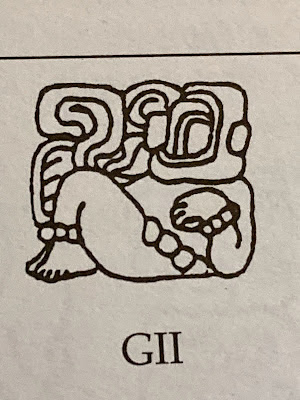

There were also disturbing carvings of humans in the arms or strange humanoid creatures. The intimacy often did not look consensual. They are similar to glyphs of the Burden of Time, but quién sabe?


Back in town we made an astounding discovery. A used comic book shop! These were Mexican comics. A lot of them were sci-fi. I recognized some as translations of American comics from the Fifties. Probably unauthorized translations.


It was run by boys about the same age–some younger–as that daredevil bus driver. I wonder what happened to them? Have they written any science fiction? Did they become Zapatistas?


Zapatista futurism. Is that a thing?


Now the Maya Train chews through the Lancondon jungle, spitting out its own future, Mayalandia, out to give Disney World a run for its money. I do wonder what it would be like to tour la ruinas in such high tech luxury. I also feel sorry for those who will not have strange adventures like mine.


Ernest Hogan, the Father of Chicano Science Fiction, has been wandering through Planet Nevada, NoCal, and Sasquatchlandia, and will be blogging about it soon. And judging the Somos en escrito Extra Fiction contest.

Thursday, December 01, 2022

Chicanonautica: Update from the Plain of Snakes

by Ernest Hogan

To most Americans--and a lot of Chicanos--Mexico is the Godzilla-esque mutant iguana living next door. I’ve been hearing people predict the end of the country for forty years. Still, it goes on . . .


“You must be careful, Don Pablo,” Rudi Roth said at the hotel. “Mexico is surrealistic.”


That’s from Paul Theroux’s On the Plain of Snakes: A Mexican Journey. I can’t resist a book with lines like that.


I once returned from Mexico, after being called a gringo by locals and tourists asked me for directions as if I was part of the landscape, and California looked like it was in black and white.  There is something ancient and surrealistic radiating from the center of the Earth into that soil. It disturbs a lot Americanos. It always changes my life. 


They do their best not to look at it directly, in fear of catching whatever horrible infection brought it into being. What is the nature of the infection? Who knows? This situation has only gotten worse in the age of Trump and the pandemic. 


Paul Theroux, bestselling author of novels and travelogues, has done us all a favor. An old gringo going on heroic road trip, alone, by car, crisscrossing the border, going down through northern regions, to Mexico City, Oaxaca, experiencing an earthquake and its aftermath, encountering crime, corruption, the muxes--the Third Sex--and the Zapatistas and Subcomandante Marcos.


. . . Marcos said to some tourists, “We apologize for the inconvenience, but this is revolution.”


Revolution now, revolution forever.


Yeah, I know some will object to an Anglo doing this job, but I’ve experienced how being a Chicano down there is problematic. And he’s a damn good writer, with a sharp eye, and sympathy. Americanos feel safe reading him. This book could help to break the crippling stereotypes that we are forced to live with.


These realities put most science fiction world building to shame.  

You want dystopia? This is real life. (Who created it? That’s an interesting story that we probably won’t see on American bestseller lists in the near future.)


Post-apocalyptic landscapes? Once again reality is more fantastic than imaginations brought up on corporate franchises. Societies undergoing transformation? These mutations have been going on for centuries.


“'Nothing is illegal here,' Francisco said with a crooked smile.”


How’s that for your anarchist utopia?


When I create my imaginary world, I try to make the reader feel the way wandering through Mexico makes me feel, in all its gritty glory.


Mexico is an exploding galaxy of new worlds and old. Theroux has provided us with a needed update. He puts it all into historic, political, and literary context–I’m going to have to go through it and take note of the books he mentions for my never-ending research.


And most important, he introduces us to an astonishing diversity of people, with fascinating lives, and things to say. Real human beings. Not stereotypes. Not monsters. Another step toward seeing things clearly . . . 


Ernest Hogan tries to see things clearly, but it keeps coming out stark, raving sci-fi.

Tuesday, June 14, 2022

How to become a travel writer

 Review: Tom Miller. Where Was I? A Travel Writer’s Memoir. Tucson: Molinero Press, 2022. ISBN 979–8–7 842–3710 – 1 (paper)


Michael Sedano


Don’t let the bastards get you down disparaging your métier, like travel writing is non-fiction light, and mouthing small-minded stuff about “writing” being something more exalted than “journalism”. Tom Miller’s heard, and ignored, those voices, even when whispered from within.  


Not that it has been an easy trek, but if becoming a noted travel writer was easy, everyone would be Tom Miller.


Young Tom Miller leaves his Washington DC home to drop out of college. Becoming a non-student student, he finds a niche among the underground press that flourishes in the sixties, where magazines like The Realist linked to dozens of newspapers whose hundreds of writers offer news and pointed satire unfit to print elsewhere.


 UnitedStatesians who lived through the era remember seeing the Millers of the era, scruffy stoners hitchhiking from crash pad to crash pad, living like bums (hippies), scrounging the scroungeable, and picking up a dime here and there for a meal or a bag. 


Miller can write, and, being naïve about publishing for money, the kid has a low threshold of satisfaction. But there’s a horizon ahead:  he learns sea-level publications, like Esquire Magazine, pay seven hundred dollars for stories Miller sells for ten bucks to an underground rag.


Young Miller goes on to befriend and write about iconic personalities and musicians as a participant-observer, building his writer’s career on the edge of conventional employment. The writer doesn’t give up his day jobs, but he’s constantly planning stories, writing and selling enough to live. Constantly.


Miller’s a person who loves what he’s doing, and he understands clearly what motivates him: 


You'll see why so many of the people in both countries who call the border home appreciate its nuance, its paradox, even its political fusion. There's a whiff of anarchy there, full of wonderful contradiction and deft incongruity. We've got a two-thousand-mile belt of cultural miscegenation, lively and mobile, and there are those of us who wouldn't have it any other way.


Miller expresses this love for his adopted tierra as part of the story of publishing his border book. Three NY houses turn it down saying no one’s interested in the border, but if you want to play up the brutality and savagery, write on.


Failing three pitches, Miller gets an audience with the world’s most insightful literary critic. This critic rakes Miller’s book over the coals and in the process, Miller admits he learns to write a book under the tutelage. 


The world's best critic isn’t some pointy-headed intellectual churning out PhD English majors at a big-name University. This critic works for a living. Harvey Ginsberg gets paid by Harper&Row. He’s an Editor.


His comments depressed me to no end. I was chastened about continuity (employ connectivity!), plot (use fictive elements!), and phrasing (keep your wording fluid!), as well as subtext (let the reader draw conclusions!), rhythm (tempo!), and character (depth of personality!). There was pacing (keep this stream flowing!), excess (don't go overboard!), and diction (keen articulation!); nuance (subtlety!) and attitude (keep your voice down!), when to expand (let ‘er roll when necessary!) and when to compress (condense when necessary!) He cringed at the title of one of my chapters, “Discreets of Laredo.”


What Miller doesn’t say (let the reader draw conclusions!) is Harvey Ginsberg’s rubric as recalled by Miller should be tacked to the wall in front of your typewriter. The recollection is amusing, not punny at all, but useful.


Showing and Telling. Where Was I? reads just fine on its own, but for the legion of Tom Miller readers (Linda Rondstadt blurbs “I am a Tom Miller fan”) the book fills-in numerous between-the-lines experiences that didn’t fit into stuff we’ve read and wondered over while enjoying the heck out of what we did get from the vato. 


Linda and I, we Tom Miller readers, have long been looking forward to the next Miller. This may be the last.


My writing has been stalled by a medical condition, a situation that has given me pause to reflect on my career and its first-person nature. I've benefited by my free-lance life, but my professional aspirations have deviated from the conventional. Writing about conflict and culture in the Southwest borderland and Latin America all these years has both shaped and suited my nature. Like a well-stamped passport, I've entered many lands. Now I invite you to join me crossing one more border. March 2022.


Where Was I? is not a eulogy, nor should readers take the self-published Where Was I? as memento mori. Parkinson’s Disease doesn’t shorten a person’s life, Miller tells us, but Parkinson’s takes the travel out of travel writing. Hence, a writer uses what he has, memory. 


Health writing, like the closing chapter, XXXIIII “Silence and Sympathy,” offer a body's most valuable insights. Readers sharing a difficult health journey will benefit from Miller’s insight into his untreatable, incurable condition. He no longer denies his disease, instead, looks at its unknowns as another journey. 


Sabes que? It’s good to learn more about Tom Miller’s writing career disguised as autobiography. So many highlights—Quixote, Cuba, Panama Hats, vengeful Saguaros—understate a key fact you have to read between the lines for. 


Living a free-lancer’s life keeps a person on edge. In turn, the border between eating and hunger lies between idea and keyboard. Miller, The Writer, keeps turning ideas into words on paper, submits them, takes rejection in stride, and submits one more time.


I have a feeling Tom Miller isn’t going to submit to this next setback. In fact, mira nomás, Molinero Press, Miller Press (must we tolerate appositional translation?), has stories to tell. I’m looking for them.


Órale. Here's Tom Miller's first Guest Column for La Bloga. Brother, be well.


https://labloga.blogspot.com/2010/05/guest-columnists-tom-miller-reading.html


Friday, October 05, 2018

Back from a Two-Week Trip to Ireland

Melinda Palacio


Doolin 

I'm back from a wonderful two-week trip to Ireland with Steve and our friends, Anthony and Crystal. The first thing I did was to make one of my favorite dishes, chiles en nogada. I didn't have any pomegranate seeds, pues ni modo. I was itching for some homemade comida like only I can make. I was warned about Irish food and how bland it was and had planned on taking some hot sauce, but failed to pick up a couple of bottles at the airport. Much to my surprise, I enjoyed the food despite its lacking in spices, a big change from New Orleans where the flavors and spices have a big party on your tongue and all the restaurants offer salt, pepper, and several choices of hot sauce. In Ireland, many of the dishes use white pepper and there was no black pepper at every table. After a week, we learned to ask for "cracked" pepper and, even then, at one restaurant, they simply brought a demitasse full of coarse black pepper. 
            I'm easy to please (if you don't poll Steve or my grandmother who had a special word for my pickiness (ideaosa or diosa or something like that), so blander food than usual was just fine with me. I was in bread heaven and could easily live off of all of their fruit scones and brown bread, as long as there was a generous helping of that famous Kerry butter. The black cows from Kerry produce the most  exquisite butter and cream in the world. Not to mention, delicious steaks and stews and, not being a fan of mutton or lamb, I wasn't having any of the lamb stews. However, I enjoyed all the potatoes and root vegetables. The first Irish dish I will try to make is their carrot and parsnip soup, which I would order any chance I got because it usually came with two pieces of  brown bread and the Kerry butter. Irish Whiskey was my drink of choice as I do not drink beer and didn't try any of the Guinness. Plus everything tastes fabulous with a dram of Irish whiskey, Writers Tears being my favorite. They even offered whiskey with the morning's porridge or oatmeal. It's a good thing our driver didn't partake of the morning whiskey. 
Kerry Cows
fruit scones 

            Apparently, it is a problem since Steve did have a breathalyzer test done at 9am on a Saturday morning. It was at one of those DUI checkpoints that looks like the local police are looking for bandits on the loose and using the breathalyzer to stop all cars exiting the Connemara mountains as an excuse to check out every vehicle.
Anthony, Crystal, Melinda, and Steve at the Cliffs of Moher

            For a small island, Ireland has all kinds of weather and views, views, views. You can experience four seasons in one day, dressing in layers is a must. Our fearless driver, Steve, was a champ at driving on the wrong side of the road and navigating what looked like a driveway, but really was a two-lane road. All roads were manageable when two small cars shared the road. When a tour bus came barreling at us, it was time for everyone to say prayers, hold their breaths, and grab onto the Oh-Shit straps above each window. I'm still a little jostled from all the close calls and wouldn't mind not getting into a car for a couple of weeks. I'd like to sit and bask in all the fun places we went to. It sure was worth the fright from medieval cities with castles in ruins and castles functioning as hotels to an even smaller island where twelfth-century monks decided they can make their home in the western most isolated point in Europe to the Wild Atlantic coastal drive to the oldest Neolithic settlement and sacred sites much older than Stonehenge and 500 years older than Egyptian pyramids to a poet's pilgrimage to the Yeats grave in Sligo to Dublin, a writer's city. 


The view from corkscrew hill

Stay tuned for more travel adventures to Ireland. In the meantime, the Bird Forgiveness tour continues in New Orleans tomorrow, Saturday, October 6 at the Latter Library at 2pm and Sunday, October 14 at the Maple Leaf Bar at 3pm.