Showing posts with label Mexican movies. Show all posts

Thursday, February 19, 2026

Chicanonautica: Sacrificing for the Aztec Empire with Chano and Cantinflas


by Ernest Hogan


I think we need a break from all the infernal politics and shameless self-promotion, so why not some chatter about a weird Mexican movie?


I was scrolling down Facebook when I saw a photo of Cantinflas—(I shouldn’t have to explain who he is, but kids and gringos may not have heard of him) a famous Mexican comedian—posing like he was carrying the Aztec Sunstone. From the size of it it could have been the real thing. It was from a movie with a tantalizing title: El Signo de La Muerte.


I Googled it. It was directed by Chano Urueta—a favorite of mine. And it was on YouTube. Sometime I want to make a blood offering to this wondrous age . . .


Once again, Chano delivered. 


It’s a pulpy tale shot in shadowy black&white from 1939. A professor has a cult and underground teocalli (they use the word) where he’s sacrificing virgins to Quetzalcoatl as part of a ritual to “resurrect the Aztec Empire.” Fun!


And some peculiarities:


Cantinflas, and Mendel (first name Manuel) --looks like a Charlie Chaplin wannabe--have star-billing, their names appear before the title, but seem to be included as an afterthought. They never interact with the rest of the cast, and if their scenes were all cut, the plot would remain intact. The way it is with a lot of lucha libre movies, of which Urueta also directed his share. You can imagine the producer saying (in Spanish, of course), “This crime thriller needs something. Call Santo and Blue Demon!”


The only thing that’s missing is a nightclub scene where we’re treated to an entire song and dance number.


During the sacrifices, the virgins’ breasts are bare. Taboos about nipples were different across the border back then. The breasts are also quickly splashed with blood–that was probably chocolate syrup, which would have come in handy for a different kind of ritual.


Also, a bourgeois matron exclaims how wonderful it would be to be sacrificed to the gods!


There are also scenes where actual Aztec artifacts–the Sunstone, the Grand Coatlicue, and others–are shown.


If that weren’t enough, in the inserted comedy scenes, Cantinflas bamboozles Mendel--who plays a typical bumbling investigator--by demonstrating magic powers that are not explained or figured into the story.


So, it’s not just a fun oddity, but has cultural significance, too!


I keep thinking that it would have been better with some additional scenes in which Cantinflas turns out to be an avatar of Quetzalcoatl (or maybe Tezcatlipoca) who has his own ideas about resurrecting the Aztec Empire.


Maybe a remake is in order.


Ernest Hogan is getting ready for the release of his latest story, “A Wild and Wooly Road Trip on Mars,” (another adventure of Paco Cohen, Tejano/Martian mariachi) in Xicanxfuturism: Gritos for Tomorrow / Codex II

Thursday, March 21, 2024

Chicanonautica: Gorgeous Widescreen Mayasploitation

by Ernest Hogan

The poster with the crucified/spreadeagled woman gave me the wrong idea about The Living Idol. The style of the credits told me it was a slick, widescreen, color production from the Fifties. It also looked Mayan. Hmm . . .


Then:


Grateful acknowledgement is made to the National Institute of Anthropology and History of Mexico for cooperation in the making of this film.


Somebody spent some money on this. It was written, produced, and directed—the whole autre deal— by Albert Lewin, who also made the 1945 version of Oscar Wilde’s The Picture of Dorian Gray.


Also, René Cardona, responsible for The Brainiac, The Batwoman, Night of the Bloody Apes, Doctor of Doom, Wrestling Women Vs. the Aztec Mummy . . . (better stop, I’m getting distracted) was credited as “associate Mexican director.”


I was intrigued and amused.


It opens with scenes filmed in the Yucatán in Mayan ruins, with Mayan extras. Every shot looks like a postcard. My overactive visual cortex was happy.


Not a bad story, been done before: An ancient artifact housed an evil spirit, the presence of a girl who is the reincarnation of a virgin—though in this case, the word is carefully avoided—sacrificial victim, brings it to life . . . 


And this wasn’t a cheap quickie that Roger Corman, or even Cardona, slapped together on a minimalist budget, meeting a ridiculous deadline. It was a lavish Hollywood production with international connections. Ambitions are apparent. And that seems to be the problem.


Instead of a horror flick with a stuntman in a rubber suit playing the monster, we have a visual spectacular--what I like to call an eye-fry--with a lot of good intentions wrapped around a pulp plot, and packaged like exploitation.


I already mentioned the poster with French-Italian actress Liliane Montevecchi splayed out for sacrifice. She’s supposed to be a Maya, but when she’s in the same scene with real Mayan women in huipiles . . . 

In the beginning, she’s supposed to be in her early teens, and in love with the hero who looks near middle age. This was a common plot point in entertainment of the era. The photojournalist hero then, in an awkward attempt to avoid impropriety, goes away on assignment for a few years, giving her time to grow into an “of age” university student.


There are a lot of beautiful Mexico City scenes, but it all moves very slow.


When the idol–the red jaguar throne, from El Castillo, AKA the pyramid of Kukulkan in Chichén Itzán–comes to life, we don’t see it, we just hear it wrecking the room it’s locked in. As an adult intellectual, I understand that the director was trying to make a point–there's an entire illustrated lecture on the history of human sacrifice, suggesting that modern warfare is carrying on the tradition–but the monster kid in me feels gypped.


Still, they get away with showing more blood than in other 1957 films.


The heroine does finally assume the position of sacrifice, in a dream sequence/flashback.


Still, I found myself enjoying The Living Idol. Maybe, someday, when I'm in the right mood and have a some Escorpion Negro Black Ale, I’ll watch it again.


Ernest Hogan is the author of Guerrilla Mural of a Siren's Song: 15 Gonzo Science Fiction Stories.

Thursday, August 10, 2023

Chicanonautica: Blazing Silver Nitrate

by Ernest Hogan 

During a summer where the world seems like it’s on fire, what we need is a book that burns like silver nitrate. In case some of you don’t know, in the early days of movies, the film was made with silver nitrate, which is highly flammable and dangerous. It’s also the title of the new novel by Silvia Moreno-Garcia. It’s so hot it’ll make you think it’s cooling off outside.


Silver Nitrate also isn’t an arbitrary title. The substance, and its use in film, particularly old film, is central to the novel. How can this be? Silver is often used in witchcraft. It makes sense that it could be used in connection with the magic of movies. 


Like in her earlier novel Signal to Noise, it takes place in Mexico City. Technology—in this case, audio cassettes-- and witchcraft intersect. There are also intersections with a lot of real life strangeness that is so well researched and presented in such rich detail that it’s hard to tell where the reality ends and the fantastic begins. There’s occultism—Aleister Crowley is evoked, along with Nazis and the incredible world of Mexican horror movies.


I’m kinda obsessed with this twisted branch of the cinematic arts. I wouldn’t call myself an expert, but I knew right away that the character Abel Urueta was named for the actor Abel Salazar and the director Chano Urueta. (Which reminds me I need to see  El Barón de Terror–called The Brainiac in K. Gordon Murray’s dubbed English version–again sometime soon).


It also has one of the most badass, intelligent female heroes ever (somehow the antiquated term “heroine” isn’t quite right here). Some reviewers have complained about Silvia’s characters not being likeable enough—but speaking as a writer, a good fictional character doesn’t have to be “likeable,” they need to have a knack for interesting trouble, and entertaining ways of getting out of it. Montserrat, Momo to her friends, is amazing. I would like to see more of her.


What I enjoyed most wasn’t the noir/thriller aspects, or the imaginative and original horror elements (Stephen King, watch out), but that it presents the joy of investigation and doing research. And in the pre-internet era! It’s an intellectual adventure. I was hesitant to say that, since the mantra of the bestseller reader as imagined but the major publishers is “I don’t like to think when I read.” But Silver Nitrate is a thrill ride, and those thrills will cause a few synapses to fire triggering the imagination. Some readers appreciate that.


I also need to make it clear that even though it deals with what some call trash culture, this is not a trashy novel—not the literary equivalent of telenovela or a grade Z horror flick. This book is a class act, and so is its author.


All this, and it will make you forget about this being the hottest summer on record, too!


Ernest Hogan is trying to sell a trashy novel, and his first story collection, Pancho Villa’s Flying Circus, is coming out soon.

Thursday, March 09, 2023

Chicanonautica: A Mexican Headless Horseman

by Ernest Hogan

I’m a pocho. Born in Eastlos, but raised in West Covina, so mi espanol es kinda wonqui. It’s like a reattached limb with nerve and muscle damage. As the Father of Chicano Sci-Fi, I consider it my sacred duty to struggle with Spanish. I can read it fairly well, but when it comes to speaking it, I’m far from fluent.


So I do my best to run the language through my twisted cerebro, hoping that someday before I die, I’ll be able to rattle it off without it being awkward.


One of the things I do is watch movies in Spanish. This has gotten easier in the days of streaming services. I used to have to tune to Spanish-language stations and hope for the best. Now on YouTube, Tubi,and others, I have access to more than ever before. Beats the hell out of the days when I had to channel surf (do people still do that?) and hope I could find something weird enough for me.


Cinema Mexican is often weird enough for me. Now I put a lot of it on my watchlists, and I'm delighted as well as educated.


Recently, I scrolled through my substantial YouTube watch list and found El Jinete sin Cabeza. A Mexican headless horseman from 1957? I went for it.


It starts out with a man being taken by moonlight to some ruins by a gang in skull masks and put on trial–there is a living, severed hand, though you can see the arm coming out of a slot in the table–and put to death. Pure poetry.


After a while the headless horseman shows up. He wears an all white charro outfit, and his head is covered in black cloth, so when he’s in front of a black background, his white sombrero appears to float over his body. A great effect, sure; you can see that it’s a black mask without eyeholes in the fight scenes, but the illusion works most of the time.


The plot is the hackneyed Scooby-Doo fake ghost mystery plot (how old is it? who did it first?), but the Mexican Gothic/Expressionist/Noir look and surreal touches send it off into another dimension.


I had caught part of it back in my channel surfing days. I was glad to see the whole thing, and to be able to Google it. Turns out, it’s by one of my favorite Mexican directors, Chano Urueta, full name Santiago Eduardo Urueta Sierra. He’s responsible for some of my favorites, like Blue Demon contra Los Cerebros Infernales, and the totally outrageous El Barón del Terror AKA The Brainiac. Besides horror/sci-fi and lucha libre, he made a lot of westerns that I have to investigate. He was also a writer and actor. Sam Peckenpah cast him in The Wild Bunch and Bring Me the Head of Alfredo Garcia.


Urueta is one of the heroes of La Cultura.


I thank Quetzalcoatl for the technology that allows me to enjoy such things, and Tezcatlipoca for the weirdness.


Ernest Hogan will be teaching Chicanos how to conquer the science fiction/fantasy/horror megagenre at the Palabras del Pueblo Writing Workshop. It’s called Papí Sci-Fi’s Ancient Chicano Sci-Fi Wisdom. Sign up, tune in, and learn.

Thursday, January 28, 2021

Chicanonautica: Aztech: The Movie—Hecho en Mexico

by Ernest Hogan


First of all, it has nothing to do with my novel High Aztech. I’d seen things about Aztech: The Movie a while back, did some checking, but my novel doesn’t have any spaceships in it, so no Ellisonian lawsuit seemed necessary (Google “aztech,” and you’ll get a long list of businesses who use the name), so I went on to other business.

Then Daniel Salvo, a Peruvian science fiction writer, called my attention via Facebook to a poster with an image of the Grand Coatlicue constructed of machine parts that could be used as High Aztech. Hmm.

“Online gratis,” it said. There was as also a link where you could VER the film. I clicked.


The site seemed to be a Russian (“.ru”) video sharing site. Could be risky, but my curiosity got the best of me. I started the video. It was a low-res copy, but a widescreen and professional-looking production, and there was this impressive state-of-the-art space opera with Mexican characters going on . . . I was amazed.


Aztech
is an anthology. Nine stories, ten directors, fourteen writers. They span the entire science fiction/fantasy/horror continuum. It uses meteors, the influence of dioses oscuros, and Mexican culture to tie it all together.


It even touches on postmodernism with one of the stories being about a the making of a movie with a similar theme.


Another story presents some impressive post-apocalyptic Aztecoid (shot in and around Teotihuacán) futurism of the sort that I’ve been doing for decades. Maybe it’s finally beginning to catch on.


And after the credits there’s an action-packed sequence about hackers using smart phones, the Internet, and cars to track meteors as they rain down on an urban Mexican landscape, that ends with a TO BE CONTINUED . . . (Yes, in English.)


An ambitious project that shows that Mexico can be a major science fiction producing country.


2020 is listed as its release date. It has played at a film festival and has a Facebook page.


I’m not sure why it’s having this freebie, low-res, online manifestation. COVID-19 has smashed the movie business. Also, I know what it’s like to have to keep one foot in the underground just to survive.


But the people who made this film, and want to make at least one sequel, don’t seem to be the sort to give up easily. I expect to see it in a hi-res, with subtitles for the Spanish-impaired, version on streaming services, and even theaters, in the near future. Be on the lookout!


Meanwhile, my computer doesn’t seem to have any weird viruses . . .


Did I ever tell you about the idea I have about one morning we all wake up to discover that the entire World Wide Web has been translated into Mayan hieroglyphics?


Ernest Hogan, author of High Aztech, Cortez on Jupiter, and Smoking Mirror Blues keeps finding it more and more difficult to tell where his life ends and the science fiction begins.

Thursday, September 12, 2013

Chicanonautica: Jesús Murciélago Velázaquez, the Original Batman?


I’ve got another story out -- Novaheads, a postcyberpunk romp with a futuristic masked Mexican wrestler and a drug made from weaponized chili. It’s in Super Stories of Heroes and Villains edited by Claude Lalumière. I’ve written about its origin and long, twisted path to publication on my blog, Mondo Ernesto.

Here, I’d like to explore the lucha libre tradition -- specifically, Jesús Murciélago Velázquez. No, Murciélago (Bat) isn’t his real name. His parents named him Jesús Velázquez Quintero. He became know as El Murciélago Enmascarado when he wrestled in a black hood, trunks, and boots. He also wore a black cape into the ring, and, according to Dan Madigan in Mondo Lucha A Go-Go: The Bizarre and Honorable World of Wild Mexican Wrestling: he would carry a sack full of live bats and release them into the crowd before the match started.

Fantástico! What a showman! Death metal bands would love to do that. Imagine the legal/insurance complications it would cause . . .

And for those of you who don’t believe that it could be done, here’s a video with him entering the ring, without a mask, but with his cape, releasing bats:


The debut match of El Murciélago Enmascarado was April 3, 1938. Batman first appeared in Detective Comics #27, in May, 1939. That’s almost a year later. Velázquez may qualify as the original Batman.

We can’t tell if Bob Kane and Bill Finger had any way of knowing about Mexican wrestling at the time, but if they did, there may be an argument for a case of cultural appropriation here.

Even though his influence on American comic books is debatable, Velázquez was one of wrestlers who helped create the weird world of lucha libre, one of the first to wear a mask. He was known for knocking the eye out of Merced Gómez in the ring, though some say Gómez actually lost his eye in his earlier career as a boxer. Like the bat-release, it helped create the drama and legend of El Murciélago Enmascarado.

When a younger wrestler tried to use the name El Murciélago Enmascarado II, he sued. The young wrestler later obtained a silver mask and took the name Santo.

He was also the first luchador to be unmasked in the ring, which didn’t end his career -- he wrestled until 1955.

This was not the end of Jesús Murciélago Velázquez, who used the “bat” as part of his name in his career as an actor and screenwriter.

According to Internet Movie Database, he wrote 25 movies -- some starring Santo -- and not just the lucha libre genre, but horror, adventure, drama, comedy, crime, western, musical, and even a Pancho Villa biopic.

As an actor he usually played himself and wrestled. American monster movie fans may have seen him in Doctor of Doom and Wrestling Women vs the Aztec Mummy.

He was a true renaissance luchador!

Ernest Hogan’s story Novaheads is in Clalude Lalumiére’s Super Stories of Heroes and Villains that was called “the best superhero anthology around, and a must-read for comic book fans” by Publisher’s Weekly.

Thursday, January 31, 2013

Chicanonautica: OVNIs Over Aztlán and Other Phenomena


Different cultures create different kinds of “aliens.” The “other” depends of who you are and where you’re from. It’s the same in UFO mythology

The OVNI literature of the Latino world is different from the UFO books of Anglolandia. You don’t find extraterrestrials without genitalia that seem to be a Puritan vision of a more advanced species -- instead, aliens are sexy, and hot for humans.

Ever since Brazilian farmer Antonio Villas Boas reported having sex with female alien in 1975 reports have come in. I’ve read about them in English and Spanish. They range from a Mexico City woman claiming to have been impregnated by a man who explained that he had to return to his home planet, to a book by a man who not only had sex with, but painted cheesy portraits of several beautiful alien women, and reverse-engineered flying saucers with Aristotle Onassis. 

I wish I could remember the authors and titles of those books . . . Meanwhile, others show up . . .

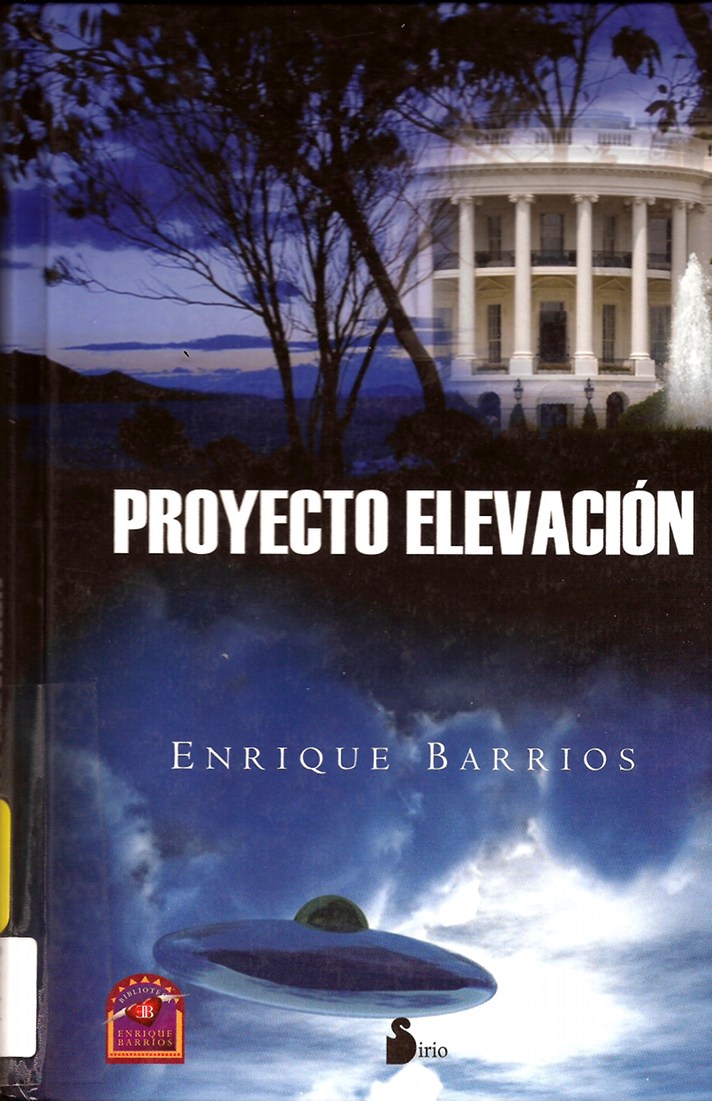
 The flying saucer and the White House on the cover of Proyecto Elevación by Enrique Barrios  attracted my attention. It has a hero on an adventure/romance with Iara, a bald, beautiful alien woman after her spaceship crashes in Arizona. “La CIA” and mysterious helicopters chase them as they race to tell the president about the conspiracy in the U.S. and British governments to stop an interplanetary project to bring advanced technology and evolution to the Earth. 

Then I looked up Enrique Barrios’ webiste. He was born in Chile and grew up in Venezuela. He has retired from “actividades públicas.” His books include a children’s book similar to Proyecto Elevacion. There is also El Oráculo del Siglo XXI that delivers I Ching-like interactions.

His attitude about a sinister Anglo-American conspiracy reminded me of the works of J.J. Benitez. I read one of his books back before he switched to writing about Jesus Christ rather than UFOs. It read like a novel, as he ran around the world chasing a mystery that never quite solidified. He had photos of his girlfriend in front of the Sphinx and in the Mediterranean with circles around what looks like dust specks in the sky. Crossing the border into America was described as a Kafkaesque nightmare. He ended the book promising that he’d reveal whatthehell it’s all about in the next book . . . maybe.

Benitez’ latest book, Caballo de Troya 9: Caná is as thick as a brick, in the Spanish Language Fiction section of the library.

Whoever runs the MilMascarasvideo2’s channel on YouTube also has a taste for UFOlogy. There you can now see the incredible movie Misterio en Las Bermudas, which has similar political themes to the works of Barrios and Benitez.

Featuring Santo and Blue Demon along with Mil, it’s a kind of everything-but-the-kitchen-sink example of the luchador/sci-fi genre: No UFOs here; instead futuristic periscopes come out of the Caribbean and alter the weather -- USOs, Unidentified Submerged Objects! Santo’s mask is found in the seaweed before the flashbacks. A wrestling tour of Europe has to be canceled because the “political situation” is getting too dangerous. An Iranian princess/martial artist needs luchador protection. There’s an underwater utopian city where people wear silver jumpsuits and headbands. The music has a lot of wah-wah.

The most bizarre thing is the ending. First, the princess is rescued, the luchadores and some babes in bikinis, all go off in a boat, like in a happy ending . . . Then we go back to the fishermen who found Santo’s mask. One of them explains that the boat disappeared into the Bermuda Triangle and declares that the prophecies of the Book of Revelation are coming true -- and we are treated to some stock footage of a nuclear explosion!

Yeah, it’s paranoid as well as sexy -- and while I wrote this, a helicopter circled over my neighborhood . . .

Ernest Hogan will have stories in the upcoming anthologies We See a Different Frontier and Super Stories of Heroes and Villains.

Thursday, May 10, 2012

Chicanonautica: The Cinema of Mil Máscaras


Let us now celebrate one of Mexico’s greatest cultural ambassadors, that great Latino artist and humanitarian, Mil Máscaras, the Man of  a Thousand Masks. He was recently made a member of  World Wrestling Entertainment’s Hall of Fame:


Not only has he successfully crossed the border from Mexican lucha libre into American professional wrestling, but he has had a long and impressive career in movies:


Santo and Blue Demon are great, but add Mil Máscaras -- especially when Rogelio Agrasanchez is producing -- to the mix, and you get a jolt of creativity that makes for cinematic mayhem that is both ecstatic as well as aesthetic. I particularly recommend El Robo de los Mumias de Guanajuato in which folklore and local color runs amok, Los Campeones Justicieros featuring a mad scientist and super-powered dwarves, and the utopian/apocalyptic Misterio en las Bermudas.
These and more can be seen on YouTube at Milmascarasvideo1’s channel. It’s a treasure trove of  clips of Míl Mascaras, UFOs, rock&roll, and of course, wrestling.


As for what he’s been up to recently:


Ernest Hogan has been struck with an exploding mass of inspiration for a fantasy novel about the preColumbian ball game, as if he didn’t have enough to do.