Showing posts with label Documentary. Show all posts

Friday, September 20, 2019

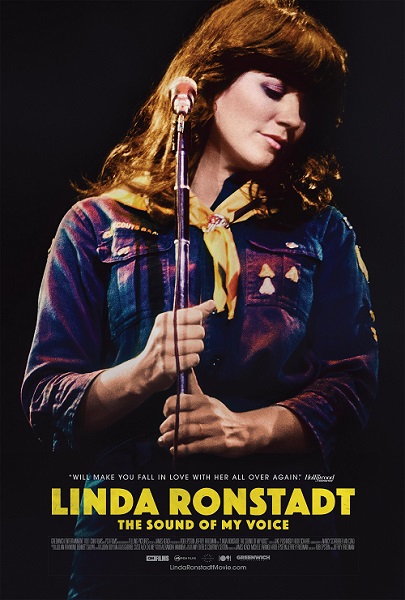
Linda Ronstadt: The Sound of My Voice

Melinda Palacio


Linda Ronstadt Tribeca Film Festival
Linda Ronstadt: The Sound of My Voice


On Wednesday, I went to see the documentary, Linda Ronstadt: The Sound of My Voice. I can’t say enough good things about this film. The only shortcoming might be the shortness of clips of her singing. However, longer samples of her songs would turn the ninety-five minute run time into something too long for one sitting. For a fan such as my late grandmother, a longer film would be welcome. Linda Ronstadt’s music was the soundtrack of my childhood. Sometimes, my grandmother would play her albums on repeat the entire day. She never tired of Linda. 

As a female pioneer and rockstar queen, Linda Ronstadt was versatile enough to own every single genre of music. She is the only woman with 5 platinum albums and one year she appeared at the top of the carts in Pop, R&B, and Country, all at the same time. Her voracious variety in musical taste, echoed the smorgasbord of music in my grandmother’s house in Huntington Park, where I grew up. Before Ronstadt’s double platinum album, Canciones de Mi Padre, my grandmother had no idea Ronstadt was Mexican. She simply loved her voice and enjoyed all her hits, but she especially loved the album that spoke to her in her language. 

The documentary shows Ronstadt’s determination to produce the album of songs in Spanish for herself. Not being fluent in Spanish didn’t stop her. Linda enlisted Rubén Blades to help her with her Spanish diction. The success of the album silenced the record company naysayers. 

Yet, for all her determination and success, Linda was lonely and insecure. Another saying comes to mind, It’s lonely at the top.  I was surprised to learn that with all of her success, awards, and a voice that was liquid gold, she doubted herself. Although I can relate to her insecurities, it’s hard to understand the feeling in someone who is so talented. During the film, I kept waiting for the moment in the film when there is a fall from grace or when the hit records hit a dry spell, but she had a stellar career. Every time she ran into roadblocks, she insisted on knocking them down. She proceeded with her vision, and never failed to produce an award-winning album. 
Of course the absolute heartbreak of the film is the ending and seeing that she has lost her vocal range (and most of her voice) to Parkinson’s, a disease her mother also had. Music is such an important part of her life. To have been one of the greatest singers and to have the gift taken away is devastating and tragic. The testament to her grit is how she is able to share the heartbreak with the world. One can’t help but admire her. 


The few months I wasn’t able to walk after I broke my leg left me yearning to do more than hobble. I couldn’t wait to skip, run, dance, sprint again. The ordeal was a tough lesson in humility. When I hurt my arm in yoga, I couldn’t play guitar and I became agitated with thoughts that I might have to give up something I loved. The old saying about not appreciating what you have until you no longer have it is the toughest lesson. I was lucky to recover from my injuries. Linda Ronstadt graciously shares how hard it is to lose the thing she loves the most: singing with her family. What courage and grace it takes to share such a vulnerable moment with the world. 

Sunday, January 31, 2016

No Más Bebés: Documentary on Latina Sterilization Premieres on PBS

Text in this blog via Independent Len's press release


Maria Hurtado: Photo from PBS Pressroom

Directed by Renee Tajima-Peña (Who Killed Vincent Chin?), No Más Bebés premieres on Independent Lens, Monday, February 1, 2016, 10:00-11:00PM ET (check local listings) on PBS.

(San Francisco, CA) — No Más Bebés tells the story of a little-known, but landmark event of women’s history and reproductive rights, a struggle that unfolded four decades ago in Los Angeles. The film recounts how a small group of Mexican immigrant mothers and activists sued county doctors, the state, and the U.S. government after they were sterilized while giving birth at Los Angeles County-USC Medical Center during the late 1960s and 1970s. Many of the mothers spoke no English, and charged that they had been forced to consent to having their fallopian tubes tied by doctors and nurses during the late stages of labor — often based on little more than the question “More babies?”

The film tells an unforgettable tale of family, cultural conflict, and resistance. Aided by an intrepid, 26-year-old Chicana lawyer and armed with hospital records secretly gathered by a whistle-blowing young doctor, the mothers stood up to powerful institutions in the name of justice. In their landmark 1975 civil rights lawsuit, Madrigal v. Quilligan, they argued that a woman’s right to bear a child is guaranteed under the Supreme Court decision Roe v. Wade.

One of the film’s key figures is Dr. Bernard Rosenfeld, then a young doctor who had noticed a troubling practice in the maternity ward at Los Angeles County-USC Medical Center — immigrant women, many of whom spoke no English, were being encouraged to sign authorizations for tubal ligations. A first year intern with everything to lose, Rosenfeld secretly gathered evidence and blasted letters to media and watchdog groups around the country, trying to get someone to take up the cause. He soon met a newly minted law school graduate, Antonia Hernández, whose own mother had given birth at the hospital. Hernández and a group of young Mexican American lawyers, working out of a legal aid storefront, set out to file a civil rights lawsuit to stop the practice.

The filmmakers spend six years tracking down the mothers who sued and other witnesses, and the unfolding drama of the case, Madrigal v. Quilligan, is told through their own words. Many of the mothers were still living under the emotional shadow of the sterilization and were reluctant to discuss the case, but six agreed to be filmed. Four decades later, their memories are still raw. Many had no idea they were sterilized until lawyers and activists helping with the case came knocking on their doors. They frankly discuss the effect the procedure had on their marriages, families, and future lives.

The film asks: Was the maternity ward functioning as a “border checkpoint” for unborn babies? Were the mothers pushed into signing consents in a language they did not understand, were in no condition to sign, or agreed to under threat? For the first time since the trial, the defendant doctors also agreed to be interviewed, including Dr. EJ Quilligan, the prominent head of OB-GYN. While the doctors deny any wrongdoing, they describe the maternity ward of the massive, public teaching hospital as a “war zone,” where so many women labored on gurneys in the hallways.


The events depicted in No Más Bebés unfolded against the backdrop of similar sterilizations of poor women at public facilities across the U.S. The Madrigal v. Quilligan lawsuit and related cases around the country led to reforms to protect women from coercive sterilizations and other significant changes in hospital policy. And yet, coercive sterilizations continue to happen. In 2010, it was discovered that incarcerated women in California prisons were unwillingly sterilized; in 2015, a Tennessee judge was found to have offered probation in exchange for sterilization. On the positive side, North Carolina and Virginia have recently agreed to compensate victims of sterilization abuse. Says Independent Lens executive producer Lois Vossen, “the struggle so vividly depicted in No Más Bebés also anticipated the reemergence of the reproductive justice movement today, as Chicana activists sought to redefine reproductive politics not only as the right to abortion, but also the right to bear a child.”

“Like most middle class women, to me Roe v. Wade meant the right to abortion,” says producer/director Renee Tajima-Peña. “I never considered I would ever be denied the choice to have a baby. Today there is a growing reproductive justice movement that argues for a woman’s control over the full range of her fertility — the right to terminate a pregnancy as well as the right to have a child and raise that child in dignity. Forty years ago, these women were talking about reproductive justice in a way that was ahead of their time. They understood that their race, poverty, and legal status affected whether or not they had any choice at all.”

About the Major Participants

The Mothers

Consuelo Hermosillo
Carolina “Maria” Hurtado
Dolores Madrigal
Maria Figueroa
Melvina Hernandez
Jovita Rivera

Antonia Hernandez migrated from Mexico as a child and grew up in East Los Angeles. She was a 26-year-old UCLA Law School graduate, working at the Los Angeles Center for Law & Justice, when she met Dr. Rosenfeld. She and lead attorney Charles Nabarrette filed the Madrigal v. Quilligan suit. She went on to become President of the Mexican American Legal Defense & Education Fund (MALDEF) and is now CEO of the California Community Foundation.

Dr. Edward James Quilligan was the esteemed head of the Women’s Hospital at LAC+USC. Dr. Bernard Rosenfeld was the whistle-blowing young resident. Frank Cruz was the first Latino anchor on Los Angeles TV news and the only reporter to cover the trial.

Gloria Molina is an activist and, as President of the nascent feminist organization, Comisión Femenil, signed on as class representatives for the Madrigal v. Quilligan suit.

About the Filmmakers

Renee Tajima-Peña (Producer/Director) is an Academy Award-nominated filmmaker whose directing credits include Calavera Highway (PBS), “The Mexico Story” of The New Americans series (PBS), My Journey Home (PBS), Labor Women (PBS), Skate Manzanar (performance and installation), My America...or Honk if You Love Buddha (PBS), The Last Beat Movie (Sundance Channel), The Best Hotel on Skid Row (HBO), and Who Killed Vincent Chin? (PBS), which was nominated for an Academy Award for Best Documentary. Her films have premiered at Sundance, Cannes, San Francisco, New Directors/New Films, Toronto, the Whitney Biennial and festivals around the world. Among her honors are a USA Broad Fellowship, a Peabody Award, a DuPont-Columbia Award, an Alpert Award in the Arts, and IDA Achievement Award, and a Guggenheim Fellowship.

Virginia Espino (Producer) is a historian at the UCLA Center for Oral History Research, and has conducted oral histories with major figures in the Latina/o community. Her research on coercive sterilization at LACMC provided the basis for the documentary project. Her research was published in Las Obreras: Chicana Politics of Work and Family, edited by Vicki L. Ruiz, and Latinas in the United States: A Historical Encyclopedia, and was supported by the Woodrow Wilson Dissertation Grant in Women’s Health, the Ford Dissertation Fellowship for Minorities, the Smithsonian Institution Minority Fellowship, the Smithsonian Institution Inter-University Program for Latino Research Fellowship, and Irvine Fellowship. She has served on the California Commission for Sex Equity, and the Los Angeles Chicano/Latino Education Committee.

CREDITS

Director/Producer: Renee Tajima-Peña
Producer: Virginia Espino
Director of Photography: Claudio Rocha
Editor: Johanna Demetrakas
Associate Producer: Kate Trumbull-LaValle
Original Music: Bronwen Jones
Executive Producer for LPB: Sandie Pedlow
Executive Producer for ITVS: Sally Jo Fifer
Executive Producers for Chicken & Egg Pictures: Julie Benello Parker, Wendy Ettinger, Judith Helfand

No Más Bebés is a co-production of Renee Tajima-Peña and Virginia Espino of Moon Canyon Films, and the Independent Television Service (ITVS), in association with Latino Public Broadcasting (LPB) with funding provided by the Corporation for Public Broadcasting (CPB), and Chicken & Egg Pictures.

About Independent Lens

Independent Lens is an Emmy® Award-winning weekly series airing on PBS Monday nights at 10:00 PM. The acclaimed series features documentaries united by the creative freedom, artistic achievement, and unflinching visions of independent filmmakers. Presented by Independent Television Service, the series is funded by the Corporation for Public Broadcasting, a private corporation funded by the American people, with additional funding from PBS and the John D. and Catherine T. MacArthur Foundation. For more visit pbs.org/independentlens. Join the conversation: facebook.com/independentlens and on Twitter @IndependentLens.

Monday, March 05, 2012

Guest columnist: Film Review by Jeanette Iskat de Aldana

Note: Daniel Olivas returns next week from travels into the southeast.

Under Arpaio
Pan Left Productions. Directed by J.M. Aragón.

by Jeanette Iskat de Aldana


Directed by J.M. Aragón, the feature length documentary, Under Arpaio, captures the day to day struggles faced by undocumented people in Maricopa county, Arizona. The film tells us the strong and justifiably angry stories about the ongoing fight to maintain safe spaces for people in the Arizona communities that are under a full scale attack by police and border authorities.

Tewa Women United and the Student Senate of Northern New Mexico College recently screened the Pan Left production of Under Arpaio. New film footage about the recent ethnic studies book ban was also shown. A panel discussion with the film's director and activists from organizations from Arizona and New Mexico followed.

Maricopa county sheriff Joe Arpaio imagines himself as a tough sheriff dealing with problems in his own strong way, a reborn John Wayne who believes that pink handcuffs and tent city concentration camps in brutal Arizona heat are actually a solution to the complicated issues of borders and immigration.

The film expertly reveals him to be an uneducated bully who doesn't write or read the books that bear his name, fully in the pocket of privatized prison corporations and banks like Wells Fargo that finance them.

Arpaio is revealed as a modern day "Bull" O'Connor, whose flagrant violations of civil and human rights grow more and more blatant as the film unfolds. Smear tactics, illegal searches and arrests, intimidation and human rights violations are all captured on film in images that bring the pain fully into the viewer's heart and mind.

The film footage is exceptional, captured over the space of several years. Aragón and his crew are regularly in the right place at the right time to get the shots that establish the truth. Lawyers, city council members and journalists outline extraordinary examples of violence, fear mongering and the pain being inflicted on all levels of the community.

The body of an undocumented man, tortured to death, is carried out, recorded only on a jail's CCTV camera, to be buried in a pauper's grave, unknown until activists found his family in Mexico. The lawyers recount tragic cases and speak of the tens of millions of dollars paid out in wrongful death settlements with grieving families. A Pulitzer Prize winning journalist speaks of repeated violations of ethical and legal standards, blatantly occurring in front of him without apparent fear of repercussion.

The film brings us along into the front lines of this war on communities of color. We see the face of one virulently racist man spewing nonsense into the camera at a day laborer job site, so close that you can feel the hate oozing from his pores, contrasted with the activist who holds down a daily vigil to keep people safe. We see two tiny children left on a curb, sobbing into cheap stuffed animals that police officers handed them as their mother was put into a car for questioning. We see activist after activist targeted, unlawfully detained and threatened.

It becomes fairly apparent that the presence of the film makers and their allies often serves a dual purpose, to document and to keep even more egregious actions in check. Pan Left, whose excellent slogan is "We give a darn", has empowered everyone in the affected communities the film unfolds in by putting cameras and 24-hour hot lines with their "Yo Soy Testigo" (I am A Witness) fully into place.

The truth outlined in this film is ultimately seen in the Department of Justice's belated investigation of Arpaio. The marches, filmed visits to the D.O.J., the documentation of repeated violations of the law and the subsequent revelation of hundreds of ignored cases of sexual abuse may produce indictments against Arpaio and his brute squads.

The full D.O.J. report can be read here: http://www.justice.gov/crt/about/spl/mcso.php

The film is currently showing in screenings around the country. Pan Left is looking to show it in communities that are again under siege, like New Mexico and that old stalwart of institutionalized racism, Alabama, and in places where new incursions into this undeclared war are occurring.

New Mexico's governor Susana Martinez, herself the granddaughter of undocumented immigrants, has again been attempting to ram through a bill that would deny driver licenses to undocumented workers in New Mexico.

If that doesn't sound too bad, remember the first step Arizona took was taking away the ability for undocumented people in Arizona to get the licenses that allowed them to drive as safe and insured motorists.

Laws often start as small incursions, the removal of tiny freedoms, much in the way that Nazis banned books, then "degenerate" art and then, ultimately, people. Incursions are continuing into the rights of the undocumented and documented alike, as with the recent cancellation of ethnic studies in Arizona, a move that bans legal books from being studied by students.

Under Arpaio shows us that this country is under attack, not by immigrants, but by people who seek scapegoats for their fear. Instead of looking for solutions to immigration issues, like the "Dream Act", we are told to hate and fear "the other". Organizations like Pan Left, Puente Arizona and Somos Un Pueblo Unido continue to fight the good fight, on all fronts. It is up to all of us to support them, with our bodies and our actions, and to stand firmly for what is right.


For more information on Pan Left: http://www.panleft.net/

For more information on Under Arpaio: underarpaio.com

For more information on Puente Arizona: puenteaz.org

For more information on Somos Un Pueblo Unido: somosunpueblounido.org/

For more information on the Dream Act: http://dreamact.info/


Abouth La Bloga's Guest:
Jeanette Iskat de Aladana is a painter, poet and activist who recently moved from Los Angeles to rural New Mexico.

She was last in La Bloga as one of the Poets Against S1070.

She believes in clean water for everyone and that she cannot be human by herself.


Thursday, November 11, 2010

The Storm that Swept Mexico


The Storm that Swept Mexico

Documentary Screening:

The Storm that Swept Mexico

A two hour documentary film of the gripping story of the Mexican revolution of 1910; its causes and its legacy

Thursday, November 18, 2010
7:00 PM - 10:00 PM
Digital Screening Theater
1422 Melnitz
Los Angeles, CA 90095

The Storm That Swept Mexico tells the story of the Mexican Revolution, the first major political and social revolution of the 20th century. The revolution not only changed the course of Mexican history, transforming economic and political power within the nation, but also profoundly impacted the relationships between Mexico, the U.S. and the rest of the world. Part 1 begins with the overthrow of dictator Porfirio Diaz in 1910 through ten bloody years of armed conflict. Part 2 tells the story of the legacy of the revolution and ends with the 1968 massacre at the Tlatelolco housing project in Mexico City.

==================================================================

NEW RELEASE: Black Mirror/ Espejo Negro

Description

The provocative three-part project Black Mirror/Espejo Negro by the artist Pedro Lasch encompasses a museum installation, photographs of the installation, and this bilingual book, including many of the photos, the artist’s statement, and critical commentaries. The project began as an installation commissioned by the Nasher Museum of Art at Duke University to accompany the exhibition El Greco to Velázquez: Art during the Reign of Philip III. In a gallery adjacent to the exhibit of Spanish Golden Age masterpieces, Lasch placed black rectangular mirrors on the walls, each with an image of a Spanish Renaissance painting behind it. Pre-Columbian stone and ceramic figures, chosen by Lasch from the museum’s permanent collection of Meso-American art, stood on pedestals facing toward each mirror and away from visitors entering the room. Viewers were drawn into a meditation on colonialism and spectatorship when, on looking into the black mirrors, they saw the pre-Columbian figures, seventeenth and eighteenth-century Spanish priests and conquistadores, themselves, and the contemporary gallery environment. The book Black Mirror/Espejo Negro includes full-color reproductions of thirty-nine photographs of the installation, as well as the text that Lasch wrote to accompany it. In short essays, scholars reflect on Lasch’s work in relation to current debates in art history and visual studies, race discourse, pre-Columbian studies, postcolonial theory, and de-colonial thought.


Edición bilingüe: español-inglés

Este provocador proyecto del artista Pedro Lasch se titula Black Mirror/Espejo Negro y comprende tres partes, una instalación museística, una serie fotográfica basada en la instalación y este libro bilingüe que incluye muchas de las fotografías, así como escritos del artista y comentarios críticos. El proyecto comenzó cuando el Nasher Museum comisionó la instalación para acompañar la exposición De El Greco a Velazquez: Arte Durante el Reinado de Felipe III. En una galería conjunta a esta muestra de obras maestras del barroco español, Lasch colocó grandes espejo negros rectangulares en la pared, cada uno con una imagen de un cuadro colonial detrás. Dieciséis esculturas antropomórficas precolombinas pertenecientes a la colección del museo y seleccionadas por Lasch, fueron puestas sobre pedestales, pero mirando hacia el espejo y mostrando su espalda a los visitantes de la galería. Después de algún tiempo de mirar estos espejos y las figuras en frente, el público entraba en una meditación sobre el colonialismo y el consumo del arte, ya que su propio cuerpo e imagen se veían colapsados en un mismo plano sobre el espacio de la galería, los retratos de conquistadores y religiosos del barroco y las figuras precolombinas. El libro Black Mirror/Espejo Negro incluye treinta y nueve fotografías a todo color, así como los textos escritos por el artista para acompañar la instalación. En ensayos cortos, académicos con distintas especializaciones refleccionan sobre la relación del trabajo de Lasch con debates sobre el arte contemporáneo, el discurso de la raza, el arte barroco y los estudios precolombinos, así como la teoría postcolonial y el pensamiento descolonial.

Pedro Lasch es profesor e investigador asistente en el Departamento de Arte, Historia del Arte, y Estudios Visuales de Duke University. Su obra se ha mostrado en muchos espacios internacionalmente, entre ellos el Queens Museum of Art, el Walker Art Center en Mineapolis, el Royal College of Art (Reino Unido), el Centro Nacional de las Artes (México), el Singapore Art Museum (Singapur), y la Gwangju Biennial (Corea del Sur).

About The Author(s)

Pedro Lasch is an assistant research professor in the Department of Art, Art History, and Visual Studies at Duke University. He has shown his work in many venues, including the Queens Museum of Art, the Walker Arts Center in Minneapolis, the Royal College of Art (London), Centro Nacional de las Artes (Mexico City), the Singapore Art Museum, and the Gwangju Biennale (South Korea).