Showing posts with label Olga Garcia Echeverria. Show all posts

Sunday, January 01, 2017

Professor Watchlist Is A Slavic Hoax

Olga García Echeverría

"The concept of global warming was created by and for the Chinese 
in order to make U.S. manufacturing non-competitive." 
--Guess who? 

Isn't the idea of climate change as a “Chinese hoax” outrageous and offensive? It's problematic on so many levels. For starters, it came out of the mouth of the soon-to-be President (#NotMyPresident). How embarrassing/frightening for a “leader” of the modern world to not believe in global warming. And “Chinese hoax,” really? Are we in the 1880's? I've titled this blog “Professor Watchlist Is a Slavic Hoax” to add sarcasm and further my point. Doesn't it sound ridiculous?

It's not entirely a hoax, though. I mean, the Professor Watchlist is an actual website and its very existence is creepy. We've heard about the possibility of a Muslim registry, but there already is an extreme right-wing registry underway. Here's a description of the Professor Watch List from the NEA Higher Ed Advocate: 

Professor Watchlist, a website launched shortly after the presidential election by the right-wing organization Turning Point USA, asks college students to report and “expose” faculty who “advance a radical agenda in lecture halls.” Its founder wrote, “It's no secret that some of America's professors are totally out of line.” 

Hundreds of professors, including NEA Higher Ed members, have been named to the site. Rodolfo Acuña, a CSU Northridge professor of Chicano Studies, was reported for telling students that Chicano people have been oppressed. Frank Barajas, of CSU Channel Islands, was written up for suggesting to students that they write to California state legislators about how rising tuition affects their lives. Meanwhile, Des Moines Area Community College instructor Darwin Pagnac made the blacklist because he asked students to write about climate-change deniers.

In short, Professor Watchlist is trying to spy on and bully professors across the country. At its core the call to report professors who are "out of line" is a scare tactic used to silence academic freedom and promote a fascist agenda.  Remember Frank Navarro, the Mountain View High School teacher who drew comparisons between Trump and Hilter? Oh, what a crime! And in a classroom of all places! As my good friend Persephone would say, the extreme right totally “got their chonies in a wad” over that one.

So, wait, let me get this right. The president-elector-elect (#NotMyPresident) can prance around and call climate change a Chinese hoax, say women like to be grabbed by the pussy, label Muslims terrorists, equate Mexicans with rapists and criminals, terrify immigrants and the children of immigrants, cheat university students (Trump University), select queer-fearing-queer-hating White Supremacists as his cabinet members....so, so many things that this man is doing and getting away with, including forever ruining Cheetos for all of us, but Mr. Navarro, a hardworking teacher of 40 years and an expert on the Holocaust and genocide, was put on leave and scrutinized/criticized for drawing historical connections between two people and two time periods in his high school classroom? And professors such as Acuña, Barajas, Des Moines and at least 160 others are put on a “Watchlist” and deemed “dangerous.” Wow, talk about upside down and bogus. Talk about a hoax!

I'm not the first or last to say it; this Professor Watchlist reeks of Witch Hunt, McCarthyism, George Orwell's 1984. But professors have been responding and fighting back. At the beginning of December, Notre Dame professors signed an open letter asking that their names be added onto the Professor Watchlist. Since then, more than 12,000 professor have joined this resistance via various platforms.

DeWayne Sheaffer, president of NEA's National Council for Higher Education has also issued a call out. “Let's invalidate the madness,” he says, “Let's make this list null and void by putting all of us on it.”

There are many ways we can do this. You can read the Notre Dame letter here and sign your name to the growing list of supporters of academic freedom. https://www.freeacademics.net/

From Advocate: You can “go to ProfessorWatchlist.org, click on 'submit a tip,' and report yourself. Let them know that you, as a higher educator, encourage students to think and speak, to challenge their own assumptions, to investigate the world around them, and to become curious, thoughtful, critical citizens in their communities.”

You can have people you love and who love you report you (so that there's joy in the resistance). This is what I did and it really was the best way to say goodbye to 2016 and welcome in the New Year, which will no doubt be a year that will push us to extremes and require, among other things, a lot of creativity on our part.

As our first act of resistance of 2017, I and my two lovely goddaughters, Gladys and Leonor, (both college students, one of them my ex-student) visited the Professor Watchlist and laughed aloud (LOL for reals, you all) at some of the descriptions of these “dangerous” professors. If you haven't done so already, check out the website and judge for yourself.

Here is a picture of my goddaughters entering my information and asking the “Watchers” at Watchlist that I be added. My goddaughters may be laughing, but they're not messing around. They are fierce daughters of Oaxacan immigrant parents, one of them an ex-teacher. They are the youth that make this country great, and as indigenous trilingual mujeres who grew up in Huntington Park, they are as American as they come; they give me hope.


Under “Please describe what this professor did that may justify adding them...” my goddaughters and I brainstormed and came up with the following:

1. Does not believe global warming is a Chinese hoax.
2. Teaches about systematic oppression of people of color in the United States and around the world.
3. Brings political art into the classroom.
4. Has been known to chant/sing, “Gay is natural! Gay is good!” (George Michael inspired, of course).
5. Has a feminist agenda.
6. Believes there are political prisoners in the United States.
7. Supports Black Lives Matter.
8. Encourages students to think critically and participate in community/grassroots organizations and movements.
9. Claims to believe more in flying unicorns than reverse racism and “White genocide.”
10. Has spoken out against Professor Watchlist and called it “bogus” and “a scare tactic to silence free expression and promote a fascist agenda.”


It was easy and fun to generate this list that may or may not render me worthy of being watched. There is truth in Alice Walker's words, "Resistance is the secret of joy." Here are my goddaughters joyfully pressing submit on my "application" for the Professor Watchlist. 


Dear Bloga readers, teaching colleagues, community organizers, artists, students, friends, parents, pranksters, Chupacabras, La Llorona, Lucha Libre fighters, cholas and social justice warriors of the world: will you  please join me and thousands of educators across the country in this small but significant act of resistance? Let's throw so many "dangerous" professors at them that they don't know what to do with us. NEA Higher Education Advocate sums it up with, “Report Yourself! Render useless the 'Professor Watchlist.'” It's a great idea, but we need your help.

Thank you in advance, amig@s. Happy New Year, and may the force of resistance be with us.

#AddMyName
#WatchMeTeach
#StandUpForAcademicFreedom
#TakeActionNow
#SignMeUpBeforeYouGoGo
#NoChinguen

Here are a few articles on the Professor Watchlist and on resistance from scholars from across the country:

https://www.washingtonpost.com/news/post-politics/wp/2016/12/27/professor-keeps-job-after-white-genocide-tweet-but-conservatives-seek-out-more-academic-and-media-controversy/?utm_term=.50d73e094703

http://www.thecollegefix.com/post/30544/

https://www.washingtonpost.com/news/answer-sheet/wp/2016/12/08/a-twist-on-controversial-professor-watchlist-notre-dame-academics-want-their-names-added/?utm_term=.42d0ecf161e9

http://www.huffingtonpost.com/entry/professor-watch-list-addmyname_us_58534ba1e4b0d5f48e164e23

https://www.washingtonpost.com/news/grade-point/wp/2016/12/27/a-professor-called-trumps-election-an-act-of-terrorism-then-she-became-the-victim-of-terror/?utm_term=.9677f2d54d6f

Sunday, November 01, 2015

You Bring Out The Muerta in Me: A Collective Poem For Day of the Dead

Olga García Echeverría


This past week, I invited a small group of women to conjure up some verses for Day of the Dead. Who wants to write about the dead on Day of the Dead all by themselves? Not me. With Sandra Cisneros' poem "You Bring Out the Mexican in Me" as inspiration and with La Muerte in mind, we came up with about six lines each. The intention was to play individually and then create a poetic capirotada to share here at La Bloga. In typical 21st century estilo, we did this via email. The participating women sent me their lines last night and instead of trick-or-treating, I stayed home and strung our verses together like stringing marigolds on thread.


Gracias to Sandra Cisneros for the poetic springboard and to Iris de Anda, liz gonzález, Rebecca González, and Amelia M.L. Montes for collectively birthing this poem.


You Bring Out The Muerta in Me

You bring out the calavera in me
the white painted cheekbones
the black rounded ojos
la boca abierta de la muerte
sonriente, llena de dientes

You bring out the trenzas in me
braided in yellow orange yarn
el pelo suelto y greñudo you bring
out La Pelona, La Catrina, La Huesuda

the papel picado hanging above the altar in me
the tequila shot overflowing the llorona
the calavera and cempasúchil lover
the agua dulce y ardiente pouring vida in me

You bring out el veneno in me--brilliant green,
white, and red, La Tierra natal
making mis huesos move en ritmo con tus gritos


You bring out the dead in me
the güero, hazel-eyed daddy roaring his chopper down Rancho Avenue in me
the cotton picker boy on the El Paso border
the Grandpa's teeth in a glass on the bathroom sink
the Santa Fe clerk typing love letters during breaks at work
the San Francisco del Rincon dirt in shoeless feet


You bring out the Grandma dancing in the kitchen with her granddaughter in me
the teen all dolled up walking ten blocks in heels to see her sweetheart
the softball before school girl in me


You bring out so many ghosts in me
the swelling blue crystal waves of nostalgia
the unearthed poetry of ash and dust
el canto del llanto transformed into a sugar-skulled fiesta

Under flashing lights and between the swaying and sweating bodies
You coax me on the dance floor
strengthening my balance while guiding my hips to the chaos

We play at night, you and I
in the alleys of this old noisy town
picnics at “El Pino” with a bottle of Malbec
under moonlight you offer serenatas from the neighbors' radios
spilling out Jose Alfredo Jimenez and Dinah Washington
resting your kiss on the nape of my neck while we slow dance
our bodies never too far apart

You live on my breath and I in your bones
You bring out the Muerta in me.


Amelia M.L. Montes is a Los Angelena from East Los living in Lincoln, Nebraska. Her Xicana name is “roja.” She's a profa at The University of Nebraska-Lincoln, teaching Chicana/Chicano and Latina/Latino literatures. She publishes critical work, fiction, poetry, and non-fiction.


Iris De Anda is a writer, activist, and practitioner of the healing arts. She is a native of Los Angeles with roots in Mexico, El Salvador, and The Cosmos. She believes in the power of Spoken Word, poetry, storytelling, and dreams. She is a member of the poetry community Poets Responding to SB1070 and her poems have been featured here at La Bloga numerous times. She is also the author of Codeswitch: Fires From Mi Corazón.


Cultivated by the sun and moon peeking past the shoes dangling from the phone lines, Rebecca Gonzales was raised and resides “one block East of El Pino” in East LA. Rebecca’s work has been published in various literary anthologies and journals such as Issue 1 of Dryland Lit., Brooklyn and Boyle, Hinchas de Poesia, the Mas Tequila Review, Cipatli and others. As a mother she is humbled, as a poet she is obedient, and as a woman she is unapologetic.


liz gonzález's poetry, fiction, and memoirs have appeared in numerous literary journals, periodicals, and anthologies. Recently, an excerpt from her novel appears in Inlandia: A Literary Journey and her poetry appears in the anthology Wide Awake: The Poets of Los Angeles and Beyond and in Silver Birch Press's Series. She hosts, curates, and organizes UPTOWN WORD Reading Series, is a member of the Macondo Workshop, and works as a writing consultant and teaches creative writing through the UCLA Extension Writers' Program.


Olga García Echeverría is dead tired.
Sending love and good wishes to you and all your dead.

Sunday, November 30, 2014

Literary Triggers


Olga García Echeverría


This past October, Wendy Oleson, Pat Alderete, Cheryl Klein, Bronwyn Mauldin, and I gathered in the lobby of the North Hollywood Laemmle's. It was a Wednesday night, and we had come to participate in the NoHo Lit Crawl. From the onset, the allocated space for our reading seemed awkward. A narrow strip of carpeted hallway had been reserved and bordered off by retractable belt barriers. Yet despite feeling a bit corralled, we (both the readers and our audience) managed to successfully squeeze in and do what we had come to do—participate in a literary event, The LA Word: Exploded Guns.
 
No real guns exploded that night in the lobby of the movie theater, but around the world bullets were blasting, thundering, ricocheting through time and space.
 
Guns are not the source of all evil, we know. There are other evils. Greed. Racism. Misogyny. Classism. Homophobia. The quest for domination and power. But the gun (fueled by these other evils) has been and continues to be a tool used for some of the most heinous crimes committed against humanity. The legacy of gun violence in the Americas can be traced directly back to colonization. When the Europeans first conquered and “settled” the Americas, they brought with them the mighty gunpowder. The West was “won” with the help of guns. What would Manifest Destiny be without guns? Entire peoples and nations have been subjugated and enslaved at gun point.
 
Despite the common misconception that the passage of time = progress, gun-culture today is alive and thriving, interweaved into every aspect of American society, transcending race and class (one has only to examine the numerous suburban school shootings perpetrated by White males to realize this). We are a culture that glories guns on TV, in movies, in music, in video games, in toy manufacturing, in our weapon industries, and, of course in our legislation. The sale of high-powered weapons to other countries, even when illegal, goes mostly unnoticed and unchallenged. And despite the growing number of people who support gun control, the powers-that-be in this country, seem to remind us all: Don't mess with “our” Right to Bear Arms or we'll shoot you!
 
In the midst of all the gunpowder, The LA Word: Exploded Guns was merely a moment to pause and reflect. These short excerpts from our reading in October are literary snapshots of the casualties of the American gun culture. We share them with you today.

The first selection is from a ghazal poem written by Bronwyn Mauldin. Every title included in her poem is a gun model taken from an actual gun catalog. The names of these guns speak volumes: 
 
Rodeo cowboy action, colt mustang, wild bunch,
Saddle shorty, Indian bureau rifle.

Lady derringer, ladysmith, Baronesse Stutzen,
Brittany side-by-side, lightweight stalking rifle.

Multipurpose weapon, executive carry,
Professional success, business rifle.

Predator, super X pump marine defender,
Versa max zombie, counter-terrorist rifle.

Dissipator, downsizer, decocker,
Persuader, enforcer, traveler takedown rifle.
 
The following selection is from a prose piece written by Pat Alderete.
 
          Ronnie lay on the ground, blood pouring from the gunshot wound in his 15 year old forehead. The blood was pooling around his head with big red clots mixed in. He moved slightly, as though his body was very heavy, and started vomiting. His eyes opened weakly but he didn’t say anything.
The paramedics got there at the same time that Ronnie’s mother, Rita, arrived. She inched her way carefully through the crowd, growing more nervous as people dropped their eyes as she came into sight. Spotting her son laying on the dirty pavement, she threw back her head and wailed, kneeling by his feet. The paramedics grabbed their cases and started wrapping gauze around Ronnie’s head but I could see the utter hopelessness on their faces. You didn’t have to be a doctor to know Ronnie was bad off.
          Princess, who was 8 years old and had a crush on Ronnie, was sobbing uncontrollably, snot running into her mouth, her tears washing clean spots on her face.
“Some car drove by,” Princess cried, “and when I heard the bang I looked up and saw the blood spurting outta his head!”
          The paramedics lifted Ronnie onto a gurney and put him in the ambulance, Rita climbing in with him. Princess pounded on the door but they pulled away. We stared as the ambulance turned up the street, its tires and siren screeching. Dumbly I turned towards the sound of water and realized that the man in whose yard this had happened had a water hose and was washing the blood and vomit off his lawn. I watched it drain into the sewer like so much trash and I felt my stomach get tight and my head get light. I wanted to cry but I bit my lip and forced myself not to, even though it would of been okay since I was only a girl.
 
The next piece is an excerpt from, “Hey, Little Man,” written by Cheryl Klein.
 
          There are five of them in the car, four heavy black weapons, a few dozen tattoos. Jordan feels like a weapon. There is a spring coiled in his chest. There are devil horns tattooed on his shaved head, and a word like a brand across the back of his skull.
          “Move, you crowding me,” grouches Tiny Ninja, who has the middle seat. He is the newest and youngest. Last summer, Jordan had the middle seat. He’d felt like a kid stuffed into a parent’s car on the way to the movies, and he’d secretly been fine with that. Now he is bigger. When he doesn’t feel like dealing with the streets, he stays in his room eating chicharrones. He has a belly pressing against the waistband of his boxers.
          “You move,” Jordan says. “Stop trying to touch me where my bathing suit covers.”
The other guys in the car laugh. “Fuck you,” Tiny Ninja says.
          They turn onto the street where their enemies hang off porches and take girls down alleys. It looks like their own street. Government brick and metal window frames from the 1950s, sidewalks veined with weeds, tsking grandmas pinching clothes onto clotheslines, smug in their own quiet violence. It looks the same, but it feels different. A parallel universe where everything is just a little lopsided, or brighter, where alleys hang left instead of right.
          Who will make himself a target first? Who will step away from his kid or his mama or his six homies? Jordan holds his gun just below the rolled-down window. On the street, people look without looking. Everyone knows why they’re here.
          A guy Jordan knows as Painter offers himself to them. He’s on Jordan’s side of the car, between the pistol’s bloodhound nose and an open garage.
          Painter is his. He is glad. And also, he is sinking. It’s not as if anyone really gets away with it. You go to jail or your enemies find you. He doesn’t mean to pause before squeezing his index finger, but his homies are yelling and grumbling. They’re following a script, but maybe they’re glad, too. For the pause. Because prison is one thing and murder is another.
          The bullet skims that line. Past one parked car, through the windshield of another, so close behind Painter’s head that it would make ripples in his hair if he had any.
          Jordan is as surprised as anyone. In the gap of time between the rise of his arm and the embedding of the bullet in old Señora Castillo’s flower box, his devil horns sprout. They push against his skull and then his skin, emerging sharp and bloody. There is no turning back. There is a box he will have to check on job applications for the rest of his life, and no nice girl will ever love him again, but technically, no one dies.
 
This is an excerpt from my prose-poem, “Flores for Brisenia”
 
The morning radio speaks of wars, “over there,” far away. And here? The roosters started crowing at the break of dawn. I’m in the kitchen imagining the falling of a bomb. Ceiling blasted into smithereens. Sparrows murdered in their trees. It’s the radio making me imagine the silencing of songs, the crumpling of walls. There are the walls of people’s homes being knocked down. And the walls of nation-empires being built. Everywhere. Apartheid walls. Border walls. Prison walls. Memorial walls. Which remind me of how we like to make monuments of things we kill. Soldiers. Children running down the streets with angry stones, fighting tanks. Who’s there behind the gunner, behind the missile, behind the barrel, behind the bullet?

This morning I can’t stop thinking of Brisenia Flores, that little girl murdered in Arizona. Minutemen vigilantes broke into her family’s home. A woman and two men plagued by hate, stealing, shooting, killing because they could. In America people love their guns. The weight, the steel, the metal extracted from the earth. The lever of power. The trigger. The trigger happy. He shot her in the face. The little girl who pleaded, "please don’t…"
 
And although Subcomandante Marcos was not physically present at our poetry reading in October, he was there in spirit. I leave you with these words that I am sure will resonate with all of you out there, who like us, are grappling with the current horrific violence in the world. Violence that, although complex and full of intricate layers, transcends geographical borders and nationalities, asking all of us to take a stand, break silence, and fight for a more just and peaceful world.
 
I have a dead brother. Is there someone here who doesn’t have a dead brother? I have a dead brother. He was killed by a bullet to his head...Way before dawn the bullet that was shot. Way before dawn the death that kissed the forehead of my brother. My brother used to laugh a lot but now he doesn't laugh any more. I couldn't keep my brother in my pocket, but I kept the bullet that killed him. On another day before dawn I asked the bullet where it came from. It said: From the rifle of a soldier of the government of a powerful person who serves another powerful person who serves another powerful person who serves another in the whole world. The bullet that killed my brother has no nationality. The fight that must be fought to keep our brothers with us, rather than the bullets that have killed them, has no nationality either. For this purpose we Zapatistas have many big pockets in our uniforms. Not for keeping bullets. For keeping brothers.


Sunday, June 16, 2013

To the Best Bad Dad in the World: A Tribute to My Fragmented Father

Olga García Echeverría

I have a fond memory of my father. In the 11th grade, as part of a school fundraiser, I had to sell glazed donuts. I took home 4 dozen with nothing but good intentions, but since donuts are a weakness of mine, I ate one and then another. Originally, this was not a big concern. Each donut was .50 cents and I figured I could afford a few dollars worth. But as the days passed, I sold nothing; I didn’t even try. Instead, I peered at the aging donuts in the cardboard box, whispered “sorry” to some invisible Donut God, and devoured another. Before I knew it my debt had skyrocketed. When I did the math, I owed the school close to $20.00. This was a lot of money for a teenager in 1986. I had no idea how I was going to pay. My father, who understood the pressure of debt, must have picked up on my anxiety. I had about five donuts left when he said, Ya comételas, mija. ¡Yo te las pago todas! And he did, all 4 dozen.

I can share this story now, but there was a time when I was so angry at my father that I believed I had no good memories of him. For years, I completely blocked memories like the one above. Yes, it was a bit dysfunctional of him to simply pay for all the donuts I had eaten (encouraging my emotional eating like that), but it was also tender, especially for someone who rarely showed affection. For most of his life, my father was a hardcore alcoholic. Although he could sometimes be a harmless drunk mumbling to himself at the kitchen table, he was more often than not explosive. Yelling curses, breaking things, and raising fists in the air were a few of his fortes.

Mostly this was due to his childhood wounds. My paternal grandfather had been shot and killed when my dad was just a toddler, and later my grandmother remarried and “lent” my father out as a farmhand to an uncle who beat and berated him regularly. I don’t know why my grandmother “lent out” my dad or if she did it willfully—there are many gaps in the story--but I do know my father lived with a deep sense of abandonment thereafter. The years he spent with that uncle also scarred him for life; they crippled his ability to give and accept love; they filled him with pain and rage.  Alcohol became his life-long anesthesia.


Wallet & toy gun found in dad's old suitcase
Patriarchy screwed my father. It gave him a limited and oppressive definition of manhood. In short: guns, liquor, lots of women, and violence. Patriarchy rooted him on, encouraging irrational, destructive behavior. I’m remembering him drunk on our porch in East LA, shooting bullets into the night sky on the 4th of July. This made him feel like a real man. I’m also remembering him packing his gun into a leather bowling bag and insisting on taking it grocery shopping. According to my father, one never knew what could go down at the local Johnson’s market on Whittier Boulevard. Once, he actually got into a showdown in the parking lot with someone else’s alcoholic Mexican father who, like my dad, had packed a gun to go shopping. Hijole! Were they from the same pinche rancho or what? Both of them had probably seen way too many John Wayne movies. Nobody got shot or maimed that day thanks to the women and children on both sides of the showdown; we had to literally drag our fathers into their respective station wagons.


Picture of Indio-looking dad
I can laugh now, but growing up with my dad was crazy. Aside from patriarchy, colonization también lo chingó. It taught him caste and color. It fed him self-hate. In his eyes, everything wrong with my mother was a result of her pinche sangre Yaqui. He talked a lot of Yaqui shit, my dad, but at times in the middle of a Yaqui curse, he’d go into a monologue about how fierce they were, what great warriors, how they resisted the Spanish and then the Mexicans like no other tribe. Buenos para luchar los Yaquis! There was an overtone of awe and respect. My father wasn’t an Aztec, or a Toltec, or a Yaqui. He was a colonized Mestizo (and a borracho to boot) who’d long lost the thread of his own indigenous ancestry. When he cursed the Yaqui, he was cursing the long-lost Indio in himself.

I have a folder titled DAD that is full of all the scraps of poems, letters, essays, stories I’ve tried to write about my father over the years. When I sit down to tackle my papa drama in words, there is always an initial outpour of red-hot emotions—hurt, anger, wounded love—but before long, the momentum fizzles (red-hot emotions are exhausting) and another unfinished piece gets stuffed into the folder.

In a recent interview on PBS, Bill Moyers asked Sherman Alexie if his writing was cathartic. Alexie chuckled and answered, “No.” There was something cathartic about hearing Sherman Alexie say that his writing was not cathartic. He added, “I think it can be healing for readers. You know, I have been helped and healed by other people’s words. But I, my own words for myself, oh man, I don’t think so.”

Perhaps I was laughing because a part of me understood. Although I believe writing can be healing, there is also that other side of writing—the one that claws at the most vulnerable parts of us. The one that haunts and hurts like the jagged pieces of my father stuffed into a manila folder.

In her poem, “Tepalcate a tepalcate,” Elba Rosario Sánchez writes about how Spanish colonization in the Americas broke us, both physically and spiritually. Tepalcate, Elba notes at the onset of her poem, is a Nahuatl word which means “fragmento de una pieza de barro quebrada.” Through the generations of violence and racism, we became broken pieces of clay, dispersed. At the end of Elba’s poem, we (esos pedazos rotos) stand before each other as if standing before a mirror, tepalcate a tepalcate. We recognize one other through time and space. “Somos caras en relieve,” writes Elba, “de una misma pieza.”

When I open my DAD folder, this is what I see—tepalcates. The fragments are not only reflections of me; they are splintered pieces of American history. My father first migrated from Mexico to the U.S. in the late 1940’s, when he was in his early twenties. It was a time of overt racism, “unofficial segregation,” where signs that read No Dogs or Mexicans Allowed reflected a national, deep-seeded fear and hate for Mexicanos.

Like many migrants of his time, my father did not join the Bracero Program. Instead, he crossed and worked illegally, sin papeles. Much like today, deportations were rampant, and my father recalls being deported numerous times. Pero yo siempre regresaba al siguiente día, he says defiantly.

For years, my father followed the crops up and down California, working in pesticide-sprayed fields and in slave-like conditions. He tells stories of being “promoted” in the fields at some point and becoming a migrant camp cook, feeding close to a hundred workers a day. For several years in the 1960’s he worked for the Southern Pacific Railroad Company. And later, when he settled in Los Angeles, he was gardener and handyman for White man, warehouse packer, factory worker, security guard.

Through the years, I’ve recovered other memories of my father that challenge my previously held belief that he was a one-dimensional monster, like memories of him sacrificing to take us to the most elegant of downtown restaurants—Clifton’s Cafeteria. We were ecstatic as we slid our food trays along the silver rail, scanning the steaming meats, mashed potatoes, gravy, cake slices and bright-colored gelatins. Agarren lo que quieran, my father would say as if we were rich, and our small hands would reach out, grabbing.

Or the memory of him in the kitchen baking cinnamon bread from scratch. He’d shed his machoness then, put on an apron and play chef. He had sazón and everything he made was delicious. Chile chipotle salsa. Birria. Barbacoa. Tortas de camaron con nopalitos. Homemade chorizo. Deep fried donuts (the root of my donut obsession).

There is the memory of him coming home after a long day of work and throwing himself on the couch like a falling giant, moaning, Aiii, Aiii. ¡Quítenme las botas! He gave us quarters, nickels and dimes for taking off his heavy boots and pulling out his blooming grey hairs, all our fingers eagerly digging into his scalp, searching. I loved the feel of his dark wavy hair and the smile of surrender on his face.

Portrait of dad with wavy hair sans canas
 
There were also the fruits and vegetables he seeded in whatever little niche of dirt he could find. We lived right by the 710 freeway where concrete and smog ruled, but he made of our immediate surroundings a small garden. We had corn, sprawling chayote, an orange tree, sugar cane stalks that grew twice our size. He sliced open the stalks with his navaja and gave us and the neighborhood kids pieces to chew. We sucked on the sweet juicy stalks until they became stringy mush in our mouths.

My father wasn’t a monster. True, when he staggered around the house unable to express himself he reminded me of Frankenstein. When he beat his fist against his inflated chest he reminded me of King Kong. When he threw his fits and roared, he resembled Godzilla. But in the end, weren’t these monsters misunderstood and mistreated beasts? Poor Frankenstein, created and then abandoned. King Kong taken from his homeland (for capitalistic interests) and displayed as a freak in the good old U.S.A. Even Godzilla, the most destructive of monsters, was conceived by the Japanese imagination post the nuclear bombing of Hiroshima and Nagasaki. Destruction breeds destruction and even “The Bad” are multilayered stories waiting to be told and understood.

Which brings me to the act of excavating and piecing together tepalcates in an attempt to get a more comprehensive picture. I was going through one of my father’s old suitcases a few days ago, organizing. I found some treasures. Among them a Father’s Day card I gave him when I was a child. I have no recollection of making him this card and it’s not dated, but gathering from the writing and bad spelling, I’m guessing early elementary school. What child doesn’t want the fantasy “Best Dad In the World”? Despite my home reality I gave my father a card that reflected that deseo, esa fantasía. The funny thing is I misspelled “dad” and instead the card reads: To the best bad in the world. Happy Father’s Day! Freudian slip?
 

I’m not sure whose terrycloth I massacred in the making of this card and it’s obvious that colonization también me chingo a mí, since my father appears as a pink-skinned, light-haired, blue-eyed beach boy in striped shorts. There is so much more to say, but I will leave you with these few sentimental fragments and with a shout out to all the fragmented fathers, daughters, and sons out there who are trying to put themselves back together again, one tepalcate at a time.


Sunday, February 10, 2013

Writing Rocks


Olga García Echeverría

You must write every single day of your life…You must stay drunk on writing so reality cannot destroy you.
--Ray Bradbury

I hung Bradbury’s quote above the kitchen sink. It was supposed to inspire. Instead, as the days passed and I failed to write, it began to haunt and eventually torture.

It was early 2012 and reality was slowly destroying me. The educational program that I worked for at the time, Adult Ed, was being threatened with extinction and we--students, teachers, administrators, staff, and community members--were embarked in an ugly battle with the LAUSD school board to try to salvage it. It was one of those David and Goliath battles that you almost know you’re going to lose, if not completely, enough to leave you maimed or jobless. Yet, you give your best fight anyway--for the principle and because, well, as Zora Neal Hurston once wrote, “If you are silent about your pain, they’ll kill you and say you enjoyed it.”

More dreadful for me than the looming extinction of Adult Education was the news that one of my dearest friends, tatiana de la tierra, former Bloggera, had been diagnosed with colon cancer.

Half of Adult Education was killed in June of 2012, my job along with it. And at the end of July, tatiana died.

These candles, our bodies, see how they burn.
How many hours will they last—days, months, years?
--Hafiz

It is difficult to summarize the chaos that reigned the months during and after those two losses. It is even harder to summarize what tatiana’s passing meant for me. Aside from our friendship of 17 years, tatiana was my closest writing partner and confidant. She was also my editor and I many times hers. We swapped poems and prose and commented candidly, almost brutally, on each other’s work, a skill practiced in graduate school while getting our MFAs and mastered throughout the years. Nobody could tear my work apart like tatiana and make me laugh so hard at the same time, and I truly loved her for it. I respected her work greatly, so comments like “Me gusta!” or “You still got it, girl” were golden, and ones like “No sirve!” could be devastating. She was, among many other things, bold, colorful, passionate, keen, obsessive, Una Diva Divina, unpredictable, eccentric, magical, hilarious, hedonistic, and a royal fucking blast. Like sisters or a long-married couple, we fought over stupid things, like each other’s idiosyncrasies. Sometimes out of anger at something I'd said, done, or not done, she’d stop calling or texting me for a week. She’d later explain that her lack of communication was my punishment, to which I’d laugh and answer, “That wasn’t punishment. That was a vacation!” If we could make each other laugh, which we usually always did, then we were good, and we could move on. Regardless of what was happening in our lives and in our relationship, though, words were our most sacred glue. Above everything else was The Creative Word. The Bilingual Spoken-Broken Word. The Immigrant Word. The Word of Poverty. The Word of Abundance. The Queer Word. The Chicana from East L.A. Word. La Colombiana from Miami, Buffalo, Long Beach Word. And The Word was always with us. And we were The Word.

antes de la muerte, la poesía
--tatiana de la tierra

There are people who can write through anything I suppose. Pain and loss are fuel; words are medicine. I know that. But in 2012 my writing came to a standstill, and it wasn’t merely due to the year’s challenges and losses. My writing life has always been riddled with sporadic dry spells; now it had just reached an unprecedented season of drought. But maybe what appeared to be a drought on the surface had a deeper meaning. Could it be a much-needed period of rest, mourning, or creative incubation where seeds were being cultivated?

We are cups, constantly and quietly being filled.
The trick is, knowing how to tip ourselves over and let the beautiful stuff out.
--Ray Bradbury

I spent the last days of 2012 with loved ones in Yucca Valley. The cold night pierced through our layers of sweaters and jackets as we huddled around a bonfire. Beneath the waning gibbous moon, I reflected on everything that had transpired in the previous year. The world as I knew it had come to an end. But before me was a breathing metaphor, the desert. On the surface its vast open land seemed empty, desolate, almost post-apocalyptic, but upon looking closer, there was unyielding strength and beauty—the ubiquitous creosote bush that clones itself in extreme drought, the queer Joshua tree with its gnarled branches, the tough, standoffish Cholla, and the ocean of rocks—the speckled quartz monzonite, the coarse layered gneissic, the sand, the silt, the gravel, the clay, the rocks.

There are years that ask questions and years that answer.
--Zora Neale Hurston

On the morning of the New Year, I awoke in the desert with an urge to go rock hunting. What were the rocks for? I didn’t really know. Originally, I thought I was picking them as small gifts for friends, but the more I wandered, looked, and touched the plethora of rocks, the more I felt something heavy shifting inside me, like a planet slowly changing its axis or a boulder moving, clearing a new path. Suddenly, it was hard to move or breathe. I sat down on a slab of rock the size of a lifeboat and took several long breaths, trying to replicate the rhythmic flow of a gentle wave. I could feel the earth spinning, the Universe churning, and my heart pounding. My year of gestation was coming to an end and it was time to say goodbye to 2012. I crawled further onto the rock, and then lay flat on my back, surrendering completely, the beautiful stuff inside me, my tears and cries, spilling out. I’ll never forget you, beautiful dying sun. I’ll always love you, 2012. Thank you for everything.

Whatever touches us touches our writing.
--Octavia Butler

I picked dozens of rocks that day and upon returning to Los Angeles I got myself a large mason jar. An idea was forming and the urge to write was surging from the ground up. It had occurred to me in the desert that I needed a new approach to creating my own writing routine, one that did not judge or torture and one that was in sync with my personality and lifestyle. What I needed was a habit-forming ritual and the rocks from Yucca Valley were going to help me. They were going to be my grounding stones, my Writing Rocks.

First forget inspiration. Habit is more dependable.
Habit will sustain you whether you're inspired or not.
Habit will help you finish and polish your stories. Inspiration won't.
Habit is persistence in practice.
--Octavia E. Butler

The idea was very simple--put a stone in the mason jar for every day that I write. At first I thought I’d empty the jar at the end of each month and start anew. Then I envisioned growing fantastically old, like a redwood, and being surrounded by my own sea of stones. Visual metaphors speak to me louder than words sometimes, and I dug the image, so I started to write, clumsily at first, like someone learning to walk again after a serious car crash, but writing nonetheless.

There is no poetry where there are no mistakes.
–Joy Harjo

Once I began my new ritual it wasn’t important to have a set time to write during the day or even the week. Rocks could care less about schedules. Time is time. This works wonderfully for me, since some days I’m a night owl who stays up till the crack of dawn and others I’m an 85-year-old woman who needs to be in bed as soon as the sun sets. I write whenever there is a block of time, and if there’s no apparent block of time, I move rocks to create it. It doesn’t matter so much where I write either. Of course, I want “a clean, well-lighted place,” and “a room of my own” would be rad, but that’s not always my reality. I don’t even have a desk at this time. I have a small kitchen table that’s one hundred years old. I can feel its spindled legs squeaking as I type. It’s a fine desk for now if you ask me. Other times, I write on the sofa with a laptop. Almost any place is game for a writing place—a café, a park bench, a library, a friend’s home. What matters most is that the writing happens, and that it be braided into my life, por vida, like a vigorous habit I cannot shake.

Let the world burn through you. Throw the prism light, white hot, on paper.
--Ray Bradbury

I cannot completely explain why this visual metaphor, rocks in a jar, has been so empowering and healing. There’s something about the small physical act of holding a rock and placing it in a jar that is helping me make peace with one of my oldest nemesis--discipline. And I love my rocks, the desert quartz, the ocean pebbles, the river rocks, the precious turquoise, the random earth stones that are grounding me like little anchors with no strings attached.


In loving memory of taiana de la tierra, escritora extraordinare
May 16, 1961 -- July 31, 2012


Tuesday, September 02, 2008

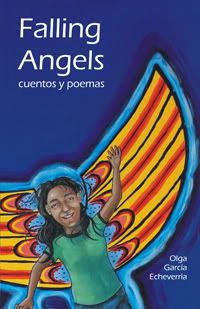
Falling Angels Goes On Sale Now

Falling Angels is a must-have for all readers of chicana literature!


Falling Angels now can be purchased from the publishers and from the author.

Calaca Press: PO Box 2309, National City, CA 91951, calacapress.com, calacapress@cox.net
Chibcha Press: tel: (716) 886-3499, chibchapress@delatierra.net
Olga García Echeverría: mariposa@datapillar.com

Distributed by Small Press Distribution: http://spdbooks.org

Order online at:
http://www.spdbooks.org/root/pages/serp.asp?Title=&Author=&Subtitle=Calaca&ISBN=&submit=Search

Tuesday, August 26, 2008

Review: Falling Angels

Angel lintel. Diego Rivera. Secretaria de la Educación Publica. DF. Foto Msedano.

Olga Garcia Echeverria. Falling Angels: Cuentos y Poemas. San Diego: Calaca Press, 2008. ISBN: 978-0-9717035-6-8/ $14.00+S/H / Perfectbound/ Flipbook (one side stories/one side poetry)/ 136 pages total. Cover and illustrations by Ricardo Islas.

Michael Sedano

Some readers are never satisfied, including me. When Calaca Press brought out its spoken word CD, “Raza Spoken Here, Poesia Chicana Volume 1” Olga Angelina Garcia Echeverria’s captivating reading of her “Meztli Chingona” and “Sonia on Hope Street” weren’t enough for this listener. I complained that a printed companion would have made “Raza Spoken Here” a perfect literary achievement. Garcia’s unique voice and characters stand out in a stellar collection.

Later that same year, 1999, when Calaca released “When Skin Peels,” featuring Elba Rosario Sanchez and Olga Garcia, the jewel case included a printed insert offering all of the CD’s poetry. I complained that the microscopic type size makes reading impossible without a magnifying glass. But what a completely satisfying experience, to hear these two poets and be able to follow along, as one might follow an orchestral score of a great symphony, just for the awe of watching its grandeur unfold.

Calaca, in conjunction with Chibcha Press, have now laid to rest those complaints. Their 2008 collection of Olga Garcia’s poems and stories publishes for the the first time those beautiful pieces from “Raza Spoken Here Vol 1,” and reprints in legible type with ample white space a substantial number of Garcia’s work from “When Skin Peels.” If you were fortunate enough to buy the CDs, both now out of print, you owe it to yourself to own Falling Angels so as to experience to the fullest Garcia’s arresting poetry and characters.

Falling Angels’ poetry is only half the story. Flip over the poetry book and read a handful of intriguing short fiction, much of it humor. The first story, “The Disappearance” offers a sad and multi-level account of its title event. A neighbor woman, somewhat the local harridan, mysteriously vanishes, her car found later abandoned. At the same time, a street person named Zelma has taken up daily residence at a bus stop. When the vendors attempt to run her off, Zelma fights them into a humiliating truce. When, one day, Zelma fails to appear, the mango vendor asks, “Who’s Zelma?”

There’s a saying about people who attempt to whitewash their identity. Such a person can put on airs, talk all fancy and dress muy mainstream, but one look at their indio face tells the whole story—you can’t escape who you are con el nopal en la frente. Self-denial is oft termed selling out, or vendido. To me, that’s too strong a charge and I prefer to designate such people as vencidos, gente beaten down into cultural submission. Garcia has a lot of fun with a story of one such fellow’s cultural redemption. A vencido returns home after an extended absence. His tía regañars him for being mean to his departed abuelo, mean to his suffering mother, and generally being a bad son. Nature treats him like a chicano-Mexicano Gregor Samsa. He is transformed into an enormous nopal. At first, the fellow grows a nopal en el frente. Literally. A cactus grows out his forehead, then tunas. Finally, the man has become a useful member of the community—his pencas and tunas are delicious.

The prose collection in Falling Angels includes a bizarre funeral in “Death of a Kleptomaniac” that highlights Garcia’s outrageous imagination, likewise her “Assault with a Deadly Donut.” One of my favorites, reprinted from The Calaca Review: La Revista Calaca, is Garcia’s hilarious “Ana Leticia Armendáriz: Matando cucarachas.” Readers will find great fun in reading “Matando cucarachas” in tandem with the poetic piece, “Conversation Between Two Dead Bilingual Roaches.” Do the rich offer roaches a better death?

Much of Garcia’s poetry work is just plain fun to read, “Lengualistic Algo,” being the best example. A hilarious, pissed-off satire offering gems of expression such as

I've already eaten the thin white skeletons
of foreign words
choked on the bones of Inglés Only,
learned the art of speaking in codes
and code switching,
learned to spit palabras
out of boca abierta
like bullets

More of Garcia’s work explores the poet’s image of a womanly ideal. Meztli, Mamá Azucar, and the unnamed persona of “Beso” offer up a “toda mujer” for whom the term “liberated,” seems so tame and misleading, but “nihilistic” perhaps dangerously misleading. I might heed MacLeish’s conundrum that poems should “not mean but be” and simply enjoy Garcia’s work. But I would love to have teenagers and young adults read and think about some of these women.

Meztli—full name Meztli Chingona—lives pura carpe diem, life to its fullest,

You turn the tide red
turn tough illiterate colos
into poets

Mamá Azucar has a scandalous reputation in the apartment house, drawing tsk-tsks of chismosas and object lesson of outraged morality.

Didn’t matter what Simón
or anybody else said
Mamá Azucar was the only woman
in the building who didn’t have a man
yelling at her

What Garcia suggests about woman’s freedom in apostrophe or third person takes its own voice in “Beso.” The kiss of the title is a metonymy for one woman’s life and choices, consequences be damned.

this kiss
tired of Sunday mass
and pleated skirts
has painted herself rojo
burning orange
bruised purple pressed
against cold mirrors
and warm faces

Consequences, indeed, lurk in the background—the bruised purple. Ultimately, nothingness resolves itself into mere existence, and for this woman, that seems to be more than enough.

she’s disappeared

but she comes back every time
like an endless mambo
a full grown woman
in bare shoulders and bangles
all fucked up and beautiful
dancing beneath a raining showerhead
cold water on hot skin
she steams
rattles
howls
splits herself open
like a ripe pomegranate

she breathes

Four poems titled “Vuelo” offer a counterstatement to those lives. The first Vuelo has a little girl daydreaming out the window of her mid-rise apartment. Her mother warns her against falling out—the vuelo of the title—but looking out into the urban landscape the little girl dreams that she would exit the window in flight,

They didn’t know it but
she had already fallen
226 times
. . .
her flight was always
slow
and elegant
body gracefully ascending
arms and shoulders opening softly
into wings

In the second “Vuelo,” Rosie, a woman who, perhaps having tired of the excesses of bare shoulders and bangles, or hopscotching kisses across shirt collars, has leapt to her certain death. In mid-vuelo Garcia recounts the woman’s instantaneous regrets. The powerful vision ends with a snapshot of her tumbling body seen from afar, she

Wanted to be
Blue silk
dress
fluttering
down
ward
clean
white
cotton
sheet
flapping
last
flag
of
surrender.

Vuelo three could be one of Rosie’s final thoughts.

she lost her memory in the wind
a cold gust of air swept
across her hair rose
danced like angry fuego
en el viento

The final Vuelo poema comes as a dirge, a eulogy, sung at Rosie’s funeral. Imagine a gathering of weeping gente and what will you tell the children? Should they, like Mamá Azucar’s neighbors, admire her from afar, not heed Simón’s warnings about “two kinds of women”? Should they live with abandon, “La party girl / who smokes mota / and drinks too much tequila” like Meztli Chingona? No. Find your own place, the mourners hear,

mujer sembradora
suelta semilla
lo que llevas sembrado
bajo tu lengua
entre tu pecho
en tu puño
abriéndose como flor
floreciendo
mujer suelta
las flores moradas
mariposas blancas
tan blancas
que llevas
suelta la mascara
échala al río

The answer is there is no answer, other than what remains when the woman sows her seeds and lets go her masks. Puro choice. Obviously, it’s futile to extract “meaning” from poetry, especially when the poetry offers such richness and insight as the twenty-two titles contained in Falling Angels. The answer, clearly, is contact Calaca and order copies for yourself and all your friends.

As I noted, some readers are never satisfied. My only complaint about Olga Garcia Echeverria's latest work is the fact so much is reprinted from earlier editions. Olga, I want to say, find a way to write more! Your friends may be all forgiving--Garcia notes in her "Thanks" page separating the poetry from the prose, "Gracias to my family and all of the artists and allies who throughout the years have supported my work . . . tolerated my long hibernations and encouraged me to grapple with my words and finish this book."--but readers don't need to forgive, they need to read! And we can read only when you write. Adelante, Olga, otra!


Kansas Chicana Chicano Poets Earning Notice.

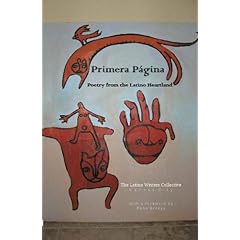
La Bloga friend Rigoberto Gonzales writes up the outstanding collection from Kansas City MO's Latino Writer's Collective, Primera Pagina: Poetry from the Latino Heartland, from Scapegoat Press, 2008. La Bloga reviewed the collection itself, in June. Note: the group's site seems to be broken right now. Here's the URL to their site: http://www.latinowriterscollective.org/anthology.htm

Here's an excerpt from Rigoberto's interview with Latino Writer's Collective portavoz Linda Rodriguez:

Although Latinos thrive in every part of the U.S., not just along the coasts, it always seems to surprise people that Latinos have a long history in the Midwest. A project like this is an excellent reminder of that relationship, and of how Latinos also contribute to the cultural life of the country's "heartland." Can you discuss the genesis and history of this collective and how this project came to be? Can you also speak to the decision not to name an editor?


As you mentioned, there have been strong Latino communities in Kansas and Missouri for a hundred years or more, but no one elsewhere seems to know about them. The Latino Writers Collective came about because there were no local Latino writers (and hardly any nationally known Latino writers) giving readings in the area. Two of our members, Jose Faus and Angela Cervantes, came together with the hope of forming a supportive group for Latino writers. The rest of us coalesced around that tiny core. We always had the same mission, articulated at a very early stage--to support each other's writing efforts, to provide role models and instruction for Latino youth, and to provide an opportunity for the diverse voices of the Latino community to be heard. Early on, we set up the first of what we hoped would be an annual reading series, and while we were still in the throes of trying to do that, we decided we wanted to do the anthology. That series was hugely successful and continues to grow each year, and our first anthology grew out of it. Hence its title, which, like that first year's series, is Primera Pagina.


Here's that link again to read the full interview.


Denver Convention Chisme.

Don't forget to send your fotos, chisme, news, views to RudyG. Rudy's posting the next two Mondays during Daniel Olivas' vacation in the piney woods and granite massives of northern Califas.


That's the view for the last Tuesday of August 2008. August 31 marks my wife's 40th wedding anniversary to her first husband. Since I got married on my birthday, when next you hear from me, I'll be a year older and working on number 41. Tempus fugit. Yo! hymen hymenaeus. See you next week.


La Bloga welcomes your comments on this or any column. Click the Comments counter below right to leave your observations.

If you'd like an opportunity to do a guest column at La Bloga, please click here for details.