Showing posts with label call for submissions. Show all posts

Tuesday, June 02, 2015

La Palabra Wraps May. Muralists of LA. On-line Floricanto Welcomes June. Submissions & Notes

5th May Sunday Brings La Palabra to Avenue 50 Studio
Michael Sedano

La Palabra hosted by Karineh Mahdessian ordinarily brightens the fourth--the final--Sunday of every month, but because May 2015's calendar quirk brought a fifth Sunday, La Palabra bided its time until the fifth, final, Sunday.

Dynamic hostess Karineh Mahdessian confessed to butterflies fifteen minutes before the two o'clock curtain. She looked across the empty main gallery of Highland Park's Avenue 50 Studio and saw an empty circle of chairs.

As La Palabra has proven year after year, month after month, people thronged through the front and side doors and by 2:00, Mahdessian was smiling broadly at the full house. Mejor, as the reading progressed, the house added visitors until La Palabra became an SRO event.

Featured Poets: Jenuine Poetess and Thelma Reyna

Tempus fugit! One of the featured readers, Jenuine Poetess, was on her way to LAX to board a flight to Italy. The ticketed passenger motivated the on-the-dot start.


Jenuine Poetess wrapped her reading and headed out the door toward her 100 Thousand Poets for Change event in Salerno. The next global 100TPC event comes in September. More information, and sign-ups here.

The second featured poet, Thelma Reyna followed the as-always fully subscribed Open Mic.

Reyna, Poet Laureate of Altadena, recently launched her ALTADENA POETRY REVIEW: ANTHOLOGY 2015. Reviewer Carol Davala observes, "This well-rounded book showcases work representing a broad spectrum of poetic style and subject matter, and it includes details indicative of spanning generations, cultural diversity, and a special blend of topical life experiences. From traditional formats to free-flowing verse, rhyming acrostics, elemental haiku and tankas, the poetic voices illuminate childhood memories, observe modern technology, and reflect on nature for both its beauty and consequences." Here's a link to the full review.


Thelma Reyna knows how to hold an audience. Today's reading threaded her work with a running commentary focused on a poet's sources of inspiration. She transitioned between readings telling biographical stories, current events items, and other material that lent her compositional urgency.


Among the places a poet finds poems is familia. Victor Reyna, Thelma's husband, beamed throughout the reading, knowing first-hand the sweat and tears that produced the works that Thelma reads so effectively, as if the poems were writing themselves in the moment.


Open Mic Frequent Guests and a Debut

Poetry at Avenue 50 Studio is a regular event, with La Palabra and the Bluebird series. The Open Mic sign-up fills quickly with local poets as well as visitors to the region making their first time presenting in Highland Park. 

Given the relaxed atmosphere, many sign with only their first name. Some poets arrive while the reading is in progress, or do not sign up yet elect to join the readers on-the-fly.

Karineh Mahdessian watches the time carefully but generously finds space for readers not on the list. "Anyone want to read?" The hapless photographer is left high and dry by that, able to create an image but unable to ID some readers.

Ni modo; among the frustrations of a poetry foto essay is being unable to share the poems themselves, so what's one additional frustration? Lacking the poet's name, or last name, simply adds to the reasons to attend the next poetry event at Avenue 50. 


Left to right, top-bottom: Don Kingfisher Campbell. idi. Jackie. Art. Mahdessian insisted Art
return with his gut-strung guitar to play a bit of Bach.

A fabulous reading about the poet's notches on a bed post entertained.
Mira Mataric. Poet in a black shirt works from memory. Briony James.

Among the pleasures of an Open Mic, a debut! Marsha Oseas shares her first public reading.

Seven, Brian Dunlap, energetic G T Foster uses the full area; an unidentified gentleman.


Prof Jonathan Vos Post, like Foster, used the space available to maximum advantage. His Space Shuttle necktie
mirrors his subject, the ghost in the machine.

Victor, Vos Post, Pauline Wiland, C E Jordan

C E Jordan invites gente to an upcoming poetry event
Photography note: ISO3200, plus 2 stops against the bright windows produces acceptable images, most 1/50 f/5.6. The seating circle creates challenges for photographer and poets. Reading from one's seat severely limits the effectiveness of text-bound readers. The photographer leans and twists to capture near-by readers. All-in-all, such a setting is fun.


Fabulous Mural Event Features Stellar Artists
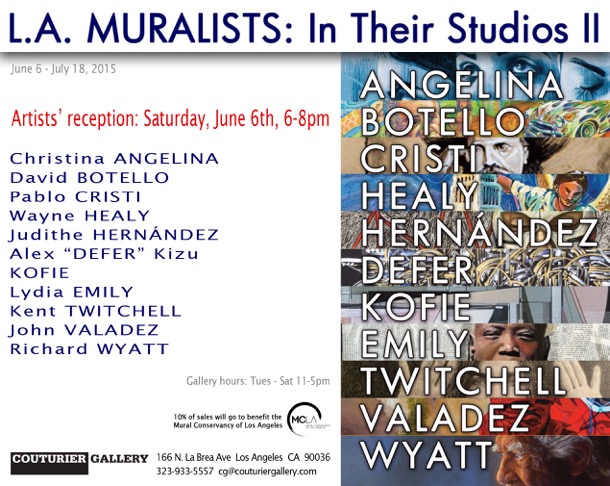

La Bloga friend, Isabel Rojas-Williams, Executive Director of Mural Conservancy of Los Angeles (MCLA) sends the following:

It would be wonderful should you be available to join us at Couturier Gallery for "L.A. Muralists: In Their Studios ll," an exhibition showcasing pioneer muralists, mid-career, and emerging artists, thereby giving a new generation of artists the opportunity to connect with some of LA’s most prominent public artists. 

10% of the proceeds will benefit The Mural Conservancy of Los Angeles. Looking forward to seeing you there & thank you for your support!

What: L.A. Muralists: In Their Studios ll

When: June 6th, 6-8pm (opening reception)

Where: Couturier Gallery, 166 N. La Brea Ave, LA 90036

Who: Angelina Christina, David Botello, Pablo Cristi, Wayne Healy, Judithe Hernández, Alex "Defer" Kizu, Kofie, Lydia Emily, Kent Twitchell, John Valadez, and Richard Wyatt


Sixth Month's First On-line Floricanto
Francisco X. Alarcón, Carl Allen Begay, José Hector Cadena, Ángel Mario Escobar, Sam Hamod, Briana Muñoz, Sharon Elliott


With Father's Day an upcoming June ritual, today La Bloga-Tuesday happily celebrates the first of two On-line Floricantos. The Moderators of Poetry of Resistance: Poets Responding to SB 1070, led by peripatetic poet Iris de Anda, nominate seven poems to launch the pair of June On-line Floricantos.


POETA MACEHUAL*
por Francisco X. Alarcón

soy un poeta
macehual, seguidor
de mariposas

un trovador
sin corte, sin cuartel
que anda a pie

por los senderos
sin caminantes fuera
de los linderos

mi voz es flor,
canto silvestre libre
como el rocío

la Luna de abril
es mi madre del cielo
que me bendice

el río revuelto
que un huracán desata
es hermano mío

soy un poeta
hacedor de versos
de vida y lluvia

sin otro templo
que la cima del monte
bajo el Sol

mi cara la hallo
en las caras y sonrisas
de mi gente

soy un poeta
macehual, seguidor
de mariposas

sin otro techo
que el cielo raso
lleno de estrellas

mi bandera es
blanca nube del cielo,
paloma de paz

el mundo entero
-ya sin fronteras- es
mi casa y solar
* Macehual: término náhuatl (azteca) para la gente común que forma la mayoría del pueblo y cuya labor constituye el meollo vital de la sociedad.


MACEHUAL (COMMON FOLK) POET
by Francisco X. Alarcón

I am a macehual
poet, a follower
of butterflies

a troubadour
with no court or quarter,
a hiker on foot

trekking paths with
no other walkers, beyond
well travelled ways

my voice is a flower,
a wild song free
like the dew

April’s Moon is
my mother blessing me
from the sky

the unruly river
a hurricane brings about
is my own brother

I am a poet,
a wordsmith of verses
for life and rain

with no other temple
than the mountain summit
under the Sun

I find my face
on the faces and smiles
of my people

I am a macehual
poet, a follower
of butterflies

with no other ceiling
than the open sky
full of stars

my sole flag is
a white cloud in the sky,
a dove of peace

the whole world
-already borderless- is
my home and backyard
Macehual: A Nahuatl (Aztec) term for the common folk, the bulk of the people, whose labor constitutes the vital core of society.

FOWK POET
Francisco X. Alarcón

am a fowk makar,
a follaer
o butteries

a fowk singer
wi nae coort or quarter,
a traiker on fuit

traikin peths alane,
ayont
weill-traikit weys

ma vice's a flooer,
a wull sang lowse
lik the deow

Aprile's muin's
ma mither sainin me
frae the lift

the gurly watter
blowster steert
is ma ain brither

am a makar,
wrochtin verses
fir life an weet

wi nae ither tempel
than yon muntain peen
unner the sin

a fin ma neb
in aw the smiles
o ma ain fowk

am a fowk makar,
follaer
o butteries

wi nae ither ruif
nor the apen lift
fou o sterns

ma yin flag's
a fite clud i the lift,
a doo o Pace

the hail warl
-a'ready mairchless -
is ma hame, ma back coort
Scots translation by John McDonald


Modern Day Warrior
By Carl Allen Begay - Navajo Nation - Nakai Dine/Tahnezahi Clans.

I am a modern day warrior
from the Navajo Nation 
I am
living and surviving
the holocaust
on my people
the Indigenous People 
of Turtle Island 
aka America 
We have survived 
in spite of all 
the tactics 
by the u.s government 
and all political corporate bullsh*t 
of this country
We will not be wiped 
off the face of this earth. 
We are here 
with loud voices
strong hearts
strong minds
strong bodies
strong spirits. 
We are still here
and 
We Shall Remain. 


Cruzando 
Por José Hector Cadena

¿Qué estrategias existen para calmar las ansias que surgen
cuando el border agent me cierra la reja?
Me hubiera comprado una nieve de limón pero
es demasiado tarde para buscar un alivio frío azucarado
no hay remedio más que esperar en mi carro encajonado
entre cámaras y letreros y perros enloquecidos por encontrar droga,
todo esto es un juego para ellos, un juego

Con la música de la radio me tranquilizo y me doy cuenta
que tal vez deba practicar la paciencia,
pronto regresará el borde agent de llevar a otro sospechoso
al secondary inspection a que le pregunten de todo y de más

Al abrirse la reja, el border agent me señala que me arrime
y pregunta de donde vengo, porque fui, que traigo, en un tono
que intenta hacerme sentir desposeído, pero al ver que no
me tiembla la voz, sigue a inspeccionar mi carro, revolviendo y
azotando con un tubo de metal, tap, tap, tap,


An Apology to My Children
By Ángel Mario Escobar
In the distant sleep
bodies I love
rest underneath
an old Amate tree
I smile
to ease
my broken
years
thirty-six
familiar
needles
knitting
histories
across borders
leaning on
secret tears
my children
know nothing of
Salvadoran rezos
prayers that won't give up
a long journey
echoing desperate footsteps
back in Morazan
a lineage crackling
like dry leaves
a child crying out for help
leaping red puddles
Now opening doors
so that tender kiss
can be passed on
to his children
who demand
to know
why daddy
mourns
while he
gazes
at the
deep
sea


What Shall We Say Today: What Shall We Do Today  
By Sam Hamod

what now
can we say
about israelis...
who shoot young girls
or young soccer players
      just for fun—
and what is worse,
they get away with it
not only that,
but
what can we say
about America
or
the americans who
support these atrocities,
whose government
gives money freely
to Israel,
while letting americans
go hungry,
go malnourished
lets cities go bankrupt
      while their citizens still pay taxes
      to this same government
      that doesn’t care about them
what can we say
to a world
that allows this to go on
day
after day
after day
after day  after day
while the world
looks the other way,
while the American president
preaches peace and justice, but
closes his eyes to these killings,
these brutalities,
who ignores it when Israelis
kill innocent American kids
who go to Palestine
to help
in humanitarian ways
  what are we to say,
what are we to think,
what are we to feel,
are we to love Israel?
are we to love our
corrupt u.s. government?
are we to stand by
and let this evil continue?
shall we let ignorant alleged pastors,
lead ignorant people to love
this Israel that commits these crimes?
this is a day
we should all stand up,
this is a day
we should all write in protest
this is a day
we should all work and pray for justice
in a world gone mad,
in a world in the hands of devils,
especially those who run Israel and America 
What Shall We Say Today: What Shall We Do Today
what now can we say about israelis... who shoot young girls or young soccer players just for fun—and what is worse, they get away with it
not only that, but what can we say about America or the americans who support these atrocities, whose government gives money freely to Israel, while letting americans go hungry, go malnourished lets cities go bankrupt while their citizens still pay taxes to this same government that doesn’t care about them
what can we say to a world that allows this to go on day after day after day after day after day
while the world looks the other way, while the American president preaches peace and justice, but closes his eyes to these killings, these brutalities, who ignores it when Israelis kill innocent American kids who go to Palestine to help in humanitarian ways
what are we to say, what are we to think,
what are we to feel,
are we to love Israel?
are we to love our corrupt u.s. government?
are we to stand by and let this evil continue?
shall we let ignorant alleged pastors, lead ignorant people to love this Israel that commits these crimes?
this is a day we should all stand up, this is a day we should all write in protest this is a day we should all work and pray for justice in a world gone mad, in a world in the hands of devils, especially those who run Israel and America


Raíz     
By Briana Muñoz
      
You tell me that my scars are hideous.
I respond by saying “Hideous, tu madre.” 
You formally inform me, in a Times New Roman letter 
That my school work is “below average” 
I ask you, “And exactly what is your definition of average?”
     
You laugh at the music blaring out of my 
’93 nearly broken down pick-up truck
Rusty paint, chipping away like the old folks at the country club
But my music,
     
My music es de mi papá
This music represents beautiful colored women
In beautiful colored dresses
Multicolored ribbons
Floral head pieces
     
Canciones del país de mis abuelos
México Lindo
What my nana calls it.
    
So please, continue making fun
Of her thick Spanish accent
While you sit there
Ordering wet burritos and carne asada fries
From the Mexican food restaurant 
Down the street from the multi-million dollar houses
In Del Mar
       
Because my culture is pinche beautiful
And so is my abuelita in her plaid mandil and sweaty forehead
And those mariachi lyrics I yell out proudly
Beautiful are my dark eyebrows which you make fun of
But I know they were passed down from my hard working mother
My culture is pinche beautiful; I refuse to allow you to tell me otherwise.


Violent Domesticity
by Sharon Elliott

what is it
they want
when they break a woman

wring her eyes dry
into a room
no bigger than a shotglass

carve her bones
into
a leftover casserole

sift her blood
into a bend
in the river

gag her
with her
own tongue

it must be
nothing
a momentary leap of groin

a game of tag
with eternity
theirs not hers

or maybe
the only something they can feel
is her suffering

through their
hands
her heart is broken

pumps only
at their whim
from its place underfoot

a power
so intoxicating
they refuse her escape

keep her breath
in a box
by the fireplace

like a match
to burnish
the night
Copyright © 2015 Sharon Elliott. All Rights Reserved.

Meet The Poets
Francisco X. Alarcón, José Hector Cadena, Ángel Mario Escobar, Sam Hamod, Briana Muñoz, Sharon Elliott

Francisco X. Alarcón, award-winning Chicano poet and educator, was born in Los Angeles, grew up in Guadalajara, Mexico, and now lives in Davis, where he teaches at the University of California. He is the author of thirteen volumes of poetry, including his most recent books, Canto hondo / Deep Song (University of Arizona Press 2015) and Borderless Butterflies / Mariposas sin fronteras (Poetic Matrix Press 2014). He is also the author of six acclaimed books of bilingual poems for children on the seasons of the year originally published by Children’s Book Press, now an imprint of Lee & Low Books. He is the founder the Writers of the New Sun community in Sacramento and also the creator of the Facebook page “Poets Responding to SB 1070.”

Jose Hector Cadena is a writer, poet, and collage artist. He grew up along the San Ysidro/Tijuana border. VONA fellow 2014, Jose’s work can be found in Cipactli, Transfer Magazine, Pacific Review, and more. He currently teaches at San Diego State University and Southwestern College.


Mario A. Escobar (January 19, 1978-) is a US-Salvadoran writer and poet born in 1978. Although he considers himself first and foremost a poet, he is known as the founder and editor of Izote Press. Escobar is a faculty member in the Department of Foreign Languages at LA Mission College. Some of Escobar’s works include Al correr de la horas (Editorial Patria Perdida, 1999) Gritos Interiores (Cuzcatlan Press, 2005), La Nueva Tendencia (Cuzcatlan Press, 2005), Paciente 1980 (Orbis Press, 2012). His bilingual poetry appears in Theatre Under My Skin: Contemporary Salvadoran Poetry by Kalina Press.


Sam Hamod is an internationally awarded poet, nominated for the Nobel Prize by Carlos Fuentes and for the Pulitzer Prize by Ishmael Reed and Ray Carver; he has published15 books of poems and runs the websites, www.contemporaryworldpoetry.com
and www.contemporaryworldliterature.com     He  has a Ph.D from the Writers Workshop and has taught at the Univ of Iowa and at other leading universities in America and overseas. He may be reached for readings, books and lectures at:   drsamhamod@gmail.com


Briana Muñoz is a writer from San Marcos, California. She is a full time student and enjoys writing about what she observes around her on her free time. She writes fictional short stories, creative non-fiction and poetry. Briana is striving to publish her works some time in the near future.


Born and raised in Seattle, Sharon Elliott has written since childhood. Four years in the Peace Corps in Nicaragua and Ecuador laid the foundation for her activism. As an initiated Lukumi priest, she has learned about her ancestral Scottish history, reinforcing her belief that borders are created by men, enforcing them is simply wrong.

She has featured in poetry readings in the San Francisco Bay area: Poetry Express, Berkeley, CA in 2012 and La Palabra Musical, Berkeley, CA in 2013.

She was awarded the Best Poem of 2012, The Day of Little Comfort, Sharon Elliott, La Bloga Online Floricanto Best Poems of 2012, 11/2013, http://labloga.blogspot.com/2013/01/best-poems-of-2012.html


On-line Poetry Anthology: Chicanas en Italia


In her column Monday,  Xánath Caraza announced the publication in Italy of seven Chicana poets. Here's a YouTube that includes readings of the works, in Spanish and translated into Italian.

The cover arte is by noted Chicana artist Pola Lopez. Pola's Los Angeles studio shares space in Avenue 50 Studio.


Submissions
Razorhouse Magazine


Now There Is One


Once there were two Raza-Centric Writers Conferences. With the suspension--or demise--of the National Latina Latino Writers Conference formerly hosted by the National Hispanic Cultural Center in Albuquerque NM, only the East Coast iteration remains, the Comadres and Compadres Latino Writers Conference in New York City.

Offering workshops, camaraderie, keynote addresses, comida, and, most importantly, individual interviews with influential gente in the publishing industry, the 4th annual conference helps open the door that quality work keeps open.

Click here for registration datos.

Tuesday, May 12, 2015

La Bloga News ‘n Notes

Michael Sedano

This second week of 2015's only May brings bustle and last-minute hustle for gente only just now finding out about a reading, a conference, or a conjunto. A pair of calls for submissions open now or soon and have long-opened windows of opportunity.

The weekend conference at Cal State LA--the one in El Sereno--promises invigorating panels and interesting teatro. The grandchildren of los de abajo have Ph.D.s now, and are studying their antepasados from interesting points of view. The conference is free but parking is fee.

Here are notes from a variety of La Bloga friends' emails for this week.


Late-breaking news
Librería Martínez Hosts Santiago Vaquera-Vasquez

The author presents his new book of cuentos, the first in English, One Day I'll Tell You the Things I've Seen (UNM Press, 2015), in Santa Ana California.


Libreria Martinez Books & Art Gallery is still at 216 N Broadway, Santa Ana, CA 92701
Phone:(714) 954-1151. The organization now exists under the umbrella of Chapman University.


Call For Submissions
“Pariahs: Writing From Outside the Margins” anthology

Editors Mónica Teresa Ortiz and Sarah Rafael García invite creative non-fiction, prose, poems and short stories up to 4,000 words or a maximum of three poems. All submissions will be read blind; thus, your name or contact information should only appear on your cover letter. Please submit previously unpublished work only. We accept simultaneous submissions, but please notify us as soon as possible should your work be accepted elsewhere.

The theme for this anthology is “Pariahs.” We encourage submissions that provoke thought or discussion about this topic from the writing perspective and address one of the following questions: as a writer, have you ever felt left out and expected to only write from the place where you stand (specific to gender, sexual orientation, race, ethnicity, geography, education, etc)? Has academia, such as the MFA experience, limited you and your perspective? Have you been left out from “mainstream” literature or the writing industry? Do you feel silenced as a writer?

We require a $5 submission fee. Call for submissions runs from May 31st through September 1st. Submissions will be accepted through Submittable. The Submittable link is scheduled for activation on May 16.

Please email the editors at  pariahsanthology2015@gmail.com with any questions.


Mónica Teresa Ortiz was born and raised in Texas. Her work has appeared in Bombay Gin, Sinister Wisdom, Huizache, Pilgrimage Magazine, Paso del Rio Grande del Norte, Borderlands, As/US, The Texas Observer, Autostraddle, and Black Girl Dangerous. A two-time Andres Montoya Letras Latinxs Poetry prize finalist, Ortiz is the Poetry Editor for Raspa Magazine, a Queer Latinx literary art journal.


Sarah Rafael García is a writer, community educator and traveler. Since publishing Las Niñas in 2008, she continues to share her passion by founding Barrio Writers and hosting Wild Womyn Writers workshops. Her words have been featured in Connotation Press, EXSE Spoken Word Showcase, Label Me Latina/o, La Bloga, Brooklyn & Boyle, LATINO Magazine, Santanero Zine, Flies, Cockroaches and Poets, IN MY BED Magazine, E4rth is my Flesh Zine and has a forthcoming publication in theContraPuntos III anthology. Sarah Rafael is the Editor for the Barrio Writers annual anthology.


Call For Submissions
Origins Journal Seeks Shame


Origins Journal explores the narrative arts through the lens of identity. We’re interested in distinct voices. Writing that tells us something about a character's roots or what makes her unique. Stories that transport us across town and country, beyond and within borders both physical and abstract, to discreet moments that change or define us. We publish poetry, prose, translation, interviews and flash fiction. Our fall issue will focus on the theme of shame. For full guidelines, visit us here: http://www.originsjournal.com/submit/.


Free Conference
Cal State LA Hosts Conference on Mariano Azuela and Novels of the Mexican Revolution


from the event's website: Mariano Azuela (Lagos de Moreno, Jalisco, 1873-1952) was a medical doctor by profession and by mid-century one of Mexico’s leading writers. The author of novels, plays, biographies, and literary criticism, Azuela served as field doctor under Francisco Villa during the Mexican Revolution and, after Villa’s military defeat, published Los de abajo (The Underdogs) while in exile in El Paso, Texas. This conference on Azuela commemorates the first centenary of the publication of Los de abajo (1915) and aims to trace its narrative affiliation to twentieth-century autobiographies, memoirs ,and, more specifically, narratives of the Mexican Revolution.

Click here for the details of this event.


SanAnto Conjunto Festival Kicks Off With Seniors Dance

Check the organizer's website for contact information to attend the kick-off event, a dance for senior citizens featuring Tim Rodríguez y Oro de Tejas (San Antonio). The major musical happenings are Friday through Sunday.

Scheduled at the reasonable hour of 10 a.m. to noon, the dance--free for seniors--is Wednesday, May 13 at Guadalupe Theatre. 

Go to the Guadalupe site for the full schedule.

Saturday, November 02, 2013

Diversity a food group best served frío


I'm supposed to eat from each of the food groups, not just meat and chile. When I get an apple or carrots, I can feel I met the obligation. Americanos very often treat Chicanos, and latinos in general, the same way. As if brown people were part of the Colored Diversity Food Group, consisting of ALL non-white people. Call it a white potatoes, Anglo-centric worldview.

If you're in the middle of this Anglo-centric world, then EVERYBODY else is the Non-Anglo Other; it's you on the one hand and all THEM on the other. If the producers of a TV program want to appear to be culturally "sensitive" to a multinational audience, they'll assume that including one "colored" character from the "diversity group" fulfills that obligation. Not so.


What about latinos on SNL?

In an AP article yesterday, the topic was the lack of black female comedians on Saturday Night Live.
One of the shows white-male comedians explained this: "The producers never find ones that are ready.” NOTHING was explained about the lack of latinos, although the article's author, David Bauder, did at least mention, "There has often been criticism through the years that late-night comedy in general is a boy's club, particularly a white boy's club. There aren't any Asians or Hispanics on the show either, male or female."

The fact that the SNL comedians and producers never talked about latino comedians is one example of the Diversity Food Group mentality--they didn't need to because talking about blacks fulfilled their Diversity Food Group obligation.


US latino lit NO must-read?

At Esquire magazine, you can read the "Greatest Books Ever Written" list of The 80 Books Every Man Should Read. It's described as, "An unranked, incomplete, utterly biased list of the greatest works of literature ever published." [my emphasis] To my knowledge, none of the 80 include a female, which would obviously be part of their sex-biased mentality.

Black male writers Ralph Ellison and Richard Wright are on the list, but not one U.S. male latino is included. Jorge Luis Borges is the only latino. (It's strange that Nobel Prize winner Gabriel Garcia Marquez didn't make their cut.) In this case, using the Diversity Food Group guide, I assume Esquire's thinking was, "We got one South American latino; that'll cover U.S. latinos, too."

Esquire should've read the words of Anglo author Russell Banks, included in their list: "I accepted that I was obliged to have African American friends. I was obliged to address deliberately the overlapping social and racial contexts of my life. I'm a white man in a white-dominated, racialized society; therefore, if I want to, I can live my whole life in a racial fantasy. Most white Americans do just that. Because we can. In a color-defined society we are invited to think that white is not a color. We are invited to fantasize and we act accordingly." Esquire's list is a great example of such "living in a racial fantasy."


No kids' latino classics?

Seems like some of the Anglo-centrics just won't give a latino a break. Speaking of racial fantasies, check out The New York Review of Books Children’s Collection, described as "Time-honored classics for children of all ages." [ages 3-14] It's for children of all ages, if you exclude any "colored" kids and you believe that Anglo kids don't need to realize they live on a multi-racial, multinational planet.

Of course there are authors from England--lots of them--but not one First Voice latino, author or book, from any continent. Using the Diversity Food Group paradigm, I suppose they think they filled their obligation to broadening children's horizons by the couple of Asian-themed books. Is there even one about blacks or indios?

So the next time you need an example of how biased U.S. publishers are, you can use NYRB to make your point. NOT one latino, Chicano, puertoriqueño, mexicanos author or book deserves to be considered "a time-honored classic for children of all ages."


Nerds of Color

Better than the Diversity Food Group approach, a post that I quote at length contains a rich set of information about diversity in spec lit. It has much more material that deserves checking out. La Bloga is mentioned.

On his website, latino Daniel José Older explains how he put together a "round table of writers and editors to imagine an anti-oppressive SFF community at Strange Horizons." It's called Set Truth on Stun: Reimagining an Anti-Oppressive SF/F.

He reports about his #DiversityInSFF hashtag "to the longstanding, often-ignored, ever-trolled, much-needed convos about race and gender, privilege and science fiction/fantasy that have been going on since the dawn of time. For a few weeks Twitter was all aflame with debates, links and related shenanigans. Backlash against those who speak out has come in the form of death and rape threats, hate mail, doubling down on sexist-racist-homophobic-ableist material, and mind-numbingly nonsensical counter-arguments. [my emphasis]

"In a recent Guest of Honor speech at the Continuum convention in Sydney, Nora Jemisin said: "we must now make an active, conscious effort to establish a literature of the imagination which truly belongs to everyone.

"I asked a group of writers, editors, and publishers to imagine in both practical and fantastical ways what the SciFi and fantasy community would look like if it was actively anti-oppressive. This conversation took place over email in August 2013."

"Most notably, Tor added an explicit diversity statement to their submission guidelines. [Tor is a major US spec publisher.]

"As always, there have been precious, panicked pleas to avoid quotas and to remember the importance of quality, as if a demand for diversity is synonymous with a higher tolerance for mediocrity. These pleas arise any time the marginalized demand to be heard and those making their needless pleas realize the status quo is about to change.

"What does it say about writers that it is easier to imagine creating an alien species and alien worlds than it is to create a non-white and/or heterosexual and/or male and/or differently abled and/or working-class humanoid character in a non-Western setting?

"We see such reticence to approach difference in fiction, across genres and it is, in part, understandable but it is also a bit offensive, this notion that underrepresented people are so different and mysterious, so far from the dominant understanding of normal, we dare not even try to write their experiences."

Daniel José Older is author of the latino spec collection Salsa Nocturna. He’s co-editing the anthology, Long Hidden: Speculative Fiction From The Margins Of History [submissions now closed].


Diversity submissions wanted

From their website: "We encourage diversity in publishing: authors are chosen regardless of sex, gender, race or ethnicity. Non-US authors, or authors who usually work in a different genre, are also welcome.

Flash: Stories of less than 1,000 words.
Short Fiction: Stories of 1,001 to 2,500 words.
Poetry: Any length.

Diversity call for spec subs

From Twelfth Planet Press comes this: "The beautiful Kaleidoscope backers have pushed us over the $7k mark, and we are now open to submissions! Please send us your stories, and/or tell your writer friends about us. We are interested in seeing stories from anyone at all, and we’re especially looking forward to seeing submissions written by people whose voices tend to be underrepresented."

From Arte Público Press


Will the Taco win?

It seems today is Esquire's day on my chopping block and not even our food gets a break. (Thanks for the material, boys.) Continuing with the food group theme, in the article Why The Taco Cannot Win, Josh Ozersky writes:
"At least three times a year somebody announces that fast-food tacos are an all-conquering force; or, "For American Restaurant Chains, the Future Is Mexican." While this may well be true in terms of their hiring practices, it's not so in any other way and never has been. Not in even the most dystopian of food futures will tacos ever be our dominant foodstuff. [my emphasis]

"Fast-food tacos are cheap, because they are made from sawdust and beef drippings. Mexican-themed chains do a very lucrative volume business. All Mexican-themed restaurants do; the format offers the greatest profit potential this side of organ harvesting.

"But that doesn't make it food. In a country where 47 million people are on food stamps, a lot of people are feeding their families on hamburgers, which are still the most wholesome of all fast foods, in my opinion."

Ozersky sometimes tries so hard to be funny and cute that he steps in some of his own "sawdust and beef drippings." Dumping on Taco Bell is like kicking the crippled kid. But in expressing his opinion, he Anglo-centrically manages to trash Mexican food, restaurants and the loyal customers of such places, us. He'd do well do read Gustavo Arellano's Taco USA: How Mexican Food Conquered America. And then go eat a taco.

Es todo, hoy,
RudyG

Saturday, April 23, 2011

Houston the Texan & Houston the author

Tejanos Unidos!


If you're from Texas, like me, you received a public school indoctrination, practically from the delivery room through graduating from high-school, in one version of the history and culture of the state. Their version. The website tejanosunidos.org aims to correct dominant, Anglo historical revisionism with facts, facts, facts. Here's info from their homepage:


"Hola! Bienvenidos a Tejas!" (Hello! Welcome to Texas!) That is how our Spanish Mexican ancestors welcomed Anglo U.S. citizens who first moved to Texas. The second part of the greeting was: "Mi casa es su casa!" (My house is your house.) The only problem is that our ancestors didn't think the Anglos would take the offer so seriously.


"Tejanos Unidos is committed to preserve early Texas history. We have a great story to tell. We are Tejanos (descendants of the first Spanish Mexican citizens of Texas). Our Roman Catholic Tejano ancestors established thriving communities from Louisiana to the Rio Grande from the Gulf of Mexico to the San Elizario area in West Texas where the First Thanksgiving in the U.S. was celebrated in 1598. These early settlements include the early communities of Los Adaes, Nacogdoches, Bexar (San Antonio), La Bahia (Goliad), and the communities of the Villas del Norte on the Lower Rio Grande.


"Modern-day Spanish-surnamed people whose ancestors originated in Texas, New Mexico, Arizona, Colorado, California and other parts of the U.S. Southwest are the product of the strong inter-marriage between the Spanish and the Native American people. We are united by our Spanish names and language, as well as a common heritage that is bonded by both Old World and New World characteristics. Additionally, many Tejanos have Anglo, French, Italian, Irish, German, and many other non-Hispanic names. Our extended family runs deep into Central Mexico, since that is where our ancestors came from. Like the "coat of many colors", we are united in our "keep it simple" purpose. That is, to re-discover and share pre-1836 Texas history.


"The more that Spanish Mexican descendants learn about their lost history, the higher their self-esteem. The more that others learn about early Texas history, the more they will see that "Texas history without Tejanas and Tejanos is like a story with no beginning".


Their website contains an extensive listing and summaries of books on state history, bios of tejanos that played significant roles despite Anglo dominance, and other materials.

______


The truth about the Battle of San Jacinto


If you go to another site, for the Rio Grande Guardian, you can search for the Wed. March 16, 2011 article about historian and civil rights activist José Antonio López, a member of Tejanos Unidos, where he takes "exception," to a Texas state senator's jingoism about "remembering the Alamo." As Lopez states, "It’s time to stop using ‘Remember the Alamo’ slogan." Turns out, Sam Houston didn't lead any great cavalry charge against Santa Ana's army. Plus, there's more. I love it when the truth comes out.

________


Call for Submissions


The publishers Heyday are looking for first-rate fiction or nonfiction written by an emerging author. Friends and family of the late Santa Cruz author James D. Houston have established a fund to honor his memory and further his legacy. Known as a masterful writer in both fiction and nonfiction genres, Houston was also a dedicated teacher and passionate promoter of emerging authors. The James D. Houston [no relation to the Texan] Legacy Fund will support publication of books by writers who reflect Houston’s humane values, his thoughtful engagement with life, and his literary exploration of California, Hawaii, and the West.


The first James D. Houston book will be published in the fall of 2012, and the writer whose manuscript is chosen will receive a $5,000 advance upon submission of a mutually acceptable final manuscript.


The fund will be administered by Heyday, a 501(c)(3) nonprofit publisher, which will publish one book per year in honor of James D. Houston. The following are examples of the types of manuscripts we are looking for: novels, literary memoirs, creative nonfiction (book length or collection of essays), short story collections. The editorial committee especially favors works by emerging writers (this would be his or her first or second published book). Works with a California focus would play best to Heyday’s strengths.


To submit a manuscript for consideration, please mail a hard copy of the following to Acquisitions—James D. Houston Legacy, Heyday, P.O. Box 9145, Berkeley, CA 94709:

• a cover letter (concrete ideas and opportunities for the promotion of your book would be appreciated; please include an email address if you want us to acknowledge receipt of your proposal);

• a summary and outline (especially for collections of shorter pieces) of the project, including estimated word count(s);

• an excerpt of the proposed manuscript not to exceed thirty pages (double-spaced, standard font and font size);

• a CV, especially listing previous publications;

• a SASE to notify you if our decision. (Please include the necessary postage if you want your materials returned to you; otherwise, our policy is to recycle proposals that do not meet our needs.)


Submissions are due by June 1, 2011. There is no entry fee. Decisions on publications will be made collegially by Heyday’s publisher, Malcolm Margolin, by the Houston family represented by Houston’s wife Jeanne Wakatsuki Houston, and by friends of the late author. If we are interested in a full manuscript, we will contact you by July 15, 2011. Please, no phone calls or emails.