|
| Kathleen Alcalá |
Alcalá’s words
“convincingly move the reader from one reality to the other. Her craft
illuminates the souls of her characters: the Mexican women who carry the
universe in their hearts," says author Rudolfo Anaya. Kathleen's work takes
readers to “a world where one would like to stay forever” (Ursula K.
LeGuin)."
Her following bio provides a non-macho perspective to both latino and speculative literature.
This is great stuff--una escritora diversifying the no-female-heroines worlds of Lord of the
Rings and the Star Treks.
Science Fiction and Me
by
Kathleen Alcalá
1.
When I was five, I knew how to read. Outside was a vast starry sky at night,
and at times, a California condor by day. It looked like a small airplane. We
did not know it was one of the last, come inland to cruise the thermals. The
wind blew constantly through Cajon Pass, and earthquakes reminded us how small
we were. It was not a prehistoric landscape, but it was mindful of its pre-history.
One night, someone showed me a snowy owl in a palm tree, well out of its
territory, and another night, I watched a mole with glistening fur dig itself
out of the ground.
Inside,
were things I could see without difficulty – crayons and paper, postcards from
my aunt, and then my aunt herself, my older sisters who came home from school
speaking English. I attended a two-room schoolhouse with all grades divided between
them. When I was six, I discovered the Bookmobile and checked out a set of Dr.
Seuss books. My picture was in the paper, a skinny brown girl with messy
braids. “I feel like I’m five, but I’m six,” read the caption. My birthday had
been a few days before. The Bookmobile to Devore Heights, California, was
discontinued within months due to budget cuts, and because I was one of the few
users.
 |
| contains an Alcalá story |
2.
Shortly after, my father lost his job, and we moved into the city of San
Bernardino, where he became a substitute teacher until he was hired into a
regular position. I attended Eliot Elementary School. It had an entire library
full of books. After the first
year or two, we did not have a librarian, but I continued to read the books,
working my way across the shelf of science fiction and fantasy books from Isaac
Asimov to Roger Zelazny. Here were worlds within worlds, fully realized answers
to “what if” questions, such as “what if we could fly? What if people lived on
Mars? What if I could go back in time and visit another civilization?”
3.
When I was in sixth grade, Star Trek
debuted on television. My friends and I were ecstatic. The Man from U.N.C.L.E., a spy Cold War spy series, was also on. They
could hide a microphone in a pen! We giddily waited for each weekly program.
Before then, television had offered live variety shows featuring people our parents’
ages, then Laugh-In, that appealed to
our older brothers and sisters. But Star
Trek was aimed at us, the generation that grew up with astronauts and space
travel. Star Trek was canceled after
two years, but revived a couple of times after that, and lives on forever in
reruns.
4.
My oldest sister took her first teaching job in Arlington, California, part of
Riverside County. She was not used to being by herself, so I went to live with
her for one year when I was twelve. She taught sixth grade at a middle school,
and I was in seventh at the same school. It was a better school than the one I
had been attending, for which I was grateful. My sister was invited to meet an
author along with some other teachers. When I heard it was Madeline L’Engle, I
tagged along. I was the only person in the group of ten or so who had read A Wrinkle in Time. If I had owned a
copy, I could have gotten it signed. It is still one of my favorite books.
5.
I returned to San Bernardino, where my father now taught at Franklin Junior
High School. In the summers, I took summer school classes at my own school, art
and home economics (required), typing and library science. A brand new city
library was built next to Franklin, but nobody used it. I sometimes went and
spent the evening there while my father taught adult classes. I read three or
four of The Chronicles of Narnia
series by C.S. Lewis, as well as books about dragons by C. S. McCafferty. My
mother worried that I was learning about witchcraft.
A
boy at school, whose glasses were thicker than mine, claimed to have found the
best fantasy books ever, The Lord of the
Rings trilogy. I read one and proclaimed it, “good, but not the best” which
led to heated arguments. What made a good fantasy book to thirteen year olds?
Action and adventure, of course, but also depth of character, people we cared
about. Where were the girls and women? Well-imagined worlds. I got him to read
another book I had found, The Valley of
Joy, and he admitted it was better. But it wasn’t as long, and so did not
offer the same submersive experience.
6.
In high school, we tried to stay alive. We had race riots, and the police would
come and Mace us. I don’t remember if I read any sf or fantasy then. Does Kurt
Vonnegut count? I got in trouble for reading a book called The Centaur, by John Updike. The woman who had played Lt. Uhuru on Star Trek, one of the very first African
American women in a starring role on television, came to town for some reason
and signed autographs. I got that one, and hope I still have it.
7.
In college, I continued to read everything I could get my hands on. I was
interested in language itself, so I studied linguistics and wrote for the
school paper. A Clockwork Orange was
released as a movie, and I refused to see it, because I had read the book and
knew it was too violent for me. I can read most things, but movies affect me at
a visceral level. I am less sensitive now than I was then. I found a copy of Cien Anos de Soledad and sent it to my
parents, it was so much like the family stories with which I had grown up.
8.
I went to work for KNBC in Los Angeles as a production assistant in the
documentary unit. We were sometimes given free passes to movie openings. I saw Star Wars from the front row of Grauman’s
Chinese Theatre. It was the best sf movie I had ever seen, hands down. The
experience was entirely wasted on my friend, who was unable to understand such
a grand metaphor for the human condition. I had begun to write stories, but in
a very realistic mode.
9.
While living in Western Colorado, I spotted a small article in the Grand Junction Sentinel. There was a
contest for the best science fiction story submitted to the Western Colorado
Science Fiction and Fantasy Association. The prize for first place was a paid
registration to a World Con that would be held in Denver later that year. ‘This
one’s for me,’ I thought, and wrote “Midnight at the Lariat Lounge,” about
people who come from another world to mine uranium. One of them falls in love
with a human. It’s a pretty bad story, but it won first place. In order to
accept the prize, I had to attend a picnic in Grand Junction. I drove around
the park until I saw people in long costumes with face paint. “How did you know
it was us?” someone asked. The food included blue, hard-boiled eggs pressed
into square cube shapes.
10.
I attended Denvercon while staying with my in-laws. A bit strange, and
completely overwhelming for someone living in rural Colorado at the time. This
was the first time I met a professional science fiction writer, or any living
writer, for that matter, other than my aunt, who had self-published a book
called I Married a Priest. I made
friends with author Ed Bryant, who was later one of my instructors in Clarion
West.
11.
I moved to Seattle and applied to graduate school at the University of
Washington. I said I was interested in science fiction. Joanna Russ taught
there, and I would be able to study with her if I was accepted. I found and
read one of her books. Russ, a famous feminist in the field of science fiction,
was also the author of How to Suppress
Women’s Writing, now in its umpteenth printing, which takes a humorous but
devastating look at the excuses that have been used over the years to not
publish certain work. As an afterthought, she added women of color.
11.
Russ dropped a small pile of literary magazines in the middle of the table one
day. “These will be the first places that publish you,” she announced to the
class. I had never heard of small press publishing. I thought it was The New Yorker or nothing. I went
through a directory and picked out the most obscure magazine I could find that
took sf. I published my story, Midnight at the Lariat Lounge as a result. I continued
publishing in small presses, including Black
Ice and Calyx, a feminist press
out of Oregon. People described my work as magical realism, while all I knew
was that this was how stories were told in my family.
12.
After receiving an M.A. in Creative Writing, I worked one year and bought my
first computer with the proceeds. Daringly, I bought Microsoft Word software,
new at the time. I should have bought stock.
13.
I applied for and was accepted into the Clarion West Science Fiction Workshop,
held in Seattle. The original Clarion was founded in 1968 at Clarion University
of Pennsylvania (itself inspired by the Milford Writer's Workshop). Six weeks
of writing boot camp, a different instructor each week, and one editor. All
pros, all people worthy of emulation. My instructors included Ursula K. LeGuin,
Samuel (Chip) Delany, Ed Bryant (as noted above) and editor Tappan King. My
classmates included many sterling writers whose work you can read right now. I published Sweetheart in Isaac Asimov’s Magazine of Fantasy and Science Fiction about a year
later.
This
year’s class got to attend a reading by Neil Gaiman and attend a screening of
Guillermo del Toro’s recent movie, Pacific
Rim, with Gaiman. The workshop offers the Octavia E. Butler scholarship
to writers of color. People make life-long connections by attending the
workshop, but it is not for the faint of heart. In 2002, I served as an
instructor.
 12.
Published my first book, Mrs. Vargas and
the Dead Naturalist in 1992 with Calyx Books. The director and editor at
the time, Margarita Donnelly, grew up in Venezuela and is perfectly bilingual.
She was delighted to publish my stories, and worked hard to get it national
exposure and reviews.
12.
Published my first book, Mrs. Vargas and
the Dead Naturalist in 1992 with Calyx Books. The director and editor at
the time, Margarita Donnelly, grew up in Venezuela and is perfectly bilingual.
She was delighted to publish my stories, and worked hard to get it national
exposure and reviews.
13.
I published my first novel, Spirits of
the Ordinary, with Chronicle Books. It was rejected by over twenty other
publishers before Chronicle picked it up. Letter after letter went to my agent
from editors who loved it, but marketing would not let them buy it for all the
reasons listed in Rudy Garcia’s essays. It was not a coming of age story. It
was not an immigrant’s story. It was aimed at a literary market.
 14.
Ten days in the Sonoran Desert researching my second novel, The Flower in the Skull. By day, I used
the libraries at the Amerind Foundation and the University of Arizona. By
night, Hyakutake burned in the western sky, and coyotes (the four-footed kind)
chased javelinas through the dark. The spirits of my ancestors were very much
with me.
14.
Ten days in the Sonoran Desert researching my second novel, The Flower in the Skull. By day, I used
the libraries at the Amerind Foundation and the University of Arizona. By
night, Hyakutake burned in the western sky, and coyotes (the four-footed kind)
chased javelinas through the dark. The spirits of my ancestors were very much
with me.
 14.
I published a third novel and a collection of essays. None of my work really
qualifies as science fiction, but mainstream publishing does not make room for
more than a couple of “ethnic” writers at a time. I have never made a living
solely from my writing, but then, that is true of most writers. Science fiction
helped make room for writing such as mine, another world within the world. I
try to pay it forward by letting others know about these portals and windows.
14.
I published a third novel and a collection of essays. None of my work really
qualifies as science fiction, but mainstream publishing does not make room for
more than a couple of “ethnic” writers at a time. I have never made a living
solely from my writing, but then, that is true of most writers. Science fiction
helped make room for writing such as mine, another world within the world. I
try to pay it forward by letting others know about these portals and windows.
15.
I am writing a collection of stories that walk the edge of what editor Leslie
What in the magazine Phantom Drift
calls “The
Genre That Dares Not Say Its Name,” What provides a dozen other names for “new
fabulism”: “Slipstream . . . Magical Realism, Fabulist Fiction,
Transrealism, New Weird . . . It is rooted in folk tale, religious
belief, magic, surrealism, and superstition. Fabulist writing blends literary
tropes with fantastic conceits, and in the process frees fiction from the
limitations of realism.”
Am I a literary writer? All this, and more. - Kathleen Alcala
Kathleen is the author of
a short story collection, three novels set in 19th Century Mexico and the
Southwest, and a collection of essays based on family history. She received the
Western States Book Award, the Governor’s Writers Award, and a Pacific
Northwest Booksellers Association Book Award, and two Artist Trust Fellowships.
She
has a B.A. in Linguistics from Stanford University, an M.A. in Creative Writing
from the University of Washington, and a Master of Fine Arts at the University
of New Orleans. Her work is often referred to as magic realism, but Kathleen
considers most of it historical fiction. She does, however, have a great
affinity for the story-telling techniques of magic realism and science fiction,
and has been both a student and instructor in the prestigious Clarion West Science Fiction
Workshop.
 10
new latino writers for 2014
10
new latino writers for 2014
La Bloga amiga Sandra Ramos O'Briant is
one of ten latin@s who received the following news: "You have been
selected by LatinoStories.com among the 2014 Top Ten New Latino Authors to
Watch (and Read).
 Texas
writing workshops open
Texas
writing workshops open
At the Raul R. Salinas Classroom,
Mexican American Cultural Center, Austin, TX
Next Saturday,
November 30th, as part of the Flor de Nopal Literary Festival, a Solo Playmaking workshop
will be led by Natalie Goodnow, a nationally recognized theatre-maker,
teaching artist, and activist from Austin. "We’ll explore a variety of
approaches to generating material for solo performance – monologue,
storytelling, poetry, and movement."
 The Bridge Building/Border Crossing: The Poet as
Nepantlera workshop will be led by poet John Fry. "Poems enter us just as we enter them when we write.
During the act of composition, we’re at once both builders of bridges and
crossers of borders in a way that summons us body, mind, and soul. Following the
writings of Gloria Anzaldúa, in this workshop we will explore how the act of
writing poems allows for us to experience a state of being-in-between. She
calls this state nepantla: a threshold state, or place, between supposed
opposites like here and there, male and female, right and wrong, true and
false, living and dead. Open to poets of all levels."
The Bridge Building/Border Crossing: The Poet as
Nepantlera workshop will be led by poet John Fry. "Poems enter us just as we enter them when we write.
During the act of composition, we’re at once both builders of bridges and
crossers of borders in a way that summons us body, mind, and soul. Following the
writings of Gloria Anzaldúa, in this workshop we will explore how the act of
writing poems allows for us to experience a state of being-in-between. She
calls this state nepantla: a threshold state, or place, between supposed
opposites like here and there, male and female, right and wrong, true and
false, living and dead. Open to poets of all levels."
Events for Friday, December
6th
Flor De Nopal Literary Festival 2013
Reading
featuring: Daniel Chacon, ire’ne lara silva, Natalie Goodnow, Lee Francis, Liza
Wolff-Francis, Lisa Marie Estus, Mónica Teresa Ortiz, John Fry, and other
writers TBA. Location: Multi-Purpose Room,
Mexican American Cultural Center, Austin, TX.
A
million petitioners to stop climate change
 |
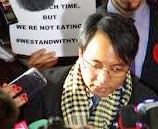
| Yeb Sano |
After Super Typhoon Haiyan ravaged the Philippines,
Yeb Sano, Climate Commissioner
for the Philippines, pleaded with the world to take immediate,
drastic action to reduce climate change-causing carbon dioxide emissions in an
emotional speech at the UN's climate meeting in Warsaw, Poland. He pledged to
fast [hunger strike] for the two weeks of the conference. You can still add
your name to the other three quarters of a million humans who already
signed his petition.
Es todo, hoy,
RudyG