Showing posts with label writing workshop. Show all posts

Tuesday, June 23, 2015

Radio DJ Suspected of being chupacabra.


Review: Max Uballez. Alexander Uballez. Chuy de Cabra. The Journey Home. The Chupacabra. 
n.p.: Chuy de Cabra Books, 2014. ISBN: 978-0-9909308-1-5 ebook via publisher link here.

Michael Sedano

I didn’t grow up knowing about chupacabras. Seems to me I learned its name only recently,
not more than a few years. I grew up with el cucui. We would huddle around a crackling firepit getting escalofrios at owl calls, populating dreams with spirits of the night. We didn’t have a chupacabra because it hadn’t been invented yet.

Wherever the hybrid vampire-werewolf story of la chupacabra came from, it’s well-known enough nowadays to be the basis of speculative fiction in a fun read from an independent publisher.

I wouldn’t be surprised to learn somewhere in the guts of a big library a researcher toils amid the microfiche and dusty ephemera, looking for that first mention in a folklorist newsletter, an allusion buried in ancient usenet archives. For all I know, either Max Uballez or Alexander Uballez started it way back when. Their novel, Chuy de Cabra, takes the devil by the horns and scores a winner. It’s fun.

The authors have given their chupacabra a taste for human flesh. Along with a diabolic power to rob a body of vitality--brush up against, a tap on the shoulder, hours later the victim has aged thirty years and lethally enervated--chupacabra inhabits the body of someone you know. The cops think it's Chuy, and he's not sure he's not.

Chuy de Cabra spins speculative fantasy out of shape-shifting, time and place dislocation, multidimensionality, police brutality, bilingualism. Here and there the writing sparkles with psychedelic force and draws a smile. “Otra!” the reader says, “give me another little piece like that.”

It may be mere coincidence how this literary romp mirrors canonical chicano literary motives such as the quest for identity, uses of language and speech, a community-based philosophy, indigenism.

That’s if you want to look at it like that. Maybe that rhetoric lies there on the page because that’s how we are. It’s chicano literature. Sabes que? Forget that stuff.

Take Chuy de Cabra to the wash, or el rio, or the beach, or the back yard. Wherever you kick back and want to or need to get lost in puro fantasy, have a book like Chuy de Cabra. Read it, then give it away. If you buy the ebook, oh well, you have the book all to yourself.

Sadly, Chuy de Cabra will not sit well with curmudgeons, strict linguistic prescriptivists, and irritable critics. The novel needs a sharp blue pencil and sharpening its cast of characters. The writers lose sight of comedy now and again and slip into metaphysical dementia. I know third-party editors are expensive, and word processing does spell check, y todo, so why flip out over discontinuities, translation, grammar, challenging layout, when the story’s there? Would it help if people knew a Tommy Burger plays a key role in making casí everything all right?


Charge! Mariposa Poetry Retreat

La Bloga friend Maritza Rivera alerts poets that registration opens now for Rivera's Catoctin Mountains setting north of Washington, D.C.  Click here for the organizer's website.


Saturday, April 26, 2014

Border-patrolling us. Fabulist fiction contest. Hard SF contest. L.A. latino sci-fi workshops.


Border Patrol Nation

Most U.S. citizens tend to think stopping undocumented workers at the border is a good thing that won't affect them. They should check out Todd Miller's new book about what militarization has done to the Land of the Free. It's entitled Border Patrol Nation: Dispatches from the Front Lines of Homeland Security and here's some facts from it.

"The U.S. borders have long been Constitution-free zones where more or less anything goes, including warrantless searches of various sorts. In the twenty-first century, however, the border itself, north as well as south, has not only been increasingly up-armored, but redefined as a 100-mile-wide strip around the country.

"Our “borders” now cover an expanse in which nearly 200 million Americans, or two-thirds of the U.S. population, live. Included are nine of the 10 largest metropolitan areas. If you live in Florida, Maine, or Michigan, for example, no matter how far inland you may be, you are “on the border.” You can be stopped, interrogated, and searched “on an everyday basis with absolutely no suspicion of wrongdoing.”


See a bigger No Constitution map.


Omnidawn Fabulist Fiction Chapbook Contest

I own a copy of a previous winner, In A Town Called Mundomuerto, and love the magical realist writing of author Randall Silvis. Anyway, the submission period for this contest doesn't begin until August, but this posting will give you speculative fiction writers time to get manuscripts prepared. There is a reading fee.

From the Omnidawn website:
The winner of the annual Omnidawn Fabulist Fiction Chapbook Competition receives a $1,000 prize, publication of their chapbook with full-color cover, 100 copies, and display advertising and publicity. Fabulist Fiction includes magic realism and literary forms of fantasy, science fiction, horror, fable, and myth. Stories can be primarily realistic, with elements of non-realism, or primarily, or entirely non-realistic.

Open to all writers. All stories must be original, in English, and unpublished. 5,000 to 12,000 words, consisting of either one story or multiple stories. Online entries must be received between Aug. 1 and Oct. 22, 2014. Reading fee $18. We expect to publish the winning chapbook in August of 2015. 

About Omnidawn: "Since 2001, we publish writing that opens us anew to the myriad ways that language may bring new light, new awareness to us.
We began Omnidawn because of our belief that lively, culturally pertinent, emotionally and intellectually engaging literature can be of great value, and we wanted to participate in the dissemination of such work. We believe our society needs small presses so that widely diverse ideas and points-of-view are easily accessible to everyone.”


Issues Science Fiction Contest

If you're more into writing "hard" sci-fi, here's a contest with a $1500 honorarium and only requires one-page about what you would write! No reading fee.

"Authors should submit a précis or brief treatment (no more than 250 words) of a science fiction story idea that explores themes in science, technology, and society. Submissions must be received by June 1, 2014.

"Stories should fall into one of the following five theme areas: Big data / artificial intelligence / brain science; Education / jobs / future of the economy; Defense / security / privacy / freedom; Biomedicine / genetics / health / future of the human; Future of scientific research / automation of research & discovery. IST will select up to five semi-finalists for each category. Authors will have 3 months to submit their story, between 2,500 and 5,000 words. Winning stories will be published in IST, and authors awarded a $1,500 honorarium. Read all the details."

Issues in Science and Technology (IST), a quarterly journal that explores the intersections of science, technology, society, and policy. The editors of IST believe science fiction (SF) can help to bring key challenges and dilemmas in science and technology to an influential readership in new and compelling ways. Scientists, engineers, researchers, and policymakers often only see small pieces of an issue. SF writers can imagine entire worlds. By fully thinking through how today’s critical issues will play out, science fiction inspires, cautions, and guides those shaping our future. Throughout 2015, IST will publish one SF story per issue, on topics of broad societal interest.


Denver Museo's children's summer camp


Latino Science Fiction Explored

And if you haven't heard yet, I'll be in L.A. next week and hope to meet and talk with everyone who can attend. This is a precedent-setting gathering of 6 Latino sci-fi authors! What could happen? Quién sabe, pero vamos a ver.

The Science Fiction and Technoculture Studies Program at University of California, Riverside will host “A Day of Latino Science Fiction” next Wednesday, April 30, to be held in the Interdisciplinary Symposium Room (INTS 1113). Free and open to the public.


The morning author panel will feature 1. Mario Acevedo, author of the bestselling Felix Gomez detective-vampire series (The Nymphos of Rocky Flats, chosen by Barnes & Noble as one of the best Paranormal Fantasy Novels of the Decade, and finalist in the Colorado Book Awards and the International Latino Book Awards.

2. Science-fiction and cyberpunk novelist Ernesto Hogan (Cortez on Jupiter); the co-authors of Lunar Braceros 2125-2148, 3. Rosaura Sánchez and 4. Beatrice Pita. The afternoon panel features writer and director 5. Jesús Treviño (Star Trek: Voyager, Star Trek: Deep Space Nine, and Babylon 5 and the book The Fabulous Sinkhole); and Michael Sedano, La Bloga Latino lit blogger; as well as Ph.D. candidates Danny Valencia, Rubén Mendoza and Paris Brown.

6. I'll be there talking about my alternate-world fantasy novel The Closet of Discarded Dreams (and about sci-fi stories) that took honorable mention in the International Latino Book Awards’ Fantasy/Sci-Fi, last year.

Come and find out about getting your spec lit published, the market for Latino sci-fi, the state of Latino spec lit and what the future might hold for our obras. It should be a chingón time, and we hope you come to add your voice and opinions. Check the details, especially about parking.

Es todo, hoy,
RudyG

Saturday, November 23, 2013

Latina spec lit bio, Lit festival, writers workshops, y mas


Combining themes from Melinda Palacio's post on author writing and Ernesto Hogan's post Thursday on sci-fi/magical realism, today we feature a spec-lit bio by Kathleen Alcalá.

Kathleen Alcalá
Alcalá’s words “convincingly move the reader from one reality to the other. Her craft illuminates the souls of her characters: the Mexican women who carry the universe in their hearts," says author Rudolfo Anaya. Kathleen's work takes readers to “a world where one would like to stay forever” (Ursula K. LeGuin)."

Her following bio provides a non-macho perspective to both latino and speculative literature. This is great stuff--una escritora diversifying the no-female-heroines worlds of Lord of the Rings and the Star Treks.

Science Fiction and Me
by Kathleen Alcalá

1. When I was five, I knew how to read. Outside was a vast starry sky at night, and at times, a California condor by day. It looked like a small airplane. We did not know it was one of the last, come inland to cruise the thermals. The wind blew constantly through Cajon Pass, and earthquakes reminded us how small we were. It was not a prehistoric landscape, but it was mindful of its pre-history. One night, someone showed me a snowy owl in a palm tree, well out of its territory, and another night, I watched a mole with glistening fur dig itself out of the ground.

Inside, were things I could see without difficulty – crayons and paper, postcards from my aunt, and then my aunt herself, my older sisters who came home from school speaking English. I attended a two-room schoolhouse with all grades divided between them. When I was six, I discovered the Bookmobile and checked out a set of Dr. Seuss books. My picture was in the paper, a skinny brown girl with messy braids. “I feel like I’m five, but I’m six,” read the caption. My birthday had been a few days before. The Bookmobile to Devore Heights, California, was discontinued within months due to budget cuts, and because I was one of the few users.

contains an Alcalá story
2. Shortly after, my father lost his job, and we moved into the city of San Bernardino, where he became a substitute teacher until he was hired into a regular position. I attended Eliot Elementary School. It had an entire library full of books.  After the first year or two, we did not have a librarian, but I continued to read the books, working my way across the shelf of science fiction and fantasy books from Isaac Asimov to Roger Zelazny. Here were worlds within worlds, fully realized answers to “what if” questions, such as “what if we could fly? What if people lived on Mars? What if I could go back in time and visit another civilization?”

3. When I was in sixth grade, Star Trek debuted on television. My friends and I were ecstatic. The Man from U.N.C.L.E., a spy Cold War spy series, was also on. They could hide a microphone in a pen! We giddily waited for each weekly program. Before then, television had offered live variety shows featuring people our parents’ ages, then Laugh-In, that appealed to our older brothers and sisters. But Star Trek was aimed at us, the generation that grew up with astronauts and space travel. Star Trek was canceled after two years, but revived a couple of times after that, and lives on forever in reruns.

4. My oldest sister took her first teaching job in Arlington, California, part of Riverside County. She was not used to being by herself, so I went to live with her for one year when I was twelve. She taught sixth grade at a middle school, and I was in seventh at the same school. It was a better school than the one I had been attending, for which I was grateful. My sister was invited to meet an author along with some other teachers. When I heard it was Madeline L’Engle, I tagged along. I was the only person in the group of ten or so who had read A Wrinkle in Time. If I had owned a copy, I could have gotten it signed. It is still one of my favorite books.

5. I returned to San Bernardino, where my father now taught at Franklin Junior High School. In the summers, I took summer school classes at my own school, art and home economics (required), typing and library science. A brand new city library was built next to Franklin, but nobody used it. I sometimes went and spent the evening there while my father taught adult classes. I read three or four of The Chronicles of Narnia series by C.S. Lewis, as well as books about dragons by C. S. McCafferty. My mother worried that I was learning about witchcraft.

A boy at school, whose glasses were thicker than mine, claimed to have found the best fantasy books ever, The Lord of the Rings trilogy. I read one and proclaimed it, “good, but not the best” which led to heated arguments. What made a good fantasy book to thirteen year olds? Action and adventure, of course, but also depth of character, people we cared about. Where were the girls and women? Well-imagined worlds. I got him to read another book I had found, The Valley of Joy, and he admitted it was better. But it wasn’t as long, and so did not offer the same submersive experience.

6. In high school, we tried to stay alive. We had race riots, and the police would come and Mace us. I don’t remember if I read any sf or fantasy then. Does Kurt Vonnegut count? I got in trouble for reading a book called The Centaur, by John Updike. The woman who had played Lt. Uhuru on Star Trek, one of the very first African American women in a starring role on television, came to town for some reason and signed autographs. I got that one, and hope I still have it.

7. In college, I continued to read everything I could get my hands on. I was interested in language itself, so I studied linguistics and wrote for the school paper. A Clockwork Orange was released as a movie, and I refused to see it, because I had read the book and knew it was too violent for me. I can read most things, but movies affect me at a visceral level. I am less sensitive now than I was then. I found a copy of Cien Anos de Soledad and sent it to my parents, it was so much like the family stories with which I had grown up.

8. I went to work for KNBC in Los Angeles as a production assistant in the documentary unit. We were sometimes given free passes to movie openings. I saw Star Wars from the front row of Grauman’s Chinese Theatre. It was the best sf movie I had ever seen, hands down. The experience was entirely wasted on my friend, who was unable to understand such a grand metaphor for the human condition. I had begun to write stories, but in a very realistic mode.

9. While living in Western Colorado, I spotted a small article in the Grand Junction Sentinel. There was a contest for the best science fiction story submitted to the Western Colorado Science Fiction and Fantasy Association. The prize for first place was a paid registration to a World Con that would be held in Denver later that year. ‘This one’s for me,’ I thought, and wrote “Midnight at the Lariat Lounge,” about people who come from another world to mine uranium. One of them falls in love with a human. It’s a pretty bad story, but it won first place. In order to accept the prize, I had to attend a picnic in Grand Junction. I drove around the park until I saw people in long costumes with face paint. “How did you know it was us?” someone asked. The food included blue, hard-boiled eggs pressed into square cube shapes.

10. I attended Denvercon while staying with my in-laws. A bit strange, and completely overwhelming for someone living in rural Colorado at the time. This was the first time I met a professional science fiction writer, or any living writer, for that matter, other than my aunt, who had self-published a book called I Married a Priest. I made friends with author Ed Bryant, who was later one of my instructors in Clarion West.

11. I moved to Seattle and applied to graduate school at the University of Washington. I said I was interested in science fiction. Joanna Russ taught there, and I would be able to study with her if I was accepted. I found and read one of her books. Russ, a famous feminist in the field of science fiction, was also the author of How to Suppress Women’s Writing, now in its umpteenth printing, which takes a humorous but devastating look at the excuses that have been used over the years to not publish certain work. As an afterthought, she added women of color.

11. Russ dropped a small pile of literary magazines in the middle of the table one day. “These will be the first places that publish you,” she announced to the class. I had never heard of small press publishing. I thought it was The New Yorker or nothing. I went through a directory and picked out the most obscure magazine I could find that took sf. I published my story, Midnight at the Lariat Lounge as a result. I continued publishing in small presses, including Black Ice and Calyx, a feminist press out of Oregon. People described my work as magical realism, while all I knew was that this was how stories were told in my family.

12. After receiving an M.A. in Creative Writing, I worked one year and bought my first computer with the proceeds. Daringly, I bought Microsoft Word software, new at the time. I should have bought stock.

13. I applied for and was accepted into the Clarion West Science Fiction Workshop, held in Seattle. The original Clarion was founded in 1968 at Clarion University of Pennsylvania (itself inspired by the Milford Writer's Workshop). Six weeks of writing boot camp, a different instructor each week, and one editor. All pros, all people worthy of emulation. My instructors included Ursula K. LeGuin, Samuel (Chip) Delany, Ed Bryant (as noted above) and editor Tappan King. My classmates included many sterling writers whose work you can read right now. I published Sweetheart in Isaac Asimov’s Magazine of Fantasy and Science Fiction about a year later.

This year’s class got to attend a reading by Neil Gaiman and attend a screening of Guillermo del Toro’s recent movie, Pacific Rim, with Gaiman. The workshop offers the Octavia E. Butler scholarship to writers of color. People make life-long connections by attending the workshop, but it is not for the faint of heart. In 2002, I served as an instructor.

12. Published my first book, Mrs. Vargas and the Dead Naturalist in 1992 with Calyx Books. The director and editor at the time, Margarita Donnelly, grew up in Venezuela and is perfectly bilingual. She was delighted to publish my stories, and worked hard to get it national exposure and reviews.

13. I published my first novel, Spirits of the Ordinary, with Chronicle Books. It was rejected by over twenty other publishers before Chronicle picked it up. Letter after letter went to my agent from editors who loved it, but marketing would not let them buy it for all the reasons listed in Rudy Garcia’s essays. It was not a coming of age story. It was not an immigrant’s story. It was aimed at a literary market. 

14. Ten days in the Sonoran Desert researching my second novel, The Flower in the Skull. By day, I used the libraries at the Amerind Foundation and the University of Arizona. By night, Hyakutake burned in the western sky, and coyotes (the four-footed kind) chased javelinas through the dark. The spirits of my ancestors were very much with me.

14. I published a third novel and a collection of essays. None of my work really qualifies as science fiction, but mainstream publishing does not make room for more than a couple of “ethnic” writers at a time. I have never made a living solely from my writing, but then, that is true of most writers. Science fiction helped make room for writing such as mine, another world within the world. I try to pay it forward by letting others know about these portals and windows.

15. I am writing a collection of stories that walk the edge of what editor Leslie What in the magazine Phantom Drift calls “The Genre That Dares Not Say Its Name,” What provides a dozen other names for “new fabulism”: “Slipstream . . . Magical Realism, Fabulist Fiction, Transrealism, New Weird . . . It is rooted in folk tale, religious belief, magic, surrealism, and superstition. Fabulist writing blends literary tropes with fantastic conceits, and in the process frees fiction from the limitations of realism.”

Am I a literary writer? All this, and more. - Kathleen Alcala

Kathleen is the author of a short story collection, three novels set in 19th Century Mexico and the Southwest, and a collection of essays based on family history. She received the Western States Book Award, the Governor’s Writers Award, and a Pacific Northwest Booksellers Association Book Award, and two Artist Trust Fellowships.

She has a B.A. in Linguistics from Stanford University, an M.A. in Creative Writing from the University of Washington, and a Master of Fine Arts at the University of New Orleans. Her work is often referred to as magic realism, but Kathleen considers most of it historical fiction. She does, however, have a great affinity for the story-telling techniques of magic realism and science fiction, and has been both a student and instructor in the prestigious Clarion West Science Fiction Workshop.
Kathleen's blog, website and Twitter.


10 new latino writers for 2014

La Bloga amiga Sandra Ramos O'Briant is one of ten latin@s who received the following news: "You have been selected by LatinoStories.com among the 2014 Top Ten New Latino Authors to Watch (and Read).


Texas writing workshops open

At the Raul R. Salinas Classroom, Mexican American Cultural Center, Austin, TX

Next Saturday, November 30th, as part of the Flor de Nopal Literary Festival, a Solo Playmaking workshop will be led by Natalie Goodnow, a nationally recognized theatre-maker, teaching artist, and activist from Austin. "We’ll explore a variety of approaches to generating material for solo performance – monologue, storytelling, poetry, and movement."

The Bridge Building/Border Crossing: The Poet as Nepantlera workshop will be led by poet John Fry. "Poems enter us just as we enter them when we write. During the act of composition, we’re at once both builders of bridges and crossers of borders in a way that summons us body, mind, and soul. Following the writings of Gloria Anzaldúa, in this workshop we will explore how the act of writing poems allows for us to experience a state of being-in-between. She calls this state nepantla: a threshold state, or place, between supposed opposites like here and there, male and female, right and wrong, true and false, living and dead. Open to poets of all levels."

Events for Friday, December 6th
Flor De Nopal Literary Festival 2013 Reading featuring: Daniel Chacon, ire’ne lara silva, Natalie Goodnow, Lee Francis, Liza Wolff-Francis, Lisa Marie Estus, Mónica Teresa Ortiz, John Fry, and other writers TBA. Location: Multi-Purpose Room, Mexican American Cultural Center, Austin, TX.


A million petitioners to stop climate change

Yeb Sano
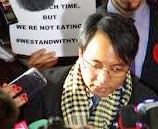
After Super Typhoon Haiyan ravaged the Philippines, Yeb Sano, Climate Commissioner for the Philippines, pleaded with the world to take immediate, drastic action to reduce climate change-causing carbon dioxide emissions in an emotional speech at the UN's climate meeting in Warsaw, Poland. He pledged to fast [hunger strike] for the two weeks of the conference. You can still add your name to the other three quarters of a million humans who already signed his petition.


Es todo, hoy,
RudyG

Friday, May 27, 2011

Spotlight on Rolando Ortiz

Rolando Ortiz

Poet Rolando Ortiz exposes details of his life on Facebook, reveals the top items on his Cholo Bucket List, and posts photos of his food creations and the silly antics of his kids. La Bloga recently sat down with the ex-gangster who was put behind bars at the tender age of nine.

The poet and writing teacher has moved away from a bounce-back system of incarceration. His last arrest was over ten years ago. In his neighborhood, police know him as someone they can talk to. This doesn’t make him exempt from the occasional stops and pullovers for driving while looking like a gangster. However, public speaking is an asset for the charismatic poet who laughs easily and always looks happy.

“I learned in life whatever vibe that you give out is what you get back. Being friendly and being able to be approached by others is important. I learned that from the Dalai Lama. Part of my happiness comes from my family, my kids, and poetry. I try to let other people feed off my vibes.”

When he’s not writing poetry, he enjoys cooking the Mexican dishes that his mother taught him. He was the youngest of seven kids and credits his mother for his love of cooking. Rolando says he was a chef in a past life and jokes that his cooking is the real reason his fiancé loves him. His Facebook updates are filled with photos of his latest mouth-watering creation. The 36-year-old says his kids love it when he cooks breakfast.

In January 2010, he was approached by a gang unit officer and asked to give writing workshops to troubled youth. “It was something I always wanted to do,” says Ortiz, “it’s important to give back to the community.”

Rolando has been writing poetry since he was a 12-year-old youth at East Lake Juvenile Hall. While inside, he started his Cholo Bucket List to express all the things he wanted to do when released. He shares his Cholo Bucket List with his students and talks about all the things he’s been able to cross off, including hearing the Dalai Lama speak. One of his biggest accomplishments is working with Luis J. Rodriguez who has encouraged his mentorship of troubled youth and his poetry. His poetry influences include Luis Rodriguez, Octavio Paz, Pablo Neruda and Federico G. Lorca, Luivette Resto, and Diego Robles.

Acceptance among local poets has also been important to Ortiz who also names the meeting of Rafael Alvarado as an important step in his career as poet. “I’ve never met another poet who I’ve hit it off so well,” said Ortiz. “I met Rafael at a literary festival and now I’m part of the Hollywood Institute of Poetics (H.I.P.).

Part of his role in H.I.P. is hosting a regular poetry reading at the Paloma Room in Montebello. The barroom setting offers mixed drinks and food. The next event on June 5 from 5:30 to 9:00pm features Liz Gonzalez, Richard Modiano, Luis J. Rodriguez, A K Toney and Diego Robles at 624 Whittier Blvd.


Tonight: Friday, May 27 at Beyond Baroque, Muejerismo and Latina Poets. Join La Bloga’s Melinda Palacio, the editor and publisher of Pilgrimage Magazine, Maria Melendez, local poets, Luivette Resto and Frankie Hernandez, and a one-day art gallery presentation by Gabriella Azul Parra at Beyond Baroque, 681 Venice Blvd, Venice, CA 90291, 7:30 pm. Host is Rafael Alvarado.

Saturday, May 28, is the 6th Annual Small Press Book Fair, 235 Hill Street, Santa Monica. Melinda Palacio reads with Teresa Dowell and poets from New Poets of the American West: An Anthology of Eleven Western States. Look for the booth, starting at 10:00 am.

Friday, January 28, 2011

Outside the Box: PALABRA
by Melinda Palacio

elena minor, photo courtesy of PALABRA


The editor and publisher of PALABRA, a Magazine of Chicano & Latino Literary Art, keeps a fairly low profile. However, she was adventurous enough to meet with La Bloga. I’m lucky in that I have an insider’s view.

When I first heard about PALABRA in 2006, I sent many poems and short stories to the magazine, which were rejected. As someone who relishes rejection, I kept sending work to the magazine until I finally had a breakthrough with two poems in 2009 issue 5.

One important memo I’ll divulge has to do with the magazine’s visual aesthetics, a bit of information that might help potential contributors to the literary magazine. PALABRA is always spelled with capital letters and the publisher’s name is always spelled with lower case letters, as in “elena minor.” If you get this visual quality correct, she won’t frown at your submission or be in a bad mood when she reads your promising manuscript.

Remember, persistence. I don’t take anything for granted. PALABRA is an annual publication that rejected my work for three straight years, published my work in 2009, and rejected everything I sent in 2010. I’m happy to report that PALABRA has accepted my poetry for the forthcoming 2011 issue.

The Bay Area native started PALABRA in 2006 because she wasn’t finding any Latino literary magazines that published the kind of work she wanted to see. “I wanted writing that wasn’t geared to an Anglo audience, whose interest didn’t lie in trying to explain us (Chicanos and Latinos),” she said. “I wasn’t interested in footnoted Spanish. I wanted work that was different and unapologetically Latino.”

Over the past five years, PALABRA has taken on a life of its own. Also, she gets the word out by attending AWP, the Association of Writers and Writers Programs conference; this is her fourth year at the roving conference. In addition, she started the PALABRA readings at the REDCAT Lounge in the Disney Center in Downtown Los Angeles three years ago. She also gives authors who’ve been published in PALABRA the opportunity to read and feature their books at REDCAT. Working for CalArts at REDCAT helped secure the lounge’s excellent reading space. PALABRA Press will soon publish single-authored books of short, unconventional fiction.

Being the publisher, marketer, and editor of PALABRA takes its toll on minor’s writing time. She hopes to retire someday from all her jobs and devote more time to her writing. She’s an award-winning dramatist who also writes fiction, poetry, and hybrid works. She is currently polishing a poetry manuscript and working on an episodic novel. The MFA grad from Antioch puts her name out there and also rides the acceptance and rejection roller coaster. “I want to make sure they know Latino writers exist,” she said. “There are still a lot of editors of lit mags who have no clue about Latino literature.”

Eventually, the publisher would like to hand off the editorial decisions to someone else. For now, she thrives on finding exciting work that’s different. “I’m not a big fan of trying to repeat a formula,” she said. “I’m looking for writing that’s working from some well spring of originality.” She’s such a fan of originality, she tries to give that element of surprise in every issue and page of PALABRA: “I try to surprise people. Surprise is a reflection of the many different ways we write.” She’s also happy to discover new writers: “I enjoy the response of writers who’ve been published for the first time in PALABRA.”

This weekend I will attend the Fiction Bootcamp Intensive in Oxnard. You can join the next one March 11, 12, 13. Contact Toni Lopopolo or Shelly Lowenkopf. Shelly Lowenkopf is an editor and fiction instructor from Boyle Heights. He’s lived in New York and Mexico City and may surprise you by correcting your prose and Spanish. Toni Lopopolo is an East Coast agent, former executive editor at Macmillan and St. Martin’s press in New York City. The literary agent since 1991 is seeing novels written by Latinas. Try your luck with this NY agent, now based in Santa Barbara. The March intensive is for advanced novelist. So you think you’re advanced? Send some pages to Lopopolobooks@aol.com to find out before signing up for the 3-day intensive. The fee, including reception, is $350 for the March workshop that’s limited to 15 people.

Wednesday, January 23, 2008

Children's Writers Workshop at Chautauqua

René Colato Laínez

Chautauqua offers many quiet places. Dayton O. Hyde (right) and Rene
Colato find such a place to discuss Rene's writing.

highlightsfoundation.org


In my classroom, I loved to tell funny, scary, sad, happy and adventurous stories. One day, one of my students asked me, "Can you write that story and draw the pictures?"

"What a wonderful idea!" I told him.

That night, I wrote and illustrated my first picture book- "El numero 1/ The Number 1."

I finished the book at 1:00 A.M. and I was thrilled.

Then, I wrote and illustrated more books. Soon, I had a box labeled “Mr. Colato’s Books”. I discovered that during independent and silent reading, this box was empty. All around the classroom, my students were reading my books. I was so excited and decided to write more and more books.

After presenting a new book, Elvis told me, “You are the teacher full of stories.”

“Sí, yes! He is the teacher full of stories,” all the children said at the same time.

And I became the teacher full of stories at Fernangeles Elementary.

One morning, children’s book authors Alma Flor Ada and F. Isabel Campoy visited my school and told me, “You have to send this wonderful books to publishers.”

Then I met Amada Irma Perez at CABE, California Association for Bilingual Education. Amada inspired me with her workshop about writing your own stories and get them published.

On March 2001, I was ready to drive the bumpy road to publication. I signed up for the Chautauqua Workshop in New York. Highlights for Children was one of my favorite magazine. I wanted to learn from their creators. This could be a great workshop for my writing career.

By July 2001, I had written two manuscripts and had rejection letters for both of them. I took the manuscripts to Chautauqua.

Patricia Lee Gauch, editor at Philomel Books, read my first manuscript and told me, “Good writing but I have seen many picture books about this topic. Do you have another manuscript?”

“Yes,” I told her. “It is in my room.”

That afternoon, I gave her my manuscript “Waiting for Papá.” Something magical happened. Patricia did not like my manuscript, SHE LOVED IT. Patricia sat with me and with her pen, wrote suggestions all over the manuscript. At the end of the workshop, she gave me a big hug and told me, “We can do this book together.”

Four months later, I received a lovely rejection letter for Patricia. She still loved the manuscript but the acquisition table did not select the manuscript. However, Patricia had more suggestions for me. I followed them and submitted my manuscript to Piñata Books/ Arte Publico Press.

On January 2002, my dream became a reality; my manuscript was selected for publication by Piñata Books. Bravo! Ahora era un autor, I was an author.

Yes, the Chautauqua Workshop changed my life and now it can change your life too.

Kent Brown, the executive director of the Highlights Foundation, is offering scholarships to Latino writers to attend the conference this summer. The funds are there but you need to apply before February 15, 2008. Get in contact with Kent Brown.

This is info about the scholarship:

Since the Highlights Foundation Scholarship Program was first established in 1988, more than 250 scholarships have been awarded to applicants who wish to attend the Foundation's Annual Children's Writers Workshop at Chautauqua, New York. These scholarships make the experience of Chautauqua possible for many individuals who might otherwise not have the opportunity or the resources to participate.

Individuals with a serious interest in writing for children and who have an established financial need are invited to apply. Scholarship applications are evaluated on an ongoing basis by the Highlights Foundation Scholarship Committee. Scholarships vary in the stipend awarded depending on an applicant's requirements and the funds available. Funds for scholarships come from two sources: a Foundation Endowment Fund or scholarships that are funded annually by donors.

This year the scholarship committee will be considering applications in two groups. It works in your favor if we receive your application early. The early group of applications is reviewed on December 1, and you are encouraged to apply BEFORE that date. The final deadline is February 15, 2008.

For more information on the Foundation Scholarship Program or to receive an application form, please contact:
Kent L. Brown Jr.
Executive Director
The Highlights Foundation
570-253-1192
klbrown@highlightsfoundation.org

Wednesday, August 29, 2007

Macondo 2007 Highlights

René Colato Laínez

These pictures are courtesy of many Macondistas. ¡Gracias!


*The Macondo Writing Workhop was celebrated from July 29 to August 5 in San Antonio, Texas.

*Most of the Macondistas stayed at the Our Lady of the Lake University dorms.

*Our famosas workshop teachers were Joy Harjo and Dorothy Allison.

*Our Macondistas teachers were Levi Romero, Liliana Valenzuela,
Alex Espinoza and Jackie Cuevas.

*We had great seminars throught the week. Just check the titles and presenters.
-Borderlands With in Us by Dr. Marga Speicher.
-Creating Real Life Characters- Yourself and Others by Gregg Barrios.
-Making Peace in Time of War by Baldemar Velasquez and Amelia Mesa-Baines
-The Political Essay by Norma Alarcon and Macarena Hernandez.


*Our invited literary agent was the talented Stefanie Von Borstel from Full Circle Literary.

*Natalia Treviño organized the Bexar County Juvenile Detention Center visit.

*Noche de Macondo at Esperanza Peace and Justice Center was a blast. Joy Harjo gave us a great concert.


*Jump-Start Theatre featured Dorothy Allison. Two or Three Things I know For Sure are that Dorothy is great, great and great.

*Lucha Corpi and Dr. Amalia Mesa-Bains received the Gloria Anzaldua’s Milagro Award.

*The yoga teacher was our Macondista Michelle Otero.

*The readings at Macondo BBQ were amazing and unpredictable.

*The talented children's Book Author Amada Irma Pérez read at the San Antonio Public Library.

*And as always Sandra Cisneros was our angel, amiga, consejera and la mera mera. Sandra all the Macondistas love you!


About the Macondo Workshop

The Macondo Writing Workshop is a unique summer gathering for writers working on geographic, cultural, social and spiritual borders.

Founded in 1995 by writer Sandra Cisneros and named after the sleepy town in Gabriel García Marquez's One Hundred Years of Solitude, the week-long workshop transforms San Antonio, Texas — and more broadly, La Frontera — into a space of intense artistic and cultural creativity.

Macondo is a master's-level workshop, meaning that participants are expected to take their writing seriously and to have fulfilled at least one of the following:

1. published a book or several stories in journals or magazines,
2. enrolled in or completed an MFA program, or
3. studied under at least three professional writers.


An essential aspect of the Macondo ethic is a global sense of community; workshop members should, in addition to being already established and capable of participating in a master's-level class, recognize their place as writers in our society and the world.

A second element of the Macondo ethic is a spirit of generosity. In the spirit of Sandra Cisneros, who volunteers valuable writing time for the nourishment of other writers.


Monetary contributions are accepted from those with better means to assist workshop participants who cannot fund their own airfare and lodging.

In addition, workshop members are expected to review each other's work with rigor and vision. Time is viewed as a gift equal to that of money, so time given is as valuable as cash!

The workshop is divided into three mixed-genre groups, each of them headed by an accomplished writer or team of writers. After attending one year, participants are allowed to enroll in Sandra Cisneros' class.

Mornings are spent individually reading each other's work, afternoons consist of "workshopping" by groups, and evenings are spent discussing various artistic, political and spiritual issues related to writing.


For more information visit www.macondoworkshop.org