by RudyG
Since this week's La Bloga's 1st birthday, I thought I'd add a few thoughts, plus sorta "review" some Spic Spec Fiction.
When I laid out the initial blogger page for La Bloga, it went more like a dutiful exercise--to get M.Ramos off my back--than any labor of literary love. As far as it's gone, to date, it's turned into more than envisioned.
True, it's not the voice of Chicano lit-crit, but, you know--you get four Chicanos together anywhere, and you've got five opinions, four of which are probably driven by inebriation and only one, sober. Tú sabes.
Today, La Bloga is: Manuel Ramos, Michael Sedano, Dan Olivas, Gina Ruiz and, occasionally, this Garcia. Maybe they've each created a wit- and useful, meaningful niche for themselves, even the last guy, when he shows up.
Whatever another year brings, the last one's meant growth, diversity; been informative and entertaining. I know; I've witnessed it and am glad Ramos was on my back.
Now for one of those nonreviews I'm not yet famous for.
I like spec fiction, and I like humor. I think both are genres we Chicanos haven't gone into enough, maybe 'cause we take ourselves too seriously and seem to easily take offense, even with satire. And if you don't believe me, culo, just try making fun of my old lady, again.
I picked up A. Lee Martinez's Gil's All Fright Diner (Tor, 2005, $12.95) hoping to find a good Chicano attempt at humor in the spec fiction realm. The antagonist is an adopted Japanese girl--hot--aka Mistress Lillith, who's about to open the doors to Hell. (If she'd been Chicana, maybe she'd have opened the doors to La Frontera, and really scared the shit out of readers!) I found it worth the read, enjoyable; in some way it might find itself one day a part of Chicano literary lore, depending on who's defining "Chicano."
I couldn't google anything on the author, other than he hails from Terrell, Texas, out east of Dallas, north of the Big Thicket, both damn good places to be from, but not to stay in. Actually, I don't know if Martinez calls himself Chicano, so there I'm assuming he's lucky enough to be one. Anyway, according to M.Ramos, if Martinez calls himself Chicano, then Gil's is a Chicano novel.
From my reading, this is not your generic horror, but rather a comic horror tale, done deadpan-humor style. The only "Chicano thing" about it is on p.83, where middle-aged Wanda Gonzalez, owner of Gonzalez General Repair, replaces some broken glass in the diner; she's got "skin like leather." That, plus Ramos's definition, is all the Chicano there is here.
I prefer a deadpan style of humor; that's just me. I never understood people who try to be funny, like Seinfeld or most WB programs. On the other hand, the deadpan rarely had me ROTF; nomás me hizo reir.
So, if you're into not-so-blatant laughs that include a vampire, werewolf, ghost, ghouls, zombies, and the end of the non-barrio world, pick up a copy. (I liked it enough I decided spoof it in my next unpublished novel, make it less deadpan and more blatantly Chicano.)
Happy Birthday, Fello/a Bloguistas!
Rudy Ch. Garcia
Las Blogueras Los Blogueros

Click to email a writer. Denver CO • Pasadena CA • The San Fernando Valley CA • Eagle Rock CA • Lincoln NE • Glendale AZ • Santa Barbara CA • Lincoln Heights CA • Kansas City MO • Santa Monica CA
Tuesday, November 29, 2005


Upscale Chicas Patas Get Upscale Lifestyle Magazine
Michael Sedano
I was struggling to come up with a hook for a review of Lorna Dee Cervantes' wondrous collection Drive: The First Quartet, when the day's mail caught my eye. No, not the guy on the cover illustrated here, but a bright red 8-1/2" x 11" page featuring a slim woman with a come hither smile and not showing a lot of skin. So I'll review Drive: The First Quartet next week. In the meantime, please buy your copy of Drive: The First Quartet and find your favorites. With over 300 pages of work, you're sure to find Cervantes' collection a worthwhile way to spend those quiet moments between tasks, or rewarding yourself with extended periods of personal enjoyment paging through the collection's five distinct sets.
Tu Ciudad's Dec/Jan 2006 issue is the publisher's third. The magazine debuted with its June July number, with plans to appear every other month. Subtitled, "Your Guide to Latino L.A.", it works to live up to its billing. The cover story on television actor Vanessa Marcil, "Unwrapping My Masa Memories", does a gorgeous layout of samples from Mama's Hot Tamales. The article is not for las delicadas, los delicados, by the way--writer Carolynn Carreño is shown making a tamal sans headcovering in the otherwise sanitary-appearing kitchen. I hope Carreño washed her hands!
Lifestyle magazines aren't noted for their crusading work, so I wasn't surprised that Carreño glosses over Mama's Hot Tamales' raison d'etre. To the magazine's credit, it does note the pushcart venture Mama's launched, but doesn't delve. The enterprise, located south of MacArthur Park, manufactures pushcarts that it sells--call it technology transfer--to local immigrants who can then peddle their comida and botanas to the gente who throng to this busy crossroads of Latino L.A.
I am pleased to note the magazine's guest columnist in the striking red covered December/January number is La Bloga's Monday columnist, Daniel Olivas. Dan's insightful piece on literacy bears reprinting; perhaps the publisher will encourage Olivas to share the piece with La Bloga readers.
Tu Ciudad is no home-grown proposition but that of a conglomerate, Emmis Publishing, who puts out Los Angeles Magazine, as well as eponymous monthlies for Texas, Atlanta, Indianapolis, and Cincinnati. Indeed, Tu Ciudad reads exactly like Los Angeles Magazine, but with what I'll call and Eastside focus. The publisher declares circulation at "110,000 total: 70,000 mailed, 35,000 newsstand, 5,000 public distribution."
I approached the magazine with trepidation, fearing the advertising would be a monton of booze ads. A three-pager from Cuervo tequila, in Spanish, a double truck "Advertorial" from Dulseda liqueur, and a full pager from Miller Lite were the prominent alcohol buys. Luxury automobiles take the big play. I chuckled at Mercedes-Benz' ad, misreading !Oh, Cielos! for "Oh Celos", thinking, aha, an advertiser with a finger on the pulse of the community. Wrong. The tiny print and eloquent Spanish clearly shows an advertiser out of touch.
Tu Ciudad is still finding its way. It needs to update the webpage to illustrate the current cover. The humor piece, the golden bean award, recyles Esquire magazine from the 1970s. But that's good. The champurrado article chooses to ignore the hundreds of pushcart and street corner vendors selling champurrado, tejuino, orange juice, and tamales, in favor of naming only licensed concerns. And that's blind. Do Upscale Chicanas Chicanos not care about tasting the best of the best, irrespective of accessibiliity? Then again, I wonder if there's a cost for being listed? The publisher elects a bit of a defensive pose--or assimilationist hard-headedness-- arguing with reader Alfonso Alvarez Carson that "tamale" is the correct singular form for "tamal," based on the publisher's "in-house English dictionary." I think Editor Oscar Garza needs a different dictionary.
You may find Tu Ciudad on a local newstand, or you can inquire at the website linked above. I'm looking forward to the February/March issue. It's cool seeing a magazine that turns its sights on my side of town for once.
Atentamente y sin otro motivo other than read! raza and fellow readers, hay les wachamos next week. (I'm not doing diacritics well this week, sorry).
mvs
I was struggling to come up with a hook for a review of Lorna Dee Cervantes' wondrous collection Drive: The First Quartet, when the day's mail caught my eye. No, not the guy on the cover illustrated here,
 but a bright red 8-1/2" x 11" page featuring a slim woman with a come hither smile and not showing a lot of skin. So I'll review Drive: The First Quartet next week. In the meantime, please buy your copy of Drive: The First Quartet and find your favorites. With over 300 pages of work, you're sure to find Cervantes' collection a worthwhile way to spend those quiet moments between tasks, or rewarding yourself with extended periods of personal enjoyment paging through the collection's five distinct sets.
Tu Ciudad's Dec/Jan 2006 issue is the publisher's third. The magazine debuted with its June July number, with plans to appear every other month. Subtitled, "Your Guide to Latino L.A.", it works to live up to its billing. The cover story on television actor Vanessa Marcil, "Unwrapping My Masa Memories", does a gorgeous layout of samples from Mama's Hot Tamales. The article is not for las delicadas, los delicados, by the way--writer Carolynn Carreño is shown making a tamal sans headcovering in the otherwise sanitary-appearing kitchen. I hope Carreño washed her hands!
Lifestyle magazines aren't noted for their crusading work, so I wasn't surprised that Carreño glosses over Mama's Hot Tamales' raison d'etre. To the magazine's credit, it does note the pushcart venture Mama's launched, but doesn't delve. The enterprise, located south of MacArthur Park, manufactures pushcarts that it sells--call it technology transfer--to local immigrants who can then peddle their comida and botanas to the gente who throng to this busy crossroads of Latino L.A.
I am pleased to note the magazine's guest columnist in the striking red covered December/January number is La Bloga's Monday columnist, Daniel Olivas. Dan's insightful piece on literacy bears reprinting; perhaps the publisher will encourage Olivas to share the piece with La Bloga readers.
Tu Ciudad is no home-grown proposition but that of a conglomerate, Emmis Publishing, who puts out Los Angeles Magazine, as well as eponymous monthlies for Texas, Atlanta, Indianapolis, and Cincinnati. Indeed, Tu Ciudad reads exactly like Los Angeles Magazine, but with what I'll call and Eastside focus. The publisher declares circulation at "110,000 total: 70,000 mailed, 35,000 newsstand, 5,000 public distribution."
I approached the magazine with trepidation, fearing the advertising would be a monton of booze ads. A three-pager from Cuervo tequila, in Spanish, a double truck "Advertorial" from Dulseda liqueur, and a full pager from Miller Lite were the prominent alcohol buys. Luxury automobiles take the big play. I chuckled at Mercedes-Benz' ad, misreading !Oh, Cielos! for "Oh Celos", thinking, aha, an advertiser with a finger on the pulse of the community. Wrong. The tiny print and eloquent Spanish clearly shows an advertiser out of touch.
Tu Ciudad is still finding its way. It needs to update the webpage to illustrate the current cover. The humor piece, the golden bean award, recyles Esquire magazine from the 1970s. But that's good. The champurrado article chooses to ignore the hundreds of pushcart and street corner vendors selling champurrado, tejuino, orange juice, and tamales, in favor of naming only licensed concerns. And that's blind. Do Upscale Chicanas Chicanos not care about tasting the best of the best, irrespective of accessibiliity? Then again, I wonder if there's a cost for being listed? The publisher elects a bit of a defensive pose--or assimilationist hard-headedness-- arguing with reader Alfonso Alvarez Carson that "tamale" is the correct singular form for "tamal," based on the publisher's "in-house English dictionary." I think Editor Oscar Garza needs a different dictionary.
You may find Tu Ciudad on a local newstand, or you can inquire at the website linked above. I'm looking forward to the February/March issue. It's cool seeing a magazine that turns its sights on my side of town for once.
Atentamente y sin otro motivo other than read! raza and fellow readers, hay les wachamos next week. (I'm not doing diacritics well this week, sorry).
mvs
Monday, November 28, 2005
SPOTLIGHT ON REYNA GRANDE
 Monday’s post from Daniel Olivas…
Reyna Grande was born in Guerrero, Mexico in 1975. When she was five years old her father and mother left for the U.S. and left her and her siblings in care of her grandmother. She entered the U.S. as an undocumented immigrant in 1985. She attended Pasadena City College for two years before transferring to the University of California, Santa Cruz, where she obtained her B.A. in Creative Writing and Film & Video in 1999. Her short-stories and poems were published in the student-run publication "Las Girlfriends." She also self-published a collection of short-stories entitled Under the Guamuchil Tree with a grant from the university. In 2003, she was selected as one of the eight fellows in the Emerging Voices Rosenthal Fellowship offered by Pen Center USA. She was mentored by María Amparo Escandón, author of Esperanza's Box of Saints and Gonzalez & Daughter Trucking Co. Across a Hundred Mountains is Reyna’s first novel which will be published by Simon & Schuster/Atria Books in spring 2006.
Reyna is working on a second novel, where she explores the world of folklorico, Mexican folk dancing. The novel centers around four folklorico dancers: Elena, Adriana, Yesenia, and Soledad. Reyna believes that "folklorico is an integral part of the Mexican culture, yet it is not often written about." Reyna has also been working on a collection of short-stories set in East Los Angeles about different characters who use shopping carts. Reyna thinks that “the shopping cart is one of the inventions that has greatly benefitted la Raza!” You may read one of her shopping cart stories, Chona Pichona.
THE TOMAS RIVERA AWARD IN CRITICAL WRITING: CRATE seeks essays that explore or examine emerging writers, Latino/a contemporary works, American landscapes, migrant issues that reflect global transformation, power and the arts.
Total prizes in $1000.00:
1st prize - $500 and publication in CRATE Journal and CRATE website
2nd prize - $250 and publication in CRATE Journal and CRATE website
Honorable Mentions - $125 and possible publication on CRATE website
Please limit your submissions to 3,000 words. All submissions must be postmarked by Dec. 15, 2005 to be considered.
CRATE only reads between Sept. 15 through Dec. 15. Winners to be announced Winter 2005. Visit CRATE’s guidelines for complete details and mailing address.
LATINO/LATINA WRITERS ISSUE OF THE INDIANA REVIEW, SUMMER 2006:
The deadline for submissions considered for this special issue of IR will be the postmark date of December 31, 2005.
Submission Guidelines: Indiana Review is proud to announce a call for work by Latino & Latina writers. We are seeking Poetry, Fiction, and Non-Fiction by Latino & Latina writers that that is well-crafted and lively, has an intelligent sense of form and language, assumes a degree of risk, and has consequence beyond the world of its speakers or narrators. We also welcome interviews with established writers. Content that addresses political, social, and cultural aspects of the Latino and Latina identity and community are welcome but not a pre-requisite for consideration. Our intent with this issue is to showcase the vibrant and diverse voices of new and established Latino and Latina Writers.
Stories: Send only one story per submission, up to 40 double-spaced pages. Translations are welcome.
Poems: Send up to four poems, no more than ten pages, per submission. Do not fold poems individually or staple poems together. Translations are welcome.
Nonfiction: Send only one essay per submission, up to 30 double-spaced pages.
Book Reviews: Reviews should be of recent fiction, poetry, nonfiction, and literary criticism (publication date within two years). Small press titles are preferred. Reviews must be 1,000 to 1,500 words, double-spaced, and include complete publication information (press, ISBN, price). Send a maximum of two reviews per submission.
Graphic Arts: Paintings, photographs, comics, and drawings are welcome. In lieu of originals, please send digital images of work. Slides cannot be accepted. DO NOT send only copy of work. Indiana artists are preferred. Send up to five pieces that are up to 6" x 9" in dimensions or may be later reduced to this size. Visual works must also be publishable in black and white, but, when funding allows, may be published in full color.
How to submit: There is no need to query editors about submitting work. Submission status may be queried by mail or email, but please allow 4 months before querying.
All submissions and correspondence MUST include a self-addressed stamped envelope. We cannot respond to submissions otherwise. Include additional postage if work is to be returned.
Simultaneous submissions are okay, but we must be promptly notified of acceptance elsewhere.
Clearly mark envelope to the appropriate genre editor's attention (e.g. "Fiction Editor").
Include cover letter listing work titles, previous publications and awards, and a brief bio. For receipt confirmation, please include email address. Explanations of manuscript's meaning, theme, or technique are not necessary.
No handwritten, faxed, emailed, or poorly copied/printed manuscripts will be considered. Further, IR cannot consider work (other than book reviews) from anyone currently or recently affiliated with Indiana University.
Contact Info: Send all correspondence to address below. Again, please note that we cannot accept email submissions.
Send manuscripts to:
Latino/Latina Writers Issue
Indiana Review
Ballantine Hall 465
1020 E. Kirkwood Ave.
Bloomington, IN 47405-7103
UP CLOSE AND PERSONAL: Forging a New Path: Contemporary Latino Authors
WHAT: The Queens Library New Americans Program presents a screening of Writing a Life, a one-hour documentary about Esmeralda Santiago and the power of words to transform lives. Esmeralda's family life, work ethic, and creative process are revealed in this intimate film portrait. After the screening there will be a Q&A with Esmeralda moderated by Marcela Landres.
WHEN: Tuesday, November 29, 6:00 p.m.
WHERE: Queens Library, Jackson Heights branch, 35-51 81 Street, Queens, NY
WHO: Esmeralda Santiago is the author of The Turkish Lover, When I was Puerto Rican, America's Dream, and Almost a Woman, which was made into a Peabody Award-winning film for Masterpiece Theatre. She is married to the filmmaker Frank Cantor and is the mother of two adult children, jazz guitarists Lucas and Ila.
Marcela Landres is an Editorial Consultant and was formerly an editor at Simon & Schuster where she published the bestselling authors Karen Rauch Carter and Dora Levy Mossanen. She speaks frequently for organizations such as the Learning Annex and is often quoted by the media as a publishing expert.
REGISTER: No registration is required. Admission is free. For more information, call 718-990-0891.
UCLA CHICANO STUDIES RESEARCH CENTER ANNOUNCEMENT:
Applying to Graduate School: A CSRC Workshop
An in-depth guide for undergraduate students thinking of applying to graduate programs. Led by Professors Ray Rocco, Political Science, and Daniel Solorzano, Education; and Graduate Student Dolores Calderon, Education.
Wednesday, November 30
6:00 - 8:00 PM
Haines Hall Room 179
Refreshments will be served. Please RSVP by e-mailing event cosponsor Hispanic Scholarship Fund or the CSRC.
THE QUETZAL QUILL: Last Monday, I had the pleasure of being one of several writers who read at Imix Bookstore hosted The Quetzal Quill, a national collective of poets and writers on a mission to promote and share their literary works. Many thanks to Imix and to the host for the evening, Rigoberto González. The other guest authors were:
Gabrielle Calvocoressi, author of "The Last Time I Saw Amelia Earhart," is a former Jones Lecturer at Stanford. She has received the Rona Jaffe Women Writers' Award and the Bernard F. Cooper Prize from The Paris Review.
Reyna Grande (profiled above) is the author of the forthcoming novel, "Across A Hundred Mountains." She was born in Mexico, educated at the University of California, Santa Cruz, and currently lives in LA, working on her second novel.
Miguel Murphy, author of "A Book Called Rats," winner of the Blue Lynx Prize, is a graduate of Arizona State University, where he received the Swarthout Award and the University Prize from the Academy of American Poets.
And many thanks to friends who showed up including La Bloga’s very own Michael Sedano.
TU CIUDAD: The new issue of Tu Ciudad is out (Dec./Jan.) and it includes yours truly as a guest columnist. There's also an excellent profile of L.A. Times writer, Al Martinez, not to mention a fine overview of Latino L.A. arts, politics, and comida, comida, comida. Check it out.
35TH ANNIVERSARY: Sylvia Vasquez discusses the 35th anniversary edition of her late father Richard Vasquez's landmark novel, Chicano (HarperCollins/Rayo), at Vroman's Bookstore, 695 E. Colorado Blvd., Pasadena, Friday, December 2, 7:00 p.m.
HONORING HIZZONER: This Thursday, December 1, the Mexican Cultural Institute Los Angeles will honor Honorable Antonio Villaraigosa, mayor of Los Angeles, the musical group Los Lobos and artist Patssi Valdez at their 9th Annual Dinner Gala at the Omni Hotel. It begins at 6 p.m. Tickets for the gala dinner are $250. For sponsorship opportunities, topurchase tickets or for information about the 9th Annual Gala Dinner, call Cozette Munatones, at (213) 624-3660. For information about the Mexican Cultural Institute's free programs and community events, contact Lawrence Garcia, Executive Director or visit www.mexicanculturalinstitute.com.
FINALMENTE: I had the amazing luck of having my collection, Devil Talk (Bilingual Press), reviewed on KQED's California Report last Friday. The book critic is Jordan Rosenfeld. The review appears about halfway through the half-hour program so get jiggy with the the playback gizmo if you want to find it pronto. If you liked Ms. Rosenfeld's work, send an e-mail to KQED and tell them! That's the only way KQED will know that their listeners appreciate coverage of Chicano arts and literature!
All done. So, until next Monday, enjoy the intervening posts from my compadres y comadre at La Bloga. ¡Lea un libro!
Friday, November 25, 2005
Cocono Of The Year And Feliz Cumpleaños to La Bloga
Manuel Ramos
The


Not one Chicana/o, Latina/o, or Hispanic novel on the Time Magazine list. Such an inexcusable oversight ranks as the biggest gobbler of 2005, in my opinion. (I know, the year's not over yet, but this one's a no-brainer.) Here's your stuffed bird, Time - hope it doesn't stick in your collective throats.
The

Of the Year award goes to:
Not one Chicana/o, Latina/o, or Hispanic novel on the Time Magazine list. Such an inexcusable oversight ranks as the biggest gobbler of 2005, in my opinion. (I know, the year's not over yet, but this one's a no-brainer.) Here's your stuffed bird, Time - hope it doesn't stick in your collective throats.

And Happy Birthday to La Bloga. The first post on nuestra cosita literaria appeared November 28, 2004. We've scooted and crawled through these early months, perhaps soon we will start walking. Muchisimas gracias to our readers, lurkers and those who occasionally comment - you are the reason we do this. My own personal thanks and appreciation to Gina MarySol Ruiz, Daniel Olivas, Michael Sedano and RudyG for their wonderful contributions, pithy posts, and insightful observations about that beautiful mixed-bag we know as Chicana/o Literature. You all have made this first year something special.
Later.
Thursday, November 24, 2005
Napí by Antonio Ramírez, Domi (illustrator)
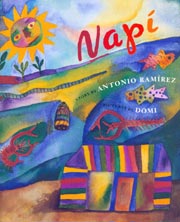
Title: Napí
Author: Antonio Ramírez
Illustrator: Domi
Publisher: Groundwood Books
ISBN: 0888996101
Napí is the story of a young Mazateca girl who lives in a small village near the bank of a river in Mexico. The story is ethereal and dreamlike as is the artwork. Napí likes to dream, she dreams of colors, of feelings, of herons flying through the wind. She talks of her village, of her Naa (mother in Mazateca) making tortillas and of the ancient pachota tree that is the center of her village.
Napí is poor, at least she says so. However, her story is of a girl who feels safe and secure, who loves her village, her huilpilli's in bright colors and her family. She loves the pachota tree under which her belly button cord is buried, the herons who live and nest in it and the colors of nature and her village. Color is important in this book, each page is dedicated to it and the lovely wash of watercolors in brilliant and vibrant colors enhance and compliment Napí's dreams of colors and the river.
Domi illustrated Subcommandante Marcos' The Story of Colors and I love her use of color and the way her paintings have not only a dreamlike quality but also of their indigenous look and feel. This is especially true in this book of an indigenous girl living in her Mazateca village. Domi is Mazateca herself and this book reflects her love of her people and their customs. My favorite illustration is the one where the pachota tree becomes alive at night with as the herons fill the branches like blossoms. It's simply beautiful.
Antonio Ramírez is an artist who has worked in many media, including books and murals. Thisis his first book. He lives in Mexico with his wife, Domi and they are both very active working for the rights of Native people in Mexico, especially in connection with the Zapatista movement in Chiapas through the Colectivo Callejero, of which they were founding members.
I hope you will find this book as beautiful as I did and enjoy it. Happy Thanksgiving!
Hasta pronto,
Gina MarySol Ruiz
Tuesday, November 22, 2005
Review: Richard Vasquez. Chicano.

Michael Sedano
Review: Richard Vasquez. Chicano. NY: Harper Collins Rayo. 2005. ISBN 9780060821043; ISBN: 0060821043
I made two mistakes* about Richard Vasquez’ novel, Chicano. The second is reading the back cover blurb and Daniel Olivas’ review. The first is waiting thirty years to read the novel.
Menso me. Uau, Richard Vasquez’ Chicano is a stunningly fine page-turner of a novel that everyone interested in Unitedstatesian literature deserves to read. If the novel must take an ethnic label, call it one of those sui generis “great American novels.” Which, of course, makes it also chicano literature.
The back cover blurb says something about “the tradition of Upton Sinclair touched with authentic color and understandable bitterness.” Which is a mistake. Chicano has nothing to do with The Jungle, and certainly none of the droning political proselytizing of that novel’s failed final pages. And Daniel Olivas notes “the novel stumbles … when Vasquez attempts to ‘explain’ Chicanismo to his non-Chicano audience.” Which is reading too much into the title. Chicano is not about chicanismo nor racism. It’s a love story that revolves around human stupidity and betrayal, and how those impact people who happen to be Mexicans and Chicanos.
This is not to deny the vital importance of the characters’ Mexican heritage. Vasquez has crafted a family saga rooted in the Mexican desert, California rural farmworker colonias, and late 1950s East Los Angeles.
The first 120 pages offer a sweeping telescopic history of happenstance leading to a family’s migration into the agricultural United States. Not until the 125th page does the term "chicano" enter the book's vocabulary, at the point Julio, one of the two main characters, arrives in Los Angeles.
The story follows the tragic history of two people who lose moral compass. Vasquez doesn’t make a case that Mexican Chicanos inherently tend to alcoholism, prostitution, drug addiction and unprotected sex with pendejos. But Julio and Mariana, in varying degrees, elect those behaviors. Those who do not taste these forbidden pleasures don’t interest the writer. Raza with kindness in their hearts, or who speak good English, attain “mainstream” solidity like business managers or migra, pop up as plot foils, then are forgotten as the writer pursues his moralistic version of family values: Julio in all his rottenness, gets only jail time in a token of revenge by the whore who helped rescue him from endless toil as a fruit picker. Poor Mariana, who represents the best of her generation—smart, articulate, insightful—has to die from a back alley abortion as the consequence of her pridefulness in seducing a cowardly man, who happens to be a rich Anglo college boy cad.
Political conservatives like to whine that raza politics is all about victimhood. These tipos surely need to read Chicano. If there’s a theme Vasquez absolutely denies, it’s that these characters are victims of anything. Greedy, ugly, anglo racists may be ubiquitous, but are little different from the exploitative hacendado, the rapacious bandidos, or imperious soldiers three generations back in Trainwreck. Julio's fall comes as result of his own evil nature. Mariana's case is more complicated, perhaps a consequence of her isolation from both cultures. Happiness comes in being self-possessed, like the illiterate grandfather back in Irwindale, or the mother who runs off with her girlhood boyfriend from el rancho, who appears in rags upon the death of her drunken husband. Now there’s a love story begging to be told.
I hope you have already read your copy of Chicano and I haven’t disclosed anything you might consider a “spoiler.” Ni modo. Richard Vasquez, qepd, has given us a novel so rich in detail and cultural awareness, that readers and critics will enjoy years of discussion. I wish I’d read it years ago. I hope you'll read it and join La Bloga's discussion.
*The mistake reflects my preference to react to a work on its own terms, uninfluenced by a third party.
Hasta, raza, and fellow readers.
mvs
Monday, November 21, 2005
SPOTLIGHT ON LUIS J. RODRIGUEZ
 Monday’s post from Daniel Olivas…
Luis J. Rodriguez has emerged as one of the leading Chicano writers in the country with ten nationally published books in memoir, fiction, nonfiction, children’s literature, and poetry. Luis’ poetry has won a Poetry Center Book Award, a PEN Josephine Miles Literary Award, and “Foreword” magazine’s Silver Book Award, among others. His two children’s books have won a Patterson Young Adult Book Award, two “Skipping Stones” Honor Award, and a Parent’s Choice Book Award, among others. A novel, Music of the Mill, was published in the spring of 2005 by Rayo/HarperCollins; a poetry collection, My Nature is Hunger: New & Selected Poems, 1989-2004, came out in the fall of 2005 from Curbstone Press/Rattle Edition.
Luis is best known for the 1993 memoir of gang life, Always Running: La Vida Loca, Gang Days in L.A. An international best seller—with more than 20 printings, around 250,000 copies sold—the memoir also garnered a Carl Sandburg Literary Award, a Chicago Sun-Times Book Award, and was designated a New York Times Notable Book. Written as a cautionary tale for Luis’ then 15-year-old son Ramiro—who had joined a Chicago gang—the memoir is popular among youth and teachers. Despite this, the American Library Association in 1999 called Always Running one of the 100 most censored books in the United States. Efforts to remove his books from public school libraries and reading lists have occurred in Illinois, Michigan, Texas, and more recently in California, where the battles were quite heated.
Luis has received many other awards including a Sundance Institute Art Writers Fellowship, a Lila Wallace-Reader’s Digest Writers’ Award, a Lannan Fellowship for Poetry, an Hispanic Heritage Award for Literature, a National Association for Poetry Therapy Public Service Award, a California Arts Council Fellowship, an Illinois Author of the Year Award, several Illinois Arts Council fellowships, the 2001Premio Fronterizo, and “Unsung Heroes of Compassion” Award, presented by His Holiness the Dalai Lama.
NUEVO LIBRO: Rigoberto González reviews Demetria Martínez’s new book of essays, Confessions of a Berlitz-Tape Chicana (University of Oklahoma Press). He says that “as a pacifist, environmentalist, feminist and cultural activist in an increasingly hostile world, she has much ground to cover, balancing ‘official stories’ with her charged collection of communiqués…” and that this book “shows a concerned and proactive citizen of the world….” González is an award-winning writer and associate professor of English and Latino studies at the University of Illinois at Urbana-Champaign. (If you're in L.A. tonight, you can see González in the flesh...see immediately below).
THE QUETZAL QUILL: Monday, November 21, 7:30 p.m. to 9:00 p.m., Imix Bookstore will sponsor an evening of entertainment and literature by hosting The Quetzal Quill, a national collective of poets and writers on a mission to promote and share their literary works.
The guest writers are:
Gabrielle Calvocoressi, author of "The Last Time I Saw Amelia Earhart," is a former Jones Lecturer at Stanford. She has received the Rona Jaffe Women Writers' Award and the Bernard F. Cooper Prize from The Paris Review.
Reyna Grande is the author of the forthcoming novel, "Across A Hundred Mountains." She was born in Mexico, educated at the University of California, Santa Cruz, and currently lives in LA, working on her second novel.
Miguel Murphy, author of "A Book Called Rats," winner of the Blue Lynx Prize, is a graduate of Arizona State University, where he received the Swarthout Award and the University Prize from the Academy of American Poets.
Daniel A. Olivas is the author of four books, most recently the story collection "Devil Talk" and the children's book "Benjamin and the Word." He is a Los Angeles based attorney with the California Department of Justice.
Your Host: Rigoberto González. González, founder and curator of The Quetzal Quill, is the recipient of a Guggenheim fellowship and professor of English and Latina/o Studies at the University of Illinois, Urbana-Champaign. He is the author of four books, most recently the bilingual children's book, "Antonio's Card."
The authors' books will be available for sale.
Venue: Imix Bookstore
Address: 5052 Eagle Rock Blvd., Los Angeles, 90041
Ages: All ages
Admission: Free!
For more information call: 323-257-2512
Or visit: http://www.imixbooks.com/
ARTE: Year End Art Sale! Saturday, November 26, 11/26 - 6:00 p.m. to 11:00 p.m.
Join La Mano Press as it says goodbye to another year and to L.A. for the month of December with an event that features the work of local artists as well as the published works that have been produced at the studio.
Artists include: Artemio Rodriguez, Dolores Carlos, Silvia Capistran, Jose Lozano, Emilia Garcia, Robert Palacios, Marianne Sadowski, John Miner, Zeroxed, Imix Books and others.
Venue: La Mano Press
Address: 1749 N. Main St., Los Angeles, 90031
Ages: All
Admission: Free
For more information call: 323 227-0650
Or visit: http://www.lamanopress.com/
Email: lamano-press@sbcglobal.net
IT’S MAGIC: The new issue of Margin is out. Margin is an online journal dedicated to exploring magical realism. The fall issue includes works by:
Kathleen Alcalá • Sherman Alexie • Naomi Ayala • Joe Benevento • Jorge Luis Borges • Kamau Brathwaite • Joseph Bruchac • Michelle Cliff • Paola Corso • Maureen Tolman Flannery • Gabriel García Márquez • Édouard Glissant • Joy Harjo • Adrianne Harun • Linda Hogan • Steve Martin • Gina Ochsner • Nnedimma Okorafor • Daniel Olivas • Simon Ortiz • Gregory Rabassa • Dee Rimbaud • Garrett Rowlan • Bruce Taylor • Mark Twain and others
All done. So, until next Monday, enjoy the intervening posts from my compadres y comadre at La Bloga. ¡Lea un libro!
Subscribe to:
Posts (Atom)