Friday, November 17, 2023

Almost Christmas ? So, New Books and the NBA Winner (not the Denver Nuggets)


The holidays are here, ready or not.  Like a good elf, I present a few titles for the book readers on your gift list.  Three books, three types of literature, three times reading enjoyment. You won't disappoint.
______________________


Flores and Miss Paula
Melissa Rivero

Ecco - December 5

[From the publisher]
Thirtysomething Flores and her mother, Paula, still live in the same Brooklyn apartment, but that may be the only thing they have in common. It’s been nearly three years since they lost beloved husband and father Martín, who had always been the bridge between them. One day, cleaning beneath his urn, Flores discovers a note written in her mother’s handwriting: Perdóname si te falle. Recuerda que siempre te quise. (“Forgive me if I failed you. Remember that I always loved you.”) But what would Paula need forgiveness for?

Now newfound doubts and old memories come flooding in, complicating each woman’s efforts to carve out a good life for herself—and to support the other in the same. Paula thinks Flores should spend her evenings meeting a future husband, not crunching numbers for a floundering aquarium startup. Flores wishes Paula would ask for a raise at her DollaBills retail job, or at least find a best friend who isn’t a married man.

When Flores and Paula learn they will be forced to move, they must finally confront their complicated past—and decide whether they share the same dreams for the future. Spirited and warm-hearted, Melissa Rivero’s new novel showcases the complexities of the mother-daughter bond with fresh insight and empathy.

_____________________
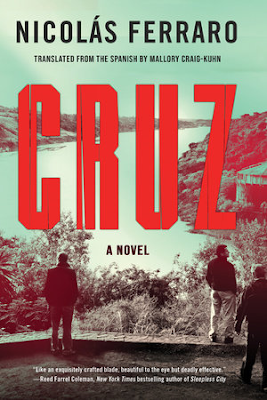


Nicolás Ferraro
Soho Crime - Nov. 14 (hardback published in 2022)

[From the publisher]
Set in northern Argentina, the gorgeous and gruesome story of two brothers following in their criminal father’s footsteps in a bloody battle to save their family from drug lords, perfect for fans of Don Winslow and Narcos.

Tomás Cruz swore he would never be like his father, an abusive cocaine junkie whose gangland exploits are notorious throughout the underbelly of northern Argentina. When Samuel Cruz is sentenced to thirteen years in prison, he leaves a laundry list of unfinished cartel business. Seba, Tomás’s revered older brother, has no choice but to abandon his straight life and take over his father’s underworld debt.

Now fifteen years has passed, Seba has been arrested, and the ruthless cartel boss is holding his wife and daughter as collateral—just in time for the holidays. Tomás is forced to choose between protecting his family and his soul as he assumes the to-do list where Seba left off, plunging into the shocking depravity of the cartel to track a drug deal gone wrong. On a bloody quest for underworld justice that will take him from a nightmarish bar staffed by teenage sex slaves to the murky depths of the Paran River, Tomás discovers himself capable of violence he never thought possible. He must ask himself if he really is his father’s son . . . and he may not like the answer.

Argentinian noir wunderkind Nicolás Ferraro’s first novel to be translated into English, Cruz was a finalist for the prestigious Dashiell Hammett Award for Best Crime Novel.

______________________


The 2023 National Book Awards (NBA) were announced on November 15.  The winner in the Fiction category is:


Justin Torres
Farrar, Straus, Giroux

[From the publisher]
Out in the desert in a place called the Palace, a young man tends to a dying soul, someone he once knew briefly but who has haunted the edges of his life: Juan Gay. Playful raconteur, child lost and found and lost, guardian of the institutionalized, Juan has a project to pass along, one built around a true artifact of a book—Sex Variants: A Study of Homosexual Patterns—and its devastating history. This book contains accounts collected in the early twentieth century from queer subjects by a queer researcher, Jan Gay, whose groundbreaking work was then co-opted by a committee, her name buried. The voices of these subjects have been filtered, muted, but it is possible to hear them from within and beyond the text, which, in Juan’s tattered volumes, has been redacted with black marker on nearly every page. As Juan waits for his end, he and the narrator recount for each other moments of joy and oblivion; they resurrect loves, lives, mothers, fathers, minor heroes. In telling their own stories and the story of the book, they resist the ravages of memory and time. The past is with us, beside us, ahead of us; what are we to create from its gaps and erasures?

A book about storytelling—its legacies, dangers, delights, and potential for change—and a bold exploration of form, art, and love, Justin Torres’s Blackouts uses fiction to see through the inventions of history and narrative. A marvel of creative imagination, it draws on testimony, photographs, illustrations, and a range of influences as it insists that we look long and steadily at what we have inherited and what we have made—a world full of ghostly shadows and flashing moments of truth. A reclamation of ransacked history, a celebration of defiance, and a transformative encounter, Blackouts mines the stories that have been kept from us and brings them into the light.


Later.

___________________________

Manuel Ramos writes crime fiction. Read his latest story, Northside Nocturne, in the award-winning anthology Denver Noir, edited by Cynthia Swanson, published by Akashic Books.


Thursday, November 16, 2023

Chicanonautica: Back to a Transmogrified World


Once again, I’m back from a road trip and the world has changed. When we took off on this one, we were about to face it all with a new Speaker of the House, and somehow that went wrong. Who would have thought that the Republicans would suddenly act like a tank full of piranha after a chunk of bloody meat? In the wake of Trump’s trials, they’re too busy going after each other to worry about us nefarious Latinoids.


Even in the face of the boiling international situation–Hey! Look! There are other borders on this planet and a lot of them are hot spots.


Then there’s those mass killings . . .


My wife, her brother Mike–the road trip Zen maestro–and I were having laughs over the news from Washington and Georgia as we wandered while cherchez-la-weirding through NoCal (being born in Eastlos, that’s exotica to me), Sasquatchlandia, and Planet Nevada. I was also taking a lot of photos, scribbling notes. Like Guillermo Gómez-Peña once said, “are we migrating in reverse? or are we simply collecting data for future projects?” When you're a writer, everything is research, and if done right, can be a lot of fun.


But then there are a lot of ugly heads being reared, and when you go looking for America, you never really know what you’ll find.

I enjoy the bizarre rasquache and weird beauty that comes from all the worlds colliding, but the post-Apocalyptic, and dystopian thread running through things is disheartening.


Disheartening. Interesting word. Why is it conjuring images of Aztec sacrifices in my brain?


I’m a dreamer and an optimist, but I believe in paying attention. I’ve got the Odysseus Syndrome–I have to hear the song of the Sirens. Once you’ve heard them, the flashes of utopias are sweeter.


And I realize that what is utopia for some is dystopia for others. That’s what politics is all about.


So, I’ve got all this stuff in my head, my phone (freshly downloaded into my computer), and my sketchbook. More stuff comes in all the time thanks to our modern media. I’m gonna do my usual travelogues both here and in Mondo Ernesto. Some of it will make its way into, or at the least influence, my stories and novels. It’s where I get those crazy ideas.


This time it's going to be more intimately linked with wondering where it’s all going.


Funny, that seems to be one of my favorite themes.


Meanwhile, on utopian flash side of things, nature is still alive and well, if wounded, cannabis is a major industry in the West (it reminds me of how in Norman Spinrad’s Bug Jack Barron, the sponsor of the hero’s TV show was Acapulco Gold), murals, graffiti, and yard art are alive and well, Mexican restaurants (and Mexicans) are thriving outside of Aztlán, and even in crumbling cities and landscapes, people get creative. When the going gets tough, the tough get creative. It’s our secret weapon and superpower.


And I’ll be reporting through mutant Chicano cyborg eyes.


Ernest Hogan's new book, Guerrilla Mural of a Siren's Song: 15 Gonzo Science Fiction Stories ( formerly known as Pancho Villa's Flying Circus) is finally available, and he will once again be judging the Somos en escrito Extra Fiction contest, and is still hoping for stories that will blow his twisted mind and turn civilization inside out.


Wednesday, November 15, 2023

A Crown For Corina

By Laekan Zea Kemp 

Illustrated by Elisa Chavarri 


Publisher: Little, Brown Books for Young Readers 

Language: English

Hardcover: 40 pages

ISBN-10: 0759556849

ISBN-13: 978-0759556843


A charming story about a girl who learns a beloved family tradition and the symbolism behind the Mexican flower crown, from two Pura Belpré award-winning creators.


Today is Corina’s birthday, and she’s excited to wear the biggest crown with the most beautiful flowers picked from her abuela’s garden.


Each flower tells a special story about all the ways Corina is rooted in the family she loves. 


With elegant and eye-catching illustrations from award-winning artist Elisa Chavarri, this charming story shares a beloved family tradition through one girl’s journey of self-discovery as she learns about the symbolism behind the Mexican flower crown.


Review


* “A gorgeous picture book celebrating tradition, family, and memories. Highly recommended for school and public libraries.”―SLJ, starred review


“Highlighting seasonal cycles and the natural passage of time, it’s a lushly told story that emphasizes the role of the past in the present and future.” ―Publishers Weekly


“Lush botanical illustrations are paired with a timeless message about the importance of family….A heartwarming story blooming with tenderness.”―Kirkus


“Kemp smoothly melds the corporeal with the intangible, lingering over the physical sensations of brushing past flowers, smelling their scent…Chavarri’s use of vivid watercolors in hazy, dream-like brushstrokes adds to the wistful warmth and movement of the story.”―BCCB


"Kemp movingly uses the setting of Abuela's flower garden to encourage young readers to explore their roots and who they might want to be....A warm meditation on family, perfect for sharing with a grandparent."

 ―Booklist


Laekan Zea Kemp is a writer living in Austin, Texas. She has three objectives when it comes to storytelling: to make people laugh, cry, and crave Mexican food. Her work celebrates Chicanx grit, resilience, creativity, and joy while exploring themes of identity and mental health.


Elisa Chavarri is an illustrator originally from Lima, Peru. She did much of her growing up in Northern Michigan where she now resides with her husband and two young children. www.elisachavarri.com


Tuesday, November 14, 2023

Chicana Chicano Literary Canon? Redux

What La Bloga Wants for Its 19th Birthday: World Peace and a Chicana Chicano Literary Canon

Michael Sedano

It was nineteen years ago this month, Sergeant Pepper taught the band to play around on the internet. We Blogueros were gainfully employed, commuter rat-racing daily to the jale. We--Rudy Ch Garcia, Manuel Ramos, Michael Sedano--were friends at CHICLE, a Listserv run by Teresa Marquez out of the Zimmerman Library at the University of New Mexico. Some sort of pedo went down and CHICLE got shut down.

Rudy wrote one day he'd registered us for a new thing called a V-log, or a Blog.

And that was the start of La Bloga, gente. Thank you for joining us in the world's longest continuously operating literary blog dedicated to raza arte.

We agreed we'd avoid discussing one topic, "what is chicano literature?" While that's an impossible question, it's possible to look at United States literature and identify clearly a genre gente are calling Chicana Chicano Latina Latino raza writing.

I don't try to define our literature, I want to read all I can and thus let the thing itself define iself. Here are a pair of reprints of "seminar speculations" from La Bloga's past, where I delve into the "definition" by means of examples, seeking input from other readers and critics. 

I know it when I read it. So, what should I read?


Reprint from January 2005
by mvs

Back in 1969 Herminio Rios and Octavio Romano from Berkeley's Quinto Sol Press published the world's first anthology of chicano literature, El Espejo. An outstanding collection that included such poets as Abelardo and Alurista. A few years later, Nicolas Kanellos in Texas, I think it was, started Revista Chicana-Riqueña, publishing work that mirrored Quinto Sol's writers, but Revista expanded its recruitment to include Boricua and other ascendencia hispanoparlante writers. An academic tipo jumped on the literary convergences he saw, and published a paper on Canonical and Non-Canonical Work. The critic found shortcomings in the puro chicano strategy Rios and Romano adopted.

My critical opinion of the brouhaha is "whatever." My preference has always been to let the writing stand on its own merits. No biography, no historical context, no appositional translation. Let the work stand on its own merit. Still, it was grist for the academic mill and I sometimes wonder if the pedo over what constitutes "canonical" hasn't slowed the acceptance of chicana chicano writing by a broader audience, and in particular, into the pages of high school anthologies. The anthology's the thing to capture the conscience of future readers.

Sadly, without some push from somewhere, chicana chicano literature keeps getting left out of the high school curriculum. Have a look at US Literature textbooks. I haven't done a comprehensive survey, but I'd bet Sandra Cisneros and Gary Soto get anthologized a lot more than any other writer.

No, I'm not donning armor to joust with textbook companies or state deptos of education. But I would like to see kids--especially chicanesque kids-- read the best US literature, which must include chicana chicano lit. So here's my question. Considering whom you're targeting, if you could give a library of essential chicana chicano writing--prose, poetry, essay, criticism--would you have a long list, or a short one? What would you recommend to a high school kid; a high school English teacher; a working class reader?

Here on the jale I run a couple of reading programs. One, a general reading program for customer service reps--knowledge workers-- who need constantly to improve their oral communication and reading skills because they talk on the phone and read stuff out of a catalog. For them, I buy a bunch of paperbacks and populate a shelf in their lunchroom. I choose good stuff that a popular audience might enjoy; if there's a film or TV tie-in, all the better. Another group is gente in the warehouse who want to move into an office job, or people I notice who seem to have a lot on the ball. Most of the latter group are Mexican or Salvadoran immigrants, the majority Spanish-speakers who don't read a lot of English. Sadly, there's no hope to become a knowledge worker until they can listen, speak, and read English.

Here's the stuff I've been handing out. It's not a canon, perhaps more indicative of what my local indie bookseller shelves, and stuff I like that I want people to enjoy:
Julia Alvarez, In the Time of the Butterflies.
Rodolfo Anaya. Shaman Winter.
Rudolfo Anaya, Zia Summer.
Rudolfo Anaya, Alburquerque.
Edgar Rice Burroughs, The Gods of Mars.
Edgar Rice Burroughs, A Princess of Mars.
Edgar Rice Burroughs, Tarzan of the Apes.
Orson Scott Card. Pastwatch. The Redemption of Christopher Columbus.
Sandra Cisneros, House on Mango Street.
Sandra Cisneros, Woman Hollering Creek.
Agatha Christie, And Then There Were None.
Charles Dickens, A Christmas Carol.
Dashiell Hammet, The Maltese Falcon.
Robert A. Heinlein, Starship Troopers.
Joseph Heller, Catch-22.
Tony Hillerman, The Ghostway.
Walter Mosley. Always Outnumbered, Always Outgunned.
Walter Mosley, Black Betty.
Walter Mosley, Devil in a Blue Dress.
Robert Parker, God Save the Child.
Manuel Ramos. The Last Client of Luis Montez.
Manuel Ramos. Blues for the Buffalo.
Manuel Ramos. The Ballad of Gato Guerrero.
Manuel Ramos. The Ballad of Rocky Ruiz.
Michele Serros, Chicana Falsa and other stories.
Sara Paretsky, Blood Shot.
Sara Paretsky, Indemnity Only.
Helena Viramontes, Under the Feet of Jesus.

How about your list? If you could offer a high school a library of chicana chicano literature, what's on the list? How about their teacher?

Reprint from September 2007
Propaedeutic to a Chicana Chicano Canon 

Michael Sedano

I confess I’ve wanted to use “propaedeutic” in a title for a long time just never got around to it. I’m glad that’s out of my system. The word, not the question. I had lunch with a professor of C/S recently and forgot to quiz her on what literature goes into today’s majors and minors across the field. I’ve looked at syllabi on the internet and see as many “essentials” as there are profes angling for enrollment, so one’s choices for cultural literacy become luck of the draw rather than some compelling sense of a literature in common, or a clear recommendation to the high school 9-12 sequence.

The notion of a canonical literature for chicanas chicanos goes back to the beginnings of “Chicano” literature, and of La Bloga. Especially with the holidays around the corner, there’s value in asking again a pair of questions: what chicanarte titles should populate the shelves of readers of United States Literature, and readers of Chicana Chicano Literature?


In 1969, Quinto Sol publishers in Berkeley, California, published a beautiful anthology titled El Espejo: The Mirror. Selected Mexican-American Literature. Editor Octavio Romano had included exciting new chicano voices—there were few but men published-- but also pieces with strong allegiances for the anglo-european mainstream that justified the hyphenated subtitle. Then, 1972, in the fifth printing, with Herminio Rios on board, El Espejo: The Mirror became “ Selected CHICANO Literature”. The assimilationist, “just as good as” writers, had disappeared to the benefit of readers who now discovered Alurista, Abelardo, Tino Villanueva, rrsalinas. Poets.

Shortly after the emergence of the movimiento-infused literature of El Espejo and its supporting journal El Grito, a competing journal showed another set of voices. An east coast journal, Revista Chicano-Riqueña, arrived, with equal power to that out of Berkeley and the Southwest. The journal went through several transformations, existing for a quarter century, and was celebrated in 1988 with an award-winning anthology Floating Borderlands Twenty-five Years of U.S. Hispanic [sic] Literature”.

The 1980s saw an explosion of literary anthologies. The editors wrote about a “Chicano Renaissance” visible in the collections, which would replay variations of the tables of contents of El Espejo, El Grito, and la revista., even as scholars debated the “canonical” approach of El Espejo versus the “non-canonical” approach out of the east.

All that was the literature of my youth. The point being, it’s been 40 years, gente, since that first El Espejo collection. By now raza have amassed a corpus of work that suggests value in renewing a search for the ten foot shelf of essential titles that every family must own, that every kid can’t graduate high school or college without having read, that fills your gift list for the next ten years of a kid’s upbringing.

Any collection of essential work must include new work. The classics might be published tomorrow, but you’ll go broke buying every tempting title showcased at La Bloga or otherwise recommended by friends. Ojalá your public library has a new books budget and buys widely.

Owing to the hundreds, perhaps thousands of chicana and chicano writers, thankfully, anthologies continue to hit the market. It’s useful to come across a couple of newish anthologies, Cristina García’s 2006, Bordering fires: the vintage book of contemporary Mexican and Chicano/a literature (New York : Vintage Books, 2006) and the more recent Hecho en Tejas: an anthology of Texas-Mexican literature, edited by Dagoberto Gilb. (Albuquerque: University of New Mexico Press published in cooperation with the Southwestern Writers Collection, Texas State University, 2006).
http://labloga.blogspot.com/2006/05/nuevo-y-viejo.html

From here, it’s time to prioritize the novels I want to read again, and start from the top. Where would you begin?


Thursday, November 09, 2023

Veterans Day, 2023, the Ultimate Sacrifice Ignored

                                                                                 
A day of remembrance and reflection

Note: On this Veterans Day, I chose to rewrite an essay I wrote last year. It only seems appropriate, lest we forget the servicemembers and their families who paid the unforgettable price.

      As another Veterans Day approaches, the words of journalist Carlos Sanchez, written in 1989, still resonate. In his Washington Post article, “Another Unknown Soldier,” Sanchez wrote: “It has fallen to the Mexican Americans of the war generation to teach Longoria’s story; too often it has fallen to chance.” 
     I came across Sanchez’s article in 1991, my third-year teaching community college in upscale Santa Monica. I’d heard of Felix Longoria, but I’d never pursued the story, not until Sanchez reporting fell into my hands. At the time, I was teaching a course in Chicano Literature, the first time it had been taught in the English department. I was the first tenured Chicano faculty member in the department, so I lobbied for the class. 
     At the time, I had just published my novel Pepe Rios, the story of a young man’s struggles through the early days of the Mexican Revolution, and I was finishing a novel about Chicanos in Vietnam, Shifting Loyalties. In 1988 Joe Rodriguez had published his Vietnam novel, Oddsplayer, and, in 1990, Charley Trujillo had just published Soldados, which would go to win the prestigious 1991 National Book Award. 
     The earliest literature I’d read about “Chicanos and Vietnam” was a poem, “Another Death in Vietnam,” by Omar Salinas, in his book, Crazy Gypsy (1970). Barely two-and-a-half-years home from the war, and having lost many friends, I was deeply affected by Salinas’ lines: “another sacrifice for America – a Mexican/ the sacrifice is not over.” 
     Just about that time, my father handed me a book by Raul Morin, Among the Valiant (1963), stories of Chicanos who had won the Medal of Honor in WWII and Korea. I knew Chicanos had won more Medals of Honor than any other ethnic group in WWII, so it made sense to me that in the final pages of his book, Morin, a WWII veteran, had written, “These Chicanos were different from the Mexican Americans that we had known before we left the States and went overseas…. Where we had been held in contempt by others who disliked us because of our constant Spanish chatter or our lax in military discipline, we were now admired, respected, and approved by all those around us including most of our commanding officers.” 
     I assigned Soldados to my students, and Charley Trujillo was gracious enough to come by and speak to my class, a real eye-opener for college students, most who knew nothing about Vietnam, and really, very little about war, at all. They’d lived in a world of relative peace. 
     I’ll always remember one female Vietnamese American student saying shyly, “I didn’t know Chicanos had fought in Vietnam.” Her comment shocked me. In the military and in Vietnam, I’d seen more Chicanos, Puerto Ricans, and African Americans than I’d ever seen in any one place, for sure not on any college campus. If she didn’t know Mexicans had served in Vietnam, this child of Vietnamese refugees, how many other Americans didn’t know, or didn’t care? As Sanchez inferred in his article about Felix Longoria, it was our responsibility to teach Longoria’s story, as well as the stories of other Mexicans who sacrificed so much for this country. 
     At the time, the early 90s, I confess, I was hesitant to teach books about war in my class, especially Vietnam, fearing students, like young Latinos and Latinas, susceptible to military recruiters on campus, might romanticize war, forego college, and join the military. Yet, one can’t separate history from literature. There would be no Chicano Studies, as we know it, without war, from the Mexican Revolution to World Wars 1, II, Korea, and Vietnam, the catalyst for the Chicano Movement. So, Felix Zepeda Longoria’s story, and the stories of all Chicano veterans, had to be told and passed down to future generations of Americans, to teach them the Mexican community is woven into the fabric of this country. 
     On June 15, 1945, Pvt. Felix Z. Longoria, “…after volunteering to flush out retreating Japanese in the Philippines,” was killed, barely two months before Truman announced the end of the war. It took three years for Pvt. Longoria’s remains to come home to Three Rivers, Texas, a small town between Corpus Christi and San Antonio. When Longoria’s distraught wife, Beatrice, went to make arrangement at the local funeral home, the owner-director, Tom Kennedy, denied her request. He said, “The whites wouldn’t like it.” 
     Beatrice’s sister, Sara, and later, Dr. Hector Garcia, a Corpus Christi physician, and a veteran, tried to intercede. Kennedy told them the same thing, that they should find another place for the viewing because the whites would not like it in the town’s mortuary, and he feared their retribution. 
     Dr. Garcia took the story to the newspapers. He sent letters everywhere, even to congress. Longoria’s story attracted national attention, embarrassing many politicians in Texas. The story “horrified” Americans throughout the country. Famed journalist, Walter Winchell stated on national television, “The state of Texas, which looms so large on the map, looks mighty small tonight.” 
     Mexicans and Americans rallied around the Longoria family. A young senator from Texas, Lyndon Johnson, embarrassed by the situation, stepped in, and though he had no authorization over the Rice Funeral Home in Three Rivers, Texas. lobbied to have Felix Longoria buried, with full military honors, at Arlington National Cemetery, in Virginia. In his letter to Senator Johnson, Dr. Garcia, wrote that Kennedy’s refusal to honor the Longoria family’s request is “a direct contradiction of those same principles for which this American soldier made the supreme sacrifice in giving his life.” Johnson replied, in part, “I deeply regret to learn that the prejudice of some individuals extends even beyond this life.” 
     The Texas legislature investigated the incident and concluded no discrimination occurred. Ironically, they “conducted the investigation in a building next door to a barbershop that did not serve Mexican Americans.” At the time, Jim Crow laws were vigorously enforced, even for returning Mexican veterans, some who had seen the worst fighting in Europe and the Pacific, the same men who, after their discharges, would challenge the racist system that still existed throughout the country. 
     In his article on racism in America, “Saying I’m not Racist,” Steven Hochstadt writes, “Throughout the first half of the 20th century American scientists, philanthropists and political leaders agreed that people of any color but white were inferior and that their lives were not worthless but worth less.” Hochstadt calls this the “racist consensus” and argues, it, “was visible in every public space in America. Every major newspaper, every radio and, later, TV station, every legislative body, every private club, and every classroom taught, repeated, and reinforced the racial rankings that had developed.” Sounds like some of those states would like to take us back to those times. 
     This was certainly true in Three Rivers, Texas in 1945, and though Pvt. Longoria’s remains rest among the country’s great Americans in Virginia overlooking the Potomac into D.C., Longoria’s sister-in-law, Sara, stated, “This is so sad, that he had to come and rest so many miles away from home because of ignorant people.” 
     No doubt, it was an honor to be buried at Arlington National Cemetery, but at the same time, wasn’t it a dishonor, a humiliation, and a slap in the face, to be refused burial on your own land, among friends and family, where your people have lived for generations? Many Texas families, like the Longoria’s, Sanchez wrote, “…traced their family back a century or more to the time Texas still belonged to Mexico, it had an unusual effect. The Mexicans of Texas, though they were U.S. citizens, thought of themselves as Mexicans. Their Anglo neighbors thought so, too.” 
     Was Felix Longoria’s sacrifice, and the sacrifices of many Mexicans during war, made in vain? Maybe not. It might carry more importance than private Longoria could ever have imagined. Dr. Garcia said, “It changed the whole situation for our people.” Educators, like Professor Ricardo Romo, UT Austin, stressed, “I think it [the Longoria story] was the catalyst for the development and emergence of the civil-rights movement in the Mexican American community.” Historian, Carl Alsup, said about Mexican Americans returning from WWII, “They returned to a situation in which all the old barriers are still in place.” Yet, he concluded, after the Longoria story broke, “For the first time, the national public took notice of the Mexican American condition.” 
     Yet, in 2017, when Ken Burns released his much-awaited documentary The Vietnam War, I, and many Chicano veterans, watched, enthusiastically, but by the conclusion I was disillusioned. Latinos, particularly Chicanos, who have served in this country’s wars longer and in greater numbers than any other ethnic group, were non-existent. Just like in Tom Brokaw’s bestselling book, The Greatest Generation, of all the WWII veterans profiled, Mexicans were absent. 
    Last year, I sat down to watch PBS series, the American Veteran, and again, but for a brief 30 second appearance by a veteran named Ayon, Chicano, Latina and Latino veterans. were absent. Is this absence just another way of saying, “Sorry, we can’t offer you services here. It might offend the whites.”

Wednesday, November 08, 2023

International Latino Book Award Ganadores 2023


This is the list of picture books awards. To find the list of all ganadores, visit https://www.latinobookawards.org


Felicidades a todos los ganadores.


A1 CHILDREN BOOK AWARDS


The Alma Flor Ada Best Latino Focused Children’s Picture Book Award

-Gold Medal:Jovita Wore Pants: The Story of a Mexican Freedom Fighter, Aida Salazar, Art by Molly Mendoza; Scholastic Books.

-Silver Medal: Only for a Little While, Gabriela Orozco Belt; Illustrated by Richy Sánchez Ayala; Balzer + Bray; Ancestry of the author(s): U.S./ Costa Rica; The author(s) lives in: Las Vegas, NV.

-Bronze Medal: Abuela’s Fideo: A Story of a Grandma’s Love, Gabriela Tijerina; Del Alma Publications, LLC; Ancestry of the author(s): USA, Mexican; The author(s) lives in: San Antonio, TX.

-Bronze Medal: Vitamina C for Cultura, Mando Rayo & Suzanne García-Mateus; Jade Publishing; Ancestry of the author(s): U.S./ Mexico; The author(s) lives in: San Jose, CA.


The Alma Flor Ada Best Latino Focused Children’s Picture Book Award – Spanish

-Gold Medal: El cabello de Gregorina, Milagros Wallace, illustrated by Alynor Díaz; Snow Fountain Press; Ancestry of the author(s): Venezuela; The author(s) lives in: Chicago.

-Silver Medal: Domingos con abuelita, Teresa Verduzco, illustrated by Gloria Felix; Adobe House Press; Ancestry of the author(s): Michoacán, Mexico; The author(s) lives in: California.

-Bronze Medal: Soy la arepa, Ximena Montilla, illustrated by Laura Stagmo; Clases Listas; Ancestry of the author(s): Venezuela; The author(s) lives in: Atlanta.  


Best Children’s Fiction Picture Book – English

-Gold Medal: Mr. Macaw Lost in the Big City/ El Sr. Macaw perdido en la gran ciudad, Leticia Ordaz; Cielito Lindo Books; Ancestry of the author(s): Mexican American; The author(s) lives in: Sacramento, CA. 

-Gold Medal: Something Happened to My Dad: A Story About Family Separation and Immigration, Ann Hazzard & Vivianne Aponte Rivera; American Psychological Association.

-Silver Medal: Something About Grandma, Tania de Regil; Candlewick Press; Ancestry of the author(s): Mexico; The author(s) lives in: Mexico city.

-Bronze Medal: Little Person, Luis Amavisca, illustrated by Anna Font; nubeOCHO; ; The author(s) lives in: Málaga, España.

-Bronze Medal: Magic: Once Upon a Faraway Land, Written and illustrated by Mirelle Ortega;  Ancestry of the author(s): México; The author(s) lives in: Los Angeles

-Bronze Medal: Run, little Chaski! An Inka Trail Adventure, Mariana Llanos, Illustrated by Mariana Ruiz Johnson; Barefoot Books; Ancestry of the author(s): Perú; The author(s) lives in: Oklahoma City.


Mejor libro ilustrado de ficción para niños

-Gold Medal: El Mundo Magico de Mishi, Carla Martilotti; ; Ancestry of the author(s): Italian/ Uruguayan American; The author(s) lives in: Miami, Fl. 

-Silver Medal: Algo Le Pasó a Mi Papá: Una Historia Sobre Inmigración y la Separción Familiar, Ann Hazzard & Vivianne Aponte Rivera; American Psychological Association.

-Silver Medal: El gato más largo del mundo, Susana Illera Martínez, illustrated by Blanca Bk; Hola monstruo; Ancestry of the author(s): Colombia; The author(s) lives in: Miami, FL.

-Silver Medal: Guapa Canta, Canizales; Apila Ediciones; Ancestry of the author(s): Colombia; The author(s) lives in: Palma de Mallorca, Spain. 

-Bronze Medal: El fantasma de las bragas rotas, José Carlos Andrés, Illustrated by Gómez; nubeOCHO; Ancestry of the author(s): España; The author(s) lives in: Santander.


Best Children’s Nonfiction Picture Book

-Gold Medal: When I Feel at Home, Dia Mixon, illustrated by Siara Torres; El Mundo Mixon Books; Ancestry of the author(s): US/ African American; The author(s) lives in: Columbus, OH. 

-Silver Medal: Arepa, Ximena Montilla, illustrated by Laura Stagmo; Clases Listas; Ancestry of the author(s): Venezuela; The author(s) lives in: Atlanta.

-Bronze Medal: Daniela y las mujeres pirata de la historia, Susanna Isern, illustrated by Gómez; nubeOCHO; Ancestry of the author(s): España; The author(s) lives in: Santander, España.

-Bronze Medal: El monstruo Téfilo, Mónica Moranchel Matarranz, illustrated by Teté Cirigliano; Editorial Gunis; Ancestry of the author(s): España; The author(s) lives in: Guadalajara, España.


Best Educational Children’s Picture Book – English

-Gold Medal: Lupe Lopez: Rock Star Rules!, e.E. Charlton-Trujillo, Pat Zietlow Miller; Candlewick Press; Ancestry of the author(s): Mexican American; The author(s) lives in: San Antonio TX & Madison WI.

-Silver Medal: Brave Lolis Learns English / La valiente Lolis Aprende inglés, Armida Espinoza, Illustrated by Robert Blancas; ; Ancestry of the author(s): Mexican American; The author(s) lives in: Fresno, CA.

-Silver Medal: Day of the Dead - Día de los muertos, Marisa Boan; Magic Spells for Teachers LLC; Ancestry of the author(s): Cuban-American; The author(s) lives in: New York.

-Bronze Medal: ABC Taíno, Armando Valdés Prieto; Little Boricuas; Ancestry of the author(s): Puerto Rican; The author(s) lives in: San Juan, P.R.

-Bronze Medal:  Chabelita’s Heart/ El corazón de Chabelita, Isabel Millán; Reflection Press; Ancestry of the author(s): Chicana: Mexican American; The author(s) lives in: Portland, OR.

-Bronze Medal: Polvorones, Marta Arroyo, Illustrated by Isa Medina; Babidi- bú; Ancestry of the author(s): Mexico; The author(s) lives in: San Diego, CA.  

-Bronze Medal: Raspas con mi Grandpa: A Spanglish Story, Eliza M. Garza; The author(s) lives in: Mc Allen, TX.

-Bronze Medal: Taking Flight with Captain Mama/ Despegado con Capitán Mamá, Graciela Tiscareño-Sato; Gracefully Global Group LLC; Ancestry of the author(s): Mexican-American; Th author(s) lives in: San Francisco. 

-Bronze Medal: The Sculpture for Children Though the Hands of Ángel Tarrac/ La escultura para niños a través de las manos de Ángel Tarrac, Carlos F. Tarrac; Unique Artistic Creations Showcase; Ancestry of the author(s): Mexico; The author(s) lives in: San Diego, CA.


Mejor libro ilustrado educativo para niños

-Gold Medal: Éramos una vez... mi mamá y yo, Saioa López Rico, Illustrated by Eva Rami; ; Ancestry of the author(s): España; The author(s) lives in: Vitoria-Gasteiz, Spain.

-Silver Medal: Pimpón, Libro para cantar y jugar, Yolanda Borrás; I’m Bilingual!; Ancestry of the author(s): Dominic Republic; The author(s) lives in: Atlanta, Ga.

-Bronze Medal: El Cielo de Susana, Lulú Buck, illustrated by Chrys Zyx; FriesenPress; The author(s) lives in: Frederick, Co. 


Most Inspirational Children’s Picture Book – English

-Gold Medal: ¡Eso es extraño! That’s Weird!, Pilar Vélez; Snow Fountain Press; Ancestry of the author(s): Colombia; The author(s) lives in: Miami.

-Silver Medal: Mi Casa is My Home, Laurenne Sala, Pictures by Zara González Hoang; Candlewick Press.

-Bronze Medal: The Tree of Hope: The Miraculous Rescue of Puerto Rico’s Beloved Banyan, Anna Orenstein-Cardona, illustrated by Juan Manuel Moreno; Beaming Books; Ancestry of the author(s): Puerto Rico; The author(s) lives in: London, UK.


Libro más inspirador ilustrado para niños

-Gold Medal: Éramos una vez... mi mamá y yo, Saioa López Rico, Illustrated by Eva Rami; Ancestry of the author(s): España; The author(s) lives in: Vitoria-Gasteiz, Spain.

-Silver Medal: Silencio, Nívola Úya; Cuento de Luz; Ancestry of the author(s): España; The author(s) lives in: Mallorca.

-Bronze Medal: Soy solo mía, Raquel Díaz Reguera; nubeOCHO; Ancestry of the author(s): España; The author(s) lives in: Sevilla, España.


Tuesday, November 07, 2023

In the Room They Come and Go and Talk of Chicano Lit

Casa Reyna Hosts Backyard Floricanto
Michael Sedano

The fact my wife and I majored in English for our BA had a lot to do with Casa Sedano’s tradition of literary salons we dubbed the Backyard Floricanto. Also, the Living Room Floricanto.

Ordinarily, a Festival de Flor y Canto takes place across several days on a college campus supported by a nice budget. The whole idea of floricanto translates well to the intimate setting of your living room or back yard.


The most famous literary salon is the setting of “The Love Song of J Alfred Prufrock,” the one where the women come and go talking of Michelangelo. At first, I considered inviting gente to a Tertulia at our house, but too many immediately asked “what’s a tertulia?” It’s a Floricanto. 

Anyone can, and should, hold floricantos in their own space. The process is elegantly simple: connect with a writer promoting a new book; invite friends for a reading and Open Mic; lay out snacks; welcome guests do the reading; kick back with the author. The fulness of the event promises a celebration of literacy, good food, and camaraderie.

The first Backyard Floricanto at Casa Sedano came out of a Pasadena Literary Festival whose organizers invited a single panel of chicana chicano writers. After the Q&A, I invited the panel and anyone within earshot and we had the first backyard floricanto. It was impromptu and it set the model.


The most recent Backyard Floricanto follows the model while establishing new standards.


As English majors, Barbara and I enjoyed the rich diet of arte and literary events that make Los Angeles a major center of world culture. Long before her diagnosis, Barbara’s Alzheimer’s Dementia had begun affecting our ability to get out. We stopped going out, and we started inviting cultura to our pad.


Jesus Treviño was on the guest list and he immediately recognized the opportunity to document the writers invited to Casa Sedano. Jesus, who directs the superb documentary site, Latinopia (link), partnered with Casa Sedano to keep a video record of the writers. 

Latinopia’s near-encyclopedic record of great raza writers comes to you free. Just click and explore.