![]() |
| Michael Sedano, Sal Baldenegro Jr., Wenona Benally Baldenegro, Jesus Treviño |
The world's longest-established Chicana Chicano, Latina Latino literary blog.
Wednesday, March 14, 2012
On the Road for Banned Books: We Meet Rising Political Stars
Tuesday, March 13, 2012
On the road for banned books. On-Line Floricanto.
![]() |
| Jesus Treviño and Ernest Hogan |
The Librotraficante bus left Houston on schedule Monday, to great fanfare from well-wishers and teevee cameras. I hope the entire nation saw that on the news and knows the book smugglers are on their way.
We --I’m hitching a ride with filmmaker Jesus Treviño—departed California about the same time, and we will join the route in El Paso on Wednesday. Treviño and I are interviewing and videographing / photographing various Chicana and Chicano authors en route to Wednesday’s meet-up with the gente on the bus. My stuff will be in these road reports. Jesus’ videos are for Latinopia and a special assignment for the LA Times.
ICE alert! Just across the Colorado River, in Arizona, traffic bottlenecks then stops for an Immigration checkpoint. The Chicano migra agent doesn’t racially profile us except in krypto solidarity. Where you headed, he wants to know. "Tooson", I answer. “Took-son” he echoes and yes, he’s hot in all that tactical gear he’s wearing.
The brother bids us a good trip to Tucson, and he’s right. It is a good trip. It shall become better by the day, heck make that by the hour because the desert is in bloom with ocotillo, lupine, brittlebush, buttercups, and gobernadora splashing the landscape with abundant colors, red, blue, yellow, green.
Monday we interview Chicano sci-fi author-artist and La Bloga bloguero Ernest Hogan and his wife, Emily, who also publishes science fiction. Today, Tuesday, we’re on the road to New Mexico.
Wednesday we’ll visit with the editor of the world’s second Chicano Literature anthology, We Are Chicanos: An Anthology of Mexican American Literature, Felipe Ortego y Gasca, and later, author Denise Chavez. That evening we’ll be covering the banned books floricanto at Mercado Mayapan in El Paso Texas.
Thursday it’s a second stop at Denise Chavez’ chante and bookshop for a morning floricanto. Then the caravan heads north to Rudolfo Anaya’s home in Alburquerque, then to the National Hispanic Cultural Center that evening for another fabulous floricanto like the earlier fundraiser.
Friday and Saturday we’re in Tucson for floricanto, workshops, banned book distribution, and a general celebration of literature and cultura for all. Visit the Librotraficante site for late-breaking details.
On-Line Floricanto Mid-March Tuesday
smuggle books
if you must
but with them smuggle compassion
sneak it into your own heart
tuck it between each page
if you must
dry your tears
soothe your fears
bare your chest show a breast
bribe the border guards with it
if you must
smuggle your heart right out in the open
into the hearts lives souls of others
wear it on your soft sleeve
make your heart an open book
take a page from the wisdom of the ages
if you must
with patience grasshopper
fellow feeling
in grace go
with a glad smile's healing tears
a new river is flowing
from these wet books
Julie SuZaNNe BröKKeN, March 2012
![]() |
| Julie Brökken |
Julie SuZaNNe BröKKeN is an artist-poet. She offers her poem, "Smuggle Compassion" as a gift from the heart, free to any and all who want to read it, print it, pass it forward profusely that we may all be the love and compassion that creates the best kind of change.
Her poem was inspired as a response to Arizona SB 1070, the banning of books in Tucson schools, and the fear and ignorance that fuels such actions. She wanted to support the Librotraficante and their efforts. (See Librotraficante.com)
Julie is descended from primarily European farmer immigrants, (Norwegian, Swedish, German, English, French, Swiss, Turkish, and Native American) many of whom experienced anti-immigrant bigotry during World War I. She learned from her Grandma Dorothy, not textbooks, that in 1919 at age nine Dorothy had to cease speaking German. Iowa's Governor Harding had issued his infamous "Babel Proclamation" which made English the only legal language in the state. There were incidents of people of German descent being lynched in Iowa and other Midwest states.
Julie states, "It was a Sunday morning I was thinking about my grandmother, and about the Defendemos Libros Benefit for Librotraficante at The Outpost Performance Space here in Albuquerque later that night. That's when the words came ~ the gift of this poem ~ when this issue really got under my skin, into my heart and soul. I wrote it for all the beautiful children, for everyone, even those fearful and misguided folks who created this untenable situation. I offer the poem as a gift to any and all... to be shared, distributed, received."
Julie SuZaNNe BröKKeN is a professional artist and poet who lived in Arizona for 27 years, taught art in public schools and private venues, and worked as a reference library assistant for the Phoenix Public Library.
After growing up on the family farm, Julie attended Iowa Wesleyan College while working as a nursing assistant in local nursing homes and the obstetrics ward of the county hospital ~ the same place her mother had worked as a nurse and where she herself was born. Julie received an arts education degree from with a strong emphasis in studio art in 1983. Her literature requirements were filled with poetry classes.
Julie taught ceramics at the Interlochen Center for the Arts in Michigan for the next four summers. She moved to Phoenix after that first summer to teach art in the public schools while also pursuing her professional art career. She's taught at Phoenix Art Museum, Mesa Summer Arts Camp, and Arizona Museum for Youth. She was a member of the Phoenix Artists Coalition and a core artist with the MARS Artspace (Movimientio Artistico del Rio Salado), a non-profit organization that promoted the artwork of Mexican American/Chicano artists in the valley and was inclusive of whole of the arts community. She served as president of the artists' board until an illness required that she resign not only from the art space, but from her teaching position as well.
Julie moved in and out of the local art scene as she moved through a series of potentially life-threatening illnesses that spanned nearly two decades. Repeatedly healing, reinventing and expanding herself, she continued to make art. She sporadically wrote more and more poetry. She describes those years illness and healing as "grace-filled journey into wholeness".
Her journey has taken her to New Mexico. Since moving to Albuquerque she has been writing poetry prolifically. "There's just something about New Mexico, about the land and the people here. I do a lot of happy dances."
A fellow poet, Dee Cohen, states " Julie Brokken's fresh voice manages to walk the fine line between the everyday and the metaphysical. Her artistic background is apparent in all she writes, a combination of whimsy and experience, depth and playfulness. Her work is filled with color and emotion. Her views of New Mexico's landscapes, both external and internal, are singularly unique and enlightening."
Julie's 6-word memoire, published on smithmag.net under the alias of Dustbunny, reads "Farm girl sprouts artist-poet wings!"
Other recent publications include the Sierra Club’s Grand Canyon Echo; Adobe Walls; The Rag; Duke City Fix: Sunday Poem; and Artistica. Julie is an open mic regular here in Albuquerque at venues including Fixed and Free, East of Edith, Adobe Walls @ Page One, as well as at Poetry at Paul’s in Chupadero.
In September, 2011, she participated in 100 Thousand Poets for Change with her poem, “Breathing for Peace”.
Julie has been a featured poet at the Albuquerque Center for Peace and Justice, and Kosmo Tapas. She will be the featured poet at Sunday Chatter at The Kosmos Performance Space on May 20th. She will co-feature with poet, Don McGiver, at Fixed and Free later that same week.
She shares her poetry, art, photography and heart on her weekly blog "Ripples from the Center" at juliebrokken.blogspot.com
Julie's White Butterfly Studio is located at the Factory on 5th Artspace in downtown Albuquerque. She is working to re-establish her visual art career with a new body of work integrating watercolor-gouache, mixed media, photography, assemblage, poetry, handmade chapbooks, and installation art. The themes parallel the rich, varied and layered themes of her poetry ~ a diverse blend of nature, mysticism, fairy tales, dreams, sensuality, wholeness, childhood experiences, farm life, the New Mexico landscape, and the landscape of the soul and spirit.
Julie says, with laughter in her voice, that her mission is to spark nothing short of expansive inclusive everyday enlightened kind community everywhere.
She asks that you please watch and share: The poets and performances at Defendemos Libros Benefit for Librotraficante at The Outpost Performance Space, Parts I, II:
http://www.ustream.tv/recorded/20895652
http://www.ustream.tv/recorded/20894649
Recent exhibitions include:
Awesome Blahj: An Assemblage Group Show at 5Gallery at the Factory on 5th, Albuquerque, NM in 2011.
Wild Grace: Inspired by Nature, an Artist-in-Residence Exhibit by Julie at the Artists Studio at The Farm at South Mountain, Phoenix, Arizona, 2009.
Art That Heals, a curated group exhibition, Tohono Chul Park Gallery, Tucson, Arizona, 2009.
Enlightened Laundry, an solo outdoor art installation at The Farm at South Mountain, 2009 and the Nourishing Words Project on the same historic grounds of The Farm at South Mountain the same year.
Permanent collections include the Tucson Museum of Art and private collections nationally.
![]() |
| Jabez W. Churchill |
Single dad currently teaching Spanish at Santa Rosa Junior College and Mendocino College. (S.R.J.C., since 1986.)
California Poet in the Public Schools since 1998.
Practicing nearly-civil disobedience since 1970, and submitting poetry for publication since 1979.
Publications:
SONG OF SEASONS, Small Poetry Press, 1996
CONTROLLED BURN, Small Poetry Press, 1996
SLEEPING WITH GHOSTS, Kulupi Press, 1999
THE VEIL, Kulupi Press, 2000
SANTA CLARA REVIEW, Spring/Summer 2002
americas review, 2003
languageandculture.net, chapbook series, 2005
FIRST LEAVES, Literary and Art Journal, 2009
Featured poet in Spain, Summer 1999.
Casa de las Americas, La Habana, Cuba, Summer 2000.
Summer Dream Poetry Festival, Vancouver, B.C. 2008, 2009, 2010, and 2011.
![]() |
| Yasmeen Najmi |
![]() |
| Mario Escobar |
Monday, March 12, 2012
Spotlight on Tim Z. Hernandez

One of the other great things about this year's AWP is that I got to spend time with so many wonderful writers such as Francisco X. Alarcón, Luis Alberto Urrea, Dagoberto Gilb, Lucrecia Guerrero, Luis Rodriguez, Rigoberto González, Melinda Palacio, Daniel Chacón, Sarah Cortez, Sergio Troncoso, Blas Falconer, Carlos Hernández, Diana Lopez, Xánath Caraza de Holland, to name but a few.
One of the writers I had the opportunity to chat with in Chicago was Tim Z. Hernandez, someone who has been covered by La Bloga. But I wanted to offer this spotlight on Tim as I decompress from my AWP experience.Tim was born in Dinuba, California, and raised in the San Joaquin Valley of Central California, having lived in the predominantly farmworker communities, including Cutler, Reedley, Dinuba, Visalia, and Fresno. He traces his family roots to East Los Angeles, Texas and New Mexico. Until the age of seven, his parents were migrant farmworkers, following the seasons across the southwest, including the states of California, Oregon, Wyoming and Colorado.
Tim received his B.A. in Writing and Literature from Naropa University, and his M.F.A. from Bennington College in Vermont. He works for the Colorado Center for the Book, and lives at the foot of the Rockies.
Tim has held a position with the California Council for the Humanities (2001 – 2004), where he traveled to rural communities of the San Joaquin Valley to listen to stories of migration and struggle. This experience profoundly impacted his life and his writing.
Tim’s books include, Skin Tax (Heyday Books, 2004), and the novel, Breathing, In Dus
t (Texas Tech University Press 2010). He is the recipient of the 2006 American Book Award, 2010 El Premio Aztlán Prize for Fiction, and a finalist for the California Book Award. His novel was recently featured on NPR's All Things Considered. Tim's performances have been featured in venues such as The Getty Center (Los Angeles), Stanford University, and The Dixon Theater in New York City, among others.Regarding his literary beginnings, this is what Tim once said: "My first encounters with literature were through voice, expression, and embodiment. It was my mother, Lydia Hernandez, a self-made woman and product of the harsh New Mexico landscapes, who believed in the transformative magic of language and narrative. And she would read to me during those long migrant road trips, field to field, across state lines and shifting landscapes. The whole way my father, Felix Hernandez, a sarcastic Tejano, spun these tales, these written words, off in new and strange directions. He was a consummate jokester, a stand-up comedian of the fields, and of family barbecues. But always, stories were at the heart of our family. This was my beginning."
Here’s to Tim Z. Hernandez, one of the many fine and powerful writers making a mark on American literature.
Sunday, March 11, 2012
Adriana Batista’s COLORS
Simple, erotic, evocative and quirky, Adriana Batista’s poetry cracks me up and inspires me all at once. Comic book author and poet, Batista is a Mexican butch-boi lesbian whose writings and art performances focus on loving women from a butch-boi identity. Born and raised in Mexico City, Adriana was co-author of Liberación Homosexual (Posada Press, Mexico, 1984), the first book that documented the history of the gay and lesbian movement in Mexico. She published Smile, the World is Shit, a pocket book of humorous and ironic short stories about everyday life in the city. Batista is author of the poetry collections Ensayo de un Sueño, Epidermic Nihilisms/ Nihilismos Epidérmicos, and COLORS. She resides in Southern California and is working on her first novel, Acid Rain.
Adriana Batista was one of poets recently featured at Lingua Form, an exposé of artwork, performances and readings. Curated by Kimberly Zumpfe from the Wont Collective in Long Beach, Lingua Form had a surprising multiplicity of voices, sound effects and body parts. Adriana’s was among them, and I present a sampling of her work here for La Bloga.
I
I open my legs
And there you are
I close my legs
And there you are.
Blonde and Yellow
Under the shadows of the night
Your silhouette appeared
Skinny blonde and yellow
Looking at me with no name
You showed me your thighs and neck
The buildings collapsed in silent
Executing the word choice
The expectations became darker
And I walked the hallway naked
Leaving my faith behind me
I hold your arms and back
The walls disappeared at once
And we became red and orange
Nipples tongues and breasts
Opening the door for the game
We played the moon between legs
Whispering dreams with no days
Promises with no hope
We ride the blue and the purple
Talking with the language of sex
The avenues remain quiet
We exhaled shoulders and fingers
As the need to justify life
Biting the skin on the surface
When the hours stop making sense
And we became just bodies
At the edge of the questions
Where nothing is important
And your silhouette appears
Skinny blonde and yellow
Looking at me with no name
While the buildings collapse in silent
Executing the word choice
Making our expectations darker
When we open the door of the game
We kiss our hope in green
Sharing our souls for a minute
With no commitment and no shame
When the world resume its chaos
We walk away alone
With the sunshine as a threat
With no tomorrows no goodbyes
No answers no questions
The city breaks down in tears
It is time to walk the streets
And we mark our bodies for life
Coming again and again
Under the shadows of the night.
II
…then I talk about it alone
Drunk and without answers
In silence with my questions
Spelling your buttocks.
Our Love Rest in Madness
You disappear in silent
Looking over your body my soul is broken
Memories made by shadows are calling me
The empty walls surround the echoes
Moments of sadness transpire dry bodies
Dark silhouettes play a blue dance naked
From the ceiling fall down arms and legs
Backs necks thighs and shoulders
Throughout the window no light of hope
A lonely feeling of despair calls your name
The anguish slaps the silence with no answers
While you disappear in silent
Looking over your body my soul is broken
Moments of sadness transpire dry bodies
And without a word our love rest in madness.
III
…you make me cum poems.
Dead
The dead is a thought that comes when I’m alone
Paralyze dreams within my mind and I stop
Black shadows of memories come to me
Like questions with no end they repeat themselves
And nothing makes sense when I try to run away
While the dead surround my soul in circles
The spasms of the night wrap my name
Blue stories with no past around my neck
A missing person that does not come back
In the middle of night bodies and desires
Dead phantoms of nostalgic wishes in white
Play orgasmic sentences of forgiven love
Naked bodies dance a waltz with fingers
The dead appears cynic and drastic like one
To take me in the middle of the night while I sleep
And the hours are taking me in their deepest time
While I’m waiting for the final breathe
The dead takes me to the final hour
Paralyzing my dreams in an agony that never ends.
IV
…you lick my ear whispering windows.
V
…trapped by your fingers
Wet of fantasies
You dive inside me.
VI
…I breathe your wetness in colors.
Saturday, March 10, 2012
Seriously, kids. Writing op. Just published.
Back in June I reviewed Go the F∆ck to Sleep, written by Adam Mansbach and illustrated by Ricardo Cortés. If you haven't heard about this fokkin' hilarious blockbuster, you must've just awakened from a year-long coma, because it's been all over the Internet. Anyway, given the use of fokk and bullshit profanities in the text that was meant for adults, some parents ad-libbed lines in the book and used G-rated prose to read to their kids. So, in response to the first book's incredible success, next month Akashic Books is issuing a children's version entitled Seriously, Just Go to Sleep.The difference in the versions is primarily replacing the profanity, like this:

Adult version:
"I know you're not thirsty. That's bullshit. Stop lying.
Lie the fuck down, my darling, and sleep."
Was changed to this in the children's version:
"I know you're not thirsty. You just had a drink.
Stop goofing around now, and sleep."
I don't have little kids to test out Seriously, so I can't say whether it would help you get your kids to sleep or would instead encourage their aberrant insomniac behavior. But, since the first version reads as if it were a children's book, it does make for a good kid's story.
Cortés illustrations are basically the same as in the Go the Fokk, with two major changes. One is toward the end of the story [no page numbers in these books; don't know why]. The dad who's creeping away was replaced by a dead-ringer illustration of Samuel L. Jackson, who did the audio version of Go the Fokk. On the recording he even claims he used to tell his daughter "Go the fokk to sleep" when she was little. Him, I'd believe.
The other illustration change is that the adult who's asleep on the couch at the end of the story is a woman, in the children's version, as the dad escorts the kid to the bedroom. In real life, I don't know that this plays realistic, since we all know it's a mom talent that gets kids to go sleep.
Given Bryce Milligan's guest column yesterday about how Amazon intends to destroy independent publishing in the Internet world, instead go to Akashic here to order a copy or get it from some independent source. Then you can go the fokk to sleep.
Writing op and just published
Label Me Latina/o
Deadline: May 15
Label Me Latina/o Journal seeks scholarly essays focusing on Latino literature, as well as creative literary pieces in English, Spanish or Spanglish. For more information, go here.
Recently published:
To learn more or order copies of this title, go here. For media review copies, contact info@demeterpress.org
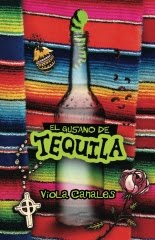
Just published:El Gusano de Tequila by Viola Canales is the Spanish translation of the novel The Tequila Worm, which won the 2006 Pura Belpré and PEN USA Awards and has sold over 50,000 copies.
Sofia comes from a family of storytellers and here are her tales of growing up in the barrio, full of the magic and mystery of family traditions: making Easter cascarones, celebrating el Día de los Muertos, preparing for quinceañera, rejoicing in the Christmas nacimiento, and curing homesickness by eating the tequila worm. When Sofia is singled out to receive a scholarship to an elite boarding school, she longs to explore life beyond the barrio, even though it means leaving her family to navigate a strange world of rich, privileged kids. It's a different mundo, but one where Sofia's traditions take on new meaning and illuminate her path. Viola Canales's warmhearted novel draws readers into an affectionate and humorous world full of memorable characters. For more information, click here.
© Latinidad®
Friday, March 09, 2012
Guest Columnists: Bryce Milligan Takes On Amazon and Lisa Alvarado Talks With Omar Tamez
Two for the price of one - today two uniquely creative people contribute
to La Bloga.Bryce Milligan, editor, writer, musician, scholar, etc., exposes the unfair tactics used by Amazon to stifle competition, which, as explained by Bryce, leads to far more dangerous consequences for all of us, and dire economic consequences for Bryce's publishing house, Wings Press.
Lisa Alvarado, poet, writer, artist, and a former bloguera right here on La Bloga, once again graces our pages with an intriguing interview of the "non-jazz" jazz artist, Omar Tamez.
Thanks to both Bryce and Lisa for these contributions.
Manuel Ramos
________________________________________________________
There is an undeclared war going on in the United States that threatens the lynchpins of American intellectual freedom. In a statement worthy of Cassandra, Noah Davis wrote in a Business Insider post last October, “Amazon is coming for the book publishing industry. And not just the e-book world, either.” When titans battle, it is tempting to think that there will be no local impact. In this case, that’s dead wrong. Amazon’s recent actions have already cut the sales of the small press I run by 40 percent. Jeff Bezos could not care less.
One recent battle in Amazon’s larger war has pitted it against a diverse group of writers, small publishers, university presses, and independent distributors. It is a classic David-and-Goliath encounter. As in that story, however, this is more than just pitting the powerful against the powerless. In this case, the underdogs have the ideas, and ideas are always where the ultimate power lies.
Wings Press (San Antonio, Texas) is one of the several hundred independent publishers and university presses distributed by the Independent Publishers Group (IPG), the second largest book distributor in the country, but still only a medium-sized dolphin in a sea of killer whales. In late February, IPG’s contract with Amazon.com was due to be renegotiated. Terms that had been generally accepted across the industry were suddenly not good enough for Amazon, which demanded discounts and practices that IPG—and all of its client publishers—could only have accepted at a loss. Yes, that does mean what it sounds like: To do business with Amazon would mean reducing the profit margin to the point of often losing money on every book or ebook sold.
IPG refused to accept the draconian terms and sought to negotiate further. In what can only be seen as a move to punish IPG for its desire to remain relevant and healthy, Amazon refused to negotiate and pulled the plug on all the Kindle ebooks distributed by IPG, marking them as “unavailable.”
Not a big deal? Imagine that Walmart controls everything you eat, and Walmart decides to stop selling fish because it thinks that fishermen are making too much profit. Amazon is the Walmart of online bookselling. The dispute between Amazon and IPG will affect every literate person in America. It is a matter that goes to the heart of what librarians have termed “intellectual freedom.” In other words, the resolution of this dispute, one way or the other, will affect every individual American’s access to certain books. It will affect your ability to choose what you read.
Restrictions on access to literature generally have more politically motivated origins. The banning of certain Native American and Mexican American authors and books in Arizona, for example, is purely political. Attempts in the past to ban literature based on its “moral content” were largely political in nature. This dispute is purely capitalistic, and is much more difficult to fight.
A single practical example. Wings Press had offered up one of its Kindle titles, Vienna Triangle by California novelist Brenda Webster, for the Amazon daily deal— a limited time offer of 99 cents per download. The book zoomed to the top ten of one of Amazon’s several bestseller lists. While it was still listed as a bestseller, Amazon suddenly marked the title as “unavailable.” The trail of loss increases in impact as it descends the food chain: Amazon doesn’t notice the loss at all. IPG sees it as one of its 5,000 Kindle titles that vanished. Wings Press sees it as one of its 100 Kindle titles that vanished. The author sees it as the loss of her book, period.
Lest one think that eliminating a single ebook novel is a loss of little consequence, Wings Press also publishes the works of John Howard Griffin, including Black Like Me, one of the most important works of the civil rights movement and widely considered an American classic. Amazon’s refusal to sell the ebook of Black Like Me should be of serious concern to every American.
Ebook sales have been a highly addictive drug to many smaller publishers. For one thing, there are no “returns.” Traditionally, profit margins for publishers are so low because books that remain on shelves too long can be returned for credit—too often in unsalable condition. No one returns an ebook. Further, ebook sales allowed smaller presses to get a taste of the kind of money that online impulse buying can produce. Already ebook sales were underwriting the publication of paper-and-ink books at Wings Press.
It has been increasingly obvious to independent publishers for the last two years that Amazon intends to put all independents out of business—publishers, distributors, and bookstores. Under the guise of providing greater access, Amazon seemingly wants to kill off the distributors, then kill off the independent publishers and bookstores, and become the only link between the reader and the author. The attack on distributors like IPG and on some larger independent presses is only part of the plan. Amazon has also been going after the ultimate source of literature, the authors.
Having created numerous (seven or more) imprints of its own, Amazon has begun courting authors directly by offering exorbitant royalties if the authors will publish directly with Amazon. Among the financial upper echelon of authors, Amazon is paying huge advances. Among rank-and-file authors, not so. Here they are offering what amounts to glorified self-publication. The effect is to lure authors away from the editors who would have helped them perfect their work, away from the publishers and designers and publicists and booksellers who have dedicated their lives to building the careers of authors, while themselves making a living from the books they love. Even the lowly book reviewer has been replaced by semi-anonymous reader-reviewers. All these are the people who sustain literary culture.
For Amazon to rip ebook sales away from independent publishers now seems a classic bait-and-switch tactic guaranteed to kill small presses by the hundreds. Ah, but predatory business practices are so very American these days. There was a time not so long ago when "competition" was a healthy thing, not a synonym for corporate "murder." Amazon could have been a bright and shining star, lighting the way to increased literacy and improved access to alternative literatures. Alas, it looks more likely to be a large and deadly asteroid. We, the literary dinosaurs, are watching closely to see if this is a near miss or the beginning of extinction. Fortunately, this generation of dinosaurs is a little better equipped than the last one to take measures to avoid such a fate.
One can choose to buy ebooks from bn.com or from almost any independent bookstore rather than Amazon. One can buy directly from IPG. A free app will allow one to read those books on a Kindle. The resistance has already begun, and it starts with choice.
Sign the petition at Change.org
Bryce Milligan is the publisher/editor of Wings Press. He is an award-winning poet and author of books for children and young adults.

I was lucky enough to meet Omar Tamez while I lived in New York City. He's a friend of another stellar jazz musician, bassist Ratzo Harris.
He studied music with masters in composition and with the composer and teacher, the Mexican classical musician, Nicandro Tamez, who is also his father - also, André Richard, Daniel Catán, Manuel de Elias, Helmut Lachmann, Pierre Boulez.
Tamez calls his music "non-jazz," and it is an intense, rhythmic soaring experience. I saw him perform with a small combo in NYC...a soaring, lyrical piece that blended poetry and spoken word of the themes of love/loss/life/death --in other word quintessentially Mexican. He is warm, generous, and is utterly, passionately, consumed by his love of music.
Some other things to note:
· For more than fifteen years he's led the group Non Jazz.
· He’s toured Mexico, United States, Italy, France, Germany, Austria, Sweden, Denmark, Holland, Turkey, Canada, Argentina, Chile, Colombia and Japan among many other countries all over the world.
· He's the founder, producer and artistic director of the “International Musicians Meeting” and is preparing for the 2012 event.
· Recently, he produced and edited a compact disc dedicated to classical Mexican music at the University of Buffalo; published by Albany Records. The CD is entitled, “Voces Internas."
· He’s played and/or recorded with musicians like Ramón López, Gebhard Ullmann, Reggie Workman, Rashied Sonny Fortune, Andrew Cyrille, André Jaume, Bruce Arnold, Tom Hamilton, Harri Sjöstrom, Kalle Kalima, Jonathan Golove, Lisa Sokolov, Felix Petry, Gabriele Hasler, Beñat Achiary, Agusto- Fernández, Michael Vlatkovich, Marcos Miranda, Nico Morelli, Hernán Rios, Mikko-Ville Luolajan-Mikkola, John Bacon, Greg Piontek, Ratzo B. Harris, Steve Baczkowski, Neil Swainson, Ronnie Burrage, André Minvielle, Ursel Schlicht, Emilio Tamez, Jorge “Luri” Molina, Gustavo Lorenzatti, Anibal Maidana, Facundo Guevara, Marco Colonna, Bruno Angelini, Carl Ludwig Hübsch, Gerald Cleaver, Alex Coke, George Schuller, Steve Swell, Joe Fonda, Michael Jeffry Stevens, Almut Kuhene, Arjen Görter, Tina Marsh, Masumi Jones, Tatsuya Nakatani, and Rémi Charmasson among many many others.
Below is our conversation --
You list your music as “Not Jazz" - Can you explain your choice of words and your feel for the contemporary American jazz scene?
Well, because my background is very wide, I try not be in any category because at the end, I feel music as one thing and not many different labels. We know many of those labels are from record companies, but sometimes musicians themselves take the easy route, an easy way and repeat every day the same things and the same way. It would make me sad to do something the same way day after day. About the American Jazz scene -- musicians want to make money and “build” a career so fast, that they don´t wait for the tree to grow and develop sound, identity and full body as a musician. Or in their bands. I still believe you can make a good living and play real, inventive music.
You come from a musical family. How do you think it influenced you, especially your relationship with your father?
In more ways than I can see or understand the blessing of living in a musical household with him. It was, and will be the best lesson in my life. My father, musically, was the strongest and wisest human I ever met. He was incredibly humble and relaxed and probably that is the biggest influence in my life. His message to me was be a simple human even If you´re doing some high level artistic project.
How do you see that act of collaboration and improvisation, as it relates to your own approach?
I can´t see the difference. For me, music is human relationships….ways to talk and share with the community in which I´m involved.
Who would you describe as musical influences?
Tell us something not in the official bio.

Lisa Alvarado is an educator, poet, novelist, and journalist, the founder of La Onda Negra Press, author of Reclamo and The Housekeeper’s Diary (originally a book of poetry and now a one-woman performance.) Her first novel, Sister Chicas, Penguin/NAL, was released in April 2006. Her book of poetry, Raw Silk Suture, released by Floricanto Press in 2008, was reviewed by Rigoberto Gonzalez. In Fall, 2009, she was awarded Hispanic Author of the Year by the State of Illinois. In 2010, she contributed to HaLapid, The Journal for the Study of Crypto-Judaism. In 2011, she contributed to Me No Habla with Acento, edited by Emanuel Xaver, and released by Rebel Sartori Press, and Still, Life, essays and poetry.
Thursday, March 08, 2012
Los recuerdos de Ana Calderón (en español)
La traducción al español, a cargo de Nuria Brufau Alvira, es impecable. El texto preserva el ritmo acelerado y las cadencias desgarradoras del original, de modo que a menudo nos olvidamos que se trata de una traducción.
La hermana de su difunta madre le advierte a Rodolfo que está a punto de cometer un grave error al dejar atrás sus raíces, incluso a sus muertos. Pero el patriarca emprende camino hacia Sonora en busca de mejor sustento. Allí encuentran un rancho donde les pagarán cinco centavos por cada balde de tomates que recojan "siempre y cuando no estén ni golpeados ni dañados".
La trama siempre cambiante toma un giro trágico de corte clásico hacia el final haciendo que Ana reflexione sobre la trayectoria de su vida y la fuerza del destino.
(LOS RECUERDOS DE ANA CALDERÓN. Graciela Limón. Arte Público. 247 páginas).