
Review: Lowriting: Shots, Rides & Stories from the Chicano Soul. Santino J. Rivera, Editor. Art Meza, Photographs. Saint Augustine, FL: Broken Sword Publications, LLC, 2014.
ISBN-10: 0989631311 ISBN-13: 978-0989631310
Michael Sedano
The man lurks across the aisle from my company’s display. A leading automotive window manufacturer, we are at the huge SEMA show in Las Vegas.
 The man stares at the van window display, then walks around to the other side of our large display area where the sunroof sales team works the crowd. Over three days he keeps appearing at the periphery of vision as I churn the crowd into the display. Finally, on the third day of the show, he walks close enough for me to step into the aisle and greet him.
English. He doesn’t speak a lot of English, back home in Kyoto. He whips out a copy of Low Rider Magazine and points to a tricked-up van with a set of bay windows and a bubble window in the rear hatch. My company makes those windows, I gesture and open my catalog.
No, not the windows in Low Rider. He pulls out a copy of a slick Japanese auto magazine. An installer’s nightmare, a craftman’s virtuoso installation. The Japanese van has a line of five window slits on the driver side, his and hers sunroofs, a pair of roof-top vents, and six more windows on the passenger side. My company manufactures them all, in Los Angeles. A tour, of course.
Over the course of several years, the gentleman from Kyoto visits me four times a year to socialize and place his orders. When his business struggles he haggles a bit more, occasionally reducing an order to a twenty-foot container. His normal buy fills a forty-footer. That’s a lot of windows.
A few years after I start selling windows to Japan, Luis J. Rodriguez comes to Tokyo and witnesses what we had wrought. Rodriguez sees a well-defined low rider cultura, from wheels to drapes, vatos to hynas, thriving among Japanese gente.
I say “we” because the assembly workers at the window factory are almost every one of them raza: Mexicanas and Mexicanos, a few Salvadoreñas Salvadoreños, and a handful of Chicanas Chicanos. They used to get a kick out of my stories about their windows cruising Tokyo streets low and slow. Copies of the Japanese magazines showing the fruits of our labor wore out their staples in the lunch rooms. If they read English, they would truly dig low writing.
Rodriguez’ account of his 2006 trip to Tokyo’s low rider culture kicks off the first two prose pieces in Broken Sword Publications’ latest contribution to chicano culture, Lowriting: Shots, Rides & Stories from the Chicano Soul.
Editor Santino J. Rivera has assembled a hybrid anthology mixing belle lettres with expository writing. Lowriting makes an ambitious attempt—270 pages--to take the pulse of Chicano Soul as expressed by automotive enthusiasts writing in diverse genres.

Three prose pieces frame the collection, Rodriguez and Rivera at the opening, and near the end, Xicano X’s apologia brings the collection to anthological climax, despite 100 pages remaining in the work. It’s an interesting collection.
Underlying the essays scattered across the collection is a vision of cars and cruising as dualities. On one hand, the cars and bikes stand for artistic and often self-taught engineering skill. On another hand--those of writers and poets--low writing collectively contains a metonymy for the chicano part of United States culture, the cars, the gente, the traje, the history. One should remember the Japanese Luis J. Rodriguez visited were imitating “American” culture, and chose low riding aesthetics. Finding Japanese Xicanos screams irony to Rodriguez, that la cultura finds a valued place in Japan while back home it’s the contrary.
Rivera’s interview with film star Danny de la Paz tackles a host of theoretical issues revolving around cars and chicanismo. The interviewer approaches the star like a fan but when the third wall comes down he discovers a serious analyst who’s done high-level chicano studies research.
De la Paz delineates between his characters’ ethos and the actor’s own upbringing as a middle-class kid in a preponderantly Anglo suburb outside of Los Angeles. There’s a dissonance lurking under the Q&A, that moviegoers think Puppet and Chuco are real and that De La Paz has special insight into their portrayal. He wasn’t a vato off the block, he was a theatre-trained college actor who used to watch “real vatos” during filming.
It’s a jarring disconnect that even the actor perceives. Rivera observes that De La Paz considers himself an “ambassador of the Chicano culture,” and delves into what rhetoricians call “ethos,” the persuasiveness, or authenticity, of a character’s (or politician’s) embodiment. The subject hangs out there, just out of reach of the interviewer. The interview ends with the interviewee illustrating that acting the part doesn’t make one an expert but only a more informed fan. De la Paz owns the low rider archetypes, it turns out he doesn’t own a low rider.
Xicano X writes a first person fan letter to low riding in the essay, “Lowriders: Time and Money Well Spent.” El Equis doesn’t own his own low rider but rhapsodizes about other people’s cars. The title explains premise of his essay. Activists and professors lament the lana and love devoted to a machine and idle cruising when there are so many issues la comunidad needs address.
Xicano X’s response is to reaffirm low riders as valuable cultural commodities that, with book banning sweeping the nation, keeping low riding culture alive is a way to ensure the survival of material culture and the values imbued in a paint job or hydraulics.
The essays, provocative as they be, are not the best part of Lowriting: Shots, Rides & Stories from the Chicano Soul. The poetry is. And, that said, one of my favorite non-expository pieces is not a poem at all, but former bloguera Gina Ruiz’ inventive story, “Lorca Green.”
Ruiz’ story comes with a familiar theme of alienated kids and sexual abuse. There’s a collection of neighborhood kids and a pachuco outcast. The vato has a soft spot for the girl narrating the story. Ruiz’ skillful narration leads the reader to what seems a set-piece rape scene when Ruiz kills the narrator. The dead girl’s voice wraps up the loose ends and brings matters to a heart-satisfying close.
Andrea J. Serrano’s “To All The Cholos I Ever Loved Before” and “A Prayer for Nuestra Señora la Reina de la Calle Central A Litany (With a Nod to Juan Felipe Herrera)", are the first poetry after the opening essays. Serrano sets a high standard that only a few of the other poets equal. Serrano’s poetry makes an especially inspired choice given the prevalence of “hynas” as toys rather than essential members of the scene.
In “Cholos” the persona might be one of those groupie hynas flitting from driver to driver. But she’s not an empty bikini, she’s a woman with longings and right now she misses the simplicity of mindless cruising because, like the woman in “Prayer,” they’ve grown beyond the mindless part but kept the identity that cruised because the mayor, the cops, adults said “no cruising.” That was like telling you not to be yourself.
Nancy Aidé Gonzalez, Viva Flores, Ricky Luv, Richard Vargas, Raúl Sanchez, and Tara Evonne Trudell, make important contributions to the literary collection, while Roberto Dr Cintli Rodriguez, Allen Thayer, and Gustavo Arellano’s essays do the same for the anthology’s expository collection.
Rivera issued a call for writers and most of the literary work is new and produced for this book. The expository stuff mostly is reprints, well worthwhile. Thayer’s discographic essay, for example, will put tunes into your ear.

Art Meza’s fotos range from breath-takingly engaging to documentary car portraits. Among my favorites are the back cover foto that appears also between the Danny De La Paz interview and Andrea Serrano’s first poem. The foto, “Dreaming Casually, Mayra Ramirez ’56 Chevy Bel Air” displays gorgeous rich tonality from the black black of the rear window at the foto’s right to the mosaic of greys to pure white framing the driver’s arm resting on the door. And yes, they’re worth a thousand words, and the price of the book.
I read the collection on a computer screen. The graphics are stunning. The print book hopefully comes on good heavy coated stock that treats Meza’s work with the respect fine art photography merits, or why bother?
Josh Devine’s spot illustrations offer clever graphic amuse bouches between entries. I wonder if the spark plug Lupe is Devine’s work? The clever pastiche deserves a credit.
The entire collection deserves not only a reading but an order via the publisher or indie booksellers. Low riding, like football or ice hockey, might be an acquired taste, but low writing, like any United States literature, is essential to comprehending the “soul” and the “chicano” in “chicano soul.” As the interview relates about the film, Boulevard Nights being taught in C/S classes, Lowriting: Shots, Rides & Stories from the Chicano Soul will be taught in chicano studies courses.

The Gluten-free Chicano Cooks
Meatless, Glutenless, Fast and Cheap Torta
This is 1920s depression-era cooking, a can of string beans, an onion, an egg, some cheese, butter. And it's delicious! It's a torta de string beans.
Growing up, my familia called these tortas. When I got to the big city after the Army, I learn the locals use "torta" for a sandwich. But then, they also called a taco a "burrito." We all speak a dialect. Where I come from, an omelette is a torta and a sandwich is a sandwich.
Use an omelette pan or one you can flip the contents with ease over medium flame. Lightly coat the sartén with some non-stick spray, then drop a tablespoon of butter into the heated pan.
Add some sliced or diced onion to wilt, and in a few seconds, the drained string beans.
Here I'm using a 6" individual sartén for a single serving. With a larger pan, you'll likely want to finish it under the broiler, and if all else fails, go ahead and scramble everything.

Cook for a few minutes, or until refrigerated beans are hot all the way through. Pour a couple of vigorously beaten eggs into the mixture, cook until the egg is almost set and top with a big pinch of grated cheese.

Fold the torta, or flip it, or--and this is what I did because the torta stuck a bit to the bottom--pop it under a high broiler for a few minutes until brown and crusty.
Present whole on a plate with your favorite sides. If you use a 10" skillet, serve on a platter and cut the large torta into pie-wedges.

Fifteen minutes start-to-finish. Gluten-free, meat-free, inexpensive, delicious, authentically chicano.
La Bloga On-line Floricanto With Tara Evonne Trudell

La Bloga welcomes Tara Evonne Trudell to On-line Floricanto, both as a way of recognizing her distinctive poet's voice, and to update Trudell's One Million Border Beads poetry bead project La Bloga reported in January.
The project advances as Tara's vision forms itself around the goal of crafting 1,000,000 strips of poems typed on paper and rolled into beads. Trudell fashions elegant jewelry like the twin necklace adorning a display of photographs of 13 poem beads. You can participate in the bead project via this link to La Bloga-Tuesday's January 7 column.
¡Soy La Tierra!
By Tara Evonne Trudell
soy la tierra
I learned
as a little girl
I knew this
always being
the dirty child
“allergic to white”
my mother would exclaim
taking one look at me
coming in
after playing
in the mud
and rain
I had a taste
for dirt
since the beginning
soy la tierra
I quickly forgot
growing up
in a Disney mentality
image obsessed
judgmental society
the mined polished diamond
meaning more
than the natural
heart shaped river rock
I wandered far
only to get lost
on paved paths
fighting meanings
on what it meant
to be a woman
defined
by material possessions
and religious persecution
the confusion
 in disconnect
I fought back
just to regain
my balance
soy la tierra
I found out
further down
the dirt path
I sat there
long enough
to realize
who I was
coming from earth
all my life
lost in the search
outside myself
soy la tierra
I tell my children
one by one
planting seeds
that will never die
soy la tierra
I will whisper
to mi hombre
only wanting
the one
who would fight
and die
for my land
soy la tierra
I share smiles
con mi hermanas
grabbing hands
sharing laughter
and tears
shaking dirt
from our skirts
our earth moments
making us real.
¡soy la tierra!
c/s tara evonne trudell
Far Away
By Tara Evonne Trudell
crossing
the mojave desert
I dreamed
my people
moving through
heat waves
and hunger pains
mothers fathers
children
willing life
dying to cross
a line
drawn in sand
drones hovering in air
dangerous spy tactics
always monitoring
the calculation
in military moves
real life
hunger war games
forcing survival
the extreme NAFTA
and CIA manipulation
taking land
and killing people
corrupt government
holding meetings
with drug lords
in slick suits
making up
hard core
statistics
to act on
with militarized force
feeding masses
misled lies
laced with hate
turning one side
against
the other
with neither side
existing at all
every day life
selling American
dreaming material
sold by elite thugs
and prison profiteers
in slick suits
making up laws
in corrupt politics
the buddying up
of corporations
filling systems
making a business
out of brown people
handcuffing butterflies
taking away
the freedom
to migrate
caught by ICE
profiling parents
the leaving
left alone
in terrified children
separating families
creating impossible reuniting
the written word
in small print
USA court documents
the taking away
of Mexico
in parental rights
when accusations fly
calling names out
illegal!
alien!
immigrant!
USA labels
of being brown
in a country
too far
to care
when not close
to home
American comfort
family circles tight
the choice
to be unaware
what’s really going down
south of the border
the human race
running away
when excluding
their own
mechanical hummingbird
droning on
the keeping
of government control
gleaming profit
in big brother eye
the elite
banking on profits
of brown people
crossing
to survive.
c/s tara evonne trudell 3 de marzo 2014

Heart Chakra
By Tara Evonne Trudell
as a woman
of experience
I can say
my broken
heart chakra
hurt
more than
birthing pain
a tattoo
going on
forever
the dying
inside love
heart chambers
bleeding
to death
his last words
before
he left
creating permanent
distance
in cold air
him telling me
love
was merely
poetic thought
cutting me
swift
and deep
his final words
letting go
crushing blow
setting me
down hard
me feeling
earth stunned
trees stilled
river stones
cast aside
me halting
on my path
the excruciating
slow time
of overwhelming
realization
not one moment
before
the shattering
of my heart
chakra
did I not
trust
my love
to matter.
c/s tara evonne trudell
Qué Amor
By Tara Evonne Trudell
qué amor
arriving
fast and furious
feeling like
the first colibrí
arriving in spring
the alive energy
in rebirth
and earth
yearning
the stillness
caught in air
the becoming
of wind
somewhere else
ocotillo y nopal
twisting and turning
shadow dancing
across desert
canyon
rock walls
seeping water
seeking rivulets
running away
in puddles
of rain
damp sand
clinging forever
qué amor
the movement
of air
in left over
feelings
of heavy storm
heart tenderness
the remains
left to grow
strong
surviving last love’s
aftermath
qué amor
cruising in
low and slow
the floating feeling
of above ground
skimming senses
the taste
in smiles
flowing nectar
leaving lips
the dusting
of golden pollen
tipping butterfly wings
qué amor
tingling natural
nature essences
breaking the surface
of brown
dirt
qué amor
copal smoke
blessing
sacred corazón
te quíero mucho
moments
pulling soul
away
from the edge
of letting go
qué amor
all over
again
trilling colibrí
arrival.
c/s tara evonne trudell

Quoting Zapata
By Tara Evonne Trudell
Quoting Zapata
while voting Obama
in a time
when being brown
is a crime
majority
racist fools
contriving
USA rules
Monsanto king
of everything
fake and untrue
the new
killing fields
poisoning
the poor
the constant need
to feed
the fat
and greedy
Politicians
playing
Nazi soldiers
camouflaged hiding
human hunting
leading cactus borders
guarding
natural crossing
Indigenous breath
struggling
to exhale
pausing pulse
crushing
natural migration
of hummingbirds
and butterflies
negotiating humanity
below
their needs
offering dirty work
lying in wait
banning books
angry desperation
to choke out
our culture
to feel us
suffocate
underneath
their heavy handed
back room ways
banks governing
a society
paying war
silencing
our people
who speak
warrior words
trilling rhythms
vibrating of resistance
don’t quote
Zapata
if you can’t handle
blood red
brown hands
raising fists
holding hearts
standing strong
drumming beats
fighting to resist
the occupation
of our Motherland.
c/s tara evonne trudell
Multicultural notebook
ISBN-10: 0989631311 ISBN-13: 978-0989631310
Michael Sedano
The man lurks across the aisle from my company’s display. A leading automotive window manufacturer, we are at the huge SEMA show in Las Vegas.

English. He doesn’t speak a lot of English, back home in Kyoto. He whips out a copy of Low Rider Magazine and points to a tricked-up van with a set of bay windows and a bubble window in the rear hatch. My company makes those windows, I gesture and open my catalog.
No, not the windows in Low Rider. He pulls out a copy of a slick Japanese auto magazine. An installer’s nightmare, a craftman’s virtuoso installation. The Japanese van has a line of five window slits on the driver side, his and hers sunroofs, a pair of roof-top vents, and six more windows on the passenger side. My company manufactures them all, in Los Angeles. A tour, of course.
Over the course of several years, the gentleman from Kyoto visits me four times a year to socialize and place his orders. When his business struggles he haggles a bit more, occasionally reducing an order to a twenty-foot container. His normal buy fills a forty-footer. That’s a lot of windows.
A few years after I start selling windows to Japan, Luis J. Rodriguez comes to Tokyo and witnesses what we had wrought. Rodriguez sees a well-defined low rider cultura, from wheels to drapes, vatos to hynas, thriving among Japanese gente.
I say “we” because the assembly workers at the window factory are almost every one of them raza: Mexicanas and Mexicanos, a few Salvadoreñas Salvadoreños, and a handful of Chicanas Chicanos. They used to get a kick out of my stories about their windows cruising Tokyo streets low and slow. Copies of the Japanese magazines showing the fruits of our labor wore out their staples in the lunch rooms. If they read English, they would truly dig low writing.
Rodriguez’ account of his 2006 trip to Tokyo’s low rider culture kicks off the first two prose pieces in Broken Sword Publications’ latest contribution to chicano culture, Lowriting: Shots, Rides & Stories from the Chicano Soul.
Editor Santino J. Rivera has assembled a hybrid anthology mixing belle lettres with expository writing. Lowriting makes an ambitious attempt—270 pages--to take the pulse of Chicano Soul as expressed by automotive enthusiasts writing in diverse genres.
Three prose pieces frame the collection, Rodriguez and Rivera at the opening, and near the end, Xicano X’s apologia brings the collection to anthological climax, despite 100 pages remaining in the work. It’s an interesting collection.
Underlying the essays scattered across the collection is a vision of cars and cruising as dualities. On one hand, the cars and bikes stand for artistic and often self-taught engineering skill. On another hand--those of writers and poets--low writing collectively contains a metonymy for the chicano part of United States culture, the cars, the gente, the traje, the history. One should remember the Japanese Luis J. Rodriguez visited were imitating “American” culture, and chose low riding aesthetics. Finding Japanese Xicanos screams irony to Rodriguez, that la cultura finds a valued place in Japan while back home it’s the contrary.
Rivera’s interview with film star Danny de la Paz tackles a host of theoretical issues revolving around cars and chicanismo. The interviewer approaches the star like a fan but when the third wall comes down he discovers a serious analyst who’s done high-level chicano studies research.
De la Paz delineates between his characters’ ethos and the actor’s own upbringing as a middle-class kid in a preponderantly Anglo suburb outside of Los Angeles. There’s a dissonance lurking under the Q&A, that moviegoers think Puppet and Chuco are real and that De La Paz has special insight into their portrayal. He wasn’t a vato off the block, he was a theatre-trained college actor who used to watch “real vatos” during filming.
It’s a jarring disconnect that even the actor perceives. Rivera observes that De La Paz considers himself an “ambassador of the Chicano culture,” and delves into what rhetoricians call “ethos,” the persuasiveness, or authenticity, of a character’s (or politician’s) embodiment. The subject hangs out there, just out of reach of the interviewer. The interview ends with the interviewee illustrating that acting the part doesn’t make one an expert but only a more informed fan. De la Paz owns the low rider archetypes, it turns out he doesn’t own a low rider.
Xicano X writes a first person fan letter to low riding in the essay, “Lowriders: Time and Money Well Spent.” El Equis doesn’t own his own low rider but rhapsodizes about other people’s cars. The title explains premise of his essay. Activists and professors lament the lana and love devoted to a machine and idle cruising when there are so many issues la comunidad needs address.
Xicano X’s response is to reaffirm low riders as valuable cultural commodities that, with book banning sweeping the nation, keeping low riding culture alive is a way to ensure the survival of material culture and the values imbued in a paint job or hydraulics.
The essays, provocative as they be, are not the best part of Lowriting: Shots, Rides & Stories from the Chicano Soul. The poetry is. And, that said, one of my favorite non-expository pieces is not a poem at all, but former bloguera Gina Ruiz’ inventive story, “Lorca Green.”
Ruiz’ story comes with a familiar theme of alienated kids and sexual abuse. There’s a collection of neighborhood kids and a pachuco outcast. The vato has a soft spot for the girl narrating the story. Ruiz’ skillful narration leads the reader to what seems a set-piece rape scene when Ruiz kills the narrator. The dead girl’s voice wraps up the loose ends and brings matters to a heart-satisfying close.
Andrea J. Serrano’s “To All The Cholos I Ever Loved Before” and “A Prayer for Nuestra Señora la Reina de la Calle Central A Litany (With a Nod to Juan Felipe Herrera)", are the first poetry after the opening essays. Serrano sets a high standard that only a few of the other poets equal. Serrano’s poetry makes an especially inspired choice given the prevalence of “hynas” as toys rather than essential members of the scene.
In “Cholos” the persona might be one of those groupie hynas flitting from driver to driver. But she’s not an empty bikini, she’s a woman with longings and right now she misses the simplicity of mindless cruising because, like the woman in “Prayer,” they’ve grown beyond the mindless part but kept the identity that cruised because the mayor, the cops, adults said “no cruising.” That was like telling you not to be yourself.
Nancy Aidé Gonzalez, Viva Flores, Ricky Luv, Richard Vargas, Raúl Sanchez, and Tara Evonne Trudell, make important contributions to the literary collection, while Roberto Dr Cintli Rodriguez, Allen Thayer, and Gustavo Arellano’s essays do the same for the anthology’s expository collection.
Rivera issued a call for writers and most of the literary work is new and produced for this book. The expository stuff mostly is reprints, well worthwhile. Thayer’s discographic essay, for example, will put tunes into your ear.
Art Meza’s fotos range from breath-takingly engaging to documentary car portraits. Among my favorites are the back cover foto that appears also between the Danny De La Paz interview and Andrea Serrano’s first poem. The foto, “Dreaming Casually, Mayra Ramirez ’56 Chevy Bel Air” displays gorgeous rich tonality from the black black of the rear window at the foto’s right to the mosaic of greys to pure white framing the driver’s arm resting on the door. And yes, they’re worth a thousand words, and the price of the book.
I read the collection on a computer screen. The graphics are stunning. The print book hopefully comes on good heavy coated stock that treats Meza’s work with the respect fine art photography merits, or why bother?
Josh Devine’s spot illustrations offer clever graphic amuse bouches between entries. I wonder if the spark plug Lupe is Devine’s work? The clever pastiche deserves a credit.
The entire collection deserves not only a reading but an order via the publisher or indie booksellers. Low riding, like football or ice hockey, might be an acquired taste, but low writing, like any United States literature, is essential to comprehending the “soul” and the “chicano” in “chicano soul.” As the interview relates about the film, Boulevard Nights being taught in C/S classes, Lowriting: Shots, Rides & Stories from the Chicano Soul will be taught in chicano studies courses.
The Gluten-free Chicano Cooks
Meatless, Glutenless, Fast and Cheap Torta
This is 1920s depression-era cooking, a can of string beans, an onion, an egg, some cheese, butter. And it's delicious! It's a torta de string beans.
Growing up, my familia called these tortas. When I got to the big city after the Army, I learn the locals use "torta" for a sandwich. But then, they also called a taco a "burrito." We all speak a dialect. Where I come from, an omelette is a torta and a sandwich is a sandwich.
Use an omelette pan or one you can flip the contents with ease over medium flame. Lightly coat the sartén with some non-stick spray, then drop a tablespoon of butter into the heated pan.
Add some sliced or diced onion to wilt, and in a few seconds, the drained string beans.
Here I'm using a 6" individual sartén for a single serving. With a larger pan, you'll likely want to finish it under the broiler, and if all else fails, go ahead and scramble everything.
Cook for a few minutes, or until refrigerated beans are hot all the way through. Pour a couple of vigorously beaten eggs into the mixture, cook until the egg is almost set and top with a big pinch of grated cheese.
Fold the torta, or flip it, or--and this is what I did because the torta stuck a bit to the bottom--pop it under a high broiler for a few minutes until brown and crusty.
Fifteen minutes start-to-finish. Gluten-free, meat-free, inexpensive, delicious, authentically chicano.
La Bloga On-line Floricanto With Tara Evonne Trudell
La Bloga welcomes Tara Evonne Trudell to On-line Floricanto, both as a way of recognizing her distinctive poet's voice, and to update Trudell's One Million Border Beads poetry bead project La Bloga reported in January.
The project advances as Tara's vision forms itself around the goal of crafting 1,000,000 strips of poems typed on paper and rolled into beads. Trudell fashions elegant jewelry like the twin necklace adorning a display of photographs of 13 poem beads. You can participate in the bead project via this link to La Bloga-Tuesday's January 7 column.
¡Soy La Tierra!
By Tara Evonne Trudell
soy la tierra
I learned
as a little girl
I knew this
always being
the dirty child
“allergic to white”
my mother would exclaim
taking one look at me
coming in
after playing
in the mud
and rain
I had a taste
for dirt
since the beginning
soy la tierra
I quickly forgot
growing up
in a Disney mentality
image obsessed
judgmental society
the mined polished diamond
meaning more
than the natural
heart shaped river rock
I wandered far
only to get lost
on paved paths
fighting meanings
on what it meant
to be a woman
defined
by material possessions
and religious persecution
the confusion
in disconnectI fought back
just to regain
my balance
soy la tierra
I found out
further down
the dirt path
I sat there
long enough
to realize
who I was
coming from earth
all my life
lost in the search
outside myself
soy la tierra
I tell my children
one by one
planting seeds
that will never die
soy la tierra
I will whisper
to mi hombre
only wanting
the one
who would fight
and die
for my land
soy la tierra
I share smiles
con mi hermanas
grabbing hands
sharing laughter
and tears
shaking dirt
from our skirts
our earth moments
making us real.
¡soy la tierra!
c/s tara evonne trudell
Far Away
By Tara Evonne Trudell
crossing
the mojave desert
I dreamed
my people
moving through
heat waves
and hunger pains
mothers fathers
children
willing life
dying to cross
a line
drawn in sand
drones hovering in air
dangerous spy tactics
always monitoring
the calculation
in military moves
real life
hunger war games
forcing survival
the extreme NAFTA
and CIA manipulation
taking land
and killing people
corrupt government
holding meetings
with drug lords
in slick suits
making up
hard core
statistics
to act on
with militarized force
feeding masses
misled lies
laced with hate
turning one side
against
the other
with neither side
existing at all
every day life
selling American
dreaming material
sold by elite thugs
and prison profiteers
in slick suits
making up laws
in corrupt politics
the buddying up
of corporations
filling systems
making a business
out of brown people
handcuffing butterflies
taking away
the freedom
to migrate
caught by ICE
profiling parents
the leaving
left alone
in terrified children
separating families
creating impossible reuniting
the written word
in small print
USA court documents
the taking away
of Mexico
in parental rights
when accusations fly
calling names out
illegal!
alien!
immigrant!
USA labels
of being brown
in a country
too far
to care
when not close
to home
American comfort
family circles tight
the choice
to be unaware
what’s really going down
south of the border
the human race
running away
when excluding
their own
mechanical hummingbird
droning on
the keeping
of government control
gleaming profit
in big brother eye
the elite
banking on profits
of brown people
crossing
to survive.
c/s tara evonne trudell 3 de marzo 2014
Heart Chakra
By Tara Evonne Trudell
as a woman
of experience
I can say
my broken
heart chakra
hurt
more than
birthing pain
a tattoo
going on
forever
the dying
inside love
heart chambers
bleeding
to death
his last words
before
he left
creating permanent
distance
in cold air
him telling me
love
was merely
poetic thought
cutting me
swift
and deep
his final words
letting go
crushing blow
setting me
down hard
me feeling
earth stunned
trees stilled
river stones
cast aside
me halting
on my path
the excruciating
slow time
of overwhelming
realization
not one moment
before
the shattering
of my heart
chakra
did I not
trust
my love
to matter.
c/s tara evonne trudell
Qué Amor
By Tara Evonne Trudell
qué amor
arriving
fast and furious
feeling like
the first colibrí
arriving in spring
the alive energy
in rebirth
and earth
yearning
the stillness
caught in air
the becoming
of wind
somewhere else
ocotillo y nopal
twisting and turning
shadow dancing
across desert
canyon
rock walls
seeping water
seeking rivulets
running away
in puddles
of rain
damp sand
clinging forever
qué amor
the movement
of air
in left over
feelings
of heavy storm
heart tenderness
the remains
left to grow
strong
surviving last love’s
aftermath
qué amor
cruising in
low and slow
the floating feeling
of above ground
skimming senses
the taste
in smiles
flowing nectar
leaving lips
the dusting
of golden pollen
tipping butterfly wings
qué amor
tingling natural
nature essences
breaking the surface
of brown
dirt
qué amor
copal smoke
blessing
sacred corazón
te quíero mucho
moments
pulling soul
away
from the edge
of letting go
qué amor
all over
again
trilling colibrí
arrival.
c/s tara evonne trudell
Quoting Zapata
By Tara Evonne Trudell
Quoting Zapata
while voting Obama
in a time
when being brown
is a crime
majority
racist fools
contriving
USA rules
Monsanto king
of everything
fake and untrue
the new
killing fields
poisoning
the poor
the constant need
to feed
the fat
and greedy
Politicians
playing
Nazi soldiers
camouflaged hiding
human hunting
leading cactus borders
guarding
natural crossing
Indigenous breath
struggling
to exhale
pausing pulse
crushing
natural migration
of hummingbirds
and butterflies
negotiating humanity
below
their needs
offering dirty work
lying in wait
banning books
angry desperation
to choke out
our culture
to feel us
suffocate
underneath
their heavy handed
back room ways
banks governing
a society
paying war
silencing
our people
who speak
warrior words
trilling rhythms
vibrating of resistance
don’t quote
Zapata
if you can’t handle
blood red
brown hands
raising fists
holding hearts
standing strong
drumming beats
fighting to resist
the occupation
of our Motherland.
c/s tara evonne trudell
Multicultural notebook
Serendipity Leads to Village
La Bloga-Wednesday’s columnist, René Colato Laínez keeps me and other readers updated on children’s picture books featuring razacentric characters and stories, a rare genre as a stroll through any bookstore illustrates.
There’s inestimable value in having characters and stories reflecting kid readers. Sadly, bookselling hasn’t caught up the pent-up demand for such work. Happily, self-publishing and specialty houses like Arte Publico and Lee and Low are closing the gap between demand and quality books.
Still, marketing is the bugaboo of all publishers. A book sells only when people know it exists. “Top 100” lists invariably fail to list raza authors. Some award programs, like Tejas Star, showcase latina latino kid lit, thus feeding titles into teacher-parent word-of-mouth networks. In the end, serendipity probably has as much to do with learning about a book as any deliberate campaign.
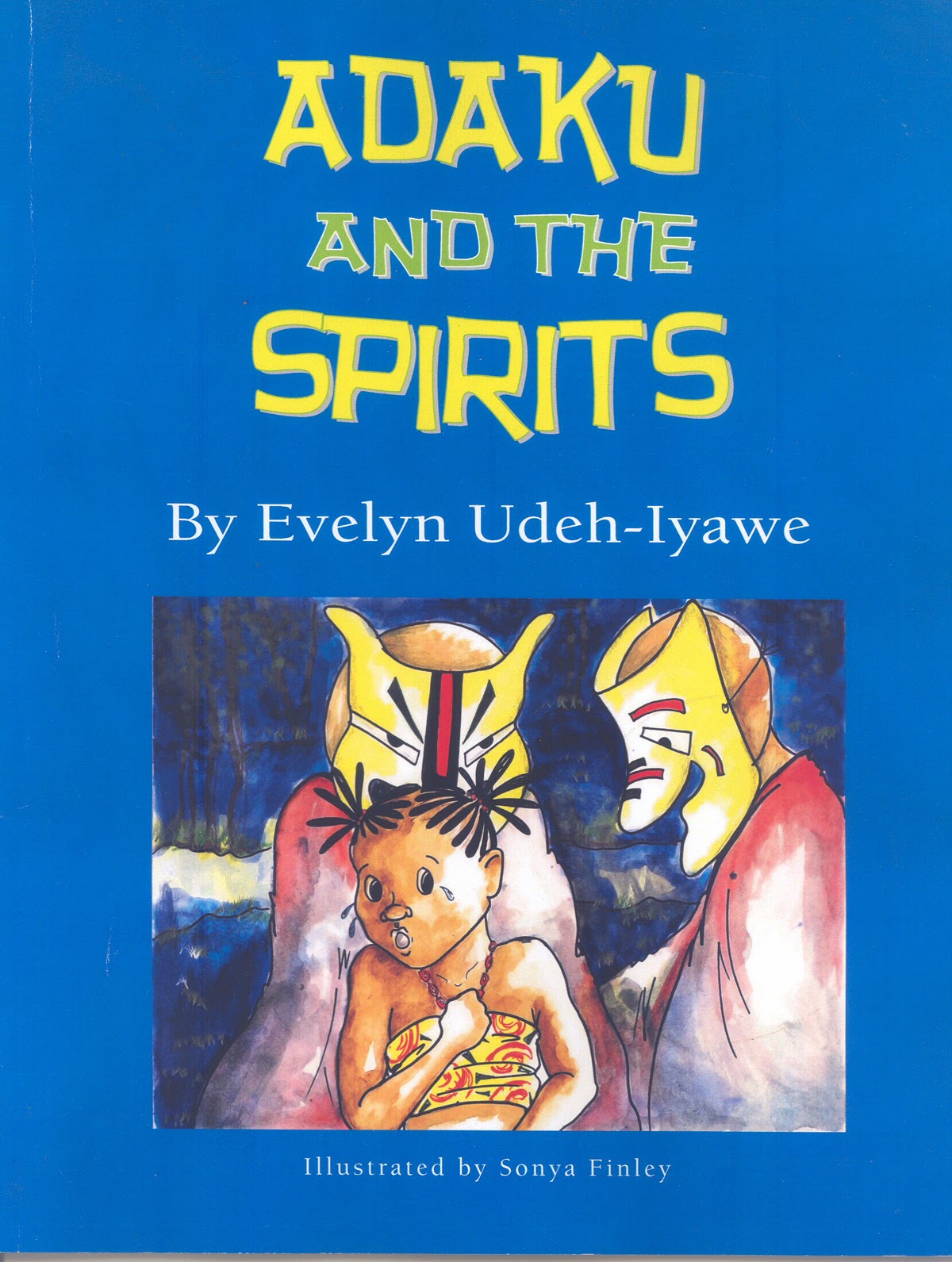
That’s how I came to enjoy a copy of Adaku and the Spirits by Evelyn Unde-Iyawe, illustrated by Sonya Finley, serendipity.
Unde-Iyawe is a school administrator whom my wife met in the course of a workday for both women. Adaku and the Spirits is a multicultural treat for kids and fabulous compare-contrast material. The story is set in an idyllic village in third world Africa.
A courtesy book of sorts, the story’s directed at pre-schoolers learning about following rules uncritically and about individual responsibility. I can imagine certain parents going into a tizzy when river spirits threaten to eat a child.
Adaku hangs out with malcriado kids who trick the girl into getting caught by loquacious spirits hungry for human meat. While the spirits debate eating Adaku, village warriors arrive to rescue Adaku. Back home in the village, the girl’s ill-raised friends have to sweep the zocalo for a week and bring leña to viejitos for three days. Everyone learns a lesson and promises never again to disobey their parents nor trick the hapless.
Information on the author and buying the book at the author’s website.


