Sunday, October 18, 2015

"Put Your Name On It": Xochitl-Julisa Bermejo on Writing, Submitting, and Honoring Our Creative Work


Olga García Echeverría


Upon Celebrating America’s Birthday


In the morning, I explore the yellow hills
of Chavez Ravine and collect trinkets for my desk:
a hawk feather, a sun-bleached snail shell,
a rusted nail sitting within the brick base
ruins of a house. I imagine great-aunt Susana
collecting herbs from the hills hugging Teocaltiche.
In the afternoon, Uncle Manny recalls remedies
she concocted and the tiny quail eggs she fried
for breakfast with handmade tortillas the shape of boats.
My finicky father never ate from her table,
but Uncle Manny has had too many Budweisers
and is spilling memories of his favorite tia this 4th of July.
“She used to put me on her shoulders and carry me
across the river,” he says dreamily. This was before L.A.,
hair products, Ford cars, and the church youth group
where he met my aunt, and my dad met my mother. 
By dusk, tears dig into the creases of his face
like a stone creek. He hushes only to watch my cousins
launch bottle rockets from the street. Smoke tails up
and sparks shoot out over our heads. Colors flash bright
and disappear into the air like my uncle’s sobriety,
like Tia Susana, like the houses of Chavez Ravine.

Xochitl-Julisa Bermejo


If you're an Angelino with your eye on the literary scene, then most likely you've heard of Xochitl-Julisa Bermejo. She's shared her award-winning poetry with audiences throughout LA and beyond. She is the creator and curated of the quarterly reading series HITCHED, formerly held at Beyond Baroque and now being hosted at Holy Grounds.

Another important and exciting LA-based literary project is Women Who Submit, which Bermejo co-founded. This group encourages and supports women writers in the submission process for publication. When Xochitl isn't organizing, submitting her work or encouraging others to submit, she's teaching, grading, and reading articles on the pedagogy of working with English language learners.

Despite her busy schedule, Bermejo ekes out writing time, a veces in the afternoon, usually in the evenings, most often on weekends or in the summer when teachers' loads are generally lighter.

Her writing essentials? Música and a laptop. A source of inspiration she keeps returning to? Long walks in nature. 

Although Xochitl says she did not become serious about her writing until her mid-twenties when she pursued her MFA, it is obvious that the creative word has been brewing inside her since she was a chiquilla. At six, she wrote her first poem, and at 11 she not only wrote a western, she also won a Knott's Berry Farm contest with her submission.

Bueno, there is so much to say about Bermejo, but we'll let her say it herself. Here is our featured and estimada poeta sharing her insights on writing, publishing, building community, going beyond AWP drama/trauma, and talking about the importance of following our hearts and honoring our stories.
 
 
Welcome, Xochitl. Let's get right into it. I've been writing a lot about my parents lately, and as a result re-discovering ways in which they influenced my writing. I'm curious, ¿Qué dicen tus padres about you being a poet, and how have they influenced your creative journey?

My parents have always been very supportive of my writing career. I think it is because they are both artists at heart. My mother wanted to be an opera singer, but ended up dropping out of community college when her music teacher didn’t show much interest. She’s told me the story a few times. She was thinking of quitting school and went to tell her teacher and her teacher basically said, “OK.” As a teacher myself, I try to remember this.

As I was growing up, my memories of my dad tend to revolve around images of him in the garage creating objects in his wood-turning workshop. We still have a table he made in those days and my aunt still has the bed he made for her and her husband as a wedding present.

The thing is they were both immigrant children, and they are both the eldest in their families, so they didn’t have the freedom to pursue their artistic dreams. My mom had to take care of her little sister and brothers, and my dad had to go into the army. I think seeing me be a writer brings them joy, and whenever anything good happens, I definitely feel like it’s happening to all of us. 
 

My dad’s number one saying is, “Put your name on it, Mija!” Whenever I come to him with some good news he always says, “That’s good, Mija! Just remember, put your name on it!” To them creating something you are proud of, something you can attach your name to is of high importance.


As a Latina writer, have you always felt free to incorporate Spanish in your creative work?


No, I didn’t always use Spanish in my work. In graduate school, I had little sprinklings of Spanish here and there when I would write about my family, and that was the first time I had people telling me I had to italicize those words. I had never heard that because I hadn’t really studied writing academically before.

It wasn’t until I went to Las Dos Brujas writing retreat in New Mexico that I started to understand the wider conversation of using Spanish and other languages in writing. Las Dos Brujas was organized by Cristina Garcia. The mentors were Cristina, Juan Felipe Herrera, Chris Abani, Denise Chavez, and Kimiko Hahn. LDB was the first time I had ever experienced being in a workshop with a majority of writers of color, and it was the first time I felt I had connected with a mentor of color.  LDB really opened my eyes to what had already been going on within the community for some time. A book that really struck me was Slow Lightning by Eduardo C. Corral. I was really amazed by how much Spanish he used. Nearly whole poems in Slow Lightning were in Spanish. His book really opened my eyes to how far it can go.

As a teacher myself, I know how difficult it is to write during the school year, especially because we take so much work home.  What helps keep you on track with your writing during the school year?

The best thing I have to keep me writing at this time is a regular workshop group I have on Wednesday nights. There are three of us. We are all women, and we are all workshopping early drafts of novels. We each take turns reading 5-10 pages aloud for feedback. Thankfully, I generated like crazy over the summer, so all I have to do is show up, bring something I’ve already written, and be ready to listen. It feels low-pressure, and it keeps me thinking about writing in the week. And then I have something to work on when the weekend comes. This group has been a life preserver. It’s definitely keeping me afloat writing-wise.  
 
You were the 2013 Poets & Writers California Writer's Exchange poetry winner. What was that experience like?

It was very exciting. I got an all-expense paid trip to New York to meet with editors, agents, and writers. As a poet, I didn’t really have much connection to meeting the agents, but it was great to hear what they had to say. Some highlights were going into The New Yorker to meet Deborah Treissman, having a glass of wine with Yusef Komunyakaa, and listening to Alice Quinn recite a poem to me. Also, it was pretty amazing to feature at a reading in Manhattan at the Center for Fiction. Some of my oldest friends live in New York, so it was really cool to be able to share that moment with them. It felt good to know I had a loving support team so far from home. It was really special. The whole experience was special. Every night, when I got back to my room, and I was alone for the first time all day, I cried. I couldn’t believe it was happening to me and it was happening to me because of something I wrote. I felt really happy and grateful. 
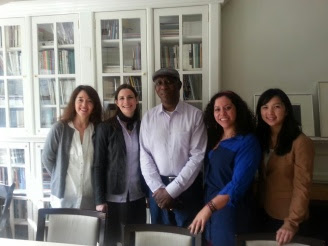


Photo from Poets & Writer's E-Newsletter 3/14/13:
From left: P&W staff member Jamie FitzGerald, Laura Joyce Davis,
Yusef Komunyakaa, Xochitl-Julisa Bermejo,
and P&W Staff member Cathy Linh Che.

Can you briefly share what inspired you to start your HITCHED reading series?

I had gone to a reading at Avenue 50 Studio where Suzanne Lummis invited her students from her classes to feature with her. I liked how she used the reading to bring out new voices, so that was one of the events that inspired me to do a reading series revolved around mentorship. I was also newly out of grad school, and I wanted to promote my friends and other new writers like myself. It was kind of great because we were all newly out of grad school, so we still had close relationships with our mentors, and so I had a bit of a built in talent pool. At the beginning it was a way to get my friends some exposure and to build relationships with the older generation of poets and writers.

You've been hosting this series for the past 5 years. What have been some of the rewards?
 
The rewards have been many. For one, every time there is a HITCHED I walk away feeling moved. I feel a little selfish saying that, like I made this reading strictly for myself, but I hope if I’ve been moved then so have other people. I’ve also had the opportunity to meet so many writers and to introduce writers to the community. The way the reading usually works is I invite someone I know to feature, and then that person invites someone to feature with them. The person they invite can be a mentor, a student, a collaborator, a workshop partner, etc. So nearly every reading, I’m introduced to someone new, and nearly every reading someone is meeting someone new.
 
Have you seen important shifts in the literary scene during these past 5 years?
 
Something that makes me happy is seeing what I think is a bigger push in the last few years to have literature in public spaces. I see it with the Jessica Ceballos and Avenue 50’s Poesia Para la Gente series, with what Iris de Anda is doing with the “Love Corner” in El Sereno, with Liz Gonzalez’s new Uptown Word Reading Series in Long Beach, and with the Los Angeles Lit Crawl. I think this is important work.

And you'll be reading at Lit Crawl,  on October 21 with Women Who Submit. Here's the link to your event:

http://litcrawl.org/la/events/between-stage-and-page-interstitial-arts-foundation/
 
On the issue of submission: one thing is creating and another is getting our work out there. Alyss Dixson, Ashaki Jackson and you took a lead a few years ago in encouraging women writers (and in particular women of color) to submit. Can you tell us a little about starting up Women Who Submit? :
 
Women Who Submit came out of the first VIDA count. The women of VIDA started counting the number of women and men published in top tier journals like The New Yorker and Paris Review. What they found was that there was a large disparity between men and women being represented in these magazines. When editors were asked why they thought there was this disparity, the most common response was, "Women don't submit as often as men."

Women Who Submit was created in an attempt to change the rhetoric. The idea of submission parties, getting a group of women together to submit work and act as a support, came from Alyss Dixson. She invited Ashaki Jackson to work on this idea with her, and Ashaki invited me to work with the two of them. I didn’t even know about VIDA until I was brought into this project in 2011. Together we planned our first submission party. It was at my mom’s house, which I thought was great. For the first few years, it was a small group of women meeting in each other’s houses about 5 times a year, but over the last year we’ve become more global. We now have monthly submission parties with submission parties open to the public and new members every other month. We’ve also started doing panels, readings, and workshops. It is definitely growing, which is really exciting!


I've yet to go to a WWS meeting myself, but I want to share that I feel encouraged by WWS from afar. WWS has, on several occasions, inspired me to send something out, so gracias! Here's the link to WWS in case readers want to find out more: : https://womenwhosubmitlit.wordpress.com/


That’s amazing! I’m glad we could inspire you to submit. Not everyone can come to an event, but if women find some strength and support for submitting from our online presence, then that makes us happy. We are trying to create a supportive community online with our Facebook, twitter, and blog. We want women to know they can always come to these parties for encouragement, information, and support.

Finding a “home” for a literary piece can be challenging, especially when we are bilingual and write in mixed languages. There is always so much negotiation (between the self and the page) that happens prior to sending something out. Should I even send this there? If I do send it out and it's not a Latino journal, how much of the Spanish do I have to take out? etc. What advice can you give women writers out there who are grappling with some of these issues and questions?

I think my advice would be to make the best piece you possibly can, and try not to worry about who will take it. I know this is hard. I’m trying to do it right now with a YA novel I’m working on. My heroine is the daughter of migrant farm workers, and I’m always thinking, Is that too much Spanish? But I think we have to fight to stay true to who we are, and fight to stay true to the piece. Each piece is different and there is never one answer.
 
What I hope other poets do is write their hearts out, and make something that makes them proud, something they are proud to have their names on (like my father says), and then send it out. If you do that, I think you will find the right home for your work. I have an essay up at The James Franco Review right now where large chunks of dialogue are in Spanish. http://thejamesfrancoreview.com/2015/08/26/non-fiction-by-xochitl-julisa-bermejo/
I definitely worried no one would take it, but then I found out about The James Franco Review. Based off of their mission and the work they had previously published I thought, if anyone is going to take a chance on this piece it’s this place. And then they did, which was amazing! So I think being true to yourself, and looking for those places who are open to what you are doing is key.

I think that even when we do make efforts to submit, though, it can be pretty discouraging, and it can also be expensive. Although it's exciting to see more people of color presses and journals, it's still a very White and very male-dominated literary world. We've made many gains, but the racism is institutionalized.

This is true, but we have to keep pushing ourselves into these spaces. I spent a month this summer at a residency that was very white, and it wasn’t always comfortable, but as one mujer told me recently, “So what’s our option? To not go? No!” Being there made it possible to finally write a first draft of a book I’ve had in my mind for years, so no, we can’t stop doing it. But this is something I’ve been thinking about with Women Who Submit. We want to support women trying to move up into these prestigious spaces, which tend to be white and male. I’m curious about what we can do to help arm them before they go. I’m curious to figure out how we can support them from afar.
 
Money is also a big issue. To apply for prestigious awards and accolades is not cheap. Reading fees and application fees are no joke, and it only helps keep the writing world classist. One dream I have is to start some kind of scholarship fund just for application fees. If we could help women submit their work to places they normally wouldn’t because of fees and financial concerns, that would be huge.

Speaking of institutionalized racism and the need for more diversity in the literary world, you wrote a great blog on your recent experience with Red Hen Press, "Kate Gale, Red Hen, and What Poetry and Community Mean to Me." To quickly recap, in August you received a letter from Red Hen stating they were interested in publishing your poetry manuscript. In your blog, you shared that this was a dream come true, and yet it was quickly followed by that horrific Huffington Post blog by Kate Gale, “AWP is Us.” There was such a huge outcry in response to to Kate Gale's blog because it offended so many--the LGBTQ community, writers of color, writers with disabilities, and I think in general just writers with consciousness. Because of Gale's affiliations with Red Hen Press, you then made the difficult decision of not publishing with them. I imagine that must have felt both empowering and heartbreaking.

The decision not to publish was heartbreaking. Writing about the decision not to publish was empowering. Making the decision to make the blog piece public was frightening. Kate Gale’s article came out on Monday. I wrote the blog on Wednesday night and sent it off to two friends for feedback with the question, Can I really do this? I revised it Thursday night and didn’t sleep at all that night. Then first thing Friday morning, I decided if I didn’t do it right at that moment, I would never do it, so I did. My hands were shaking. Then Facebook kind of exploded, and the outpouring of support was just amazing. All day long, I kept crying mostly because people were being so supportive and writing beautiful messages to me. I didn’t expect that. It was a reminder that our poetry community can be a really good place. We can’t let the Kate Gales and Michael Derrick Hudsons of the world try to distort it. We have to be vigilant in speaking out, speaking our truths, and telling our stories.

You wrote in your blog, “'AWP is US' reminded me why I write poetry in the first place. Because privileged, white America isn’t going to tell my story, or the stories of those around me. Because writing poetry is my way of claiming space in a world that wants to push me out of the way. Because writing poetry gives me the power to create and build the world I want to see.” I think these words strike a cord with so many of us.

Thank you for that. I think this was what resonated with many people who reached out to me. In all of this I only had one negative commenter (which is kind of unheard of), and this person said, “In fact, Red Hen was going to tell your story–you just opted out because, like some others, you chose to interpret Gale’s piece very narrowly, reducing her to a stereotype.” But this misses the point. Writers of color and women writers, have to be careful. Of course, we all want to be published, and we want credibility and professional accolades. And for those who choose to pursue tenure tracks, getting published by top tier journals and presses is a necessity, but we also have to feel good about where our work lands. It’s our one major commodity, and we have to handle our publishing decisions with care.

I love that you turned that situation around. It's usually the publisher who has the power to say, “No,” but in this case you took that power back into your own hands and ultimately denied them the opportunity to publish your work.

Speaking of your work, can you briefly share what your manuscript, Built With Safe Spaces, is about?

Built with Safe Spaces is a collection of poetry inspired by Los Angeles, my grandmother, and the Arizona-Mexico border where I volunteered as a desert aid worker in the summers of 2011 and 2013. By traveling from the green hills of Los Angeles to the jagged canyons of the Sonoran desert, it is my hope these poems illustrate a speaker driven to activism by a need to honor her family's journey as Mexican immigrants.  

I have no doubt your manuscript will get picked up soon by a great publisher. I look forward to reading it, and of course, we want to review it here at La Bloga as soon as it comes out.

Thank you! I’ve been losing faith lately, so your words mean so much to me. I’ve often daydreamed about the book, and how it will feel in my hands, and how my name, Xochitl-Julisa Bermejo, will look across the bottom of the cover, but I haven’t been dreaming about that too much lately. I’m more excited about my new novel these days. The novel is where most of my energy has been going, but I hope one day soon, I’ll have both, and that will be an amazing day!


Xochitl-Julisa Bermejo is the 2013 poetry winner of the Poets& Writers California Writers Exchange. She has work published in American Poetry Review, CALYX, Acentos Review, Los Angeles Review, and The Nervous Breakdown. A short dramatization of her poem "Our Lady of the Water Gallons," directed by Chicano activist and Hollywood director, Jesús Salvador Treviño can be viewed at


https://xochitljulisa.wordpress.com/


https://womenwhosubmitlit.wordpress.com/

https://twitter.com/WomenWhoSubmit

https://xochitljulisa.wordpress.com/category/hitched/

http://www.labloga.blogspot.com/2015/03/hitched-moves-to-east-side.html

http://labloga.blogspot.com/2012/12/xochitl-julisa-bermejos-road-to-winning.html

http://thejamesfrancoreview.com/2015/08/26/non-fiction-by-xochitl-julisa-bermejo/

http://litcrawl.org/la/events/between-stage-and-page-interstitial-arts-foundation/

Saturday, October 17, 2015

Christmas Toys For Kids In Need: Iguala, Mexico


A message from Reyna Grande

This December, as I did a year ago, I'm going to Iguala to hold a special Christmas Toy Giveaway. Christmas is a special time of the year in many countries, and here in Iguala, where 70% of the population lives in poverty, children now more than ever need those special times full of joy and happiness.

The children in my hometown of Iguala, Guerrero in Southern Mexico are living in a place full of poverty, violence, and instability. Ever since September 2014, when 43 college students were forcibly disappeared in my hometown, things have gone from bad to worse.

Since then, about 60 mass graves have been found around my hometown. Many more people have been killed or disappeared. Cartel gangs have been fighting for control of the area. Iguala is surrounded by poppy fields to supply the huge demand for heroin in the US. This is the place that the children in my hometown live in. 

Despite this, life in Iguala continues, and children there do the best they can to not just survive, but to thrive. There's so much more I wish I could do for my hometown, but for now, I'm happy to bring some smiles to the children and let them know we care.

Last year with help from family and friends, old and new, I was able to buy over 700 toys! This year I hope to buy just as many, or more if possible. The Christmas Toy Giveaway is something the children have been looking forward to all year and I will not disappoint them!

Please help me make this Christmas a special joyful time for the children in Iguala, Guerrero! Together we can make a difference.

******************************************************************

Este mes de diciembre, como lo hice hace un año, voy a Iguala de celebrar la Navidad y hacer una entrega de juguetes. La Navidad es una época especial en muchos países, y aquí en Iguala, donde el 70% de la población vive en la pobreza, los niños ahora más que nunca necesitan esos momentos especiales llenos de alegría y felicidad.

El año pasado, con la ayuda de familiares y amigos, viejos y nuevos, pude comprar más de 700 juguetes! Este año espero comprar lo mismo, o más si es posible. La entrega de juguetes es algo que los niños han estado esperando todo el año y no voy a defraudarlos!

Los niños en mi ciudad natal de Iguala, Guerrero, en el sur de México están viviendo en un lugar lleno de la pobreza, la violencia y la inestabilidad. Desde septiembre de 2014, cuando 43 estudiantes normalistas fueron desaparecidos por la fuerza en mi ciudad natal, las cosas han ido de mal en peor. Desde entonces, cerca de 60 fosas comunes se han encontrado alrededor de mi ciudad natal. Muchas más personas han muerto o desaparecido. Bandas del cártel han estado peleando por el control de la zona. Iguala está rodeado de campos de amapolas para abastecer la gran demanda de heroína en los EE.UU.

Este es el lugar en que los niños de mi ciudad natal viven. A pesar de esto, la vida en Iguala continúa, y los niños hacen lo mejor que pueden para no sólo sobrevivir, sino para prosperar.

Hay tanto más deseo que podía hacer por mi ciudad natal, pero por ahora, estoy feliz de traer algunas sonrisas a los niños y hacerles saber que no estan solos.
Por favor, ayúdame a hacer esta Navidad una época de alegría especial para los niños en Iguala, Guerrero! Juntos podemos hacer la diferencia.

de Reyna Grande, autora de Across A Hundred Mountains

Friday, October 16, 2015

Worthy News

A mix of books, poets, music, and an invaluable resource for listening to masters of the written word reading their work including Chicano author and scholar Juan Bruce-Novoa.  


New Anzaldúa Book

Light in the Dark⁄Luz en lo Oscuro: Rewriting Identity, Spirituality, Reality
Gloria Anzaldúa
Editor - AnaLouise Keating
Duke University Press - September, 2015


[from the publisher]
Written during the last decade of her life, Light in the Dark represents the culmination of Gloria E. Anzaldúa's mature thought and the most comprehensive presentation of her philosophy. Throughout, Anzaldúa weaves personal narratives into deeply engaging theoretical readings to comment on numerous contemporary issues—including the September 11 attacks, neocolonial practices in the art world, and coalitional politics. She valorizes subaltern forms and methods of knowing, being, and creating that have been marginalized by Western thought, and theorizes her writing process as a fully embodied artistic and political practice. Resituating Anzaldúa's work within Continental philosophy and new materialism, Light in the Dark takes Anzaldúan scholarship in new directions.

Gloria E. Anzaldúa (1942–2004) was a visionary writer whose work was recognized with many honors, including the Before Columbus Foundation American Book Award, a Lambda literary award, the National Endowment for the Arts Fiction Award, and the Bode-Pearson Prize for Outstanding Contributions to American Studies. Her book Borderlands / La frontera was selected as one of the 100 Best Books of the Century by the Hungry Mind Review and the Utne Reader.

AnaLouise Keating, Professor of Women’s Studies at Texas Woman’s University, is the author of Women Reading, Women Writing: Self-Invention in Paula Gunn Allen, Gloria Anzaldúa, and Audre Lorde, Teaching Transformation, and Transformation Now! Toward a Post-Oppositional Politics of Change; editor of Anzaldúa’s Interviews/Entrevistas, The Gloria Anzaldúa Reader, and EntreMundos/AmongWorlds: New Perspectives on Gloria Anzaldúa; and co-editor, with Anzaldúa, of this bridge we call home: radical visions for transformation.

_________________________________________________________________________________________

New Poetry


__________________________________________________________________________________________


Los Lobos Nominated For Rock  & Roll Hall Of Fame


[from Los Lobos]
We are very proud to announce that Los Lobos has been nominated for induction in the Rock & Roll Hall of Fame as part of the 2016 class!!!

It is a huge honor to be nominated and we want to thank all of our fans for their continuing support!
Please take a moment of time to vote for us to be entered into the Rock and Roll Hall of Fame + Museum. Just follow the link below and select Los Lobos! http://bit.ly/RockHall2016VOTE. When you visit the page, just select Los Lobos and make sure to scroll down to the bottom and select "Place Your Vote"

Don't forget to tag Los Lobos with @LosLobosBand on Twitter or on Facebook with @Los Lobos. Let your friends know to vote as well!

And check out their latest release:  Gates of Gold, now on sale.


_________________________________________________________________________________________

Online Archive of Hispanic Literature on Tape Launches

September 16, 2015 

As part of its celebration of Hispanic Heritage Month, the Library of Congress today launched an online selection of recordings from its Archive of Hispanic Literature on Tape, a series of audio recordings of renowned poets and prose writers reading from their work in their native languages. Writers from the Iberian Peninsula, Latin America, the Caribbean and U.S. Hispanics/Latinos have been recorded. Available as streamed audio, 50 recordings are currently available at www.loc.gov/collections/archive-of-hispanic-literature-on-tape/about-this-collection/. Additional material from the collection will be added on a monthly basis.

“I am so excited that the entire world will be able to hear some of these wonderful writers, such as Gabriel García Márquez and Octavio Paz, that we recorded for the Archive of Hispanic Literature on Tape. Hearing the voice of a writer – according to Chile’s Nobel laureate Gabriela Mistral – brings him or her alive,” said Georgette Dorn, the chief of the Library’s Hispanic Division and curator of the archive.

Highlights from the launch include:

• Argentine author Jorge Luis Borges reading from his poems in 1958
• Spanish author Juan Ramón Jiménez reading from his prose and poetry in 1947 and 1949
• Colombian author Gabriel García Márquez reading from his work in 1977
• Portuguese poet Sophia de Mello Breyner Andresen reading from her work in 1985
• Chilean poet Gabriela Mistral reading from her work in 1972
• Chicano scholar and author Juan Bruce Novoa reading from his prose in 1979
• Peruvian author Mario Vargas Llosa reading from his work in 1977.

The Archive of Hispanic Literature on Tape at the Library of Congress began in 1943 and contains nearly 700 recordings of poets and prose writers participating in sessions at the Library’s recording laboratory and at other locations around Spain and Latin America. To date, writers from 32 countries are represented in this collection, which includes readings in Spanish, Portuguese, Catalan, French, Náhuatl, Zapotec, Aymara, English and Dutch.

Most of these recordings were captured on magnetic tape reels, and, until now, were accessible on site only at the Library itself. In digitizing the archive and presenting it online, the Library hopes to greatly broaden its use and value.

Founded in 1800, the Library of Congress is the nation’s first-established federal cultural institution. The Library seeks to spark imagination and creativity and to further human understanding and wisdom by providing access to knowledge through its magnificent collections, publications, programs and exhibitions. Many of the Library’s rich resources can be accessed through its website at www.loc.gov.

The Hispanic Division, established in 1939, is the center for the study of the cultures and societies of Hispanic/Latinos in the United States and Latin America, the Caribbean, the Iberian Peninsula and other areas where Spanish or Portuguese influence have been significant. For more information about the Hispanic Reading Room and the Hispanic collections of the Library, visit www.loc.gov/rr/hispanic/.
_________________________________________________________________________________________

That's it for now -- see some of you in Texas.

Later.

Thursday, October 15, 2015

Chicanonautica: A Calaca in a Spacesuit: Confessions of a Sci-Fi Chicano Artist


(Originally published in News from Sector 2337, No. 2, Summer & Fall 2015, and featured along with some of my drawings as part of Josh Rios & Anthony Romero's installation, Please Don't Bury Me Alive! Part Two)

You used to see the image a lot in science fiction illustration: a skeleton in a spacesuit. It was a promise of action, violence, and death in thrill-packed, out-of-this world adventure. Then the world got older, speculative fiction got sophisticated, and such images were considered to be in bad taste.

Yet I use such an image, my “Calacanaut” as my icon/alter ego in my Chicanonautica column for La Bloga. Granted, the Calacanaut is more like a living calavera in the manner of José Guadalupe Posada, and his space helmet is tricked out in hot rod/lowrider style. It does give a better job of conveying what I do as a writer and artist than a photograph would.


It's also an artifact from my career as an artist, which has paralleled my writing career, intersected with it, and at times has come close to crashing and burning.

Since my days as a toddler in East L.A., I've been an artist. I always like fooling around with pencils and crayons. Before I started writing stories, I drew them. Art was something I understood. Even as a kid, I got modern art: surrealism, abstract expressionism, Pop Art, Op Art, all made sense to me.

I was never a realist, tended toward exaggeration and cartooning. Which meant I wasn't popular in a world where art is supposed to be pretty and make educated people feel civilized. In college I found that I just couldn't be abstract enough. My scribbles all wanted to say something – like the abstract painting that became the inspiration for my novel Cortez on Jupiter. It's a Chicano tradition, going back through the preColumbian hieroglyphics to petroglyphs I see as I hike through Aztlán.

The world of fine art was a mystery to a working-class vato like me who grew up buying culture at a liquor store. But, though I designed my first ad that appeared in a local newspaper while I was in high school, I had to practically mug the teacher who hired me to get paid, which more or less predicted how my commercial art career would go. In the fringes of the science fiction world, I have done cartoons, illustrations, and even magazine covers, but once again, my stuff was considered too weird for the mainstream markets.


And back in the twentieth century, the Chicano movement also found me too weird. Why wasn't I respectfully illustrating their political agenda? They thought technology was the tool of the oppressors, and they weren't amused at my bizarre, Aztecoid visions.

It was a good thing I had the writing going.

Still, I found myself always having a sketchbook. I had to be creative, even if it wasn't my profession. Another Chicano tradition. There's a lot of art and artists out there in the barrios, undiscovered, like los Américas before Columbus.

In the early days I carried the sketchbooks around, showing them to everyone, hoping to make some kind of deal. I mostly scared people. Later I became more humble, though I still take them along while traveling, taking notes, making sketches.

The Internet and scanners were a big change for me. I could illustrate my blogging, and when I needed to self-publish my novels I could do the art. Now and then ancient illustrations I did resurfaced online.

There were always the people who told me I'd have to choose between art and writing, but now I'm seeing them as part of the same creative process. Rasquache. Another Chicano tradition.

The problem is, America doesn't trust creativity and the imagination. You have to be careful, sneaky. It's like living in a science fiction story.

And like I've said, Chicano is a science fiction state of being, like a calaca in a spacesuit.


Ernest Hogan's "Chicanonautica Manifesto," and more artwork, are in Aztlán: A Journal of Chicano Studies, Volume 40, Number 2, Fall 2015.

Wednesday, October 14, 2015

The Donkey Lady Fights La Llorona and Other Stories / La Senora Asno Se Enfrenta a la Llorona y Otros Cuentos

By Xavier Garza
•    ISBN-13: 9781558858169
•    Publisher: Pinata Books 
•    Imprint: Pinata Books 
•    Publication date: Oct 31, 2015
•    Language of text: English, Spanish

Margarito is eleven years old now and he's way past believing in Grandpa Ventura's ghost stories, but he loves listening to them anyway. One evening on his way home from his grandfather's, Margarito finds himself alone in the gathering dusk, crossing a narrow bridge. Suddenly, a woman in white floats towards him and calls, "Come to me, child ? come to me!" He frantically hides in the shallow river, but soon sees a pair of yellow, glowing eyes swimming towards him. Before long, the Donkey Lady and La Llorona are circling each other, fighting to claim poor Margarito as their next victim!
Popular storyteller Xavier Garza returns with another collection of eerie tales full of creepy creatures from Latin American lore. There are duendes, bald, green-skinned brutes with sharp teeth; thunderbirds, giant pterodactyl-like things that discharge electricity from their wings during thunderstorms; and blood-sucking beasts that drain every single drop of blood from their victims' bodies!
Set in contemporary times, Garza's young protagonists deal with much more than just the supernatural: there are chupacabras and drug dealers, witches and bullies, a jealous cousin and the devil. Accompanied by the author's dramatic black and white illustrations, the short, blood-curdling stories in this bilingual collection for ages 8 ? 12 are sure to bewitch a whole new generation of young people.


Also by Xavier Garza


Creepy Creatures and Other Cucuys
The stories in this collection curdle with the creepy and crawling characters of traditional folklore. These stories brim with the supernatural: the mysterious disappearance of children who made deals with duendes, evil trolls who live inside the walls of our houses; the ghostly specter of La Llorona who floats along the creek bed, howling, "¡Ay, mis hijos!"; witches that turn into great white owls; a severed hand that hurtles across floors and catches a death grip; and even the Devil himself harvesting wayward souls. 
Kid Cyclone Fights the Devil and Other Stories / Kid Ciclon Se Enfrenta a El Diablo Y Otras Historias 
Popular kids' book author Xavier Garza returns with another collection of stories featuring spooky characters from Mexican-American folklore. There's a witch that takes the shape of a snake in order to poison and punish those who disregard her warnings; green-skinned, red-eyed creatures called chupacabras that suck the blood from wild pigs, but would just as soon suck the blood from a human who has lost his way in the night; a young girl disfigured in a fire set by a scorned lover who gets her revenge as the Donkey Lady; and the Elmendorf Beast, said to have the head of a wolf with skin so thick it's impervious to shotgun blasts.


Tuesday, October 13, 2015

Chicanarte lives! San Antonio Update

Michael Sedano


Chicanarte lives! You know that, if you’re anywhere near galleries in Seattle, San Francisco, Los Angeles, Phoenix, San Antonio, Chicago, Kansas City, Glendale, or Pomona.  Or so I hear from the internet. Wherever people settle, cultura thrives to enrich everyone's lives.

They brought their arte with them. Where la raza is, there too is arte. Aqui pintamos y no nos vamos.

http://www.daartcenter.org/da_infor/exhibit_flyer_1.pdf Click the link for a high-resolution view of the portrait and a list of artists participating 

Not that Chicanarte has ever been absent but sometimes a rousing reaffirmation becomes the order of the day, especially as brilliant examples of Chicana Chicano art find their way into the permanence of public art installations, reaching new audiences while affirming Chicana Chicano culture in the regional character.

Coupled with the thriving ephemera of gallery shows, and literary arts events, Chicanarte has never had such a vibrant presence on the Unitedstatesian cultural landscape. Locals have to check it out; cultural tourism for out-of-staters pays off because internet coverage remains spotty and there's no substitute for standing in front of a work of art and letting it have its way. 

La Bloga is always on the lookout for local reports of arte and cultura as a method of reaffirming the presence among us of art in all its various aesthetic, political, communitarian, and rhetorical dimensions. If you're a writer and cover the cultural scene where you're at, click here.

I don’t know if Chicanarte lives at The Broad, LA’s “new contemporary art museum,” per its website. A quick jaunt through the website-based collection turns up no familiar surnames. Still, there’s hope for The Broad, and other institutions that are missing the boat. MOLAA was one of these, but turned itself around.

Chcanarte lives! in Long Beach, California where MOLAA—the Museum Of Latin American Art-- rescinded a policy prohibiting curators hanging U.S.born raza artists. For years the policy had been a sore point among regional artists.

Recently MOLAA opened its walls to local and other US painters, and while the museum hasn’t announced an acquisition budget for US raza art, the inaugural show, Somewhere Over El Arco Iris: Chicano Landscapes; 1971 – 2015--on the walls of MOLAA, until November 15—marks MOLAA’s new inclusiveness.

Chicanarte lives! on the Metro 


Los Angeles travelers are about to have transit that runs from the Pacific Ocean in Santa Monica to the foot of the Sierra Madre mountains in Azusa. Perhaps as soon as next year’s AWP, riders along that route will have the pleasure of seeing permanent installations by Chicana and Chicano artists.

Passengers boarding the Expo line at Downtown Santa Monica Station will admire Judithe Hernandez’ mythos-infused paintings converted to tile mosaic murals.

At Expo’s Westwood/Rancho Park Station, commuters will enjoy Abel Alejandre’s graphite observations of bipedalism, scaled to monumental enamel signage.

Transferring at Union Station, a detour to the LA Plaza de Cultura y Artes might discover an interesting temporary exhibition. For certain, a detour into Olvera Street to view the conserved America Tropical by David Alfaro Siquieros, will be worthwhile.
La Bloga's Saturday columnist, Rudy Ch Garcia visits America Tropical

On the Gold Line, at Pasadena’s Allen Street Station, Michael Amescua’s iron work casts intriguing shadows across the boarding platform. Amescua’s entry gate at street level makes a breath-taking entrance passage for riders.

Chicanarte lives! at Glendale’s Forest Lawn Museum, where “Leading Ladies – From Fantasy to Reality” delights. This tribute to women heroes, as real as Maria Guardado in Sandra Cornejos’ painting, or ideal as Margaret Garcia’s everywoman, runs through early next year, allowing ample time for multiple visits to this impressive collection of art about women, principally by women artists. See La Bloga’s fotoessay on Leading Ladies here.


The thirteenth annual Aztlán art show at Pomona’s dA,Aztlán 2015. Mujeres de Aztlan / Desde el Corazon de las mujeres (from the heart of women). Honoring Margaret Garcia, features more than 80 artists, principally painters but the show includes also photography, sculpture, and assemblage.

Margaret Garcia radiates joy
dA’s outstanding Aztlán 2015 exhibition culminates an historic period in Chicanarte history.

At 13 iterations, the show's longevity deserves notice. Thirteen comes not as a measure of endurance but an index of the ongoing vitality and importance of Chicanarte. Just as the mujeres in the Leading Ladies exhibition equalled their peers, the quality of work packed onto the walls of the dA kept the crowd circulating from frame to frame then, completing a cycle of the exhibition, begin the cycle again.


A second gallery up the street at the art institute exhibited some gems of such power that visitors will appreciate having these paintings held in their own space.

A show like Aztlán 2015 deserves multiple visits to spend time with a few favorite pieces, then see the entire collection again. Or a second visit after dining at one of the local spots, a dessert for your eyes.

Margaret Garcia's flames paintings glow, infused with the spirit of their subject.

Aztlán 2015 Mujeres de Aztlan / Desde el Corazon de las mujeres runs through November 21. Parking is close, convenient, and only a few bucks. Admission to the dA center is free.

The people, yes, the gente are the most important element of successful events. La Bloga attended the Friday afternoon Preview, when many of the artists attended to talk with one another and to see the show, see what their friends had submitted to this annual arte extravaganza.

Sergio Hernandez and his work, The Last Slap. Behind, Pola Lopez Loteria pin-Up Girl.
Sergio Hernandez talks in detail about his entry. His condemnation of violence against women, The Last Slap, shows a woman staring her abuser in the eye, grimly determined to stop his upraised hand with the power of the seething contempt she holds for him. The man's back bears a torso-length Virgen of Guadalupe, the idealized woman whose worship he profanes with every upraised hand.

Behind Hernandez is Pola Lopez' Loteria Pin-Up Girl. It's an intriguing piece that requires hours to view every square inch. Lopez infuses the cards with wit and insightful commentary on everyday behaviors. "La Sin Vergüenza" for example, lies on her back, notches carved on her bedstead. and "La Facebook" is number 24/7.

The Aztlán show is a social highlight for artists and their friends. It was good to see Mario Trillo stroll casually through the crowd.

Trillo's work hangs in the show, but his appearance is also notable because Mario a week ago had a knee replaced, a long-delayed aftereffect of Vietnam wounds.

Artist Mario Trillo receives Bonnie Lambert's portrait of him.
During a poetry reading at Avenue 50 I stopped by Pola Lopez' studio in the complex. She took a break to chat while the unfinished Loteria Pin Up Girl rested on an easel. It had made an enriching introduction to the finished work.

Estela Hyde and Pola Lopez exhibited work in the show.
Margaret Garcia's portrait of Hyde is the show's poster.
A work of art makes a grand holiday gift. A special treat to oneself because workaday rewards pale in contrast to owning a work that warms your heart and eye every time you see it. At the dA, the most exquisite works in the show sell below four thousand dollars. 

That's that vacation to Cuba, but go and a week later, you're home. 

On the other hand, buy that painting. This beautiful entity hangs there every time you walk through the room and it makes you glad. The arte is there every time your kids bring their little friends over to see how you live.

©michael v sedano, ca 1980 on east 1st St
Circa 1980 graffiti near Self-Help Graphics


SanAnto
Festival, Film, Poets Laureate

La Bloga friend, publisher and musician Juan Tejeda, wants his friends to spread the word about important happenings in one of the world's most vibrant cities, San Antonio, Texas. This month-long celebration promises to make this a Fall to remember! Juan observes:

We have a great month-long celebration programmed (see poster with the complete schedule and flyers) which will feature the first Chicano/Latino U.S. Poet Laureate in history, Juan Felipe Herrera; the World Premiere of 100% NDN, an original theater/dance production featuring San Antonio's own, Jesse Borrego, and written, directed and choreographed by Isaac Alvarez Cardenas; a Free Friday Film Series of Indigenous Documentaries; some of our most important academics and authors; and more. 


All events will be held at Palo Alto College and are free and open to the public.

Monday, October 12, 2015

Let Me Tell You a Story


A short story by Daniel A. Olivas

            Let me tell you a story.  It’ll be the truth.  Not that gabacho lying claptrap that you’ll get from the front desk.  Even the Chicanos who sit up there lie because they want their pinche white boss to smile and pat their brown heads like good little beaners.  So let me tell you a story.  The story.  The truth.  Because I have no reason to lie.  I have nothing to gain.  So listen for a few minutes.  And you can judge for yourself.  Deal?
            First I need to tell you something.  I’m not a stupid man.  I finished pinche high school.  I’ve read shit.  Some good books like that one about the Mississippi River by that dude with two different names and a big white mustache.  Funny shit.  And I remember reading about this Cubano who tries to catch a big fish and the pinche fish is so big it drags that poor Cubano’s boat around the ocean for days even when the guy’s hands are a bleeding mess from the fishing line.  Man, what a pendejo!  But I felt bad for him.  You know?  Fighting for something he wanted so bad that he’s willing to bleed for it.  Even die for it.  Ever want something so bad?  I have.
            So this is what happened.  What really happened.  My wife, Leticia, wants to get this job up in pinche Yosemite cleaning rooms at a fancy hotel or lodge or whatever they fucking call it.  She sees this ad and she shows it to me.  She says she’s sick of Canoga Park and all the cars and people and the hot days and she says it’s beautiful up in Yosemite and shows me pictures from this book she checked out from the library on Owensmouth.  Leticia says she wants our niño, Nicky, to have more than this and she waves her arms around our small apartment.  And I look over at Nicky who is crawling around the floor playing with this beat up old yellow Tonka truck that my Mom gave me when I was three.  And I look around our shitty little apartment and I think about my job at the Ralphs and this pinche strike we’ve been on for so many weeks I’ve lost count so we’re mostly living on Leticia’s check from cleaning houses in Encino and West Hills and Calabasas.  So I think yeah, they must have a Ralphs or Vons or something up in Yosemite where I can work and we can be around all those trees and animals and clean air instead of the streets and cars and people everywhere.  So I say, okay, let’s do it.  Let’s go.  For us.  For Nicky.
            But this is where it gets tricky, you know?  This is where the pinche cops tell you one thing and I’m trying to tell you the truth.  Okay?  Listen up.  Look, there’s this buddy of mine, Lalo, who really is a gabacho but he acts more Mexican than me.  His real name is Frank.  Grew up in Reseda.  Anyway, Leticia applies for that job, fills out a form that she got off the internet at the library and emails it up.  And they hire her.  Right away.  She’s a hard worker with a lot of experience.  And she’s no wetback, either.  So, we need to get our shit all packed up and pull together our cash.  That’s where Lalo comes in.  The vato owes me money.  Two hundred and fifty.  A lot.  I call him and tell him we’re fucking moving to nature and he laughs but he says it’s cool.  Wish he could come with us.  I ask him for the money and he says come on by.  No problema.
            Leticia had three houses to do that day and her sister’s been kind of sick lately so I have to take Nicky with me to Lalo’s place.  It’s not too far, just in Winnetka.  So I get all of Nicky’s shit to keep him happy and load him in the backseat of my old Camry.  I put on a Kinky CD and Nicky is happily playing with a plastic, smiling bear he got in a Happy Meal last week.  I’m in a real good mood because, you know, maybe Leticia is on to something.  I think this especially with all this fucking traffic just to drive six miles and it’s goddamn hot, almost a hundred and it’s not even lunch time.  But life is going to get better and I’ll be getting my money real soon.
            I pull up to Lalo’s apartment and I know I’ll be gone for only a minute so I pat Nicky on his head and say, mijo, I’ll be right back.  He smiles and I lock the car and run up to Lalo’s door.  Well, man, he answers it and he’s all fucked up.  I could see it.  His eyes are narrow little slits and, shit, he’s been crying, too.  I say, dude, whattup? And he starts to blubber like a goddamn woman and he says his life is over.  I say I need my money and he says, vato, come in for a second and talk.  I look over to Nicky who is happy and I turn back to Lalo and say, only for a minute.
            Now you have to believe me on this.  He gives me a Coors and I take it just to be friendly and besides it was fucking hot and he has no air conditioning in that place.  I didn’t do no hard drugs like the cops say.  I don’t do that shit.  Not since Nicky was born.  Anyway, Lalo is crying over some pinche bitch and I can’t believe it but I listen.  He’s my friend.  I finish the beer and have another.  Lalo is doing better.  He lights up a little weed and offers me some.  I only take one or two hits.  No more.  And Lalo is doing way better now and he lets out his famous hyena laugh at everything I say so I know he’s going to be okay.  He says thanks and that he has my money and wants to get it for me.  So Lalo stands up and walks to his bedroom.  That’s when I hear it: a siren, people yelling, glass breaking.  I jump up and look out the window.  There’s this crowd around my car and police lights are flashing and I see an ambulance.  I yell something, I don’t know what, and run out.  I push through the people and start screaming and I know something’s happened to Nicky and I want to throw up. 
            Dude, give me a second.  Wait.  Okay?  I’m all right.  Just give me a second.  Okay.  I’m okay.  I just want to tell you that I am a good father.  I mean, I was.  I wanted a better future for Nicky.  Like that Cubano fisherman in that book.  I wanted it so bad I would’ve died for it.  I don’t know how I could forget about my niño in that hot car.  My little, little boy.  But I didn’t do it on purpose.  And I wasn’t reckless or whatever the cops are calling it.  I just forgot.  That’s all.  They took Nicky to the hospital but it was too late.  And Leticia blames me.  She took the car and went up to Yosemite.  Said she couldn’t stay around here.  Made her think of Nicky.  Doesn’t care what happens at my trial.  So, like I said, I have nothing left to lose, see?  I have no reason to lie to you.  Right?  No reason at all.  So you have to believe me.


[“Let Me Tell You a Story” first appeared in the Houston Literary Review and is featured in Anywhere But L.A.: Stories (Bilingual Press.]