Tuesday, April 10, 2018

NLWC Year Eleven. Bless Me, Ultima Opera Debut. April On-line FLoricanto,

A National Latino Writers Conference Again? 
Michael Sedano

For a decade, the History and Literary Arts division of the National Hispanic Cultural Center gave the New Mexico institution a dominant role in developing the nation’s raza literary heritage through HLA’s annual National Latino Writing Conference, and the literary prizes awarded at the NLWC.

With a staff of three key employees, the state of New Mexico got a lot of bang for its buck from HLA. What they accomplished was really something!

Then upheaval. Retirements. Dismissals. Lawsuits. Transition. The unknown.

Facing the latter is Valerie Martinez, the NHCC’s new Director of History & Literary Arts. Martinez is Poet Laureate emerita of her home town, Santa Fe, and comes to the state-supported institution with cognate experience in higher education and public service organizations.

With twenty hands, HLA looks to be staffed for achievement and productivity. The division’s archivist, Anna Uremovich is in process of digitizing the foto archives, magnificent treasure to debut the HLA's new service as digital library. Martinez and Uremovich will supervise three interns, whose work will be enhanced with a team of sixteen volunteers.

The National Latino Writers Conference teamed experienced author teachers with small workshops of emerging writers. Enrollment was an ideal 70 to 75 writers. Agents and Publishers attended for 1-on-1 interviews. Teachers shared approaches to writing novels, short fiction, poetry, childrens picture books, screenplays, drama, and for its final years, my seminar on reading your stuff aloud.


Two years ago, maybe more, NHCC then-leadership invited input from friends of the center. I was a donor to the foundation, sponsored (anon) an NLWC scholarship, and liked what I saw up there (except la cocina put wheat in the red and the green) and got some friends together to propose a genre  NLWC. I hope Valerie and her gente are considering the idea.

What’s hot in literature, movies, teevee, video games? Science fiction, fantasy, adventure, horror is what’s hot. Breaking into paying work is the result of preparation and craft. Writers workshops led by seasoned speclit and sci-fi hands can be a boost to any writer’s genre career. Why not raza writers and raza mentors? Why shouldn't the L in NHCC get the jobs?

Money’s all it takes. Back in 2010 I lucked into working with USC librarian Barbara Robinson who won a generous arts program grant and we organized el Festival de Flor y Canto: Yesterday • Today • Tomorrow that reunited writers from 1973 with contemporary peers. With generous library support, the three-day floricanto left a digital record at USC's digital library.

The idea emerged, enthusiasm grew, then we found money and ahi vamos. Is there money in New Mexico for literary culture? A ver.


Now HLA NHCC is NLWC name-dropping. In an email, HLA observes:

In the past, HLA hosted an annual writers conference. LATINX WRITERS: please STAY TUNED for plans to hold a national conference here at the NHCC where all can gather, share, learn, socialize, and strategize. We will spend the next year brainstorming with Latinx writers locally, regionally and nationally. Join the conversation!

Click here to  “join the conversation.” The link opens your email to share your views with Valerie Martinez. If you favor a genre NLWC, add your view. If you have some other model in mind, share your view.

None of this is idle speculation. 
The NHCC has a way of making things happen. An amazing interactive mural exhibit is proof. The first time I visited the Barelas campus, an empty Torreón greeted visitors, and staff speculated about a prospective commission. Over subsequent visits leadership’s vision of an epic mural took shape. I saw the half-finished mural one time. Now at a mouse click I can see the mural in detail and without getting all dizzy and falling to the ground.
http://mundos.nationalhispaniccenter.org/torreon_interactive/


No Laureate rests on her laurels and clearly Valerie Martinez isn't one to turn from challenging opportunities. Risk-Payoff analysis says Go. Contact vendors. Develop donors. Get free airline rides. Squeeze the operating budget. Train in-house staff. Have fun. So much opportunity to renew and advance what was.


Bless Me, Ultima The Opera Curtains Up in April


Bianca Galicia, Suzanna Guzmán 2011
foto msedano
La Bloga has been following the opera edition of Rudolfo Anaya's immortal Bless Me, Ultima (banned in Arizona) since Teresa Marquez first gave me the heads up.

I interviewed Héctor Armienta, the composer in January 2017, when the opera's debut seemed far away.

No leads had stepped into their roles but there was tantalizing news Armienta wouldn't disclose as nothing was set. I mentioned a name.

The opera opened on the road at the NHCC then returned to San Jose for final tuning.

Singing Ultima is Suzanna Guzman, a stellar role for a brilliant singer and the only mezzo right for Ultima.


Order tickets to the San Jose premiere via this link.


Rudolfo Anaya, Héctor Armienta


La Bloga On-line Floricanto In April
Sister Lou Ella Hickman, Frances Kakugawa, Aideed Medina, Kim McMillon, Arnoldo García

La Bloga-Tuesday for April 27, 2010 published a call for poets to send response to Arizona's racist hubris to think they could get away with banning an entire cultura from their schools. The first La Bloga On-line Floricanto came to light on May 4.

Although La Bloga itself is banned from Facebook, our collaboration with the Facebook group Poets Responding, a community begun by Francisco X. Alarcon as Poets Responding to SB 1070, sustains our shared commitment to poetry as a form of discourse on critical cultural exigencies.

Courts in this land were prepared to erase us from their sight but for the massive wave of energy that rose from the massive outrage

Courts were prepared to go along with Arizona but for the outrage that rose like a Haboob to wipe the shine off their façade of legitimacy. It's a fitful win for rationality in Arizona, no victory installed. Lawyers, poets, voters have to keep to their briefs and strophes and GOTV.

Marking this commemorative month, the Moderators of Poets Responding nominate five voices of resistance for April 10th's La Bloga On-line Floricanto.

the migrants By Sister Lou Ella Hickman
Voice from your Child By Frances Kakugawa
Liberación Por Aideed Medina
May You Fly with Eagles By Kim McMillon
Soy del otro lado | I am from the other side By Arnoldo García


the migrants
By Sister Lou Ella Hickman

snippet of memory:
a truck wobbles ahead of us on the highway
wooden sides hold up brown men
in old t-shirts
this is the season of the fruit and vegetable pickers
more trucks have already come and gone
this single slide projects on my mind’s eye . . .
then another slide appears:
i, too, was a fruit picker once as a child
for a dollar entrance
my family gathered the remnants of peaches
as many as our baskets and paper sacks could hold . . .
so the childhood question still haunts
where were those men going


Voice from your Child
By Frances Kakugawa

You promised me
A world, free of battlefields, soldiers, children
Abandoned in fear— hunger—
Children, trembling in closets, amidst gunshot fire.

You offered Hope, again and again.
A world, you said, where we will stand
Hand in hand, safe, beyond color, religion, gender, age,
Agenda—politics free.

You promised me a world
Free of poison in oceans, earth and air.
“You are the future,” you told me,
“Come and be born in this world I will
Create for you. Trust me.”

My brothers and sisters who believed you
Are now old men and women, and they wait.
They wait.

Stop using me, your invisible child
For promises and meaningless rhetoric.

Candles and flowers now fill spaces
Where my friends once lived and played.

Hear me.
See me.
The future is now. Today.
Today. Save me.
To honor all the students who are doing what we adults have failed to do.


Liberación
Por Aideed Medina

Fue lo primero que liberé,
el nudo de mi mente sumisa.
Fue lo primero que escapó,
de esta prisión, mi vida, esta prisión,
mi cuerpo
inmóvil.
Fuiste la primera ventana
hacia el vasto cielo, y de allí,
me escape al mar,
sin fin de horizontes,
y capaz de acurrucar
todas mis intenciones
y las canciones que canto
para ti.
Solo esa inmensidad
puede con mi deseo
de encontrar paz y libertad.
Si me entrego,
no lo hago por necesidad,
aunque es verdad
que te necesito, lo hago,
sin que me lo pidas,
y por eso sabes que si es amor
lo que te ofrezco.
No estoy contigo,
pero siempre estoy contigo,
lo mío no tiene forma, ni capsula, ni tiempo.
Lo mío, lo respiras, lo tomas, y lo comes.
Aquí estoy.
Constante, como la luna, llena o oscura.
Te llama a mi, la tierra, cuando nacen girasoles y
los cultivas hasta el punto de semilla.
Y así, vuelvo a sembrarme en tu corazón.

Te amo, Liberación.


May You Fly with Eagles
By Kim McMillon

May you fly with eagles
And dance upon mountains
Gathering tribes
For you are the heart
Oh yes!
But, many will say,
How can one woman be the heart?
Because, that heart is connected
In an endless stream of love
It beats
Its feels
Pure Love
Pure Light
Pure Joy
Opening a doorway to the universe
A Light
Healing
Hearts and minds
That have fallen through the cracks
You pick them up
And heal them with words
Saying their names
As no one has ever done
Now it is our time
Our place
To say
your name
In Grace
In Love
Through eternity.


Soy del otro lado | I am from the other side
By Arnoldo García

Soy del otro lado
del lado bravo
del lado tuyo
del lado izquierdo
donde tengo el nido
para tus abrazos
Soy del otro lado
donde los muros
son las sombras
que persiguen
a los policías
que defienden
a los tiranos del mercado
Y el sol está
a nuestro lado
el lado de la tierra
el lado de las lágrimas con sus sonrisas
el lado de la luna llena y vacía
el lado que es combustible para las estrellas
el lado donde somos íntegros
el lado que divide a las bestias
adomándolas con nuestra luz
el lado que nos abriga
contra la rabia del dinero
Soy de ese lado
con sus seis direcciones y sus siete espacios
donde los abrazos abren cielos y puertas
donde los llantos espantan a las fronteras
y las mujeres nos dan su espalda
para cargarnos y sobrevivir
Del lado donde nuestros desaparecidos
reaparecen
Soy del otro lado
del lado tuyo . . .
*
I am from the other side
from the wild side
from your side
from the left side
where I have a nest
to hold your embraces
I am from the other side
where the walls
are shadows
that persecute
the police
that defend
the tyrants of the market
And the sun is
on our side
on the side of the earth
on the side of all tears with their smiles
on the side of the full and empty moon
on the side that is fuel for the stars
on the side where we are whole
on the side that divides the beasts
taming them with our light
on the side that holds us
against the rage of money
I am from that side
with its six directions and seven spaces
where our hugs open skies and doors
where our cries scare off borders
and the women give us their backs
to carry us and survive
From the side where our disappeared reappear
I am from the other side
from being at your side . . .


the migrants By Sister Lou Ella Hickman
Voice from your Child By Frances Kakugawa
Liberación Por Aideed Medina
May You Fly with Eagles By Kim McMillon
Soy del otro lado | I am from the other side By Arnoldo García


Frances H Kakugawa grew up speaking Pidgin in Hawaii. At age six, she discovered that Dick, Jane and Sally from her Readers didn’t speak as she did. Fascinated, she decided then to become a writer. She protected this dream, avoided writing courses in college, afraid a professor would tell her she couldn’t write. Her collection of childhood poems were lost when her village was destroyed by lava flows.

Her first of 14 books, Sand Grains, a book of poems, was published when she was in her 30’s. When she became a caregiver for her mother who had Alzheimer’s, it was poetry writing that transformed her experiences into an art form. She published three books for adults and one for children on caregiving. Her four award-winning illustrated children’s book about a little mouse poet give children the power for change through poetry. She recently published Dangerous Woman: Poetry for the Ageless

Today, Frances , internationally published, goes nationwide to give lectures and workshops on using poetry to humanize caregiving, patients, and the care of our elders. She visits classrooms as a writer. She writes a Dear Frances monthly advice column for caregivers in the Hawai’i Herald. Frances resides in Sacramento where she conducts a poetry writing support group for caregivers. In her previous life, she was an educator in Kindergarten to the college level. She has taught in Hawaii, Micronesia, and in Michigan. Meet her at: www.francesk.org  http://franceskakugawa.wordpress.com


Aideed Medina, poet and spoken word artist, creates and performs poetry in English, or Spanish, as dictated by the inspiration of each individual piece.

She enjoys mentoring high school students under the direction of the Fresno Poet Laureate, Bryan Medina, with the Poetry Out Loud Program, and for youth slam competitions throughout the California central valley.

She was honored to be the 2017 Representative for the Loud Mouth Poetry Slam of Visalia, CA at the Women of the World Poetry Slam DTX, and recently received the 2017 Fresno Arts Council Horizon Award for her contributions to the city’s artistic and cultural scene in the category of individual artist.
She is currently working on her first two manuscripts, “A California Dime” and “Mis Papelitos”.
Her work has appeared in Fresno State's Club Austral Literary Magazine, Chicano Writers and Artists Association Journal. Online on La Bloga, Poets Responding, Art of the Commune, and as part of a collection of original art songs composed for The Opera Remix, Fresno Grand Opera.


Kim McMillon is currently completing a Ph.D. in World Cultures, at the University of California, Merced. Ms. McMillon's research focuses on the marginalization and emancipation of the women of the Black Arts Movement. In the spring of 2014, Ms. McMillon in collaboration with UC Merced’s Office of Student Life and Center for the Humanities produced the UC Merced Black Arts Movement Conference: 50 Years On. In September 2016, Ms. McMillon produced Black Arts Movement: Southern Style, a conference at Dillard University in New Orleans with the support of Harvard's Hutchins Center, Tulane University, and UC Merced. Ms. McMillon is guest editor for the April 2018 Journal of PAN African Studies special edition on the Black Arts Movement and has been asked to contribute to Black Power Encyclopedia (1965-1975), a two-volume reference work that explores the emergence and evolution of the Black Power Movement in the United States.


Arnoldo García is a poet who lives in East Oakland and does restorative justice work in the public schools. Arnoldo recently edited “Poets against War & Racism | Poetas contra la guerra y el racismo,” a mini-anthology poems by African, Mexican and other community-rooted poets and writers, available at https://artofthecommune.wordpress.com/

Monday, April 09, 2018

What a wonderful time at the 2018 Tucson Festival of Books!


The Tucson Festival of Books is a community-wide celebration of literature. Offered free-of-charge, the Festival exists to improve literacy rates among children and adults. Last month, the Festival celebrated its tenth year on the beautiful University of Arizona.


I was honored to be one of the guest this year along with many other authors including Luis Alberto Urrea, Zoraida Córdova, Erika Sánchez, Daniel José Older, Juan Felipe Herrera, Frederick Luis Aldama, Xelena González, Celeste Ng, Bill Esparza, Vickie Vértiz, and many more. And that does not include all of the wonderful publishers, booksellers, book lovers, and volunteers who helped make this event such a success.
Below I paste a few photos from the Festival. See if you can name some of the wonderful writers and publishers (and one famous political cartoonist)…there’s no prize for guessing all of them, just pride in your literary knowledge. Enjoy the sights.


My very short fiction writing workshop...students hard at work.


***

Speaking of book festivals, the Los Angeles Times Festival of Books swoops down onto the USC campus the weekend of April 21 and 22! Check out this amazing lineup. Also, I will be on a panel titled "The Art of the Short Story" the first day at 3:00. Make your schedule using the interactive website, and we’ll see you near Tommy Trojan!

Saturday, April 07, 2018

Part II, Yoeme Mask Carvers and Artists : La Familia Martinez by Antonio SolisGomez


Frank ‘Chico’ Martinez began carving when he was twelve, learning from his uncle Luis Garcia. He achieved a degree of fame, some of his masks hang at the University of Arizona Museum, carving with very rudimentary tools, three flat chisels, a couple of files, a rasp, a small hand saw and some sand paper. He painted with ordinary acrylic paint and when needed, used horse hair. He died young in 2006, leaving his wife Feliciana with two daughters and two sons. While he lived, Chico sold his masks to tourists and locals for $50.00 and gave them as gifts to the Pascolas. The Wolf Mask is the only mask that Feliciana has that was made by late her husband. 

Wolf Mask


 Her house in the Old Pascua Village is modest and houses three generations as she has been raising some of her grandchildren including Santiago who has taken up the tradition of carving. Her son Eddie who is also a carver, also lives there.


Feliciana works for the Tucson Unified Schools as a classroom aide. Hired originally to teach Yoeme language and culture to children, for reasons unknown to her that assignment ended. The school still utilizes some of her knowledge but mostly she works with individual children that need extra help. Although not a carver Feliciana makes clay figures, depicting Yoeme figures, Deer Dancers, Pascola’s, Fariseos etc with modeling clay. She says that at one time she used regular clay but her kitchen oven was deteriorating from the firings.

 
A completed clay deer dancer

Feliciana, raised by her grandmother who spoke only her native language was seeped in the history and traditions of Yoeme and is one of the few who still speak the language. She and about sixteen others helped compile a Yoeme dictionary and she helps pass on traditions and culture to children at the school.
Feliciana working on a clay deer dancer

Santiago works with the same rudimentary tools used by his grandfather Chico but the chisels were dull and wanting to give something back I gave him an Arkansas Stone and showed him how to sharpening the chisels. His uncle Eddie who was not home uses the same tools for his carvings. Below is a walking stick that he has recently carved.


Santiago 3rd generation carver. His goat mask is the one on the left


Santiago's mask in prgoress


Mask made by Eddie


Friday, April 06, 2018

Gary Soto's Reboot 2018: Review The Elements of San Joaquin

Melinda Palacio

The Elements of San Joaquin: Revised and Expanded
Gary Soto's The Elements of San Joaquin
Pages: 88 pp;
Format: Paperback 
Publication: Chronicle Books February 2018
ISBN: 9781452170138


There are few opportunities for do-overs in life; make-overs are aplenty. But how often can you reach back forty years and sculpt some improvements? Gary Soto's new book of poems, TheElements of San Joaquin: Revised and Expanded, is an exception. The book was first published in 1976 by Pitt Press and some of the poems were first published in 1972. Chronicle Books reissued a new and selected edition this year with a thoughtful introduction by Soto. Although the concept of revising a collection of new and selected poems is nothing new, many poets at the height of their careers publish such a collection. However, in Soto's case the revisiting of his earliest poems, along with the addition of new ones feels unprecedented, as if he is offering the reader a new and improved version of his younger self. He is at peace with the child he was with roots in Taxco who grew up in the San Joaquin Valley in a family of farmworkers, warehouse men, janitors, egg candlers, and in the case of his grandfather, a security guard for the Sun Maid Raisin factory.
           Here a man in his sixties revisits his childhood and the early poetics that put him on the map as a pioneer in Chicano poetry. He wrote those early poems using the backs of album covers as his portable desk while listening to those records sounding  the likes of Dylan, the Rolling Stones,  and Santana. Careful brushstrokes, some so minute only a trained eye would recognize the changes, to addition of new and recovered old poems refresh the original book that describes both the hardships and joys of growing up in the central valley. 
            The poet has an impeccable memory for capturing the music and sounds of his childhood. He carries a heavy sense of nostalgia with such grace, you'll want to return to these poems again and again. Soto is of the same generation as my parents. Reading his work gives me insight into their world even though they had very different lives and grew up very different places, such as Del Rio, Texas and Panama. The language of the poems remains rich and timeless in phrases such as the days shut like a suitcase, plastic bags that ghost in the wind, and tomatoes hanging/Like small red globes. An entire cosmos is found in his poem "Summer" where the moon pulled its own weight /And the black sky cleared itself like a sneeze.

            If you've lost or loaned your original copy of The Elements of San Joaquin, stop what you're doing and order the 2018 Chronicle Books edition.


Wednesday, April 04, 2018

Danza!: Amalia Hernández and Mexico's Folkloric Ballet


By Duncan Tonatiuh

Age Range: 6 - 10 years
Grade Level: 1 - 5
Hardcover: 32 pages
Publisher: Harry N. Abrams
Language: English
ISBN-10: 1419725327
ISBN-13: 978-1419725326

Award-winning author and illustrator Duncan Tonatiuh tells the story of Amalia Hernández, dancer and founder of El Ballet Folklórico de México.

Published in time for the 100th anniversary of Hernández’s birth, Danza! is the first picture book about the famous dancer and choreographer.

Danza! is a celebration of Hernández’s life and of the rich history of dance in Mexico. As a child, Amalia always thought she would grow up to be a teacher, until she saw a performance of dancers in her town square. She was fascinated by the way the dancers twirled and swayed, and she knew that someday she would be a dancer, too. She began to study many different types of dance, including ballet and modern, under some of the best teachers in the world.

Hernández traveled throughout Mexico studying and learning regional dances. Soon she founded her own dance company, El Ballet Folklórico de México, where she integrated her knowledge of ballet and modern dance with folkloric dances. The group began to perform all over the country and soon all over the world, becoming an international sensation that still tours today.

Duncan Tonatiuh’s picture books have been honored with many awards and accolades, including the Pura Belpré Award, the Robert F. Sibert Award, and the New York Times Best Illustrated Book Award. With Tonatiuh’s distinctive Mixtec-inspired artwork and colorful drawings that seem to leap off the page, Danza! will enthrall and inspire young readers with the fascinating story of this important dancer and choreographer.

Reviews
"Tonatiuh tells Hernández's story with careful attention to detail and with obvious admiration for the subject... His digitized, hand-drawn illustrations are striking. They showcase, in his signature style based on Mixtec art, the beauty and grace of many different dance styles."(Kirkus- STARRED REVIEW)

"This beautifully designed, large-format picture book is a showcase for Tonatiuh’s distinctive illustrations, drawings with digital collage elements that add colors, patterns, and textures to strong, well-delineated forms."
(Booklist- STARRED REVIEW )

"Tonatiuh’s recognizable illustration style, inspired by Mixtec art and with well-chosen photo-collage elements on costumes and accessories, is par- ticularly resonant with a subject whose own desire was to preserve and celebrate Mexican arts and culture. A beautiful look at one of Mexico’s most cherished institutions." (The Horn Book)

"Employing his his customary brand of Mixtec-inspired collage, Tonatiuh makes expert use of photographic bits of lace, cloth, and hair to bring warmth to the dancers, who dip and turn on each spread."(Publishers Weekly)


"The book does an excellent job of chronicling Hernández’s work as cultural explorer and celebrator of both pre-Columbian past and Mexican present...Tonatiuh’s signature stylized figures in side view and flattened perspective are surprisingly well suited to dancing." (Bulletin of the Center for Children's Books)


Tuesday, April 03, 2018

Brotherhood Endures. Writers Face Their Fears. USC Centro Faces Oblivion

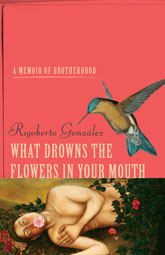
Review: Rigoberto González. What Drowns the Flowers in Your Mouth: A Memoir of Brotherhood. Madison: U Wisconsin Press, 2018. ISBN 978-0-299-31690-7 (link)

Michael Sedano


The vision on the page blinded me to the world around me and my own memories. The forgotten farmworker shack sealed against time, a dusty lump on the floor perhaps an abandoned boot, then realizing a desiccated cat that waited patiently until no one came to open the door.

Who is this poet I’ve just met, Rigoberto González, who stuns me like this? The years since 1999’s So Often the Pitcher Goes to Water Until it Breaks have filled in a partial portrait of a complete artist: poet, college professor, critic, novelist, painter, memoirist.

The pen of memoirist González brings his difficult familia to public scrutiny, in his 2018, What Drowns the Flowers in Your Mouth: A Memoir of Brotherhood.

The memoir extends Gonzalez’ reporting on intimate familia, personal, emotional matters. That the book jumps into dark matter is a product of truth, and a deliberate style.

González speaks to his hard-edged reporting in a 2007 interview (link), when the writer told La Bloga’s Daniel Olivas,

if I was going to write about my life I was going to offer it to the reader completely, not selectively, and that meant including the ugly parts too. I come from a home where humor and storytelling were the everyday expressions of love, but so too where violence and abuse were expressions of frustration and hardship.

What Drowns the Flowers in Your Mouth is published as part of University of Wisconsin’s Living Out Gay and Lesbian Autobiographies series. A four-page listing of titles appended to this volume attests to the market for targeting specific readerships.

More readers will find this interesting work where booksellers stock it among the general titles, as well as LGBTQ shelves. The audience of this book is anyone pursuing exemplars of the memoir genre. Being that memoir is the fastest-growing genre among an aging population, anyone who wants to write a memoir needs to read What Drowns the Flowers in Your Mouth.

Any writer who fears saying certain things about real events and people in their lives needs to read this book for permission.

Writers and poets facing personal hardship need to know what got this poet through it.

“It” is the ugly. Orphanhood, death, abandonment. Big brother Rigoberto is driven by instinctive manda to protect his little brother in a world of abusive abuelos. Their father comes back now and then, infecting the narrative with negativity for a few pages until he’s evicted again. This is their lot and each deals with what comes in his way.

Readers seeking equipment for living in these pages will find two strategies but no consejos. Number one is aguantando.

The father endured a life’s oppressive reality through story. That creative spark is something the author inherited from him, in the home, in the DNA. The author grew up aguantando by thinking, reading, being outspoken when the situation demanded, hiding, withdrawing into other people’s narratives when all he could do was aguantar. Then he got out, strategy two.

Little brother isn’t motivated to pursue an escape despite summers piscando la uva. He takes it. Then he drops out of school, settles into the local ambiente, marries, has kids, gets a gas station job, struggles. Aguantando.

Big brother is big time. World traveler, celebrated, paid to write, his name spoken in important places. The author’s public doesn’t see exhaustion, incessantly writing to-spec to raise cash to support his struggling brother. There’s a lesson of sorts there for every writer: when you need more money, write more and write better.

Sixteen chapters track the González family’s progress from isolated Michoacan to a wilderness settlement outside Mexicali. Side visits to the maternal Alcala family put an exclamation mark on the loveless isolation defining the two boys’ lives.

Reading What Drowns the Flowers In Your Mouth is a literary treat for its substance, detail, expression. The opening page of the penultimate chapter, “The Wondrous Flight of the Hummingbird,” says not quite all with its beautifully woven tapestry of language; poetry, irony, disillusion, sorrow, and finally acceptance.

The name of the town at the northeast shore of Lake Patzcuaro is pure onomatopoeia. Say it- Tzin-tzun-tzun-and a hummingbird zips by with each syllable. These elusive little birds are so fast they're invisible and can never be caged. In fact, the only way the people of Tzintzuntzán can attempt to capture a hummingbird is to carve one out of wood, or to sculpt one in iron. The only way for visitors to own one is to buy it. I brought two of them with me that hang from the kitchen doorway of my NYC apartment. As soon as I put them up, I realized how ridiculous this illusion was since the wings are frozen midflight and the bodies dangle from fishing lines because what I "caught" was nothing less than decorated dead weight. These are memorials to the fleeting hummingbird, a wondrous feathered creature whose population has been dwindling over the years. I saw hundreds of memorials in Tzintzuntzán, but not a single living example of what all that artistry honors. Still, it is difficult to challenge the town's name-it is the place of the hummingbirds. They are everywhere: on furniture, on pottery, and stitched near the hems of pretty little dresses.

The chapter is a valedictory letter to a little brother from big brother. Conspiculously absent here is abuelo, and no talk of their father’s abuse. Turning a blind eye to a father who weaves in and out of their lives always leaving a bad taste puts together two words in the same sentence that would seem unlikely given the history of the man we’ve had to endure, “paternal duty” and “father,” as if there can be redemption for leaving the boys to be lashed and tortured by abuelo’s cruel words and capricious control.

The book's thread about physical disability casts light upon the dark mood infecting the author's account of his boyhood. Forced by MS-like symptoms to walk with a cane, physical incapacity wears on the man’s sense of personhood, as well as denying him physical independence. Where escape had been his life’s praxis he becomes prisoner of his disability, and it’s a hard thing to aguantar.

Illness becomes the lens through which the memoirist constructs his scenes. Where a body feels pain, the mind resides in misery and shuts out the rest. The closing chapters, with their diction of reconciliation, reflect the author's growing strength and healthy prospects for an able-bodied future.

Physical debilitation progressively surrenders to a patient's determined diet and activity, and the right pills. The man sheds weight. Now eroticism grows in awareness and usefulness, he can flirt again. Reinvigorated, the artist rededicates time to being productive and joyful. It works; there is this book.


La Bloga Sponsors Face Your Fears Writers Workshop With Ana Castillo

When La Bloga learned that Ana Castillo was contemplating a west coast swing, Michael Sedano offered to host a Pasadena workshop on behalf of La Bloga. At first, the plan was to recruit a donor to underwrite the entire effort and award scholarships to all participants. That plan got hung up on technical financial details and institutional mordida.

Plan B was to sponsor a no-host workshop at the public library. Demand immediately filled the space, generating Plan C. We added a workshop at Casa Sedano. The author would be kept busy with two workshops the same day and more writers would share the experience.


Writer workshops play vital roles in literary culture. Workgroups who nurture and safely critique one another’s work are indispensable to many writers. Workshopping with a professional author is another essential element in a writer’s growth. Personal insight, Q&A, one-on-one environment, small group interaction offer ineffable benefit to one's skill.

Giving local writers access to Castillo’s workshop was the prime goal of the plan. Better writing would be up to them.

Having fun doing it was an important benefit for the residents of Casa Sedano.

This is the first writer workshop Casa Sedano hosted. We’ve welcomed Mental Menudo, Mental Cocido, Book Releases, Backyard Floricantos, Living Room Floricantos, Guest Author Readings, and now Face Your Fears Workshop for 15 writers congregating around a dining table.

For writers, conducting workshops is an extension of one’s marketing and promotional responsibilities. Preparing the workshop is a demanding job for a travel agent, supply chain manager, promotional factotum,  p.r. flack. Local arrangements for lodging and transportation place high priority demands on time budget and purse. Books and other material must ship well in advance against delays. Someone is appointed to receive and store the boxes, then arrange pickup and transfer to the workshop destination. A workshop is a major project involving details worthy of making and following a checklist.


Arranging workshop space entails institutional fees, setup against deadline, parking and transportation issues for participants.

Getting the public room at the Santa Catalina Branch of the Pasadena Public Library became a lesson in civic resources. Six phone calls to the branch, a website message, two calls to the central office, and three visits to the branch, and a check, secured the public room. An assistant city manager sent a query to the central office, a happenstance that didn’t help attitudes at the local branch.

A workshop’s enrollments and attendance are subject to caprice. Last-minute cancellations become headaches. Last-minute adds, disappointments. Even good maps and exact directions don’t get people to the place on time owing to traffic conditions and making the wrong turn someplace. Sometimes garbled information and the vagaries of cut-and-paste email lead to inconvenience.


The pair of Face Your Fears workshops were successful, according to Castillo. One disappointment for La Bloga grows from faulty memory.

Arriving at the end of the first workshop, Sedano neglected to bring his good camera and took a group foto with an iPhone. The foto failed. The second workshop, at Casa Sedano, found the Canon camera in readiness. The group portrait and a few candids capture the spirit of writers workshopping facing their fears.


USC Chicano Centro On the Verge
Michael Sedano

I arrived at USC in 1972 with the time-honored stereotype of the “University of Spoiled Children” whose campus perched at the edge of black and raza Los Angeles, but whose black enrollment consisted mostly in world-class athletes. I was on the G.I. Bill and the only Chicano in my graduate program. Down the hall from the Speech Department in Founders Hall, English grad school student Mary Ann Pacheco was promulgating plans that eventuated in El Centro Chicano.


Pacheco and a cohort had a plan that blossomed spectacularly to USC's lasting benefit: they integrated the campus.

Frank Sifuentes was employed as a recruiter and he brought in 102 first-year, mostly first-generation-college raza kids from East Los, Boyle Heights, and eastward. A building at the main campus entry gained a set of murals and a name, El Centro Chicano. In one fell swoop, raza gained an inescapable presence at USC.

Fast forward to last Friday in the confined corridor that serves as today's El Centro Chicano. Mary Ann Pacheco visited a “Power Pan Dulce.” The small gathering represented a cross-section of classes, frosh to grad school. The meeting mirrored the tardeadas the original centro hosted, serving light dessert instead of free buffet.


Pacheco shared unique stories of private confrontations with powerful Deans, threats to yank financial aid over activism, a university president’s curiosity and support, and the suspicions young raza entertained that the old guy with the camera was FBI or a narc.

Now, diversity renews the “battle of the name” that grudgingly settled on “Chicano” out of a welter of terms like Mexican American or Mexican-American, Spanish or Spanish-American. At USC, there’s a move afoot to change to some other name.


An upcoming  “Power Pan Dulce” will discuss the idea, or perhaps a proposal, to change El Centro Chicano's name. There's probably a movida bubbling to surface a new handle. As I bade adios to Billy Vela, the director, I reminded him that just because you discuss a topic doesn’t mean you have to change the name.

USC El Centro Chicano alumni and benefactors may wish to contact Vela via his website (link) to voice an opinion. How do “League of United Latin American USC Students,” LULAUSCS, or, “Cardinal, Gold, and Brown Trojans,” sound?

 –x suffix words have gained popularity, Pacheco observes, saying she finds “Chicanx” pretentious. She goes with the flow and switches to the dialect of her setting, tolerating "hispanic" if that is lingua franca to her audience.

The actively retired English professor reminds that the word “Chicano” is not an historical artifact but inheres a strategy of emergence and peoplehood.  Read Suarez' El Hoyo, Pacheco recommends, to gain a feel for the term.

USC’s public mind and historical memory have forgotten much, and may be on the verge of abandoning a source of power, acting subversively against themselves.

I urge El Centro Chicano’s gente to keep the name El Centro Chicano, to seek instead ways to renew El Centro's founding energy. Fight on.

Willie Herrón mural adorns the side and front of El Centro Chicano in 1973 at Hoover & Jefferson