Friday, March 10, 2023

A Brown Book Club and Cinderella Frenzy

Today La Bloga features two guest contributors, both educators, writers and community advocates.

Jesse Tijerina presents exciting news and a bit of history about his latest project, the Between Brown and Me Book Club, something in which our readers should be keenly interested.

Maria Ramirez gives us a slice-of-life vignette based on her own experiences assisting teachers on both sides of the border.

And away we go.

_________________________________


Hesse, Anaya, and the Origin of the Between Brown and Me Book Club
Jesse Tijerina


Strangely, as long as I can remember I've been fascinated by books and libraries despite my reluctance for reading throughout my K-12 schooling. Nonetheless, I was conscious of the value and power behind words. I knew words mattered to others and I knew words mattered to me. 

The first book I read from cover to cover was Narcissus and Goldmund by Hermann Hesse. I was 23 years old and struggling at college. I bought the small paperback at Waldenbooks because the last name Hesse resembled my first name Jesse, we were almost tocayos. For nearly twenty-seven years Hesse has remained my pound-for-pound writer. Finishing his 558-page opus, The Glass Bead Game is when I became a reader. 

Not long after as I was leaving campus, I found myself sitting at a book signing; it was for Bless Me, Ultima by Rudolfo Anaya. What led me into the reading was the way Rudolfo Anaya’s name pronounced itself in Spanish when I read the flyer. I had no idea such events existed. I had no idea Ultima had been published one year before my birth. I’m doubtful I would have become an educator without Antonio and the Golden Carp. But the beginning that came with Ultima is when I became a Brown reader. Although my library is shelved with thousands of words that have shaped me along my journey, the words that have mattered most are the words that reveal the realities of Brown lives like mine. When I read Brown books, I’m reminded that we read in solidarity for the sake of community. 

Months before Brown Enough hit the shelves, a friend sent me a video of Christopher Rivas breaking down Brownness. I googled him and read an exchange he’d had with Ta-Nehisi Coates at a Coates reading in downtown Los Angeles.

According to Rivas it went something like this: “All I hear is Black and white. As a Brown man, a Latin man, where does that leave me?” Coates took a short breath and responded, "Not in it.” Rivas’ statement and question about a Brown man’s role in the race conversation happened to be familiar territory for me as well. 

Playing on the words from the title of Coates’ book, Between the World and Me, I created the Between Brown and Me Book Club and invited fourteen Brown educators and friends to explore two foundational questions posed by Rivas. “What are the consequences of not being in the conversation?” And, “What does it take to be in it?” Following three months of meetings at The Midnight Oil Bookstore, tacos de carne asada, school visits with high schoolers, and breaking down Brownness at the personal level, three of us mobilized and figured we’d share the experience with others. Hence, the Between Brown and Me Book Box was born. (Team: Jesse Tijerina, Manuel Tapia , Pablo Guzman)

The quarterly box subscription will include the book of the quarter, discussion guides, access to in-person and virtual gatherings, and sorpresas rooted in Brownness including stickers, patches, bookmarks, merch, and original art. To honor the inspiration of the book club, box #1 is Brown Enough: True Stories About Love, Violence, the Student Loan Crisis, Hollywood, Race, Familia, and Making it in America by Christoper Rivas. Join us in preserving and protecting our Brown joy. Join us in reclaiming and reconnecting with what may have been taken or lost along our journey. Life's a Risk Carnal, Turn Up Your Brownness!

Boxes can be purchased at The Midnight Oil, a Latino-owned bookstore in Greeley, Colorado or at https://booksatmidnight.com/products/between-brown-and-me-book-box.

Questions to consider for readers:

What do you read?

When did you become a reader?

When did you become a Brown reader?


_________________________


Cinderella Frenzy

Maria Ramirez

Two women who lived with several Mexican states between them found themselves in a common place and time in a breath-taking setting, El CREFAL (Regional Center for the Education of Adults in Latin America) in Pátzcuaro, (Michoacán,) México. They shared an experience they had in common. The two women had been sent to prepare to go to the United States as exchange teachers. I had hosted these ladies in past years at my Colorado home for these programs of which Colorado and Mexico were a part. 

A friendship blossomed since my first visit to Mexico in 1993 when I was part of a group at CU Boulder’s teacher exchange program. After my first visit to central Mexico, I fell in love with Puebla. I also enjoyed all the other states in Mexico I had visited throughout my educational career. Mexico became my healing place, a place where I was taken care of so I could continue to face my challenges at home.

The teachers from Mexico treated me like royalty when they hosted me in their homes. I did my best to try to match their hospitality when they stayed in my house. After hosting teachers year after year, we became good friends. We’ve kept in touch since then. Our relationship grew beyond friendship. To this day, we treat one another like family. Each time I visit Mexico, I fill my bags to the maximum with items that are abundant in the United States. We take things such as clothes, shoes, kitchen utensils, Christmas lights, and ornaments for granted. These items are lacking in my friends’ homes and communities. Likewise, my home is full of the beautiful gifts they have brought me throughout the years. My walls have Puebla’s hand painted decorative plates, known as Talavera. My china cabinet is full of these beautiful and unique plates of all sizes, a complete tea set, hand embroidered cloth kitchen towels and a huge collection of ponchos, sarapes, and dresses. 

            When I was teaching at CU Boulder in 1999, the professor sent me to Mexico to bring back documentation and photos of el Día de los Muertos, the Day of the Dead celebration in Mexico. I called my Puebla friend, Aleyda, and asked her what she needed since I was traveling through Puebla on my way to Morelia, Michoacán.

            —Un abrigo, Maria, está bien frio—. A coat, it’s very cold, she told me.

            Days before my trip, I started looking to see how much coats cost at the local K-mart®. The cheapest I could find was around forty dollars. I could afford that for one, yet I could not take a coat only for Aleyda. I had many other teacher friends in Puebla who I knew had similar needs. As teachers, they earn very little, and many times did without what they needed to pay for the bare necessities. I then decided to go to a local thrift store in Brighton. I looked carefully at the price tags so I could find several nice coats for my other six teacher friends. When I had selected them, I approached the counter. 

The attendant rang up my items and said, “It’s $9.98.”

            “What?” I (asked.) “There must be a mistake.”

            “No mistake, miss, today is our 99-cent Wednesday.”

I could not believe what I had just heard. I quickly paid and told the lady, “I’ll be right back.”

I raced to my vehicle, unloaded, came back, overflowed another cart, then went home to unload, and returned for more.

            By the time I packed, I had two huge bags, plus one more that went over the weight limit of ninety-five pounds. Luckily, the lady at the counter said, “No worries,” and tagged them. To save space, I took minimal clothes for myself and whatever I could pile on, I did. I had double socks, two sweaters, and a coat on my arm. As a carry-on, which had no restrictions then, I took a Christmas dish set for the school director and things to help Aleyda’s father who had recently lived through a mudslide in their mountain home in Cuetzalan. I also packed a bag of shoes, hoping they would fit my teacher friends, especially my friend Rosa, who had a hard time finding comfortable shoes. 

            Before I left, I had called the Puebla teachers to meet me at Mexico City’s airport during my layover. 

When I was pulling my line of suitcases, an immigration agent looked at all the things I had and asked, —¿Quien viene con usted? — Who is traveling with you?

—Nadie—, No one, I responded. 

—Todo esto es suyo—?  All of this is yours? He turned his head, scanning the long line of bags.

—Sí, — I said.

—Le van a cobrar por todo, y si le toca la luz roja, le van a quitar todo. — They are going to charge to get this across, and if you get the red light, they’re taking it all.

—Pero todo es usado y lo llevo para gente necesitada. — It’s all used things. I am taking it for people in need, I told him. 

He shook his head as I pulled and pushed all my cargo, praying that I would get a green light. I prayed and said to myself, “God, you did not bring me this far to leave all these needed things behind.”

I held my breath as I pushed the button for the light, looked up, saw green, and breathed. I looked back at the immigration officer, smiled, and waved. He stood, arms crossed, frowning as I walked away.

As soon as I crossed the immigration station, I saw all my friends and their family members waiting for me. We were elated to see each other, yet I had to hurry so that I could make my connecting flight to Morelia. I had packed each of the teachers’ things in separate bags, so I quickly handed each her own things.

—Aleyda, esto es para ti, Rosa, para ti, Conchita, esta es para ti, Blanquita, Lolita, y esto es para Mago. — This is for you Aleyda, Rosa, for you, Conchita this is for you, and Blanquita and Lolita, this is for you, and this is for Mago, “I told them as I distributed the bags. 

            Then there was the bag of shoes, which I dumped on the floor, and said, “I don’t know which will fit you, so try them on and take the ones that you like. “

It was a Cinderella frenzy; everyone took off her shoes and started trying on the different footwear. Rosa was over joyed that she had found several pairs that fit her wide, chubby feet. They all took some for themselves and their daughters. While people stared, I smiled as I watched their excitement. We hugged and said goodbye. I rushed to my connecting flight with the gifts I had separated for my Morelia hosts. 

            Years later, Rosario from Zacatecas and Rosa from Puebla attended el CREFAL the same summer to prepare for another exchange visit to the United States. 

One of the participants shared a concern. —Me platican que las maestras de los Estados Unitdos son muy frias y distantes. — I’m told that the teachers from the U.S. are cold and distant.

Then Rosario stood up and said, —No todas. Una de las maestras de Colorado me brindó lo major de ella. — Not everyone. One of the Colorado teachers gave the best of herself for me. My host was not the best. When I shared this with Maria Ramirez, she picked me up and had me join her and the other teacher from Zacatecas she was hosting and gave me the best experience of my life.

            Rosa, who was sitting across the room, stood up and said, — Yo conozco a Maria. Yo también me he hospedado con Maria Ramirez. Ella es maravillosa. Me compró zapatos, muchos zapatos. Si tienes suerte, te tocará alguien como ella. — I know Maria. I have also stayed with Maria Ramirez. She is wonderful. She brought me shoes, lots of shoes! If you are lucky, you will be hosted by a person like her.

Both teachers glanced at each other. The rest of the class was speechless. When Rosa shared this story with me, I too was without words and my heart smiled. To think that two individuals who lived in different distant states in Mexico brought up my name to share their appreciative experience at my home was extraordinary. 


Later.

__________________________


Manuel Ramos writes crime fiction. Read his latest story, Northside Nocturne, in Denver Noir, edited by Cynthia Swanson, published by Akashic Books.


Thursday, March 09, 2023

Chicanonautica: A Mexican Headless Horseman

by Ernest Hogan

I’m a pocho. Born in Eastlos, but raised in West Covina, so mi espanol es kinda wonqui. It’s like a reattached limb with nerve and muscle damage. As the Father of Chicano Sci-Fi, I consider it my sacred duty to struggle with Spanish. I can read it fairly well, but when it comes to speaking it, I’m far from fluent.


So I do my best to run the language through my twisted cerebro, hoping that someday before I die, I’ll be able to rattle it off without it being awkward.


One of the things I do is watch movies in Spanish. This has gotten easier in the days of streaming services. I used to have to tune to Spanish-language stations and hope for the best. Now on YouTube, Tubi,and others, I have access to more than ever before. Beats the hell out of the days when I had to channel surf (do people still do that?) and hope I could find something weird enough for me.


Cinema Mexican is often weird enough for me. Now I put a lot of it on my watchlists, and I'm delighted as well as educated.


Recently, I scrolled through my substantial YouTube watch list and found El Jinete sin Cabeza. A Mexican headless horseman from 1957? I went for it.


It starts out with a man being taken by moonlight to some ruins by a gang in skull masks and put on trial–there is a living, severed hand, though you can see the arm coming out of a slot in the table–and put to death. Pure poetry.


After a while the headless horseman shows up. He wears an all white charro outfit, and his head is covered in black cloth, so when he’s in front of a black background, his white sombrero appears to float over his body. A great effect, sure; you can see that it’s a black mask without eyeholes in the fight scenes, but the illusion works most of the time.


The plot is the hackneyed Scooby-Doo fake ghost mystery plot (how old is it? who did it first?), but the Mexican Gothic/Expressionist/Noir look and surreal touches send it off into another dimension.


I had caught part of it back in my channel surfing days. I was glad to see the whole thing, and to be able to Google it. Turns out, it’s by one of my favorite Mexican directors, Chano Urueta, full name Santiago Eduardo Urueta Sierra. He’s responsible for some of my favorites, like Blue Demon contra Los Cerebros Infernales, and the totally outrageous El Barón del Terror AKA The Brainiac. Besides horror/sci-fi and lucha libre, he made a lot of westerns that I have to investigate. He was also a writer and actor. Sam Peckenpah cast him in The Wild Bunch and Bring Me the Head of Alfredo Garcia.


Urueta is one of the heroes of La Cultura.


I thank Quetzalcoatl for the technology that allows me to enjoy such things, and Tezcatlipoca for the weirdness.


Ernest Hogan will be teaching Chicanos how to conquer the science fiction/fantasy/horror megagenre at the Palabras del Pueblo Writing Workshop. It’s called Papí Sci-Fi’s Ancient Chicano Sci-Fi Wisdom. Sign up, tune in, and learn.

Wednesday, March 08, 2023

Hora del cuento con René Colato Laínez / Bilingual Storytime with René Colato Laínez


Te invitamos este jueves 9 de marzo a las 6:00 p.m (Hora Colombia) a nuestra Hora del Cuento Bilingüe con el autor y docente salvadoreño René Colato Laínez, quien realizará una lectura de su libro: René tiene dos apellidos / René has Two Last Names.
 Descubre los ingeniosos esfuerzos de un niño para ayudar a sus compañeros de clase a entender la tradición de tener dos apellidos.

René tiene dos apellidos: En este cuento, René, que es de El Salvador, no entiende por qué su nombre tiene que ser diferente en los Estados Unidos. El primer día en su nueva escuela, su maestra le da una calcomanía que solo tiene su nombre y únicamente su primer apellido. Faltaba su segundo apellido... ¿quieres saber cómo terminará esta historia?


Este evento lo realizamos con el apoyo de MakeMake y Arte Público Press y es ideal para niños y niñas de 5 a 7 años, docentes y promotores/as de lectura. Inscríbete para recibir los enlaces de la transmisión en vivo y un recordatorio 30 minutos antes de iniciar: https://forms.gle/XghkWQzCdnAPSPrN6


 * * *


Join us this Thursday, March 9th 6 pm ET in our Bilingual Storytime with the Salvadoran author and teacher René Colato Laínez, in his reading of: René tiene dos apellidos / René has Two Last Names.


In this story, René, who just arrived from El Salvador, doesn't understand why his name is different in the United States. The first day of class, his teacher gives him a sticker that reads: Rene Colato. The sticker is missing his second last name: Laínez.  


Thanks to the support of MakeMake and Arte Público Press. For children ages 5 to 7 years old, teachers and librarians. Sign up to receive the live stream links and a reminder 30 minutes before the start: https://forms.gle/XghkWQzCdnAPSPrN6


Tuesday, March 07, 2023

Reprint: Anaya, Billy the Kid, Building A Cement Boat

Note: March roars in like a mouse that roars and catches La Bloga-Tuesday's Michael Sedano in the midst of major transitions. Let change arrive on its own time. In the meanwhile, we gotta read, and we gotta eat gluten-free comida.

Expanding Limits, Making New Rules, Setting History Straight


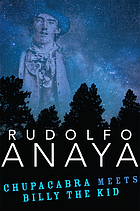
Review: Rudolfo Anaya. Chupacabra Meets Billy The Kid. Norman:UOklahoma Press, 2018.
ISBN 9780806160726
Michael Sedano

Rudolfo Anaya continues expanding the horizons of Chicano Literature in his newest work, Chupacabra Meets Billy The Kid in so many ways. First off, the title is sleight-of-hand. While folklorists might come looking for some Chupacabra, a sci-fi platonic romance breaks out. Beyond that, let me count the ways Anaya is busting Chicano Literature loose from conventionality and celebrating himself. And if I’m wrong, I trust I’m not alone in celebrating Rudolfo Anaya’s ongoing enrichment of literatura Chicana with this exploration of the speculative muse.

For one, Chupacabra Meets Billy the Kid is a valedictory-in-progress for Anaya’s oeuvre by the author himself. For another, the author, a descendant of the New Mexico legend, sets the record straight about his forebearer. Then there’s the novel of the title, a science fiction plot knitting together the goat-sucker with la llorona, Big Foot, space aliens, an infested office of the U.S. president. There’s a meta-novel unraveling in the process. From University of Oklahoma Press, Chupacabra Meets Billy the Kid arrives as the year’s most entertaining title. Anaya sets the bar for 2019 U.S. Spec-Fic.

In one hundred seventy-two pages, the author weaves threads drawn from the fabric of his literary output. Curandera and mystic Ultima hovers on the outskirts of the action, these settlements are her haunts, the whole llano, is her tierra. As the story draws the character Rosa home, the author reminds readers of her origins, it carries her home: 

The golden carp from a story told by the man who had told Ultima’s story. She had seen the boys fishing at the river when they left Puerto de Luna. Now the carp had appeared, a miracle. 

Other tokens of the Author’s career step forth aside from that magical carp; those muchachos from young Mares’ boyhood; place names; Anaya’s familia, even Roberto Cantu makes an appearance. These allusions offer metynomic cameos concatenating all the words and characters who’ve come before in Anaya’s life, culminating for the moment, here. It's not that this title stands alone, it belongs to this long-lived familia of created truths.

Chupacabra’s science fiction angle has its origins in Anaya’s Sonny Baca series that begins with Alburquerque and follows the seasons, Zia Summer, Rio Grande Fall, Shaman Winter. The detective’s nemesis, Raven, brings mysticism and time travel to Sonny’s world in that final title, in a bit of a fictive stretch then. Time travel is the central motive of today’s plot, and it works. 

Unchanging and unchangeable, time travel makes for one long bitter irony for Rosa. She knows how the stories end. The girls she hugs farewell, they’ll be dead from disease a few years after Rosa’s hugged them and wished them long lives. Billy, too, is headed for his death.

People who read history get it. Pat Garrett was a hero. People who read more history, and fiction, get it, too. People related to Billy, like Rudolfo Anaya, and country gente, think of a cowardly blast, a kid singled out by double-crossing land barons, not the only killer in town. That's the story Rosa tells here.

Don Rudy adopts a female persona for Chupacabra’s lead character. She’s a novelist frustrated because, writing yet another Billy the Kid story, she feels its absence of authentic, of things and people not known anymore. All those women of the llano, the ones Bilito romanced, the ones who endured and gave succor after drunken gunfights to men with names. Research carries one only so far. Seeing is believing and the ultimate research. It's like Rosa makes a deal with the forces of nature.

The novel itself contains no surprises. The kid lives a short, violent life and gets gunned down and buried. End of story. What was his name, this Billy the Kid? Anglin? Bonney? Henry McCarty? The characters are what give the novel its fresh life. Rosa the researcher keeps novelist’s notes that leap from date to event to person. Rosa the storyteller seeks out the women whose stories didn’t get told, who lived in between those facts.

Rosa recorded the names of the families she met in the Pecos River villages. They always welcomed her into their homes, gave her a place to sleep, shared their meals. The women were the strength of the family and community. Work was strenuous and difficult for the men outdoors, and just as hard for the women. Raising families, preparing meals, canning for winter, making soap from lard and lye, washing, sewing, gardening, sometimes riding to the range to help with shearing sheep or branding cattle, bringing in water from cisterns or the river, chopping wood, cooking three meals on a wood-burning stove, attending church, raising chickens, having babies, curing every conceivable illness that struck family or neighbors, helping their comadres: the list was endless and exhausting.

For me, what I call the meta-novel offers the best moments of Chupacabra Meets Billy The Kid. Like a Shakespearean dramatic monologue, the author steps outside the narrative to offer writerly consejos about the creative process, an historian’s gloss on a particular detail, something the author needs to tell his readers at this juncture. For example, expounding on evil, Anaya has Rosa ask “What does this have to do with me?” and the reader should take that “me” as themselves.

“For starters, we know that most Advanced technological civilizations destroy themselves in their infancy. Nations create weapons, and once each country has its nuclear arsenal, political forces keep adding to the stockpile. No one wants to disarm. When we acquired nuclear weapons, we fit the rule. You only have to look at the proliferation that’s taking place, loose nukes being sold to terrorists. A crazy president with his finger on the nuclear button.”

The voice is Marcy, a disembodied character from an earlier novel, a voice in the machine who guides Rosa’s travels through space and time. Marcy is also Anaya’s voice, the omniscient metaphysical narrator hanging--perhaps impaled-- on the point of the Arrow Of Time.

Time, travel, space, the critters, these elements make up the whole cloth of the meta-novel. Anaya devotes some explanation to how Rosa gets to nineteenth century New Mexico. It’s not clear why Billy isn’t freaked out that he understands Rosa’s presence, but he’s of his time and of the future, multidimensional, as in this scene:

Billy forced a nervous laugh. “Maybe that’s why I don’t trust the written word. Most written about me is lies. You tell ‘em the truth, Rosa.” 
Billy could not look into the future. Many books had already been written about him. lies and truths. Each reader had to come to his or her own conclusion about where the truth lay.
Rosa nodded. “I’ll try, Billy.” 

After two years in Billy’s time, Rosa rides a horse upriver and into her own time. Do the people in Billy’s time think Rosa stole Mancita, the horse she rode into the sunset on? Why doesn’t Rosa’s laptop run out of juice? Is it because in her own time, she's been gone just a few hours?

Readers need to sit back and enjoy the ride. Sci-fi is supposed to make sense, but only up to a willing suspension of the rules. After all, the imagination’s the limit, and Anaya’s muse lets loose a todo dar page after page. For example, a classic scene borrowed from the stopped clock showdown scene in a movie.

Rosa’s helplessly worked up seeing a jailer bully pounding Billy’s face with the butt of a rifle. Rosa gets kicked out of the jailhouse and comes face to face with the devil, a creature named “Saytir.” This is a formidable enemy, only a hidden derringer saved Rosa the last time she was alone with the alien spawn from her own time.

Saytir wore purple bell-bottom pants with silver rosettes sewed down the sides of the legs, a bright red shirt, and a dazzling blue satin vest. His neckerchief was pink, his hat a poor excuse for a large mariachi sombrero. His boots were obviously from a Juárez Mercado. On his gun belt he sported two silver pistols, one on each hip.
“Rosa,” he whispered in his best imitation of Gary Cooper in the movie High Noon. “We meet again.” 

The ridicule is Anaya's most trenchant indictment of daily events. Much as the evil is a clownish buffoon, Saytir's power can destroy the world and only Rosa has the answer, it's tied up in the inevitability of Billy's legend, in the writer's power to suspend time and write events to fit their outcome.

Filling in Billy’s story demands mas o menos straight history, or in this narrative, fashioning creative non-fiction heavy on the fiction element, as Anaya develops the facts of the Lincoln County war. For readers with an historical bent, there’s a set of research notes at the end that links plot events to history. In other words, this stuff really happened, the names have been supplied to tell the fuller story.

Ultimately, Billy’s story is satisfying because of its fantasy—the time trip, the monsters, are supposed to be fun. And they magnify the horror of the truth. Big Foot and cyborgs aren’t real but that evil is. Marcy and Rosa step away from Billy’s narrative to address, engage, a writer’s ethical responsibility to record, document, reveal, explain. Marcy talks:

Write Billy’s history. Let people know we have this self-destructive instinct in us. It’s what led to the violent times in Lincoln. But there was some good in Billy. If you can find some goodness in Billy’s life, that’s the lesson to be learned and taught to the young. Otherwise, we’re lost. Your story can save the world.”
“ I didn’t set out to save the world!”
“Few writers do, and yet that’s your mission.”

At this juncture the transmission fades and Rosa and the reader are on their own. Billy gets buried. Rosa rides home with Josefa’s blue taffeta dress. Time returns to normal. None of this happened. Evil abounds. The 

Order Chupacabra Meets Billy The Kid  publisher-direct at this link. Independent booksellers can order it for you.


The Gluten-free Chicano Cooks
Kathy and Jim Build a Boat. Boatyard chile verde.

Durf marveled at his teammate, a javelin thrower who lived in the Goleta monte. A born storyteller, my roommate spun a fanciful tale of a man I knew only by sight from track meets. I sought what germ of truth must lie at the heart of Durfee’s account.

Jim Clark back to camers
“Jim Clark goes takes his javelin to hunt deer in the mountains.” The story was Jim lived for free on a remote ranch and survived mostly off the land, running down deer in the chaparral. I loved the image my roommate conjured, a wild man living at the edge of civilization because he chose to live like that, free and unencumbered. I imagined Jim Clark went hungry a lot.

Jim Clark’s girlfriend, Kathy, loved him with immense dissonance. Jim’s life was impossible to share with a woman studying to make a career teaching high school English. It was during one of their off-again separations that Kathy and I were hanging around together.

Kathy filled whatever space she occupied. Not many people chose to occupy space with her, however, because Kathy spoke her mind. A woman of wit and brains, Kathy was a formidable personality who fit perfectly into my world, especially as we both were single and not looking. An ideal end-of-college-summer partnership.

Four years have ways of changing a person’s life and attitudes. I was back from overseas and learned from the locals that Kathy and Jim lived in the boatyard along the railroad tracks. They were building a boat and needed help. I called the boatyard. I hadn’t heard Kathy’s voice in four years but I recognized her “hello?” instantly and she mine. Old friends are good friends, separations are meaningless.

I asked him about the javelin story. “I tried it one time,” Jim Clark laughed. That was the day we laid the keel for the cement boat.

Kathy looks out while Jim and friend cement the deck.
Jim had identified a pile of rotted railroad ties where some steel rails lay by the rail side. He had already picked out his keel and pulled the rail to clear ground. All he needed was someone with a truck or car to transport the rail to the boatyard.

I drove the car into the weeds where Jim directed me to stop with the rail underneath. Jim and another fellow lifted the front end and I lashed it to the front bumper. We did the same on the other end.

The nose of the rail extended a few feet from both ends of the Buick Skylark. Slowly and not spotted by cruising cops or railroad dicks, we drove the back streets to the boatyard and dropped the keel in place. In the boatyard shack’s two-burner propane stove, Kathy made her famous dumpster soup and we feasted friendship, old times, the cement boat to be.

A few months after, the boatyard shack has gained a dining table, an outdoor couch and several makeshift seats. Where we’d dropped the keel now stood a rebar and steel wire superstructure of a 40-foot boat. Jim worked on that boat with the intensity that led him to think he could chase down a deer and kill it with his javelin. The deer was certainly out of reach but Jim had built a boat. All it needed now was a skin of cement.


Months passed as Jim constructed the hull, deck, interior spaces and hidden recesses. The work took the time required. Ugency arrived with cementing. The work must be completed in one weekend so the boat dries and cures as a single mass of cement and steel that floats on the open sea. Friday after work, Barbara and I drove up from Temple City. The work was well underway by our arrival late afternoon. Jim and Kathy had lots of friends.
Jim Clark. qepd.

The third day the hull looked like a boat. Only a few people fit inside so workers took shifts pounding cement into the interior walls. Others touched up the exterior. By noon Sunday, the cement boat was done. Most of the crew had left, exulting in knowing they’d joined the culmination of an incredible feat. Jim had read books and talked to old salts, he and Kathy moved into the boatyard, and they built that boat by hand.

I volunteered to make the celebratory feast, a one-dish meal I call Boatyard Chile Verde. After Jim and the cement boat were taken by pirates in southeast Asia, Kathy sailed those waters in hopes of word. She cooked Boatyard Chile Verde for merchant mariners the world over, it was the crew’s favorite dish.


You can make this on a one-burner propane stove, or in a sartén over an open fire. Ingredients, improvisation, and preparation are the keys to making Boatyard Chile Verde.

INGREDIENTS
Pork. Sub beef or chicken.
Gf flour.
Tomatillos.
Green chile – hatch, California, mild new mexico, canned whole are fine.
El pato hot sauce.
comino
Onions
Garlic.
Cilantro
Cast iron frying pan and lid.
Paper or plastic bag.
Sharp knife.
Salt
Pepper
Chile powder
Olive oil

Into the bag, put a ¼ cup of gluten-free flour, a pinch of salt, pepper, and chile powder.

Wash and dry the (pork) meat.
Cut the meat into ½” cubes.
Dust the meat with seasoned flour in the bag.

Dice a large onion and six or eight garlic segments.
Chop cilantro to make 1/8 cup.
Chop 6-8 large tomatillos

Get 1/8” of olive oil hot in the pan. High flame.
Wilt the onion and garlic, stir don’t burn.
Toss the meat cubes with the wilted onions and garlic.
Season with salt, pepper, ground comino or a pinch of seed.
Brown.
Add the chopped tomatillos and chopped fresh/canned chiles, and the can or two of el pato.
Stir and cover.
Lower heat to medium and bring to a boil.
Lower heat to lowest simmer setting and cook for an hour, stirring now and again.

This is ready to serve right away. The objective to fork-tender bits of meat that look like meat, not a paste. Cook vegetable longer before adding chicken, then simmer raw chicken fifteen or twenty minutes until firm. Chicken is fast. Cook beef an hour and a quarter, maybe longer.

Friday, March 03, 2023

Para Las Mujeres: El Menopause

Melinda Palacio


Women’s History month is in full swing and I am shining a spotlight on menopause, that tricky life change that happens to women of a certain age. As I reach that age, that is middle age or half of life under the belt, I am in the middle of a new era for me, menopause. 

As if adolescence wasn't enough what with pimples and menstrual pains, menopause also brings pimples and body aches as hormones go awry and attack the host body, me. Mood swings, weight gain, hot flashes, joint aches, anxiety, trouble sleeping, hair loss or gain are just a few symptoms. 


I used to chalk up symptoms of depression and weight gain to the pandemic and lock down and having to watch people die of the plague. The whole world experienced Covid, changing how we interact with each other. A new normal of social distance and life on zoom ensued. All because some of us refused to wear some kind of face covering. The news and politics during the first two years of the pandemic didn’t help either.


However, much more was going on within my aging body. Not having access to my doctor, who didn't want to see patients unless it was absolutely necessary, didn’t help either. I figured I would take a page from Sedano's book, time to aguantarme, bear it and move on. 


Reaching a certain age meant finally being comfortable in my own body, until my body started to betray me with night sweats and anxiety, making it impossible to get a good night sleep. There's nothing like waking up in a coffin of your own sweat, thank you memory foam mattress. 


I used to sleep soundly the minute my head or arm found a pillow. Now, I count backwards, tell myself to concentrate on tensing and then loosening a body part until I've gone through each limb and toe. 

Then there's the daytime sweats. Those come on with a vengeance. Having ice water at restaurants helps. You can dab an ice cube on your forehead. It's a new kind of discomfort to meet a friend for coffee and then feel as if you have to disrobe or fan yourself; better hope no one sees you sweat. The term for the sudden change in temperature is a hot flash and it is no picnic. I always ran cold, was the girl that carried a little sweater in my purse or car because I knew I would get cold, especially at restaurants.


 Now, I'm the woman that needs a personal fan, resorts to fanning herself with a coaster. A bandana or handkerchief helps with the sudden breakout of sweat, a tip I learned from my friends in New Orleans. Men and women in the South carry a handkerchief to help with the summertime heat. 


I will be returning to this neglected topic. I am not a doctor. I leave medicine to my sister. I'm a poet, a writer, whose had menopause pause on my well-being, and writing. I've added vitamins, more greens to my diet, and anti-inflammatory foods. I'm started to feel better, as if awakening from a bad dream that has lasted more than a year. My body may be trying to kill me, but I will survive and be much stronger for it. 


Thursday, March 02, 2023

Land or Lineage...What is an American?

by Daniel Cano 
                                                                               
After generations, my uncle Francisco Gonzalez, still on the land in Jalisco

     In college, I majored in English because I wanted to learn to write -- short stories and novels. It was 1969, we were the first wave of Chicano and Chicana Baby Boomers entering the hallowed halls of academia. Of course, there were many reasons to go to college. Most of us had graduated high school, unlike earlier generations of raza, where smaller numbers had graduated high school, or not graduated at all. In some cases, liberal teachers had begun encouraging us to apply to college. Also, the Vietnam War was in full swing, and we knew attending college could get us draft deferments. Then, in 1969, just like 1945 and the end of WWII, many returning vets took advantage of the G.I. Bill, so Vietnam veterans did the same. 
     There was no Chicano Studies major, back then, certainly not in community college where many of us started. I do recall one Chicano Studies class. It was attached to the Spanish department, the only department, at the time, that had a Mexican professor, or two, willing to teach the class. 
     I remember quite a few Chicanos declared Spanish as their major, figuring it was the closest they were going to get to learning anything about their culture or ethnicity, which, at the time, was mostly Mexican, way before the 1980s migrations from Mexico and Central America. 
     A few Chicano students were curious and wanted to know why I’d chosen English as a major, the language of the oppressor. It was a time of political awareness. I told them I wanted to be a writer, so how else but to learn English. Besides, I wanted to understand the English-speaking world, since that's where my ancestors had chosen to make their permanent home. I surmised the better I could understand the United States, through its literature, the more opportunities I'd have surviving its complex socio-political structure. 
    I admit, I was far from an academic star in high school. Still, the nuns and brothers had done a decent enough job forcing us to learn, whether we wanted to or not. In college, studying Beowulf to Shakespeare was challenging, like learning a foreign language. Then, moving through the various periods, the renaissance, the classical and romantic ages on through modern times was taxing but rewarding. After all, the entire western world, including Mexico and Spain, had experienced many of those same periods in their literary and cultural histories. 
     When I received a fellowship to live and study in Spain, I changed my major to Spanish, which had been my minor. Immersing myself in the Spanish language and culture opened an entirely new world, not only about Iberia but about Latin America and Mexico, as well. For my master's degree, I chose to return to English, the reason I'd gone to college in the first place. The focus of my studies became: how Mexicans are represented in American literature. 
     So, here I am, fifty-plus years later, still trying to understand the English-speaking world and its relationship to Chicanos/Latinos. My new endeavor, now, is to read the biographies of each so-called “founding father.” I mean, we hear so many politicians refer to the founding fathers, I began to wonder if they really knew what the founding fathers believed. I mean, the first thing I learned was some founding fathers questioned religion rather than embraced it. They were sons of the "enlightenment."  
     I started with Monroe, moved to Jefferson, and I am now on Benjamin Franklin, the working-class founding father. I also learned most of them were not rural, puritan yokels-plantation owners, as many people think, but they were ambassadors to England and France, where they lived for years. They travelled broadly through Italy and Spain, and dined with the aristocracy, as they negotiated trade treaties. Where some supported the British, others supported the French.
     As I read, I began to think: and what was happening in Alta California or Mexico at that time? What was the relationship between the two? Florida was still a province of Spain, and France owned Louisiana. Then, I read a passage in Benjamin Franklin’s biography by Walter Isaacson. The idea got my juices flowing. Isaacson wrote, about trying to understand another person, “…the most important formative element is 'place' (my quotation marks). To appreciate Harry Truman," Isaacson wrote, "you must understand the Missouri frontier of the nineteenth century; likewise, you must delve into the Hill Country of Texas to fathom Lyndon Johnson. But Benjamin Franklin was not so rooted. His heritage was that of a people without a place—the youngest sons of middle-class artisans—most who made their careers in towns different from those of their fathers. He is best understood as a product of lineage rather than the land.” 
     Hmm, I thought, “Of lineage rather than land….” Wasn’t that like my ancestors, the generation of Mexicans who came north to escape the ravages of the Mexican Revolution of 1910, including those who came later, up through 1950s, the “braceros” fleeing unemployment, starvation, and poverty, all of them making homes in a place “different than their fathers"? 
     And what of the migrants who make the same journey to the U.S., today, from all parts of the world, especially the caravans from Central and South America? My grandfather’s generation migrated from Mexico. and as Isaacson argues, lost their ties to the land -- but not their ties to the culture, which ran deep in their veins. They were products of lands, villages, and towns where their families lived and worked for generations.
                                                                                    
Creating their own lineage on a new land

     My father’s generation, though, the first generation born in the U.S., “who made their careers in towns different than their fathers,” would have been like Franklin’s family, “a product of lineage rather than the land.” What does that even mean? Isaacson says, because he was so far removed from his small English town, “…Benjamin Franklin thought so as well.” In the opening lines of his autobiography Franklin wrote, “I have ever had a pleasure in obtaining any little anecdotes of my ancestors.” 
     This reminds me of interviews I conducted with men and women of my father's generation, the first Chicanos and Chicanas who created the Pachuco mystique. In their seventies, and thinking back, most admitted to knowing little about their Mexican parents, their towns, or their parents' lives in Mexico. They said their parents never, or rarely, spoke about the past. They didn’t know why all the secrecy. 
     My dad thought his father was bitter with Mexico, a “place” that failed him and his generation, the corruption and loss of lands during the revolution. Even if my grandparents' generation worked hard and suffered discrimination here in the United States, they had a spiritual and cultural connection to "home," in Mexico, their homeland, their memories, their understanding of the stories and culture, but not so my father’s Chicano, WWII generation. 
     They had to create their own culture in the United States, their own stories, and their own ties to the land. Maybe that’s why my father’s generation fought segregation and, instead, chose to assimilate, anathema to the 1960’s college-educated Chicanos. Most of my father’s generation assimilated, because -- they could, where my grandfather’s generation -- could not. My father’s generation integrated the military, the labor unions, and social clubs. Many spoke English better than Spanish, which, for them, was a step closer to financial success and social stability, so they insisted that their own children speak English rather than Spanish, play football instead of soccer, and listen to jazz in place of corridos and mariachis. 
     I remember my father telling me he knew nothing about his dad's life in Mexico, not even the name of the town, but he had no problem recalling how he, and his friends, translated for their parents at the post office, the bank, or in business. When I asked my dad about enrolling in school as a child, he said he went to the elementary school down the street by himself to enroll. Once, an older brother accompanied him in junior high school. When I asked, “Didn’t your parents go with you?” He answered, “For what? They couldn’t speak English. They didn't understand the system. It intimidated them.” 
     Maybe that’s why, as veterans returning from WWII, they started organizations like the G.I. Forum and LULAC, political-social clubs the younger Chicano generation, my generation, saw as “selling out,” because those clubs were more conservative, encouraging the next generation to adopt American values instead of Mexican values, or transitioning to Chicano-American personas. 
     Many didn’t really know or understand the old country. The land didn't run in their veins. It had been taken from them. In Los Angeles, they were urban kids whose parents built the suburbs. They only understood this new land, one they needed to maneuver to avoid the pain of discrimination their parents suffered. Maybe that’s why they saw themselves as Americans first and Mexicans second because it was all they knew. 
     They weren’t children of the “land” but children of “lineage,” a harder concept to grasp, and, even so, like Ben Franklin, they left their mark on society.

Wednesday, March 01, 2023

2023-2024 Tejas Star List


https://txla.org/tools-resources/reading-lists/tejas-star/current-list/


The Tejas Star Reading List (TSRL) provides a recommended reading list to encourage children ages 5-12 to explore multicultural books and to discover the cognitive and economic benefits of bilingualism and multilingualism. The Tejas Star Reading List is intended for recreational reading, not to support a specific curriculum.


1. La bendición de Zahra: Una Historia de Ramadán (Zahara’s Blessing: A Ramadan Story) by Shirin Shamsi, illustrated by Manal Mirza, translated by María A. Pérez (Barefoot Books, 2022).


2. La canción del cambio: Himno para niños (Change Sings: A Children’s Anthem) by Amanda Gorman, illustrated by Loren Long, translated by Jasminne Mendez (Viking, 2021).


3. El carnaval de mi bisabuela (Bisa’s Carnaval) by Joana Pastro, illustrated by Carolina Coroa, translated by Abel Berriz (Scholastic, Inc., 2022).


4. ¡Corre, Pequeño Chaski! Una aventura en el camino inka (Run, Little Chaski! An Inka trail adventure) by Mariana Llanos and illustrated by Mariana Ruiz Johnson (Barefoot Books, 2021.)


5. Cultivando a un artista: la historia de un jardinero paisajista y su hijo (Growing an artist: the story of a landscaper and his son) by John Parra. Translated by Adriana Domínguez (Simon & Schuster Books for Young Readers, 2022).


6. La dama de los tiburones (The Shark Lady) by Jess Keating, illustrated by Marta Álvarez Miguéns, translated by Isabel C. Mendoza, (Vista Higher Learning Inc., 2021).


7. La guardiana de la libreta: una historia de bondad desde la frontera (The Notebook Keeper) by Stephen Briseño and Magdalena Mora, translated by Juan Vicario (Random House Studio, 2022).


8. Latinitas: Una celebración de 40 soñadoras audaces (Latinitas Celebrating 40 Big Dreamers) by Juliet Menéndez, translated by Isabel C. Mendoza (Henry Holt and Company, 2022).


9. El Murciélago (The Bat) by Elise Gravel, illustrated by Elise Gravel, and translated by Salvador Figueirido (NubeOcho, 2022).


10. My Town (Mi Pueblo) by Nicholas Solis, illustrated by Luisa Uribe (Nancy Paulsen Books, 2022).


11. El nuevo hogar de Tía Fortuna: Una historia judía-cubana (Tia Fortuna’s New Home) by Ruth Behar, illustrated by Devon Halzworth, Translated by Yanitizia Canneti (Knopf Books, 2022).


12. Poemas de ciencia para cabras y libélulas (Science poems for goats and dragonflies) by Andrés Pi Andreu and illustrated by Héctor Boriasca (Santillana USA, 2022).


13. En realidad, es Yefferson (Yefferson Actually) by Katherine Trejo and Scott Martine-Rowe, illustrated by Karla Monterrosa (Lil’ Libros, 2021).


14. Reina de la música tejana: Selena (Queen of Tejano Music: Selena) by Silvia López, illustrated by Paola Escobar, and translated by Nuria Mendoza (Little Bee Books, 2020).


15. Serpiente Emplumada y los cinco soles: un mito mesoamericano (Feathered Serpent and the Five Suns: a Mesoamerican Creation Myth) by Duncan Tonatiuh (Vista Higher Learning, 2022).


16. Soldado por la igualdad: José de la Luz Sáenz y la Gran Guerra (Soldier For Equality: José De La Luz Saenz And The Great War) by Duncan Tonatiuh (Vista Higher Learning, 2022).


17. Srta. Quinces (Miss Quinces) by Kat Fajardo (Graphix, 2022).


18. Tekis by Gómez (NubeOcho, 2021).


19. Vámonos (Let’s Go): Mexican Folk Art Transport in English and Spanish by Cynthia Weill, wooden sculptures from Oaxaca by Martín Melchor, Agustín Tinoco Cruz, Avelino Pérez, and Maximino Santiago (Cinco Puntos Press, 2022).


 20. Un verano especial con la abuela (Something About Grandma) by Tania de Regil (Candlewick Press, 2022).