Friday, April 26, 2013

From La to L.A.


Melinda Palacio


I've spent most of National Poetry Month in Louisiana. The Spring here has been unusually cool, almost cold with skies darkening at noon and crazy rain dumping sideways and falling at angles that flip umbrellas upside down.

Last weekend, California ordered up sunshine and warmth for the Los Angeles Times Book Festival. 
I was one of the lucky authors to be invited to sit on a panel with David Treuer, Luis J. Rodriguez, Reyna Grande, and our moderator Hector Tobar.


If you tuned into La Bloga on Tuesday, you'll be able to read Michael Sedano's excellent account of the Festival. We had a great crowd. I'm glad a full house attended the panel because it was one of the best (Sure, I always say that, but last Saturday's panel was up there).
Reyna Grande and Melinda Palacio riding the metro to the festival.


I am grateful to Hector Tobar and the organizers of the festival for including me on this panel. Of course, I always think of great things to say after the panel is over; this is probably why I am a writer and not a news pundit. In hindsight, I wish I had talked more about the memoir qualities of How Fire Is a Story, Waiting.

Every author interviewed on our panel had a new memoir, except for me. Originally, the panel was going to be called: Memoir: American Identity. Although I was the only one without a memoir, I could see how my poetry book disguises itself as a memoir and reveals several themes that memoirist lean on. However, as Frank Mundo points out in his review for the Examiner, the narrator of the poems in How Fire, is not always Melinda Palacio, but, rather, a made up narrator, especially in "Water Mark," where I make up an entire childhood in New Orleans, a town I first visited ten years ago.


"If you only read one new book of poetry for National Poetry Month this year, make it this one." --Frank Mundo

A few weeks before the Los Angeles Times Festival, the organizers decided to leave me on the panel with three memoir authors and simply changed the name of the panel to Writing American Identity. This allowed for a lively discussion on identity, stereotypes, and I, along with the audience, had a chance to hear from David Treuer, author of Rez Life, who was very funny; I'm looking forward to reading his book.
Melinda Palacio, Reyna Grande and Hector Tobar before the Writing American Identity Panel (not shown are David Truer and Luis J. Rodriguez).


I'm glad I was able to dash to the festival last weekend. Many thanks to my super hostess, Reyna Grande, for picking me up, asking her five-year-old daughter to give up her princess bed for me, and having her 11-year-old son make us sweet potato pancakes, bacon and eggs. Our metro to  adventure to USC, the festival's site, will be the subject of a future blog post.

Happy National Poetry Month

Here's a video of me reading Martin Espada's Isabel's Corrido from his award-winning book, The Trouble Ball. Among Espada's many awards, he received the Milt Kessler Award for the Trouble Ball. I was lucky enough to be a finalist for the 2013 award, which went to Marilyn Nelson.

Recently, Daniel Olivas interviewed me for the Los Angeles Review of Books. Read the entire interview here. 

Congratulations to all the finalists for the 2013 InternationalLatino Book Awards, especially fellow Bloguero and La Bloga Founder, Rudy Ch. Garcia. How Fire is a Story, Waiting is also a finalist. Winners will be announced next month after the awards ceremony at the Instituto Cervantes in NYC. Last year, Ocotillo Dreams, won the Mariposa Award for Best First Book and an honorable mention for Historical Fiction. 


Last night, April 25, the events coordinator at the Jefferson Parish Library was impressed by the turnout (I think my name in lights helped).


Upcoming Events:

April 26, Tonight in Baton Rouge at Louisiana State University
& the beat goes on, featuring Tony Medina, with My Nguyen, Martha Reed, and Melinda Palacio.


Starting: 2:00PM to 3:00PM

PANEL: Omnipresent: The Vibrancy of Latino Literature (2:00pm-3:00pm)
Omnipresent: the Vibrancy of Latino Literature offers something for everyone. From memoir to noir mystery, poetry to historical fiction, and magical realism to L.A. fiction. The showcase of literature by Latino authors includes Reyna Grande (The Distance Between Us: A Memoir), Manuel Ramos (Desperado: A Mile High Noir), Alex Espinoza (The Five Acts of Diego León), Melinda Palacio (How Fire Is a Story, Waiting), and moderator Daniel Olivas (The Book of Want). (Julia Child Stage)

May 18, Tia Chucha's Words and Music Festival,

The Banned Books panel is slated to begin at 1:30 and will end at 2:15 on Saturday May 18, 2013 at Los Angeles Mission College, 13356 Eldridge Avenue, Sylmar, CA. 91342.


May 19, Bat Cave Reading Series at the Old Zoo in Griffith Park at 4pm.
The readers are Chiwan Choi, Melinda Palacio, Diana Wagman and Amanda Yates, with our special musical guest, Bloody Death Skull

Thursday, April 25, 2013

Chicanonautica: Futures for Arizona

by Ernest Hogan

Writing about what you know isn’t just good advice for a writer. You can’t seem to help it, even if you write science fiction -- especially if you're a Chicano. La Cultura percolates through my work. And since I’ve been living in Arizona, I mine its natural weirdness for material.

From when Brainpan Fallout was serialized in The Red Dog Journal, a Phoenix coffee house giveaway zine to “Burrito Meltdown” in Angel Body and Other Magic for the Soul to “Doctora Xilbabla’s Datura Enema” in Rudy Rucker’s Flurb, and “Novaheads” soon to be in Claude Lalumière’s Super Stories of Heroes and Villains, Arizona has provided me with a fertile location for my stories.

I really should dedicate a book to the politicians of the Grand Canyon State. They have been such an inspiration to me.

But what about Arizona’s real future? Beyond the racist dystopia that has become the current stereotype . . .

The real estate barons who caused the latest economic crunch have long dreamed of making Arizona into duplicate of the SoCal sprawl. They would buy up the desert, install shopping centers and ticky-tacky housing, with the idea that “If you build it, they will come.”

The problem is, where’s the water going to come from? Captured comets?

So you see them, modern ghost towns along the highways. Even an occasional lonely Walmart among the cactus.

And now the Navajo Nation is making a bid to for ownership of the Navajo Generating Station, that besides sending electricity to Nevada and California as well as Arizona, pumps a lot of water to central and southern Arizona.

This could change things.

Then there’s the real reason we have nervous legislators coming up with crazy plans to seal off the border with Mexico, and keeping our history and culture out of the schools:

In the Metro Phoenix area, especially on the West Side where I live, it’s becoming more and more Latino. There are more signs in Spanish. More and more often, when you need something, it’s a young, bilingual brown person behind the counter, at the computer taking care of you. I’m not just talking Mexican restaurants, but hospitals, and the police.

In my neighborhood, a lot of the people who would complain about all the “Mexicans” and “illegals” -- sometimes when my wife and I were walking by -- have moved out. Funny how a lot of white people can’t take it when they’re outnumbered -- makes you wonder how their ancestors ever “won” the West. Now it’s looking more like White Flight.

The Build the Fence/Show Your I.D. crowd is also getting older and and dying off. Sheriff Joe, Governor Jan, and their ilk will find their clichés harder to sell in a few years.

And recently, while we were taking in a spectacular view while hiking, my wife, said, “I wish all the houses would go away.” 

I was reminded about rewilding. To quote the Rewilding Institute’s mission statement:

To develop and promote the ideas and strategies to advance continental-scale conservation in North America, particularly the need for large carnivores and a permeable landscape for their movement, and to offer a bold, scientifically-credible, practically achievable, and hopeful vision for the future of wild Nature and human civilization in North America.

Interesting. I have a story idea about it that I haven’t gotten around to yet. Maybe I should. Soon. 

After all, the future is coming.

Meanhile, I’m having a vision in my smoking mirror of a future Arizona that is mostly park and nature preserves, and Indian nations -- maybe reservations to keep cowboy culture alive -- financed by tourism and casinos.

Ernest Hogan’s underground cult novel, High Aztech will be available again soon. . .

Wednesday, April 24, 2013

Niño and Pancho Rabbit


 From the Publishers


Niño Wrestles the World 

by Yuyi Morales


  • Age Range: 4 - 8 years
  • Hardcover: 40 pages
  • Publisher: Roaring Brook Press (June 4, 2013)
  • Language: English
  • ISBN-10: 1596436042
  • ISBN-13: 978-1596436046


Señoras y Señores, put your hands together for the fantastic, spectacular, one of a kind . . . Niño!

Fwap!
Slish!
Bloop!
Krunch!

He takes down his competition in a single move!

No opponent is too big a challenge for the cunning skills of Niño—popsicle eater, toy lover, somersault expert, and world champion lucha libre competitor!


Pancho Rabbit and the Coyote
by Duncan Tonatiuh

  • Age Range: 6 - 9 years
  • Hardcover: 32 pages
  • Publisher: Abrams Books for Young Readers (May 7, 2013)
  • Language: English
  • ISBN-10: 1419705830
  • ISBN-13: 978-1419705830


In this allegorical picture book, a young rabbit named Pancho eagerly awaits his papa’s return. Papa Rabbit traveled north two years ago to find work in the great carrot and lettuce fields to earn money for his family. When Papa does not return, Pancho sets out to find him. He packs Papa’s favorite meal—mole, rice and beans, a heap of warm tortillas, and a jug of aguamiel—and heads north. He meets a coyote, who offers to help Pancho in exchange for some of Papa’s food. They travel together until the food is gone and the coyote decides he is still hungry . . . for Pancho!

Duncan Tonatiuh brings to light the hardship and struggles faced by thousands of families who seek to make better lives for themselves and their children by illegally crossing the border.


Tuesday, April 23, 2013

Book Fair, Fundraiser, Floricanto

Writing American Identity at LA Times Book Fair

Michael Sedano

The Los Angeles Times Book Festival has taken root on the grounds of the University of Southern California. I took the train the whole way. The Gold Line to the Red Line to the Green Line, and exit across the street from the main gate and nearby Green Room.

The campus' level landscape encourages browsers to leisurely promenades from east to west then south to north. Tented booths line every walkway and pack into the campus' numerous shady pocket parks. The gorgeous southern California Spring weather made such strolls de rigueur, especially with so many booths to see.

For the most part booth staff sit and watch the crowds pass. The most aggressive marketing effort I saw was a  sandwich board exhibitor trudging through mildly interested pedestrians. I doubt there's a rule prohibiting exhibitors employ the greet and meet strategy of commercial trade shows.

A trade show costs a lot of money whose pay-back is tough to calculate. In addition to the price of booths, the enterprise has to foot the bills for staff, transportation, meals and other expenses. Much of this becomes unrecovered overhead, the price of "showing the flag" at a prestigious event.

The "greet and meet" approach assigns staff to stand and catch the eye of passersby, offer a friendly greeting, then invite the person into the booth for a conversation, or stop at the table long enough to answer a question and take a bookmark. This method offers a better bang for the buck compared to mutely watching crowds approach, slow, pause, move along. Over the course of an hour observer-operators seeking to sell books at the fair let hundreds of opportunities swerve off down the line.


I hadn't been inside Town & Gown since 1973, when the Festival de Flor y Canto filled the room with Chicana Chicano literature and free lunches. Today, the Times and USC use the space as the Green Room for the writers and we affiliated tipas tipos.

My host for the afternoon is Melinda Palacio. She's to be on the afternoon's stellar panel, Writing American Identity moderated by Hèctor Tobar. The panel joins Reyna Grande, Melinda Palacio, Luis J. Rodriguez, and David Treuer together to relate their current book to the critic's probes.

Luis Rodriguez, Hector Tobar, Melinda Palacio, Alex Espinoza share the excitement of the hour before the panel.


Time passes quickly in the air-conditioned bustle of Town & Gown. The Gluten-free Chicano finds some hummus and celery to go with the Starbuck's coffee. It's a spectacular vista of Doheny Library, Tommy Trojan, and the downtown skyline on the walk to Mark Taper Hall. Back when I was a TA here at USC, my office was in the basement, but then it was called Founder's Hall.

There's a good-sized line outside, folks waiting for the doors to open. I get into the lecture hall early enough to choose a good location and test the ambient light for held held photography. Before the house fills, Daniel Olivas wishes Melinda Palacio a rewarding panel.


The panel draws a full house and excited chatter. Artist José Lozano and poet Gloria Alvarez find seats behind me. I nod to a fellow I met at Alurista's UCLA signing of Floricanto en Aztlán. 

Moderator Hèctor Tobar is a book critic for the Times and a powerful novelist. He's also an accomplished oral reader, a skill he displays by reading a passage he's selected in each writer's book, then tossing them an invitation to talk about their work.


David Treuer recounts his interview methodology for his nonfiction book, "Rez Life: An Indian's Journey Through Reservation Life."


Reyna Grande's detailed and engaging remarks reflect rigors and benefits of touring her memoir "The Distance Between Us".


Luis Rodriguez blends roles of writer, consejero, elder with practiced spontaneity. He weaves in and out of his boostore enterprise, Tia Chucha's, as well as his current book, It Calls You Back.


Melinda Palacio practices effective use of speaking aids, holding up her poetry collection, How Fire is a Story Waiting, When the audience gets outside to signing area 5, they'll spot the familiar cover.

Melinda, who grew up in HP--Huntington Park--pointed out that she, Reyna, and Luis were South Central gente.


After the panel, individual audience members chatted up the writers.


Fundraiser for Rarámuri Tarahumara

Cultural Arts Tours & Workshops put together one of the best organized fundraisers in memory. That was the consensus among those I overhead, among the hundred-plus guests who turned out for a night of plática, ceremony, poetry, song, and boleros by Xavier Montes and Trio de Colores,  


La Bloga friend, and principal in Cultural Arts Tours & Workshops, Vanessa Acosta, identifies Dennis Garcia, Chumash Elder singing birds songs and sharing a Red Tail Hawk story with our guests with Rudy Ortega, Tomair (Capatian) of the Tataviam - San Fernadeno Mission Band Indian, sageing and blessing our event and food.


Manuel and Lupe Morales landscaped their ample backyard into an ideal setting for a maze of chairs and tables. Guests found available seating, introduced one another, then discovered their dinner served in an instant! This element of the amazing organization had people smiling all around. A buffet line would have been a killer on the extensive program.


Olivia Chumacero offers an emigrant's lament on conditions in her Rarámuri tierra. She sings a grandmother song then reads one of her own poems.


Javier Avila speaks at length about his work with the gente of Cañon de Cobre. A Jesuit Priest and Human Rights warrior, Avila's animated information-packed discourse offered some lighter moments when artist writer J. Michael Walker endeavored a translation.

Avila devotes the larger portion of his talk introducing Tarahumara culture, delving briefly into ugliness alluded by Chumacero.


As with any evening fête, the ceremonial elements drew out their moments. By the time poet Naomi Quiñonez was welcomed to the stage, the restless audience induced her to read only briefly.

With poetry completed, it was dance time. Being I get up with la chickenada, I said my farewells and missed the rest of tonight's festivities. Just before I left, artist Mario Trillo handed me a traguito of sotol, so I have a good idea what I was going to miss. Así es.


Penultimate La Bloga On-line Floricanto in March 2013
Viva Flores, Mario Angel Escobar, Em Jollie, Jesus Cortez/Stay True, Tony Díaz

"El Paso Lover" by Viva Flores
"Tribute to Sal Castro (1933-2013) / Tributo a Sal Castro (1933-2013)" by Mario Angel Escobar
“Three P.M., April 15, 2013: Pipestone, MN/Boston, MA” by Em Jollie
“The Promised Land” by Jesus Cortez/Stay True
“Work” by Tony Díaz


El Paso Lover
by Viva Flores

“La Frontera” he says aloud with tilted chin
cigarette dangling out of his upturned mouth.

I lay languidly in dampened sheets as he searches the cityscape downtown,
rasps a match and begins to smoke frantically.
“This place is crazy” he says with uninhibited wonder,
“I can’t wait to leave.”
Then turns his head
expecting me
to
agree.

There are dogs barking faintly somewhere down the street.

I think back to when you mentioned
your childhood and the
westerns you’d watch on TV,
there were saloons , right?
and
gunslingers who never gave up
and
women,
women with long hair and
bit parts that looked,
that looked
just like me?

I want to say this and so many things.

When you return to your University and write about
the desolate border,
and
describe the harrowing conditions you were forced to live under
I doubt you’ll detail
how your desolate
hunger
existed years before
that night we exchanged
badly scribbled phone numbers.
How it burned
anxiously in the mind of a little boy
lonely who watched too many westerns
on TV , grown into
a man
desperately grasping for
lost identities
like hoping to find a pair of leatherette shoes
that match from a discard pile.

You come to the border,
stay awhile,
only to
later regale friends and memoirs with your
rugged phase.

You forget my face,
melding me into just another seamless memory
of the naked Mexican women once strewn
on your bed.

Do your lovers in Chicago or New York fuck less
hungrily than I do,
to you?

He writes about heads chopped in Juarez and sometimes the nobility of the
Mexican milieu,
dropped head in reverence for the countless women buried,
blind to how he buries
burrows and uses this place
to hide secrets in its women,
too.

Every city has its saloons.

All of this I want to say.

Downtown apartments lead to
drunken rooms
in Anywhere, USA,
and lonely little boys can move anyplace
only to remain
afraid.

We don’t need another gunslingin’ hero to
come and save the day,
in
“La Frontera”.

Viva Flores 2013


TRIBUTE TO SAL CASTRO (1933-2013)
by Mario Angel Escobar

A body is dead
but the spirit of a teacher
still lives in the gentle
landscape of dreams.

The cry of his activism,
vibrant red in the horizon,
is an encouraging hug
that pushes us to continue
to demand justice in
the educational system.

His legacy today,
tomorrow and forever
will be a battle cry:

Sal Castro!
Sal Castro!
Sal Castro!

Presente!
Presente!
Presente!

TRIBUTO A SAL CASTRO (1933-2013)
por Mario Angel Escobar

Ha muerto un cuerpo
pero sigue vivo un maestro
en el tierno paisaje de los sueños.

El grito de su activismo
que el horizonte guarda,
es un alentador abrazo
que nos empuja a seguir
exigiendo justicia.

Ahora él es, una leve mirada
llena de gritos que entra
por el alma y se convierte
en grito de lucha:

¡Sal Castro!
¡Sal Castro!
¡Sal Castro!

¡Presente!
¡Presente!
¡Presente!

by Mario A. Escobar
Edited by Francisco X. Alarcón


Three P.M., April 15, 2013: Pipestone, MN / Boston, MA
by Em Jollie

Here we kneel, for a few hallowed moments,
on the small island of dry rock
showing from beneath Minnesota snow.
Red Pipestone seems to glow and sing
with the waterfall. Ancestors crowd
along the stream as our foreheads touch
down on frigid Earth just long enough
for us to Bless and be Blessed.

There they kneel, for long frightening moments,
and fall and tear and run -- some towards the blast,
others away. Several never to run again. Red
shines on the sidewalks, say the news channels,
repeating, recreating the carnage. Amidst stories
of those who rushed in to assist, donate blood,
help in any way possible.

What can I say from this Sacred place of Ancient
Ceremony? That it has been mined for centuries
in order to carve holy Chanupas, Talmaqns,
making grace from something hard? That our human
history is full of senseless killing, that it still happens
all over the world today, but that there always have been
and always will be those who are called to Pray?

No words that can undo the damage, make sense
of the grief, just that those Prayers
come alive, and grow, and grow,
carried in hopeful hearts until
the healing is done,
and Peace is all we know.


The Promised Land
by Jesus Cortez

Yes, America, as we left
Our small town with hunger pangs,
All we could think of were food stamps
All we could think of was welfare.

Yes, America, as we travelled
Through unknown lands,
Within our own country,
We dreamed of the Projects.

Yes, America, as we attempted
To cross your border,
All we could dream of
Was never leaving again.

Yes, America, as your border patrol
Shot at us at the border,
All we could dream of was
Being Patriotic and dying for you.

Yes, America, as they tried
To kill our soul in your schools,
All I could think of was going to
College for free.

Yes, America, as your police
Kicked our legs open,
Violated our bodies,
We wished to be accepted.

We dreamed of this Promised Land
Where we could die.

We dreamed of this Promised Land
Where we are judged.

We dreamed of this Promised Land
Where freedom is a farce.

This promise…
This land…
This dream…

This land for the few,
This hate for the many

Who were never promised anything.

By: Jesus Cortez


WORK
by Tony Díaz, El Librotraficante

My parents picked crops.
I pick my destiny.

My mother and father worked jobs no one else wanted.
I create works no one else imagined.

Mis padres believed in the American Dream.
I am blessed to shape it.

Copyright 2013 Tony Diaz
All rights reserved
Previously published at www.thehuffingtonpost.com, 4/12/2013

Bios
"El Paso Lover" by Viva Flores
"Tribute to Sal Castro (1933-2013) / Tributo a Sal Castro (1933-2013)" by Mario Angel Escobar
“Three P.M., April 15, 2013: Pipestone, MN/Boston, MA” by Em Jollie
“The Promised Land” by Jesus Cortez/Stay True
“Work” by Tony Díaz

Viva Flores is a poet and performer living and working out of El Paso, TX. has written and produced a one-woman show, “Mujer Corazon” in 2007, as well as a play, “Moños de Batalla, a Revolutionary Fairy Tale” in 2009. Performance highlights include reciting poetry at the Border Book Festival in 2008 at the NALAC Conference 2008, The Chicano Moratorium March in Los Angeles 2010, alongside Jimmy Santiago Baca at NMSU in 2010, and being invited as a special guest for Lalo Delgado’s Annual Birthday Celebration by the Metro College in Denver 2010. Viva was also featured at Café Cultura in Denver, 2010, Barbed Wire Open Mic, El Paso 2011 and Flowers of Fire, 2011 in Los Angeles, and most recently at Resistencia Bookstore 2012, Austin, TX. She was also a featured performer at “El Mundo Zurdo, An International Conference on the Life and Work of Gloria Anzaldua, UTSA 2010, and performed for Tony Diaz’s famed “Librotraficantes” movement, 2012. Published poetry includes Mujeres de Maiz Anthology Editions Cantando al Amanecer 2007 and La Sagrada 2009, the upcoming Anthologies Mussa 2013 and From Turtle Island to Abya Yala, Malinalli Press, 2012, and the Rio Grande Review online edition 2013. Her first book of poetry, Capitana is due out in 2013, edited by Juan Pablo Plata.
Viva spent several years performing as the dubious Chicana poet “La RaNa”.

Mario A. Escobar (January 19, 1978-) is a US-Salvadoran writer and poet born in 1978. Although he considers himself first and foremost a poet, he is known as the founder and editor of Izote Press, the first Central American publisher in the United States. Escobar was born in La Union (El Salvador) on January 19, 1978. Escobar has stated that his exposure to “poetic sounds” began during his childhood and that his foundation in poetry stemmed from what he witness during the Salvadoran Civil War. Escobar began his writing career by the age of 13 as a poet. He cites Roque Dalton, Tato Laviera and Jaime Sabines as some of his early poetic influences. Escobar’s work has been feature in UCLA’s publication Underground Undergrads which recognizes the poet as an activist for the undocumented Student Movement. In 2004, Escobar was placed under arrest and was scheduled to be deported. In 2006, Escobar won his case for political asylum making him one of the last Salvadorans to win a political case fourteen years after the Salvadoran Peace Accords were signed in 1992. Escobar currently lives in Alhambra. Escobar has been featured in documentaries like Mimoun en Mario, studenten met een missie and in The healing Club. Some of Escobar’s works include Al corre de la horas (Editorial Patria Perdida, 1999) Gritos Interiores (Cuzcatlan Press, 2005), La Nueva Tendencia (Cuzcatlan Press, 2005), Paciente 1980 (Orbis Press, 2012).

em jollie currently resides in the woodland hills of western mass on the vermont border. she loves the natural world & all our relations. she plays wooden flutes, and is learning ukelele. visual art is another medium she enjoys. em identifies as a full blood breed (mi'kmaq anishinaabe acadian-french german). questions, comments, greetings welcome: emjollie@gmail.com


Jesus Cortez grew up in Anaheim as an undocumented immigrant to a single mother. His love for poetry comes from the love for stories his mother told him growing up. He hopes that his poetry creates a sense of awareness about the struggles, the pain, but also the resistance that exists in the undocumented community.


Monday, April 22, 2013

Tía Chucha Press and Kaya Press join forces at the Los Angeles Times Festival of Books...and other close encounters with wonderful writers, presses and readers

Tía Chucha Press's table with Trini Rodriguez 

On Saturday, I had the pleasure of joining Luis Rodriguez for a joint reading at the Kaya Press booth at the Los Angeles Times Festival of Books. Kaya Press, Tía Chucha Press and other wonderful independent presses and literary journals joined forces at the Smokin’ Hot Lit Lounge to bring two days of readings, workshops and game playing on the sunny USC campus.

Luis Rodriguez reading poetry 

Luis began with a rousing reading of several of his poems. If you haven’t heard him perform his poetry before, you must make certain to do so soon. After Luis, I read a few flash fiction pieces from one of my short-story collections, Devil Talk (Bilingual Press).

Daniel Olivas reading from Devil Talk 

And here are a few photos of readers, writers, editors and publishers having fun with Kaya Press and Tía Chucha Press, et al.:

Helen, Michele, Tina and Barney after reading 
 
Sunyoung Lee, publisher of Kaya Press, being silly! 

Kaya Press competitive Scrabble contest 
 
Kaya Press book offerings 

I also had a chance to visit a couple of panel discussions including “Nonfiction: A Singular Passion” which included bestselling authors Gustavo Arellano and Ricardo Cortés.

Gustavo Arellano, Daniel Olivas and Ricardo Cortés

Late in the afternoon, I caught “Writing American Identity” moderated by Héctor Tobar with panelists Reyna Grande, David Treuer, Luis Rodriguez and Melinda Palacio. Michael Sedano (not pictured) prowled the room with his omnipresent camera.

David Treuer, Luis Rodriguez, Melinda Palacio, Reyna Grande and Héctor Tobar

Kudos to all of the Latin@ authors and presses (including Cinco Puntos Press shown below) who shared their great literature at the Los Angeles Times Festival of Books!

Lee Merrill Byrd of Cinco Puntos Press

Sunday, April 21, 2013

Desde La Ciudad de México Se Les Regala Una Canción "de la tierra"

Olga García Echeverría


Warning: The fonts in this blog have a mind of their own and refuse to succumb to my wishes. 

Saludos dear Bloga readers. I'm in Mexico City this weekend, eating panbazos and leading a creative writing workshop at LesbianArte, el primer festival y encuentro de arte y activismo lésbico.  For more information on what's happening at LesbianArte visit: http://festivallesbianarte.tumblr.com/

Foremost on my mind and in my heart here in México City is former bloguera, tatiana de la tierra. Hardcore LesbianArtista that she was, tatiana ventured to Mexico City annually to attend lesbian encuentros and to congregate with fellow radical artistas. El mundo lésbico de la ciudad de México adores tatiana y el amor definitivamente se ve, se siente. This first LesbianArte festival is actually dedicated to tatiana as "un homeaje poético visual transfronterizo."

A regret: while tatiana was alive, I was never able to attend a lesbian encuentro in Mexico with her. We spoke of it several times and our intention was to someday go together. On our wish list were also travels to Hawaii and Colombia. Whenever I think of lesbian encuentros in Mexico, of los mares de Hawaii or las montañas de Colombia, my heart swells and I get terribly nostalgic. 


Medicina: I'm here in Mexico City with my girlfriend and two of tatiana's dearest friends, las fabulosas Rotmi y Ina, organizers of this year's LesbianArte Festival, where tatiana's work is being celebrated. I first met Rotmi and Ina when they visited Los Angeles last November. These are two hardcore LesbianArtistas dedicated to fighting patriarchy and homophobia at both local and international levels. They have also been active in promoting, documenting, and honoring tatiana's contributions to the Latina Lesbian literary world. Here's a picture of them in front of Self Help Graphics giving some solidarity love to La Mujer de Maíz.

I would love to keep blogging, but I'm currently surrounded by arte, activists, talleres, lesbians, and kick-ass, blue corn quesadillas (hechas a mano, of course). 
In honor of the first LesbianArte festival and Earth Day 2013, I'll close with  a poema by tatiana de la tierra and a few words regarding the enclosed piece. 

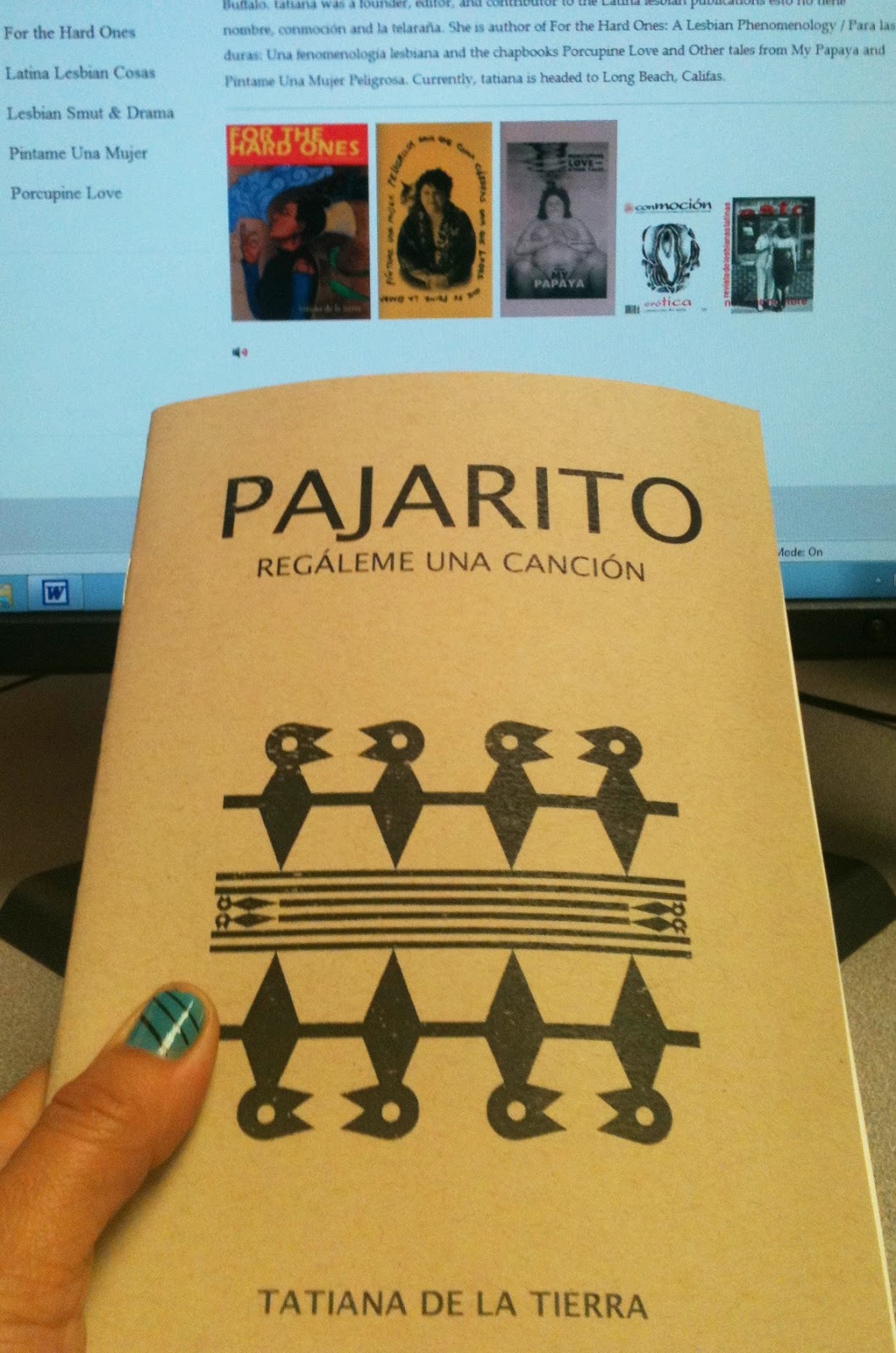
"Gaia Mother Earth Tierra Santa" is one of tatiana's many alabanzas to mother earth. The piece was published in 2011 in tatiana's last chapbook, Pajarito: Regálame una Canción. It is being posted here con mucho amor and with the permission of her mother, Fabiola Restrepo. One of the last poetic projects that tatiana didn't get a chance to manifest prior to her passing was an audio recording of her poem-canciones. She wanted people to hear the music in the poems she was writing. We don't have her voice to accompany the poem below, but there's so much musicality in the piece that it sings off the page regardless. Hasta la próxima, enjoy!


GAIA MOTHER EARTH TIERRA SANTA

tierra que tú me tienes
tierra que eres mi cuna
tierra que estoy contigo
y con toda tu fortuna

gaia mother earth tierra santa
todo lo tuyo es mi mantra
gaia mother earth tierra santa
todo lo tienes nada te falta

teirra con tus aguaceros
tierra con tus orquídeas
tierra con tus montañas
esmeraldas y semillas

gaia mother earth tierra santa
todo lo tuyo es mi mantra
gaia mother earth tierra santa
todo lo tienes nada te falta

tierra que tú me cuidas
tierra que yo te cuido
tierra te pertenezco
y te gozo, vida mía

gaia mother earth tierra santa
todo lo tuyo es mi mantra
gaia mother earth tierra santa
todo lo tienes nada te falta

For more on tatiana's work: http://www.delatierra.net/