Wednesday, August 17, 2022

24th International Latino Book Awards Ceremony


August 19-20, 2022

Saturday, Aug. 20

Los Angeles City College


From https://www.latinobookawards.org


August 19-20, 2022. 

This event will be divided into FOUR ceremonies spread across two days. During each ceremony we will announce 1st, 2nd and 3rd place winners.


Friday, Aug. 19

12:00 pm -

Poetry

EBooks

Audiobooks

Portuguese

Design

Translation

Mariposa

Themed, & Marketing


6:00 pm- 

Fiction Awards Ceremony


Saturday, Aug. 20


12:00 pm- 

Children, Youth & Young Adult Awards Ceremony


5:00 pm- 

Nonfiction Awards Ceremony


ISLA Latino Publishing University

UPDATE, this event will now be launched with two free workshops for all attendees of the ILBA Ceremony. The rest of the workshops will happen virtually every month after August. The ISLA Latino Publishing University is an education program to support author growth, to provide a setting to network, and to increase publishing success. The core of this program is a series of workshops in English and Spanish targeting topics that authors and small publishers often ask about.


Both events will be at this location:

Los Angeles City College

855 N. Vermont Ave.

Los Angeles, CA 90029


Tuesday, August 16, 2022

Guest Norma Cantú Reviews Delicious Day

Guest Reviewer: Norma Elia Cantú reviews Arturo Mantecón, El Día Más Delicioso de Mi Vida. Santa Fe:Prickly Pear Publishing & Nopalli Press,  

Arturo Mantecón’s El día más delicioso de mi vida (link) is an “as-told-to” tale that weaves hybrid narrative and poetry; it includes a rambling fast-paced meandering that geographically covers wide terrain but remains anchored in Laredo, Texas where the Streets of Laredo song merges with the narrator’s fantastical and surreal world where animals have surreal appearances and the terrain and the story or non-story are intimately bound, como en un Mobius strip. 

The book’s Foreword by Rubén Medina, an Introduction by Iván Argüelles, and the author’s own preface signal the nature of what is to come: a delightful linguistic romp told by Mantecón’s alter-ego, Emeterio “el chango” Landeros, born of the author’s  own imagination and a fitting guide through the world of South Texas. Emeterio is a cousin de Mantecón and whispers his story in Mantecón’s ear.

 Mantecón in his foreword offers a sort of genealogy whereby we find the relationship between the author, Arturo Mantecón , and Chango, his cousin.  The Most Delightful Day allows Mantecón to show off his dexterous meanderings through a fantastical world that is only too real. When I first read the rbook, I was taken by the Spanglish and the premise of a disembodied Chango narrating the content to Mantecón. Moreover, because I am from South Texas, the terrain felt real;  I felt a kinship with the nicknamed Chango (at one time named Changó) and his musings. I sit right there next to him as he sits on a bench in Laredo’s Bruni Plaza. I know the place well, I know the streets he names and the characters who dwell in that phantasmagoric world of the border. When the Circo Fantasma is gone in a poof of air, and only el Cerro de la Silla—the magnificent hill (almost mountain) in the shape of a saddle-- is seen on the horizon, I imagine the wide-open range around Cadereyta and the distant view of Monterrey y los cerros. It is a terrain that is at once mythical and real. Equally at home in Laredo or in Austin, I travel with him on this his most delicious and delightful day.

A folklorist who studies life cycle rituals, I was taken by the funeral where Chango’s tía Hermenegilda is buried; the scene was all too familiar to me. We encounter characters and scenes reminiscent of Garcia Marquez or Cervantes, but with the weaving through of contemporary cultural manifestations and of literary references to “red wheelbarrow” or German thinkers.  To enjoy this Mantecón’s mind-trip through the landscape one doesn’t need to be from the area or well-versed in the issues and problems that the community faces. I know only too well, the gods that roam the streets and the characters who lie or who guide. Asking ‘where are you from? or how did you get here? He repeatedly encounters wild stories. He is not disappointed to hear these wild stories that have brought people to the border and the stories of those who have always been there. It makes me wonder what other fantastical days Chango has experienced and whether Mantecón will tell us of them in some future instalment. Confronted with a giraffe on 6th street in Austin or with a blonde octogenarian at the wheel of a baby blue convertible? It is all possible. A beautiful Indian maiden riding a horse in a parade? Perhaps a reference to Pocahontas in the George Washington’s Birthday parade in Laredo—may appear to be figments of his imagination, yet, none of these are strictly phantasmagorical and indeed are real absolutely and explicit to that border reality.

The magic and the surreal world of the border and especially Laredo comes alive in Chango’s experiences. Others have commented on the linguistic agility of codeswitching or Spanglish, what we now call trans-languaging, and so I must also. While I admire the effort, it didn’t’ always ring true for me and felt a bit forced at times. Perhaps because it is my language and I can discern some misuses as well as some Chicano Spanish verb uses. And here and there, misspelled words too. However, the general sense is one of wonder and fantasy. The illustrations and black and white photographs add verisimilitude but could be better executed; they were often blurry.

In the style of Ron Arias’ Road to Tamazunchale,  Mantecón’s El día mas delicioso de mi vida takes us on a quixotic trip aboard his mustard yellow Citroën. We travel the wild linguistic and geographical spaces in a daze of wonder and awe. And we are the better for it! I invite you to take spin and let yourself be driven/taken for one day in this phantasmagoric world.


Meet Today's Guest Reviewer


Norma Elia Cantú currently serves as the Norrien R. and T. Frank Murchison Professor of the Humanities at Trinity University in San Antonio, Texas, where she teaches Latinx and Chicanx Studies.  

Her most recent publications are: Meditacion Fronteriza: Poems of Love, Life, and Labor and the novel, Cabañuelas. 

She has edited or coedited over a dozen anthologies, most recently: Teaching Gloria E. Anzaldúa: Pedagogies and Practices for our Classrooms and Communities, co-edited with Candace de León Zepeda and Margaret Cantú-Sánchez and meXicana Fashion, Politics, Self-Adornment and Identity Construction, co-edited with Aída Hurtado.

Monday, August 15, 2022

Dos eventos en agosto por Xánath Caraza

Dos eventos en agosto por Xánath Caraza


La Doctora Mónica Sarmiento Archer-Castillo comparte lo siguiente:


La 4ª Conferencia Global de Investigadores Universitarios sobre Temas del Mundo Hispano: Tendiendo puentes entre investigadores, artistas, legisladores y científicos se celebrará en la ciudad de Nueva York del 17 al 24 de agosto de 2022. Entre otras iniciativas, se conmemora el octogésimo aniversario del fallecimiento del poeta Miguel Hernández.


The Empowering Latino Futures Team: Ana, Yenni, Martha, Daniel, Melanie, Edward, Andres, and Kirk Whisler share:


The 2022 International Latino Book Awards Ceremony is nearly here and our team has been diligently working to acknowledge all the items. They are very excited to observe all the authors and others who will be in attendance at the ceremonies. Join us on Friday, August 19 & Saturday, August 20 at Los Angeles City College.  Visit Empowering Latino Futures for more information.


Para finalizar comparto:


Para finalizar comparto que este 2022 dos de mis poemarios recibieron mención de honor para los International Latino Book Awards. Así mismo fueron finalistas para los International Book Awards. ¡Viva la poesía!


Perchada estás / Perching

de Xánath Caraza; traducido por Sandra Kingery

Mouthfeel Press (2021)

ISBN: 978-0-9967247-8-4


Ejercicio en la oscuridad / An Exercise in the Darkness

de Xánath Caraza; traducido por Sandra Kingery y sus estudiantes, imágenes de Tudor Serbanescu

Pandora Lobo Estepario Productions (2021)

ISBN: 978-1-940856-43-8

Friday, August 12, 2022

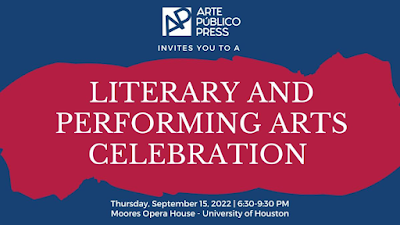
Arte Público Celebrates 40 Years

 From our friends at Arte Público Press -  news of a literary and performing arts celebration.  Party on.


JOIN THE CELEBRATION!

Arte Público Press, the country’s oldest and largest publisher dedicated to amplifying US Hispanic voices, will celebrate its 40th anniversary with a performing-arts showcase September 15, 2022, from 6:30-9:30 pm at the University of Houston’s Moores Opera House (3333 Cullen Blvd, Houston, TX 77004).

Bringing together outstanding artists from a variety of genres, the event will highlight the vibrant influence of Latin American and Latino cultures. The University of Houston’s Mariachi Puma will welcome attendees; other performers include the Brazilian dance and drum group, Samba Bom; the River Oaks Chamber Orchestra, presenting its piece based on Sandra CisnerosThe House on Mango Street, which was originally published by Arte Público; Solero Flamenco; and the Houston Grand Opera, doing its children’s production based on Jorge Argueta’s trilingual picture book, Agua, Agüita / Water, Little Water (Arte Público Press, 2017). A post-performance party in the lobby—with food, drink, author signings and entertainment—will wrap up the event.

We invite you to play a crucial role in the celebration by participating as an anniversary event sponsor. Sponsorships are available for $25,000; $10,000; $5,000; and $2,500. Individual tickets are available for $250.

Click here to become a sponsor or purchase tickets.

For more information, contact: appinfo@uh.edu


_______________________________________


Manuel Ramos lives in Denver. His latest novel is Angels in the Wind: A Mile High Noir.

Thursday, August 11, 2022

Chicanonautica: Gold, Greasers, Yaquis, and Zane Grey

by Ernest Hogan

Recently, I ran across an old western on Tubi that had me smiling and shaking my head. It was called Desert Gold, from 1936. Buster Crabbe, who also played Flash Gordon, Buck Rogers, Tarzan, Billy the Kid and other heroes was listed as the star. Here he was cast as an Indian, with a wig and full body makeup (after all, it took a dye job to make him Flash Gordon). 


As I watched it, the surprises just kept coming.


It was based on a novel by Zane Grey, who laid the foundations of the Wild West genre. Old white men still buy his books, and when they die, their families donate their collections to libraries. This is a case of a writer having an influence on society. 


Turns out Crabbe is not the star of the movie. There’s the usual white cowboy with a white silly sidekick who wisecrack through foiling bad guys (also white) who are plotting to steal land and gold from the Indians. It’s not clear if the line, “You know how these things are—it belongs to the first white man who finds it” is intended to be ironic.


Crabbe plays Moya, “Chief of an Indian Tribe” that is never named. They look kind of Navajo or Apache depending on how friendly or hostile the script required. And despite his heroic looks, he plays the victim. He’s stoic, noble, gets beat up, tied to a post and whipped, and is grateful when the hero saves him.


There’s also a mention of how the Indians are mysteriously dying out due something more like a natural blight rather than government policies.


In the end, Moya and his nameless tribe ride in and save the day like the cavalry. He even gets to shoot the villain, while the white hero gets the girl and the gold.


I got curious about the novel, so downloaded it from Gutenberg, and well, it was mind blowing. Turns out, the movie is like a toned-down, liberal makeover of the book.


Zane Grey’s original Desert Gold was published in 1913, and like many westerns of the period was set in “modern times.” The West was a place, rather than a historical period. The Mexican revolution is going on. The dashing young hero takes a job as a “border ranger” who’s job is mostly to keep “Chinese and Japs” from crossing over and trying to take over. (This was a thing back then: In the 1932 movie Border Devils, also on Tubi, and co-written by science fiction writer Murray Leinster, the villain is a Fu Manchu clone called The General.) 


The story begins in Casita, a “Greaser town” –yes, Greaser is capitalized, like Chicano–where lots of bad hombre “rebels” are causing trouble. It's explained that the reason Greasers are a problem is because their Spanish blood makes them sadistic killers. No mention is made of Native blood, or any ill effects.


We are also told that Casita has some nice Mexicans who make great food . . .


The hero falls in love with the beautiful Mercedes Castaneda, a “Spanish” girl. She is never referred to as Mexican, or Greaser. More than once, she’s described as having lovely white skin. She also shows no sign of the tendencies toward cruelty and murder said to be carried in her Spanish blood.


A Greaser gang leader also falls for Mercedes, and kidnaps her, and takes her to Moya’s village, where he’s taken over. 


Moya is identified as a Yaqui, but this time he isn’t given a name. They call him Yaqui, even after he learns a few words of English. The bandits torture him, but he doesn’t reveal the location of the gold mine. 


The hero and his sidekick rescue Mercedes and Yaqui, but in trying to escape the Greasers—who are said  to be worse than Indians—they get lost among the lava and cactus where Yaqui’s knowledge of wild herbs comes in handy, and there’s even some desert mysticism that foreshadows Edward Abbey. “Color, race, blood, breeding–what are these in the wilderness?” slips into the narrative, but then they have to go back to so-called civilization.


And Yaqui’s skill with “Aztec knifework” comes in handy.


In the end, even though he worships Mercedes as if she were a goddess,  he rides off without saying goodbye, being an inscrutable Indian.


The book is a primer for border racism. It is also the sort of thing generations of white patriarchs read for comfort and relaxation. And the attitudes and beliefs in it are alive and well in the 21st century.


Happy trails, amigos!


Ernest Hogan’s mother’s stepfather was Yaqui. She called him Daddy. He called him Grandpa.

Wednesday, August 10, 2022

Annual Círculo Conference


From https://circulowriters.com


Annual Círculo Conference, Saturday, August 13th, 2022


Register at 

https://docs.google.com/forms/d/e/1FAIpQLSfqJ5uLkNxLIIOfXH0kU6o1y_G3UmSp8Wy61xuxSH3a8NoctA/viewform


What to Expect


The Círculo summer conference is our major annual event. Join us on Saturday, August 13th, 2022 from 10:30 am to 4:00 pm on Zoom. It will be a full day of getting to know each other, workshops, and more, concluding with an open mic for all participants.  


Conference Schedule:


10:30 to 11:00: Welcome, Chat, and Questions

11:00 to 12:00: Break-Out Session #1 (three workshops/choose one)

12:00 to 12:30: Lunch (Take a break! Stretch? Go for a walk?)

12:30 to 1:15: Tribute to Gloria Anzaldúa

1:15 to 1:30: Intermission

1:30 to 2:30: Break-Out Session #2 (three workshops/choose one)

2:45 to 3:30: Reading and Open Mic

3:30 to 4:00: Closing, Chat, and Bendiciones


The 2022 Círculo de poetas and Writers conference includes two break-out sessions where participants write poetry and prose with our workshop leaders. As always, each workshop is open to all writers, from those just starting their writing journey to published authors.


Tuesday, August 09, 2022

Floricanto In GOPlague-time: Doing It Right

Renascimiento Floricanto: Floricanto Renaissance
Michael Sedano

We did it and it worked for years. Then it couldn't, doing it was dangerous. Still might be, but with considerations, so we've done it again. And we'll be doing it again later this month 

Oh, do not ask, “What is it?"
 Let us go and make our visit. 
In the room the women come and go 
Talking of Michelangelo. 

Floricanto, that's what it, is. It is the United States National LivingRoom/BackYard Floricanto Movement, and it's your turn to host them at your chante. Join the Movement! 

A few years ago, my wife and I frequented galleries and poetry readings like it was going out of style. We were the ones going out of style. Early signs of dementia began slowing us down and then, eventually, inevitably, we could no longer do the arte circuit. So it goes.

CasaSedano, already the scene of Barbara's magnificent seasonal parties, and where many a Mental Menudo with Magu went down, saw few hurdles to launching the LivingRoom/BackYard Floricanto Movement. 

Join the LivingRoom/BackYard Floricanto Movement! The easiest element, the Plan, makes hosting Floricanto events a breeze.

The LivingRoom/BackYard Floricanto Plan: invite good people, have a reading and discussion, and have fun. You don't even have to feed people, but come on. Clean up the yard and house. Make sure you have seating. Invite to your seating capacity.

We had a good run of readings. Authors making LA stops on book tours accepted CasaSedano's invitation to the informal gathering. At times, the Stanford Chicana Chicano Book Club met with the author, other times, the junta was a just for itself. 

Then the GOPlague hit and our living room shut down. 


Two years ago, Sergio Troncoso closed our unbroken string of annual+ LivingRoom/BackYard Floricantos. Sergio will the second guest at the 2022 resumption of CasaSedano floricantos.

Daunted, but not done, we waited out the GOPlague's worst years, isolating ourselves and looking at the world pass by the front window. No more of that. The world has begun opening up and we opened up CasaSedano to Richard Vargas's touring How A Civilization Begins (link, click please).

Richard has a special place in my memories and not-memories. 

In 2012, Jesus Treviño and I joined the book smuggling Librotraficantes on a journey (link) from El Paso to Alburque to Tucson. When we arrived at the National Hispanic Cultural Center, local artists had filled the main auditorium and Richard Vargas emceed a fabulous floricanto! I photographed the readings from the back of the house with a long lens.

Richard Vargas at the Librotraficante reading NHCC Alburquerque March 2012

Comes 2014, I'd put Jessica Ceballos in contact with Richard Vargas, and Jessica scheduled a Sunday Palabra reading, or was it a Blue Bird?, at Avenue50 Studio, featuring Richard. I planned to get some portraits up close.

I got myself hospitalized just in time for the reading. I hear Richard dedicated a reading to me. Having enjoyed an NDE (science calls dying and coming back a "near death experience") so recently, hearing some poet dedicated one to me made a big difference to my attitude.

Launching the CasaSedano LivingRoom/BackYard 2022 Edition with Richard Vargas is perfection. All those connections coming together gave the event a special feeling for me. 


Latinopia Word Richard Vargas How a Civilization Begins.mp4 from Latinopia.com on Vimeo.


Scenes from a BackYard Floricanto: Round Robin featuring Richard Vargas and John Martinez


Richard Vargas
John Martinez