Showing posts with label #LaBloga. Show all posts

Monday, September 07, 2020

Tía Chucha’s bookstore is open!


If you are a regular reader of this blog, you already know that La Bloga celebrates Latinx culture in its many forms: literature, art, food, politics, and more. In our different voices, we try to bring you news of where and how you can join in the celebration—wherever it might be. But in the end, our truest love are books, especially those written by Latinx authors.

One way is to celebrate Latinx literature is to visit (and support) independent bookstores such as Tía Chucha’s Centro Cultural in Sylmar. The mission of Tía Chucha’s is to transform community in the Northeast San Fernando Valley and beyond through ancestral knowledge, the arts, literacy and creative engagement.

Tía Chucha’s began as a café, bookstore and cultural space owned and run by former Los Angeles Poet Laureate Luis J. Rodríguez, his wife Trini Rodríguez, and their brother-in-law Enrique Sánchez. Tía Chucha’s provides year-round on-site and off-site free or low-cost arts and literacy bilingual intergenerational programming in mural painting, music, dance, writing, visual arts, healing arts sessions (such as reiki healing) and healing/talking circles. Workshops and activities also include Mexica ("Aztec") dance, indigenous cosmology/philosophy, and two weekly open mic nights (one in Spanish, the other in English). Tía Chucha’s also has hosted author readings, film screenings, and art exhibits as well. 

While the pandemic has moved many of these offerings into the virtual world, Tía Chucha’s is still going strong because of the committed staff and vibrant community members.

You may visit Tía Chucha’s and do some socially distanced book browsing, or order online. Check out some of these wonderful titles, and stock up on books for adults, teens, and kids.

Saturday, August 22, 2020

Lupe Mendez - On Point and Staying There


Cover Artist: Ramiro Rodriguez

2018 Editor’s Choice Selection

AVAILABLE FROM WILLOW BOOKS, HERE

WHY I AM LIKE TEQUILA is a collection of poetry spanning a decade of writing and performance. This collection exists in 4 parts – each a layered perspective, a look through a Mexican/ Mexican – American voice living in the Texas Gulf Coast. Set within spaces such as Galveston Island, Houston, the Rio Grande Valley and Jalisco, Mexico, these poems peel away at all parts, like the maguey, drawing to craft spirits, quenching a thirst between land and sea. 

Originally from Galveston, TX, Mendez (Writer//Educator//Activist) works with Nuestra Palabra: Latino Writers Having Their Say, Brazilian Arts Foundation and other organizations to promote poetry events, advocate for literacy/literature and organize creative writing workshops that are open to the public. He is the founder of Tintero Projects and works with emerging Latinx writers and other writers of color within the Texas Gulf Coast Region. Lupe co-hosts INKWELL, a collaborative podcast on regional, national and international Latinx writers and other writers of color. Mendez is a CantoMundo Fellow, a Macondo Fellow and an Emerging Poet Incubator Fellow.

Mendez has close to 20 years of experience as a performance poet, having opened up for such notable writers as Dagoberto Gilb, Esmeralda Santiago and the late Raul Salinas. He has shared his poetry across the country in places such as the Holocaust Museum Houston, the Jung Center, MECA (Houston), the Mission Cultural Center For Latino Arts (San Francisco), the National Hispanic Cultural Center (Albuquerque) and the Mexican American Cultural Center (Austin). A keynote speaker/poetry performer across Texas, Mendez hosts writing workshops across the country, most recently as a teaching artist for the Poetry Foundation’s Teacher Poetry Summits.


I wanted to start our conversation with a quote from your site:

“Si me quedo dormido con un lápiz en la mano, no me lo quites - podría estar escribiendo en mis sueños.”

- Terri Guillemet


How does that reflect your life and work?


Hijuesu, I love that quote.  It serves as both a bit of a reminder and a focal point. I have been an educator roughly around the same amount of time I have been a writer and so the Guillemet's quote speaks to me in both ways.  I used to have that quote painted on butcher paper on the front wall of my elementary school classroom when I was a writing teacher. It was high up, because I knew my kids' ojitos would eventually gravitate to the ceiling and I wanted it to seep into their subconscious: always write, always explore, always dream. I am fond of it for other reasons. I use it remind myself that I was more than my day job. I never resented the time I spent creating lesson plans and teaching kids the writing cycle. I was building a well oiled machine in these young readers and writers. It takes a sense of creativity to build up curriculum and access points where you are encouraging the body to engage in speaking about language and craft, to think about these patterns, to emulate them in writing and to read with corazón. But I did go through periods where I felt a longing to get back into my own writing or sometimes fearing that if I took too long a break from it, I'd get rusty. I giggled to myself the first time I read this quote - it is a truth. I have fallen asleep with a pen or pencil or a laptop in my hands. I used to post this quote in 2009 - 2013. I still stay up and write in the dark well past midnight. Now I do it because it's sometimes the only quiet time I get (I have a two year old, so no way can I write when she's got my full attention).  This quote keeps me grounded. Me hace recordar que hay que seguir adelante.


Talk a little about your book, Why I Am Like Tequila. How does it reflect your own journey as a writer?


So I had worked on the poems in the collection for well over a decade. Some of the pieces were poems I used to perform with at venues across Houston and Texas for a bit. I write about the worlds I belong to. The landscapes and communities I am a part of.  I kept thinking of home in Galveston, TX, of home in La Pareja, a rancho just outside Atotonilco El Alto, Jalisco, MX. I kept thinking of playas and cerros. I kept thinking about the rising/receding tides, the hectares of maguey, and the rhythm in the poems and it all started to come together. 


I kept going back to my time as a 5th grade Science teacher. When I taught the life science unit, there was always one factoid I used to throw into the unit that amazed the kids, but also amazed me - that every 7 years the human body has completely replicated all the cells in the body.  You are practically a whole new being. And it was this notion that always had me make a comparison between my worlds. I thought of tequila as well. I have always been around and known of the process by which tequila is made - Don Julio happens to be made in Atotonilco El Alto and its a given fact that it takes seven years to cultivate a full maguey to harvest the root to then make tequila.  


It was also this notion that got me thinking of how everyone is like tequila:  we are always being pressed, chopped at, boiled, pressured, fired, into something refined.  The world comes at us, in whatever order, and cleaves at us but in the end, every once in a while, we are an elixir. We are the best, most new, refreshed, refined thing we can be at certain time, just as often as we are in the ground, tumbling and mixing it up with the dirt. The human experience is full of the highs and the lows and this became the perfect analogy for it all. I am like tequila because the world remakes me every 7 years, every 7 thoughts, every 7 breaths into something better than I was before.


A Chicano?


You know, to this day, I don't know if I am Chicano.  I didn't grow up with the identity. I didn't discover Chicano understandings until my twenties in college. I knew Mexicano. I knew Tejano, but a Mexican - American identity didn't always sit well.  I always felt on the outside. Even in Texas, Even in Jalisco.  Most gente from Jalisco don't move to Texas. 


I used to laugh when I would go out to norteño spots and hear the DJs do a shout out "para todo la gente de San Luiiiisssssss" and the crowd would go nuts, or "para todo la gente de MOOONNNTTTEEERRRRRRREEEEYYYYY" and same thing, a roar. And with most of my friends when the occasional "para todo la gente de Jalisco" they would laugh and I would jump in the air and did't give a shit "a su pinche madre!" and it never failed, I would look out across the room para que veas - I would see one or two paisas and we would wave to one another. My friends would giggle and say "vez, no 'stas solo." Even though this is just a jovial moment, I have always been cognizant that there are differences between what Mexico looks like, what it sounds like, what it prays like, what it tastes like for me. The same geographical and cultural nuances that happen in the US happen in other spaces - Mexico is no different. I remember hearing banda as a kid well before it became prevalent in the US. Well before it became such a major genre in Mexico. Banda has always been in Jalisco.  The same can be said about my life in Texas.  I didn't grow up with many a Mexican role model in a space like Galveston. There was no poetry scene there when i was growing up. There is a small community that is a mix of 3rd and 4th generation Mex-Ams and Mexicans present, and this was my community. I was still the outsider. I went to school with Mex-Am kids that didn't know Spanish and they would make prejudicial remarks about "being too Mexican". And then there was always the geography - being from a barrier island, one already knows what it means to live in isolation. My writing was a way to push into all this understanding. I am still looking inward in this regard. I want to be able to stand up and provide space for the brown writer who lives a coastal life, who lives in two worlds, whatever those worlds may look like.


Are there core themes you return to, and if so, what are they and what is their power in your life?


So I think in a way I alluded to this in the end of the previous question - I look at both space and time, history and culture in my writing. I look at social issues and hope I serve as a decent observer of events. I know that time is fleeting and am aware of how ethnic and racial histories are vital to the growth of historically marginalized communities. I keep looking at the Latinx condition. I keep looking at what the counter history has told us for years. I keep going back to the sea. I try to go back to Mexico and to the RGV as much as I can.  I used to listen to corridos, just for the story, just for the bajo sexto or the acordeón. But that was before I realized that these are part of a brilliant Mexican form of poetry. The corrido is all things subversive.  It is cutthroat. It is infinite. It is both non-academic and story of witness, narrative and legendary.  It is consumable and linguistically profound. When I am writing, i am thinking along those lines. I want my work to be as infectious as a corrido.  I want for my work to work in you in some ways that you don't even know it is changing your understanding of "world".  I want it to work like the corrido: so ingrained in you that you don't even know you are reciting poetry.


You are involved in several incubators - Tintero Project, among them. What about this juncture in time fuels that work?


As I read this now, I think perhaps, one day, Tintero Projects can serve as a full on incubator program, but we are not there yet. Wouldn't that be something?  I am a long time member, partner, producer, you name it - in Nuestra Palabra: Latino Writers Having Their Say. The org has been around for over twenty years and shows no sign of slowing down. It was in this community that I began to see what community can create for itself. Tony Diaz, novelist and political commentator created NP to respond to the statement we heard time and time again "Hispanic people just don't read." 


So Tony helped build a community of readers and writers here in Houston. When I was a novice writer, I was also a volunteer, licking envelopes, mailing flyers, setting out chairs and folding them back up at the end of readings. I was boxing and boxing books, helping people purchase books and sometimes, even selling books out of the back of my car. But I also got the perks - I got to sit at dinners, or have coffee or have drinks with visiting writers from all of the US and America Latina and got to listen to them, even ask them questions about both craft and the lit biz. 


I remember what it was like to run and host and provide space for established as well as rookie writers, even before I ever got on the mic as a poet. NP grew up: it went from monthly live shows to hosting the Latino Book and Family Festival to hosting a still current radio show to eventually participate in an ethnic studies movement with the Librotraficante Caravan and the Librotraficante Movement.


I knew that there was still room to hold some of these things current and with Tony's blessing - I worked to establish Tintero Projects, trying out the old formats but expanding in ways NP talked about. So Tintero Projects works to provide a platform for newer and established writers. It's for all POC writers, but we always maintain a heavy support for Latinx writers. We've provided time and space for performance, for workshops and for collaborative opportunities. I don't even know if I responded correctly - but in the end, what fuels this work is community.  If we want to see Latinx writers and POC writers, then we have to make sure that there is space for them to do their thing.


Where do you clock in on the "What is Latinx literature" discussion?


Is there a discussion? If there is one, I need fellow Latinx editors, writers, publishers, to begin to widen their understanding that the labels that are present weren't created by those of us the labels seek to identify.  "We" are not a monolith. We are every race. If we somehow hide or make invisible the Black body or the Indigenous body, then we are doing the work of colonizers before us. Somebody reading this might even have a fit because we are saying "Latinx" and I can already hear people speaking out "I am not Latinx, I am [add in Nationality name]!" and I already have a response, ARE YOU REALLY THOUGH?


I have been a part of the conversation where Spanish purists say that Latinx was made by Caucasian folks and it isn't a word in Spanish like "Latino" and frankly - that's an ignorant response. People forget that Spanish/SPAIN was just a vulgar a colonizing force as the English, the Dutch, the French, the Portuguese, etc.


It has taken me a whole life time to figure out that my roots tie back to the Wirikuta (Huichol) peoples of Jalisco. So much of all of our beginnings are lost to false comfort in "history". Hell just now, in these last few months in the pandemic, in conversations with a cousin (as HE is working to piece together side of the family tree), I learned where our grandmother was born: San Carlos, Tamaulipas, Mexico.


It took me til I was 35 to figure out that my father's side of the family is connected to the lands of the Kauyumari and the Huichol tribes. No telling how long it will take me to learn of my mother's people. I am eager to begin this learning and unlearning of names and systems, people and places. And this is where language must take us. Language changes and the links to language and people give us the tools and the means to collect and birth counter-histories that need to be told.


I'm not here to make this comfortable for gente. But I am here to learn and be taught, to grow with and to guide as much as I can. As far as I know, I support books in all Spanish, in Spanglish, in Portunol, in Portugues. I support books in indigenous languages.  I support books as much as I support stage performances. Spoken word and threate is as noteworthy as the book, because they are EQUAL FORMS OF PUBLICATION. Anybody that tells you otherwise has never tried the other. I support books and performances created by Afro-Latinx writers. I support self-published work. I support gorilla theatre. I support including Hatian writers in Latinx canon. I support ethnic studies. You with me? Good. Let's go.  


Who were your influences/mentors?


My grandparents. My parents. My theatre teacher in high school (S/O to Mrs. T), my Government teacher and track coach, Tim Cotton. Tony Diaz. Luis Omar Salinas. Martin Espada, Sasha Pimentel, Lorna Dee Cervantes. Carmen Tafolla. Patricia Smith. Norma Elia Cantú. Raul Salinas, Robin Davidson, Jonathan Moody, Stephen Gros, Tim Z. Hernandez, Lucille Clifton, Miguel Piñero, Lex Wiliford, Gil Scott Heron, Sylvia Plath, Roque Dalton, Mario Benedetti, Jose Alfredo Jimenez, Chavela Vargas, Nina Simone,


How does being a husband and father inform your work?


Being married and a father has morphed when I write. It informs how much focus and tension to the work I create. I look at mortality in a different way.  My partner and fellow writer, Jasminne Mendez, a Dominican-American writer lives with Lupus and there have been complications to her condition a different points in our journey together. I once took part in an MFA poetry workshop while she was recovering in an ICU. She was on the mend, and got the ok from her to participate and I asked my classmates and prof. if they were ok with hearing the occasional "beep" of a heart monitor. 


And now as a father, I have learned that I am definitely not on a time clock to get this work done. I published my first book in 2019. We have a photo of my daughter at 10 months old holding a copy of the book in her little hands. Me dio orgullo. She just stared at it for a while. I am more confident than ever that I have something to say.


What is something not in the official bio?


I am a good cook and used to play in a samba band. 


Sunday, July 21, 2019

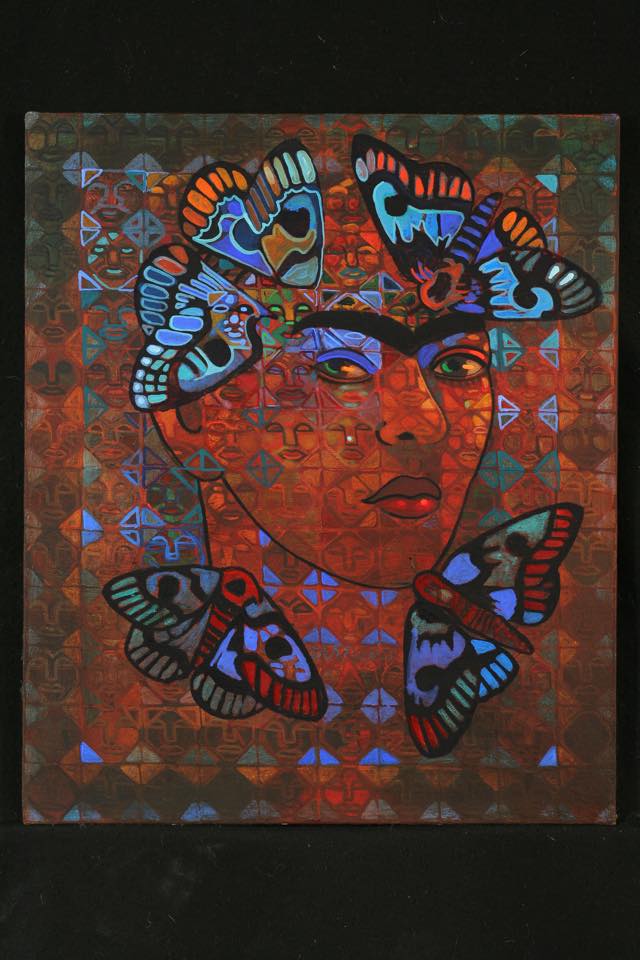
Art, Arreguin, and What Lies in the Bardo

Lisa Alvarado, Returning Guest Columnist


Photo by Eva Blanchard Arce


Seattle artist Alfredo Arreguin has exhibited his work internationally, most recently at the Museo de Cadiz in Spain (2015). He has exhibited solo shows at Linda Hodges Gallery since 2001. Arreguin has a long and distinguished list of accomplishments. In 1979 he was selected to represent the U.S. at the 11th International Festival of Painting at Cagnes-sur Mer, France, where he won the Palm of People Award. 

In 1980 he received a fellowship from the National Endowment for the arts. In 1988 in a competition that involved over 200 portfolios, Arreguin won the commission to design the poster for the Centennial Celebration of the State of Washington (the image was his painting Washingtonia); that same year he was invited to design the White House Easter Egg. Perhaps the climatic moment of his success came in 1994, when the Smithsonian Institution acquired his triptych, Sueno (Dream: Eve Before Adam), for inclusion in the collection of the national Museum of American Art. 

A year later, in 1995, Arreguin received an OHTLI Award, the highest recognition given by the Mexican government to the commitment of distinguished individuals who perform activities that contribute to promote Mexican culture abroad. More recently, success has been cemented by an invitation to show his work in the Framing Memory: Portraiture Now exhibition, at the Smithsonian National Portrait Gallery. One of his paintings included in this show, The Return to Aztlan, will remain in the permanent collection of the gallery. 

Arreguin's work is now in the permanent collections of two Smithsonian Museums: The National Museum of American Art and the National Portrait Gallery. In 2017 he was awarded to the keys to the city of Morelia, an honor only shared with Pope Francis.  In 2018 he collaborated with Doug Johnson for "In the Shadow of the Master" in Tacoma, and had a solo retrospective at the Bainbridge Island Museum of art.  It was so popular, the show was extended.

Alfredo Arreguin's work is represented by Linda Hodges Gallery in Seattle, Washington
Inverarte in San Antonio, Texas
La Llorona Gallery, Chicago, Illinois


For an in-depth online interview, click here


Here is a piece I wrote about Alfred and Frida.


Alfredo In the Bardo and Frida in the Cut


In the Bardo

In some schools of Buddhism, bardo (Tibetan བར་དོ་ Wylie: bar do) or antarabhāva (Sanskrit) is an intermediate, transitional, or liminal state between death and rebirth.

Milam bardo (mi lam bar do): is the second bardo of the dream state.

I chose this as part of the title of this essay. Essay, rumination, love letter to Alfredo Arreguin.

I will talk about Frida in the cut a bit later. I first found Alfredo’s work several years ago, chatting with people of Facebook, of all places. Whether it’s portraiture, landscape, or still life, Alfredo’s work is all at once representational and symbolic.

 In his paintings, the key subject is at first “hidden” against a patterned background, just like the emerging images in a dream. And like a dream, the background stays suggested, while the central image gradually comes into focus, capturing your attention. Liminal, you see, in the bardo, Alfredo takes you to the borderland of what exists in the “real” world and what we see in our mind’s eye, in our dreams.

Speaking of dreams, Alfredo’s intricate patterns, his ingots of color, precise in placement and repetition, remind me of Huichol beaded worship – animals, icons – all painstakingly built and layered bead by bead. Alfredo shapes his work, I think, in much the same way. Huichol beaded work, their yarn work, is an expression of the bardo; a present-time bridge from this world to the real world of the spirit, of what exists in a shared vision quest.

Alfredo invites you to see, and see past this world, into the tangible realm of the deeply felt, the perfect spirit. It is specific, in that the imagery springs from the roots of Mejicanismo, and by implication Chicanismo. It is universal, in that it assumes the viewer, from whatever background, understands the longing, and the revelations of the borderland.

And like the art and living message of our indigena brothers and sisters, Alfredo’s work calls us to reconnect, the re-construct from a borderland/bardo place of a Pan-American experience, something I truly understand. Alfredo was born in Mexico, and I am the child of immigrants, and the idea of border/ bardo is one that constantly shapes my self-definition, and I suspect shapes his as well. I want to share this poem about the power of the bardo, specific and universal. I hope it also serves as the introduction to my reaction to Alfredo’s re-creation of Frida.

RECLAMO

En este sueño
estoy completa.
No tengo que guardar
las historias de otra gente.
No tengo que buscar y escudriñar
a través de los restos de sus palabras.

En este sueño
paso mis dedos
através de la cabellera de Frida
Con esa cabellera,
tejo flores obscuras
del color de la sangre.
Y me dice
que el jaguar viene a traerme
su poder.

La medicina que calma este dolor
es como comida para
calmar esta hambre.

En este sueño
hago magia
con el lodo del Rio Grande.
Arropado en corridas y música ranchera,
que son el hechizo y el encanto
que anula la edad
del olvido y el adoctrinamiento.

En este sueño
tengo un amante
cuya cara es de piedra,
como el antiguo marcador del templo.

Su boca es carnosa,
sus ojos están entrecerrados y
murmura:

“Ven conmigo mi India,
mi pequeña perdida.
Recuerda quien eres.
Recuerda quien eres.”

RECLAMATION

In this dream,
I am whole.
I am no longer
saving other people’s stories,
scavenging their words;
sifting thru their remains.
In this dream,
my fingers run
thru Frida’s hair.
In this hair, I plait
dark flowers
the color of blood.
She tells me
the jaguar comes
to bring me power.
The medicine
to end this pain,
the food for this hunger.
In this dream,
I have made magic
from the mud of the Rio Grande.
Wrapped in corridas and ranchero music;
are spells and incantations
to undo
the age of forgetfulness
and indoctrination.
In this dream,
I have a lover
whose face is stone;
ancient as a temple marker.
His mouth is full,
his eyes half closed.
He whispers:
“Come to me, mi India,
mi pequeña perdida.
Remember who you are
Remember who you are.”

In the Cut

Agency is the ability to express your true self on your own terms. It is the power to think for yourself and act in ways that shape your experiences and life trajectories. Alfredo’s portraits of Frida reveal his root understanding this essential truth. It utterly rejects the common trope in the most recent cult of Frida expropriation - Frida as victim; with the artist and the viewer indulging in the voyeurism of pain. Alfredo never stoops to that. In every painting depicting her, she is vibrant, aware, her gaze resolute and self-aware. This is the greatest homage and the deepest understanding of one of the twentieth century’s most important artists.

I tried to capture that agency in writing about her and strengthening the agency in myself.

BASHERT

I am the catch
in your throat;
the wordless cry,
unexplainable.
I am the cloud
that follows you;
raining
at the slightest provocation.
I am the scar
that has
become a flower.
I am the pilgrim
you brought home;
the Jew you hid
from the fire.
I am your dark sleep.
I am your dream
of finding someone
whose arms
will hold you
when daylight comes.


Frida was never her wound, her physical limits, her crushing disappointments in private life.

She takes her life and as alchemist, transforms it into art, into awareness, into a psychic rebar stronger than any back brace. She gives all comers as good as she gets. I chose the phrase “in the cut” – a hip hop term meaning hidden in the ‘hood, but also someone at the top of their game, their quintessential self.

Frida will always be the foundation for Latinx artists of all persuasions, as we emerge from the ‘hood., as we gather onto ourselves our own rebar, forge our own identities.

Tuesday, June 11, 2019

Blogueras Forever: Alvarado Reviews Cardinal. Living Room Floricanto Vincent Cooper.

Wonder Woman is Puerto Rican or Ann Dávila Cardinal has a new novel!!!
Lisa Alvarado

*Editor's Note. La Bloga welcomes former weekly columnists Lisa Alvarado and Ann Dávila Cardinal to today's pages.


Ann Dávila Cardinal is a force of nature.  I met her when I was trying to harass then Vermont College's admissions to let me finish my B.A. at the ripe old age of 38. I remember sitting in her office, feeling all at once at home. She got me. And more importantly I got her - her grit, talent, dedication as a writer.  I got my degree and was lucky enough to stay in touch after graduation.

But wait! There's more! Through Ann's keen eyes and ears she contacted me and Jane Alberdeston  Coralin about a call for Latinx YA. Through that we wrote Sister Chicas together and once again, Ann's broad reach helped us find an agent and publisher.

I remember a conversation we had back in the day where Ann put it to the universe that she wanted to write a novel... and folks, this is one amazing read from an uber-talented hermana, whose grace, literary chops, and other worldly work ethic has born more fruit. Below is a brief description from her publisher and our conversation about the acclaimed new novel.


From the Publisher: 
   
Five Midnights by Ann Dávila Cardinal is a modern take on the El Cuco myth that is bound to be loved by many. With a narrative that’s well-paced and intriguing, the author builds a world that utilizes a story passed down through generations since the Spanish Colonization of Puerto Rico and Latin America.
Javier Utierre and Lupe Dávila are trying to find out who (or what) killed two boys in San Juan, and along the way uncover an old magic based on the aforementioned myth. As Lupe and Javier become embroiled in the chase for the murderer, their adventure grows more nebulous. The mystery introduces us to some colorful side-characters who give us pieces of the ultimate puzzle, such as Papi Gringo, one of Javier’s childhood friends who’s become a sort-of Bad Bunny personality, and Izzy, another one of Javier’s friends but also Lupe’s elusive cousin. All the characters add to the story’s sense that everyone knows or is connected to each other, which is essential when writing about Puerto Rico; there’s always a feeling like you know somebody who knows somebody within Puerto Rican culture.

What would you like to say to La Bloga’s readers about Five Midnights?
You mean beyond that I hope they will read it? 😊 I guess that I’ve always been fascinated with the legend of El Cuco, and how the threat of supernatural forces is used to try and get children to behave. And that though he is called different things, a version of him appears in pretty much every Latin culture, which tells me either this tactic has worked for generations, or that parents resort to desperate supernatural threats when feeling powerless (yes!). My hope is that I captured the spirit of this myth, and the spirit of Puerto Rico.
Briefly describe your protagonists and what you see as the point of connection for readers.
Lupe Dávila is a sixteen-year-old Gringa-Rican from Vermont whose mother took off when she was little, and she is left struggling with life with an alcoholic father. This particular summer, her father ships her off to his brother’s home in Puerto Rico for the entire season, where she gets in involved in a mysterious murder case. Lupe is a fighter who takes zero shit from anyone but doesn’t let anyone close either. Being of mixed ethnicities and from a broken, drunken home, she struggles with fitting-in in either place, something which I think will connect with many readers.
Javier Utierre is a smart and kind almost-eighteen-year-old from a middle-class city near San Juan that has been badly affected by the economic issues on the island. As people left his neighborhood, drugs moved in, and he found himself caught in the net of addiction. But thanks to a priest he connected with, he’s been in recovery for two years. But when a childhood friend is brutally murdered, he is forced to face his past and the hand he had in creating the darkness he has been running from. Javier is a young man facing some bad choices he made, something most of us must face at one point or another in our lives.
Usually, there is more than one message in a novel. What is the major message in Five Midnights? What are the other takeaways you would hope for readers?
What I hope is that it helps shine light on certain issues, the major one being addiction, specifically that though most of what we hear are stories of drugs affecting certain socio-economic classes, in reality it affects us all. And that though it is mostly a love letter to Puerto Rico, I strove to show la isla in a realistic light (I mean, other than mythic monsters traipsing around). The beauty and the struggles as it was written pre-Maria when the island was already suffering. And finally, that if you don’t fit into one neat little box on a census, you still fit in with the community you make.
Talk about your own evolution as a novelist -from being co-author in Sister Chicas to your current book. Describe the ways you found helping hands, as well as what barriers you had to address.
Helping hands? Like, I didn’t know how to write a metaphor until you and Jane Alberdeston Coralin taught me? 😊 I learned so much working with you two on Sister Chicas, especially since you both are poets. Such beautiful language. Then I earned my MFA at Vermont College of Fine Arts, and my craft deepened and deepened thanks to my faculty advisors. But we knew so little of the business then, we were flying blind. We did well despite that, but since then I’ve built a community of writers who are at different points in their careers so I can draw on their knowledge, and then pass that on to younger writers. The first time we got an editorial letter, we felt as if we’d done something wrong. Now I know that those letters are what brings out the best in the book, that you should hope for at least two so you are certain the work is where it should be. I’m a dreamer, so there was also a thickening of skin, a tether to expectations. The work is still joyous, but I’m more realistic about the outcomes.
What is the importance of YA literature from your point of view as a writer and a member of academia? How does what you do for a living impact your life as a writer?
Oh, it is through my job that I fell in love with young adult literature. Years back, I sat in on a lecture in our MFA in Writing for Children & Young Adults (WCYA) program by Sundee Frazier—brilliant writer, lovely human being—who talked of craft and representation, and I remember my blood pulsing faster and faster through my body, it was all I could do not to jump to my feet and cheer. I’d never heard someone talk about craft like that, with an eye always on the reader, on the responsibility of shaping young minds. It adds an entire level to the craft of writing, an additional depth of meaning. And my job of counseling writers into VCFA’s programs only feeds my hunger. I get paid to talk to writers all day long, it doesn’t get much better than that! And each conversation inspires me. Truly.
In working with you on Sister Chicas, the idea of representation was central. How is representation on the micro and macro level an element in Five Midnights?
In Five Midnights I tried to represent my own story, and those of my family. Though Lupe has a lot of me in her, so does Javier, and Marisol. In this novel my frustration and anger at how Puerto Rico has been treated came out in the character of Marisol. And the intense bond of island family. As someone who did not have the best situation at home, the caretaking of my family in Puerto Rico was invaluable. It made me who I am today. And my love for my uncle Esteban, who always made me feel cared for, something a child of an alcoholic/addict thirsts for. So in addition to representing my own experience teetering between the two worlds, I hope I captured what being una Boricua means to me.
Particularly at this historic juncture, what is the significance of Puerto Rican literature and visibility? Who influenced you? Who continues to influence you?
Oh, this one made me tear up. I have lived on a steady diet of Latinx literature most of my life, studied Puerto Rican literature at Columbia, read everything I could get my hands on from Manuel Alonso’s El Jibaro (written in 1845) to Yolanda Arroyo Pizarro’s recent work. And the Dávilas have produced a number of writers, from my great-great uncle Virgilio Dávila to my cousin Tere Dávila who manages to write award-winning books while running an advertising agency. I feel…not the pressure of this legacy, but rather the buoying. Does that make sense? Can buoying even be a verb? But it is my wish that more work of the island is translated and released via traditional academic and commercial publishing venues on the mainland. There are so many brilliant mainland writers of Puerto Rican heritage, but not much work of the island-based writers coming this way. I’d love to see a bridge built, so all these brilliant works can go both ways.
Talk about literary fiction and genre fiction. How do you see the categories? Are the distinctions useful? What’s your observation about the intersection of literary fiction/YA/Latinx fiction?
Oh, girl! Now you know I’m pulling out my soapbox now! You know this is a passionate subject for me. I was going to get a t-shirt made for AWP that read “Genre is not a four-letter word!” But these days I’m beginning to realize that this division and judgement is dated. Younger generations of writers just don’t have these prejudices anymore, I mean, Colson Whitehead wrote a zombie novel, and George Saunders…well, that’s all I need to say: George Saunders. Victor LaValle, Carmen Machado…these are all literary writers who write speculative fiction. I predict that this classist perception of genre as “less than” is going away. And really, as far as I can tell that bias hardly ever existed in YA literature. Almost all our WCYA faculty have written some genre work, and there just isn’t that judgement when you’re writing for young people. There is so much depth that can be carried along with a magical storyline. If you don’t believe me, read All of us With Wings by Michelle Ruiz Keil, or The Storm Runner by J.C. Cervantes. Gorgeous, elegant work, with so many layers.

Tell us something not in the bio.
From the age of four to about six or seven, I slept with the sheets wrapped tight about my neck to prevent a vampire biting me in my sleep. I am the youngest of five children, a span of sixteen years between my oldest sibling and me, and so I was dragged to all kinds of movies. My mother also had a huge crush on Bela Lugosi (never did get that one) and so I saw Dracula at about four years old. I loved horror but had so many nightmares that I had to take preventative measures. Must have worked since I never did get bitten. 😉

Living Room Floricanto At Casa Sedano Welcomes SanAnto's Vincent Cooper
Michael Sedano


A few years back I actively coupled a goal of taking the perfect public speaker photograph with another goal of photographing every raza and allied poet on the Eastside reading their own stuff. That's almost the same foto, que no?

Public speaking--I call it Oracy--is equivalent to Literacy and Numeracy as fundamental competencies of a civilized person. I think in Aristotelian terms. The third century pagan held it would be unthinkable in his 'hood for someone to be unable to defend themselves with a sword. Equally unthinkable, Aristotle said, that a person would be unable to defend themselves with their words. And when people started agreeing with that notion, people became civilized.

Aristotle was thinking the courts and the agora, but the point applies to one's writing. An effective reading is the writer's way of honoring not just the composition but the labor of creation. Don't do a crummy reading but give your words the respect all that work earned it. In short, it's not enough to write it, fulfill the process by reading it aloud well.

The Living Room Floricanto, and its al fresco variant, the Backyard Floricanto, is a way to celebrate Oracy, take fotos, and bring poets to the pad, since Barbara and I don't get around much any more. It's much more, of course. The Living Room Floricanto is fun. My gosh, as today's fotos show, we did an open mic then enjoyed our featured guest. After that, a hootenanny broke out.


As the Emcee, Michael Sedano leads off the Open Mic with two minutes of creative  non-fiction. Sedano introduced the guest with the second-longest drive, Santa Barbara-NOLA's Melinda Palacio.


Melinda introduced Steve Beisner, wearing orange marking his opposition to gun violence.


Steve, a La Bloga Guest Columnist in the past, introduced Viktoria Valenzuela, Vincent's poet-wife.

foto:Concepcíon Valadez

Viktoria had the pleasure of introducing Living Room Floricanto At Casa Sedano's special guest,  fellow Veteran, San Antonio's Vincent Cooper reading from his recent publication, Zarzamora.


Melinda brought her Fender Montecito model Ukelele, a beautifully crafted instrument with mother-of-pearl inlay and mirrored finish. And what a tone! In the fotos, I have a great posture because I'm leaning back to hear those plunking chords and get into the beat.


Steve is a professional musician. I appreciate his tolerance with my poorly-disciplined fingers. We played some Irving Berlin, Lennon-McCartney, Sabor a Mi. The most wondrous event happened when guest Angel Guerrero sang a capella in a clear powerful contralto.


Friday, January 01, 2016

Happy New Year! No Resolutions for Me.

Melinda Palacio


I sat down to write my New Year's resolutions but came up blank until I realized that my life is a work-in-progress, never finished. Perhaps, the masterpiece that is I will not be complete until someone, maybe my godson, puts the last rose on my coffin or virtual memorial stone. Not that I am a morbid person, just realizing that my time on this earth is finite. I plan on honoring this time by living in the joyous spirit of my mother, Blanca Estela. I was very depressed after her death, but at some point in the last decade, I chose to live. I'm grateful for family that I still have, especially my mother's mother who has a wicked sense of humor and makes me laugh every time we speak. Laughter has been a great healer throughout the years. And all my life apparently. My grandmother used to say that when I was a baby I was laughing in my crib with the angels. I still laugh in my sleep.

Most people's resolutions involve losing weight or getting in shape. Check. Last year, I fully recovered from my broken leg (and my year from hell, Adios 2014 and don't come back). Thanks to a new and improved spring in my step and ankle full of hardware, I am free to walk, run, jump, plank, and balance on one leg. The leg that broke, my right leg, continues to be my dominant leg. I am no longer crooked thanks to my wonderful yoga teachers. I still have a bit of a confidence issue that I continue to work on. When I approach a long flight of stairs, I take a breath before ascending or descending them. I am overly cautious about enjoying the outdoors and going hiking. I plan on overcoming my fear of falling next year, but this is something I've been working on since before I broke my leg. I've also taken a page from La Bloga's Gluten Free Chicano and tried out some gluten free recipes and have a adopted a low- carb diet so that I can have my cake and eat it too once in a while. So far, I've lost ten good pounds and counting. Adios extra stomach luggage. I'm glad I have a head start however since for me the process of shedding pounds is excruciating slow.

During most of my yoga meditations, there's usually a point in the class when the instructor reminds us to "let go of that which does not serve you." After two plus years of hearing Disney's Frozen, Let It Go, song, I've decided to let a facebook friend or two go. Since 2015 was the year of the fade away, I feel comfortable in unfriending people simply for being creepy or insincere in their friendship agenda. Adios creepy people. No explanations needed.

Last, but never least, is the most important business of writing. Yes, another work-in -progress. It's always satisfying to see books come to fruition. I plan on continuing work on two books and sure hope to finish them. Twice a month, I look forward to materializing a blog post for La Bloga. The time before a book belongs to the public is the sweetest. However, I am happy to announce that I see the three letter word approaching both manuscripts. And many of the poems for my bird book have been accepted and published by a variety of literary journals and websites, including the Academy of American Poets, The New Laurel Review, Rare Feathers: Poems on Birds & Art, Latina Authors andTheir Muses, The Mas Tequila Review #10, and three publications coming up in 2016, the new journal MockingHeart Review, the anthologies Coiled Serpent by Tia Chucha Press and Poetry of Resistance forthcoming from the University of Arizona.
 
Happy Day One of 2016! I'm looking forward to continuing my journey. Thank you for enjoying La Bloga, sharing our community, and supporting our literature. Join me in keeping bookstores and our culture alive through writing. Since I am in New Orleans for the New Year, later today I will eat black eyed peas, cabbage, and ham. My friend Crystal says the cabbage is for prosperity, the black eyed peas for good luck and the ham is to continue to look forward because a pig cannot turn its head to look back. Provecho and Cheers!


Monday, November 09, 2015

The La Bloga interview with Brian Calvert, managing editor of High Country News


Brian Calvert is the managing editor of High Country News. He grew up in Pinedale, Wyoming, at the foot of the Wind River Mountains. Calvert studied English at the University of Colorado before starting his career as a freelance foreign correspondent. He has lived extensively in Cambodia and China, as well as in Sri Lanka and Afghanistan. In 2011, Calvert moved back to the United States, spending a year and a half writing and producing radio from Southern California. In 2013, he was awarded the Ted Scripps Fellowship in Environmental Journalism, at the University of Colorado – Boulder, where he studied climate change and the American West. Calvert was hired by High Country News in May 2014. He now lives in Paonia, Colorado, where High Country News is headquartered, with his dog, Perle Haggard, and cat, Luna.

Calvert reached out to me because he has a desire to explore the “hidden and under-reported connections between the natural world and under-represented communities.” I asked if he would be interested in a La Bloga interview, and he kindly agreed. 

OLIVAS: For those who are not too familiar with High Country News, could you give a brief description of the publication’s origins and mandate?

CALVERT: High Country News is a non-profit magazine that covers the environmental issues, natural resources and communities of the American West. We publish 22 issues per year in print and have a vibrant website with daily content. We have a small budget, but a lot of heart, and we punch well above our weight. We’ve been around since 1970, and were started in Lander, Wyoming, by a rancher who was concerned about the environmental despoilment of the region, and we hew to those roots, on one hand, while being the voice of the West overall, on the other.

Our approach is journalistic, which is to say that fairness and accuracy in our reporting is our top priority, though we do try to take the extra step of providing meaning from that reporting. We write with authority on a broad number of issues, and we devote a lot of ink to nuance, so that someone walking away from one of our stories will have a pretty good grasp of any number of complex issues. We’re a magazine for people really want to understand the West and all its facets.

In many ways, we work to conserve the environments of the region, and in other ways, we seek to report on issues that could use some improvement. So you might see in the same issue one story on fish conservation and another on which Western states are leading the way on higher minimum wage. We’ve won awards for reporting on deaths in the oil fields, and are currently running a feature on the war on coal. We’re just as likely to cover elections in Navajo Nation as we are to cover a mainstream politics. We cover energy—both extractives and renewables; drought and water; agriculture and farming; the recreation industry; the National Parks and other the public lands; wildlife; climate change; pollution; and a great many other issues that define the American West, sometimes through essay, sometimes through deep-dive analysis and sometimes through good old-fashioned narrative storytelling.

The American West has a diverse, yet distinct, geography, driven very much by ecological relationships between a lot of different people and cultures and a lot of different landscapes and resources. High Country News tries to make sense of that geography and of those ecologies, from Los Angeles to Portland, Yellowstone to the Rockies, Denver, the Grand Canyon, the Great Basin, Albuquerque, the Mojave, and on and on.


OLIVAS: You have mentioned to me that as the new managing editor, you are interested in the “hidden and under-reported connections between the natural world and under-represented communities.” How did you develop this interest and what are some examples of what you are looking for?

CALVERT: I grew up in a small town in western Wyoming, but through journalism I became a foreign correspondent. So I know what it’s like to live in the isolated West, but I also have had exposure to a lot of different cultures in my career. I’ve spent significant time abroad, and have lived in Cambodia, China, Sri Lanka and Afghanistan, and traveled to many places in between. I would say that most of my life I’ve spent looking at the way people are the same, and understanding where they are different. Ultimately, though, I came to realize that some of the biggest questions of our age had to do with our environment and our resources, and so I ultimately came back to the West, where I think they come into sharp relief. High Country News offers a great vantage from which to ask these questions, and figure out these relationships—and I’d like to take the magazine further into that space. But I know there’s a ton that I don’t understand, or can’t even see, and I’m always looking for other perspectives and vantage points.

The West is a huge place, and it would be hubris to think I understand it even a little bit.
As the managing editor, I want my writers to help our readers understand the relationship different people have with the places they live. What kind of pressure will booming demographics in the Southwest put on the region’s resources? What kind of solutions to environmental problems can new and old Western cultures provide? What does “wild” mean to someone who lives in Los Angeles? Phoenix? What is life like for a Vietnamese community that lives along a polluted river in Seattle? What is it like for a family from Nepal running an ice cream store and gas station in the middle of nowhere, Wyoming? I’m interested in finding these “new” places that many of our readers may be unfamiliar with, old wisdom, fresh perspectives. I’m interested in finding new readers, by asking new questions. And I’m especially interested in learning what I don’t know about the West’s many dimensions.

At the heart of all these questions again are these ecological relationships, and I think High Country News is devoted to exploring them and very open to new ways of seeing things.

OLIVAS: If writers are interested in pitching ideas to you, how may they contact you and what should the pitch include?

CALVERT: We have fairly extensive submission guidelines on our website at http://hcn.org/about/submissions. Writers can send me their ideas directly: brianc@hcn.org. Deeply reported stories, powerful narratives, thought-provoking essays, quick scenes or short profiles all have a place in the magazine, along with news and analysis. We’re always trying to figure out what’s new about the West, so we often pass on stories that reinforce the stereotypes or mythologies of the region. We wouldn’t really write about a cattle drive, for example; but we recently ran a story about an abbey of nuns who make a living ranching.

I’m really interested in pushing the magazine into areas we haven’t been in before, particularly the urban wild, coastal economies, and diverse cultures and communities (again, though, with the focus on these ecological relationships). We’re also interested in multimedia storytelling online, and in opinion and personal essays, as well. High Country News is really in a period of expansion and experimentation, and I think our content reflects that, so I would love to hear out-of-the box ideas. Our focus will always be on solid reporting and good writing, but beyond that, I’d like to be surprised.

I should also say that we are developing a prize for journalists of color reporting on under-represented communities of the region. We’ll be announcing the details of that in January. And we also run a very well-respected, rigorous internship and fellowship program, six months to a year, respectively, that help writers really understand what High Country News is about and gives them the skills and training they need to continue writing (or editing) for us and shaping our future.