Showing posts with label #writing. Show all posts

Friday, September 18, 2020

Puppy Love Solves Pandemic Fatigue

Melinda Palacio


When Pandora sleeps, it's time to write. 


I can check all the boxes: zoom fatigue, social distancing fatigue, mask fatigue, fatigue of feeling fatigue. However, adopting a puppy has filled me with a welcome muscle fatigue brought on by a dog bred for retrieving ducks. This puppy can play fetch until your arm feels as if it will fall off if you have to throw the ball, stick, or toy one more time. I named the two-month old Labrador Retriever Pandora, meaning all gifts, and she is certainly a gift to cure all sorts of malaise that can come with life in Covid-19 lockdown. 


The sight of her eager face in the morning sets things right in the world and makes me forget about the pandemic she was born into. Since early May, the nation has experienced a shortage in dogs and puppies. Shelters report no available dogs. I know of at least four friends who have adopted puppies. La Bloga’s own Michael Sedano took in a gray kitten. After my dog Montezuma passed, almost eight years ago, I thought I’d never get another dog, the heartbreak is too much, but I had been missing having a furry companion to fuss over. I’ve come very close to rescuing dogs who seem to have the type of personality similar to my old dog, a beagle crossed with a Labrador Retriever. Montezuma was a smart dog and won the sit-stay competition at PetSmart during his puppy training class. 

Having a pet makes staying at home a lot easier. On occasions when I venture out in the real world, I can take my dog with me since most restaurants and cafes are now outdoor only establishments. 


There are downsides to having such a young creature. Puppies don’t come with automatic training. There’s potty training and rules to teach, such as no biting, no chewing on shoes or tables or hair. People have warned me that having a puppy means losing a pair or two of good shoes. My strategy has been to hide my shoes away from puppy level, but, so far, I’ve only succeeded in hiding my shoes from myself. The social distancing imposed by life during a pandemic also poses conundrums for puppies. How can you socialize dogs when people can’t socialize. Places such as PetCo and Petsmart no longer offer group puppy training classes. 


Today, Pandora is three months old. I look forward to beginning her puppy training this weekend. She’s pretty smart and learned how to use a doggie door in two weeks. I trust she’ll pick up basic commands easily, especially walking on leash. At least, that’s what her trainer told me. With the abundance in people adopting pets, dog trainers are in high demand. Nathan, the dog trainer, tells me puppy training is more for the human than the puppy. I’ll let you know how that worlds. One thing I have learned is the full extent of the word Retriever. Pandora is the perfect example of a yellow Labrador Retriever. 


Tuesday, September 01, 2020

75 miles


Seventy-five. 
Michael Sedano

75 and my pants are falling down. They’re old pants and the belt needs another punch. I ate a nectarine the other day and it was good. First time I lost my trousers, I was four, maybe. Old enough to be enraged at the world for my predicament, and I did wear the bottoms of those trousers rolled.

Lynch Field bordered our back acre and Catter’s egg ranch next door. That day, I climbed to the topmost rail on the eight-foot wooden fence of center field. Inching my way along the rail, holding both hands tightly to the top of the planks, I made it around to left field and Caterino’s first jaulas.

From up here I can see to the corner and la tiendita, my uncle Lugo’s house, the empty lot where the Nationals hang out and they burned that agave to make pulque. Over the top of Catter’s cement block house, I regret the big pepper tree that’s easily climbed. Not like this fence. It wasn’t so hard to get up here.

I feel my pants slip. I can’t let go to pull them up. No way from up here will I release my hold on the fence! 

I puff out my belly but the hand-me-down Levi’s keep slipping past my hips. The oversize pants slide down to gather at my knees in a wrinkly bundle. I resist revealing my indignity as long as I can.

I scream for help. My Mom and Dad respond quickly with my Dad laughing. He goes back inside to get his camera, a German war prize. First, he photographs my predicament, then climbs up to carry me down to the ground, my Mom snapping off a few frames of the rescue. 

Plague-time and 75 is cleaning the attic time. Sure hope I find those negatives in my Dad's stuff.

Saturday, August 22, 2020

Lupe Mendez - On Point and Staying There


Cover Artist: Ramiro Rodriguez

2018 Editor’s Choice Selection

AVAILABLE FROM WILLOW BOOKS, HERE

WHY I AM LIKE TEQUILA is a collection of poetry spanning a decade of writing and performance. This collection exists in 4 parts – each a layered perspective, a look through a Mexican/ Mexican – American voice living in the Texas Gulf Coast. Set within spaces such as Galveston Island, Houston, the Rio Grande Valley and Jalisco, Mexico, these poems peel away at all parts, like the maguey, drawing to craft spirits, quenching a thirst between land and sea. 

Originally from Galveston, TX, Mendez (Writer//Educator//Activist) works with Nuestra Palabra: Latino Writers Having Their Say, Brazilian Arts Foundation and other organizations to promote poetry events, advocate for literacy/literature and organize creative writing workshops that are open to the public. He is the founder of Tintero Projects and works with emerging Latinx writers and other writers of color within the Texas Gulf Coast Region. Lupe co-hosts INKWELL, a collaborative podcast on regional, national and international Latinx writers and other writers of color. Mendez is a CantoMundo Fellow, a Macondo Fellow and an Emerging Poet Incubator Fellow.

Mendez has close to 20 years of experience as a performance poet, having opened up for such notable writers as Dagoberto Gilb, Esmeralda Santiago and the late Raul Salinas. He has shared his poetry across the country in places such as the Holocaust Museum Houston, the Jung Center, MECA (Houston), the Mission Cultural Center For Latino Arts (San Francisco), the National Hispanic Cultural Center (Albuquerque) and the Mexican American Cultural Center (Austin). A keynote speaker/poetry performer across Texas, Mendez hosts writing workshops across the country, most recently as a teaching artist for the Poetry Foundation’s Teacher Poetry Summits.


I wanted to start our conversation with a quote from your site:

“Si me quedo dormido con un lápiz en la mano, no me lo quites - podría estar escribiendo en mis sueños.”

- Terri Guillemet


How does that reflect your life and work?


Hijuesu, I love that quote.  It serves as both a bit of a reminder and a focal point. I have been an educator roughly around the same amount of time I have been a writer and so the Guillemet's quote speaks to me in both ways.  I used to have that quote painted on butcher paper on the front wall of my elementary school classroom when I was a writing teacher. It was high up, because I knew my kids' ojitos would eventually gravitate to the ceiling and I wanted it to seep into their subconscious: always write, always explore, always dream. I am fond of it for other reasons. I use it remind myself that I was more than my day job. I never resented the time I spent creating lesson plans and teaching kids the writing cycle. I was building a well oiled machine in these young readers and writers. It takes a sense of creativity to build up curriculum and access points where you are encouraging the body to engage in speaking about language and craft, to think about these patterns, to emulate them in writing and to read with corazón. But I did go through periods where I felt a longing to get back into my own writing or sometimes fearing that if I took too long a break from it, I'd get rusty. I giggled to myself the first time I read this quote - it is a truth. I have fallen asleep with a pen or pencil or a laptop in my hands. I used to post this quote in 2009 - 2013. I still stay up and write in the dark well past midnight. Now I do it because it's sometimes the only quiet time I get (I have a two year old, so no way can I write when she's got my full attention).  This quote keeps me grounded. Me hace recordar que hay que seguir adelante.


Talk a little about your book, Why I Am Like Tequila. How does it reflect your own journey as a writer?


So I had worked on the poems in the collection for well over a decade. Some of the pieces were poems I used to perform with at venues across Houston and Texas for a bit. I write about the worlds I belong to. The landscapes and communities I am a part of.  I kept thinking of home in Galveston, TX, of home in La Pareja, a rancho just outside Atotonilco El Alto, Jalisco, MX. I kept thinking of playas and cerros. I kept thinking about the rising/receding tides, the hectares of maguey, and the rhythm in the poems and it all started to come together. 


I kept going back to my time as a 5th grade Science teacher. When I taught the life science unit, there was always one factoid I used to throw into the unit that amazed the kids, but also amazed me - that every 7 years the human body has completely replicated all the cells in the body.  You are practically a whole new being. And it was this notion that always had me make a comparison between my worlds. I thought of tequila as well. I have always been around and known of the process by which tequila is made - Don Julio happens to be made in Atotonilco El Alto and its a given fact that it takes seven years to cultivate a full maguey to harvest the root to then make tequila.  


It was also this notion that got me thinking of how everyone is like tequila:  we are always being pressed, chopped at, boiled, pressured, fired, into something refined.  The world comes at us, in whatever order, and cleaves at us but in the end, every once in a while, we are an elixir. We are the best, most new, refreshed, refined thing we can be at certain time, just as often as we are in the ground, tumbling and mixing it up with the dirt. The human experience is full of the highs and the lows and this became the perfect analogy for it all. I am like tequila because the world remakes me every 7 years, every 7 thoughts, every 7 breaths into something better than I was before.


A Chicano?


You know, to this day, I don't know if I am Chicano.  I didn't grow up with the identity. I didn't discover Chicano understandings until my twenties in college. I knew Mexicano. I knew Tejano, but a Mexican - American identity didn't always sit well.  I always felt on the outside. Even in Texas, Even in Jalisco.  Most gente from Jalisco don't move to Texas. 


I used to laugh when I would go out to norteño spots and hear the DJs do a shout out "para todo la gente de San Luiiiisssssss" and the crowd would go nuts, or "para todo la gente de MOOONNNTTTEEERRRRRRREEEEYYYYY" and same thing, a roar. And with most of my friends when the occasional "para todo la gente de Jalisco" they would laugh and I would jump in the air and did't give a shit "a su pinche madre!" and it never failed, I would look out across the room para que veas - I would see one or two paisas and we would wave to one another. My friends would giggle and say "vez, no 'stas solo." Even though this is just a jovial moment, I have always been cognizant that there are differences between what Mexico looks like, what it sounds like, what it prays like, what it tastes like for me. The same geographical and cultural nuances that happen in the US happen in other spaces - Mexico is no different. I remember hearing banda as a kid well before it became prevalent in the US. Well before it became such a major genre in Mexico. Banda has always been in Jalisco.  The same can be said about my life in Texas.  I didn't grow up with many a Mexican role model in a space like Galveston. There was no poetry scene there when i was growing up. There is a small community that is a mix of 3rd and 4th generation Mex-Ams and Mexicans present, and this was my community. I was still the outsider. I went to school with Mex-Am kids that didn't know Spanish and they would make prejudicial remarks about "being too Mexican". And then there was always the geography - being from a barrier island, one already knows what it means to live in isolation. My writing was a way to push into all this understanding. I am still looking inward in this regard. I want to be able to stand up and provide space for the brown writer who lives a coastal life, who lives in two worlds, whatever those worlds may look like.


Are there core themes you return to, and if so, what are they and what is their power in your life?


So I think in a way I alluded to this in the end of the previous question - I look at both space and time, history and culture in my writing. I look at social issues and hope I serve as a decent observer of events. I know that time is fleeting and am aware of how ethnic and racial histories are vital to the growth of historically marginalized communities. I keep looking at the Latinx condition. I keep looking at what the counter history has told us for years. I keep going back to the sea. I try to go back to Mexico and to the RGV as much as I can.  I used to listen to corridos, just for the story, just for the bajo sexto or the acordeón. But that was before I realized that these are part of a brilliant Mexican form of poetry. The corrido is all things subversive.  It is cutthroat. It is infinite. It is both non-academic and story of witness, narrative and legendary.  It is consumable and linguistically profound. When I am writing, i am thinking along those lines. I want my work to be as infectious as a corrido.  I want for my work to work in you in some ways that you don't even know it is changing your understanding of "world".  I want it to work like the corrido: so ingrained in you that you don't even know you are reciting poetry.


You are involved in several incubators - Tintero Project, among them. What about this juncture in time fuels that work?


As I read this now, I think perhaps, one day, Tintero Projects can serve as a full on incubator program, but we are not there yet. Wouldn't that be something?  I am a long time member, partner, producer, you name it - in Nuestra Palabra: Latino Writers Having Their Say. The org has been around for over twenty years and shows no sign of slowing down. It was in this community that I began to see what community can create for itself. Tony Diaz, novelist and political commentator created NP to respond to the statement we heard time and time again "Hispanic people just don't read." 


So Tony helped build a community of readers and writers here in Houston. When I was a novice writer, I was also a volunteer, licking envelopes, mailing flyers, setting out chairs and folding them back up at the end of readings. I was boxing and boxing books, helping people purchase books and sometimes, even selling books out of the back of my car. But I also got the perks - I got to sit at dinners, or have coffee or have drinks with visiting writers from all of the US and America Latina and got to listen to them, even ask them questions about both craft and the lit biz. 


I remember what it was like to run and host and provide space for established as well as rookie writers, even before I ever got on the mic as a poet. NP grew up: it went from monthly live shows to hosting the Latino Book and Family Festival to hosting a still current radio show to eventually participate in an ethnic studies movement with the Librotraficante Caravan and the Librotraficante Movement.


I knew that there was still room to hold some of these things current and with Tony's blessing - I worked to establish Tintero Projects, trying out the old formats but expanding in ways NP talked about. So Tintero Projects works to provide a platform for newer and established writers. It's for all POC writers, but we always maintain a heavy support for Latinx writers. We've provided time and space for performance, for workshops and for collaborative opportunities. I don't even know if I responded correctly - but in the end, what fuels this work is community.  If we want to see Latinx writers and POC writers, then we have to make sure that there is space for them to do their thing.


Where do you clock in on the "What is Latinx literature" discussion?


Is there a discussion? If there is one, I need fellow Latinx editors, writers, publishers, to begin to widen their understanding that the labels that are present weren't created by those of us the labels seek to identify.  "We" are not a monolith. We are every race. If we somehow hide or make invisible the Black body or the Indigenous body, then we are doing the work of colonizers before us. Somebody reading this might even have a fit because we are saying "Latinx" and I can already hear people speaking out "I am not Latinx, I am [add in Nationality name]!" and I already have a response, ARE YOU REALLY THOUGH?


I have been a part of the conversation where Spanish purists say that Latinx was made by Caucasian folks and it isn't a word in Spanish like "Latino" and frankly - that's an ignorant response. People forget that Spanish/SPAIN was just a vulgar a colonizing force as the English, the Dutch, the French, the Portuguese, etc.


It has taken me a whole life time to figure out that my roots tie back to the Wirikuta (Huichol) peoples of Jalisco. So much of all of our beginnings are lost to false comfort in "history". Hell just now, in these last few months in the pandemic, in conversations with a cousin (as HE is working to piece together side of the family tree), I learned where our grandmother was born: San Carlos, Tamaulipas, Mexico.


It took me til I was 35 to figure out that my father's side of the family is connected to the lands of the Kauyumari and the Huichol tribes. No telling how long it will take me to learn of my mother's people. I am eager to begin this learning and unlearning of names and systems, people and places. And this is where language must take us. Language changes and the links to language and people give us the tools and the means to collect and birth counter-histories that need to be told.


I'm not here to make this comfortable for gente. But I am here to learn and be taught, to grow with and to guide as much as I can. As far as I know, I support books in all Spanish, in Spanglish, in Portunol, in Portugues. I support books in indigenous languages.  I support books as much as I support stage performances. Spoken word and threate is as noteworthy as the book, because they are EQUAL FORMS OF PUBLICATION. Anybody that tells you otherwise has never tried the other. I support books and performances created by Afro-Latinx writers. I support self-published work. I support gorilla theatre. I support including Hatian writers in Latinx canon. I support ethnic studies. You with me? Good. Let's go.  


Who were your influences/mentors?


My grandparents. My parents. My theatre teacher in high school (S/O to Mrs. T), my Government teacher and track coach, Tim Cotton. Tony Diaz. Luis Omar Salinas. Martin Espada, Sasha Pimentel, Lorna Dee Cervantes. Carmen Tafolla. Patricia Smith. Norma Elia Cantú. Raul Salinas, Robin Davidson, Jonathan Moody, Stephen Gros, Tim Z. Hernandez, Lucille Clifton, Miguel Piñero, Lex Wiliford, Gil Scott Heron, Sylvia Plath, Roque Dalton, Mario Benedetti, Jose Alfredo Jimenez, Chavela Vargas, Nina Simone,


How does being a husband and father inform your work?


Being married and a father has morphed when I write. It informs how much focus and tension to the work I create. I look at mortality in a different way.  My partner and fellow writer, Jasminne Mendez, a Dominican-American writer lives with Lupus and there have been complications to her condition a different points in our journey together. I once took part in an MFA poetry workshop while she was recovering in an ICU. She was on the mend, and got the ok from her to participate and I asked my classmates and prof. if they were ok with hearing the occasional "beep" of a heart monitor. 


And now as a father, I have learned that I am definitely not on a time clock to get this work done. I published my first book in 2019. We have a photo of my daughter at 10 months old holding a copy of the book in her little hands. Me dio orgullo. She just stared at it for a while. I am more confident than ever that I have something to say.


What is something not in the official bio?


I am a good cook and used to play in a samba band. 


Tuesday, June 11, 2019

Blogueras Forever: Alvarado Reviews Cardinal. Living Room Floricanto Vincent Cooper.

Wonder Woman is Puerto Rican or Ann Dávila Cardinal has a new novel!!!
Lisa Alvarado

*Editor's Note. La Bloga welcomes former weekly columnists Lisa Alvarado and Ann Dávila Cardinal to today's pages.


Ann Dávila Cardinal is a force of nature.  I met her when I was trying to harass then Vermont College's admissions to let me finish my B.A. at the ripe old age of 38. I remember sitting in her office, feeling all at once at home. She got me. And more importantly I got her - her grit, talent, dedication as a writer.  I got my degree and was lucky enough to stay in touch after graduation.

But wait! There's more! Through Ann's keen eyes and ears she contacted me and Jane Alberdeston  Coralin about a call for Latinx YA. Through that we wrote Sister Chicas together and once again, Ann's broad reach helped us find an agent and publisher.

I remember a conversation we had back in the day where Ann put it to the universe that she wanted to write a novel... and folks, this is one amazing read from an uber-talented hermana, whose grace, literary chops, and other worldly work ethic has born more fruit. Below is a brief description from her publisher and our conversation about the acclaimed new novel.


From the Publisher: 
   
Five Midnights by Ann Dávila Cardinal is a modern take on the El Cuco myth that is bound to be loved by many. With a narrative that’s well-paced and intriguing, the author builds a world that utilizes a story passed down through generations since the Spanish Colonization of Puerto Rico and Latin America.
Javier Utierre and Lupe Dávila are trying to find out who (or what) killed two boys in San Juan, and along the way uncover an old magic based on the aforementioned myth. As Lupe and Javier become embroiled in the chase for the murderer, their adventure grows more nebulous. The mystery introduces us to some colorful side-characters who give us pieces of the ultimate puzzle, such as Papi Gringo, one of Javier’s childhood friends who’s become a sort-of Bad Bunny personality, and Izzy, another one of Javier’s friends but also Lupe’s elusive cousin. All the characters add to the story’s sense that everyone knows or is connected to each other, which is essential when writing about Puerto Rico; there’s always a feeling like you know somebody who knows somebody within Puerto Rican culture.

What would you like to say to La Bloga’s readers about Five Midnights?
You mean beyond that I hope they will read it? 😊 I guess that I’ve always been fascinated with the legend of El Cuco, and how the threat of supernatural forces is used to try and get children to behave. And that though he is called different things, a version of him appears in pretty much every Latin culture, which tells me either this tactic has worked for generations, or that parents resort to desperate supernatural threats when feeling powerless (yes!). My hope is that I captured the spirit of this myth, and the spirit of Puerto Rico.
Briefly describe your protagonists and what you see as the point of connection for readers.
Lupe Dávila is a sixteen-year-old Gringa-Rican from Vermont whose mother took off when she was little, and she is left struggling with life with an alcoholic father. This particular summer, her father ships her off to his brother’s home in Puerto Rico for the entire season, where she gets in involved in a mysterious murder case. Lupe is a fighter who takes zero shit from anyone but doesn’t let anyone close either. Being of mixed ethnicities and from a broken, drunken home, she struggles with fitting-in in either place, something which I think will connect with many readers.
Javier Utierre is a smart and kind almost-eighteen-year-old from a middle-class city near San Juan that has been badly affected by the economic issues on the island. As people left his neighborhood, drugs moved in, and he found himself caught in the net of addiction. But thanks to a priest he connected with, he’s been in recovery for two years. But when a childhood friend is brutally murdered, he is forced to face his past and the hand he had in creating the darkness he has been running from. Javier is a young man facing some bad choices he made, something most of us must face at one point or another in our lives.
Usually, there is more than one message in a novel. What is the major message in Five Midnights? What are the other takeaways you would hope for readers?
What I hope is that it helps shine light on certain issues, the major one being addiction, specifically that though most of what we hear are stories of drugs affecting certain socio-economic classes, in reality it affects us all. And that though it is mostly a love letter to Puerto Rico, I strove to show la isla in a realistic light (I mean, other than mythic monsters traipsing around). The beauty and the struggles as it was written pre-Maria when the island was already suffering. And finally, that if you don’t fit into one neat little box on a census, you still fit in with the community you make.
Talk about your own evolution as a novelist -from being co-author in Sister Chicas to your current book. Describe the ways you found helping hands, as well as what barriers you had to address.
Helping hands? Like, I didn’t know how to write a metaphor until you and Jane Alberdeston Coralin taught me? 😊 I learned so much working with you two on Sister Chicas, especially since you both are poets. Such beautiful language. Then I earned my MFA at Vermont College of Fine Arts, and my craft deepened and deepened thanks to my faculty advisors. But we knew so little of the business then, we were flying blind. We did well despite that, but since then I’ve built a community of writers who are at different points in their careers so I can draw on their knowledge, and then pass that on to younger writers. The first time we got an editorial letter, we felt as if we’d done something wrong. Now I know that those letters are what brings out the best in the book, that you should hope for at least two so you are certain the work is where it should be. I’m a dreamer, so there was also a thickening of skin, a tether to expectations. The work is still joyous, but I’m more realistic about the outcomes.
What is the importance of YA literature from your point of view as a writer and a member of academia? How does what you do for a living impact your life as a writer?
Oh, it is through my job that I fell in love with young adult literature. Years back, I sat in on a lecture in our MFA in Writing for Children & Young Adults (WCYA) program by Sundee Frazier—brilliant writer, lovely human being—who talked of craft and representation, and I remember my blood pulsing faster and faster through my body, it was all I could do not to jump to my feet and cheer. I’d never heard someone talk about craft like that, with an eye always on the reader, on the responsibility of shaping young minds. It adds an entire level to the craft of writing, an additional depth of meaning. And my job of counseling writers into VCFA’s programs only feeds my hunger. I get paid to talk to writers all day long, it doesn’t get much better than that! And each conversation inspires me. Truly.
In working with you on Sister Chicas, the idea of representation was central. How is representation on the micro and macro level an element in Five Midnights?
In Five Midnights I tried to represent my own story, and those of my family. Though Lupe has a lot of me in her, so does Javier, and Marisol. In this novel my frustration and anger at how Puerto Rico has been treated came out in the character of Marisol. And the intense bond of island family. As someone who did not have the best situation at home, the caretaking of my family in Puerto Rico was invaluable. It made me who I am today. And my love for my uncle Esteban, who always made me feel cared for, something a child of an alcoholic/addict thirsts for. So in addition to representing my own experience teetering between the two worlds, I hope I captured what being una Boricua means to me.
Particularly at this historic juncture, what is the significance of Puerto Rican literature and visibility? Who influenced you? Who continues to influence you?
Oh, this one made me tear up. I have lived on a steady diet of Latinx literature most of my life, studied Puerto Rican literature at Columbia, read everything I could get my hands on from Manuel Alonso’s El Jibaro (written in 1845) to Yolanda Arroyo Pizarro’s recent work. And the Dávilas have produced a number of writers, from my great-great uncle Virgilio Dávila to my cousin Tere Dávila who manages to write award-winning books while running an advertising agency. I feel…not the pressure of this legacy, but rather the buoying. Does that make sense? Can buoying even be a verb? But it is my wish that more work of the island is translated and released via traditional academic and commercial publishing venues on the mainland. There are so many brilliant mainland writers of Puerto Rican heritage, but not much work of the island-based writers coming this way. I’d love to see a bridge built, so all these brilliant works can go both ways.
Talk about literary fiction and genre fiction. How do you see the categories? Are the distinctions useful? What’s your observation about the intersection of literary fiction/YA/Latinx fiction?
Oh, girl! Now you know I’m pulling out my soapbox now! You know this is a passionate subject for me. I was going to get a t-shirt made for AWP that read “Genre is not a four-letter word!” But these days I’m beginning to realize that this division and judgement is dated. Younger generations of writers just don’t have these prejudices anymore, I mean, Colson Whitehead wrote a zombie novel, and George Saunders…well, that’s all I need to say: George Saunders. Victor LaValle, Carmen Machado…these are all literary writers who write speculative fiction. I predict that this classist perception of genre as “less than” is going away. And really, as far as I can tell that bias hardly ever existed in YA literature. Almost all our WCYA faculty have written some genre work, and there just isn’t that judgement when you’re writing for young people. There is so much depth that can be carried along with a magical storyline. If you don’t believe me, read All of us With Wings by Michelle Ruiz Keil, or The Storm Runner by J.C. Cervantes. Gorgeous, elegant work, with so many layers.

Tell us something not in the bio.
From the age of four to about six or seven, I slept with the sheets wrapped tight about my neck to prevent a vampire biting me in my sleep. I am the youngest of five children, a span of sixteen years between my oldest sibling and me, and so I was dragged to all kinds of movies. My mother also had a huge crush on Bela Lugosi (never did get that one) and so I saw Dracula at about four years old. I loved horror but had so many nightmares that I had to take preventative measures. Must have worked since I never did get bitten. 😉

Living Room Floricanto At Casa Sedano Welcomes SanAnto's Vincent Cooper
Michael Sedano


A few years back I actively coupled a goal of taking the perfect public speaker photograph with another goal of photographing every raza and allied poet on the Eastside reading their own stuff. That's almost the same foto, que no?

Public speaking--I call it Oracy--is equivalent to Literacy and Numeracy as fundamental competencies of a civilized person. I think in Aristotelian terms. The third century pagan held it would be unthinkable in his 'hood for someone to be unable to defend themselves with a sword. Equally unthinkable, Aristotle said, that a person would be unable to defend themselves with their words. And when people started agreeing with that notion, people became civilized.

Aristotle was thinking the courts and the agora, but the point applies to one's writing. An effective reading is the writer's way of honoring not just the composition but the labor of creation. Don't do a crummy reading but give your words the respect all that work earned it. In short, it's not enough to write it, fulfill the process by reading it aloud well.

The Living Room Floricanto, and its al fresco variant, the Backyard Floricanto, is a way to celebrate Oracy, take fotos, and bring poets to the pad, since Barbara and I don't get around much any more. It's much more, of course. The Living Room Floricanto is fun. My gosh, as today's fotos show, we did an open mic then enjoyed our featured guest. After that, a hootenanny broke out.


As the Emcee, Michael Sedano leads off the Open Mic with two minutes of creative  non-fiction. Sedano introduced the guest with the second-longest drive, Santa Barbara-NOLA's Melinda Palacio.


Melinda introduced Steve Beisner, wearing orange marking his opposition to gun violence.


Steve, a La Bloga Guest Columnist in the past, introduced Viktoria Valenzuela, Vincent's poet-wife.

foto:Concepcíon Valadez

Viktoria had the pleasure of introducing Living Room Floricanto At Casa Sedano's special guest,  fellow Veteran, San Antonio's Vincent Cooper reading from his recent publication, Zarzamora.


Melinda brought her Fender Montecito model Ukelele, a beautifully crafted instrument with mother-of-pearl inlay and mirrored finish. And what a tone! In the fotos, I have a great posture because I'm leaning back to hear those plunking chords and get into the beat.


Steve is a professional musician. I appreciate his tolerance with my poorly-disciplined fingers. We played some Irving Berlin, Lennon-McCartney, Sabor a Mi. The most wondrous event happened when guest Angel Guerrero sang a capella in a clear powerful contralto.


Friday, December 28, 2018

Facing the Truth about Facebook 2018

Melinda Palacio


Before ringing in the New Year, I am taking advantage of the quiet everywhere to get some writing done. I realized only too late that I had not prepared a piece for this week's La Bloga. My New Year's Resolution will involve being better prepared and better organized. It's safe to say that a few of my husband's good habits have rubbed off on me. After ten years, I see the benefits of having less clutter and an organized closet. One change Steve has made in his life that I continue to resist is his decision to close his Facebook account for good. He has pointed out how FB has gotten rich over the concept of using people like me, people who regularly put up free content on a website that they get rich off of by selling my information and those of my 'friends' and reading my posts and messages and learning what I like and dislike and sharing that information with their advertisers. See the NYT article for 5 Ways Facebook Shared Your Data or yesterday's article which breaks down Facebook's rule book and how the company makes about $5 billion in profit per quarter thanks to our sweet posts and rants. The bottom line is Steve does not appreciate being used or manipulated and he values his privacy more than I do.

Earlier this month, La Bloga learned that Facebook had unblocked and restored all of our posts. Now, that have a platform again, I'm not eager to give it up. I suppose I can point to vanity of wanting to share that photo of me in Ireland or of me eating a fabulous meal or wearing a new dress that keeps me buying into the deal with the FB devil, all under the guise of being connected to over a thousand friends and of being a writer who will reach a bigger audience with this great deceit that we've all signed up for. In reality, every private message, every red heart or smiley face means data that the FB sells to other companies like Netflix and Yahoo. And if you think you're too savvy to fall into the traps of how FB is using you, think two words: President Trump. Sure, neither you nor I voted for the thing in white house, but a whole bunch of other people did and a whole election was stolen thanks to FB giving access to real and fake accounts in exchange for the product: you.

Before I was addicted to photographing my food and looking at random videos of people that I vaguely know, I viewed the internet as a source for useful essays and information that might help my writing. It was here on La Bloga, before I joined my fellow esteemed Blogueros, that began my day in anticipation of what I might find on La Bloga. After all, being a fan of Daniel Olivas's column led to my first published story, and eventually, my first published novel. I trust that there are still La Bloga readers who turn to our site before turning to the a highly curated website where users manipulate their reality and post what they want you to see. Better yet, I trust readers of La Bloga will choose to lose themselves in a book and wonder where the time went.

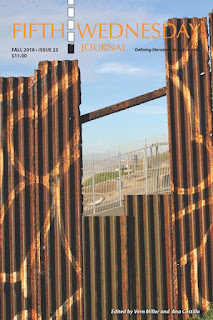
As 2018 comes to a close, I've published a a new poetry book, Bird Forgiveness (3: A Taos Press) two of the Bird Forgiveness poems were nominated for the Pushcart Prize. Readers of La Bloga know I've written several journalism and personal memoir pieces on La Bloga, as well as poems in literary journals, the most recent in Fifth Wednesday Journal, a special issue, Fall 2018 Issue 23, coedited by Ana Castillo and Vern Miller with cover art by Claudia D. Hernandez. La Bloga's own, Amelia Montes, contributed an excerpt from her upcoming memoir that was nominated for the Pushcart Prize. The call for Fifth Wednesday Journal's special issue on immigration was earlier this summer before the deaths of two children: Felipe Gomez Alonzo and Jakelin Caal. I also found out about the call for entries through a message on Facebook.


Friday, December 04, 2015

The Muse's Editor: Mayra Calvani

Melinda Palacio

Latina Authors and Their Muses
Edited by Mayra Calvani


I am honored to be included in Mayra Calvani's anthology, Latina Authors and Their Muses (Twilight Times Books 2015). In addition to reading about the distinct writing styles and inspirations from 40 different Latina authors, the book itself is a sort of muse that will bolster any aspiring writer. The book is also available in digital form for those who have crossed over to the non-paper side. I had the pleasure of interviewing Mayra Calvani. She also reveals who her personal muse is. Gracias, Mayra for this beautiful book. 

La Bloga: 
After reading Puerto Rican Voices in English, the 1997 anthology edited by Carmen Dolores Hernandez, you decided to do something similar for Latina Authors and Their Muses. What was it like creating interview questions for 40 different authors? And what would you like La Bloga readers to know about this book?

Mayra Calvani:

It was quite challenging because I wanted to ask questions that were important to me and that would be informative for some of my target readers (aspiring authors), so this meant some of the questions had to be generic (the usual questions about the creative process, landing an agent, finding a publisher, etc.), and others had to be somewhat repetitive because I wanted to get answers to the same questions from different perspectives. At the same time, the questions had to be interesting and original. I tried to combine all these elements into the questionnaires.

Latina Authors and Their Muses has been a project very dear to my heart ever since I came up with the idea back in 2008. The journey has been long and challenging, which is why I’m so thrilled to see the book published. It’s also been a wonderful journey of discovery and of sisterhood. I’m deeply honored to have worked with these accomplished authors. My goal is to spotlight their work and bring into attention the richness of their talent, but also to encourage aspiring authors and teach them a thing or two about the publishing industry.


LB:
What if anything would you do differently, now that book is finished? Did any answers surprise you?

MC: 
Now that I’m doing a master’s in Comparative Literature and have taken courses in literary criticism, I see how I could have included even better, more inquisitive, challenging questions. Apart from this, I don’t think I would have done anything differently. I feel that the journey evolved organically, that everything happened the way it should have. I actually wanted to include more authors, but the publisher told me we would have had to split the work into two volumes, so I decided to stop it at 40 interviews.

I was especially interested in the meaning of “success” for authors, and what it means to be a “professional author.” This is one of the questions I asked several times. It was enlightening to read the different responses. More than surprising, it was illuminating to get into the minds of these authors, what inspires them, what drives them, and what keeps them going in spite of the odds. In a way, they’ve all become my muses.

I was surprised by how different the journey has been for each author. For some, finding an agent and getting published by one of the big NY houses was fairly quick and easy. For others, it has taken many years.


LB:
For the cover of the book, you polled the authors and asked them to weigh in on the decision. I was pleased and nervous for you. Did bringing in all 40 authors make the process easier or more difficult for deciding on the final cover. Tell us a little more on the process. Who came up with the initial designs? Were you happy with the outcome or did you secretly hope for one of the other covers?

MC: 
The search for the perfect cover was an exciting journey! It took several artists and multiple covers (about 10, if I remember correctly) to come up with the “look” that the publisher and I were after. We wanted a look that would reflect the content and also appeal to target readers, but at the same time we didn’t want to be stereotypical. This was a big issue.

After several months we rounded up four covers designed by Tamian Wood. It was hard because all four of them were great in their own way, even though they all had different looks and evoked different feelings. That’s when I decided to conduct a poll with the authors. An overwhelming number chose the present cover as their preferred one—which also happened to be my and my publisher’s favorite. So everybody won.

Mayra Calvini
LB:
Why did you decide to focus on the author's muse. Do you have a muse? I'm guessing you do. Tell us about your muse and how your muse has influenced and inspired your volumes of books. 

MC: 
That sprang from the title. I came up with the title first, and that gave me the idea to begin each interview with a quote from the author about their muse. I thought it would be a nice attention grabber, something that would make the anthology stand apart from other similar titles.

I have a muse, but like Esmeralda Santiago’s, it is often elusive and mysterious. It has various faces and can shapeshift into many forms.  At times, she’s a nurturing angel who fills me with peace and confidence. Other times, she’s a belittling and cruel ice queen. Mostly, she’s the statue of the Egyptian cat goddess Bastet sitting on my desk and keeping a close eye on me. I like her the most because although she keeps me on a leash, she’s the perfect balance of gentle encouragement and firm discipline.

LB:
Is there anything else you'd like to tell La Bloga about this project or any future ones? What are you currently working on or what will your next book entail?

MC:
I recently terminated with an agent and I’m in search of another agent for a YA psychological thriller set in Puerto Rico in the 1970s. I’m also awaiting response from a publisher on a 4-book YA mythological fantasy series. At the same time, I’m self-publishing a series of novels under a pen name.

On the nonfiction front, I just got an offer for a contract for another anthology titled, Born to Write: Honoring Your Gift When Your Partner Doesn’t Support Your Writing. This will be a collection of essays from different authors.

So I guess I’ll have my hands full for a while. I’m excited about 2016 and can’t wait to find out what the New Year has in store for me.


LB:
Thank you for taking time out of your busy schedule, Mayra.

MC: 
Thank you for giving me this opportunity to talk about my book, Melinda!


About the editor:
Award-winning author Mayra Calvani has penned more than ten books for children and adults in genres ranging from picture books to nonfiction to paranormal fantasy novels. She’s had over 300 articles, short stories, interviews and reviews published in magazines such as The Writer, Writer's Journal and Bloomsbury Review, among others. A native of San Juan, Puerto Rico, she now resides in Brussels, Belgium.

Latina Authors and Their Muses includes interviews with 40 multi-talented authors:

Marta Acosta
Lisa Alvarado
Julia Amante
Margo Candela
Kathy Cano-Murillo
Mary Castillo
Jennifer Cervantes
Leila Cobo
Zoraida Córdova
Lucha Corpi
Sarah Cortez
Angie Cruz
Liz DeJesus
Anjanette Delgado
Carolina De Robertis
Lyn Di Iorio
Teresa Dovalpage
Carolina Garcia-Aguilera
Iris Gomez
Reyna Grande
Rose Guilbault
Graciela Limón
Dahlma Llanos-Figueroa
Diana López
Josefina López
Dora Machado
Maria Gabriela Madrid
Michele Martinez
Sandra Ramos O'Briant
Melinda Palacio
Caridad Piñeiro
Berta Platas
Toni Margarita Plummer
Thelma T. Reyna
Lupe Ruiz-Flores
Esmeralda Santiago
Eleanor Parker Sapia
Alisa Lynn Valdes
Diana Rodriguez Wallach
Gwendolyn Zepeda