Showing posts with label ana castillo. Show all posts

Friday, December 28, 2018

Facing the Truth about Facebook 2018

Melinda Palacio


Before ringing in the New Year, I am taking advantage of the quiet everywhere to get some writing done. I realized only too late that I had not prepared a piece for this week's La Bloga. My New Year's Resolution will involve being better prepared and better organized. It's safe to say that a few of my husband's good habits have rubbed off on me. After ten years, I see the benefits of having less clutter and an organized closet. One change Steve has made in his life that I continue to resist is his decision to close his Facebook account for good. He has pointed out how FB has gotten rich over the concept of using people like me, people who regularly put up free content on a website that they get rich off of by selling my information and those of my 'friends' and reading my posts and messages and learning what I like and dislike and sharing that information with their advertisers. See the NYT article for 5 Ways Facebook Shared Your Data or yesterday's article which breaks down Facebook's rule book and how the company makes about $5 billion in profit per quarter thanks to our sweet posts and rants. The bottom line is Steve does not appreciate being used or manipulated and he values his privacy more than I do.

Earlier this month, La Bloga learned that Facebook had unblocked and restored all of our posts. Now, that have a platform again, I'm not eager to give it up. I suppose I can point to vanity of wanting to share that photo of me in Ireland or of me eating a fabulous meal or wearing a new dress that keeps me buying into the deal with the FB devil, all under the guise of being connected to over a thousand friends and of being a writer who will reach a bigger audience with this great deceit that we've all signed up for. In reality, every private message, every red heart or smiley face means data that the FB sells to other companies like Netflix and Yahoo. And if you think you're too savvy to fall into the traps of how FB is using you, think two words: President Trump. Sure, neither you nor I voted for the thing in white house, but a whole bunch of other people did and a whole election was stolen thanks to FB giving access to real and fake accounts in exchange for the product: you.

Before I was addicted to photographing my food and looking at random videos of people that I vaguely know, I viewed the internet as a source for useful essays and information that might help my writing. It was here on La Bloga, before I joined my fellow esteemed Blogueros, that began my day in anticipation of what I might find on La Bloga. After all, being a fan of Daniel Olivas's column led to my first published story, and eventually, my first published novel. I trust that there are still La Bloga readers who turn to our site before turning to the a highly curated website where users manipulate their reality and post what they want you to see. Better yet, I trust readers of La Bloga will choose to lose themselves in a book and wonder where the time went.

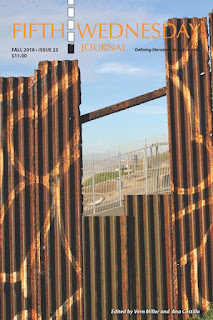
As 2018 comes to a close, I've published a a new poetry book, Bird Forgiveness (3: A Taos Press) two of the Bird Forgiveness poems were nominated for the Pushcart Prize. Readers of La Bloga know I've written several journalism and personal memoir pieces on La Bloga, as well as poems in literary journals, the most recent in Fifth Wednesday Journal, a special issue, Fall 2018 Issue 23, coedited by Ana Castillo and Vern Miller with cover art by Claudia D. Hernandez. La Bloga's own, Amelia Montes, contributed an excerpt from her upcoming memoir that was nominated for the Pushcart Prize. The call for Fifth Wednesday Journal's special issue on immigration was earlier this summer before the deaths of two children: Felipe Gomez Alonzo and Jakelin Caal. I also found out about the call for entries through a message on Facebook.


Friday, March 10, 2017

Banner Day on the Eve of My Tahiti Trip and IWD2017 with Ana Castillo

Melinda Palacio

Sojourner Kincaid Rolle, Ana Castillo, Melinda Palacio, and Mary Rose Ortega


Sometimes a day leading up to a big trip is worth leaving any last minute packing details behind. Yesterday, International Women's Day 2017, was one such day. Friends who have known me most of my life, Mary Rose and Teresa (Little Teri), came to visit me in Santa Barbara from Los Angeles. Mary Rose was my late mother's best friend and she often makes a point of seeing me when we happen to be in the same city (she tends to travel almost as much as I do). Mary Rose and Little Teri were in search of hearing Ana Castillo present her latest book, the memoir Black Dove/Paloma Negra, a road trip to Santa Barbara and spending the day with me was, as they say in New Orleans, Lagniappe, or a little something extra.

Throughout the day, Little Teri kept asking if I was all packed. Short of getting my nails done for trip, I was. In fact, I've been packed for several weeks. It's not everyday one gets the opportunity to travel to the South Pacific. Now that I'm on the airbus, I can think of a thing or two I may have forgotten. But back to Wednesday. We picked up my friend Sojourner at UCSB and made our way to the Isla Vista Theater, a large movie theatre that doubles as a lecture hall for UCSB in a pinch. Thanks to Aida Hurtado and the UCSB Chicano Studies Department, they accommodated Ana Castillo and all of her fans within and outside of the university at the lecture hall, where there were plenty of seats. Mary Rose mentioned that she tried to catch Ana at an earlier reading in the San Fernando Valley, but the seats had been sold out.

We arrived early because Mary Rose and Little Teri didn't want to miss seeing Ana on her California tour, before she headed further south to San Diego. The two friends have been fans of Castillo since they first heard her read in 1993, during the author's promotion for her novel, So Far From God.
Ana Castillo before her UCSB presentation

They came up to Santa Barbara on a gorgeous day that just so happened to be International Women's Day. We may not have gone to a march, but we were four women in attendance to hear a Chicana Feminist author and poet. Castillo describes herself as a poet first; and with descriptions of her mother's hands as 'Soft hands like crushed orchids,' it was a pleasure to hear the poetry in Castillo's work through her deep voice and veil of long hair.
Ana Castillo at the Isla Vista Theater
Ana Castillo not only read from her latest book, Black Dove: Mamá, Mi'jo, and Me, but she regaled us with readings from her epic poem turned novel or novel in verse, Water Color Women/Opaque Men and her open letter to the current President of the United States. The letter was filled with irony and ire. In the near future, I'd like to reprint the entire letter here on La Bloga.

The Word bench holds copies of Isla Vista's literary magazine.

As is customary, Castillo ended with questions, signing of books, and photos. Department Chair, Aida Hurtado ended the Q & A with the popular question, What advice might you give to students who want to become writers. Castillo's advice was to check your intentions, make sure you love literature and love to read, but, most important of all, write, write and rewrite. "The magic is in the revision," she said. "Do not treat early writing so precious." She described her process as sometimes needing to step away from the computer to mull over a phrase in her head. "I'm constantly thinking of a better, clearer word," she said. " With most author presentations, the Q & A is an opportunity to go off script and veer from the prepared readings. There was a tender moment when one of the students thanked Castillo for writing about her experience with her son's incarceration and family history of depression, the centerpiece of Black Dove/Paloma Negra.

If you missed Castillo's appearances in Los Angeles and Santa Barbara, there's still more California tour dates, including a workshop for writers in Sacramento, April 2. See Ana Castillo's website for more information.


Tuesday, April 22, 2014

Conference Time. News 'n notes.

Michael Sedano


University Conference on Latino Culture and Science Fiction April 30.

The University of California, Riverside hosts a trailblazing academic inquiry into science fiction and speculative fiction written by raza writers in a gathering of casí all the raza writers of science fiction and speculative literature.

The April 30 conference arrives at a time of literary ferment when writers and readers come to the book market with higher expectations than publishers can understand.


The conference explores how six writers get their books to market, the role of sci-fi and speclit genres in United States letters, the nature of literary exclusion, and stories about what each writer brings to readers.

The morning panel joins almost all raza published authors of the genres into the same room at the same time. Hosted by UCR’s Professor of Science Fiction Media Studies, Sherryl Vint, the discussions will be classics among literary conferences. Mario Acevedo’s vampires and Jésus Treviño’s zombie fiction meets Rudy Ch. García’s and Treviño’s dimensional surrealism. Rosaura Sánchez and Beatrice Pita’s lunar braceros meet el padrino of Chicano sci-fi Ernest Hogan’s mexicas in outerspace. Y más.

In the afternoon, Michael Sedano and UCR graduate students join the circle to include critical perspectives and readerly responses to these sci-fi and speclit genres, and to join the audience in speculation into what directions each sees raza speculative literature and science-fiction taking.

A grand event in the late afternoon, years in the making, puts a capstone on the conference.

See Rudy Ch. Garcia’s Saturday, April 26 column for building/meeting-room specifics. Here's a link also: http://ucrtoday.ucr.edu/21579

The beautiful Riverside campus is freeway convenient off the 60/215, in Susan Straight country.


Conference on Rudolfo Anaya: Tradition, Modernity, and the Literatures of the U.S. Southwest May 2-3.


La Bloga friend Roberto Cantú brings the most arrestingly interesting academic conferences to Southern California and the east side of the LA basin. May 2-3, Cantú surpasses himself with a conference dedicated to La Bloga friend Rudolfo Anaya and literature of the US Southwest.

Scholars from New Mexico to old Germany will lecture, moderate, and sit panel presentations.

Four keystone fiction writers take the lectern during the conference, Ana Castillo, Rolando Hinojosa-Smith, Reyna Grande, and Mario Acevedo, fresh from his stunning appearance UCR's raza in spec lit and sci-fi conference.

The Anaya conference on the campus of California State University Los Angeles in El Sereno is free and open to public visitors for just the cost of parking or a short walk from the bus station. There is no light rail serving this campus directly.

A word of caution: parking rules are posted so you can read them and avoid a ticket. Be assured local regulations are strictly enforced.

The conference is sponsored by Cal State L.A.'s Gigi Gaucher-Morales Memorial Conference Series, the College of Arts and Letters, the College of Natural and Social Sciences, the Department of Chicano Studies, the Department of English, the Barry Munitz Fund, and the Emeriti Association.

See the conference website for details.


Writing Workshop With Ana Castillo

© foto: workshop at NLWC in 2011

Working with a seasoned writer to develop ideas, polish writing, glean insights from conversation often comes with the payoff of better writing, an improved attitude. This happens for beginners as well as polished authors.

The opportunity to work with one of Chicana Chicano Literature's most accomplished talents, Ana Castillo, should quickly fill the handful of seats available on May 3 through auspices of La Bloga friend Iris de Anda.

 Visit the workshop Facebook page for your invitation. There is a fee for the workshop.


Writing Workshop for Newer Writers in East Los

La Bloga friend Sam Quinones organizes a writing workshop series for those who've never published before, Tell Your True Tale.


Students from recent workshops appear Saturday April 26 at the  East L.A. Public Library at 2:30 pm. The East LA Public Library awaits your attendance at 4837 E 3rd St, LA, 323-264-0155.

Quinones' workshops revolve around insisting stories fit in limited space. Tell Your True Tale approach forces writers to hone their thoughts and imagination, eliminate unnecessary words, make the hard choices that are part of strong writing, no matter the genre.

The Saturday event showcases the students' work with, according to Quinones, stunning variety and quality of stories: A vet returning home from Vietnam; a janitor in Houston trying to find her children in Mexico; of braceros finding their way north and back home again; a man learning confidence as he woos a woman; a bus rider in Los Angeles; a mariachi singing for a heartbroken family on Christmas Eve.

Find details on the workshops here.


Free Poetry Column Follow-Up: Veterans Land.

I noted in La Bloga's coverage of the Grand Park Downtown Bookfest that one organization performs Shakespeare with kids on the grounds of the Veteran's Center and elsewhere. The observation draws a response from the Shakespeare Center of Los Angeles Associate Director of Veteran Affairs Kellogg Brengel.

I receive Brengel's words with appreciation for his organization's role in the VA's efforts helping GIs. LA is the homeless GI capital of the world. It's a moral outrage that so many of these men and women are walking wounded soldiers not receiving the care we owe them. I am a Veteran of the US Army but no one needs to be a Veteran to be outraged by this crud.

For Veterans and supporters of Veterans, a critical issue simmers just at the surface of efforts like the Shakespeare Center and other companies. Many, if not all, private or non-Veteran users of the West LA Veterans home lost a federal case and will have to vacate VA land, absent some amicable resolution that benefits Veterans more than others. A commercial laundry, the UCLA baseball team, an exclusive Brentwood girls' school, a theatre, all don't want to leave low-cost Veteran land for market-rate facilities.


Mr. Brengel notes the program goes into its third year on the VA campus, he says, supported by a veteran workforce. Working with the VA's Greater Los Angeles Healthcare System, SCLA has hired a total of 61 veterans over the past two summers and because of our free admission policy for  veterans, active military, their families, friends and caregivers/VA employees, SCLA has given away 5,665 tickets to our summer performances.  

The veterans we hire are recruited from the VA's Veterans Community Employment Development program which helps find supported employment opportunities for veterans enrolled in VA services who are chronically unemployed, homeless, and/or receiving psycho-social rehabilitative treatment. 

Veterans receive paid on-the-job training and work in all aspects of the production including: production and venue crews, audio engineer, wardrobe assistant, ushers, parking attendants, and site-specific marketing. The transitional work experience this program provides has been a great success and we are very much looking forward to being back in the Japanese Garden for the summer of 2014. 

A ver.


La Bloga Welcomes Guest Columnists

Thank you for reading La Bloga. When you have a comment, a need to enlarge, clarify, or correct La Bloga's coverage of literatura, cultura, arte, o más, don't hide that light of yours under a bushel basket, dale shine. Contact La Bloga here for particulars of your Guest Column, or email labloga@readraza punto com. Of the eleven daily blogueras blogueros, eight began writing for La Bloga as Guest Columnists.


Late-arriving News

Just as I was putting La Bloga to bed, this opportunity pulls into sight.


Tuesday, January 28, 2014

Review: Give It To Me. La Palabra. Quest. On-line Floricanto: Marisa Urrutia Gedney.

Ana Castillo's Give It To Me 2014's Literary Sensation 
Michael Sedano

Review: Ana Castillo. Give It To Me. NY: The Feminist Press, 2014.
ISBN: 9781558618503

The literary sensation of 2014 is Ana Castillo’s Give It To Me. Castillo’s written no flash-in-the-pan-let’s-churn-out-a-series sensation.
Castillo’s outrageous storytelling creativity will have readers passing copies to all their friends, who will already have their own copy. Give It To Me is sure to engage many a graduate seminar, moving the novel toward the top of all United States novels for its character, Palma Piedras, the novel’s narrative voice, its satire of eroticism, and overall richness.

Ana Castillo sends a woman on a sexual odyssey that samples incest, orgy, rape, cougarhood. Palma Piedras is bi- though mostly prefers women. Palma repeatedly takes on random partners, men, women, gay, straight, singly and in pairs. Rather than move with deliberation, Palma is often simply in the way of other people’s passions. At 43 years old, Palma Piedras is at the nadir of a life in shambles in the wake of death, divorce, and hysterectomy.

Unabashedly sexual without being erotic, Ana Castillo introduces a new ethos to her cast of women. Highly competent as a book translator, emotionally directionless, Palma is neither strong nor in control of much more than where she sleeps. “Anything goes, why not?” would be Palma’s motto if she had one. If Palma has a motive or philosophy, the narrator keeps it well under cover, snarking out Palma’s views on men and sex.

Machismo is lonely, keep the front up, never let anyone in. Palma doesn’t object that a macho perceives himself at war with the world, she’s at war, too. Men are “sex, food, and leave me alone for the rest of my life.” Sex is teatro, performance. The act gets old soon enough, else people get "laid to waste." Women make emotional contact leading to an intimacy that replaces passionate sexual athleticism of early dates.

Palma Piedras is a normal woman with a freaky side that takes over Palma’s vulnerable moments, or asserts itself seemingly at random, in guise of something Palma wants to do. Palma and her enamorado, Pepito, go through a series of misadventures dating back to when he was fourteen and Palma left Abuela’s house and her lil cous’. Pepito focuses Palmas awareness--he is unfinished business, otherwise she’s careening from this to that.

Palma and Ursula split up. Pepito comes to town. Gay friend Randall and Palma prove that each has equipment the other needs. Palma gives it to some gardener by sunbathing nude while he trims the bushes. Pepito takes an intimate cellcam foto and promises to sell it, later sends her cash. Don Ed comes to town and Palma’s his sure thing blind date. Palma is arrested for lewd public display next to Abuela’s grave. Palma hooks up with a 25-year old Apple genius and poet who thumps her against the wall to a rap beat. Palma is having second thoughts about being on the bottom with Austin on her and Mischa on top of Austin, when the hotel maid walks in. Palma gets naked and alluring, Pepito keeps his clothes on then walks out.

Those are the misadventures just of Part I. The novel is put together in three parts.  In Part II, Palma is raped and exacts revenge on the woman. Palma meets her birth mother and unknown father in Los Angeles. The man looks Palma up and down and licks his lips, he’d take it from her.

Abandoned by the mother and raised by a resentful abusive abuela, Palma has invested longing that her mother will be the opposite of abuela and welcome the long-lost abandoned child. Mom can’t wait for the stranger to leave town. She has a replacement family.

Castillo draws an interesting parallel between Palma’s love life and family ties. Once the passion fades, emotional intimacy defines the value of relationships. Palma’s mother long lost passion borne of guilt. Mom’s world is so distant that there’s no absence to fill with emotional connection. Palma knows she can move on from a lover. How can she go home again when there was never a home?

Part III sees Palma and Venus break it off. Venus’ kids and in-laws probably hate Palma with a passion. Palma and Venus aren’t the belles of the quinceañera. It comes time for Venus to kick Palma out, but Part III presents a different Palma, a decisive, here and now attitude developing.

Rather than allow Venus the current lover to dictate the dissolution of their affair, Palma takes full control. She’s packed her bags, chooses the time, and heads out with determination.

Flying back to Chicago, she asserts herself to Jimbo. The narrator has painted a foul fellow in Jimbo and readers will enjoy when Palma and Pepito kick the worthless lout out of abuela’s house. He’ll get his cut of the sale. Pepito says goodbye, and Palma is happy about giving him her blessings. Palma doesn’t look back, her fashion line hits the market. The background world the narrator keeps at the periphery of Palma’s pansexualism pokes its head back onto the scene, Palma’s life pivots.

Give It To Me will inevitably draw comparisons to similar work, especially with Castillo’s direct allusions to Collette and Anaïs Nin sprinked here and there. Give It To Me is none of those and all of those and more, a capstone piece of writing and character. Terry Southern’s Candy, more than others, comes to mind. Not just all the happenstance sex, but details like Palma’s mistaken Dalai Lama broadly parallelling Candy’s guru with “total bodily control” add layers of delight when a reader happens on them. Give It To Me is Candy without Southern’s sophomoric though sometimes wickedly diabolical humor.

There’s lots of humor in this narrator’s sardonic, nonjudgmental voice. Unlike the comparison erotica, where prurience is its own reward, Castillo’s work uses counter-eroticism as a reductio ad absurdum. For instance, in the graveyard sex scene, Palma’s mind goes to her stolen uterus while Pepito is laboring mightily under her. The narrator grows wildly metaphoric, fleeing the sex, hiding behind colorful images, “after a few throbbing thrusts she knew he had sent his troops off to infertile territory.” Just as she’s about to orgasm the cop siren goes off.

The narrative voice of Give It To Me gets subsumed in a reader's “she did what?” response to what's caroming off the page. Castillo’s skill in weaving the story through flashback to flesh out a moment illustrates the value to telling opposed to showing. There’s little to no dialog, nor quotation marks. Except for the rape scene, there are no graphic sex scenes.

Readers have to take the narrator’s word for what’s happening. Does Palma feel a little guilty about having wild sex with her cousin, after acknowledging the two were raised brother and sister? Palma’s revenge on the rapist is a delicious moment of comedy and understated lethality, but the narrator doesn’t dwell on it, Palma just spins the chef into the pool and walks off. The next chapter does the most “showing,” with its responses to the pool fight.

Scholars are going to delight in linking Give It To Me to classical Greek teatro as well as the body of Castillo’s work. In Palma Piedras, Ana Castillo creates a textbook eiron, the “hero” of satire that dates back to ancient Athens, continues through Quixote, Euphues, Gulliver, Balso Snell, Yossarian. Like them, Palma’s life assaults her like a thousand blows, each successive lash taking a bit more skin than the one before. Not the eiron, not the reader has a clue how the character is going to get out of her headlong charge into a brick wall of empty relationships and impulse, if that’s what it is. At one point, Palma realizes if someone knew what she’d just done they’d have Palma hospitalized.

As Castillo wraps up the story, the author provides the literary connection that informs Palma’s seemingly sudden emergence from declivity. Peel My Love Like An Onion shows up as Palma’s gift to a friend. Then, Palma runs into a wheelchaired older woman with a younger flamenco dancer male attendant. Coja Ex Machina feeds into Palma’s intuitions. Palma’s desperate grasping at relationships have proved meaningless and harmful. Carmen La Coja reversed the role; she used to be a pawn. Now, the old woman continues relationships only when her satisfaction is served, a point to then that completely escaped Palma. Find your own satisfaction first, on your terms.

After giving her a hectic career, Castillo turns kindly to her Palma. Palma’s lifelong unfinished business with Pepito is now wrapped up. It wasn’t incest after all, and she doesn’t Love him. On the familia front, Palma may develop a relationship with her niece in LA, maybe familia can be made to work. And her fashion line is about to make Palma wealth and fame.

Not all is whole in Palma’s story. An element of her anomie drives Palma to see “mulch” where others see ordinary folk. Castillo scatters the outlook, the word, in numerous spots but the point of view never gets shown nor told, other than Palma acknowledges her quondam middle-class life was mulch. The Rocky allusion of striving and intensity has a more limited use. The prominent first reference had me looking to see how the narrator would slip in other Rocky allusions and was disappointed there are so few. It’s a personal failing I couldn’t locate again that gluten-free beer Palma ordered. I went looking for that brand multiple visits but inevitably found new insights, phrases, diction, and confirmations, those “that’s what I thought she said” moments.

Satire and erotic literature challenge sexual mores, follies, and excesses of the popular culture it satirizes. It gets people talking about important matters. Give It To Me challenges many a reader’s sexual mores and sense of humor. And that’s only one of its charms. I look to see Give It To Me leading a loud and public discussion. Then the scholarly stuff over time. That’s what literary sensations do.


Renews Quest For Lost Floricanto Videos

Magu. Private collection. Used with permission.
The Digital Library at the University of Southern California offers access to videos of artists who read their work at the first festival de flor y canto, El Centro Chicano's Festival de Flor y Canto, in 1973.

Hear and see California Poet Laureate Juan Felipe Herrera and Alurista as young poets launching legendary careers. The Salinas boys, Omar and raúlr read powerfully, as do Ricardo Sánchez, Veronica Cunningham, Lyn Romero qepd, Vibiana Aparicio-Chamberlin, Alejandro Murguía, Oscar Zeta Acosta. It's a stunning assembly of luminaries and antepasados, that first floricanto. And Roberto Vargas and José Montoya read, but that’s hard to prove.

Until USC acquired its digital copies, only two libraries in the world owned videos of the 1973 performances, UC Riverside and Texas A&M Kingsville.

Neither library can find their copies of Vargas and Montoya’s readings.

UCR traces their lost tape to an interlibrary loan to Cal State Bakersfield. TAMU couldn't find the box anywhere.

The performances I digitized were on ¾" U-Matic video cassettes. Elsewhere, I located audiocassettes of the missing video soundtracks, but these were poorly recorded and are unintelligible.


Videos of the 2010 reunion floricanto, Festival de Flor y Canto. Yesterday • Today • Tomorrow will be available from my files to USC this year. Along with those, my goal is to locate the missing videos of José Montoya and Roberto Vargas, and get IDs on all the "unidentified subject" fotos.

This is my 2014 project, find the Vargas and Montoya videos and return their performances to USC. They’re out there, somewhere, and who knows what more? The pianist accompanying Oscar Acosta’s reading, Javier Pacheco, sent USC a copy of Pacheco’s 1973 performance that had not been cataloged at UCR nor TAMU.

Click these Links for:
Index of Festival de Flor y Canto videos and photographs.

Background on the “lost” floricanto videos.

La Palabra's Double First In 2014

Avenue 50 Studio welcomes poets with open arms and mics. The Highland Park gallery is among Los Angeles' more active poetry sites, hosting two regular reading series, La Palabra Readings and The Bluebird Reading Series and supports the peripatetic Poesía Para La Gente.

Sunday, January 27th was a fourth Sunday, hence the first La Palabra of 2014 called a handful of spirited poets for Open Mic, and to hear the spotlighted guests. Karineh Madhessian is the new host and emcee for La Palabra, and her first reading featured Marisa Urrutia Gedney and Ramona Pilar Gonzales.

Here is a link to  a gallery of individual portraits included in the slideshow below. Photographing writers, poets reading their stuff aloud to an audience is part of The Oracy Project. The goal is capturing perfect moments of oral expression. There's eye contact, if not with the lens then with the gente out there. The body is all attitude--a readiness to act purposively--and exposed, away from a lectern. Hands and arms in motion, or holding a manuscript, add their own expressivity, the energy of a moment, a strategic gesture.

Effective text analysis and practice will produce photogenic moments that fit the profile of a "perfect"portrait of an orally literate writer. See the Writers & Oracy links at Read! Raza for tips on reading your stuff aloud.


I like a lot of these portraits. The light in the gallery spilled in through curtained storefront glass. Overhead lighting modeled the readers' left side and the off-white walls glowed with reflected ambient light. None is yet the perfect moment. Most of these reflect an eloquent moment, a point where the words demanded reaching out to the audience. A couple of readers need to use their eyes as one of their interpretive tools, because, as the old song reminds, "read to me only, with thine eyes, and I will buy your book."

Data: Handheld, ambient light. Canon T2i, 18-55mm. ISO1600. 1/50 f/5.6. In rooms like this I find it preferable to use a manual setting and the camera's RAW image. I use Adobe Lightroom to process the files.


On-line Floricanto: Marisa Urrutia Gedney


Firefall
By Marisa Urrutia Gedney

I open my eyes and remember I love you
when our faces pushed together and I didn’t mind
the scratch of beard, warm breath so close
the flowers of the bedspread
kicked off in the middle of the night
because I need to kick something.
Body a tangle.
I fight in my sleep for what’s supposed to cover both of us
wires firing from bone to muscle to anger
writhing with confusion.
But, I always have the answer.
I am always right.
Not when a nowordslongnight comes
I can only hear Christmas carols and children singing Silent Night in memory of other children. All of them? Or only the ones from those classrooms?

I think of what I will say in the morning
a commitment to not cause harm, or unleash everything
Las Fridas fight
sharing the same blood
boiling, popping for air.
Furioso, the word keeps saying itself
wishing gold swans would swim it away
with grace--
that only happens on stage.

And what about when the map turns topographical?
There are so many more mountains than we thought.
Yosemite Valley is the smallest part on this square of Sierra
Look, the triangle is so small and we wonder what it’s like in Cascade Cliffs, Horizon Ridge, Mt. Starr King, May Lake, and Merced Peak.
The John Muir Trail crosses through most of this big square
but I’m afraid of no bathrooms, and what about when I want a soft squishy pillow,
where will I find a blanket to steal in Pine City?

Should we go to the middle of it all instead,
stand on top of Glacier Point,
make an all day fire and then throw it down the side of a mountain
yell to the whole valley while
fire turns to water and doesn’t disappear.


Her Name Doesn’t Say Enough
By Marisa Urrutia Gedney

Were you mad when your Indio daughter gave us
a revolutionary name
a hard to say name
names with r’s that roll-
and tanned her skin to
deep, dark brown, parted black hair,
all the way down to her butt.
There was no mistaking that she was a shiny happy Chicana
fighting for her rights getting around in her own VW bus.
But then she introduced herself as Beverly and
white black brown, all were confused.
It’s not quite the movie star name you thought it was,
where did a Beverly come from?
She drove from East LA to Commerce, knew she was poor
really poor,
but she had her NO accent tongue,
perfect Spanish on the inside and her name,
no-ita can be added to that!
She’s pure, three syllables of
you fit right in.

You gave her this,
because she didn’t come out with milky skin
or eyes like a messy blue storm.

You gave her this,
and she passed it on.

Didn’t you understand
what happens
when people get here?
They want to be
More
American
More
not what their skin
or voice
or smells
or sadness shows.

Were you mad when you found out that your granddaughter wishes to speak Spanish like it rolled right out,
all natural, no books, no photographic memory to learn
the tenses.

Her name doesn’t say enough.


What the body shows
By Marisa Urrutia Gedney

1.
At the bottom, the base, the trunk
At the place that sticks to the ground,
are women.
Women in their hose and comfy shoes
still cute in a two piece suit,
long beaded necklaces.
It doesn’t matter how wrinkly your hands are, when you gossip
you gotta look good.
A woman with her hair done, 40s style, a hand on her hip
a red smile against orange brick.
Are we only strong on the bottom?
Another on the edge of the bed,
boobs hanging, far apart
seen through a button up blouse that she sewed for a party that night.
Two of them, same height, same dark almost black eyes,
holding hands in a driveway
white folded socks inside oxfords.


And that’s how you walk around, with other women
carrying each step
landing every jump
cushioning hard clumsy or aged falls.
In your calves, rooting down to the earth
they are the closest to their mother.

2.
At the top, the start
the highest reaching point
the place that gets the most sun
hang gold adorned picture frames
with color and cactus,
not the kind from the desert that you’ve never even seen,
but a gift for an illness you endured
and it made it through,
you made it through.
Emerging, more pink lines, green
splashed around
and one gold studded cactus
plump, fat, full of water

It must have just rained.


I trace chameleons
By Marisa Urrutia Gedney

I trace chameleons
in the dark
the raised lines on your chest
blue hues and greens of the place you
wish Comelona could have been set free
at the same time you were
sent off to college all by your own making
darkness there too, the fog horn always calling. The air was so wet.

At home, your mom opened the door to more people,
with you two hours away, your own room for the first time ever, with a long twin bed,
that meant more people she could take in: tios who aren’t tios, new babies, both grandmas at once.
Filling space that didn’t exist until her own kids had to do something to leave.
The one thing you asked her to take care of,
dead.
The other person you left, on his own, no more skateboard or big brother,
gone, living in a different kind of room.

I trace long rose stems
down your back to the curve of your stomach.
Those raised lines I know better.
To remember the men that worked hard,
drove all night, got their leg chopped off for you, not because of you,
but so that you
could live like they might have
near orange groves, growing greens, sawing benches and whatever else I might wish for.
Not able to give your reina whatever she wants
but the work and the imagination to thrill her.

I tell them to leave too to get an education
down the street, two freeways away, a three day train ride. Something, somewhere.
When I help 17 year olds tell their story and learn what they will leave behind
and what might not keep living, I wonder how they will handle their losses
and who will trace their pain.


Thursday, April 17, 2008

Goddess of the Americas: Looking Back to Create the Future


Writer extraordinaire, Ana Castillo

photo/mixed media by Alma Lopez


This a brilliant collection celebrating the love of and devotion to the enduring influence of the Virgin of Guadalupe. Castillo includes male and female writers, agnostics, traditional Catholics, feminists, and Santeras in this eclectic homage. This anthology contains essays, memoir, poetry and rhetoric celebrating a complicated relationship with a folk deity, one that is much less European, and traditionally Catholic, much more than that. This is a deity that is full-bodied, sensual, actively involved in the thrum and unraveling and reclamation of the world.
In the preface, Castillo writes that this brown-skinned Mary appeared in 1531; but in reality, existed as Tonatzin, a thousand years before the conquest. The thread that weaves these essays together is the fascination with the ways in which Tonatzin, the moon goddess, morphed into this particular image of Mary.

She is essentially Latina, essentially an emblem of indestructible indigena roots, which survived through a syncretic practice. (Much like the ways Mejicanos/Chicanos themselves survived the conquest.)
Authors such as Elena Poniatowska, Luis J. Rodriguez, Sandra Cisneros, Denise Chavez, and Gloria Anzaldua write with clarity, precision and grace, depicting a 'Virgin' that has survived the conquest and embodies a multiplicity of identities, based on the multitude of goddesses that are her antecedents. Shaped in their image, this goddess is rooted in the indestructible, the indigenous. Each of imbue this goddess with qualities the colonizers could not imagine, let alone control.

This Virgin is an amalgam of mother, consort, liberator, guardian of the living and the dead, and wellspring of the revolutionary.
Of particular interest to me was Sandra Cisneros' essay entitled, Guadalupe the Sex Goddess. In it, she traces the Virgin's pre-Columbian roots as icon of fertility and sexuality, central to a cosmology in which female sexuality was valued, not denigrated. In that cosmology, Guadalupe's antecedents included Tonatzin, the moon Goddess who embodies the feminine principle of cyclical re-creation. She (Guadalupe) is also linked to Tlazolteotl, patron of sexual pleasure and Tzinteotl, goddess of the rump. Lastly, there is a connection Tlaelcuani, the filth-eater, she who transforms the ugly, the corrupted, into the sanctified and renewed. Cisneros on her significance:

When I look at the Virgin of Guadalupe now, she is not the Lupe of my childhood, no longer the one in my grandparent's house in Tepeyac, nor is she the one of the Roman Catholic Church...Like every woman who matters to me, I have had to search for her in the rubble of history. And I have found her. She is Guadalupe the sex goddess, one that makes me feel good about my sexual power, my sexual energy, who reminds me I must...speak the most basic, honest truth...write from my panocha.

This is the vivid imagery, the hidden history I need in order to shape a reconstruction of identity, one woven with both Catholic and more ancient threads. The is the Goddess that saves and transforms sexual violence and abuse, celebrates the sacred, sexual body.
A formidable read. This book has helped me think about what in means to be a Latina, in a personal and epic sense.

Noticias:
Check out what's happening around pop culture, racial stereotyping, social commentary, and William Nericcio here.

Lisa Alvarado

Tuesday, September 04, 2007

Review: Ana Castillo. The Guardians.

The Guardians. A Novel.
NY: Random House, 2007.
978-1-4000-6500-4


Michael Sedano

Now that Ana Castillo has left Chicago for southern New Mexico's lonely ranchitos, she's also left behind her normally strong older woman character. Carmen la Coja, the one-legged flamenco dancer of Peel My Love Like an Onion, captivates her younger lover until he's no longer amusing and she locks him out of her high-rise apartment. In The Guardians, Regina's low self-esteem keeps her clumsily in the path of an ardent younger swain. They kiss, but that's the limit of their physical intimacy.

Regina's incompetency comes as quite a surprise, since so often a Castillo woman stands as a model of independence and growth, like la coja. But then, rural New Mexico presents its own set of challenges for Regina and the writer: Hardscrabble farming, limited job horizons, complications of la frontera for the characters. Sadly, Castillo allows herself to be trapped by the lurking conventionality of evil coyotes and gang members, turning the story into a mere thriller.

Not that The Guardians is a disappointment, far from it. The early chapters express affectionate involvement with a middle-aged woman eking a living on sandy plots, supplementing one's income with wild-haired schemes and a big heart. The plot wends its way into the Juarez murders of thousands of women, mixing it with immigrant smuggling, narcotraficantes, and evil coyotes. Borrowing from another Juarez murders novel, Alicia Gaspar de Alba's Desert Blood, one of the key characters is kidnaped by the sex torturers, but unlike Gaspar de Alba, Castillo shies away from the gruesome details.

A four-voice novel, Castillo supplements Regina's narrative with nephew Gabo, would-be lover Michael, and Michael's WWII veteran cantinero grandfather. Regina is the stunning redhead teacher's aide, Michael the chongoed middle school historian who's dated every woman on the faculty with no results. Gabo's torment at his father's disappearance complicates his deterioration into madness. The blind abuelo if not quite a blind Tiresias is often the voice of common sense who keeps as even a keel as their circumstance permits.

They make an unlikely team of detectives. Worse, the camaraderie among them is never fully developed. And, as with any detective story, a lot of what happens is completely predictable, but Castillo serves up a couple of good surprises. The fun comes from letting the characters do their thing and see what happens when the dust settles.


Notes of a Distracted Driver

Traffic clogs to a stop just across the intersection. pig snount's last sniff I stop at the yellow light, tensing that the driver too close behind me may be thinking to synchronize both of us running the light. Across the street, thronged pedestrians lean urgently against the traffic, expecting to dash out to catch the connecting bus pulling up just now.

A pig hauler has halted in the snarl. A sixteen wheel trailer, forty feet of meat hauled by a big rig diesel. The aluminum box heads to Farmer John, a mile down the street. Everything but the squeal.

The aluminum sides of the trailer reflect the dull morning light in a swath of grey. Perforations checker the sides, bulging here and there with pinkish-brown bristled flesh. The light changes. My lane advances faster than the pigs'. I catch up just as traffic slows again and I begin to stop. Up on the second level a pig snout prods the air up there. I hope it is sweeter than the exhausted contamination that keeps my windows tightly up. Still, I hit the window switch. One-handedly, I switch on my camera, point in the right direction, and shoot.

Both lanes come to a dead halt. The pig pulls back its snout, looks up at the brightness of the western sky, and smiles at the glory of the coming day. sharp focus snout

Monday, August 13, 2007

INTERVIEW WITH ANA CASTILLO

Ana Castillo is a renowned poet, novelist, short story writer, and essayist. Castillo’s books include the novel, The Mixquiahuala Letters (Bilingual Review Press, 1986; Doubleday, 1992), for which she received the Before Columbia Foundation’s American Book Award in 1987. She is also the author of Sapogonia (Bilingual Review Press, 1990), So Far From God (Norton, 1993), and a work of non-fiction, Massacre of the Dreamers: Reflections on Mexican-Indian Women in the United States 500 Years After the Conquest (University of New Mexico, 1992).

As a poet, Castillo is the author of several works including the chapbooks, Otro Canto (1977), and The Invitation (1979); these were followed by several volumes of poetry which include Women Are Not Roses (Arte Público, 1984), My Father Was a Toltec (West End Press, 1988), and I Ask the Impossible (Anchor Books, 2001). She recently published Water Color Women, Opaque Men: A Novel in Verse (Curbstone Press, 2005).

In addition to the above books, Castillo’s other works include Peel My Love Like an Onion (Doubleday, 1999), and a children’s book, My Daughter, My Son, The Eagle, The Dove (Dutton Juvenile, 2000). In 2005 she published a dramatic work Psst…I have something to tell you, mi amor (Wings Press).

In her new novel, The Guardians (Random House), Castillo ventures into controversial terrain as she explores the issue of undocumented immigration through the hardships of one family. She tells her story through the voices of several distinct and unforgettable characters as we follow Regina, a middle-aged widow living in southern New Mexico, who cares for her teenage nephew, Gabo, an undocumented immigrant. Gabo’s mother died seven years earlier attempting to cross into the United States from Mexico. Now Gabo’s father, Rafa, might have met a similar fate. As Regina and Gabo embark on their search for Rafa, they confront the underground and dangerous world of coyotes who are willing to smuggle immigrants into the United States for a steep price.

Born and raised in Chicago, Castillo currently lives in New Mexico. For a complete listing of her publications, awards and scheduled appearances, visit her website.

Castillo kindly agreed to take time out of her busy book tour to answer a few questions for La Bloga.

DANIEL OLIVAS: Undocumented immigration is such a hot-button issue which, sadly, brings out some of the worst xenophobic feelings in some people. Writers such as Luis Alberto Urrea and Reyna Grande have stepped into the fray in non-fiction and fiction, respectively. Why did you decide to put this issue at the center of your novel’s narrative?

ANA CASTILLO: Living in the desert in Southern New Mexico, near the border since the end of 2003, brought this reality front and center for my imagination to run with. I’ve taken on subjects of concerns in a variety of genres, and I have to make a decision each time as to which genre I will choose. I have found that storytelling is the way to reach out to audiences who might not come to an article or a poem.

OLIVAS: The Guardians is not a traditional novel in the sense that you use many different voices to tell your story. Did you try other structures first or did you decide on this structure from the start? What are the benefits to you, as a writer, to the multi-voice structure?

CASTILLO: The quartet of narrators happened as the story evolved. I don’t work with an outline. As the story develops the structure takes shape. In this case I felt it was important to give Gabo, the young man, his own voice. And Miguel/Mike, the Chicano, naturally had to speak for himself. And as they say, the apple doesn’t fall far from the tree, so Miguel’s grandfather also spoke for himself.

The benefit it gave me was the challenge of trying something I hadn't done in a previous book. For me personally as a writer, structural challenges are very important. They keep things interesting. I call myself a “genre jumper.” For example, a few years ago I started to re-work a long poem while I was supposed to be writing a novel. Six weeks later,I had written a novel in verse, Watercolor Women, Opaque Men: A Novel in Verse (Curbstone Press, 2005).

OLIVAS: One of my favorite characters in your novel is El Abuelo Milton. Is he based on anyone in particular? How did you create a character who is so different from you?

CASTILLO: I believe for every novelist it’s the same. All our characters have some of our selves in them just as they do in our dreams. We dream about our dead grandfathers, have arguments with old lovers, but in fact, all of those dream characters are ourselves. We’re working it out. In the novel, we writers do that and to make it accessible to the reader, we further develop a character that is a composite of many people.

OLIVAS: Do you have a favorite character in your novel?

CASTILLO: I put the same amount of love in each of them and each returned it.

OLIVAS: As you were writing The Guardians, did you have any friends or family members read drafts?

CASTILLO: I credited the friends who read a late draft in the acknowledgements. Sometimes I read passages out loud to people close to me as I'm writing. Basically, it’s to anyone who will listen! It started with my poetry -- to hear cadences. It helps me to hear it out loud.

OLIVAS: If there’s one thing you’d like readers to take away from The Guardians, what would it be?


CASTILLO: Extraordinary reading pleasure.
First and foremost, and I teach this about fiction: it’s for pleasure. No one reads a novel or short
story for the news of the day. “Pleasure” doesn’t necessarily mean that the subject has to be “pleasant” or comfortable for the reader.

OLIVAS: What are you reading these days?
Any recommendations?

CASTILLO: I'm reading Between Worlds: The Making of an American Life, by New Mexican Governor Bill Richardson. Let’s not rely on CNN and NPR to give us all the information we need to make responsible decisions for our communities. When I’m writing, I don’t read fiction. My other recommendation is: Vote in the primaries.

OLIVAS: Any advice for beginning writers?

CASTILLO: Short and sweet: Read, read read. Write, write, write. Re-write, re-write, re-write.

OLIVAS: Thank you for spending time with La Bloga.