Showing posts with label Lucha Corpi. Show all posts

Sunday, December 15, 2024

Lucha Corpi en breve plática con Xánath Caraza

Lucha Corpi en breve plática con Xánath Caraza


LC:   Xánath, eres autora de varias colecciones de poesía. Acaba de salir al público tu excelente nueva colección Donde la luz es violeta [2016], la cual es en varios aspectos muy diferente a tus otras colecciones. Me intriga saber


1)    ¿Cuáles fueron las razones o circunstancias que te llevaron a una estancia de casi tres meses en la ciudad de Venecia en Italia?


Xanath Caraza

XC: Tuve la fortuna de pasar el verano de 2015 en Italia, principalmente en Venecia y en la isla de Murano.  Agradezco la invitación al Festival Internacional de Venecia La palabra en el mundo, la palabra como acción de paz y, así mismo, la participación en el Festival de Virgilio en Mantúa, Lombardía.  Tuve la gran oportunidad de presentar mi poemario Sílabas de viento / Syllables of Wind en el Instituto Cervantes de Roma y de asistir en Salerno a 100 Thousand Poets for Change World Conference.  No menos agradecida estoy por las presentaciones con Proyecto Siete Lunas de Venecia donde he sido editora invitada.


Fue un verano caluroso y amable pero sobre todo me sorprendí gratamente cómo recibieron mi poesía en Italia. Lo pude observar al terminar las presentaciones en los festivales y por las oportunidades que se me fueron ofreciendo, como la traducción al italiano de mi poemario Sílabas de viento / Le sillabe del vento por Zingonia Zingone que será publicado por Gilgamesh Edizioni en junio de 2017 en una versión bilingüe, español e italiano. Me hicieron dos grabaciones de voz, una por parte de la Universidad de Ca’Foscari en Venecia, hecha por el Dr. Mistrorigo del departamento de Filosofía y Bienes Culturales. El otro proyecto de archivo de voz se llama Blind Spot, también de Venecia, creación de Debra Werblud, en el cual participamos poetas de diferentes países enfocados en lo social.  Me siento honrada por la invitación, se los agradezco mucho, de todo corazón.


2)    ¿De qué manera influyeron esas circunstancias tu producción poética en cuanto a Donde la luz es violeta?


XC:  No me di cuenta qué tan benéfico había sido el viaje en Italia hasta que regresé a los Estados Unidos y empecé a procesarlo. Siento como si se me hubiera quitado un peso de encima porque conviví con muchos poetas y, por otro lado, leí muchísima poesía italiana en italiano. Para mí fue un reto porque yo quería leer en italiano, adentrarme en la poesía y eso me reconectó con cosas que yo hacía pero que las tenía relegadas. Creo que el viaje me reabrió canales que tenía casi olvidados; por otro lado, me limpió de una parte de 2014- 2015 que fue tan difícil para mí.


La seguridad en Venecia me sorprendió gratamente. Entrada la noche y sola salía de la casa de algunos amigos poetas, caminaba hasta Fondamente Nove a tomar mi vaporetto, atravesaba la laguna para llegar a Murano y caminaba sin ningún problema. Esa libertad la agradecí y sigo agradeciendo. Se lo he dicho a varios amigos para que entiendan la felicidad que me daba poder caminar sola en el laberinto que es Venecia a media noche. ¡Eso fue maravilloso! Ese sentimiento de seguridad, esa sensación de que nadie me iba a tocar y de que estuve ahí para escribir fue un regalo. Yo fui a Venecia para escribir, para aprender lo que estaban haciendo otros poetas y para leer poesía italiana.


Aunque tuve la fortuna de haber ido a Italia a varios festivales de poesía, reitero, también fui para escribir.  Escribí, entre otras cosas Donde la luz es violeta.  Haber escrito este poemario ha sido como quitarme un peso de encima. Comencé a escribir desde el primer día que llegué y el último poema lo escribí subida en el avión.  Hay en este poemario noventa y cinco poemas en total.


LC:   Hace muchos años, el poeta Gary Soto me hizo una observación en cuanto a mi manera de pensar al organizar un poemario. En ese momento, tenía yo como sesenta diversos poemas y sus traducciones y me ocupaba en buscar la mejor manera de organizarlos orgánicamente en una colección.   –Escribe poemas con la idea de que van a ser parte de un tema, de un libro. Piensa en términos de libros –me sugirió Gary.  Esto no tenía sentido para mí en ese tiempo. Perseguía las obsesiones de la conciencia, de los sentidos, o del corazón y obedecía a los duendes cuando llegaban a pellizcar. Hasta la fecha, en esa onda puedo escribir obsesivamente sobre un tema unificador. Pero eso no quiere decir que todos esos poemas estén bien logrados o sean de mayor importancia. En ese caso escojo los mejores, los cuales van a ser parte de una colección en algún momento. Los que quedan van ya sea al “baúl negro” a esperar que haya en mi lo que necesitan, o bien arden en la chimenea.


Díme, Xánath, en general


3)    ¿Hay método en tu locura? ¿Escribes diariamente lo que se te ocurre y sigues esa veta día a día a donde te lleve?  O, ¿Dejas que lleguen los duendes y te den pellizcos en el corazón o la conciencia para empezar? 


XC:  Mi locura es diaria.  Escribo todos los días.  En casos específicos, como en Donde la luz es violeta, dejo que el tema de los poemas sea diferente; siendo el viaje mismo, el proceso creativo y la secuencia cronológica de los poemas el hilo conductor.  En otros poemarios me enfoco en un tema, como en mi próximo poemario, Lágrima roja (Editorial Nazarí, 2017).  Lágrima roja es un poemario de brillo oscuro pero necesario ya que se enfoca en una preocupación personal, la grave situación que viven las mujeres en México, las desparecidas, mutilas, muertas, violadas.  Es un documento lírico sobre los feminicidios, solidario y doloroso.


LC: Escribes poesía y cuento en su mayoría en español y en náhuatl, ambos propios de la cultura mexicana en su diversidad lingüística.  Sandra Kingery los traduce diestramente al inglés, aunque tú manejas el inglés muy bien, y se nota, de hecho, que posiblemente lo hablas desde pequeña. Así, dime


4)    ¿Has escrito poesía o cuento en inglés también? ¿Por qué sí o no?


XC:  Hace tiempo decidí escribir de manera creativa en español y después traducir mi trabajo o que alguien más lo hiciera.  Si escribo un ensayo, artículo o columna, muchas veces lo hago directamente en inglés.  Para mi escritura creativa, por elección propia, lo hago en español, lo edito y después, en la mayor parte de los casos, Sandra Kingery hace las traducciones.  Me siento muy a gusto trabajando con ella.


Tengo algunos poemas escritos directamente en inglés, como “Kansas City” de mi poemario Ocelocíhuatl (Mouthfeel Press, 2015).  Tengo un microrrelato, “Cuando pasa la iguana”, que escribí en español, lo traduje a inglés; luego el editor de una revista donde lo publiqué, quien no leía español, me pidió correcciones, lo hice directamente en inglés y después corregí la versión en español.  Sinceramente, no estoy segura si eso significa que su versión original fue en español.  Quiero seguir pensando que escribo de manera creativa en español.


Susurros en la atmósfera


Polvo de oro cubre el agua

de Venecia esta mañana.

Las gaviotas no se han

fijado en mí.


Hace frío en esta barca

a la deriva.


El viento salvaje de la laguna

corre por doquier,

alborota mi pelo negro.


Voy en busca de Marco Polo, su fantasma.


Los ecos de sus pasos encerrados

en este áureo sendero me llaman.

Los caracteres negros de Il Milione

enclaustrados en las páginas.


Milenaria memoria frente a mí,

los dedos crecen. 


Nadie sabe que soy coleccionista

de palabras, de susurros en la atmósfera,

de sonidos acuáticos, de pasiones contenidas

en caracolas y bivalvos

de estas mezcladas aguas de Venecia,

de los secretos más íntimos, de besos robados.


Soy poeta en esta barca a la deriva:

la nave de los locos, quiero pensar.

Prisionera de Cronos en este dorado laberinto de agua. 


Oro líquido es el agua de Venecia esta mañana.

Ulula, viento mi canto, llévalo al fondo del mar

junto con mis lágrimas.


Esta entrevista fue originalmente publicada en Somos en escrito en 2016.


Monday, May 28, 2018

Lucha Corpi on _Hudson_


Lucha Corpi on _Hudson_


Xánath Caraza is and will no doubt continue to be one of the most innovative poetic voices in the Spanish language. Hudson, her new poetry collection, is much more than a journey down any river that flows onward and inevitably empties its waters into a sea. The Hudson River is no ordinary river as it follows a dual course. So, our journey begins at the point of its origin, a tidal estuary—a habitat in constant flux—where the river begins and also empties into the sea, where salty and fresh water fauna cohabit. It also flows inland, providing routes and ways for people in cities along its course to prosper as well. It gives birth to another river along the way. On its riverbed, Caraza writes her “text”—the river’s story, which is also her story. The saline-fresh-water, restless currents become the tempo of her bloodstream.  Guided by the verses in bold lettering embedded in the text, the poet challenges us to seek the spirit of the river—the lyrical beauty. A third reading of verses in italics takes us deeper into the poet’s mind, into Caraza’s lifelong quest for answers to philosophical questions all of us ponder from time to time. So much more richness I have found in Hudson. All made accessible to an English-speaking readership by the beautifully crafted translations of Sandra Kingery.  Hudson is a must-read for poets and lovers of poetry—most definitely for lovers of rivers too! Bravo.

Lucha Corpi, poet and writer
Oakland, CA, May 2018


Xánath Caraza es y continuará siendo, sin duda, una de las voces poéticas más innovadoras en el idioma español.  Hudson, su nueva colección de poesía, es más que un viaje por un río que fluye e inevitablemente vierte sus aguas en el mar.  El río Hudson no es un río ordinario ya que sigue un curso doble.  Por lo tanto nuestro viaje comienza en el punto de su origen, un estuario—un habitante en flujo constante—donde nace y también se vacía en el mar, donde cohabitan las faunas de agua fresca y salada.  También fluye tierra adentro, provee rutas y caminos para la gente en las ciudades a lo largo de su cauce para también hacerlas prosperar.  Le da vida a otro río en el camino.  En el lecho del río Caraza escribe su “texto”—la historia del río, que es también la historia de la poeta.  Las tumultuosas corrientes-salinas-frescas de agua se convierten en el tempo de su torrente sanguíneo.  Guiados por los versos en negritas, incrustados en el texto, la poeta nos reta a buscar el espíritu del río—la belleza lírica.  Una tercera lectura de los versos en itálicas nos lleva a un nivel más profundo, a los cuestionamientos filosóficos y búsqueda de vida que Caraza se hace y que todos nosotros cuestionamos en algún momento.  He encontrado mucha riqueza en Hudson.  Todo accesible, para lectores angloparlantes, a través de la bella traducción hecha por Sandra Kingery.  Hudson es un libro que debe ser leído por poetas y amantes de la poesía—¡definitivamente por amantes de los ríos también!  Bravo.

Lucha Corpi, poeta y narradora
Oakland, CA, mayo de 2018

Saturday, March 29, 2014

Corpi's latest book. Small press friendly to readers and writers.


Lucha Corpi out with a new book

Award-winning poetess, mystery novelist and children’s book author Lucha Corpi's newest work has just been released by Arte Público Press. Even though it's available for ordering, I couldn't find an image of the cover. An early April 1st truco?

Entitled, Confessions of a Book Burner: Personal Essays and Stories, here a synopsis from the publisher: "Writer and activist Lucha Corpi was four-years-old when she started first grade with her older brother, who refused to go to school without her. The director of the small school in Jáltipan de Morelos in the Mexican state of Veracruz knew the family, and he gave permission for the young girl to accompany her brother “just for a while.”  She was given a desk in the back of the classroom, where she sat quietly in her little corner. Just as quietly, she learned to add and subtract, to read and write.

"In this moving memoir, Corpi writes about the pivotal role reading and writing played in her life. As a young mother living in a foreign country, mourning the loss of her marriage and fearful of her ability to care financially for her son, she turned to writing to give voice to her pain. It “gave me the strength to go on one day at a time,” though it would be several years before she dared to call herself a poet.

"Corpi’s insightful and entertaining personal essays span growing up in a small Mexican village to living a bilingual, bicultural life in the United States. Family stories about relatives long gone and remembrances of childhood escapades combine to paint a picture of a girl with an avid curiosity, an active imagination and a growing awareness of the injustice that surrounded her. As an adult living in California’s Bay Area, she became involved in the fight for bilingual education, women’s and civil rights.

"In addition to examining a variety of topics relevant to today’s world—including race, discrimination and feminism—Corpi relates riveting family tales of mountain men and cannibals, preachers and soothsayers, old-style machos and women who more than hold their own. These confessions offer an intriguing vision of the rich and complex world of an acclaimed poet and novelist."

The book is available for ordering, definitely with a cover.


Barking Rain Press worth checking out

This small press offers readers the chance at the first four chapters of their books for free!

Their publications cover genres of Alternative History, Contemporary Fiction, Fantasy, Historical Fiction, Horror & Dark Fantasy, Mystery & Crime, Science Fiction, Suspense, Westerns and Young Adult Fiction.

They're also open to writers of non-agented submissions and accept completed manuscripts of novels or novellas of at least 20,000 words to sell through the BRP website and other partner sites in print and eBook formats.

They will consider: Short story collections with a strong central theme, written by a single author.
Reprints of previously published works that are out-of-print, so long as the author owns both the worldwide electronic rights and print rights.
Open to a variety of literary genres, they're not open to poetry, a single short story, single piece of short fiction or of flash fiction, children’s books, erotica or porn.

I didn't recognize any latino names on their authors page, so someone reading this might become their first. Quién sabe.

Es todo, hoy,
Rudy G

Friday, January 08, 2010

Lucha Corpi on Writing, Research, and the Birth of Eulogy for a Brown Angel


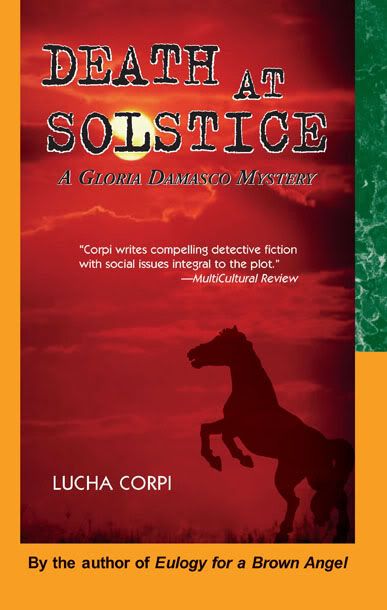
Today a very special treat: an essay from Lucha Corpi that explains some of her writing process; more specifically, how she was "inspired" to write her memorable, award-winning novel Eulogy for a Brown Angel (one of my all-time favorite novels) and how Gloria Damasco, Chicana private eye, first made an appearance. This essay originally was posted, in a slightly different version, as a response to blog host Book-lover Carol's question during Lucha's virtual Latino Book Tour (www.latinobooktours.com) for Death at Solstice: Who is your main character and how do you plot your mystery novels? Thank you, Lucha, for sharing. Readers - enjoy and learn.

Gloria Damasco, Private Investigator and Clairvoyant

I first saw and heard Gloria Damasco, Chicana P.I., when I was in the Sierra Nevada in California. I was trying to revise and organize a poetry manuscript, Variaciones sobre una tempestad/Variations on a Storm, which was already due at the press. Friends in Donner Lake, a short drive from Lake Tahoe, offered me a stay in their condo there for a week, so I could get my work done. Four days later, my poetry manuscript was ready. But, since I had the condo for two more days, I decided to stay and get some rest.

I had taken with me some CDs, among them a recording of the Puccini opera Madame Butterfly. I am not an opera buff, but for some unknown reason, I was obsessed with that opera, especially the aria Un Bel Di. I had also started a list of books I wanted to read about the architecture and the wine industry in Napa and Sonoma Valleys, also known as the Wine Country. Before my stay in Donner Lake, I had made repeated trips to both valleys and, for unclear reasons, to East L.A. to study gangs and the events that led to a riot during the 1970 National Chicano Moratorium. I was also researching an elixir I had come across during a trip to Brazil, and the history of the Peralta family in the East Bay. I had already decided to write my first mystery novel, Eulogy for a Brown Angel, and sensed, more than knew, that all of my obsessions and interests had to do with the plotting of the novel, yet had no idea how they would eventually fit together. Nor had I conceived my main character, the detective that would need access to all that knowledge and experience.

Looking for books on research topics to read during my sojourn in the mountains, I paid a fruitless visit to a local bookstore in Lake Tahoe. I bought instead a P.D. James mystery novel and drove back to Donner Lake. I took a walk along the lakeshore, getting back to the condo when dark heavy clouds began to gather above the mountains. The sunset was still two hours away. I made sure the sliding doors to the lake were locked before I went up the spiral staircase to the living area on the upper level.

I turned on my CD player and began to listen to Puccini’s opera then lay down on the sofabed to read the mystery novel. About an hour later, I slipped into a deep sleep only to be awakened later by a loud noise and to total darkness around me. I was sure someone was in the sleeping area downstairs. My thoughts immediately raced down the spiral staircase to the sliding doors. Had I locked them after all? Was someone down there, lurking, waiting? How long before the intruder made his way up the spiral staircase?

I listened intently. I was hyperventilating, trembling; my heart raced. But I forced myself to sit up while I weighed the risks of going downstairs and confronting the intruder. My eyes adjusted to the darkness and as quietly as could be done, I walked to the fireplace and got hold of the poker, then began my descent, barefoot, taking one step and deep breath at a time. I stood at the foot of the stairs and surveyed the area then walked to the sliding doors and checked them. They were locked. I looked behind each closet and room door and under each bed till I was satisfied no one was there.

As I got to the top of the stairs, my heart did a Mexican hat dance in my chest. Something or someone, a white raggedy gown on, its arms flailing wildly, swayed and gestured just outside the sliding doors to the dark balcony.

“My God!” I said, sucking in breath. “It’s not of this world.”

The phantasm went on with its macabre dancing. I put down the poker still in my hand and looked around for a cross but saw none. So I made the sign of the cross and walked closer. The specter turned out to be a large white windsock, dancing in the night wind. I had no idea who had hung it from a branch of the pine next to the balcony during my long nap. I dropped to the floor, laughing and crying alternately.

I was scared out my wits, still shaking and breathing hard when I made myself a cup of coffee and sat in an easy chair, cloaked in a cotton blanket and darkness, unable to close my eyes, except for quick blinks. Closer to dawn, I turned on the CD player, hoping that Madame Butterfly would lull me to sleep. It took at least a half hour for the soprano to reach the first heart-wrenching phrases of the aria Un Bel Di, and for my eyes to finally close for what seemed only seconds. As if on a red screen inside my lids, I saw a pair of dark hands and arms and nestled between them a toddler, a little boy, who appeared to be asleep.

“I am Gloria. And this child is for you,” a woman’s voice said as she handed me the little boy. I extended my arms to receive her gift. They were still outstretched when I opened my eyes.

I heard the crack of thunder in the distance, the same noise that had wakened me up the night before. It was noon and the thunderstorm was moving in. It would soon be raging right above Donner Lake. Driving down the mountain in such unsettled weather made no sense. I made lunch and ate. Then I picked up my notebook and wrote: “Luisa and I found the child lying on his side in a fetal position.” This is the opening line of Eulogy for a Brown Angel, my first Gloria Damasco mystery novel.

In time, I learned that Gloria possessed some sort of psychic power. Was she a kind of fortuneteller? Palm reader, perhaps? Did she delve in Black or White Magic? Maybe she was a healer, then again maybe a sorceress. Was she a New Age or Old Age psychic? There was so much to research. And I dove into the psychic pool without hesitation.

I attended countless psychic fairs, séances, mid-summer and mid-winter solstice celebrations, Sabbaths, had my fortune read many times, my aura cleansed at least twice, had regressions to at least four past lives, visited with a clairvoyant, and attempted astral projection, but my reptilian brain refused to let my spirit soar freely. I learned the techniques for channeling and regression to past lives and used them on my most trusted poet friends, with some fascinating results.

At every séance, Sabbath, solstice celebration and psychic encounter, I asked for receipts. I mostly got them from well-established psychic institutes; none from the mediums at séances or spiritualistic sessions, who always eyed me with suspicion. At home, I put the receipts in a Mexican basket together with the rest of my tax receipts and documents. I had to justify my research expenses. And they were legitimate research tax deductions for a writer, or so I thought until the IRS decided to audit my tax return two years after the facts. By that time, Eulogy had been published. And I had the book to prove that indeed my delving into the mantic arts was a legitimate endeavor for a writer who respects her art and wants to be factual. Eventually, I was notified that I owe Uncle Sam nothing.


Long before my dealings with the IRS, as I wrote Eulogy, I found out that Gloria Damasco is a clairvoyant. In each of the novels, she tries to explain to herself and to the rest of us what her dark gift is all about. In Death at Solstice, her latest adventure, published by Arte Público Press in 2009, she says:

“… Prior to the night before, I had never been able to save anyone whose life, in my visions, was fated to end. It bothered me no end to see what fatal blow destiny had in store for someone yet be unable to prevent it. But that was the nature of this dark gift, this extrasensory prescience in me—la otra.

“Most people did not understand what clairvoyance was. My visions weren’t a tidied bunch of related scenes laid out, like a classic story, in a linear narrative. They varied from images to smells and sounds that bombarded my dreams. My subconscious somehow sorted them out and stored them until, if ever, I worked on a related case.

“Talking with some of my poet friends over the years, I realized that poets, without being aware of it, also went through a similar process as mine. All the incongruent elements of a poem were already present at various levels of consciousness or the subconscious. In the poet’s case, the outcome was the poem. In mine, the results were not so easily discernible, not even for me.

“Although at times I still doubted the legitimacy of my dark gift, I seldom allowed myself not to act on a vision. I pushed myself to do the necessary legwork to solve its cryptic warnings, regardless of its outcome. It was the only way to keep my twin psyches in check, my split spirit in harmony.

“What would happen when I entered the darkness of another recurring vision plaguing my dreams more and more often? Two pairs of black eyes watching me in the night; a phantom horse and the horseman on him; the redolence of gardenia and rose and candle wax in the night air; the black curls and sweet face of a boy toddler searching for his mother; an animal’s growl; a place of worship by the water’s edge, steeped in the suffering of people; the voice of a woman saying, ‘Find this place and you’ll find me.’ Would I survive being trapped in a body of water unable to free myself before my breath bubbled totally out of me?”

Gloria’s reason is forever running interference. She is always trying to prove to herself that she indeed possesses a dark gift. She is compelled by her visions to take a case, but she solves it by following and analyzing clues, using her powers of deduction, as any normal P.I. would, to bring the criminal to justice.

In some way, Gloria’s visions form and inform the plot of Death at Solstice as is also the case in any of the novels in the series. Her visions become my obsessions and concerns and I follow them. But like Gloria, I also do my share of legwork, by doing my research thoroughly, experiencing to the extent safely possible what I must write about, including the handling of firearms, so Gloria has everything she needs to solve the case at a moment’s notice. That's my job. I am Lucha Corpi, Gloria Damasco’s ghost writer.

Oakland, California
Copyright: 2009

Lucha Corpi is a poet, novelist and children's book author. In addition to Death at Solstice (Arte Público Press, 2009) she has written three other mystery novels featuring Gloria Damasco, all published by Arte Público Press: Black Widow's Wardrobe (1999), Cactus Blood (1995) and Eulogy for a Brown Angel (1992). Corpi was a tenured teacher in the Oakland Public Schools Neighborhood Centers Program for over 30 years. She is now retired and lives in Oakland, California.

___________________________________


Later.