Showing posts with label birds. Show all posts

Tuesday, July 21, 2026

Reluctant Climb to Blue Happiness

 The Blue Heron of Happiness Atop Tallac Knoll

Michael Sedano


Three mallard ducklings cut through Baldwin Lake’s green algae surface leaving a trail of open water in their wake. Algae quickly fills the gaps behind the ducklings, the sole bird life Thelma and I observe along this shoreline. 

Our previous visit to the Los Angeles County Arboretum in Arcadia, we’d twice come face-to-face with a magnificent Great Blue Heron. I’m hoping for another sighting today at the Turtle Pond. I hoped hard. I am daunted by thoughts of climbing the steps to the top of Tallac Knoll. 

Thelma and I point our way toward the Turtle Pond, a quarter-mile distant with a slight upgrade. I adjust the strap of my 300mm lens preparing to slide it off at first sighting. The blue could fly away when we arrive. More likely if it’s there it will tend to ignore me. A ver.


I don’t want to climb to the top of the knoll and the upgrade is a feature of the place but that’s where we need to be. I adjust the camera strap and pull the 300mm lens against me so it won’t bounce during the trek ahead. 

My eyes take in the road ahead. No shade at all every step of the way where we learn if that blue has hung around the Arboretum and is at the pond again.

The Arboretum’s eight-dollars-a-ride tram passes us on its way to the pond, the driver’s narrative keeps his tram entertained and informed. We pause. In a few moments the tram arrives at Turtle Pond. I watch with anticipation: will the driver stop and give his tourists a glimpse of a gorgeous water bird, my Great Blue Heron?

Thelma and I do an about face and head toward the herb garden. No heron today.

Suddenly a blue heron appears from the lake. It soars into the sky almost directly overhead, toward Turtle Pond. Then the magnificent silhouette wheels toward Tallac Knoll and its froggy feast.


Rustic cement steps twist and turn. The steps rise irregularly giving the ascent to the top of Tallac Knoll an extra measure of exercise. With urgency in my step as I pull myself up the handrail, I calculate the likelihood a crowd could spook the bird into flight. The Arboretum has good attendance today, but thankfully a sparse few appear as Thelma and I summit the knoll. 

The Great Blue Heron stands like a statue at the far bank of the narrow pond, waiting for a lens to point its direction.

Herons like to stand immobile for long passages of time. A twitch, a slow turn to the left or right offer more or less, the same picture. After long minutes the bird may lift a foot, stretch a bony leg, then freeze again. After some time, the bird will change locations and fly away in the blink of an eye, but not before a happy watchful photographer captures the despedida.


Today, the blue heron steps closer to my spot behind the rushes where frogs lurk. The creature resumes its statuesque pose. Slowly the heron does as herons do, it forms an “S” with its neck. When the bird straightens, we are face to face. The Great Blue Heron stares at me and gives me a yawing laugh.  

It has been a good day to climb to the top of Tallac Knoll.

Tuesday, April 06, 2021

Beauty Break: Birds & Bees

Michael Sedano

Spring fever strikes Southern Californians with a vengeance in 2021. With vaccinations progressing at a reasonable pace, and a plurality of people wearing masks from nose to chin at recommended distances, I find a remedy for cabin fever in plain sight.

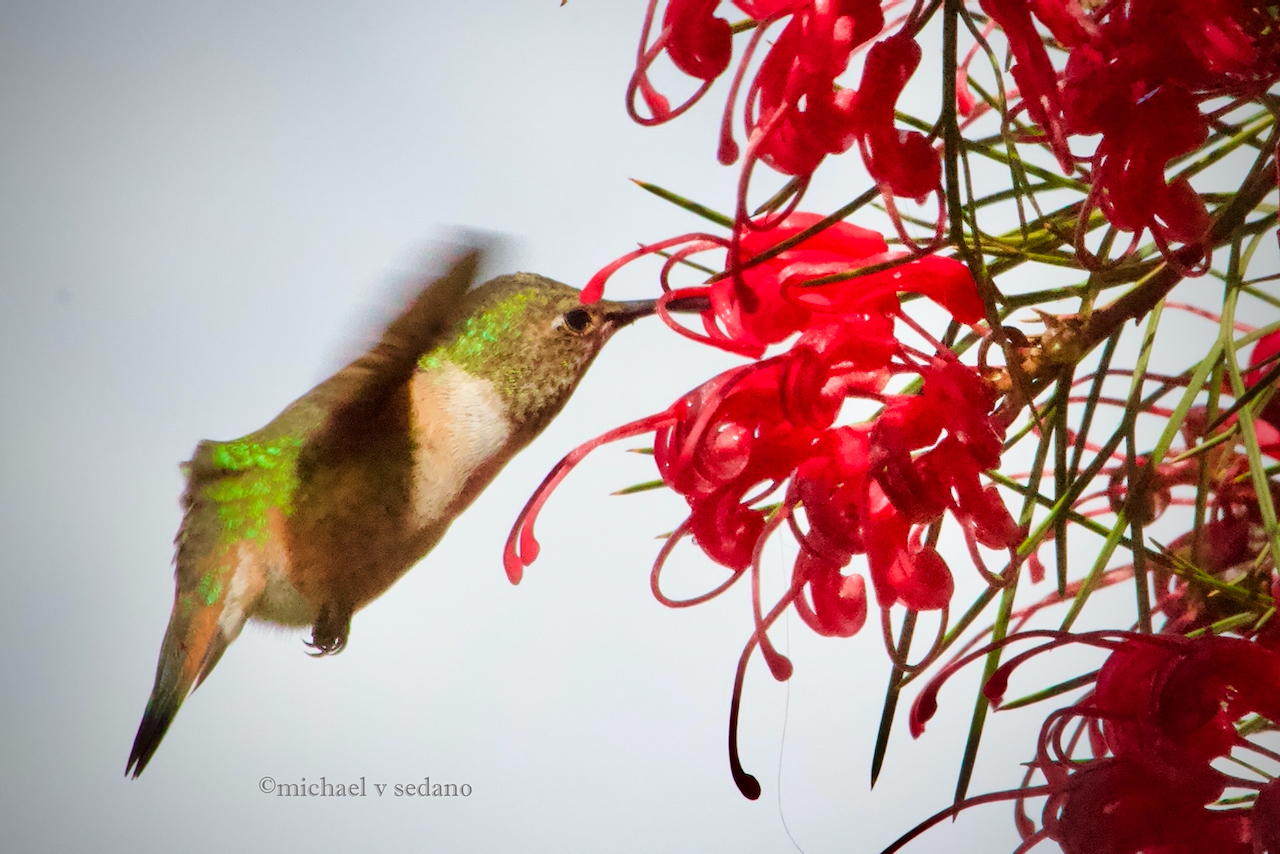
It doesn't matter if Allen's Hummingbirds dominate the vista. Anna's and Black-chinned Hummingbirds occupy their own territories. I'll be focused on capturing those birds, as well as bumblebees, as Spring turns into Summer.

These fotos are from the Los Angeles County Arboretum in Arcadia, and The Huntington Library in San Marino, California.

Clicking a foto opens a Blogger foto gallery offering a larger image to enjoy. Do enjoy these. These are all Allen's Hummingbird on a variety of blossoms. 

Calliandra


Grevillea "Fire Bush"
Purple Salvia


& The Bees 

Acacia
Sakura: Cherry Blossoms
A Rare Sight This is a Brown Honeybee. Golden yellow bees dominate any garden, so finding one of a different color is a genuine treat for a photographer. Photographing Allen's Hummingbirds and Carpenter Bees, in flight, offer hours of captivating fun. Finding a rare specimen like this, having it in focus, is as good as it gets.

Friday, June 15, 2018

Bird Forgiveness: the Box Landing and Tour

Melinda Palacio


The birds have officially landed. I've received a box of author copies of my new poetry book, Bird Forgiveness. When my publisher requested a photo of me opening the box, I sent several stills and I also took a video to post on the feisboo (the big FB will most likely ban this post as well). I noticed that the ritual opening of the book box is a social media tradition that allows readers to share in the big moment when the author finally views the finished copy of books that will go out into the world. I'm thrilled to share this moment with La Bloga.


Will the birds land in your area?

For bookings and to bring the Bird Forgiveness Tour to you: contact melindapalacio@gmail.com or 3 Taos Press


Bird Forgiveness, the new poetry book.

Bird Forgiveness Tour  2018


Summer


June 17-22, Santa Barbara Writers Conference
June 21 panel, June 20 workshop
June 26, interview new orleans


July 14, Camarillo Library panel   2-3pm 

July 15 Poetry Zone Santa Barbara, Karpeles Manuscript Library 21 W Anapamu, 2pm, with Gina Ferrara

July 17, Santa Barbara     Chaucer's Books 7pm, Loreto Plaza3321 State Street, Santa Barbara CA 93105

July 25, New Orleans, Octavia Books, 6pm,

August 3, Teche Center for the Arts, 210 E. bridge St., Breaux Bridge, Louisiana in the heart of Cajun-Creole Country, 6pm.

Fall


September 1                Santa Barbara Paseo Nuevo 2-4pm

September 6          Ventura, Topping Room EP Foster Library, 7:30 pm,  Ventura, 651 E. Main Street       host Phil Taggart


October 6          Poetry Buffet with Valentine Pierce and Dennis Formento, New Orleans Latter Library  2pm

October 28    Maple Leaf Bar, New Orleans 3pm


November 10              Louisiana Book Festival      Baton Rouge TBA

November 14, University of New Orleans CWW with Neil Shepard   New Orleans, 8pm


2019

February 9, Core Winery, 7:30 pm, Orcutt Tasting Room, 105 W Clark Ave., Old Orcutt, CA, corewine.com


March 27-30 AWP Portland

Tuesday, January 21, 2014

Latinopia Spotlights Octavio Romano. Chicano Photographer in Morro Bay.

Latinopia Honors First Publisher of Chicano Literature

In 1969, Quinto Sol Publications was publishing Mexican-American literature. Then, in 1972, editor Octavio Ignacio Romano-V was joined by Herminio Rios C. to put together the first collection of Chicano literature, the fifth printing of El Espejo: The Mirror.

Latinopia, the nation's leading site for Chicano visual documentaries, updates its offerings weekly. This week, Latinopia features Romano talking about mestizo and chicano literature. It's interesting to hear Romano declare an open door policy, especially given the academic pedo that flew when other scholars accused Romano of foisting a false canon upon Chicana Chicano literary theory.


Morro Bay Birds and Seals
Michael Sedano

Photographing writers reading their work to an audience is my chosen challenge. Capturing a reader in a dynamic instant, forming a sound, eyes looking at the audience, poised in readiness, requires a good ear to anticipate a gesture or an eye contact moment. Over the course of a 10 minute presentation, numerous moments pass, some of them photographed. Nature adds the challenge of once-in-a-lifetime moments.

A rustle and a chirp in bushes calls my eye to a mostly hidden brown beauty. It flits out of sight then flies over to a backyard fence bordering the wetlands. If that California Thrasher turns toward the camera the eye will sparkle. The bird flits away just after the shutter goes "click".


A modern camera takes lots of the work out of a photograph. A fast-moving bird moves in and out of focus except the photographer keeps a target on the moving animal and the lens quickly adjust to maintain focus. Given a bright sunshiny day allows both fast shutter speed and smaller apertures for sharp focus.

If the bird stands still in the early morning chill and the water is still the reflection makes a great photograph. Luckily, this Curlew is not far from the camera.


Bright sunshiny day describes my weekend in Morro Bay in this year's annual trek to the estuary at Morro Bay along the California coast north of Vandenberg Air Force Base. A night launch from Vandenberg caught my eye as I admired the sky. A fast-growing contrail rose from my right swiftly passing overhead, three spotlights of engine fire winking back at me as the missile climbed into space.


Up the coast, four and a half miles north of Charles Foster Kane's castle at San Simeon, Elephant Seals complete a migration to arrive and give birth. The State of California erected boardwalks and railing systems allowing visitors to peer down upon individual animals, neonate babies suckling sleeping mothers, bulls surrounded by mates, thousands of animals spread as far as the eye sees in both directions.


The animals flip sand over their bodies then lie motionless. The mothers protect their young with flippers of sand. Sand trickles off the tiny bodies that crawl along a mother's smooth belly, finding a nipple. One tiny body lies covered with sand. Sand has settled into the crevices of its skin. Successive flippers of sand pile atop the eyes, the unblinking eyes.


Across the beach animals conserve energy by lying as still as corpses. A shudder, a flip, a blinking eye is all to identify the living from the dead.


But this baby has not moved, has not knocked off the sand off its body, not off the soft rolls of loose skin, not off the unmoving eyelids. Some babies sidle up to a bull, the fleshy proboscis snorting sand at the offspring.

The still baby moves a flipper. It is not dead today.


The salt marsh stretches miles across a watershed grown with thickets of red-brown brush. Shallow channels form with the tides, bringing food that attracts roaming herons and millions of shore birds.


Long, long lenses are a photographer's boon. I did not rent a 500mm lens and relied upon a zoom lens up to 300mm. That isn't enough lens for a superior image. My camera has an 18 megapixel chip which means it produces a huge image that 25% of the frame offers satisfactory pictures, like those of birds in flight.


Some images are more challenging than others, despite their predictability. Flocking sandpipers take to air hundreds in a tightly spaced group. They fly in synchrony, their dark backs offering illusions of smoke moving across the water, instantly the cloud flashes a brilliant white when the birds turn their bellies toward the viewer. It's spectacular seen across the water in the Morro Bay estuary.


The sandpipers, like many sea animals, are dark on top, light on the bottom. A prey looking up at the animal sees white like the sky is white. A predator looking down at the animal sees dark, like the ground is dark.

The estuary gets the photographer close enough to see through the camouflage.


This Osprey, a sea hawk, heard the camera from several hundred feet and flew off a moment after this exposure.


Friday, July 12, 2013

A Walk in the Park

Melinda Palacio


This weekend in New Orleans Spanish lovers and Francophiles will vie for attention during the El Encierro Festival, the running of the roller derby bulls (now a whole weekend plus worth of events), and Bastille Day, both occupying the same long weekend in the same general vicinity of the French Quarter. El Encierro festivities are bit newer (7 years) to the Bastille Day celebrations, but, then again, the Spanish arrived first in New Orleans.

I'm not sure which events I will attend, but one thing's certain, my days will begin with a walk through Audubon Park. Since moving on up to Uptown, two blocks from Audubon Zoo (I can see giraffes from my window), every morning at about six a.m., my husband and I take a vigorous two mile walk around the park. Two miles may not seem like much, but at 6 a.m., 80 degrees and 80% humidity, everything seems like an enormous feat, especially keeping up the fast paced march of someone who naturally wakes up much earlier than I do. After a shot of coffee and some water splashed on my face, I'm good to go, prepared to march and sweat. I'm grateful for the heavy cloud and tree cover.
The walk/cycle path through Audubon Park  

On days when I want to snap a photo, I must be prepared to jog in order to catch up to my fast companion. There are dozens of egrets, ducks, sparrows, crows, sandpipers, geese, and always the handsome lone swan. It's fun to see the occasional, unexpected bird that's not in a big flock, such as a woodpecker, hawk, or a western reef-heron.
 
an egret 
The most unexpected dweller at Audubon's bird island is the aquatic Nutria. Last year, I went to a Nutria fur fashion show. Nutria have overrun South Louisiana. They have big chompy teeth like beavers and long skinny tails like muskrats. Tabasco mogul McIlhenny brought nutria from South America for their fur. Yesterday, I saw four nutria, two in the lake where the swan likes to bathe and two hanging out on land with the ducks and geese.

Ned, the Nutria


Two different types of duck.

I have even adopted a bird theme in my house, in honor of being so close to Audubon Park. When I emailed my friend Susan in Santa Barbara the picture of my desk. She remarked on me having the 'bird by bird' curtains for inspiration. True, Anne Lamont's Bird by Bird has become a sort of bible or handbook for anyone facing a big writing project, such as a novel. But when I put up my bird curtains, I simply liked the pattern. Now whenever I look up from my computer screen, I will be reminded of my friend Susan and my friend whom I've only met through her books, Anne Lamont, and how a big project is possible by breaking it down into smaller parts, bird by bird. 


Next month, August 6 at 6pm, I will read with Nancy Harris at Octavia Books at 6pm in New Orleans.

Tuesday, January 19, 2010

Review: The Informers. Bits & Pieces

But first a wonderful Bit of news...

2010 Festival de Flor Y Canto at the University of Southern California


The event is scheduled for September 15, 16, 17 2010. The Funding Proposal is in its final stages now. I want to invite all the poets and writers from the 1973 Festival de Flor Y Canto. If that's you, or you know someone who read their work back in 1973, please contact Michael Sedano. I encourage others who would enjoy reading a selection of their work at the Festival to respond to the Call for Artists at this link.


Review: Juan Gabriel Vasquez. Translated by Anne McLean. The Informers. NY: Riverhead, 2009.
ISBN 9781594488788


Michael Sedano

Near the end of his novel, The Informers, Juan Gabriel Vásquez treats readers to an irony laden line, “'Let’s not use of the whole morning talking about the past,' he said, 'Let’s be realistic. You and I are alone. These stories don’t matter to anyone anymore.'” The irony is how vitally important “these stories” remain in today’s repression-minded times. That the subject is repression against Nazis is but an added irony.

The speaker, an old friend of Gabriel Santoro’s father, refers to Gabriel’s post-mortem investigation into what made his crusty namesake father tick. The father, a noted Colombian rhetorician—teacher of oratory and legal communication—estranged himself from his son by writing a scathing review of fils’ historical account of Jewish and Nazi immigrants in the pre-war years.

Colombia firmly aligned itself with Franklin Roosevelt’s U.S. policies. Much as FDR had, Colombia rounded up Germans with Nazi sympathies and shipped them off to internal exile. Not to concentration camps like Tule Lake but interior towns where the exiles lived on the dole in public accommodations. German language schools were closed. Speech—denunciations—had the power to put people away. The government created blacklists, neighbors and rivals reported various sins. Some denunciations had validity, others nonsense, as in the case of a man who dressed in mourning black and was blacklisted for wearing the uniform of fascism.

Gabriel’s book related how Jews escaped Germany, through fear, prescience, or owing to kind-hearted neighbors warning of impending arrest. Once in Colombia, Jewish and Nazi Gemans lived side-by-side, some with a kind of gentleman’s agreement to put aside the European schism. Others, intent on assimilating into their new patria, turned their back on the past, learning Spanish, marrying into local families, moving beyond the holocaust that was mostly rumors. Still others transplanted their attitudes unchanged into Bogotá’s parlors and families, even if the Nazi had married a local woman. These are the characters in Gabriel’s story, and his father’s life.

Gabriel père contacts fils out of the blue. The aging scholar has fallen ill and turns to his only living family for sympathy and care. Son brings up the matter of the scathing review. Father explains but ambiguously, not to son’s satisfaction. But they appear to be on the road to reconciliation. Son wonders how much of the emotion is his own fault?

Gabriel the writer has interviewed Sara Guterman, his father’s long-time friend. Daughter of a German Jew, a hotelier, Sara had a front row seat at the goings-on between rich German exiles. Her history informs son’s story. But evidently the son hasn’t asked the right questions, and the holes in the story infuriate the father, the son believes. Moreover, as close as old Santoro was to Sara, old Gabriel isn’t mentioned in Sara’s narratives, except obliquely in a single paragraph. Is that why the old man has such bitterness that his son would write journalistic trash, as father alludes?

Then Gabriel the father drives off a mountainside under mysterious circumstances, leaving Gabriel the son with a haunting set of questions that require a 347 page novel. Framing the quest is the father’s love for Demosthenes’ oration “On the Crown” that talks of past injustice and forgiveness, or the absence thereof.

Can a son ever learn truly his father’s motivations—can he be worthy of his father’s esteem? Will a clear and authentic portrait of a man emerge from a son’s desperately clouded inquisition? Can the son see through the smokescreen of a life that is eulogized as “the very paragon of the impartial and honest man”? It may be the reader gleans a more fully fleshed sense of the father than his own son. And this may be Vásquez’ point after all. What’s past is indeed over, it cannot be undone. The father spoke fluent German? Quoted Nazi oratory from memory? Was an inspirational teacher of leading Columbian lawyers including Supreme Court justices. A confusing welter of contradictions for a bereft son. And the apparent profit in investigating this past: a bitter shoulda woulda coulda, a life of “if onlys”.

The Informers reads easily and smoothly, with some hidden gems. This surely the result of an able translation by Anne McLean. I imagine she has good material to work with from the Spanish. As old Gabriel’s a rhetorician, Vásquez / McLean put forth language rich with schemes and tropes. Some the novelist elects to name, others sit there on the page as an in-joke, the techniques having their effect because such impact is their nature. In once scene, old Gabriel employs paralipsis to great effect, “I have not come here to talk of these cases but to keep quiet. I have not come to talk about the enormous error…I have not come to make cheap accusations….I’m not going to give details …Today I want to speak to you about what is not said…” The technique works seamlessly into the novel, a speech-within-a-speech that shakes Gabriel profoundly. The unspoken fills in the story the father never told the son.

In the end, these stories do matter. In a period when people worry about unrestrained eavesdropping, when government officials justify torture or decide who can marry, when Christmas is under attack, who knows what new repressive movida will sally forth from Washington or some idiotic demagogue and gain a foothold? The ugly history of blacklists, denunciations, concentration camps, whether in the United States or Colombia deserves another day in the sun. I’m not going to say Juan Gabriel Vásquez is asking readers to think about what happened, how easily, and who promulgated these horrors. I will say he, and translator Anne McLean have put forth a provocative novel that deserves to find a U.S. audience.


More from the Heartland...Report from Kansas City MO

The Voice That Reaches You II and the Latino Writers Collective in Kansas City, MO
By Xánath Caraza


For the second consecutive year, the Latino Writers Collective (LWC) collaborated with Cara and Cabezas Contemporary in Kansas City, MO (http://www.caraandcabezas.com) with their annual exhibition: The Voice That Reaches You II, organized by Paulo Cabezas, Director, and Cara Megan Lewis, Curator. This annual show is about an exploration of immigrant/emigrant/migrant experiences in contemporary culture. The art displayed is a combination of local and international Latino artists. For this year’s exhibition, the art work is by Alexia Miranda, José Faus, Roxana Marroquín, Boris Ciudad Real, and Ernesto Bautista. In Segment of a Scribble, a labyrinth-like map on the wall, by Boris Ciudad, we perceive how easily human beings may become abstract numbers in contemporary daily life, lose themselves and forget who they are and where they have come from.

Before our poetry reading, on the evening of January 16, 2010, I had a friendly conversation with Paulo Cabezas, Director of the Gallery. We talked about the experiences of some Latinos in the US. We agreed that at times some Latinos mourn cultural loses as we go on in our daily and fast paced lives. For a moment, we remember our grandparents, parents, and places of origin, before the realization that we have become foreigners within our original cultures, which is nothing new, but a vivid experience for those who live between cultures, such as the border culture between Mexico and the US. Thanks to the mediums of art and poetry, these experiences can be explored and shared with others.


For this poetry reading, six LWC members participated in the event enveloped by art and social commitment. Roosevelt Campbell, Carlos Duarte, Gloria Adams, Gustavo Aybar, José Faus and Xánath Caraza were readers this occasion. After the reading, several people approached LWC members, having the opportunity to listen to audience reactions. I very clearly remember Jeff’s explanation. He said that he came without really knowing what to expect. However the diversity of voices shocked him in a good way. It was as if he could dance with the words he was listening to from the various poems he heard, and learned through the words about the Latino experience. The Voice That Reaches You II accomplished its goal of giving a voice to the immigrant/emigrant/migrant experience. Hasta la próxima.


The Voice That Reaches You II y el Latino Writers Collective en la Ciudad de Kansas, MO
Por Xánath Caraza


Por segundo año consecutivo, el Latino Writers Collective (LWC) colaboró con Cara and Cabezas Contemporary en la Ciudad de Kansas, MO (http://www.caraandcabezas.com) con su exhibición anual: The Voice That Reaches You II, organizada por Paulo Cabezas, Director, y Cara Megan Lewis, encargada de la galería de arte. Esta muestra anual es sobre la exploración de experiencias inmigrantes/emigrantes/migrantes en la cultura contemporánea. El arte expuesto es una combinación de artistas latinos locales e internacionales. Para la muestra de este año, el arte es de Alexia Miranda, José Faus, Roxana Marroquín, Boris Ciudad Real y Ernesto Bautista. En Segmento de un garabato, un mapa-laberinto en la pared, por Boris Ciudad, percibimos qué tan fácilmente los seres humanos se vuelven números abstractos en la vida diaria contemporánea, se pierden y se olvidan de quiénes son y de dónde vienen.

Antes de nuestra lectura de poesía, la noche del 16 de enero de 2010, tuve una conversación amistosa con Paulo Cabezas, Director de la galería. Hablamos de las experiencias de algunos latinos en EEUU. Concordamos con que a veces algunos latinos están de luto por pérdidas culturales provocadas por el ritmo apresurado de la vida diaria. Por un momento, recordamos a nuestros abuelos, padres y lugares de origen ante el descubrimiento de que nos hemos vuelto ajenos a nuestra cultura original, nada nuevo bajo el sol, pero sí una experiencia vívida para los que viven entre culturas, como la cultura fronteriza entre México y EEUU. Gracias a medios como el arte y la poesía estas experiencias pueden ser exploradas y ser compartidas con otros.


Para esta lectura de poesía, seis miembros de LWC participaron en el evento rodeado de arte y compromiso social. Los lectores de este acontecimiento fueron Roosevelt Campbell, Carlos Duarte, Gloria Adams, Gustavo Aybar, José Faus y Xánath Caraza. Después de la lectura varias personas se acercaron a miembros de LWC, teniendo la oportunidad de escuchar las reacciones de la audiencia. Muy claramente recuerdo la explicación de Jeff. Dijo que vino sin saber en realidad qué esperar. Pero la diversidad de voces le impresionó de buena manera. Fue como si pudiera bailar con las palabras de los varios poemas que escuchaba y aprendió a través de las palabras sobre la experiencia latina. The Voice That Reaches You II cumplió su cometido, dar voz a la experiencia inmigrante/emigrante/migrante. Hasta la próxima.


Foto Credits
1. LWC Wanted by Stephen Holland-Wempe
2.Photos on the Wall by Carlos Duarte
3. Carlitos by Stephen Holland-Wempe
4. Gloria by Stephen Holland-Wempe
5. Galeria con gente by Carlos Duarte
6. Paulo Cabezas y Xanath by Carlos Duarte
7. La lectura de poesia by Stephen Holland-Wempe


Morro Bay Bird Festival


I am far less than a dedicated birder and much more than a part-time photographer. As a photographer of public speakers and literary readers, my goal is to take what I call The Perfect Speaker portrait. I've come close a number of times, but when I finally do it, I'll let you know.

Nature photography is another endeavor. I rent a beauteous lens, a 300mm f2.8 telephoto lens made by Canon. It focuses automatically and has image stabilization technology. This means I can hold the lens in my hand on a rocking boat and get sharply focused frames. The Osprey and Sea Otters, for example, I exposed on a boat, hand held. A tripod is really for the best, except when taking a four mile hike with the tripod and camera right shoulder arms. Just like the Army, only I'm far older and just as foolish. The Quail and Oyster Catcher frames are tripod hike images.

The end of January every year takes me and a group of friends up the California Coast to Morro Bay. When I was a kid, my Dad used to take us up there on a sentimental journey. Both before and after WWII, he trained at Camp San Luis Obispo and weekended at a then far more primitive Morro Bay. He climbed to the top of the rock. I'm glad it's off limits now, because climbing it would probably kill me, but I would attempt the climb to get a photo from up there.

Please enjoy the following slidemovie of Egrets in flight. I captured these images just after sunrise on the Morro Bay Salt Marsh. I love it when a plan comes together, and this was planned. I arrived well in advance of the sun, set up the tripod and waited for the light and the birds. For quite a while I entertained myself whistling sub voce Pajarillo Baranqueño, and rehearsing dire predictions that all the birds would remain half a mile away.


The music is Haydn's "Bird" string quartet Number 3, IV Rondo. Presto. Salomon Quartet.

That's 3/4 of January 2010's Tuesdays. A Tuesday like any other Tuesday, except You Are Here. Thank you for visiting La Bloga. The third of four. Amazing how time flies.

See you next week.

Ate.
mvs


La Bloga welcomes your comments on this and any column. Click the comments counter below to share your thoughts. If you'd like to be a Guest Columnist, you are welcome! Click here to send your idea; a book review, an arts or cultural event, something from your writer's notebook.