Showing posts with label diego rivera. Show all posts

Tuesday, November 28, 2023

Dreamy Magic at the Dot Chandler

Opera Review:  El Último Sueño de Frida y Diego. 

Michael Sedano

foto: L.A. Opera

I was mildly disappointed not attending the L.A. Opera’s production of Mozart’s Don Giovanni last month. Happily, I can make up for the lapse with another don Juan, the notorious mujeriego pot-bellied Diego Rivera in the Los Angeles Opera’s El Último Sueño de Frida y Diego.
 
A far cry from Mozart,Grammy Award-winning composer Gabriela Lena Frank and Pulitzer Prize-winning playwright Nilo Cruz put together an experience worthy of any other Grand Opera on the nation’s premiere stage for opera, but with the taste of raza and lo nuestro. Gente paid attention and throng to the production. I would not be surprised to see the run extended prior to moving up North to The City.
 
Credit for the look and feel of the stage experience goes to Stage director Lorena Maza, scenic designer Jorge Ballina, costume designer Eloise Kazan and lighting designer Victor Zapatero, all of whom son chilangos. The choreographer is Ruby Tagle, also based in Mexico City. Jeremy Frank is the chorus director.
 
Frida.
 
Diego.
 
Audiences. 
 
Especially in L.A., say the magic words “Frida” “Diego” and with the snap of credit card plastic on the counter, gente fill the plaza of the Music Center rubbing shoulders with delighted opera regulars. Those People welcome Diversity to dispel the fusty fuddy-duddy reputation of opera-goers and Grand Opera.
 
Órale, El Último Sueño de Frida y Diego is Grand Opera, and our gente flocked to the magic. 
 
Welcome to the mainstream, raza. El Último Sueño marks all manner of innovative and unique highpoints in United Statesian High Culture. The best part, this becomes the first time many people have ventured this far into the cultural heart of Anglo L.A. Aquí estamos que no?
 
Programmers at the Music Center get it right. Tickets start at fourteen bolas. If you ride the train you can walk there. 
 
At the front doors, there’s a large gold frame for selfies with a muted blue lienzo flat emblazoned with trademark logoi. People line up fifty deep for a few seconds enchanted, framed inside el marco de oro. 
foto: Irene Hernandez
L, Irene Hernandez, R, 
Helen Suquett- Krolik

The selfie set evokes the most magical vignette in the magical production  inside:  identical gold frames enfold tableaux vivants quoting classic Kahlo paintings. Only after seeing the scene will the selfie-taker realize the fulness of their interaction with the experience.
 
Sueño is sung entirely in Spanish, with English supertitles. Hispanoparlantes filling a preponderance of the 3200 seats in the Dorothy Chandler auditorium relied upon the Spanish supertitles to decipher operatic phrasing--recitative-- that tends to break single syllable words into five- or six-syllable articulations and listeners go "no one talks like that", and "what is she saying?"

The musical score provides an aural tapestry that seems fit to the emotions of the moment. No one left the theatre humming the catchy tunes because there aren't any. I was expecting a "La Llorona" melody somewhere in the "folklore-inspired score" but I recognized nothing evocative of stuff I know. Maybe Carlos Chavez devotées would recognize the notes, but it doesn't have to sound familiar to be effective. The music works and drives the action onward.
 
Úlitmo Sueño is easily the first purely cultura Mexicana libretto to play on Bunker Hill. The Opera association's literature proclaims the All-Mexican creative staff and have bent over backwards to make this an L.A. event wrapped in Mexicanismo.
 
It's an opportunity raza really should jump into with both jobs and a loan from the readycash place. Even at fourteen bucks a seat, attending the opera is not for the faint of heart. The lobby bars take a C-note for four drinks.
 
Eat before you go. But go. Mejor, save your bucks and make an event of going to the Opera, with friends. "Grand" means something, so be grande and enjoy the opera a todo dar.
 
There's magic on that huge stage. Mictlán. Real Life. An orchestra directed by Lina González-Granados provides the symphonic musica. Voices include a sizeable chorus, leads include Soprano, Mezzo-soprano, Countertenor, Baritone. No amplification, it's real Opera.
 
Gente generally don't know all the technical stuff about the opera nor this one in particular. We're here to experience.
 
foto:L.A. Opera 

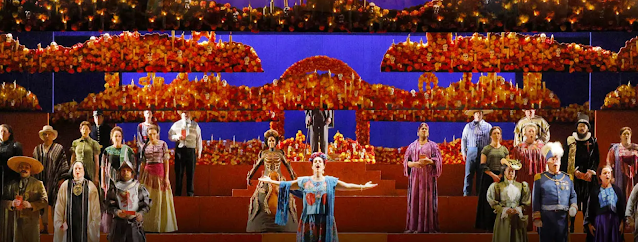
Color is the first sense the stage engages. Scenic designer Jorge Ballina keeps everything orange and warm tan colors. Warm diffused light softens every garment and line and angle in sight. The characters are dead; here is Mictlán and the setting for the first two acts. 
 
The scene offers puro magic. And more magic. Then more than enough magic so that people at intermission hope the second half will have a faster pace.
 
Still, it's imaginative and a bit rasquache how the ranks of wooden Cempasúchil winch into the air above the singers. The real world is up there with the Marigolds, Mictlan is on stage, beneath the garlands and graves. In fact, I was delighted by numerous old-fashion stage effects that eschew technology for the make-do of elegant rasquachismo like a gauze curtain and light effects.

 
The audience doesn't applaud at all the cool places like a "regular" audience would. Ni modo. The audience as a single entity are fully engaged in the slowly unfolding drama and iconography. At the end, applause and a few chifles sound the genuine appreciation of this audience. I whistled.
 
As in most operas, story doesn't matter so much as sensation, emotion, and for Sueño in particular, hero-worship. (Note: references to fat-bellied Diego aren't bashing but allusions to the libretto). Frida wears her floral headdress and in the audience, hundreds of women pay tribute to Frida by wearing floral headdresses and Puebla embroidered textiles.
 
It's a beautiful thing going on like never before at the Dot Chandler.


Michael Sedano photobombs two visitors after the matinee. Attending the performance infuses the audience with joy and a giddiness born of sharing a magical experience.
 
Plotted after Orpheus and other adventurers into the underworld, Frida returns to earth to assuage Diego's desperate longing. There's a condition, a catch: Frida can only observe, not touch. To touch is to regain the pain of being crushed by a streetcar and confined to a stiff corset much of her days.
 
She touches. Diego probably dies--Frida kills Diego--with that touch. Frida has abandoned eternal peace to gain a momentary reunion with the Love of her Life knowing she will rediscover physical agony. 
 
Frida even sings how loving Diego is more painful than being crushed by that streetcar. The audience Saturday matinee gives off a collective gasp of empathy at the brutality of the thought, and Frida's nobility comes through, her dalliances purified with her sacrifice for Love and her man.
 
That's why Story doesn't matter. You're not supposed to ask the questions that strike you while enjoying an after-Opera dinner with friends. What did Frida do to deserve having to live with agony again? Does Diego have a right to ask Frida to abandon liberation from pain to serve his selfish longing? There's nothing in it for Frida. She's following a patriarchal imperative but we're not supposed to notice. 
 
That's OK, it's only a pinche opera. El Último Sueño de Frida y Diego offers spectacle unavailable from any other experience. Going to the Opera like the rich people is an engaging social event that goes better with compañeros in the next seat. Our gente belong in places like Music Center Hill and productions like this will fill seats when we feel welcome. When we are made to feel welcome. This time around, órale, L.A. Opera, te aventáste.
 
Note:
El Último Sueño de Frida y Diego has  only six Los Angeles performances, 7:30 or 2:00 p.m., through December 9 via this link to L.A. Opera.


Friday, November 25, 2022

Quick Trip to San Francisco

 Melinda Palacio

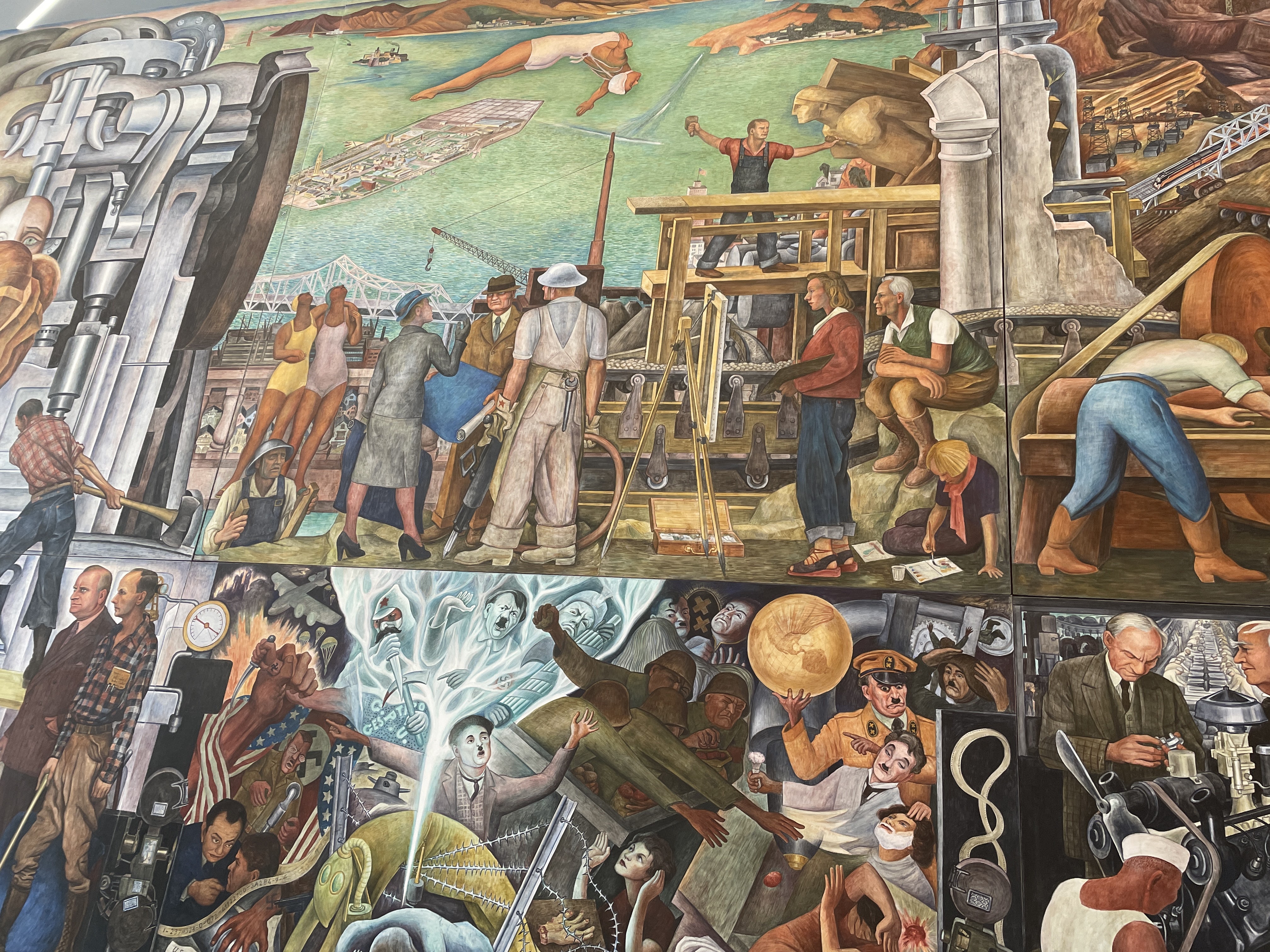
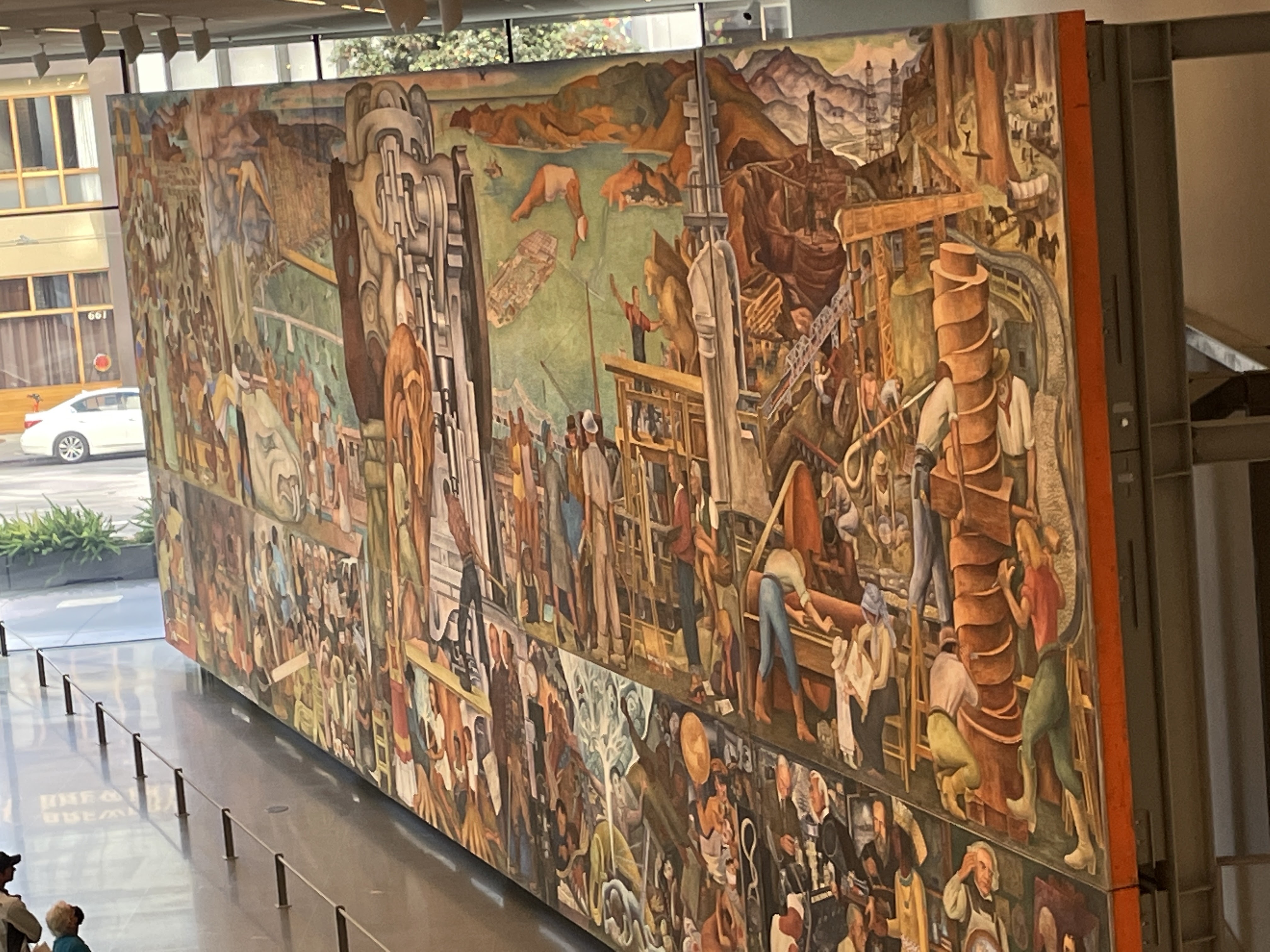
November is a beautiful time to visit California. Crisp, sunny weather makes for a nice weekend getaway. Bonus excursion to the San Francisco Museum of Modern Art, where you can view Diego Rivera's America exhibit until January 3, 2023. 

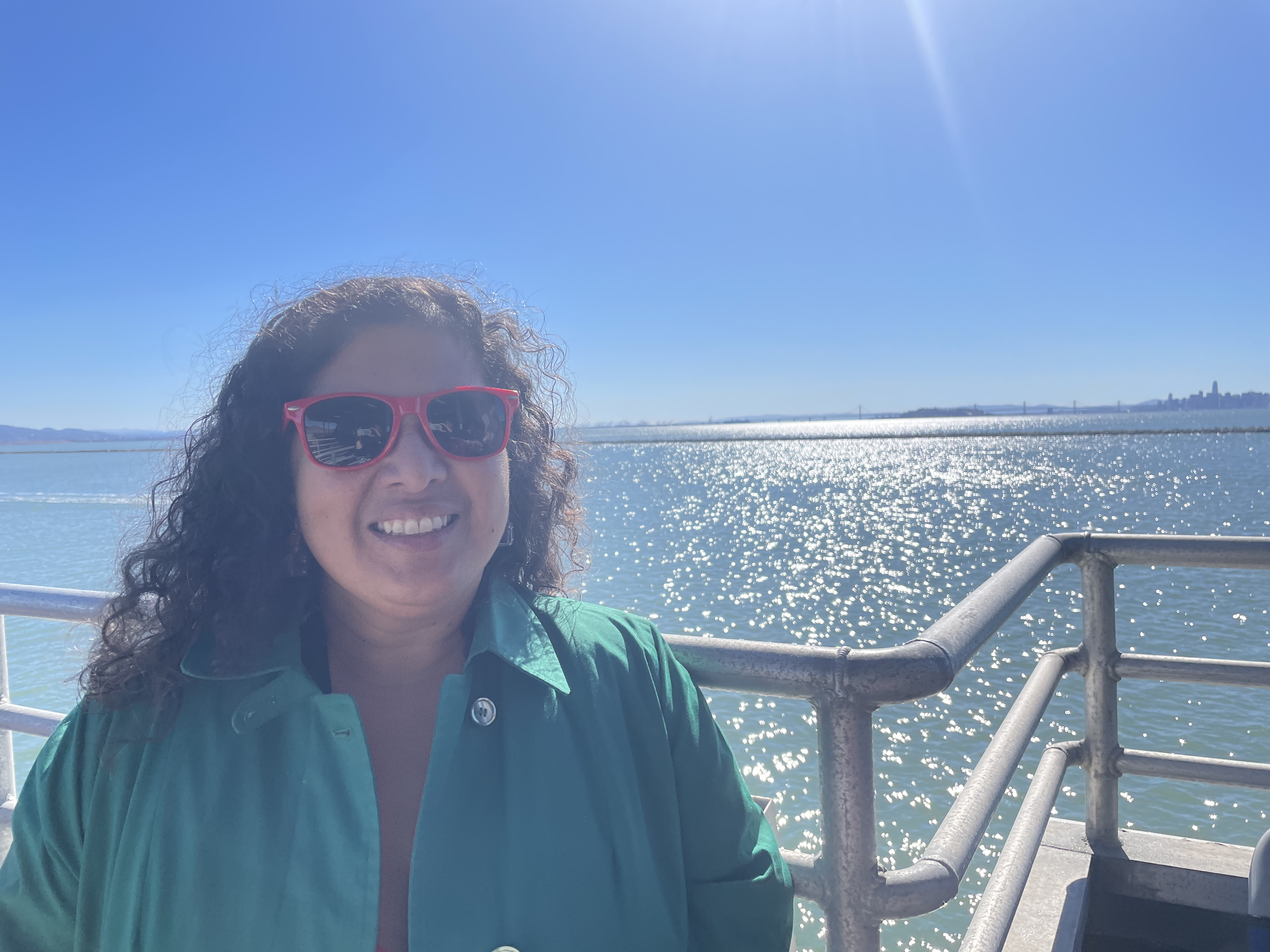
I had the pleasure of visiting a friend in Richmond who introduced me to the ferry near her house that goes straight to San Francisco. When I lived there, the only non car option was to take Bart and get to SF. Bart is the Bay Area Rapid Transit system and how you will get around without being stuck in car traffic. 


San Francisco

Views of the Golden Gate Bridge from the Richmond Ferry to SF.


Once in the city, Bart will get you to all destinations, but it's fun taking the trolley. 

close up of the Rivera's mural

With Diego's Siren drawing. 

Andy Warhol's Triple Elvis 


Bording the trolley from Powell street

If you look closely, you might see Nancy's house in the distance. 

Do not attempt this photo while the trolley is moving. 

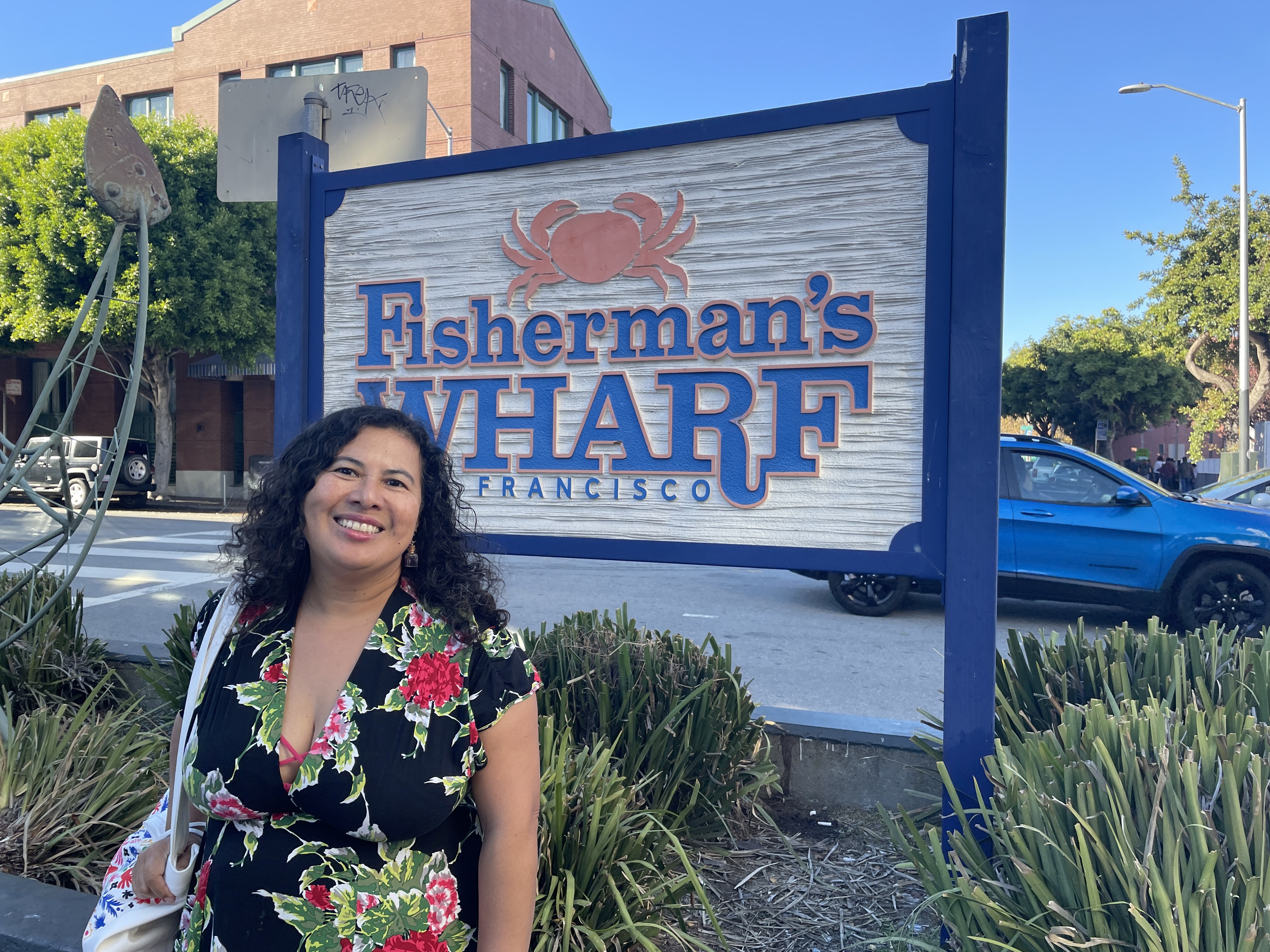
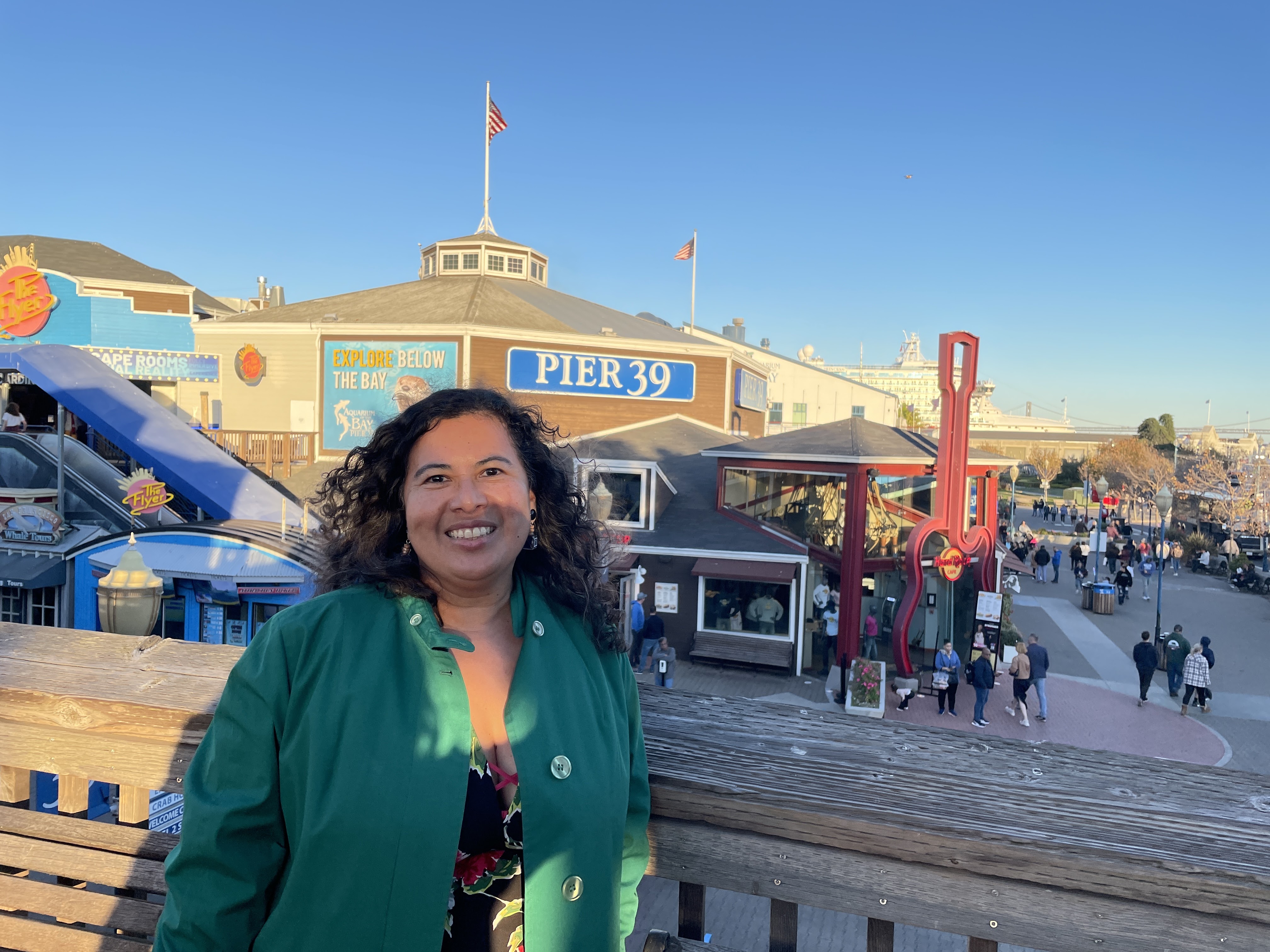
Fisherman's Wharf was different from what I remembered, busier, crowded. Allioto's shuttered and a victim of the pandemic. 


Tony Benett sang about leaving his heart in San Francisco and it's easy to see why. It's still a special city by the bay and I am a lucky to have good friends who showed me around the city I once loved and lived in. San Francisco will always have a piece of my heart. 


Thursday, July 20, 2017

Chicanonautica: Diego and Pablo in 20th Century


The Frida and Diego exhibit at the Heard Museum left my mind reeling. I also came away with some books. That got the ideas percolating . . . Ah, the creative process!


With Frida dominating the show, I feel the need to talk about Diego, one of the giants of 20th century art. It can be argued that he is responsible for the Latinoid/Chicanoid identity as we know it, and any genre of futurism it is spawning. I also couldn’t resist his My Art, My Life, especially with La Catrina from his mural Dream of a Sunday Afternoon in Alameda Park on the cover.


In her, Diego created her most magnificent manifestation--beautiful as she is monstrous, and wearing Quetzalcoatl as an accessory, pointing the way for her evolution from caricature of middle class pretension to the goddess of La Cultura to whom artists and writers must make sacrifices.


The autobiography is based on interviews with Gladys March, and gives an idea of his voice, and a taste of his mythomania--a strange word that often comes up concerning Diego. As it was with Frida, his public image and myth are just as important as his art. If you don’t create your own myths, someone else will do it for you. An important survival lesson for the age of social media.


Personally, I prefer the term mythotech.


The book reads like a fantastic novel--dare I say magic realism? Someday the story of Frida and Diego, and the way it twines through history, will probably be made into the greatest telenovela of them all.


At one point Diego calls Frida “a Mexican artist of European extraction looking to the native traditions for her inspiration.” Please allow me to throw that monkey wrench into the controversies over cultural appropriation.


Diego is a chingón of 20th century art. He has gained stature as time has gone by. When I was an art student during the Ford administration, my teachers would not have considered him any where near as important as Picasso--yet also in the museum bookstore was a catalog from another recent exhibition, Picasso & Rivera: Conversations Across Time, edited by Diana Magaloni and Michael Govan.


Sometimes I write like comic books. Sometimes I try to write like Rivera murals, or Picasso paintings. The book is also brimming over with great art. I had to have it.


A lot of the la gente these days don't like to recognize our Spanish heritage--as in Spain, the conquistadors, and the whole hijo de la chingada. They tend to know more Español than any native language. I identify with El Quijote and artists like Picasso more than I do with all the BBC stuff that Americanoids think is so damn civilized, and Spain is a bridge through Europe to Africa and the Middle East in my global barrio.

 
Like Rivera, Picasso had classical training. Picasso remained rooted in Europe's Greco-Roman past, providing a foundation of postwar Anglo/America-centric modernism. Rivera built off of pre-Columbian civilization. And mythology. Don't forget the mythoteching. And the mythomania.


As modernism and the 20th century cool down in living memory, who knows which artist will be seen as the biggest influence on the World Wide Latinoid Continuum of the new millennium.


Ernest Hogan is the author of High Aztech. His latest works are in Altermundos, Latin@ Rising, and Five to the Future.

Thursday, July 06, 2017

Chicanonautica: Visiting Frida and Diego in Phoenix


Caught Frida Kahlo and Diego Rivera from the Jacques and Natasha GelmanCollection at the Heard Museum here in Phoenix. It’s spectacular and inspiring. It’s also very successful. It'll be here until August 20.

There has also been some controversy.

There are some folks who don’t get what all this Mexican stuff has to do with Native American culture, and why it should be in an Indian museum. They don’t see the Aztlán connection. I’m amazed that it has to be explained. Maybe we should start insisting that this should be General Education rather than Ethnic Studies.

As usual--I have seen the work of both artists in Mexico and Casa Azul--seeing the art in person blew me away. I tend to be a lowbrow who likes his art as part of his environment; in this case, I can see going downtown to visit the fine art. It gave a me the itch to get back to my cartooning.

Meanwhile, the Phoenix Metro Area’s Latinoid population is pouring a lot of money into the Heard.

As fitting for our times, Frida dominates the show. The new millennium has made her A goddess for Latinoids, hipsters, and folks of various sexualities.

Today’s culture consumers prefer her inner trip to Diego’s prototype to outward bound Chicanonaut explorations. But it’s interesting to see their work displayed together, and see that the influences goes both ways--sometimes it’s hard to tell them apart. As a writer married to another writer (is it legal in your state?), I see how having a creative partner helps.

The catalogue offers a less intimate look at most of the displayed works, and essays in which the artists discuss each other. Mutual respect is seen. Their relationship had more to it than most: personal, professional, historical. It was something powerful.

And with Frida, art was never confined to paper, or canvas; as the exhibit shows, she was creative in the way she dressed, the way she decorated her home, and the very way she lived. Her influence can be seen in today’s creative young women--back in the 20th century, I saw a lot of them who would dress in bold styles, but who were intimidated by taking that final step to becoming artists themselves. They would settle to be artist’s girlfriends or hangers-on.

Now we have more women artists, and we are better off for it. 

A creative home helps, too. Though often creativity leaks into the home environment whether it’s intended or not. This is the case with Casa Azul, that I have visited twice. Recently, I acquired a book, La Casa Azul: Un Encuentro Con la Existencia, produced to be a souvenir of Museo Frida Kahlo. It featured a lot of photos--including some spectacular panoramic shots. Most of the text is written as if Frida’s ghost was giving a tour. No American museum would get so magic realist.

I have a feeling that this disturbance in the separation between art and life will have a lasting effect on culture in Phoenix.

Ernest Hogan is the author of High Aztech, and his work has appeared in Amazing Stories, Analog, Aztlan, and Altermundos.

Wednesday, May 23, 2012

Tomás Rivera Book Award 2012


Texas State University College of Education developed the Tomas Rivera Mexican American
Children's Book Award to honor authors and illustrators who create literature that depicts the Mexican American experience. The award was established in 1995 and was named in honor of Dr. Tomas Rivera, a distinguished alumnus of Texas State University. For more information visit www.education.txstate.edu.


2012  Award Co-Winners

Sylvia & Aki
by Winifred Conkling


Sylvia never expected to be at the center of a landmark legal battle; all she wanted was to enroll in school.

Aki never expected to be relocated to a Japanese internment camp in the Arizona desert; all she wanted was to stay on her family farm and finish the school year.

The two girls certainly never expected to know each other, until their lives intersected in Southern California during a time when their country changed forever.

Here is the remarkable story based on true events of Sylvia Mendez and Aki Munemitsu, two ordinary girls living in extraordinary times. When Sylvia and her brothers are not allowed to register at the same school Aki attended and are instead sent to a “Mexican” school, the stage is set for Sylvia’s father to challenge in court the separation of races in California’s schools. Ultimately, Mendez vs. Westminster School District led to the desegregation of California schools and helped build the case that would end school segregation nationally.

Through extensive interviews with Sylvia and Aki—still good friends to this day—Winifred Conkling brings to life two stories of persistent courage in the face of tremendous odds.


Diego Rivera: His World and Ours
by Duncan Tonatiuh


This charming book introduces one of the most popular artists of the twentieth century, Diego Rivera, to young readers. It tells the story of Diego as a young, mischievous boy who demonstrated a clear passion for art and then went on to become one of the most famous painters in the world.

Duncan Tonatiuh also prompts readers to think about what Diego would paint today. Just as Diego's murals depicted great historical events in Mexican culture or celebrated native peoples, if Diego were painting today, what would his artwork depict? How would his paintings reflect today's culture?

Diego Rivera: His World and Ours is a wonderful introduction to this great artist.

Tuesday, April 19, 2011

Review: Frida Kahlo Her Photos. On-Line Floricanto: Japan. Conjunto Update.

Review: Frida Kahlo. Her Photos. Ed. Pablo Ortíz Monasterio. México DF, Editorial RM, 2010.
ISBN : 978-607-7515-51-7 (Spanish) / 978-84-92480-75-3 (English)

Michael Sedano

Readers do not come to photography books for text, particularly with the title Frida Kahlo Her Photos. Turn page stop enjoy, turn, enjoy, turn...page after page, 401 photographs in all.

So many faces, places, and still lifes. Some instantly recognized, others sublimely anonymous. Editor Pablo Ortiz Monasterio has filled his six hundred pages amply with both. Mejor, Editorial RM ordered 130-gram Lumi Matt Art paper that holds detail superbly in the warm-toned grayscale and sepia reproductions.

Three preliminary essays set the context for the collection. When Diego Rivera died, he directed a friend to hold the material fifteen years. Instead, the thousands of fotos remained locked in a disused space at La Casa Azul for fifty years.

The collection amasses personal snapshots typical of any family album. As well, the collection includes signed work by such photographic luminaries as Man Ray, Imogen Cunningham, Edward Weston, Tina Modotti. Some images are signed by Kahlo, others most likely are her work but unsigned. Several defaced fotos display Kahlo's active involvement in images as tokens of enmity or other emotional connection.

There’s also a trove of historical images purchased by Rivera and Kahlo of European and Soviet history. The section essayist avers such artifacts inform a view of the collectors' interests and values. Maybe. That section could easily have waited for another volume, its pages instead taken with more family, friends and at-work subjects.

Ortiz divides the book in seven sections, each with a leading essay. The essays are helpful and adequately brief. Still, to consume and enjoy these images, no other knowledge required but eyes to see.

Nonetheless, historically aware readers will recognize Frida, Diego and numerous famous people. Famous people know famous people, and Diego and Frida were really famous so there's no dearth of famous faces to learn or acknowledge. Connecting faces with art, O'Gorman and Orozco, for example adds to the book's multiple pleasures.

The collection presents a significant number of bled-to-the-edge fotos and a few double truck pages reproducing exceptional frames. Descriptive text with fotos adds context, leading to numerous “So that’s what Mrs. Trotsky looked like!” moments. (326)


As mementoes, fotos act as a kind of prosthesis for memory, for example, a photograph of a drawing. Enhancing the point, facing that there's a foto of the artist, Miguel Covarrubias, and Kahlo.

Another image, signed by Kahlo, appears twice in the collection, a deluxe double truck on 202-203 and on 384-385 back and front. On a straw mat, a doll lies on its back, a toy horse kicks back its rear legs breaking loose from its carreta. The essayist suggests it a metaphor for the accident that put Kahlo in pain for the rest of her life, as well as a reminder that Kahlo’s pain occupies a central role in her art.

Ensuring against failed memory, many gente turn the print over and document the obverse. Delightfully, Ortiz photographs the backs, too. Lipstick imprints, autographs, dedications further contextualize the image, and if one can make out the cursive hand, read Kahlo’s thoughts on the subject for oneself.

Despite a photographer's best intentions, inevitably anonymity infects a memory. There’s the smiling woman on page 289, sprawled on a chaise, legs spread offering her crotch. She’s autographed her snapshot, “My normal position in life.” Perhaps a reader will have a “there’s bis-abuela!” moment and send in granma’s name. Per the publisher’s invitation, several subjects remain unidentified. Should you possess any information regarding these issues, please contact: info@editorialrm.com. That would prove delightful. An unidentified foto is a lot like Ozymandias, without the inscription.

Kahlo’s face has generated a large market for painters and other graphic artists. Frida Kahlo Her Photos comes with dozens of new images probably never seen heretofore. There’s Frida at two years old (left), the first plate in the book. Somewhat later, there's Frida circa 1952, which may be the most recent portrait in the collection. One troubling feature of the collection is the non-chronological layout within the generally organized sections. Then again, the lack of sequencing allows each image to stand on its own.

Obviously, this collection is a marvelous tribute to Frida Kahlo. Diego Rivera makes his de rigueur appearances here and there. But this is Frida's book. One three page sequence editorializes sin palabras their relationship:

A somber Kahlo looks into the lens on October 16, 1932, confronting anyone who will look into her eyes.

Turn the page. On the left, 298, there’s Diego, arms crossed, crinkled eyes and contented smile. He’s looking off the page to the right. On the right, 299, there’s a naked woman--Nieves Orozco--sitting on a straw mat in pura mujer profile, face obscured by an arm, her back to the contented Rivera's eyes.

La Casa Azul in Coyoacán was one of those places, the one time I visited Frida Kahlo’s home in el Defie, that forbids cameras on the grounds, check your lente at the door. And don’t think for a moment I don’t want my own fotos of the pad. I want that bookshelf with titles Frida and I both read. I want to memorialize those alcatrices in the garden. No, and no. No photography. That is irony.


On-Line Floricanto - Japan
Guest Editor: Odilia Galván Rodriguez


On Thinking of Japan

by Devreaux Baker


I begin to pray

Even the birds will listen

The flower unfolds


Sometimes tears will fall

Even the moon falls sometimes

Trees let their leaves fall


Do not be worried

This morning I heard a lark

It made me grow calm


Ancestors call me

I hear their voices in wind

The world disappears


TSUNAMI

by Francisco X. Alarcón


the wings of the seas

weep so furiously inland—

tears mix with sea mist


water ignites fires—

buildings, orphan houses burn

out of shaking grief


waves carry this grief

to all the Pacific shores—

one Earth family


TSUNAMI

por Francisco X. Alarcón


las alas del mar

barren furiosas tierra

lágrimas, brisa


el agua incendia

edificios, casas huérfanas

arden de dolor


olas con dolor

van a todas las costas—

todos familia


Aftermath

by Francisco X. Alarcón


snow flecks weep over

the wreckage of erased towns

along Japan's coast


silence all around

is now only broken by

the sobbing of trees


a lone cherry tree

is getting ready to bloom

in spite all this doom


Devastación

by Francisco X. Alarcón


cópulos de nieve

lloran los destrozos de

pueblos costeños


el silencio es roto

sólo por el lloriqueo

de los árboles


un cerezo solo

se alista a florecer

entre tanta pena

Tanka for Japan

by Elizabeth Marino


LEGACY SAPLINGS

Two groves --a cartographer's dream

Your blooms --a sudden sweetness

Here, your openhanded gifts

thrive under our militant sun.

Cherry blossom dreams.


Cherry blossoms, heavy water

Fall from legacy saplings.

In a moment, the earth

Rose and met the sea.


Time's idea meets

Your blooms --a sudden sweetness

Our pinks singed by snow.


Four Haiku, the Earth, Turtle Islands

By Alma Luz Villanueva


Earth spring dances sweet

new axis, new birthing time,

salt, roses, one song.

* * * *

Children jump the waves,

innocent as dolphins leap,

claim our oceans back.

* * * *

May the greedy shrink

to fit their wallet's shadow,

stay there for-ever.

* * * *

May the sharing ones

flow over time space to love

the other, the one.


Fukushima Daiichi 1

Por Xánath Caraza


Al oscilar la tierra

Caen las casas

La gente desespera


Hacia la isla noble

Corren las olas

Agua cubre la tierra


De reactores sale

Yodo radiactivo

Agua marina cerca

For Japan

by Lorna Dee Cervantes


3/27/11

Butterfly wakes, bees

Still, hearts go out with a surge

Melt down the hours


3/14/11

Single mourning dove

Kura who who who who who?

Green river, no town


II

Ocean apart: same

Surge as cherry trees shudder

Sad sunrise waiting


3/11/11

Turtle Island wakes

Stretches of waves take life while

She paddles. Love her.


II

Cherry blossoms' pink

Shrouds quake, ocean becomes wind

Wood shreds. So many lives!


Rising Sun

by Ivan Torres


for Japan...

The sun needs to rise

to help heal all the people

shaken, awakened.

- - -

The sun needs to rise

and so do we, earth siblings

to mend the broken east.


"Warrior Zen of the Dishes"

by Meg Withers


"I however, am a woman of warrior descent." (Shido, c. 1304)

Do not forget

you are handling a knife.


The window disappears

into steam.


Wet yellow plates squeak

new shoes.


What has this moment to do

with ancient texts?


Haiku for Japan

By Sabrina Vourvoulias


Petals on each face,

white and fragile spring flowers.

Uncertain beauty.


Light

by Raul Sanchez

Steel sky turns iridescent shades

heaven's torch emerging

across the horizon blinding me

✿

Five Senryu ~ an offering to Ocean

by Odilia Galván Rodríguez


on wings of ocean

water gives life or destroys ~

they were carried skyward


ocean endless

with no bottom to speak of

she cannot be blamed


for mysteries of life painful as they are deep

clouds without answers


mighty ships sinking

as if gravity were no more

a chasm


earth-water fissures

a breach in realit

your safety lost


©Odilia Galván Rodríguez, 2011


In A Few Words ~ Poems for Japan

Weeks after northern Japan was devastated by an earthquake and tsunami, the number of confirmed dead and people missing has surpassed 28,000, and the nuclear crisis continues to threaten even more lives. We know that we are but a tiny part of this grand web of life, and that what has happened to Japan affects us all.

In response to this tragedy, in addition to prayers, Poets Responding to SB 1070 asks that the community also continue to offer any other forms of assistance that they can lend.

Additionally, in mid-March we organized a call for Haiku and Senryū poems to be dedicated to the people of Japan, with some to be selected for a special edition of La Bloga's weekly floricanto to be published on April 19th. Odilia Galván Rodríguez, one of our moderators, agreed to coordinate the effort and we extend to her our heartfelt thanks.

Our solidarity, condolences and prayers continue to be with all of the people of Japan.

United in struggle ~

Sí, se puede!

The moderators of Poets Responding to SB 1070

A note on the Haiku and Senryū and Tanka (Waka) forms:

There are many forms of Japanese poetry, three of the forms most popularly written in the English language are haiku senyru and tanka (waka). Both haiku and senryu are expressions of what is called the “The American Haiku Moment."

The Japanese equivalent of syllables are much shorter and carry less informationthan in the English language. The 5-7-5 format, which is traditionally employed in writing these forms, is difficult to achieve and many Western writers of haiku feelthat a 12 syllables, with a 3-5-3 syllable meter, achieves the same quality as theJapanese form, both forms are used and are acceptable.

Senryū poems are similar to haiku, except they reveal an aspect of human nature juxtaposed with an image of nature. In contrast, haiku are short poems that inviteus into a shared experience of nature. In the Japanese tradition, seasonal words areassociated with haiku. The use of seasonal words may or may not be used in thesenyru genre of poetry. The waka or tanka, is an unrhymed verse of thirty-onesyllables or sound units. It is given rhythm by writing to a pattern of 5/7/5/7/7syllables and employ similar themes as those of haiku or senyru.

BIOS

Devreaux Baker is a writer who lives in Northern California. Her most recent book is "Red Willow People" published by Wild Ocean Press.


Francisco X. Alarcón, award winning Chicano poet and educator, is author of twelve volumes of poetry, including, From the Other Side of Night: Selected and New Poems (University of Arizona Press 2002), and Snake Poems: An Aztec Invocation (Chronicle Books 1992) His latest book is Ce•Uno•One: Poems for the New Sun (Swan Scythe Press 2010). His book of bilingual poetry for children, Animal Poems of the Iguazú (Children’s Book Press 2008), was selected as a Notable Book for a Global Society by the International Reading Association. His previous bilingual book titled Poems to Dream Together (Lee & Low Books 2005) was awarded the 2006 Jane Addams Honor Book Award. He has been a finalist nominated for Poet Laureate of California in two occasions. He teaches at the University of California, Davis. He is the creator of the Facebook page POETS RESPONDING TO SB 1070 that you can visit at:
http://www.facebook.com/pages/Poets-Responding-to-SB-1070/117494558268757?ref=ts


Alma Luz Villanueva was raised in the Mission District, San Francisco, by her Yaqui grandmother, Jesus Villanueva- she was a curandera/healer from Sonora, Mexico. Without Jesus no poetry, no stories, nomemory...
Author of eight books of poetry, most recently, 'Soft Chaos' (2009). A few poetry anthologies: 'The Best American Poetry, 1996,' 'Unsettling America,' 'A Century of Women's Poetry,' 'Prayers For A Thousand Years, Inspiration from Leaders & Visionaries Around The World.' Three novels: 'The Ultraviolet Sky,' 'Naked Ladies,' 'Luna's California Poppies,' and the short story collection, 'Weeping Woman, La Llorona and Other Stories.' Some fiction anthologies: '500 Great Books by Women, From The Thirteenth Century,' 'Caliente, The Best Erotic Writing From Latin America,' 'Coming of Age in The 21st Century,' 'Sudden Fiction Latino.' The poetry and fiction has been published in textbooks from grammar to university, and is used in the US and abroad as textbooks. Has taught in the MFA in creative writing program at Antioch University, Los Angeles, for the past eleven years. And is the mother of four, wonderful, grown human beings.
Alma Luz Villanueva now lives in San Miguel de Allende, Mexico, for the past five years, traveling the ancient trade routes to return to teach, and visit family and friends, QUE VIVA!! And taking trips throughout Mexico, working on a novel in progress, always the poetry, memory.


Xánath Caraza is a traveler, educator, poet, and short story writer. She has published her original work and essays in Circulodepoesia.com
, Pegaso of the University of Oklahoma 2010 and 2009, Pilgrimage Magazine, Quercus Review, Thorny Locust, Antique Children, La Bloga, Latino Poetry Review Blog, Present Magazine.com, El Cid, Utah Foreign Language Review, and elsewhere. Additionally, her work has been published in the following anthologies: Woman’s Work: The Short Stories (Girl Child Press, 2010), Cuentos del Centro: Stories from the Latino Heartland (Scapegoat Press, 2009), Primera Página: Poetry from the Latino Heartland (Scapegoat Press, 2008), and Más allá de las fronteras (Ediciones Nuevo Espacio, 2004).


Meg Withers grew up in a small northern California town She has traveled a lot, living in England and all over the continental U.S.A. She lived in Hawai`i for nine years. She earned her MA and MFA from San Francisco State and currently teaches at Merced Community College – Los Baños campus – an island in the middle of cotton fields and dairy farms. She considers herself a really lousy example of Buddhist practice, but her first book of poems, Must Be Present to Win, based on Buddhist practice, was published by Ghost Road Press in 2006. Her second book of poetry, A Communion of Saints, based on her life working in gay bars in Hawai’i, in the midst of the AIDS epidemic of the 80’s, was published by TinFish Press in 2008. Forthcoming this year is a book of poems based on her simultaneous love and complete ignorance of the language of math and science, particularly theoretical physics. It is entitled Particular Odyssey: In Search and will be published by Slack Buddha Press.


Sabrina Vourvoulias was born in Bangkok, Thailand -- the
daughter of a Mexican-Guatemalan visual artist and an
American entrepreneur. She grew up in Guatemala and moved to
the United States when she was 15.
Her poetry has appeared in Dappled Things, Graham House
Review and in Scheherezade's Bequest at Cabinet des Fees;
her fiction in Crossed Genres #24, the Crossed Genres Year
Two anthology and forthcoming in GUD magazine. Read her blog
at www.followingthelede.blogspot.com. Follow her on twitter
@followthelede.


photo credit: Dan Vera
Odilia Galván Rodríguez, is a poet/activist and healer. She has been involved in social justice organizing and helping people find their creative and spiritual voice for over two decades. Odilia is a moderator and one of the founding members of Poets Responding to SB 1070. She also co-hosts "Poetry Express" a weekly open mike with featured poets in Berkeley, CA.


Cultura es Conjunto! Make San Antonio Plans Now.

From Juan Tejeda, this update:

Camaradas: we're a little less than a month away from the Guadalupe Cultural Arts Center's historic 30th Annual Tejano Conjunto Festival en San Antonio 2011, and we hope you're making plans to be here.

The updated TCF Schedule includes the Free Seniors Conjunto Dance on Tuesday, May 10; the free Roland workshop on Wednesday, May 11 (digital accordions).

Conjunto Music Hall of Fame Dinner & Baile on Thursday, May 12, features performances by Hall of Famers. Hohner Accordion Tuning, Repair and Maintenance workshop on Saturday, May 14 at the Guadalupe Theatre.

The return to our original conjunto musical showcase line-up, Friday-Sunday, May 13-15, at Rosedale Park will feature 25 of the very best conjuntos, plus, a student recital, special presentations by Dwayne Verheyden from the Netherlands and Conjunto J from Japan.

First-time-ever: Accordion Conjunto Jams at the end of each night; accordion raffles, food and beverage booths, plenty of dancing and fun for the entire family.

You can order your tickets online by going to www.guadalupeculturalarts.org scrolling down and clicking on Tejano Conjunto Festival, or by calling 210.271.3151. Please spread the word and hope to see you here next month. Gracias. En conjunto carnalismo, Juan.