Showing posts sorted by date for query Lisa Alvarado. Sort by relevance Show all posts

Sunday, July 21, 2019

Art, Arreguin, and What Lies in the Bardo

Lisa Alvarado, Returning Guest Columnist


Photo by Eva Blanchard Arce


Seattle artist Alfredo Arreguin has exhibited his work internationally, most recently at the Museo de Cadiz in Spain (2015). He has exhibited solo shows at Linda Hodges Gallery since 2001. Arreguin has a long and distinguished list of accomplishments. In 1979 he was selected to represent the U.S. at the 11th International Festival of Painting at Cagnes-sur Mer, France, where he won the Palm of People Award. 

In 1980 he received a fellowship from the National Endowment for the arts. In 1988 in a competition that involved over 200 portfolios, Arreguin won the commission to design the poster for the Centennial Celebration of the State of Washington (the image was his painting Washingtonia); that same year he was invited to design the White House Easter Egg. Perhaps the climatic moment of his success came in 1994, when the Smithsonian Institution acquired his triptych, Sueno (Dream: Eve Before Adam), for inclusion in the collection of the national Museum of American Art. 

A year later, in 1995, Arreguin received an OHTLI Award, the highest recognition given by the Mexican government to the commitment of distinguished individuals who perform activities that contribute to promote Mexican culture abroad. More recently, success has been cemented by an invitation to show his work in the Framing Memory: Portraiture Now exhibition, at the Smithsonian National Portrait Gallery. One of his paintings included in this show, The Return to Aztlan, will remain in the permanent collection of the gallery. 

Arreguin's work is now in the permanent collections of two Smithsonian Museums: The National Museum of American Art and the National Portrait Gallery. In 2017 he was awarded to the keys to the city of Morelia, an honor only shared with Pope Francis.  In 2018 he collaborated with Doug Johnson for "In the Shadow of the Master" in Tacoma, and had a solo retrospective at the Bainbridge Island Museum of art.  It was so popular, the show was extended.

Alfredo Arreguin's work is represented by Linda Hodges Gallery in Seattle, Washington
​Inverarte in San Antonio, Texas
La Llorona Gallery, Chicago, Illinois


For an in-depth online interview, click here
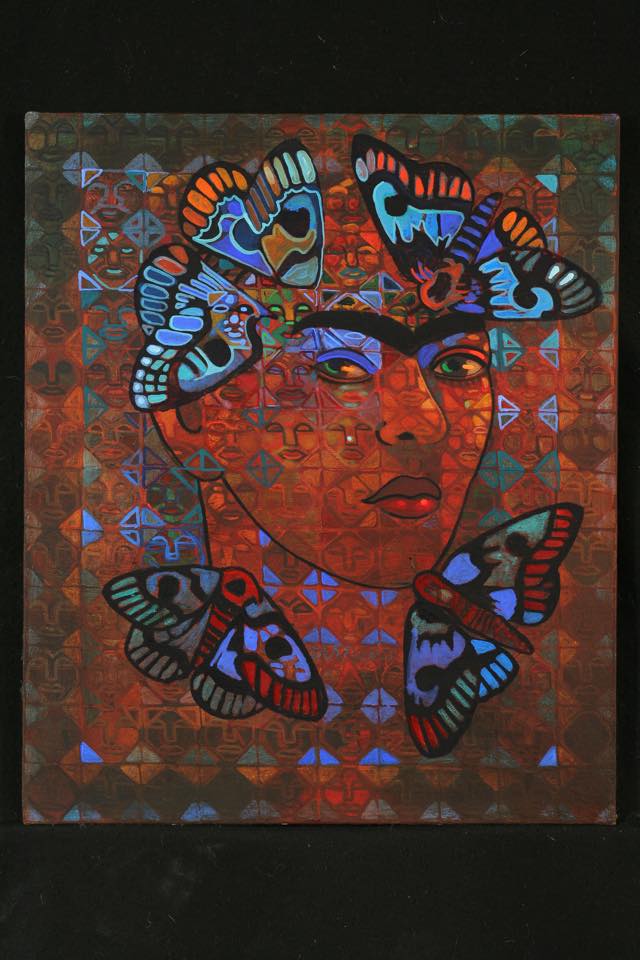


Here is a piece I wrote about Alfred and Frida.


Alfredo In the Bardo and Frida in the Cut


In the Bardo

In some schools of Buddhism, bardo (Tibetan བར་དོ་ Wylie: bar do) or antarabhāva (Sanskrit) is an intermediate, transitional, or liminal state between death and rebirth.

Milam bardo (mi lam bar do): is the second bardo of the dream state.

I chose this as part of the title of this essay. Essay, rumination, love letter to Alfredo Arreguin.

I will talk about Frida in the cut a bit later. I first found Alfredo’s work several years ago, chatting with people of Facebook, of all places. Whether it’s portraiture, landscape, or still life, Alfredo’s work is all at once representational and symbolic.

 In his paintings, the key subject is at first “hidden” against a patterned background, just like the emerging images in a dream. And like a dream, the background stays suggested, while the central image gradually comes into focus, capturing your attention. Liminal, you see, in the bardo, Alfredo takes you to the borderland of what exists in the “real” world and what we see in our mind’s eye, in our dreams.

Speaking of dreams, Alfredo’s intricate patterns, his ingots of color, precise in placement and repetition, remind me of Huichol beaded worship – animals, icons – all painstakingly built and layered bead by bead. Alfredo shapes his work, I think, in much the same way. Huichol beaded work, their yarn work, is an expression of the bardo; a present-time bridge from this world to the real world of the spirit, of what exists in a shared vision quest.

Alfredo invites you to see, and see past this world, into the tangible realm of the deeply felt, the perfect spirit. It is specific, in that the imagery springs from the roots of Mejicanismo, and by implication Chicanismo. It is universal, in that it assumes the viewer, from whatever background, understands the longing, and the revelations of the borderland.

And like the art and living message of our indigena brothers and sisters, Alfredo’s work calls us to reconnect, the re-construct from a borderland/bardo place of a Pan-American experience, something I truly understand. Alfredo was born in Mexico, and I am the child of immigrants, and the idea of border/ bardo is one that constantly shapes my self-definition, and I suspect shapes his as well. I want to share this poem about the power of the bardo, specific and universal. I hope it also serves as the introduction to my reaction to Alfredo’s re-creation of Frida.

RECLAMO

En este sueño
estoy completa.
No tengo que guardar
las historias de otra gente.
No tengo que buscar y escudriñar
a través de los restos de sus palabras.

En este sueño
paso mis dedos
através de la cabellera de Frida
Con esa cabellera,
tejo flores obscuras
del color de la sangre.
Y me dice
que el jaguar viene a traerme
su poder.

La medicina que calma este dolor
es como comida para
calmar esta hambre.

En este sueño
hago magia
con el lodo del Rio Grande.
Arropado en corridas y música ranchera,
que son el hechizo y el encanto
que anula la edad
del olvido y el adoctrinamiento.

En este sueño
tengo un amante
cuya cara es de piedra,
como el antiguo marcador del templo.

Su boca es carnosa,
sus ojos están entrecerrados y
murmura:

“Ven conmigo mi India,
mi pequeña perdida.
Recuerda quien eres.
Recuerda quien eres.”

RECLAMATION

In this dream,
I am whole.
I am no longer
saving other people’s stories,
scavenging their words;
sifting thru their remains.
In this dream,
my fingers run
thru Frida’s hair.
In this hair, I plait
dark flowers
the color of blood.
She tells me
the jaguar comes
to bring me power.
The medicine
to end this pain,
the food for this hunger.
In this dream,
I have made magic
from the mud of the Rio Grande.
Wrapped in corridas and ranchero music;
are spells and incantations
to undo
the age of forgetfulness
and indoctrination.
In this dream,
I have a lover
whose face is stone;
ancient as a temple marker.
His mouth is full,
his eyes half closed.
He whispers:
“Come to me, mi India,
mi pequeña perdida.
Remember who you are
Remember who you are.”

In the Cut

Agency is the ability to express your true self on your own terms. It is the power to think for yourself and act in ways that shape your experiences and life trajectories. Alfredo’s portraits of Frida reveal his root understanding this essential truth. It utterly rejects the common trope in the most recent cult of Frida expropriation - Frida as victim; with the artist and the viewer indulging in the voyeurism of pain. Alfredo never stoops to that. In every painting depicting her, she is vibrant, aware, her gaze resolute and self-aware. This is the greatest homage and the deepest understanding of one of the twentieth century’s most important artists.

I tried to capture that agency in writing about her and strengthening the agency in myself.

BASHERT

I am the catch
in your throat;
the wordless cry,
unexplainable.
I am the cloud
that follows you;
raining
at the slightest provocation.
I am the scar
that has
become a flower.
I am the pilgrim
you brought home;
the Jew you hid
from the fire.
I am your dark sleep.
I am your dream
of finding someone
whose arms
will hold you
when daylight comes.


Frida was never her wound, her physical limits, her crushing disappointments in private life.

She takes her life and as alchemist, transforms it into art, into awareness, into a psychic rebar stronger than any back brace. She gives all comers as good as she gets. I chose the phrase “in the cut” – a hip hop term meaning hidden in the ‘hood, but also someone at the top of their game, their quintessential self.

Frida will always be the foundation for Latinx artists of all persuasions, as we emerge from the ‘hood., as we gather onto ourselves our own rebar, forge our own identities.

Tuesday, June 11, 2019

Blogueras Forever: Alvarado Reviews Cardinal. Living Room Floricanto Vincent Cooper.

Wonder Woman is Puerto Rican or Ann Dávila Cardinal has a new novel!!!
Lisa Alvarado

*Editor's Note. La Bloga welcomes former weekly columnists Lisa Alvarado and Ann Dávila Cardinal to today's pages.


Ann Dávila Cardinal is a force of nature.  I met her when I was trying to harass then Vermont College's admissions to let me finish my B.A. at the ripe old age of 38. I remember sitting in her office, feeling all at once at home. She got me. And more importantly I got her - her grit, talent, dedication as a writer.  I got my degree and was lucky enough to stay in touch after graduation.

But wait! There's more! Through Ann's keen eyes and ears she contacted me and Jane Alberdeston  Coralin about a call for Latinx YA. Through that we wrote Sister Chicas together and once again, Ann's broad reach helped us find an agent and publisher.

I remember a conversation we had back in the day where Ann put it to the universe that she wanted to write a novel... and folks, this is one amazing read from an uber-talented hermana, whose grace, literary chops, and other worldly work ethic has born more fruit. Below is a brief description from her publisher and our conversation about the acclaimed new novel.


From the Publisher: 
   
Five Midnights by Ann Dávila Cardinal is a modern take on the El Cuco myth that is bound to be loved by many. With a narrative that’s well-paced and intriguing, the author builds a world that utilizes a story passed down through generations since the Spanish Colonization of Puerto Rico and Latin America.
Javier Utierre and Lupe Dávila are trying to find out who (or what) killed two boys in San Juan, and along the way uncover an old magic based on the aforementioned myth. As Lupe and Javier become embroiled in the chase for the murderer, their adventure grows more nebulous. The mystery introduces us to some colorful side-characters who give us pieces of the ultimate puzzle, such as Papi Gringo, one of Javier’s childhood friends who’s become a sort-of Bad Bunny personality, and Izzy, another one of Javier’s friends but also Lupe’s elusive cousin. All the characters add to the story’s sense that everyone knows or is connected to each other, which is essential when writing about Puerto Rico; there’s always a feeling like you know somebody who knows somebody within Puerto Rican culture.

What would you like to say to La Bloga’s readers about Five Midnights?
You mean beyond that I hope they will read it? 😊 I guess that I’ve always been fascinated with the legend of El Cuco, and how the threat of supernatural forces is used to try and get children to behave. And that though he is called different things, a version of him appears in pretty much every Latin culture, which tells me either this tactic has worked for generations, or that parents resort to desperate supernatural threats when feeling powerless (yes!). My hope is that I captured the spirit of this myth, and the spirit of Puerto Rico.
Briefly describe your protagonists and what you see as the point of connection for readers.
Lupe Dávila is a sixteen-year-old Gringa-Rican from Vermont whose mother took off when she was little, and she is left struggling with life with an alcoholic father. This particular summer, her father ships her off to his brother’s home in Puerto Rico for the entire season, where she gets in involved in a mysterious murder case. Lupe is a fighter who takes zero shit from anyone but doesn’t let anyone close either. Being of mixed ethnicities and from a broken, drunken home, she struggles with fitting-in in either place, something which I think will connect with many readers.
Javier Utierre is a smart and kind almost-eighteen-year-old from a middle-class city near San Juan that has been badly affected by the economic issues on the island. As people left his neighborhood, drugs moved in, and he found himself caught in the net of addiction. But thanks to a priest he connected with, he’s been in recovery for two years. But when a childhood friend is brutally murdered, he is forced to face his past and the hand he had in creating the darkness he has been running from. Javier is a young man facing some bad choices he made, something most of us must face at one point or another in our lives.
Usually, there is more than one message in a novel. What is the major message in Five Midnights? What are the other takeaways you would hope for readers?
What I hope is that it helps shine light on certain issues, the major one being addiction, specifically that though most of what we hear are stories of drugs affecting certain socio-economic classes, in reality it affects us all. And that though it is mostly a love letter to Puerto Rico, I strove to show la isla in a realistic light (I mean, other than mythic monsters traipsing around). The beauty and the struggles as it was written pre-Maria when the island was already suffering. And finally, that if you don’t fit into one neat little box on a census, you still fit in with the community you make.
Talk about your own evolution as a novelist -from being co-author in Sister Chicas to your current book. Describe the ways you found helping hands, as well as what barriers you had to address.
Helping hands? Like, I didn’t know how to write a metaphor until you and Jane Alberdeston Coralin taught me? 😊 I learned so much working with you two on Sister Chicas, especially since you both are poets. Such beautiful language. Then I earned my MFA at Vermont College of Fine Arts, and my craft deepened and deepened thanks to my faculty advisors. But we knew so little of the business then, we were flying blind. We did well despite that, but since then I’ve built a community of writers who are at different points in their careers so I can draw on their knowledge, and then pass that on to younger writers. The first time we got an editorial letter, we felt as if we’d done something wrong. Now I know that those letters are what brings out the best in the book, that you should hope for at least two so you are certain the work is where it should be. I’m a dreamer, so there was also a thickening of skin, a tether to expectations. The work is still joyous, but I’m more realistic about the outcomes.
What is the importance of YA literature from your point of view as a writer and a member of academia? How does what you do for a living impact your life as a writer?
Oh, it is through my job that I fell in love with young adult literature. Years back, I sat in on a lecture in our MFA in Writing for Children & Young Adults (WCYA) program by Sundee Frazier—brilliant writer, lovely human being—who talked of craft and representation, and I remember my blood pulsing faster and faster through my body, it was all I could do not to jump to my feet and cheer. I’d never heard someone talk about craft like that, with an eye always on the reader, on the responsibility of shaping young minds. It adds an entire level to the craft of writing, an additional depth of meaning. And my job of counseling writers into VCFA’s programs only feeds my hunger. I get paid to talk to writers all day long, it doesn’t get much better than that! And each conversation inspires me. Truly.
In working with you on Sister Chicas, the idea of representation was central. How is representation on the micro and macro level an element in Five Midnights?
In Five Midnights I tried to represent my own story, and those of my family. Though Lupe has a lot of me in her, so does Javier, and Marisol. In this novel my frustration and anger at how Puerto Rico has been treated came out in the character of Marisol. And the intense bond of island family. As someone who did not have the best situation at home, the caretaking of my family in Puerto Rico was invaluable. It made me who I am today. And my love for my uncle Esteban, who always made me feel cared for, something a child of an alcoholic/addict thirsts for. So in addition to representing my own experience teetering between the two worlds, I hope I captured what being una Boricua means to me.
Particularly at this historic juncture, what is the significance of Puerto Rican literature and visibility? Who influenced you? Who continues to influence you?
Oh, this one made me tear up. I have lived on a steady diet of Latinx literature most of my life, studied Puerto Rican literature at Columbia, read everything I could get my hands on from Manuel Alonso’s El Jibaro (written in 1845) to Yolanda Arroyo Pizarro’s recent work. And the Dávilas have produced a number of writers, from my great-great uncle Virgilio Dávila to my cousin Tere Dávila who manages to write award-winning books while running an advertising agency. I feel…not the pressure of this legacy, but rather the buoying. Does that make sense? Can buoying even be a verb? But it is my wish that more work of the island is translated and released via traditional academic and commercial publishing venues on the mainland. There are so many brilliant mainland writers of Puerto Rican heritage, but not much work of the island-based writers coming this way. I’d love to see a bridge built, so all these brilliant works can go both ways.
Talk about literary fiction and genre fiction. How do you see the categories? Are the distinctions useful? What’s your observation about the intersection of literary fiction/YA/Latinx fiction?
Oh, girl! Now you know I’m pulling out my soapbox now! You know this is a passionate subject for me. I was going to get a t-shirt made for AWP that read “Genre is not a four-letter word!” But these days I’m beginning to realize that this division and judgement is dated. Younger generations of writers just don’t have these prejudices anymore, I mean, Colson Whitehead wrote a zombie novel, and George Saunders…well, that’s all I need to say: George Saunders. Victor LaValle, Carmen Machado…these are all literary writers who write speculative fiction. I predict that this classist perception of genre as “less than” is going away. And really, as far as I can tell that bias hardly ever existed in YA literature. Almost all our WCYA faculty have written some genre work, and there just isn’t that judgement when you’re writing for young people. There is so much depth that can be carried along with a magical storyline. If you don’t believe me, read All of us With Wings by Michelle Ruiz Keil, or The Storm Runner by J.C. Cervantes. Gorgeous, elegant work, with so many layers.

Tell us something not in the bio.
From the age of four to about six or seven, I slept with the sheets wrapped tight about my neck to prevent a vampire biting me in my sleep. I am the youngest of five children, a span of sixteen years between my oldest sibling and me, and so I was dragged to all kinds of movies. My mother also had a huge crush on Bela Lugosi (never did get that one) and so I saw Dracula at about four years old. I loved horror but had so many nightmares that I had to take preventative measures. Must have worked since I never did get bitten. 😉

Living Room Floricanto At Casa Sedano Welcomes SanAnto's Vincent Cooper
Michael Sedano


A few years back I actively coupled a goal of taking the perfect public speaker photograph with another goal of photographing every raza and allied poet on the Eastside reading their own stuff. That's almost the same foto, que no?

Public speaking--I call it Oracy--is equivalent to Literacy and Numeracy as fundamental competencies of a civilized person. I think in Aristotelian terms. The third century pagan held it would be unthinkable in his 'hood for someone to be unable to defend themselves with a sword. Equally unthinkable, Aristotle said, that a person would be unable to defend themselves with their words. And when people started agreeing with that notion, people became civilized.

Aristotle was thinking the courts and the agora, but the point applies to one's writing. An effective reading is the writer's way of honoring not just the composition but the labor of creation. Don't do a crummy reading but give your words the respect all that work earned it. In short, it's not enough to write it, fulfill the process by reading it aloud well.

The Living Room Floricanto, and its al fresco variant, the Backyard Floricanto, is a way to celebrate Oracy, take fotos, and bring poets to the pad, since Barbara and I don't get around much any more. It's much more, of course. The Living Room Floricanto is fun. My gosh, as today's fotos show, we did an open mic then enjoyed our featured guest. After that, a hootenanny broke out.


As the Emcee, Michael Sedano leads off the Open Mic with two minutes of creative  non-fiction. Sedano introduced the guest with the second-longest drive, Santa Barbara-NOLA's Melinda Palacio.


Melinda introduced Steve Beisner, wearing orange marking his opposition to gun violence.


Steve, a La Bloga Guest Columnist in the past, introduced Viktoria Valenzuela, Vincent's poet-wife.

foto:Concepcíon Valadez

Viktoria had the pleasure of introducing Living Room Floricanto At Casa Sedano's special guest,  fellow Veteran, San Antonio's Vincent Cooper reading from his recent publication, Zarzamora.


Melinda brought her Fender Montecito model Ukelele, a beautifully crafted instrument with mother-of-pearl inlay and mirrored finish. And what a tone! In the fotos, I have a great posture because I'm leaning back to hear those plunking chords and get into the beat.


Steve is a professional musician. I appreciate his tolerance with my poorly-disciplined fingers. We played some Irving Berlin, Lennon-McCartney, Sabor a Mi. The most wondrous event happened when guest Angel Guerrero sang a capella in a clear powerful contralto.


Saturday, November 04, 2017

Lisa Alvarado - "It only looks like I'm sleeping."

Ah, mi gente, one of the things I love about La Bloga is its love and support for its blogistas, something I have experienced in spades. I was a regular for a while, and have made special guest appearances several times since then. I appreciate the chance to have had this Saturday spot for the last few months. It's a blessing to connect with talented writers and artists from all over the country, along with the wonderful writers of La Bloga.

This is my final post for now. I haven't been able to generate a consistent flow of interviews despite social media outreach Add to that sea level changes in me --- I'm not as driven to produce as I was a few years back. The people I have been able to interview offer our world much to celebrate. Another element is personal resources. Life has been challenging, to say the least.

To all the La Bloga familia, especially, Em, Rudy, Manuel, and Daniel, and to all the La Bloga readers and loyal followers, abrazotes y adios. I hope I catch you on the flip side.

Tho' much is taken, much abides; and tho' 
We are not now that strength which in old days 
Moved earth and heaven, that which we are, we are; 
One equal temper of heroic hearts, 
Made weak by time and fate, but strong in will 
To strive, to seek, to find, and not to yield.

Directive

Bring on the Dark Ages, please.

I have seen the whitewashed world 
And I find it
Lacking.
I call up the bones of the ancestors 
To rise and weave the flesh upon itself
Rise from the ocean and slaveship shackles
And Rikers and Control Units and the back of police cars
Rise from Tlatelolco and East LA and Pilsen and the Bronx
Rise from burned down bodegas and sunscortched fields
Rise from Wounded Knee and smallpox blankets, 
Heart Mountain and shredded silk.
Rise, I beg of you
And color the world
Stain it with your hidden brilliance
Your beauty
You
And only you can undo this bleached and poisoned landscape.
I need your hue
Your tint
This place
This nation Needs your brown/black/red/yellow coloration.
New civilization
Older than the first breath

The Botany of Hope

Think, at this blessed moment: 
one thornless rose opens in the blue vase; 
that tarnished bargain treasure that you, wanderer,
ferreted out of chaos. 

You reading this — you know 
nothing of how it came to flower there, 
and I try to tell you that I wished it for you.

What knotted history twists its wild way
in your garden? That we can talk of easily, in
breathless laughter, between the war stories.

What flowers in secret 
inside the walls of your chest?
Is it longing? Fear? 

If I press my lips above your heart, 
will my kiss set it free?

Listen to the wind, the way it sighs every night.
The gates of heaven never close,
that’s our lesson, that’s our imperfect miracle.

DreamTime

And what good is a dream finally? It cracks your head open
and saxophone music pours out of your mother's window and
the one person you've loved like no other says it was a wrap
and you‘ve let him be, endings are what they are --
Paz y amor--You took back your Pandora’s box to heal years ago.
And there is peace and then and you see yourself with him-
Kissing everywhere. In the trees. On boats. Against the bathroom wall.

II
The grind of daily life never lifts and you've lost your check stubs and
and the dream dog wants to go outside please and just
when you think you're waking you're in the heart of the dream
and the dream breaks your head open.
Touching the hair of a friend at work who laughs at you. Flying
over burning cityscapes so close and so fearlessly that when you wake
there is ash between your legs. Your arms are tired and hang
at your sides like the wings of a bird who is about to die.

4:00 am
And what the hell do these dreams mean anyway? It breaks your heart,
and you stand in the lush dark of the moment no one can name
and you actually think you can write a poem--nothing makes
sense to you and you speak the words out loud for awhile and
then when no one answers you awkwardly sit down where you are.

5:15 am
And the stars overhead shine a little—no more or less than usual—
and whether it is daylight and they hide from you or whether it is night
and they are like embers. They shine and you are grateful.
Love is always a hammer.

New Mexico Diary

This place does not want you.
Or more to the point,
Your buildings that erupt thru the brown, cracked earth.
Groaning, pushing aside the scrub juniper and pinon.
What is called civilization shatters the land like and angry fist.
This place was not meant for tourists, or visitors.
Only the inheritors,
Only The People
Who knew this place, could live with it and on it.
Every morning
You understand this in a deeper way, City Girl.
As you drive past boxes like the ones you live in.
As you pass the palaces of those who think they’ve conquered.
But they will die, just as you will.
And the silent, waiting desert will remain.
No amount of throwback grooviness, big city real estate grabs,
Or carefully remembered  historias of la conquista will change that.
Nothing changes the quiet patience of dust and sand.
And one day tus huesos will crumble en algún otro tipo de polvo.
And no memorial will say more than the blink of the sun setting,
And the wind will whisper the true name of this place.


Saturday, June 17, 2017

Microagression Girly Style

La Bloga welcomes the return of Lisa Alvarado as a regular Saturday columnist. Lisa's columns appear on alternate Saturdays. See Lisa's bio at the bottom of today's debut contribution.


Lisa Alvarado


A microaggression is the casual degradation of any marginalized group

  •  microassault: an explicit racial derogation; verbal/nonverbal; e.g. name-calling, avoidant behavior, purposeful discriminatory actions. 
  • microinsult: communications that convey rudeness and insensitivity and demean a person's racial heritage or identity; subtle snubs; unknown to the perpetrator; hidden insulting message to the recipient of color. 
  • microinvalidation: communications that exclude, negate, or nullify the psychological thoughts, feelings, or experiential reality of a person belonging to a particular group.

From the time I was able to wear make up- which was 15, until now, at age 60, I gird my loins and swallow hard every time I look for what I laughingly call foundation.

Why do I even bother?

It’s complicated – I’m a femme/butchy combo who loves girly stuff, a Mejicana daughter of another Mejicana – who by the way was a former Maybelline cosmetics model.

I am also someone who has struggled with the bombardment of shame about “looking good”; i.e.: pretty enough by white standards. Years in, I still fight the good fight to carve out a sense of myself as beautiful. This is, by the way not a fishing expedition for praise on my appearance. I am more in love with myself than I have ever been, but the dominant culture's assault requires suiting up every day.

Here’s the most recent struggle - harder to identify and fight because it came in the package of a smiling, white, liberal “friend.” This person was selling cosmetics as a sideline. What’s not to like? We work together and she’s bouncy, funny, maybe not on my wavelength, but hey, I can buy some foundation and maybe do a solid.

Going through the catalog was revisiting the wounding that you absorb like it’s the air around you. You look, and you look, and no color listed seem to match the face you see in the mirror. There’s no shade called Poetisa Mestiza Diosa.

I picked “Neutral” and ordered it. When it arrived, it was the color of wallpaper paste. I guess “Neutral” means anemic white girl. I exchanged it and tried again….three times.

All during this process my “friend’s” agitation was building. With each order I could see and feel her frustration, even though she kept saying: “I just want you to be happy.”

Finally with the last order, she said. “I’ve never had anyone have as much trouble as you.” I paid her, because, well, that’s what you do. And when I got home that night the first thing I did was toss it into the garbage can.

Even as I write this, I feel that clutch in my chest, that sadness of “not being OK.” But I keep on. And I understand.

Insisting on your own space, your own face, and refusing to be erased is trouble.


My mother, Rita Alvarado. Beauty. Poise. 
All Mejicana, all the time.
A version of this article appeared in The Seattle Star

Meet Lisa Alvarado


Lisa Alvarado is an educator, poet, novelist, and journalist, the founder of La Onda Negra Press, author of Reclamo and The Housekeeper’s Diary; originally a book of poetry and now a one-woman performance. Her first novel, Sister Chicas, Penguin/NAL, was released in April 2006. It won 2nd place, Best First Novel in English. (Latino Literacy Now/2007) She was also honored as Hispanic Author of the Year 2009/State of Illinois. Her book of poetry, Raw Silk Suture was released by Floricanto Press in 2008.

She has contributed to contributed to HaLapid, The Journal for the Study of Crypto-Judaism, Me No Habla with Acento, edited by Emanuel Xavier, and in 2011, published Still, Life, essays and poetry. She is also the curator and editor for Love you Madly, a poetry website devoted to jazz, and is currently an editor for The Seattle Star.

Friday, December 04, 2015

The Muse's Editor: Mayra Calvani

Melinda Palacio

Latina Authors and Their Muses
Edited by Mayra Calvani


I am honored to be included in Mayra Calvani's anthology, Latina Authors and Their Muses (Twilight Times Books 2015). In addition to reading about the distinct writing styles and inspirations from 40 different Latina authors, the book itself is a sort of muse that will bolster any aspiring writer. The book is also available in digital form for those who have crossed over to the non-paper side. I had the pleasure of interviewing Mayra Calvani. She also reveals who her personal muse is. Gracias, Mayra for this beautiful book. 

La Bloga: 
After reading Puerto Rican Voices in English, the 1997 anthology edited by Carmen Dolores Hernandez, you decided to do something similar for Latina Authors and Their Muses. What was it like creating interview questions for 40 different authors? And what would you like La Bloga readers to know about this book?

Mayra Calvani:

It was quite challenging because I wanted to ask questions that were important to me and that would be informative for some of my target readers (aspiring authors), so this meant some of the questions had to be generic (the usual questions about the creative process, landing an agent, finding a publisher, etc.), and others had to be somewhat repetitive because I wanted to get answers to the same questions from different perspectives. At the same time, the questions had to be interesting and original. I tried to combine all these elements into the questionnaires.

Latina Authors and Their Muses has been a project very dear to my heart ever since I came up with the idea back in 2008. The journey has been long and challenging, which is why I’m so thrilled to see the book published. It’s also been a wonderful journey of discovery and of sisterhood. I’m deeply honored to have worked with these accomplished authors. My goal is to spotlight their work and bring into attention the richness of their talent, but also to encourage aspiring authors and teach them a thing or two about the publishing industry.


LB:
What if anything would you do differently, now that book is finished? Did any answers surprise you?

MC: 
Now that I’m doing a master’s in Comparative Literature and have taken courses in literary criticism, I see how I could have included even better, more inquisitive, challenging questions. Apart from this, I don’t think I would have done anything differently. I feel that the journey evolved organically, that everything happened the way it should have. I actually wanted to include more authors, but the publisher told me we would have had to split the work into two volumes, so I decided to stop it at 40 interviews.

I was especially interested in the meaning of “success” for authors, and what it means to be a “professional author.” This is one of the questions I asked several times. It was enlightening to read the different responses. More than surprising, it was illuminating to get into the minds of these authors, what inspires them, what drives them, and what keeps them going in spite of the odds. In a way, they’ve all become my muses.

I was surprised by how different the journey has been for each author. For some, finding an agent and getting published by one of the big NY houses was fairly quick and easy. For others, it has taken many years.


LB:
For the cover of the book, you polled the authors and asked them to weigh in on the decision. I was pleased and nervous for you. Did bringing in all 40 authors make the process easier or more difficult for deciding on the final cover. Tell us a little more on the process. Who came up with the initial designs? Were you happy with the outcome or did you secretly hope for one of the other covers?

MC: 
The search for the perfect cover was an exciting journey! It took several artists and multiple covers (about 10, if I remember correctly) to come up with the “look” that the publisher and I were after. We wanted a look that would reflect the content and also appeal to target readers, but at the same time we didn’t want to be stereotypical. This was a big issue.

After several months we rounded up four covers designed by Tamian Wood. It was hard because all four of them were great in their own way, even though they all had different looks and evoked different feelings. That’s when I decided to conduct a poll with the authors. An overwhelming number chose the present cover as their preferred one—which also happened to be my and my publisher’s favorite. So everybody won.

Mayra Calvini
LB:
Why did you decide to focus on the author's muse. Do you have a muse? I'm guessing you do. Tell us about your muse and how your muse has influenced and inspired your volumes of books. 

MC: 
That sprang from the title. I came up with the title first, and that gave me the idea to begin each interview with a quote from the author about their muse. I thought it would be a nice attention grabber, something that would make the anthology stand apart from other similar titles.

I have a muse, but like Esmeralda Santiago’s, it is often elusive and mysterious. It has various faces and can shapeshift into many forms.  At times, she’s a nurturing angel who fills me with peace and confidence. Other times, she’s a belittling and cruel ice queen. Mostly, she’s the statue of the Egyptian cat goddess Bastet sitting on my desk and keeping a close eye on me. I like her the most because although she keeps me on a leash, she’s the perfect balance of gentle encouragement and firm discipline.

LB:
Is there anything else you'd like to tell La Bloga about this project or any future ones? What are you currently working on or what will your next book entail?

MC:
I recently terminated with an agent and I’m in search of another agent for a YA psychological thriller set in Puerto Rico in the 1970s. I’m also awaiting response from a publisher on a 4-book YA mythological fantasy series. At the same time, I’m self-publishing a series of novels under a pen name.

On the nonfiction front, I just got an offer for a contract for another anthology titled, Born to Write: Honoring Your Gift When Your Partner Doesn’t Support Your Writing. This will be a collection of essays from different authors.

So I guess I’ll have my hands full for a while. I’m excited about 2016 and can’t wait to find out what the New Year has in store for me.


LB:
Thank you for taking time out of your busy schedule, Mayra.

MC: 
Thank you for giving me this opportunity to talk about my book, Melinda!


About the editor:
Award-winning author Mayra Calvani has penned more than ten books for children and adults in genres ranging from picture books to nonfiction to paranormal fantasy novels. She’s had over 300 articles, short stories, interviews and reviews published in magazines such as The Writer, Writer's Journal and Bloomsbury Review, among others. A native of San Juan, Puerto Rico, she now resides in Brussels, Belgium.

Latina Authors and Their Muses includes interviews with 40 multi-talented authors:

Marta Acosta
Lisa Alvarado
Julia Amante
Margo Candela
Kathy Cano-Murillo
Mary Castillo
Jennifer Cervantes
Leila Cobo
Zoraida Córdova
Lucha Corpi
Sarah Cortez
Angie Cruz
Liz DeJesus
Anjanette Delgado
Carolina De Robertis
Lyn Di Iorio
Teresa Dovalpage
Carolina Garcia-Aguilera
Iris Gomez
Reyna Grande
Rose Guilbault
Graciela Limón
Dahlma Llanos-Figueroa
Diana López
Josefina López
Dora Machado
Maria Gabriela Madrid
Michele Martinez
Sandra Ramos O'Briant
Melinda Palacio
Caridad Piñeiro
Berta Platas
Toni Margarita Plummer
Thelma T. Reyna
Lupe Ruiz-Flores
Esmeralda Santiago
Eleanor Parker Sapia
Alisa Lynn Valdes
Diana Rodriguez Wallach
Gwendolyn Zepeda