The world's longest-established Chicana Chicano, Latina Latino literary blog.
Thursday, June 24, 2010
Mr. Mendoza's Paintbrush
Wednesday, June 23, 2010
Latino authors and illustrators honored for outstanding works in children’s literature
Contact: Macey Morales
accept awards, sign winning books
Given annually, the Pura Belpré Medal is awarded to a Latino writer and illustrator whose work best portrays, affirms and celebrates the Latino cultural experience in an outstanding work of literature for children and youth. The award is known worldwide for the high quality it represents and serves as a guideline for educators, parents and bookstores for the best of the best in Latino-themed children’s literature.
The event will honor the following 2010 Belpré Medal winners and honorees:
- Julia Alvarez, author of “Return to Sender,” published by Alfred A. Knopf, an imprint of Random House Children’s Books.
- Rafael López, illustrator of “Book Fiesta!: Celebrate Children’s Day/Book Day; Celebremos El día de los niños/El día de los libros,” written by Pat Mora and published by Rayo, an imprint of HarperCollins Publishers.
- Carmen T. Bernier-Grand and David Diaz, author and illustrator of “Diego: Bigger Than Life,” published by Marshall Cavendish Children.
- Georgina Lázaro, author of “Federico Garcia Lorca,” illustrated by Enrique S. Moreiro and published by Lectorum Publications Inc., a subsidiary of Scholastic Inc.
- Yuyi Morales, illustrator of “My Abuelita,” written by Tony Johnston and published by Harcourt Children’s Books, Houghton Mifflin Harcourt.
- John Parra, illustrator of “Gracias. Thanks,” written by Pat Mora and published by Lee & Low Books Inc.
Event highlights include a performance by Los Quetzales Mexican Dance Ensemble under the direction of Laura Ortiz. Participating authors will sign copies of their award-winning books.
The Pura Belpré Medal is named in honor of Pura Belpré, the first Latina librarian from the New York Public Library. As a children’s librarian, storyteller and author, she enriched the lives of Latino children through her pioneering work of preserving and disseminating Puerto Rican folklore. The award is given by the Association for Library Service to Children (ALSC), a division of the American Library Association (ALA), and co-sponsored by the National Association to Promote Library and Information Services to Latinos and the Spanish-Speaking (REFORMA).
For more information regarding the Pura Belpré Medal please visit http://tinyurl.com/Belprémedal.
ALSC is the world’s largest organization dedicated to the support and enhancement of library service to children. With a network of more than 4,200 children’s and youth librarians, literature experts, publishers and educational faculty, ALSC is committed to creating a better future for children through libraries. To learn more about ALSC, visit their Web site at www.ala.org/alsc.
Founded in 1971, REFORMA is committed to promoting the development of library collections that include Spanish language and Latino oriented collections; advocating for library services and programs that meet the needs of the Latino community; educating the Latino population of the availability of library resources; and the recruitment of bilingual and bicultural library professionals and support staff. For more information on REFORMA, visit www.reforma.org.
Tuesday, June 22, 2010
On-Line Floricanto: Poets Respond to Arizona Racists
"The Stone Garden" and "I Am" by Luis Ascencio-Cortez
"To the Poets / A los poetas" by Edith Morris-Vásquez
“A.R.I.Z.O.N.A” by José Gutiérrez
"Rubbish" by Luzma Umpierre
“Kokopelli Pauses” by Alma Luz Villanueva
"Prayer For The Civil Disobedient" by Iuri M. Lara
"Rimas contra las cárceles de papel" by Octavio Merecias Cuevas
"Broken"- Rosa Escamilla
---------
LIGHTNING ON A BLACK NIGHT OVER THE CHUSKA MOUNTAINS
By Kristopher Barney
yaaishjaach'ili'.7.10
there’s a part of me that becomes alive
becomes deadly aware of everything
in all the insane moments of my life
in every cloud shape
in the shapes of my homeland
in the faces
in the rough texture of brown bodies
where one can find
trails of beauty
parts of the eternal
passions ignited in the sensuality of the touch
that gives me goose bumps
the magic that happens
too sudden and less often and
yes i miss you and my mind
runs a separate road of longing of
absorbing beauty through silence and the
internal dialogue over the value of life and
words & actions given to
souls lost somewhere between
this world and the next
a dual battle between gods and men & the
gentle children who
walk in the first days of freedom
we still have it inside of us
this sense of freedom
everything before Columbus
before all the bullshit
this fragrance
this look in the eyes
in bodies tanned by desert wind
and blue sunned skies
beautiful brown bodies that
fit right into scenes of
red canyon bottomlands
brown eyes
black hair
the beauty that only Native can appreciate
this spirit that brings songs to me
in this early morning
all that i take in
when i’m on a journey
hell bent on easing the lonesomeness and
momentary heartbreak of coming to terms with
this life
with seeing
the organs of the earth split open
the trembling nature of anger taken hold
when i walk through this land
see coal trains and trucks hauling
coal to power plants and hear the endless rhetoric
and debates of NDN politicians
hear the worthless discussions over
how life contains so little value next to pleasing
the greed of corporations and
the shadows that implode
as shareholders withhold their investments
as the world of Wall St. becomes
covered in seaside oil sludge
when all so called transparency gets fogged
by the smoke stacks of power plants and cities
the death
the black winds that cover us all and yet
all i can think of is you this morning
the restless night
the wrestling to sleep
this wind that surrounds me in this a.m. moment
the images fading through overcast and sun’s
first light and the silent wishing to be
somewhere else
an escape from the torture of this life
the responsibility those like myself face
this road
this song
this act of pure resistance
this dance with eagle plumes and clouds
the lightning that strikes
through a black night over
the Chuskas……..
(c) Kristopher Barney
THE STONE GARDEN
By Luis Ascencio-Cortez
Packed with the innocent, not the guilty
Death row inmates are hidden
By the people who hide the sea
The souls of Granma’s babies
Taken from us by the presidency
The president, a shadow cloaked in white sheets
White supremacy is the enemy
Racist faces of rulers, shun us from power
People are treated like sheep herded,
And used for their products by the hour
We need revolution; we need to act, before we are dead
Because, if we don’t, then no one will
People have lost their will
A will to obtain their freedom
I haven’t lost it, I have kept it hidden
So they don’t steal it
The CIA, FBI, all after it
There are scared of all of us taking action
To destroy the evil in this,
This world, full of fake democracy
By Luis Ascencio-Cortez
TO THE POETS / A LOS POETAS
Dedication to Those Responding to SB1070
By Edith Morris-Vasquez
Laws are the broken shackles of hatred
Entwining you in this Ritual of Old,
Bards,
Poetas, Declamadores… son nuestro ejercito verbal
y poseen herramiento alfabético
que es relacionado
con el herramiento que cargan los músculos
desgastados de nuestro pueblo indocumentado
Their Labor is your Labor. Their tools much heavier
Your tools are Words and Poetic Strategies
Poetas, su herramiento
Consiste en palabras en términos poéticos
Que manejan al nivel poético,
where tragic quantities are measured
donde se miden las trágicas cantidades
Este reclamo se ve aumentando
The Disquieting Clamor is Growing
(I Recall that when I
Waitressed Away all my Youth, a Sign in the Kitchen
Spoke Very Loudly. It Read:
A happy customer tells one friend,
an unhappy customer tells everybody.)
A.R.I.Z.O.N.A.
Por José Gutiérrez
Aquí estamos y no nos vamos
Recuerda tu historia indígenas logramos
Impactar al mundo con un profundo legado
Zodiacos escritos en paredes de concreto
Olor a puerco vigilando el corral despierto
Nunca nos dividen unidos como ancestros
Armados pero en vez de matarte te dejo tieso
RUBBISH
por Luzma Umpierre
Vivo en el país de los amaestrados
I beg your pardon, excuse me, I'm sorry
Fila india para coger la guagua pisotón
I beg your pardon
Ir por la calle siempre a la derecha encontronazo
Excuse me
Hablar siempre en voz baja ¡CARAJO!
I'm sorry
No dejar que un papelito se te caiga en la
acera FLOP
Excuse me
Coger un número y esperar ¡Colao!
I beg your pardon
Estacionar a quince pies, ni uno menos,
del fire-hydrant ¡Déjalo ahí al frente!
Twelve inches from the curve ¡Párate en la curvita!
Excuse me
Caminar siempre de prisa ¡Acángana!
I'm sorry
I b-e-g yul paldon, escuismi,
am sorri pero yo soy latina
y no sopolto su RUBBISH.
KOKOPELLI PAUSES
By Alma Luz Villanueva
Sergio Adrián Hernández Huereka
es muerto, un hijo
es muerto, este día
7 de junio de 2010, Ciudad Juárez...
under the railway
bridge between Mexico
USA, el Río Bravo between
the boys, the Border
Patrol- his mamá, María
Guadalupe, displays a
photo of a skinny boy,
eyes of soft light, on
two soccer teams, his
report card of 'As & B's',
just graduated from junior
high, dreaming of university,
what was his true destiny,
we can only guess, perhaps
a healer in his work,
a father, husband, grandfather,
his family mourns his
death, the murder of
a fifteen-year-old boy
accused of throwing
rocks across the wide
river bank, so the
agent turned, blindly turned,
the rocks falling in the mud,
his friends say he was
just there, no rocks,
just there, rocks thrown
across the wide river
bank that shifts, that
swells with storms, that
ancient river still
sings of migrations, that
Kokopelli laughs over,
his plumed serpent wings,
that day, that moment,
the agent blindly turned,
Sergio Adrián Hernández Huereka
es muerto, un hijo
es muerto, este día
7 de junio de 2010, Ciudad Juárez-
Let us remember this
skinny boy with
eyes of soft light,
his murdered dreams,
Sergio Adrián Hernández Huereka
es muerto, un hijo
es muerto, este día
7 de junio de 2010, Ciudad Juárez-
Kokopelli pauses where his
blood feeds the ancient
river, and he sings an
ancient child-warrior song,
which carries on the
wind to our ears, to the
Sixth Sun, that we
not forget too soon,
Sergio Adrián Hernández Huereka
es muerto, un hijo
es muerto, esta dia
7 de junio de 2010, Ciudad Juárez,
blindly murdered
while standing
in his
own country.
Alma Luz Villanueva
San Miguel de Allende, Mexico
10 Junio, 2010
SERGIO ADRIÁN HERNáNDEZ HUEREKA SIEMPRE PRESENTE....
An angel leads the way- San Miguel de Allende...Semana Santa, 2010...
-------
Luri M. Lara
PRAYER FOR THE CIVIL DISOBEDIENT
Madre Tonantzin,
Madre Tozi-
Madre fuego of the buried
heart.
Don’t allow the police
to take us prisoners.
Don’t allow them to arrest
our bodies
for acting
with disobedience
towards the laws that take our
blood, voice,
attempt to take our dignity.
Make our spirits live forever
on the mountain collective
of vibrant butterflies who gather
pine medicine.
Don’t allow our voices
to die, let them be
heard in the sound
of the conch shell
blown by Native dancers
with intent
to honor the
four directions-
speaking.
-----
Rimas contra las cárceles de papeles
Para mis hermanitas(os) morenitas(os)
Por Octaviano Merecias-Cuevas
A ella le gusta surgir, sentir, decir, reír, escribir
Su día se describe entre surcos agrícolas de Oregón
Su historia es abnegada, ignorada por el blanco barrigón
sus sueños son ilegales en el mundo del anglosajón
No tiene papeles que puedan limpiar lágrimas de sus sueños
Sus amigas regresan del colegio el día de su cumpleaños.
Y entre lunas sigue en el mismo campo esperando el día
Que la cobardía no triunfe sobre la misericordia.
Vive sin papeles entre Ángeles materiales de inglés
sueña que educando, escribiendo, leyendo se va doctorando
pero vuelve a la triste realidad de su identidad sin nacionalidad
otro día más como sombra en una tierra sin pluralidad.
Vuela, vuela palomita de papel, alas de miel,
llévale al mandatario hojas arrancadas de su triste diario.
Que la sociedad vea las letras de su abecedario rutinario.
A diario, sus sueños son el motor de mi vecindario.
Este país solitario es beneficiario de su aporte comunitario.
BROKEN
By Rosa Escamilla
Tortuga of the five legs,
ruling your throne of shell
and creosote brush blooming
after the rains,
immortalized in
shards of native pottery, broken,
left behind,
with bones and sacred remains,
honored remnants,
disturbed and spat upon, profaned,
shards, of earth baked and used
in a myriad ways and functions,
kicked by a cavalry soldier
intent on destroying all the breakables,
but most especially the hearts and minds
of those molders of clay.
A seed pot when it breaks,
strews the kernels, born of the sun,
maiz-colored, blue as midnight,
red as the rust of mountains
when the day's light falls.
Maiz-to-be,
reaching heights of phototropic splendor
and sweetness, jewels of topaz shrivel,
sink in the earth, as if driven
through a chasm, into the deep,
cannot rise and fuel a hunger,
wide as a continent,
vulturous and unabated,
dark, stalking, despairing and life-choking.
Words and wisdom, break and fall,
tongues separated from the source, stories lost.
Histories erased from children's minds,
as if a giant brush could paint over
a canvas, of figures and forms,
etched in history,
silence the many songs.
The breakers know time is a complicit ally,
and drums without skins, lose the beat.
Breaking spirits,
as easy as easing an infant's tiny hand
into yours, treacherously
breaking spirits, easy as
when little ones are stolen, insidiously,
a giant octopus, monstruous eye straying
and tentacles flailing,
grasping, tearing, lifted out
of a mother's surprised arms
to a mission's sway and influence.
But little ones wither,
like newly sprouted seedlings,
when all they are, is
unloved, unseen, unheard,
like mustangs, hobbled and tethered,
when skin and tongue and actions,
are betrayed, deemed not worthy
to exist in its essence, but only
in forgotten skins and voices.
And mother earth wails dolefully,
its mountainous curves demolished.
Nature's riches, robbed,
from its cradles, caverns,
lodes and flows,
from the prairies, where bison trudged,
from the forests, towering sentinels of majesty,
hewn, in graveyards of graying stumps,
left behind,
oil, gut flow of earth's entrails, vacuumed,
from abodes, deep and profound,
from tierra y mar,
lakes burn and lands vomit
the oily spew, while oceanic currents
strive to shake a darkened stew.
Those responsisble point a finger elsewhere;
no covenant to mother earth contemplated,
the very words, just semantics.
Greed needs no excuse, no apology.
Contracts and agreements, meaningless.
And treaties signed,
made again, again and still again,
with tribes, nations and communities,
over a timeline of centuries,
were never to be kept.
Their worth, nothing against a dollar.
And off to lands awarring.
Those recruited, upon return
discover love is a one-way trip.
No jobs await, needs not weighed,
feelings not considered,
to start the healing of
broken bones, hearts and spirits.
Again, another broken promise.
BIOS
1. "Lightning On a Black Night Over The Chuska Mountains" by Kristopher Barney

Luis Ascencio-Cortez was born on a beautiful Friday morning, on December 27, 1996 at the Garden Grove hospital, in California, He is the first son of Gabriela Cortez and Alberto Ascencio, and Eric Sweningsen has been his father, Luis lives with his parents (Gabriela Cortes-Sweningsen and Eric Sweningsen) and his two brothers and two sisters.
Luis has dealt with many obstacles in his young life, but he is always a happy kid and ready to go forward, he is going to start the eight grade, he has many aspirations for his future. Luis enjoys, writing, reading, really loves history, painting, sculpting, swimming and enjoys time with family.
Luis is a great son to have and has brought so much joy to all our family.

Edith Morris-Vasquez is a researcher, writer, and teacher. She publishes in several fields including poetry, women's studies, translation, and civil and worker's rights. While trained in the humanities, she specializes in teaching creative and research skills to students of all backgrounds. As an interdisciplinary scholar, her interests reach into the social sciences, art practice, and communication. She dedicates the poem, "To the Poets/ A los Poetas," to the literati who have always committed their verbal talents to the goal of bolstering society against incivility, racial animosity, and segregation. Que Vivan los Poetas Siempre!
4. “A.R.I.Z.O.N.A” by José Gutiérrez

March 4th, birthname Jose Gutierrez, is an established poet and emcee. He lends his name from the date the U.S. Constitution went into effect. M-4 easily weaves thru Spanish/English with thought-provoking wordplay that crosses borders and gives meaning to the phrase, "We the People..." This revolutionary lyrical approach is reflected in his personal creed: "Don't waste a breath."
March 4th has performed in the Northwest and Los Angeles with other conscious artists including Quetzal, Blue Scholars, 2Mex, Olmeca, El Vuh, and Native Guns. Whether in the studio or on stage, M-4 brings an intense energy comparable to none. He is also single and ready to mingle. For serious inquiries contact: majormarx@gmail.com

Poet, educator, and human rights advocate; born in Santurce, Puerto Rico, where she graduated with honors from both the Sacred Heart Academy and the Sacred Heart University. In 1974, Umpierre came to reside in the United States. She has published seven books, including Una puertorriqueña en Penna; En el país de las maravillas; The Margarita Poems; For Christine. Poems & One Letter; Pour Toi/For Moira, Our Only Island—For Nemir; a collection of essays, Nuevas aproximaciones críticas; the book Ideología y novela en Puerto Rico; and over 100 articles, among them, “La ansiedad de la influencia en Sandra María Esteves y Marjorie Agosín,” published in the anthology Woman of Her Word: Hispanic Women Write.
Umpierre has undertaken legal battles and pioneering work for the inclusion of issues of sexual orientation, gender, race, class, and ethnicity in the curriculum of universities. She also helped found and worked for PABE (The Pennsylvania Association for Bilingual Education) and the International Classroom at the University of Pennsylvania to help Latina/o children be given proper educational rights in the state's school system. In 1995, she received a nomination to the Women’s Hall of Fame in Seneca Falls, NY. She was also nominated for the Jefferson Outstanding Citizen Award in 1996. In 2004, the MLA held an homage session at their yearly convention to honor Dr. Umpierre's poetry and humanitarian work. She received a Lifetime Achievement Award in 1990 from the Gay and Lesbian organizations of New Jersey. She has also received awards for her advocacy of AIDS patients, including the Bayard Rustin Award from AIDS Massachusetts and Woman of the Year at Western Kentucky University. She has also worked with the Red Cross, the Ford Foundation, and Amnesty International on different Human Rights projects. Umpierre was named Outstanding Woman of Maine by the USA Congress in 2002.
Umpierre received her Ph.D. from Bryn Mawr College, PA. She also has done Post Doctoral work at the Woodrow Wilson International Center, The University of Kansas (sponsored by the Ford Foundation) and the New School of Social Work and Social Research. She now resides in Florida.
6. “Kokopelli Pauses” by Alma Luz Villanueva
7. "Prayer For The Civil Disobedient" by Iuri M. Lara

Iuri Morales Lara, was born and raised in Santa Ana-Orange County, CA. She is a Chichimeca-Mexica danzante, a youth ally to grassroots youth groups focusing on community empowerment and urban murals, and an assistant writer for the Barrio Writers Youth Program. On June 3, 2010 she and seven others collectively participated in a direct action in front of the department of Homeland Security Office in downtown Santa Ana against Arizona's SB 1070 law, and anti-undocumented peoples "rule of law statements" made by the cities of Costa Mesa, Orange, and Yorba Linda. She is also a candidate for a Master of Fine Arts in poetry at U.C. Riverside.
8. "Rimas contra las cárceles de papel" by Octavio Merecias Cuevas
A trilingual Mixteco poet, socio-linguist, researcher, filmmaker and community educator. A member of H2@arte and Black Poets Society. He is leading the new movement of Poesía Mixta, where the indigenous languages mix with Spanish, English, and Portuguese, can be part of one whole song/poem/piece using simple mathematical structures. Currently he lives in Oregon where he serves as a faculty member for Oregon State University Extension Services working with youth at risk and leading New Media Technology projects. He has long hair, is single, and is looking for his musa. You can find out more about his new media projects at vozdenube.com and Facebook.com/octaviano.merecias or @ myspace.com/oktavio104

Rosa Escamilla, a long-time union and community activist, has been writing poetry for over 20 years. Most recently, she moved to Southern California after 15 years in the Bay area. Presently, she is in Brownwood, Texas, attending to her ailing father. She is also helping to start up the first community garden in the area. It is irrigated solely with collected rainwater, lit with solar panels, and over 50% of the produce goes to local food pantries. The organic garden is also a vehicle for using and educating on sustainable garden practices. Her poetry is about family, the environment, and social justice issues.
Monday, June 21, 2010
Night in the city: Noir goes local in short-story collections
If you're a fan of crime fiction, then there is no better publisher to turn to than Akashic Books and its award-winning noir series of paperback anthologies tied to specific cities or regions.
Two of my favorites are Mexico City Noir (edited by Paco Ignacio Taibo II) and Los Angeles Noir 2: The Classics (edited by Denise Hamilton), both priced at $15.95.
In Mexico City Noir, Taibo brings together a dozen stories that involve grisly, though sometimes funny, tales of mayhem, drugs and political dirty tricks.
His roster of talent is Eugenio Aguirre, Eduardo Antonia Parra, Bernardo Fernández, îscar de la Borbolla, Rolo Diez, Victor Luis González, F.G. Haghenbeck, Juan Hernández Luna, Myriam Laurini, Eduardo Monteverde and Julia Rodríguez. (Taibo also includes "The Corner," one of his own rather wry stories concerning a crime writer.)
The stories were translated into English by Achy Obejas, the acclaimed novelist of Ruins and Days of Awe. The importance of a talented translator can never be overemphasized: Obejas captures all the nuance, mystery and suspense one would expect from noir.
Juan Hernández Luna's "Bang!" begins: "I'm standing in front of the dark barrel of a gun, which is held by a guy who is watching me carefully and gesturing unsympathetically. I try to move but the guy makes a sign indicating not to or he'll have to shoot."
But the story swerves and turns in on itself as the narrator mocks not only his situation, but also the tropes of classic noir: "Dialogue. Right now there should be dialogue. Threatening phrases that indicate who has the power, and although there's a gun aimed at me, every word suggests I'm the one with the ace up his sleeve."
The story takes several turns until it ends in an existential meditation on a life that is both "bountiful and idiotic."
In the 15 tales collected by Denise Hamilton for Los Angeles Noir 2: The Classics, we enjoy a guided tour of urban crime in a city that some would call "ground zero" for pulp fi
ction.This is the second Akashic collection to cover the City of Angels; the best-selling and award-winning 2007 anthology was also edited by Hamilton. This time out, she covers the city's dark corners with stories by Raymond Chandler, Paul Cain, James Ellroy, Leigh Brackett, James M. Cain, Chester Himes, Ross MacDonald, Walter Mosley, Naomi Hirahara, Margaret Millar, Joseph Hansen, William Campbell Gault, Jervey Tervalon, Kate Braverman and Yxta Maya Murray.
Hamilton reflects the great diversity of L.A.'s population by including stories with characters who live (and sometimes die) in the many ethnic communities that make up the city. In Yxta Maya Murray's "Lucía" (excerpted from her enormously successful 1997 novel, Locas), we visit the violent lives of female gang members in Echo Park, where crime is the child of desperation and sounds like this: "Nothing's keeping this chola down. I'm the only woman or man in this place, the only one in Echo Park, who can scratch on up to the top and stay there."
Mexico City Noir and Los Angeles Noir 2" offer nothing short of great entertainment for lovers of crime fiction.
Go grab copies of your own. Or else.
[This review first appeared in the El Paso Times. If you missed Michael Sedano's La Bloga review of Mexico City Noir, go here.]
Sunday, June 20, 2010
As Texas textbooks go to the right, so go . . .
Among others, People for the American Way launched a campaign to try to stop the changes at major publishers. Here are just some of the "high"-lights you might see coming to a textbook in your neighborhood schools:
"Former Clinton White House Science Adviser Jeff Schweitzer summed up the revisions well, noting that the new standards:
- Question the separation of church and state under the false premise that we are a Christian nation.
- Relabel the United States a "constitutional republic" instead of a democracy (think the names of our two major political parties).
- Remove the New Deal from a timeline of significant historical events, because Franklin D. Roosevelt's efforts were socialistic.
- Describe Reagan's invasion of Granada in 1983 as a "rescue" and praises Reagan for his "role in restoring national confidence, such as Reagonomics and Peace with Strength." (No mention of Iran-Contra.)
- Note Nixon's "role in normalizing relations with China and the policy of détente," but don't mention Watergate.
There were many more changes that simply cannot be allowed to be printed in textbooks to be used by students nationwide.
Take action to make sure Texas' controversial standards do not impact the education of students in other states."
The following petition was posted here, in case you want to sign it:
To Whom It May Concern:
Textbook publishers have traditionally used content which conforms disproportionately to the textbook and curriculum standards of one state: Texas. The Texas State Board of Education is currently a political body dominated by ideological extremists who are seeking to rewrite history and use social studies textbooks to advance a political agenda. Textbooks should be prepared by those with substantive subject matter expertise and not to promote a particular political worldview.
No state's market should dictate the textbook content for the nation as a whole, and that is particularly feasible now due to recent advances in printing and publishing technologies.
We, the undersigned, therefore urge your company to publish textbooks free of political or ideological bias and to reject any controversial Texas-required content in the publishing and distribution of textbooks for other states."
There's chingos more. If you want further information, you can go here.
Es todo, hoy
RudyG
Saturday, June 19, 2010
Some white editors say Latino submissions are “sub-par?” What?!
Many of the thousands of Latino writers submitting to big publishers and getting rejected are intellectuals or academics who write perfect English and Spanish, thus I was shocked to read about editors “throwing their doors wide to submissions by PoC” and saying “the work they're receiving seems to be sub-par, not polished, or in need of more work than they have time for in this highly competitive business.”Most editors don’t accept unsolicited manuscripts. Writers must first go through agents. I don’t know a single agent in these times who’d present the work of a “sub-par” Latino writer to an editor.
Who are the editors stating these comments?
In my view, the remarks seem racist and hurtful to Latino writers. Shame on you!
Marcela Landres, ex-executive editor for Simon & Schuster says:
“If you are a Latino writer… all you can reasonably expect from your publisher is for them to simply print and distribute your book. Do not expect your publisher to invest more than the minimum of time and money in promoting your book…. Don’t assume your publisher or agent will actually tell you this. Most people are unwilling or unable to convey bad news; they’d rather point fingers when things go wrong. It’s just human nature.”
In order for Latino books to sell, not only do publishers need to promote Latino books in the same way they do white authors, they must have a huge Latino list of literary journals, newspapers, blogs, magazines, etc. Sending Latino books for review to your Caucasian list is important, but we need Latino reviewers too. (I have created my own list.)
If editors put the same effort in advertising and marketing Latino books, instead of discarding, rejecting and abandoning Latino writers and authors, I’m confident we can also become best-sellers.
Two Questions to editors who made these remarks:
• Do you think most Hispanics and POC are illiterate or semi-illiterate?--I'm always surprised when people aren't aware that a large percentage of Latinos and POC are highly literate.
• If you are receiving manuscripts from Latinos that aren’t up to par, why don’t you recommend professional book doctors to them as you do with your Caucasian writers whose novels need work?
The publishing business boils down to two factors:
• MONEY
• What white editors know will sell.
Many large publishers have made a mint with white vampire, zombie and werewolf novels. Now, most editors are searching for Horror, Dystopian, Paranormal and Steampunk. Obviously, in this economy unless Latinos wish to self-publish, it’s no longer about art, literary merit, or the love for the written word.
It’s all about TRENDS that rake in the mula. It’s understandable. If editors don’t publish books or authors that sell, they could be terminated.
Film director, Alejandro Agresti (Valentin and The Lake House—the latter’s stars are Sandra Bullock and Keanu Reeves) wrote me seven moving Emails (he’s a brilliant, poetic writer and I will save them forever) expressing interest in turning Down to the Bone into a feature film. Agresti has handed my novel over to Selma Hayek, his business partner, and I’m hoping for the best.
In other words, if you give underdog Latinos an opportunity we might shine.
Everyone knows I wrote Down to the Bone over TEN YEARS ago when no one knew what LGBTQ, or tranniboy meant (just a few of us used the term back then, when blogs and tweets didn’t exist) and it got published in 2008. I sent my manuscript to every publisher possible until Harper Collins snatched it.
I’m lucky, though.
My excruciatingly painful perseverance and hard work, at a time when I was dying of chemical injury—what my dad died of—and all I could do was move my fingers to revise, paid off.
None of my talented Latina/o writer friends submitting at the same time got published.
Now that I have my foot caught in the door, I have ventured out to write for larger audiences and in different styles. Down to the Bone was written for a “niche” audience: young LGBTQ, reluctant Latino readers without a single book that spoke to them.
Editors, why not place a call for submissions for authentic Latino writers and authors? It’s not enough for white authors to add Latino characters they know nothing about or for you to secretly advise white authors to invent Spanish noms de plumes. I’m confident we can find a solution for bringing in el dinero while at the same time staying true to ourselves. In case you haven’t heard about us, there are thousands of Latino-Americanos writing contemporary books with literary merit.
It’s time for equality in the publishing business, thus the following is my plea:
EDITORS: Por favor, give authentic Latinos a chance to shine in your ultra exclusive and neon white publishing world. Let agents know you’re searching for diversity and authenticity. Authentic Latinos in literature means the following:
PUBLISHERS: Por favor, hire Latino editors. We need equality and diversity in publishing.
READERS: Please buy Latino books. Most of us write contemporary Latino-American stories set in the U.S.
LATINO WRITERS: I understand the painful struggle. Many of us don’t have the money to pay editors, but do your best and give your work to at least ten avid readers for critiques. Revise 3,000 times if you must! Never give up! Talk about the issue of inequality in publishing on your blogs. Tweet about our challenges. Make change happen.
AGENTS: please open your doors to Latino authors.
The U.S. is comprised of different cultures. Shouldn’t kids, teens and adults read diversity in books?
Regardless of the state of our economy, and even though mula comes first, there must be some publishers, editors and agents interested in diversity. If you are one of them, please RAISE your HAND!
Diversity rules!
[This post originally appeared here on GoodReads.]
Mayra Lazara Dole, was born in Havana Cuba and raised in Miami's Cuban community. Her interests: writing, languages, cultures, architecture, landscape design, Green-living, literature, international cuisine (she LOVES to eat), critical thinking, theatre/arts... Dole's debut novel, Down to the Bone, was nominated for ALA Best Books for YA 2009. Mayra is the author of two bilingual strong girl picture books: Drum, Chavi, Drum! and Birthday in the Barrio. The latter is being transformed into an animated children's film. Her Cuban dialect poems and LGBTQ short stories have been published by Cipher Journal: A Journal of Literary Translation, Palabra: A magazine of Latino literary Art, Velvet Magazine, Sinister Wisdom and other paper magazines. Dole has worked odd jobs (dancer, drummer, library assistant, hairstylist, landscape designer and chef) while writing. She's taught ESL to Central American teens and designs writing activities for aspiring authors.
You can leave comments and check out this masterful and magnificent author's blog here.
Friday, June 18, 2010
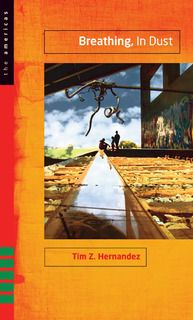
Tim Z. Hernandez -- Juan Bruce-Novoa
We also note the recent passing of another "Old Lion" of Chicana/o Lit, Juan Bruce-Novoa.
Tim Z. Hernandez
Texas Tech University Press, 2010
Tim Z. Hernandez is the latest writer I have read whose promise is obvious, whose talent is rich, and whose honest and unflinching debut novel, Breathing, In Dust, deserves a wide-readership and critical attention.
Hernandez comes from the San Joaquin Valley of Central California. His book is set in a fictionalized reflection of that land. Say “San Joaquin Valley” and we may reference Fresno, may understand the Steinbeck connection, and we most likely accept the importance of agriculture to the image of the Valley, one of the “breadbaskets of America.” Those of us not from this Valley may imagine verdant, massive farms; a hazy summer country life; a small-town American ideal. But Hernandez reveals an unfamiliar, hidden Valley. The people of Catela, the primary setting for the book, are swimming against the stream, drowning in day-to-day survival struggles, and losing the battle. Tim Hernandez gives his readers the heart of the American dream suffering from a weak and erratic pulse.
The San Joaquin Valley is plagued with poverty. For example, according to a 2009 article in the Golden Gate University Environmental Law Journal, written by Lloyd G. Carter, the Twentieth Congressional District, which includes a portion of the western San Joaquin Valley down through Kings and Kern counties, has the “dubious distinction of being the poorest of the 436 congressional districts in America. The region is rife with social problems ranging from high unemployment to gang and drug problems, high teen-pregnancy rates, an appalling high school dropout rate (25-35%), and other side effects of poverty.”
But, regardless of how compelling the statistics are, they do not tell the complete story. There is no humanity in the numbers. Revealing the humanity – the weaknesses and strengths, hopes and despair – is left to Tim Hernandez.
Breathing, In Dust focuses on Tlaloc, a teen-aged native of the Valley who witnesses and participates in the ebb and flow of life in Catela, a town on the verge of collapse from its own inertia. The book is a series of short stories that stand on their own, but together comprise a unique, satisfying whole. Tlaloc is the narrator, although he is not in every story, and he conveys Catela events in straightforward, sparse language, whether he is describing the life-risking adventure of “catching a train” engaged by bored and idle youth, or the bloody, cruel death of a pig at the hands of overeager and incompetent executioners. It is apparent that these and other similar scenes from the young man’s life will stay with him forever.
The people, too, will live with Tlaloc forever. These are the relatives and brothers-in-crime, girlfriends and enemies who participate in his coming-of-age and stimulate his imagination. The characters push and pull the reader. We pass through grief for the dying grandmother, pity for the abused wife, disgust for the wasted drug dealer, joy for unexpected love, and sorrow for neglected, already-lost children. We touch the bottom but never lose sight of the top.
Tlaloc is driven to express himself and eventually he turns to writing – to poetry to be more exact. When at last he is ready to publicly emerge as a poet, he undertakes a surrealistic journey to Los Angeles. This trip, filled with black humor and writer angst, almost caps off the book. But Tlaloc must return to the Valley one more time, after an absence of five years. He drops in on the bachelor party of an old friend, but all he can do is observe and second-guess his attendance at the drunken, chaotic celebration that he has clearly outgrown. This chapter ends with melancholy words that succinctly summarize Tlaloc’s final awareness:
“And then you get in your car and drive away. Wondering how long, or if, anyone will notice you’ve been missing.”
And isn’t that the way it is for most of us?
Breathing, In Dust is a fine example of extraordinary writing. As I said, the promise is high and the expectations are in place for more from Tim Z. Hernandez.
Tim Z. Hernandez
TZH This region of California is where I grew up, where some of my fondest memories of childhood are rooted, and yet today these rural central valley communities—veritable campitos—are inundated with violence, drugs, poverty, hunger, and all other imaginable and unimaginable disparities under the hot sun. The stories initially began as a way for me to remind myself of the good times of my youth but the strangest thing happened along the way. After writing the initial draft one summer, I realized that they were not as sweet as my recollection of them. I put the stories aside for a year and by the time I returned to them so many more incidents [in the valley] happened in the interim that I was forced to look at the manuscript in a different way. I now saw them from a removed vantage point, and then I realized that beneath the cloak of California’s image, some seventy years after Steinbeck’s magnum opus about the atrocities of the living conditions of dust bowl migrants, the very same caliber of calamity was still playing out beneath the shadow of the nation’s breadbasket. And it is precisely this byproduct of the agricultural industry that remains overlooked. That people here still live hard and often impossible lives. People here are still starving. Killing one another. Cooking meth in abandoned grain silos. Selling drugs from the back door of business fronts. Doing just about anything to make it from one day to the next. In the end I thought this information and perspective was important enough to put out there.
MR At the center of your connected stories is Tlaloc, a young man in the midst of searing human drama played out in the small farming town of Catela. How much of Tim Z. Hernandez is found in Tlaloc? And how much of Tlaloc does Tim Z. Hernandez carry?
TZH It is definitely a semi-autobiographical story. Some of the stuff in there I can’t make up, it’s just too crazy on its own merit. What is fabricated are the threads that bind the whole thing together, that is, the timeline and some of the background. Of course the town of Catela itself is a composite of several valley towns; Dinuba, Cutler, Orosi, Visalia, and Fresno. As for how much of Tlaloc is in me…I can’t say for sure, but certainly some of his choices and experiences parallel my own. But in the end, Tlaloc is really a composite of various people I know, and knew, while growing up. My intention from the get go was to play with the border between what is real and what isn’t, thus the photos that appear in the book. I wanted the reader to get a very real sense of this place I was talking about and the people who inhabit it. I wanted the reader to feel as if they were taking a tour through the valley and the town of Catela, guided by the narration of a young boy who has his thumb on the hard pulse.
MR Some of the stories are unhesitatingly downers. Your characters include tweekers, domestic violence perps, a dying grandmother, a killer, an absent father, and a strung-out drug dealer. People are in crisis or at the end of their rope. Catela is in worse shape than its inhabitants. And yet, Tlaloc is a poet. A poet who has to risk his life to do his first reading, but still, a poet. Is poetry really salvation?
TZH For me language was my salvation, and still is in many ways. Through language I make sense of things, or learn to let go of things, or start a dialogue, or continue a conversation with myself or others. Poetry was the most accessible for me when I began because a poem is immediate and feels necessary when at its best. This is what makes writing so attractive to the narrator of the book, Tlaloc. And I imagine what makes poetry so accessible to young people everywhere. The immediacy of it. The charged impulse to put experiences to words to paper to audience.
MR I’ve heard you read a few times – blows me away every time. The writing in Breathing, In Dust, is lyrical, with a rhythm that is almost musical. Did any of your stories begin as poems? Was the transition from poet to fiction writer a difficult one, a natural development, something else?
TZH The stories did not begin as poems, however, what they did have in common with my own poetry is that some of them began as stories in the oral tradition. I would tell them to audiences before entering a poem, or vice-versa. At the end of the day I consider myself a storyteller. Some of it makes it onto paper and some doesn’t. So the transition from one genre to the other was not difficult in that it felt like a natural progression, not forced at all. When it comes to writing I am not a purist. I believe that all genres and even artistic mediums are at my disposal when conveying a story or idea, and I have no hesitation about crossing these borders if necessary.
MR How would you describe the current environment for writers like you? By that I mean, what’s happening in the publishing world for a young Latino poet or a first-time novelist? Are you encouraged, optimistic, cynical, burned-out?
TZH Since I am still very new to the “environment” of the publishing world I don’t have much to gauge the current situation by. However, I will say this. Since I published my first book of poems six years ago, I have already seen publishers grow more cautious and less willing to take risks with material. I imagine so many great books are probably falling to the wayside because they are “not marketable enough.” I mean even now it’s harder to get poetry published than it was just six years ago. But I’m definitely optimistic about it. Everything comes in waves. Recently we’ve seen a lot of upstart independent publishers taking on poetry where other houses have dropped it altogether. I think the key is that wherever we see a gap or void in the publishing industry it’s up to us to fill it. That is to start are our own publishing ventures and not wait for someone to come along and make things happen for us. I guess I’m a perpetual optimist with a touch of cynicism, but the only thing burned-out about me right now is probably my carpel tunnel.
MR What are you working on now? When can we expect another book from you?
TZH At the moment I’m excited about two projects I am actively working on. The closest to completion is a novel-in-verse for Young Adults. It’s an extreme love story that combines a sense of Autobiography of My Dead Brother meets Fight Club. I expect to have it completed by this summer and I’ll be shopping it around shortly thereafter.
The second project is a historical fiction novel that’s been in the works for two years now, most of which has been research and outlining. But I’m very excited about it and I’m taking all the time I need to get it right. As I am quickly learning it’s a crazy balance between getting enough facts so that the writing is authentic, and telling yourself enough is enough and sitting down to do the work. I wont give you the particulars but I will say this; the subject is about a woman who by her mere existence—and without knowing—made a significant contribution to what would become one of the greatest North American novels of the 20th century. Without her, it’s likely that the book may have never seen print. Did I mention she is a Latina?
MR Quite a cryptic ending to a great interview. Thanks, Tim - and good luck with all your literary endeavors.
__________________________
Juan Buce Novoa passed away on June 11. An internationally renowned critic, Bruce-Novoa's insights, analyzes, interviews, essays, and literary theories contributed greatly to academic acceptance of Chicana and Chicano Literature as they simultaneously preserved the history of the writers and the writing. Among his works are Chicano Authors: Inquiry by Interview; Chicano Poetry; Retrospace: Collected Essays on Chicano Literature; and a novel, Only the Good Times. Several writers, including me, owe him gratitude and acknowledgment for his support, especially at the beginning of their careers, because of his many years of involvement with the Chicano/Latino Literary Prize sponsored by the University of California at Irvine. He was a unique man and will be missed. There is more about Professor Bruce-Novoa, including comments from friends and colleagues, at this site.
QEPD