The world's longest-established Chicana Chicano, Latina Latino literary blog.
Las Blogueras Los Blogueros
Click to email a writer. Denver CO • Pasadena CA • The San Fernando Valley CA • Eagle Rock CA • Lincoln NE • Glendale AZ • Santa Barbara CA • Lincoln Heights CA • Kansas City MO • Santa Monica CA
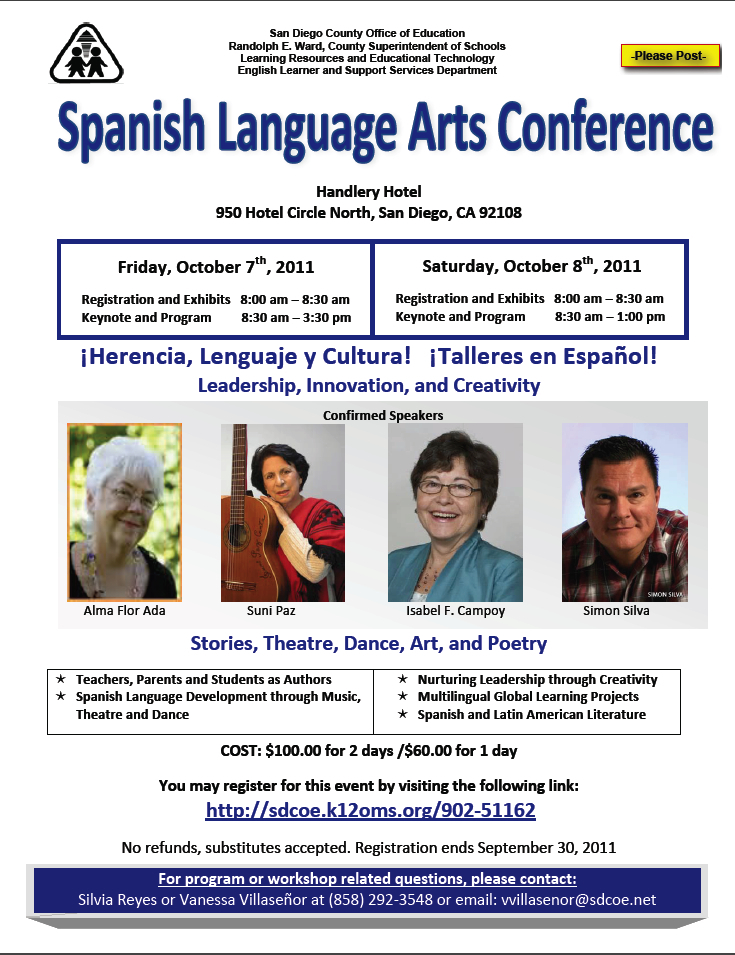
Friday, October 7th and Saturday, October 8th, 2011
Location:
Handlery Hotel
950 Hotel Circle North
San Diego, CA 92108
The goal of the conference is to assist districts to accelerate achievement for all students, eliminate the achivement gap, and increase parent and community participation, through professional development that nurtures and supports leaderships, innovation and creativity by promoting the integration of Language Development, Biliteracy and the Visual and Performing Arts.
Presenters
Alma Flor Ada, Suni Paz, Isabel Campoy, Simon Silva
Award Winning Authors, Musicians, Poets and Artists
Anne Bromley, Mara Price, Suzanne Santillan and Rene Colato Lainez will be signing books at the Reader's Inc Booth.
Rene Has Two Last Names
I found this book review on Youtube. Thanks aleciahana1 for the video.
Sergio Troncoso. From This Wicked Patch of Dust. Tucson: U of Arizona Press, 2011.
Paper (978-0-8165-3004-5)
Michael Sedano
A family saga featuring a large cast of characters can be tough to handle. A reader’s task of keeping track of relationships, incidents, and disparate unifying elements depends on the writer’s making multiple stories interesting. Noted short fiction writer Sergio Troncoso challenges himself to the task in his second novel, From This Wicked Patch of Dust. The reader will enjoy Troncoso’s decision to focus on the preposition in preference to wallowing in the adjective. The result is a chicano “American Dream” story about ordinary gente living unexceptional lives. Los Martínez are happy: how refreshing.
Oddly, the publisher’s website leads its blurb with drug fiend and gang-banger allusions, an odd marketing thrust. The novel steers clear of stereotypic victimhood and cruel tragedies, nor is it set against colorfully dangerous mean streets.
From This Wicked Patch of Dust is a breath of fresh air compared to novels populated with winos, dysfunctional families, men who beat and abandon their partners, alienated children. Sergio Troncoso doesn’t lean on tumultuous social and family upheaval to craft an arresting story of mom, dad, two sons, a daughter, and cultural migration. There's upheaval indeed, but Troncoso keeps it just outside the right margin, in the space between the turning pages.
Despite the ominous tone of its title, From This Wicked Patch of Dust is a novel about decisions, luck, and the pursuit of happiness in the early 21st century. The title is not a facile metaphor but irony borne of a young mother’s frustration. Brought to her knees the day she moves to Ysleta, Pilar shakes a handful of dirt and repudiates this place’s wickedness. By dint of determination, hard work and good character, Pilar and her family will prosper on this patch of dust.
Are Julia’s stars crossed because she carries the dross of her parents’ religious commitment like a noble burden? Poor Francisco grows into a shy, fat, cipher; didn’t anyone help? Marcos signs up for the national guard—to get away from his wife? For adventure? Because he’s a pendejo?—a decision that kills him. Can someone like Ismael be too smart but too ill-prepared for success?
The novel is told in the voice of the baby of the familia. Troncoso calls him Ismael. Confident and brilliant, by Ysleta standards, when the mocoso gets to Harvard on a full ride, the culture shock shakes his self confidence to its chicano core. Worse, he’s unprepared to exploit the opportunity, at one point expressing interest in law school but having zero notion of how to go about that. He coulda been a contender…
The author’s depiction of cultural change takes a decidedly inclusionist perspective, not always for the better. The parents are citizens of the United States and like many immigrants hold sentimental longings for things Mexicana but no love for Mexican social policy. They are from este lado now.
Pancho, the painfully fat and shy brother stays home his entire life to look after his parents and their rentals. When he finally finds love in middle age, she’s a local chicana. They are living happily ever.
Marcos goes off to UNM but returns home to teach school and marry a local girl, a blonde from the other side of town. He’s a rat of a man who faithfully serves his country in the National Guard but almost throws away a good woman when he falls in with a slimy Mexican American banker and national guard chopper jockey. Sent to Iraq, Marcos joins the five thousand men and women killed in that misbegotten invasion.
Julia is a casualty of faith. Finding conscienticized activism dissatisfying, she makes a conecta between Fatima the Catholic Saint and Fatima the Prophet’s mother. She freaks out and becomes Aliya, radicalized Muslim. Her story goes into exile with Aliya’s US-educated Ph.D. Islamist boss in Tehran. When we last see Julia Aliya she’s facing arranging a husband for her teenage daughter, when in Rome, sabes.
Ismael is picked by Lilah, a Jewish woman who fits right in with la familia, speaking adequately good Spanish. Lilah is a good breadwinner who loves her “Bear”. The nanny minds the kids so Ismael can write, house husband, and join the part-time float at Columbia. Ismael's stuff starts to sell. At Marcos’ closed-casket funeral, Ismael presents a story to his mother. In the story, the characters are, for the most part, happy ordinary gente who do not lead quietly desperate lives.
View the trailer for From This Wicked Patch of Dust, directed by Jesus Treviño. It includes excerpts from the novel and a message from the author:
La Bloga On-Line Floricanto
Francisco Alarcón and co-moderators of the Facebook group Poets Responding to SB 1070 advance four poets' work in this first On-Line Floricanto of 2011's tenth month, Claudia Hernandez , Raul Sanchez, Fernando Castro , José Hernández Díaz:
"¿Qué Más Quieres?" by Claudia Hernandez
"21 (After my presentation at the Juvenile Detention Center Seattle)" by Raul Sanchez
"La Nueva Luz" by Fernando Castro
"The Temple of the Feathered Serpent" by José Hernández Díaz
¿Qué mas quieres?
by Claudia Hernandez
You have
Crossed
My borders
You have
Drunk my
Parents'
Sweat
You have
Consumed La espalda
Cansada
De mi hermana,
De mi tía,
De mi abuela,
De mi madre.
You have
Tasted El arduo
Trabajo
De mi
Gente.
¿Qué mas
Quieres?
You have
Used and
Abused
Us
Nuestras
Costillas
Se han
Desangrado y
Quebrantado
Hasta los
Tuétanos
You have
Crossed
My borders
You have
Lost the right
To forbid us
To succeed
To pursue
El tal mentado
Sueño Americano
21
by Raul Sanchez 9-22-2011 (read it with a Hip-Hop beat)
navy blue tops 21
navy blue pants 21
white socks 21
plastic sandals 21
all in pairs y’all
all in pairs
among them
latino white and black
gang of three
rapping hip-hop hipsters
in the back jamming
to the rhyme microphone high
seventeen boys and four girls
perked up ears
even the yawning one
sat up straight
hands in the air
girls in the front
laughed and grinned
small steps to achieve y’all
last girl to the right
her attitude shined
glistened and listened
stretched on the chair
hands inside her shirt
not a huff or a groan
her attitude heavy than base
others moved, clapped in the back
young faces, no smiles on their faces
detained, arraigned, sad
all under 21 y’all
all under 21
La Nueva Luz
by Fernando Castro
It is the portly Mexican waitresses that keeps me coming;
their hirsute Frida Kahlo witch beards
and makeshift Mexican peasant uniforms,
can’t help but to be drawn to their motherly figures;
feel comfort under those hens spriteful skirts.
Solid nurse shoes grip the floor
even when customers have spilled orchata, slippery salsa splashes;
they watch me attentively as I order a ration of carnitas;
owlish stares that capture my flimsy tray,
and before I get a chance they have asked where I’ll sit;
grab an extra salsa dispenser to please me,
and direct me to sit by the porch facing Placita Olvera.
On weekends, tourists and locals fill the dining rooms
come back to Olvera Street as an urban pilgrimage
-- sad mockery of a Mexican Alta California.
They discover an alternate, tamed version of Mexico,
much closer and suposedly safer than Tijuana or East LA;
yet unaware of the Mexican core of Los Angeles.
Duos, trios of musicians sing old Los Pancho’s torch songs –
voices and guitars they no longer bother to tune.
They go from table to table until someone
breaks down and offers five bucks for a Bésame Mucho or Perfidia;
they depress me no end, but they do much for the borderlands decor.
On the Placita, the Aztec dancers strut the repetitive steps dictated by drums
and shell horns;
hefty men jump in discordant turns yet in unison: shoed in heavy guaraches;
peaccock headresses without which their costumes would be incomplete;
yet, how is it possible to prove authenticity after so many centuries of Anglification?
It must be exhausting to prance and shake, followed by younger apprentices
who cannot yet master the stamina of the elders.
Yet they all agree that their dance is a light that must be kept on
in memory of mythic Aztlan still occupied by yet another colonial power,
even if there is a zero possibility of seceeding from the union.
Pigeons and sparrows who have stolen our last grain of compassion
during the working week, scavenge oh so solicitous on weekends.
Their begging beaks come directly at your table for a morsel;
children love to give away their portions of tortillas
and the dried up tamales’ masa with so little meat, the bloating power of two cans of beer.
The statue of King Carlos III of Spain 1759-88
is there to remind us that in 1781 he ordered the foundation of Los Angeles
but Felipe de Neve didn’t get to it until September 4th, 1787
a date seldom anyone celebrates since it conflicts with the high festivities
of Mexican Independence Day, which in turn is confused with Cinco de Mayo
when Mexican restaurants, and even singles’ bars offer margarita specials.
Personally, I come to celebrate my adopted city of Los Angeles
sheltered from the bitter East Coast winters and so far away from my Colombian homeland.
I face Union Station and the millions of immigrants who have made this place home
and yet goverment has made our lives impossible at times.
The Mexican Cultural Center is next door,
oblivious and indolent to the injustices perpetuated on immigrants –
alarming news from Arizona, another province of Aztlan
whose hateful governor is having a tea party at the expense of braceros
and the porous border which is irrelevant
except when election time comes and a scapegoat needs to be found urgently.
SB 1070, the latest hate legislation du jour:
Why can’t Governor Jan Brewer and those sore losing republicans take a chill pill,
order tamales and share them with the aviary population,
take a picture with the burro with a mariachi hat and remember these lands belonged to other tribes;
remember that the Guadalupe Hidalgo Treaty of 1848 was a gun shot marriage deal!
"¿Qué Más Quieres?" by Claudia Hernandez "21 (After my presentation at the Juvenile Detention Center Seattle)" by Raul Sanchez "La Nueva Luz" by Fernando Castro "The Temple of the Feathered Serpent" by José Hernández Díaz
Claudia D. Hernández was born and raised in Guatemala. She holds a BA in Liberal Studies with an emphasis in Art and a BCLAD teaching credential. She is a bilingual educator in the city of Los Angeles and is currently working on a Masters in Multicultural Education. In her spare time she also writes, illustrates, and manually binds children’s books. She has written five children’s books, one of which (Julia Always Knew—Julia Siempre Supo) has been integrated into the curriculum for It’s OK to Be Different, a comprehensive elementary school program in the state of New Jersey that teaches children tolerance and respect for people who are different. Claudia has had photography exhibits throughout Los Angeles and has donated her photographs to various charitable organizations. Some of her photography, poetry, and short stories have been published in the Indigenous Sovereignty Issue of The Peak. Several of Claudia’s poems have been posted on the Facebook page, Poets Responding to SB 1070. In addition, a poem of hers will appear in an inaugural anthology published by Colectivo Verso Activo.
Raúl Sánchez is a Seattle Bio-Tech technician, prosody enthusiast, translator, and DJ, who conducts workshops on The Day of the Dead in Tieton WA. Featured in the program for the 2011 Burning Word Poetry Festival in Leavenworth WA. His work appeared on-line in The Sylvan Echo, Flurry, Gazoobitales, Pirene’s Fountain and several times in La Bloga. His most recent work is the translation of John Burgess "Graffitto" released by Ravenna Press. Also, he appears in the second Anthology by The Miracle Theatre Viva la Word!, Latino Cultural Magazine, on Bookmarks by the Seattle Public Library 2007 Poetic Art Project, and in the Anthology Speaking Desde las Heridas (Publisher: Universidad Nacional Autónoma de México). Lastly, soon to be announced his debut Chapbook! stay tuned.
Fernando D. Castro’s publications include Fernando’s Café, from Inevitable Press, 1998; The Nightlife of Saints, from TA’YER Books 2007; Redeemable Air Mileage, from TA’YER Books 2011; and contributions to more than a dozen anthologies. Fernando is also responsible for 25 anthologies of creative writing by youth and adults. For more than a decade, he has been an artist-in-residence in programs sponsored by such agencies as the California Arts Council, the City of Los Angeles’ Department of Cultural Affairs, and the City of Pasadena Cultural Affairs Division. He is the winner of a City of Los Angeles Department of Cultural Affairs COLA 2010 fellowship in Literature. He is a co-founder of TA'YER Multicultural Performance Collective, a non-profit organization that works with youth-at-risk, recent immigrants and the LGBT community.
José Hernández Díaz is from Los Angeles, Ca, and his parents are from Guanajuato, Mexico. He is a UC Berkeley graduate with a BA in English Literature. He plans on applying to MFA Programs throughout Los Angeles and California. Jose’s favorite poets are those of the Chicano Renaissance and the poets of the Beat Generation. José has been published in The Best American Nonrequired Reading Anthology 2011, La Gente Newsmagazine of UCLA, Bombay Gin Literary Journal of The Jack Kerouac School of Disembodied Poetics, ABCTales, Indigenous Writers and Artists Collective, Hinchas de Poesia, and he has had nine poems in La Bloga, including: The Border Within, In My Barrio (An Improvised Tune), I Haver Never Left, We Call It Work, An Ode to Los Jornaleros, Panadería Revolución (I Am Floating Gardens), The Jaguar Moon Has Risen, The Silent Corn Seed and The Temple of the Feathered Serpent. Jose has had poetry readings in Los Angeles, San Diego, Berkeley, at The Mission Cultural Center in San Francisco, and at The Museum of Latin American Art (MOLAA) in Long Beach, Ca.
Join the Hammer Museum’s residency with David Kipen's Boyle Heights lending library/used-book shop, Libros Schmibros, now continuing through November 5.
As part of this residency, David Kipen (pictured above at Libros Schmibros) will hold a conversation about L.A. with Sharon Sekhon of the Studio for Southern California History, Killer Crónicas: Bilingual Memories (University of Wisconsin Press) author Susana Chávez-Silverman, and Mike the Poet Sonksen, on October 6, at 5:30 p.m.
During the residency all visitors are welcome to borrow books for free or to keep one if they prefer. In the latter case, Libros Schmibros suggests a donation of half the cover price, except for Westwood and Boyle Heights residents, who are invited to donate just a dollar.
The Hammer Museum’s Public Engagement program seeks to create a new kind of interactive museum: an artist-driven visitor engagement program that encourages contact among visitors, artists, and Museum staff, and activates spaces in imaginative ways.
Public Engagement and AIR were established in 2009 thanks to a James Irvine Foundation Arts Innovation Fund grant. Via AIR, artists examine and respond to fundamental museum issues related to the visitor experience in an attempt to deepen the Hammer’s connection with its guests.
Libros Schmibros is a fiscally sponsored project of the Pasadena Arts Council’s EMERGE Program
For more information about this event, click here.
And...the University of Wisconsin Press has selected Killer Crónicas to be available on Amazon’s Kindle. Click here for information on this additional way to read this great book.
Finally, to read a La Bloga interview with Susana Chávez-Silverman, go here.
OTHER LITERARY NEWS:
◙ Last Monday, I interviewed Héctor Tobar regarding his remarkable and timely new novel, The Barbarian Nurseries (Farrar, Straus & Giroux). On Thursday, Michael Silverblatt, host of KCRW’s Bookworm, also interviewed Tobar which you may listen to here...it’s a wonderful discussion about Tobar’s novel as well as the City of Los Angeles, immigration, and the art of fiction writing.
◙ So much is happening at the UCLA Chicano Studies Research Center (CSRC) in the areas of art, literature and scholarship. Check out the CSRC’s website for details. One of the more important elements of the CSRC is the CSRC Library which is proud to announce the launch of its new Friends of the Library program. This organization has been established for educational, outreach, and fundraising purposes. Aimed at assisting the library achieve its mission and goals, members will act as liaisons between the library and the community that it serves. Members will enjoy not only unique opportunities for volunteering but also special workshops and other library events. The first will be the opening reception for Chican@s Collect: The Durón Family Collection on October 18, 4:00–6:00 p.m. This onsite exhibition highlights almost thirty years of collecting Chicana and Chicano art. If you would like to learn more about the Friends of the Library or are interested in joining, please contact the CSRC librarian, Lizette Guerra, at lguerra@chicano.ucla.edu.
◙ The new issue of Somos Primos is now live. Check it out!
Wangari Maathai (April 1, 1940- September 25, 2011) receiving the Nobel Peace Prize in 2004
The death of Profesora Wangari Maathai a week ago, a Kikuyu mujer, (Kenyan born), environmentalist, feminist, activist, Nobel Laureate is a great loss to all of us. For me, I grieve that my students will never meet her in person. She was supposed to arrive and give a lecture at my university last week (University of Nebraska-Lincoln). Two weeks ago, her agent called to cancel the trip. All they had said was she had taken ill. She died a week ago of ovarian cancer. I was never to meet her in person, but am lucky to say, I have been a devoted follower for years. Mi tio Pepe would have loved to meet Profesora Wangari Maathai. He was the first to tell me about her one day while he was busily unshelling peanuts. I was spending the summer at tio Pepe’s house in Guadalajara.
“Mijita,” me dijo, “esa mujer, la Wangari Maathai, es muy inteligente y es Africana. Acuerdate que los Mexicanos tienen raices de Africa.”
Mi tio Pepe often told me that our Mexican heritage included African raices.
“Si—por supuesto,” mi tia would also say.
Mi tio loved getting newspapers from all over the world and he would especially have me reading newspapers from primarily West Africa when he could get them. And there would be this fierce woman—Maathai—fighting with the government to allow women’s groups to plant trees. My aunt and uncle knew what Maathai was doing. Maathai, they taught me, was making connections among and between the well-being of the environment, climate, and poverty. She was working to provide jobs to women, encouraging them to plant trees in order to save the environment—years before anyone was talking about these connections, about land conservation. On one of those summers in Guadalajara, mi tio showed me a picture of Profesora Maathai eating peanuts during a break from planting trees. “Andale mijita, la nuez tambien compartimos con Africa.”
Years later, I realized how my tio’s penchant for peanuts helped me link the connection between the peanut and Africa. For years when I was in my tio Pepe’s small printing press workroom (that he had converted from a two-car garage), the floor would be covered with peanut shells ground down into little bits so at first sight one might think it was sawdust. Tio Pepe loved peanuts so much that when he died, we buried him with a good amount of peanut shells inside and outside of his thin humble casket. Peanuts were all around us, a reminder of our the slave trade in North America, South American, Central America: our Mexica (some scholars write: Meshica) heritage.
In Mexico, the Nahuatl name “Tlalcachuatl” is much more mellifluous than the English “peanut.” Before it reached North American shores on slave ships, the “peanut” had various African names. For example, the African Kikongo tribe called it “nguba.” The name took on a harder gutteral tone when many Bakongo people were taken into slavery. At some point within the slave ships or out on the cotton fields, the soft sweet sound of “nguba” took on the clownish name “goober” in the United States. Today in Mexico, Nuevo Mexico, en Los Angeles, Denver, Nebraska—wherever our gente lives, wherever Spanish is spoken (pretty much in all 50 U.S. states) we call the peanut “cacahuate”—a derivative from the nahuatl name.
“Plant a nut or a fruit tree,” Maathai would be quoted in the newspapers mi tio would have me read. She never wavered, speaking to the women in Africa, standing up to the men in government, most notably Kenya’s strongman, Daniel arap Moi who represented a government who wanted to take Nairobi’s central park for development. She saves so many parks, planted so many nut and fruit trees. Then she traveled the world, including Mexico, to tell others about the importance of planting trees, about the link between trees and the survival of the land, the connection with climate. And through this hard work, she founded The Green Belt Movement.
When she won the Nobel Peace Prize for “her contribution to sustainable development, democracy and peace,” there were many would wondered how planting trees could have anything to do with winning a Nobel Prize. In 2010 Profesora Wangari Maathai came to Mexico for the UN Climate Summit. She said, “[G]overnments must do what they have promised: take concrete action to reduce their emissions; deliver finance and work together to make low carbon development a reality; and protect those least able to cope with the impact of change . . . If we truly want to tackle climate change, poverty, and conflict, we need to think holistically. We need to, as Ban Ki-moon said at the launch of the UN global sustainability panel, ‘think big, connecting the dots between poverty, energy food, water, environmental pressure, and climate change.’”
Mi familia en Guadalajara understood the need for environmental sustainability and the importance of activism. They also understood the importance of recognizing and acknowledging our African history on both sides of the border, a heritage that is still not discussed enough or thoroughly among Mexicans, Latinas y Latinos/Chicana y Chicanos.
During the UN’s third global women’s conference in Nairobi in 1985, Maathai introduced her organization, The Green Belt Movement. Mi tia y tio called it, “el movimiento cinta verde de la Doctora Maathai.” This connection, as I learned from all those newspapers I read in Guadalajara, greatly aided her efforts in setting up countless programs in various countries (including Mexico!) to combat deforestation, water crises, rural hunger. Maathai had much more success in Mexico than she did in the United States.
May her efforts continue even though she is no longer with us! Que viva The Great Belt Movimiento! Que viva la Profesora Wangari Maathai!
For more information on la Profesora Wangari Maathai, just click here to see The Green Belt Movement website. Wangari Maathai: PRESENTE!!!
Las Comadres, LAPCA, West Hollywood Book Fair, and More...
by Melinda Palacio
Nora Comstock
photo by Saverio Truglia
Nora Comsock of the lower Rio Grande Valley didn’t imagine she’d lead the way to share Latino Literature and pioneer a movement networking Latino authors with readers across the country. Las Comadres has grown into a vast organization thanks to Dr. Nora de Hoyos Comstock, national and international Founder, President, and CEO of Las Comadres Para las Americas. Comstock has transformed the organization from an in home gathering to an international comadrazo with several services for authors and readers.
The businesswoman, with a technical background, understood the mechanics behind social networking before the term was coined. “I was a businesswoman,” she said, “but I also wanted a connection to my community, to my culture.”
In 1984, Comstock worked in computer marketing and communications: “I read manuals and created programs. I didn’t write software.”
Fastforward to the millennium, Comstock finds herself in East Austin. She wants to create community. She used her networking skills to help with the Las Comadres Book Club by sending out emails to hundreds of people. The email turns into a yahoo group, then an evite. The evite outgrows it maximum capacity, but more and more people want to join the conversation on Latino Books. The current result is an international teleconference with an author, a moderator, and hundreds of readers. Comstock is proud that she was able to grow the network of Latina women interested in books by Latina and Latino authors.
“If I understood software, I would be rich beyond belief, but I am not a programmer. I am a developer. I could make computers do things. I understood the package.
She kept up with the technology, and with the help of many others, including her husband, Jack Bell, Las Comadres is an international Latino book club with monthly networking opportunities for Latinas and much more. The Las Comadres website also includes Comadre University, online courses in topics as diverse as how kids (10-18) can start a business to The Slippery Art of Book Reviewing to How to Hire (or Fire) an Agent. Comstock is proud that she can share her love for books and her culture.
Next week, Comstock will moderate a literature panel at the 26thNational Hispanic Women’s Corporation Conference in Phoenix, Arizona, Thursday October 6 at 2:15 pm. The conference takes place over two days October 6-7 and features several professional development and leadership session. The Thursday literature panel features three Latina authors: Sandra Rodriguez Barron, author of Stay With Me, Kathy Cano-Murillo, author of Ms. Scarlet’s School of Patternless Sewing and of Crafty Chica fame, and Melinda Palacio, author of Ocotillo Dreams.
The next national book club reading with Las Comadres and Friends features Marisel Vera, author of If I Bring You Roses. Sign up for the next national teleconference, which will take place Monday, October 24.
This weekend in Los Angeles two literary festivals: Saturday the first Cuentos del Pueblo at LAPCA and Sunday, the 10th Annual West Hollywood Book Fair.
October 1, Saturday in Los Angeles join LAPCA for Cuentos del Pueblo, 12 to 5 pm.
On Saturday, October 1, 2011, the first installment of Cuentos del Pueblo will be held from Noon until 5 PM. This continuing series brings unique stories, perspectives, and opinion to LA Plaza, and invites visitors themselves to become part of the story. This event is free to the public, and discounted admission to the galleries will be available.
For this installment, nine Mexican-American authors will be on hand to discuss, sell, and sign their recent books, and share the personal, unknown, and unexpected stories that connect their work to the historical center of Los Angeles.
Throughout the day, music and stories will also be provided by entertainer, singer, and songwriter Mark Guerrero, son of the late, legendary singer, Lalo Guerrero. Raffles and prizes round out the day.
Attending authors include:
• Melinda Palacio, author of Ocotillo Dreams
• Roberta Martinez, author of Latinos in Pasadena
• Thelma Reyna, PhD, author of The Heavens Weep for Us and Other Stories
• Olivia Cueva-Fernandez, author of Mexican Americans in Wilmington
• Bert W. Colima, author of Gentleman of the Ring
• Alex Moreno Areyan, author of Mexican Americans in Los Angeles
• Francisco Balderrama, PhD, and Richard Santillan, PhD, authors, Mexican American Baseball in Los Angeles
I found the most interesting comic book I’ve come across in years at my neighborhood carnicería. It’s called Frontera Violenta. I’m not sure how to translate that. Frontera means both frontier and border in Spanish. In English -- especially in Norteamerica -- frontier means wide open spaces in need of heroic pioneers to go out and fill them with civilization, while a border is something that only nefarious criminals cross without official permission.
That’s the sort of thing arises when Wild West mythology collides with Mexican popular culture.
Frontera Violenta has Año XX in front of the issue number, so it’s been around for twenty years. It also has PARA SU VENTA A MAYORES DE 18 AÑOS on its covers. It’s not kiddie material.
The first issue I bought was No. 1199, “Perscucion Encarnizada,” (“Bloody Persecution”). Along with a blonde babe in revealing red dress was a naked man with a six-shooter aimed right between his nipples. The story starts with a blonde woman killed, her naked body displayed at the roadside. A bounty hunter arrives in town, and after a shootout in the bar he is hired to search for the Mexican that is accused of the crime. During the chase, the Mexican is betrayed by two blonde women before the real (blond) killer is caught and hung in the end.
To make things even more interesting is what I call the Brown Shift in Mexican comics. Either because of the four-color printing they still use, or long-held societal taboos, everyone is lighter than they would be in real life. Mestizos look white, Indians look like Mestizos, and white people -- especially the ever-popular blonds -- look like they should glow in the dark. In the above story the Mexican looked white while the bounty hunter looked Mexican.
I guess you can never tell without checking IDs.
At a more recent visit to the carnicería, I found a plastic bag with three issues of various Mexican comics, including Frontera Violenta for just $2.29 (that’s dollars, not pesos).
No. 1093 “Salieron del Infierno para Morir” (“Escape from Hell to Die”) has a blond thug kill a Mexican in a saloon. The Mexican’s son, goes out for revenge. After more fighting and shooting in saloons, the hunter and hunted wind up in a corrupt prison together. After the Mexican has a night with the commandant’s abused, blonde mistress, they escape. Once they’re out, the Mexican shoots the guy who killed his father.
No. 1114 “Obligados a Matar” (“Forced to Kill”) flirts with politics. Soldiers come to a village and take all the men away to help Presidente Díaz fight las fuerzas rebeldes. This allows a gang of Americano bandits, led by “Rush Clinton” to come in, take over, and make all the women into sex slaves. Humiliated and outraged, the women break out the household firearms, and revolt. The last bandit is shot by a boy hiding in la nopalera with a carabina 30-30.
No. 1121 “Cuando la Ley No Basta” (“When the Law is Not Enough”) begins in Mexico with a machete-wielding, sombero-wearing hombre hacking a woman to death. Two years later in New Mexico, some gringo bank robbers kill a young girl while shooting their way out of town. The girl’s mother is befriended by a Brown-shifted Mexican man who happens to be looking for the machete-maniac from the first bloody scene. The two go to wild and wooly Arizona on a revenge quest. The Mexican hero finds and shoots the leader of the bank robbers, and he and the woman have an outdoor sex scene. The next day, the machete man, shows up and takes the woman hostage, giving the hero his chance to get his revenge. Yes, a Mexican got killed at the end for a change.
Frontera Violenta is everything a comic book should be. No “graphic novel” pretensions to being art or literature. Just professional cartooning that makes the unashamed, thrill-packed pulp writing come alive. It’s the sort of entertainment to have in a pocket as you run around the Nueva Frontera, dodging bullets and talking care of business.
Ernest Hogan’s writing, and news of publications and ebooks can be found at Flurb and Mondo Ernesto.
Marisa Montes, 59, of Walnut Creek, CA, passed August 18, 2011. She was born in San Juan Puerto Rico on November 5, 1951. She died at UCSF Medical Center during a routine procedure.
Marisa was writer with a passion for Children's Book. Her publications included novels, picture books, and a Scholastic Series. She won many awards for her publications. The details can be found at her web site, www.marisamontes.com. At the time of her death, she was working on compiling an anthology of stories by Latina women about pivotal moments in girl's lives.
She was a member of SCBWI (Society of Children's Book Writers and Illustrators) and a member of the California Bar.
She was preceded in death by her brother Ruben E. Montes, Jr., M.D.
She is survived by her parents, Ruben and Maria Montes of Salinas, Ca; her husband, David Plotkin of Walnut Creek, CA; her sister, Marisol Ortiz of Victoria, Texas; as well as many aunts, uncles and cousins.
Her strength and passion for life, despite many physical disabilities, is remembered by all who knew her, including friends from across the globe. That passion translated into a zest for travel, and she and David cruised as often as possible, exploring the far corners of the world. That world will be the poorer without her.
La Bloga prepared this list of her wonderful work.
Juan Bobo Goes To Work. Illustrated by Joe Cepeda.
What can you do with a boy who tries to do things right but only leaves disaster in his wake?
Laugh—that's what! Readers everywhere will love to laugh at the hilarious antics of the ever-blundering Juan Bobo, Puerto Rico's most celebrated folk character.
In this rollicking Juan Bobo tale, our hero sets out to find work at the farm and the grocery. Although the tasks are simple and the directions couldn't be clearer, he always finds a way to bungle things up as only a character whose name means "Simple John" could!
Egg-Napped! Illustrated by Marsha Winborn
Gabbler and his wife couldn't be happier. They've just had their first egg! But during the celebrations, the Egg quietly tips, totters, and tumbles away -- and everyone thinks it's been egg-napped.
Come join this hilarious romp through the forest as the Gabblers and their friends search high and low for the beloved Egg. Young readers will be surprised and delighted from beginning to end as this wild goose egg chase unfolds.
Los Gatos Black on Halloween. Illustraded by Yuyi Morales.
Under October's luna, full and bright, the monsters are throwing a ball in the Haunted Hall. Las brujas come on their broomsticks, Los muertos rise from their coffins to join in the fun. Los esqueletos rattle their bones as they dance through the door. And the scariest creatures of all? Wait until you see them!
This lively Halloween poem introduces a spooky array of Spanish words that will open your ojos to the chilling delights of the season.
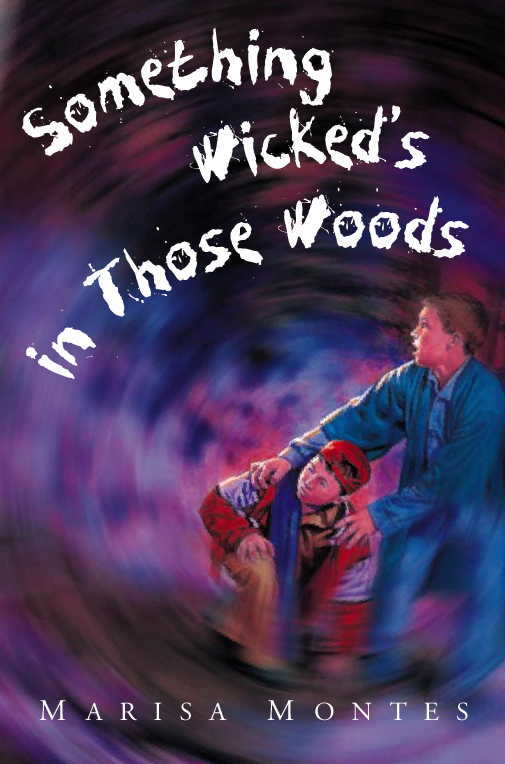
Something Wicked's In Those Woods
Evil. Eleven-year-old Javi Leál senses it the moment he and his little brother, Nico, arrive at their Tití Amparo’s in Northern California. The boy’s new home, surrounded by dark woods, is a world removed from the one they had to leave behind in sunny Puerto Rico when their parents died in a car crash. But it’s not the culture gap that makes Javi uneasy—it’s something much bigger, something sinister that he can’t name.
Strange things are happening around the house: Chairs fly mysteriously across a room. Appliances turn on and off by themselves. And Nico claims to have an imaginary friend—one who is teaching him English at an alarming rate. All too quickly the bizarre events intensify, and Javi must navigate dark, forbidding turf as he finds himself caught up in a struggle with supernatural powers. But time is running out. Will Javi find a way to protect Nico from the wickedness and rid his new family of the unearthly forces before someone is hurt?
A Circle of Time
A hit-and-run driver leaves fourteen-year-old Allison Blair to die on a winding mountain road, but a girl in a calico dress flags down a passing motorist and leads her to Allison's crumpled body.
As Allison lies comatose in the hospital, she hears the girl's voice in her head. Becky Lee Thompson pleads for help and pulls Allison back in time to 1906 -- and into Becky's fourteen-year-old body. But why? Is it to prevent Becky's tragic death or the death of Joshua, the boy who loves her?
As Becky's spirit keeps Allison alive in the present, Allison struggles to make sense of the layers of mystery, blackmail, and mistaken identity that surround the deaths. The only thing she knows for sure is that she must remain in the past -- through Becky's will and Allison's own growing feelings for Joshua -- so that history will be altered.
But in the present, Allison's body is undergoing brain surgery, and Becky does not know if she has the strength to keep Allison alive. Can Allison save Becky and Joshua and return to her own body before time runs out?
A Crazy Mixed-Up Spanglish Day. Illustrated by Joe Cepeda.
With her friends and familia by her side, Gabi* is ready for anything--sort of.Maritza Gabriela Morales Mercado (Gabi for short) has big problemas. Her worst enemy, Johnny Wiley, is driving her crazy. He makes fun of her name. He picks on her friends. And now Gabi has to spend an entire month working with him on a school project! Gabi is so upset she can't even talk straight. Her English words keep getting jumbled up with her Spanish words. Now she's speaking a crazy mix of both, and no one knows what she's saying! Will Gabi ever make sense again? Or will she be tongue-tied forever?
Who's That Girl? Illustrated by Joe Cepeda.
With her friends and familia by her side, Gabí is ready for anything...sort of. Gabí's getting new neighbors...and they are a big mystery. After a little investigating, Gabí discovers a pink and purple bike just like hers in the moving van--and that can only mean one thing: a new friend! Now Gabí, her BFFs (Best Friends Forever), and Abuelita (her grandma) are doing a little snooping to find out: ¿qué pasa? What's up with the mystery neighbors?
No More Spanish! Illustrated by Joe Cepeda.
Gabí refuses to speak any more Spanish. Ever! No es problema, right? Wrong. Gabí is only allowed to speak spanish at home. It's a family rule and her mami won't back down. Now, Gabí has to hablar Español or she'll get grounded for life! She just doesn't have a choice...or does she?
Please Don't Go! Illustrated by Joe Cepeda.
It's so hard to say, ¡ADIOS! Gabi LOVES that her abuelita is visiting. But she knows that sooner or later Abuelita has to go back home to Puerto Rico...unless Gabi can think up a plan to make her stay. Gabi tries teaching Abuelita to speak English, signing them up for kickboxing classes, & helping out with chores. But the whispered plans between her parents & Abuelita don't stop. Gabi's going to have to come up with something better, something BIGGER, something more...risky. But Gabi can't think of everything. And she's about to get a GRANDE surprise she could never have seen coming.
Marisa, gracias for touching the life of children of all ages.