Tuesday, August 04, 2015

Good Models. Flor de Nopal Workshops. On-line Floricanto

Reading Your Stuff Aloud: Magnificent Digital Resource
Michael Sedano

Magu's flor y canto drawing was the theme graphic for the 2010 festival
With the posting by USC's Digital Library of videos from the 2010 Festival de Flor y Canto, Yesterday • Today • Tomorrow, it brought a forty-two years long project to a satisfying close. There are hundreds of ways to find value in recordings of artists reading their work. Models to copy or avoid. Personal pleasure of seeing writers thirty years apart. Sentiment knowing some videos are the only record of the now deceased artist's voice. And, of course, the joy of hearing a writer read their stuff aloud. i am happy to have played a role in that.


USC digital library index grid. Selected performance plays in new window.
In 1973 I had photographed literature's first Festival de Flor y Canto, when I was a graduate student at USC. The backstage candids and performance portraits captured young writers starting important literary careers. For years I thought mine the only images of the historic event. Then I discovered a set of videos from the 1973 floricanto--one of only two extant collections--in nearby Riverside, I was able to make adequate digital copies of the outmoded U-matic tapes.

Returning the original floricanto to USC where it all began called for a celebration. Barbara Robinson, head of USC's Boeckmann Center for Iberian and Latin American Studies, received a Visions & Voices grant to put together a floricanto. I delight knowing Robinson bought the video set back when she was a librarian at UCR. The readings were coming full circle twice.

With generous support from the Dean of the library, the three-day festival of readings came together in a few months. The first day for Veteranos, a reunion of writers from 1973. The second and third days would combine active and emerging voices to round out the yesterday, today, tomorrow theme.

Jesus Treviño, founder of the video repository Latinopia, directed the videography for the three days, endeavoring to record every speaker and ample "B-roll" footage. Use this link to navigate to the digital library index page for both floricantos, and my still photography:  http://digitallibrary.usc.edu/cdm/landingpage/collection/p15799coll79
 

Flor de Nopal Festival: Doing It Right


In Austin Tx this weekend, Flor de Nopal kicks off a five month long literary festival whose scope and vision could transform the anonymous ESB-MACC into a nationally-renowned center for developing chicana and chicano literature.

The Flor De Nopal Writing Workshop, the first of four monthly workshops, begins at 2:00 pm on Saturday, August 8, 2015 in the Raul Salinas classroom of ESB-MACC.

Unless you’re an Austin local, you probably won’t recognize the location of the monthly Flor De Nopal Writing Workshops, ESB-MACC.


The Emma S. Barrientos Mexican American Cultural Center is an underappreciated cultural gem in the city of Austin’s parks system. Occupying a striking architectural monument, the institution engages its audience via no admission charge and free parking, while defining its identity through art classes, film series, gallery shows, and this year, the extended duration Flor de Nopal Literary Festival.

Beginning this weekend and continuing through early December, Austin Texas’ Flor de Nopal Literary Festival illustrates the kind of vision and planning arts organizations elsewhere might want to copy. This is the kind of program that can be replicated, and that should produce outstanding results.

Instead of a two- or three-day residency that comes and goes so fast, the Flor de Nopal model offers extended support to local writers who participate in four writing workshops across five months. In addition to the focus and continuity of regular workshops, writers attend a pair of large scale theatrical readings.


Serendipity smiles on festival organizers with the launch of Huizache’s 5th edition. The publisher will hold an October publication reading in association with Flor de Nopal. Workshoppers will be free to wonder if their manuscript is one workshop away publication in Huizache, the writer one submission away from being one of those writers up on stage.

Flor de Nopal’s mission statement declares its purpose “is to promote the work of Mexican American poets and writers, to create and nourish ties between writers, and to offer writing workshops to writers from all walks of life, and to aspiring poets and writers from our diverse community.”


On-line Floricanto. Five for Eight 2015
Michael Hureaux, Jackie Lopez, Armando Guzman,  Michael Martinez, Teresa González-Lee

This month, the Moderators of the Facebook group Poetry of Resistance: Poets Responding to SB 1070 nominate five poets to celebrate the year's eight month.

Hedy Treviño, who served as Moderator for many years, steps down with this, her final On-line Floricanto panel. Thank you, Hedy.


"Arab Spring" or the Balancing Act By Michael Hureaux
Border Disorder By Armando Guzman
The Confederate Flag By Jackie Lopez
Bicultural By Michael Martinez
Desde los arrecifes del silencio Por Teresa González-Lee


"Arab Spring" or the Balancing Act
By Michael Hureaux

Children who lived on that river which never froze
Created a thaw along the iced tightrope
It was though the banks were swarming
With Pharoah's daughter, each salvaging
A wailing beginning, and setting it afloat
To elude the swath of old men
Decked in the robes of the prophets.
On the more ancient street corners all of a sudden
It was recess where all the learned experts
Had for decades said recess would never come again.
Everyday for a month, the playgrounds were teeming
And nothing could herd the players or the game.
All nascent moves, aligned or otherwise,
Did a graceful flutter kick off the side of the jackbooted reality,
Performed a gallant header into the sawdust at center ring
Unannounced by the warlords in the starry wizard meters
Spent days in a brutal frenzied clench
And scaled that tower of bones built by the Murka mukks
Braved one more. Fall, as a child wood, or a troop of gentle tragic clowns
Hungry for the crackling warmth of a new reality.
Recess come again, despite the warnings of the specialists.
The work played to win.
For just a few hot seconds an army of way faring spirits
Held the attention of the world looking for
Other carnival masks, even harsh changes
If they brought the severe mercies of wild djinns.
The spring was a beautiful and agonized
Seeding of long sterile ground
And for just a few sweet moments
It was enough
To spur others forward
In Tunisia in Milwaukee in Athens in New York
In Lagos in Ontario in Belfast
In spite of what the experts said.
We happened. And we all saw us.
And we will happen again.


Michael Hureaux is a displaced creollo brat whose ancestry is hidden in France, the Dominican Republic and Louisiana.  He plays late life violin and is looking to find his way back to West African drum and dance.  He writes poetry sometimes.


The Confederate Flag
By Jackie Lopez

So, when she climbed the pole and pulled down that confederate flag,
she took down the memory of my crucifixion.
I was healed within a fortnight due to African medicine.
And, I think I shall write more happenstance than necessary:
He said, “I’ll break your back before I’ll break your heart.”
So, I stood in the rain and called out her name.
She said, “Give him plenty of Hell.” So, I became fire.
So with this fire I burn, burn, burn all flags everywhere because of all the lies.
The small,
the petty,
the brainwashing,
the media,
All stole boyfriends from me.
Team sports, that bastard, did the same.
So, I go outside to have a yogurt and talk to the trees as they are having their apple cider.
I tell them that there is nothing to worry about-soon, the Roman games will be over.
Ah, but when?
I walk past a school yard and hear, “Bitch,” “Spic,” “Cracker,” “Homo,” “nigger,” and “Wet-back.”
Only I know the teachers, also, say this to themselves when they get home.
I was once a teacher.
Nowadays, I just put-out.
There’s a little smile in the devilish hearts when one is made less.
They just call themselves the police.
So, when she climbed that pole, it was an act of sublime courage.
She was hot,
Awesome,
Cool,
Divine,
Courageous,
Intelligent,
Black,
Beautiful and
Worthy of capital letters.
And, I am just starting to give adjectives.
Don’t blame my color blindness.
Blame my most color worthy ancestors.
For they are the real players in my field of dishevelment.
Cut me down as soon as possible!
I think they will vouch for me.
I am a good person.
As are you, My Dear Soulmate!
Oh, when he thought I was a Southwest Girl, he thought I was a racist.
I do not join Latinos speaking evil. Nor do I join Whites.
I never join anything.
I inspire.
God Damn it!
I’m alive!!!!


Jackie Lopez is a historian who has come to the conclusion that there are no words to place in context the tumultuous life she leads.  At first, you see a distinguished figure who makes a lot of noise about history, social justice, healing, and all sorts of shamanism in San Diego‘s cultural centers.  At heart, she is a dancer and a poet who does not let go of the fact that she is  transcendental meditation.  When I ask her what she would  tell the people; all she answers is that it is in the soul where the healing lies.  Her aim is to plant seeds of enlightenment personality.  She claims that her poetry is beneficial to humankind because it awakens the “I am” process.  Recently, she has written a 120 page poem and is seeking a publisher for this.  Her poems have been published by Panhandler Productions, Warren College Literary Journal (UCSD) “The Hummingbird Review“, and Poets Responding to SB1070 face book page, Kill Radio, "La Bloga" and soon in the “North American Review.”  She can be contacted via email at:  peacemarisolbeautiful@yahoo.com, day and night.


Border Disorder
By Armando Guzman

I have a Border Disorder that is crawling in my skin.
There is no justice.
This hatred does not understand,
does not care for humanity.

I am a Desert rat with a Border Disorder.
There is a new name for this affliction;
It comes from the land of private prisons,
and the game is called Family Detention for Cash.

This Border Disorder runs in every drop of blood
running through my veins.
I can hear all the vile words the Copper State screams.

Do you not know that we are the Wild West???
This is the land of the big bad sheriff that has
special interests in the privatized prison system.
It is just good economics model.

I have a Border Disorder that has seen the inhumanity.
I have tasted the hatred;
and I have vomited upon the lies.

I am a Desert rat with a Border Disorder.
Racial profiling;
the new way of creating supply and demand.
Children in makeshift concentration camps.
We are going retro. .

I have a Border Disorder:
it steals funding from the education system;
gives free money to the prison system,
and it separates families.
This Border disorder dehumanizes
women and children.
When did being born become illegal?

I have a Border Disorder that does not let me
swallow the lies.
This Border Disorder feeds the humanity
that sustains my life force.

This Border Disorder keeps me from forgetting
the 43 students, of the thousands of women
killed and buried in mass graves.
I have a Border Disorder that calls for real justice.


Armando Guzman was born in the border town of Heroica Nogales, Sonora Mexico. He grew up facing the same challenges that other people face in a border town. Armando is a troubadour with a heart divided by the steel and concrete walls.  Es un producto de Heroica Nogales, Sonora y Nogales Arizona. He has published one chapbook, "60 Miles From Heroica."


Bicultural
By Michael Martinez

I am neither from here nor there
When society tells you to pick one side
Some of us are stuck on border lines
Being pushed and pulled but no compromise
On whom we are and where we belong
It was never our choice to begin with
But rather but rather to make others more comfortable
Let others decide where I’m supposed to be
let others decide my identity
Doesn’t matter, if I was born in this country
My English is weighted down by my Spanish accent
I listen to corridos and claim my roots in another land
Go ahead, question my existence,
claiming that i'm stealing an American dream hoping it blossoms
Like the tulips and trees planted in front yards
By the cheap labor of men with brown skin as mine
It doesn’t matter if my roots are deep in Mexican soil
My skin may be the same color as the land of my mother
But my Spanish is weighted down by an American accent
It gives me away as just another American
A minority in both lands
Carving my identity from scratch
Espanglish is my new dialect
reflecting the struggle of two identities
Being able to move back and forth
But never settling down in either one
Every time a part of me stays outside of conversation
can't be allowed in no matter how much it knocks
Being part of both but not belonging to either one.


My name is Michael Martinez and I am from Escondido Ca. I am going to California State University of San Marcos for Human Development with an emphasis in counseling. I started writing about two years ago and hope to keep going.


Desde los arrecifes del silencio  
Por Teresa González-Lee

    for 2015 Magee Park Poets

Soy mujer con labios
que han musitado el adiós
y tú borras mis sueños
dejándolos sin timón     a la deriva.

Tu corazón no quiso doblarse a descifrar
el código secreto de mis raíces culturales                            
tu corazón no supo esperar
el fruto en ciernes de nuestra ternura.

Por eso si ahora decides  
asomarte y esconderte
en  mis atardeceres virtuales    te prometo              
que esculpiré la letra de la
muerte del cisne.

Pongo en cero  la cuenta de
kilómetros recorridos por mi desposada ilusión            
mientras dejo tu nombre navegar
hacia la tierra de “Mejor olvídame, amor…”.

Soy mujer cuyos labios
ya  han gesticulado el adiós
desde los  arrecifes del silencio
hacia la voz que convierte el duelo en canción.


From the Cliffs of Silence  
By Teresa González-Lee 
    
I’m a woman whose lips
have hummed farewell
and you’ve  deleted
my dreams leaving them steer-less    adrift.

Your heart could not kneel down
and dig in to decode
deep inside my cultural roots
your heart could not wait
for our tenderly conceived fruit.

So, if you decide now to
pop in and out of
my virtual sunsets      I promise
I’ll craft the lyrics for a swan song.

I set back to zero the mileage
driven by my married hope
while I allow your name to sail away
towards the land of
“Better forget me, hon…”

I’m a woman whose lips
have whispered ‘adios’
from the cliffs of silence to the voice
that turns “mourning into song.”


Teresa González-Lee was born in Chile on August 23, 1942. She first came to the U.S. with a Fulbright Scholarship to study in Kansas where she obtained an M.A. in Linguistics. She later acquired a Ph.D. in the Golden Age of Spanish Literature at the University of California at San Diego.

She taught Spanish at Mira Costa Community College for nearly twenty-five years. She was the first bilingual editor for the San Diego Poetry Annual’s bilingual section. When Teresa retired, she wrote poetry and more poetry. She became friends with other local poets, she was eager to learn new techniques and she attended recitals and workshops all the time. On July 17, 2015, Teresa passed on; she leaves behind her son Hiram Lee-González, her 95 years-old-mother Maria, and her sister Nora González.

Poems courtesy of Hiram Lee-González, Biography excerpt courtesy of Nora González, and photograph courtesy of Charlaine Vitarelli

Monday, August 03, 2015

The Coyotes of West Hills

View from the author's backyard, West Hills, California.

An essay by Daniel A. Olivas

We bought our second home fifteen years ago by looking farther west in the aptly named community of West Hills, a move that served several purposes, both practical and psychological.  On the practical side of the equation, we wanted better schools as well as a larger home for our son, one that included a small but serviceable swimming pool, a near necessity for combating the San Fernando Valley’s infamous heat.  On the psychological side, our first West Hills home that we purchased in 1989 had been the center of great joy but also too-many miscarriages.  We had stopped using the third bedroom which remained closed most of the time, filled with baby furniture and similar items—clothing, toys, books, wall decorations—saved from our son’s infancy and which we desperately wanted to reuse.  We needed a fresh start.

Our new house is nothing fancy: a circa 1984 tract Tudor revival structure.  Comfortable, functional, efficient.  The selling point was not the house itself, but rather its location up in the Santa Monica Mountains with a view of the entire Valley.  It sits in the shadow of Escorpión Peak (also known as Castle Peak), a natural landmark that anthropologists tell us is one of nine alignment points in the ancestral Chumash homelands.  All types of creatures and birds live amongst the scrub and sparse grasses: wild hare, quail, roadrunners, a bobcat or two, and of course coyotes.

A few weeks after we moved in, I was brushing my teeth in our upstairs bathroom getting ready for bed.  I heard something that made me stop, mid-brush, to listen.  I heard what sounded like whimpering just beyond our fenced backyard.  But it wasn’t quite human.  The whimpering grew louder, going up in pitch, more aggravated, and expanded with additional participants, sort of a mournful chorus of Las Lloronas.  It eventually morphed into what sounded like maniacal laughter.

“The coyotes are having a party tonight,” my wife said as she saw my worried expression.  “Probably caught a hare—celebrating before feasting.”  My wife grew up in the San Fernando Valley and would know these things.  My old stomping grounds were near downtown Los Angeles, a bit of a drive from nature.  I finished brushing my teeth as the coyotes quieted down.  They must be feasting, I thought.  They’re enjoying a lovely meal in West Hills in an evening redolent with possibilities and hope.

Sunday, August 02, 2015

Testing Your Blood: The Importance and the Expense


Why read this post if you do not have diabetes, type 2?  Well, answer me this.  Do you know anyone with diabetes type 2?  (Click here for an explanation about diabetes type 1 and type 2.  For this post, I'm focusing solely on diabetes type 2.)  I’m guessing (especially if you are Chicana/Chicano or Latina/Latino) you will say “yes.”  You probably know a family member, a friend, a co-worker who has it. And if you have a child, know this statistic: 1 in three children born in the U.S. after the year 2000 will develop Diabetes.  Stay with me. 

Diabetes has become a widespread disease because it is exceedingly complex.  It touches all the multifarious and labyrinthine layers of our human body’s systems.  I’m talking about the cardiovascular, endocrine, respiratory, lymphatic, urinary, muscular, reproductive systems.  And because every body is unique (think fingerprint), the disease manifests itself differently in each individual.  That is why education is often lacking.  Doctors, nutritionists, diabetes cookbook authors, etc., tend to disseminate one solution to many without taking into account each person’s individual body and symptoms.  The impulse is to go for the simple, "one treatment for all" instead of taking the time to educate each patient toward a more complex and ongoing relationship with ones body, which is constantly in flux. 

So how can you truly get to know your body and/or individualize your diabetes management?  The answer lies with your blood.  Whether or not you have diabetes, your blood can tell you a lot about your health.  It can tell you if your blood glucose level is too high, too low, or stable.  It can tell you if your cardiovascular system is being compromised by plaque caused by an overabundance of glucose in the bloodstream.  You can truly become your own medical manager by becoming intimately connected with your blood.  But most people don’t know how much they can learn from a drop of blood.


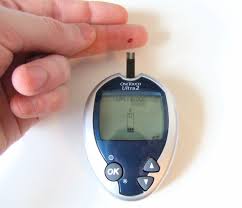
Finger is pierced. A drop of blood placed on a glucose strip.  The meter then reads the glucose level.

I can’t tell you how many times I’ve talked to people newly diagnosed with diabetes who say their doctor (1) told them they have diabetes and (2) prescribed a pill (most often metformin). I ask:  did your doctor tell you what your blood glucose was, or your A1C level?  Did they tell you what metformin does?  Most often they tell me “no” and that they don’t know what a normal glucose level is or what an A1C level is.  Then they tell me the doctor simply said to cut down on desserts. 

Today roughly 80% of individuals with diabetes are not managing the disease very well, and only 20% are successful at management.  What I mean by management is that the individual is able to keep track of her/his blood glucose levels and the individual is able to self-monitor and understands what to do when blood glucose levels are too high or too low.  Often, individuals are popping a pill or injecting insulin and continuing to eat whatever they want because they haven’t received education about carbohydrates, fiber, about how foods with a high glycemic load affect glucose levels (it's not about desserts). Exercise is crucial in managing this disease but the kind of lifestyle the average person in the United States leads does not often include exercise—especially for those individuals who are working long hours, who are living in areas where walking outside is too dangerous, whose family commitments are daunting.  Individuals with diabetes can be too busy placing other family members’ needs first before their own. 

Successfully managing diabetes demands shifting priorities, redirecting commitments and, unfortunately, management of the disease demands money.  Those who are working class or poor have much less means to manage this disease. If blood monitoring could become more affordable, if diabetes education were focused on empowering the individual to understand her/his own body, I believe the percentage of those successfully managing the disease (20%) would increase. 

The key, as I’ve said, is getting to know your blood and there are tools to do that. Here’s a quick lesson:


Glucose Meters
1.     Glucose meter:  not too expensive and sometimes they can be purchased with a discount.  They range from $5 to $30 (sometimes more).  The meter will come with a lancet device and lancets which pierce the skin (usually piercing ones’ finger) to draw blood.


Glucose strips
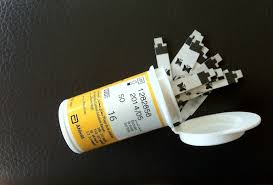
2.     Strips:  Here’s where it gets expensive. You place the strip into the meter.  After piercing your finger, the blood (just a drop) is placed on the end of the strip (see picture). 


Placing blood on the strip


The strip is designed (with enzymes) to react to blood chemically and transform it into electricity.  The meter will pick up the electrochemical signal translating the concentration of glucose into a number which appears on the meter. Because of the science behind the manufacturing of the strip, pharmaceutical companies hike up the price of each strip.

50 Strips come in one container (over $1.00 a strip)
In her article, “Anatomy of a Test Strip,” Dr. Erika Gebel, writes, “Little test strips are big business.  At Roche’s plant in Indianapolis, giant machines work around the clock to turn out test strips, a projected 4.2 billion in 2012 alone.  And that’s just one manufacturer.”  At a little more than $1.00 per strip (that’s without insurance), one container of 50 strips is in the $60 range.  And if you are testing more than once a day, the monetary hit can be painful. This is one major reason why individuals with diabetes stop testing their blood.  Here are other reasons: (1) some strips are not as accurate as others and it can be frustrating; (2) it can be difficult to get used to piercing one's finger but lancets are getting more sophisticated and less painful. The Genteel Lancet is the latest proven easy-to-use and painless device.  It really does work, but it's not inexpensive. Here's an article about the Genteel Lancet (click here).  


An article by Amy Tenderich (published in 2007) explained that test strips actually cost 8 to 12 cents to manufacture.  Manufacturers make between 60-80% profit on strips.  Illness in the U.S. is high profit for pharmaceutical companies.  Have you ever noticed how many commercials you see on TV that have to do with pharmaceutical drugs?  Check next time.  Billboards, magazine/newspaper ads, online ads--most often are from pharmaceutical companies.  And many of them have their own glucose strips to sell.  Do you ever see any ads about educating people to get to know their bodies, to understand how food and exercise actually works to heal the body, to keep the body healthy? There has to be a way to stop sacrificing the lives of so many people in exchange for profits.  If we work toward having every individual (whether they have been diagnosed or not) learn how to become intimately connected with their own blood and body systems, I'm convinced we can prevent or help individuals with diabetes successfully manage the disease.  Our lives depend on it. 

For other posts I've written or interviews I've conducted, see below:
1. Why Diabetes is not like any other Disease
2. Talking to Young Chicanas & Chicanos/Latinas & Latinos about Diabetes
3. Diabetes on Madison Avenue
4.  Creating Art from Diabetes
5. The Body with Diabetes:  Interview with Christina Elizabeth Rodriguez

Sending all of you strong healing and positive energies!  Abrazos!


Saturday, August 01, 2015

Today – Speculative fiction authors & art


Tejano David Bowles calls his work, "at the crossroads of myth and legend, genre and literature." Today he'll share some of it at Barnes & Noble Northcross in McAllen, Tex., from 2–3 pm. A reading from his YA fantasy novel, The Smoking Mirror, answering questions and signing books. He'll probably also talk about and share from his book, Border Lore: Folktales and Legends of South Texas.
  

Daniel José Older will be speaking, and reading from his Young Adult urban fantasy, Shadowshaper, at the Chilltown Lit Fest in Jersey City. 


Canadian-Chicana Silvia Moreno-Garcia, author of Signal to Noise, has a fantasy story called “To See Pedro Infante” that appears in Lightspeed Magazine, out today.


Lastly, award-winning artist John Picacio will be in Santa Fe later this month, offering prizes of his works, and a bit of gaming. Check it out.


Es todo, hoy, at least, that I know about.
RudyG, speculative fiction author Rudy Ch. Garcia