Friday, November 03, 2023

La Visión de Mi Madre

Here's a story from my collection The Skull of Pancho Villa and Other Stories.  It's based loosely on scenes I remember from my childhood.  The story was first published way back in 1986 as His Mother's Image.  Yes, it is a few days late for Halloween.  

______________________________


La Visión de Mi Madre
©Manuel Ramos


Tony died in Vietnam when a bullet from a high-powered automatic weapon tore out most of his intestines and stomach. At the instant of death, as his blood flowed into the dark, damp earth of the jungle, the ghost of his grandfather Adolfo walked up to him, cradled his head and murmured something in Spanish. Tony could see the old man smiling, tears in his eyes. The gleam from Adolfo’s gold filling reminded Tony how the light from the dining room lamp reflected off the tooth as the old man told the kids his stories of old Mexico, Pancho Villa, gambling with the devil, and, of course, La Llorona.

Tony would sit with a glass of pop, listening to Adolfo. The boy took a drink each time the grandfather sipped his bourbon. Adolfo’s voice boomed across the room in a rhapsodic mixture of Spanish and English flowing with poetry, curses, songs and other sounds the children did not understand. They all fit into the story at just the right time.

When Tony was eight, he visited the river for the first time with Johnny, his older cousin, and some of Johnny’s friends. It was a hot, dry summer with days that stretched for miles across the cloudless sky, yellow and lazy. They swam in a deep, still pool. Trees hid the place from the highway that followed the river for a short span outside the town. 

Tony floated for what seemed like hours, forgotten by the other boys.  The river was lower than usual, the trees more brittle, but the water was cool.

He thought of his missing mother and the father who was only a shadow standing over him in the night, tall and dark. He wanted to know why they were gone, why she had given him over to the grandparents, and he brooded in the water, unable to shake the feeling of desertion that engulfed him in the sticky heat of summer.

Tony drifted, almost asleep, when he noticed the change. The chicharras quit humming. Birds flew from the trees in squawking bunches. Then—silence. Tony opened his eyes, but the sun’s glare reflected off the water and blinded him.

He swam to the rocks, quickly put on his clothes and shivered. Johnny and his friends were gone. No wind stirred the wild grass. Smothering quiet lay on the river. 

“Oh-h-h. . . . Oh-h-h.” From the river, a noise Tony would remember for the rest of his life. The sad, melancholy cry surrounded him, stirred up an emotion he couldn’t understand, and Tony’s eyes filled with tears. The crying came from a woman who wanted something so bad it was killing her not to have it. 

Johnny found him at the river’s edge, softly crying that he wanted to help her. Johnny said it was La Llorona, and it was time to go home. As they walked away, Tony looked back at the river and saw a woman dressed in black, wandering along the bank.

That night Adolfo listened, nodded his head and declared, “La Llorona, hijo. The woman condemned by God to roam the earth searching for her children, children she threw away years ago.”

Adolfo held his glass of liquor in small, bony hands. The veins in his arms popped out on his skin. Their gray color deepened to blue as he drank more Jim Beam. His hair was thin and white, his moustache full and gray. Gold glistened from the corner of a smile that stretched from his black, moist eyes to the wrinkled, grizzled chin.

Jesusita hollered from the kitchen where she stirred a pot of beans. “¡Viejo! ¡Déjalo! These things are not for children. Mira, no más. You will make him afraid to go to sleep, afraid of his own shadow. Quítate con tus mentiras.” Her words were wasted on the old man and boy who were determined that the story be told.

“She was a young woman, beautiful, of course, with a dark, Indian face framed by long, rich, black hair. Every man wanted her, but she wanted only one—Don Antonio, rancher, richest man in the valley. And he fell for her, hard. They were more in love than two people have a right to expect in this world. They prospered in wealth, influence and happiness. They had three children, one after another, two boys and a girl who mirrored her beautiful mother.”

Tony had no problem imagining the mother and children. 

“That was where the love story went bad, niño. Don Antonio loved the children with a generosity that bordered on the hysterical. He showered the babies with gifts they couldn’t use for years—fancy mechanical toys, horses, clothes, even money piled up in their rooms. He watched over them with a singlemindedness that caused him to neglect his ranch. He gave them so much love that he had little left for his wife. Oh, he loved her, that was still true. But the feeling he had for the children was overwhelming, all powerful. And the woman could feel the difference.”

Tony marveled at the love a parent could show for his children.

“Soon the woman blamed the children for the lack of fire in her husband’s lovemaking. She saw them as rivals. She remembered the early days of her romance with the Don, the greatest love she had ever known, and she hated the children for taking it away. She had to do something, she was desperate, on the edge of losing everything she had ever wanted. She turned to the devil and his ways for help.”

Adolfo stopped and slowly sipped his drink. He stared into the dark liquid and rolled it in the glass. Tony waited, nervously anticipating the story. 

“Pues, tú sabes, ’jito. In those days it was much easier to deal with the devil than it is now. Brujas were everywhere. A person only had to ask the right one to get what he wanted. My own mother asked one for help for my father because of the illness he suffered for months that made him weak, unable to work or do much else. The witch gave my mother a smelly salve she rubbed on my father and it worked. It only cost my mother a few hours of work por la bruja.”

The old man whispered the word bruja each time he said it, making it sound sinister and threatening. 

“The woman sought the help of one of the bad brujas. Their plan was to take the children to the river, where the devil would trade Don Antonio’s love for the little ones. On the night of the exchange, driven by jealousy, she threw them into the rushing water.”

Tony gulped down the last of his drink and tried not to think of drowning babies. 

“Then, son, she learned the lesson all who deal with the devil must learn sooner or later. He doesn’t keep his part of the bargain. Don Antonio never loved her again, con razón. Se murió de sentimiento por sus niños. His last words were that he hated her and he would see her again in hell. She wasn’t that lucky. She tried to undo her evil but that was impossible. The bruja disappeared, and no other would talk to her, much less give her any help. Priests avoided her. Church doors were slammed in her face. La mujer se volvió loca.”

Tony heard the words as if they came from God. 

“She convinced herself that the children were alive. She said they floated down the river and were waiting for her to find them and take them home. She followed rivers to their end, crying for her children, but she never found them. To this day she wanders the earth looking for the children, crying for them. And to this day she is despised and hated for what she did.”

But Tony didn’t hate her; he thought he understood. She was a mother looking for her lost children, a woman like his own mother who regretted giving him away and now wanted him back. She was sorry and he realized he needed to go to her.

The sounds at the river were heard by others, and soon the small town was caught up in the myth of La Llorona. People parked their cars along the highway and sat on fenders and bumpers, cameras and binoculars pointed at the river. Women fingered rosaries and men had handguns hanging from their belts.

The older boys treated the story of La Llorona as a joke. They made ugly faces at the younger children and told crude stories about an old woman under the bridge. Johnny coerced his friends into searching for the source of the moaning. He wanted to show everyone that La Llorona was just another fairy story, another fantasy of old Mexicans.

Tony knew the truth. He spent hours planning how to bring his mother back to him, how to find her and lead her away from the maze she was trapped in by the river. Jesusita saw that he was deep in concentration and she warned, “The boy who spends too much time thinking is the one who ends up with more problems. Get out and play, ’jito, outside, con tus hermanos y no pienses tanto.” 

The night of the search, Johnny wore his best pair of khakis. His hair was brushed back in a ducktail. A gold crucifix hung from his neck. He put a card with a picture of the Virgin Mary in his wallet. He told Jesusita he was going to a movie and then spend the night at a friend’s. She didn’t believe him but she knew at seventeen he was almost a man and could not be told what to do by an old lady. She patted his arm and advised him, “Con cuidao.”

Tony decided he had to keep Johnny away from the crying woman. After Johnny left, Tony paced nervously, shouting and slapping at the younger children, driving them to tears with his craziness. When the house was finally quiet, all the kids and abuelitos in bed, he sneaked out the back door. He grabbed a bicycle and rode through the dark town to the river.

The day’s heat lingered. The night had a heavy, stuffy feeling. The air was clean and still. Tony rode under long, gray shadows cast by trees in the moonlight.

Details stood out. He saw numbers on houses, hopscotch patterns on the sidewalks. Fireflies flitted around the hedge near the library, where he turned onto the street that led to the river. A few bats circled the trees, but he ignored them.

He concentrated on the face of his mother. She was sorry, loving, eager for him.

Tony parked the bicycle at the edge of the woods and walked into the darkness of the trees. He avoided thick clumps of bushes and weeds. 

Bright stars hung over the hills beyond the edge of the highway. A dog or coyote howled in the darkness. Owls hooted sadly.

He stared at the river, the moon, the trees. No one appeared to talk to him, to take him home. He threw flat rocks at the river, immediately frustrated with his bad luck. He walked towards the bicycle.

“Oh-h-h. Oh-h-h.” The suddenness of the crying made him jump. It started low and soft, slowly increasing with intensity.

The wind stirred the trees and shadows danced on the ground. Tony felt the earth move.

The moaning was loud, vibrant.

He thought he saw shooting stars fall behind the trees. A cloud covered the moon and Tony was in darkness.

He heard footsteps behind him. He turned but there was nothing. He heard other sounds from other directions. Things seemed to move in the bushes. 

The moaning covered the sound of the river. The wind whipped dust in small whirlpools around Tony.

Tony knew he had made a mistake. He did not belong near the river looking for a woman who drowned children. He tried to calm himself with thoughts of his lost mother, but they were not the good ones he needed. He wanted to be home with his grandmother, with the flesh and blood person who loved him and cared for him better than any imaginary mother. He wanted to run but he forgot where he left his bicycle. Sobs came out of his throat in hiccups.

Then he saw her.

The woman in black walked to him with open arms. She was beautiful. Coal black eyes pierced into his, asking him to come to her. “Hijo . . . niño. Vente conmigo, tu mamá. Niño-ohh . . . niño-ohh.” Her voice reminded him of the train whistle he heard rushing by every night. 

Dark red lips formed a kiss she blew to Tony. “Niño . . . corazón, niño-ohh.” Her hands beckoned him. Tony stepped towards her, driven by his need to know.

“Run, Tony, run!” Johnny hollered from a hundred yards away. Tony saw him running, holding a long stick in his hands. He started to tell Johnny it was no sweat, man, this was his mother, his old lady.

A loud hiss stopped him. His beautiful mother changed into an ugly, grotesque creature. Lumps and oozing pustules covered her skin. Ragged teeth grinned evilly at him. Patches of scalp gleamed beneath strands of wispy hair. The eyes were red-orange balls.

She lunged at him.

“Run, Tony, run. Get the hell out of there!” 

Fingernails scraped his back. He dodged her by twisting as he ran to Johnny. “Move, you little shit. Run! Run!”

It grabbed Tony. He felt a warm, slimy arm wrap around his waist. He smelled the sweet, putrid odor he remembered from the time he found a dead chicken in the coop.

He screamed.

He kicked at the thing that had him. He saw a light flash, felt a thud on his back. He fell to the ground and though he tried to stop, he threw up. He sobbed into the earth until Johnny picked him up and carried him to the car. 

Years later, as Tony again lay crying in the dirt, in a place he had not known existed, Adolfo told Tony he knew what had happened, and he was sorry he couldn’t have helped the boy back when he was sick with fear and loneliness. “But hijo, now you can rest. You can come home with me.”


Later.

__________________________


Manuel Ramos writes crime fiction. Read his latest story, Northside Nocturne, in the award-winning anthology Denver Noir, edited by Cynthia Swanson, published by Akashic Books.

Thursday, November 02, 2023

Chicanonautica: Memories of Palenque

by Ernest Hogan

They say that the social media is bad for creativity, but sometimes it delivers inspiration like a sniper’s bullet through the frontal lobes. I found an interesting news item about construction of the Maya Train uncovering a tomb. I shared it on Facebook and Twitter with a comment about my having fond memories of Palenque. Then those memories came flooding back. Talk about fun.


Hey, I should write about that! So here we are . . .


In 1982, I accompanied my sister Carol on a trip to Mexico. My Spanish was a lot better than hers, and I don’t think our parents would have let her go alone. I owe her an eternal debt for it. Whenever I go to Mexico, it changes my life . . .


We went to Mexico City, Oaxaca, and the Yucatán, visiting a lot of archaeological sites. For the sake of brevity, here, I’ll concentrate on our visit to Palenque.


We did a lot of train and bus travel. It was fantastical and Kafkaeque. I was reminded of Juan José Arreola’s story The Switchman, a magic realist piece where fake landscapes line the railways, passengers never end up where they intend to go, and often are persuaded to start colonies in some undeveloped territory.


I have been tempted to steal the idea and expand it to a galactic scale. Hell, it’s what will probably happen, if it doesn’t already exist . . .


Palenque is not just the name of the Mayan ruins. An old guy I asked for directions joked about las ruinas actually being the town. A fellow tourist told us, “You can’t get to Palenque.” It took some determination, but we made it.


The town was surreal. I’m not sure how accurate my memories are. I have an image of a street on a hill, breaking off into a cliff out of which there was a drainpipe, and a feathered serpent jaw carved into the rock. Could be confabulation. There’s something about this part of the world that makes your realism magical.


Getting to the actual ruins was a real adventure. The bus driver couldn’t have yet been in his teens. He was tinkering with the engine when we found him. He wore aviator sunglasses, an unbuttoned shirt, shorts, and sandals. A cigarette hung from his lips. He had a cynical smile that grew more intense when hit bumps on the winding, cliff-hugging road and his passengers went airborne. And he loved taking those curves fast.


The ruins of Palenque were amazing.


The Lacondon jungle—now home of the Zapatistas—surrounds them like a high, living wall. They were so thick I was sure I would get lost after a few steps. I felt that it wanted to devour me. A local man trotted into it with a rifle on his shoulder and his dogs leading the way.


Looking up I saw the edges of the jungle, like a huge open mouth. The air was full of butterflies, above to them, large dragonflies, and above them, hawks. Concrete poetry.


Palenque is famous for being the location of the pyramid with the carving that Erich Von Däniken claims depicts an ancient astronaut. I suppose it looks like that if you don’t know much about Mayan art or space travel. More likely, it’s information about the mummy that was found beneath it.


I did see things that suggest a sci-fi-ish reality:


A small, onsite museum had a skull that could have been a prop for a science fiction movie. It’s probably the result of the well-documented practice of skull shaping.


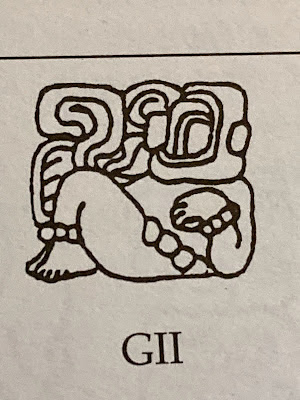
There were also disturbing carvings of humans in the arms or strange humanoid creatures. The intimacy often did not look consensual. They are similar to glyphs of the Burden of Time, but quién sabe?


Back in town we made an astounding discovery. A used comic book shop! These were Mexican comics. A lot of them were sci-fi. I recognized some as translations of American comics from the Fifties. Probably unauthorized translations.


It was run by boys about the same age–some younger–as that daredevil bus driver. I wonder what happened to them? Have they written any science fiction? Did they become Zapatistas?


Zapatista futurism. Is that a thing?


Now the Maya Train chews through the Lancondon jungle, spitting out its own future, Mayalandia, out to give Disney World a run for its money. I do wonder what it would be like to tour la ruinas in such high tech luxury. I also feel sorry for those who will not have strange adventures like mine.


Ernest Hogan, the Father of Chicano Science Fiction, has been wandering through Planet Nevada, NoCal, and Sasquatchlandia, and will be blogging about it soon. And judging the Somos en escrito Extra Fiction contest.

Wednesday, November 01, 2023

TEPOZTECO’S BELLY


Written by José Agustín


ISBN:  978-1-55885-982-1

Format:  Trade Paperback

Pages:  112

Imprint: Piñata Books

Ages: 12-18


This entertaining adventure story about Aztec gods introduces teens to Mexican indigenous traditions.


Alaín’s parents have a home in Tepoztlán, outside of Mexico City, and he invites a group of friends to spend the long Mexican Independence weekend there. They can’t wait to hang out, play video games and climb up to the Toltec pyramid that’s in the town! 


Once there, the city kids meet some of the locals, including Pancho, who’s about their age, and his mother, a curandera who does cleansings. The young people are thrilled to be able to watch the indigenous ceremony that involves copal incense, candles and rubbing an egg along the body. But more exciting is Pancho’s invitation to explore a large cave he has recently discovered. 


They set out early the next day and find the cave entrance without too much trouble, but soon things get weird. In the huge, dark cavern, they encounter an assortment of odd people. Before long, the friends realize they’ve accidentally entered Tepozteco’s Belly, where the ancient Aztec gods live. Mother figure and the goddess of sustenance, Tonantzín, and Xiutecutli, the lord of fire, want to help the kids escape, but others, including the fearsome earth mother goddess Coatlicue, want to subject the intruders to a bloody sacrifice! Soon the gods agree to a test to decide whether they will live or die. Introducing teens to Mexico’s pre-Hispanic culture and religion, this adventure novel blending fantasy and myth races to an exciting conclusion sure to satisfy young readers.  


JOSÉ AGUSTÍN, a native of Guadalajara, Mexico, is a journalist and author of numerous books. The Spanish-language original of Tepozteco’s Belly, La panza de Tepozteco, was published in Mexico in 1992.

Tuesday, October 31, 2023

Guest Writer: Nikki DeNecochea, Su Ultima

memory
Editor's Note
Michael Sedano
“We have nothing but time.”

Betty summarized our Memory Club gathering. Our fellow caregivers, living with different progressions of dementias, talk about our medications and disappointments, deteriorating status quos, our undying love for a disappearing partner. Our outlook grows dim. Our souls are hopeless. 

The four of us fight despair and look forward to talking to people going through their own versions of the same process: a brain breaking down kills a loved one’s cognitive abilities. Finally, dementia takes a spouse’s life from us. Everything we caregivers speak about has the same inevitability.

“We have nothing but time,” Betty spoke. She was hopeful for it, the time.

A year and a half passed since that conversation. Today all we have is memories. Time ran out for both of us. 

Death and dying are elements of dementia and caregiving no one talks about. It's yet another hard fact about the enormity of living with Alzheimer's or another cognitive disease. Unspoken words tend to bear great weight and value.

Guest writer Nikki DeNecochea shares the most intimate moment in a caregiver's experience, that moment of transition. 

La Bloga thanks our returning guest for sharing these moments. Dementia is a growing disease in the United States. Being aware is a way of preparing for life with Alzheimer's. Diagnosed with your partner's dementia, all you can do is prepare and endure and enjoy; all you have is Time.

SU ULTIMA
Nikki DeNecochea

It had been a day of dread and one for feeling the weight of my heavy heart.  I believe anxiety to be my comfort from total panic, and my self-protection.   My mother is ready, I am not.

 “Pay attention” is the urging of that voice that accompanies me each of these last days.  It seems I’m being asked to pay particular attention, throughout this June day.   Don’t panic, breathe, and comfort her is repeated to me.  

“Be aware” -- my ancestors taunt. 
  
All the signs are here I was being readied to be her ultimate solace, on her last night.    It would be the day that no one is fully prepared to accept -- losing a mother.   And, not one of those routine ‘get ready for bed, lock up, lights out’ kind of nights.  It was to be my mother’s last night.  Su ultima.  

On this eve she’s beginning her hard exit, and the struggle was getting noisy.  Death is noisy to the last inhale, and then the heavy silence is equally intense. 
 
This day would be different from all others.  Something extra-sensory was going on. Guides seemed to whisper, “Ayudala mija” as I felt directed to help ready her to let go of the rope suspending a freefall.  Together, moving into the last night toward her last dawn, clinging tightly to the reality of it all. 
 
I admit that there was a self-protective nudge to numb-out and reside in comfortable denial.   “Not today.  I can’t today. Maybe tomorrow, if I’m wrong and she doesn’t transition,” I think to myself.  

Today is the day.  

Our final unspoken obligation was identified and accepted without either of us ever exchanging a word, sealed by our souls, long before this last night.  She was obligated to leave, and my obligation was to let her go.  

My providence – to be the last person she heard and felt, as we held hands, and I stroked her brow while speaking softly of things that had nothing to do with death and everything to do with our lives together.   My final ofrenda to her, and my purpose was to be the conduit for her soul’s release and to help her receive all the hope and love of all who came before, waiting, waiting, waiting for her to join them.   

I imagined them giving us their ofrendas of peace and calm. She would speak of them to me, in those last weeks, and point in the direction of their spirits in the room, saying, “Ya quieren que me vaya.” So real to her, she would squint to see them, and lower her head with a laser focus to see better.   These visions were patient and forestalling.  

 It was the last time I spoke to her of her life and parents recalling her shared stories. I spoke of her children and grandchildren, and of her closest lifetime friends to fill the room with their presence, so we didn’t feel so alone.    My intent was to calm her spirit with meaningful memories, as she made headway toward releasing her soul.   My ultima ofrenda and thanks for the life she gave was to be her light on this eve.     

With it came blind faith and a calmness of purpose.    
The room glowed with candlelight and music from her era, and some from mine.  I sang the lyrics so that she could hear that I was next to her.   Or was I calming myself and my fear of this night’s inevitable loss?   

Generous to the end, she shared her deathbed with me, as we lay on her pillow that smelled of her and captured the warmth of her head.  We shared our body heat under her favorite blanket, as she began the final glide.  Hand in hand, ear to ear, and heart to heart as all those bouncing atoms in the room began transforming her soul into stardust. 

At dawn, she was gone.   

Outside, a new day, with an unexpected envoy.  A hummingbird, with full courageous intent, made its way from the yard of color and flowers, zooming under the patio cover and in a suspended flutter she buzzed and hovered inches from my face, as I sat making cell calls to announce my mother’s exit.   

Gracias, Mamita.   The hummingbird brought a resounding message and symbolic gesture on her part and a thoughtful, and reassuring ultima despedida – her last farewell.   In gratitude, I rose to return to her cooling body and summoned all her guardians to raise her and strengthen me for what is to come.   And as if by ancestral imprinting, I opened the house and windows, smudged her body and the room with white sage and invited her spirit to su ultima.

Beatriz De Necochea 

Thursday, October 26, 2023

A Día de Los Muertos Flor y Canto y Calenda: Santa Barbara

 Melinda Palacio


*This column was first published in the Santa Barbara Independent on Thursday, October 26, 2023

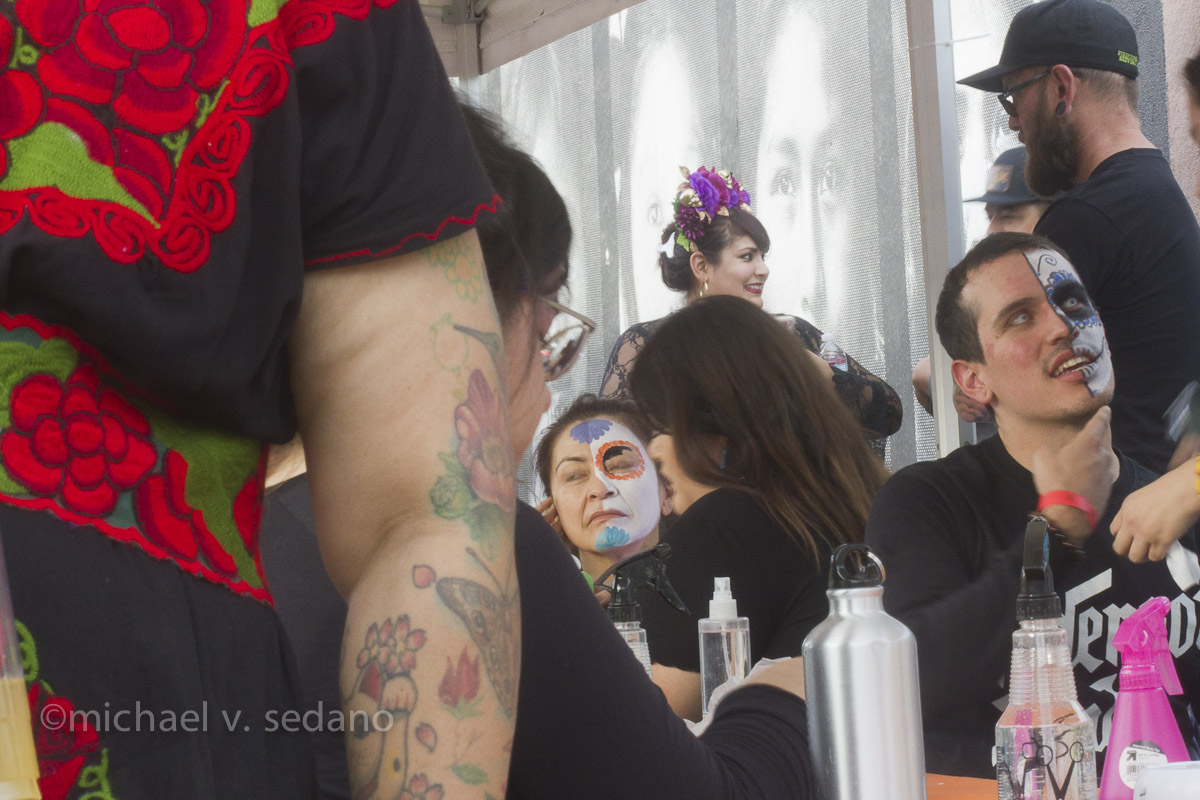
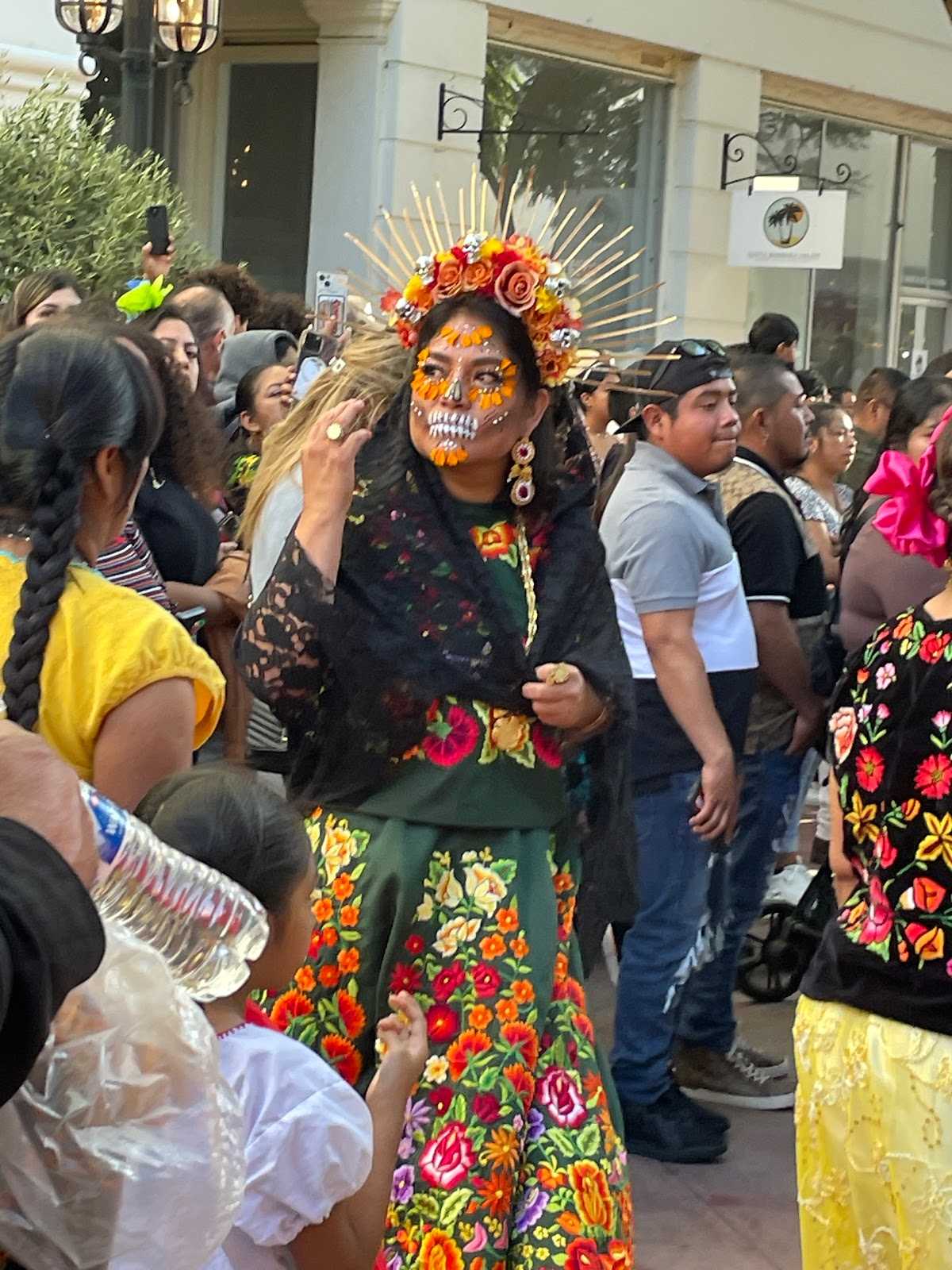
During a day-long celebration of the Day of the dead, Santa Barbara came to life. The community celebration and Calenda was something the city of Santa Barbara had never experienced before. I am very grateful to have participated in the procession and in the Santa Barbara Museum of Art’s pre-Calenda activities. The Santa Barbara Museum of Art outdid itself with altars and activities for the whole family. Many people sported their flower crowns and decorated skull necklaces. The Día de los Muertos activities made for a colorful audience. While people waited in costume for the calenda, some dropped by to hear poetry and song in the galleries. 


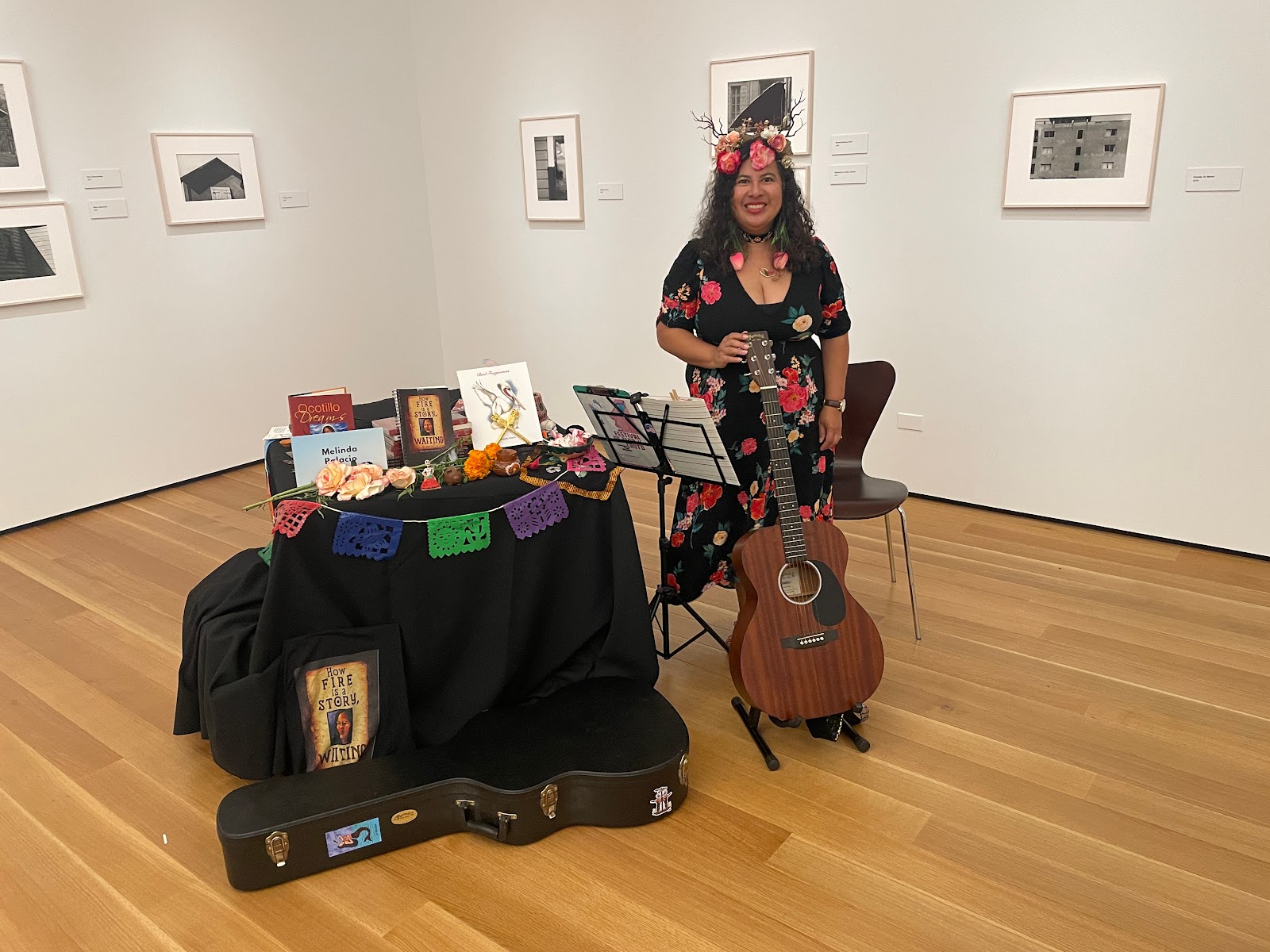
I prepared a small altar in honor of my muertitos. The museum suggested three fifteen-minute sets of poetry and music. In hindsight this format would work better in longer sets. I was also dressed for the occasion and my flower and twig headdress made managing my microphone headset a challenge. 


The first set focused on poems from How Fire Is a Story, Waiting and the companion song I had written for the book. The first audience was made up in large part by a tour group. A few friends attended and it was so nice having familiar faces in the audience. The museum’s tall ceilings meant that sound became dispersed. I made a mental note to purchase a proper microphone and stand for situations where one was not available. 


 An hour later, I presented my second set, which consisted of poems from Bird Forgiveness and the theme song, written for guitar. The Bird Forgiveness theme song was based on a poem, “What the Birds Know,” about my time taking care of my grandmother during her last month of life. I have many poems and songs that honor my deceased loved ones. I also presented a tune that was born a song, Love Always Wins. This was a big breakthrough for me because I am fairly new to playing music and writing songs. I wrote my first song four years ago. I wrote Love Always Wins this past summer after a friend suddenly passed away. 


Some of my favorite poems have been assignments or requests. Many people ask me what is it I do as Poet Laureate and a large part of the Poet Laureate duties is to write poems for various occasions or institutions. I wrote an inaugural poem when I was installed as Poet Laureate at City Hall, a poem for the Santa Barbara Botanic Garden, and, recently a poem for Perla Batalla, who asked if I wanted to read poetry during the musical interlude of her La Llorona set at the Margorie Luke Theater. I was thrilled because I’ve been a longtime fan of Perla Batalla and her music. She has gorgeous voice. Her version of the song La Llorona is a favorite. Reading the poem on stage with her and her band and daughter was a dream. 


My third set for the Día de los Muertos celebration was my La Lllorona set. I read the poem that I had written for Perla and played the companion song that composed. In the mythology of La Llorona, she is a woman who wanders and hollers in search of her children. There are different stories, in one of the more popular stories, La Llorona (she who cries) drowns her children because her lover does not want them. In my poem, La Llorona is tasked with helping the children who have crossed the border and who are alone. She is redeemed. I was humbled to be able to share this poem and song as part of the Santa Barbra Museum of Art’s Día de los Muertos celebration. By the third set, the audience was filled with people in costume, faces painted, everyone was ready for the Calenda procession to paseo nuevo and the Museum of Contemporary Art for the final stop with tamales and aguas frescas. 


Last Words to La Llorona

Melinda Palacio


The poet’s coffin is made of books.

She said, bury me with my books, 

Send me down the Rio Grande.

Even La Llorona needs to read. 

Llorona, I dedicate this poem to you.

Read these pages before my coffin sinks into mud.


If the ink should bleed onto pebbles at the bottom

of the river, do not worry.

I have memorized them all. I will sing to you.

But please, cover me, for I grow colder.


I know where you went wrong, Llorona. 

You are here and this is my last flor y canto.

On the river we will float on a song. 

My last dying wish: Protect the Children at the Border.


Children have left their homes with nothing

But a name and a flower embroidered on their sleeves.

Llorona, redeem yourself, redeem them, redeem me.

Aye de mi Llorona, ayudales. Save the children. 


La Respuesta / La Llorona’s Response

Melinda Palacio


I have come to take your hand, child.

Don’t think you’re in a stranger’s land.

Don’t you know I’ve always been here

You belong here too.


First, they came for the children

Then they came for the land

Built a wall so high, crushed butterflies

To a fine pulp, their royal wings discarded.


When I met the Devil, 

his cloven hooves wanted to dance.

I knew better. I will not lose again.

My children died in this river.

I will escort you out of this hell. 

What they say is a lie.

He alone has jailed the children.

All at the border.


Musings on the Novel, Pedro Paramo


     For me, the novel Pedro Paramo is Mexico’s Moby Dick, its Don Quixote, its Crime and Punishment, probably even, its Inferno, except for one major difference, what took Melville, Cervantes, Dostoevsky, and Dante hundreds of pages to write, Mexican novelist, Jalisco’s Juan Rulfo, wrote his masterpiece in 124 pages.

     Maybe it's just Halloween and Dia de Los Muertos, and as I walk the streets, I see calaveras and goblins hanging in neighbors’ front porches, plastic boney skulls, hands, and feet protruding from the front yard graves, as if deleting the lines between life and death. Maybe, it’s because I’m aging, and thoughts of mortality and immortality are on my mind, so Rulfo’s 1955 novel becomes more real.

     It’s been a while since I’ve read Pedro Paramo, but it remains embedded in my psyche. I first assigned it to an advanced English composition class back in 1995, and I’ve probably read it dozens of times since, its main character, Pedro Paramo, in my face whenever I hear tyrants inflict atrocities on people somewhere in the world.

     Literary critics proclaimed Pedro Paramo a masterpiece in Mexican and World literature, but I’d never read it until I assigned it in class. In college, I minored in Spanish and majored in English, but in 1977, I changed my major to Spanish to take advantage of a fellowship to study in Spain.  

     Spanish teachers in American higher education taught as if only literature from Spain had relevance in the Castellano language, or what most people call Spanish. Even the few Chicano teachers in Spanish departments assigned mostly books from the Iberian Peninsula; though, they’d begun to explore works from the America’s, mostly the big boys, like Borges, Neruda, and Garcia Marquez. So, I don’t remember hearing much in the classroom about Mexican literature, except by a few renegade professors who mentioned names, like Azuela, Castellanos, Rulfo, and Fuentes, giants in Mexican literature.

     By 1995, I had tenure, so I could assign whatever I wanted. Also, I figured my community college English students needed to know there were literary masters beyond the limits of British and American writers. They also existed in France, Russia, Spain, and, yes, Latin America. So, as the deadline approached to submit my book list, I scribbled the words Pedro Paramo, by Juan Rulfo, Grove Books, on the form, stuck it in an envelope and dropped it off at the bookstore. This was before everything became electronic.

     I had a couple of weeks before classes, so I knew I’d better read the novel to discuss it intelligently in class. Once I received my complimentary copy, I sat down and started reading, the opening line: “I came to Comala in search of my father, a man named Pedro Paramo.” Easy enough. Okay, I got it. I can deal with that, kind of like Mexico’s version of, “Call me Ishmael.”

     So, I read on, as the unknown narrator stated, almost as if whispering: “It was what my mother had told me, and I promised I would go and see him after she died. I assured her I would do that. She was near death, and I would have promised her anything. ‘Don’t fail to go and see him,’ she told me. ‘That’s what his name is, although they sometimes called him something else.  I am sure he would want to know you.’”   

     I’m not sure I read it correctly, or I completely understand, something of a mental disconnect. The words sound more like murmurs, and I feel as though my world is shrinking, like I am alone with two people, a dying woman and her son, and they’re pulling me into a death scene. It smells of death and reminds me of my own family and friends’ dying, emotions that can’t be described in words but only felt.

     The narrator continues: “The only thing I could do was to tell her I would do it and, after saying it so often, it became such a habit that I continued repeating it, even after I managed to remove my hands from her lifeless hands.”

     Not only is Rulfo assaulting my senses but also my reason. I start asking questions, the key questions, who are these people and where are they? Is the narrator talking to us, the readers? Talk about critical thinking.

     My eyes move to the next lines: “Before she died, she also told me: ‘When you go, don’t ask him for anything. Demand that he give[s] you what is ours.  What he should have given me and never did…  Make him pay dearly, my son, for the way he has neglected us.’

    “Yes, I’ll do that, mother.”

     This doesn’t sound like any story I’ve read before. Who is making whom pay for what and why? Who are these voices, and why is a mother, on her deathbed, making her son promise revenge on a man, his father, who, it sounds like, took everything from her? My mind reels. I hear echoes of Joseph Conrad and William Faulker. The narrator’s voice is haunting, addictive, like it’s coming from some place unknown. So, I go where he leads.

    “I never really intended to fulfill my promise. But now I have started to dream about it and be filled with illusions.  After that a new world began to take shape, based on the hope of a man called Pedro Paramo, the husband of my mother.  And that’s why I came to Comala.”

    He said, “The husband of my mother,” instead of “my father.” He also implies he is already in Comala, not journeying there. Comala, such a strange name for a village, like comal, a hot platter used to make tortilla, symbolism?

     The opening, or exposition, was from one fragment of many, which, eventually, together, tell the story of Pedro Paramo, a man described as, depending on the translation, "pure evil," "human bile," and hatred personified, who murders viciously, with impunity, and is ultimately responsible for the destruction of Comala, not unlike many strongmen, politician, and corporate heads, modern day caciques, responsible for death around the world, personifications of evil. Was this Rulfo’s Mexico, or even Rulfo’s view of the world?

     Rulfo writes, ignoring a traditional structure in plot, character, setting, or narration. The voices within the fragments, like vignettes, tell the story, like fallen leaves from a tree, pick up a handful, toss them into the air, and however they fall, they tell a story.

     So, as I read, the characters appear, often with no context or reference, like spirits from the grave, Eduviges Dyada, Dorotea La Curaca, Miguel Paramo, Susana, Father Renteria, Juan Preciado and his mother, Dolores, whose voices we hear at the beginning, el Tartamudo, various revolutionaries, unknown peasants, all dead, yet think they are still alive. 

     Since there is no beginning, middle, or end, it is they who tell the story, the villagers of Comala, as they recall its once rich harvest to its final desolation. It isn’t until you finish the book do you know the story of Pedro Paramo and Comala, like so many old villages throughout Mexico, like those in Jalisco, Rulfo’s home state. 

      It is said that Rulfo, a government employee traveling throughout Mexico, stood in an abandoned Jalisco village, a ghost town, and wondered what it would be like if the people who lived there returned, and so was born the novel, Pedro Paramo.

     Books and dissertations have been written about the novel, about its richness, symbolism, Christian and pagan references, European and Aztec representations, like the name Pedro Paramo. Pedro, the name Jesus bestowed on the apostle Simon, whom Catholics call the first pope of their church. Pedro originates from the Greek Petros, or Petras, which means stone or rock, as in the original Aramaic. So, when Jesus told Simon, “Thou art Peter and upon this rock I will build my church,” Rulfo took the name for the main character, as a religious symbol.

     However, unlike the apostle Peter (Pedro), Paramo’s namesake, or as Mexicans say, tocayo, Rulfo juxtaposed the name with "Paramo," a barren plain, a wasteland, a soulless entity, evil swallowing the good, God versus the devil, heaven or hell, maybe purgatory, or the Aztec underworld, where the god Mictlantecuhtli rules. 

     As a descendent of Mexicans from villages, like Comala, did my ancestors, my great-grandparents, grandparents, uncles and aunts suffer revolutions, pestilence, and starvation, like the villagers in Rulfo’s novel? Did they live in towns controlled by caciques like Pedro Paramo, trapped some place between heaven and hell? Did death hang closely about them, or did they feel trapped by the laws of a church that threatened their existence in this life and the next, so they chose to celebrate death? Is that why they came north, in search of light to escape the darkness?

     Sure, Pedro Paramo is just a novel, and a good one, written to educate and to entertain; however, it leaves readers, all readers, asking so many questions about the lives we lead, where we have been, and where we are going, for that alone, it is a powerful testament to the human spirit.     

Wednesday, October 25, 2023

MARIANO’S FIRST GLOVE / EL PRIMER GUANTE DE MARIANO


By Robert Casilla 


ISBN:  978-1-55885-983-8 

Publication Date:  October 31, 2023

Format:  Hardcover

Pages:  32

Imprint: Piñata Books

Ages: 5-10


The life of an acclaimed major league baseball player is recounted for kids. 


Mariano Rivera, a record-breaking major league baseball player, grew up in a small fishing village in Panama. His father had his own boat and wanted his son to follow in his footsteps, but Mariano didn’t want to be a fisherman. He loved baseball!  


Without money for equipment, the boy and his friends had to be creative. They improvised a mango tree limb for a bat, made gloves out of cardboard and wrapped a rock in shredded fishing nets and tape to create a ball! Even though Mariano was the smallest, he was quick and athletic, and he constantly practiced hitting, catching and throwing to improve his game.  After high school, he worked with his father, but when their boat sank, he was more convinced than ever that fishing was not for him! 


He started his baseball career as a shortstop for a local team, which made it to the national championship two years in a row. A New York Yankees scout invited Mariano to a tryout, and soon after he was hired to play for a minor league team in Tampa, Florida. He joined the New York Yankees in 1995 and went on to become a great relief pitcher and top closer, helping his team to win five World Series. He broke the record in 2011 for the most games saved as a closer, and in 2019 became the first major league player to be voted into the Baseball Hall of Fame with 100% of the votes. With engaging text and lively illustrations by acclaimed artist Robert Casilla, this book is sure to win many young fans.


ROBERT CASILLA was born in Jersey City, New Jersey, to parents from Puerto Rico. He has illustrated many children’s books, including Pat Mora’s The Remembering Day / El día de los muertos (Piñata Books, 2015) and First Day in Grapes (Lee & Low Books, 2014), which received a Pura Belpré Honor Award. He lives in New Fairfield, Connecticut, with his wife Carmen.