Tuesday, February 19, 2008

Oedipus the Pinto

Report: Luis Alfaro's adaptation of Sophocles' Oedipus Tyrannos, Oedipus El Rey. A staged reading performed at the Getty Villa, Pacific Palisades, Califas.

Michael Sedano
The recently completed run of Oedipus El Rey’s four performances has been one of those only in Los Angeles classical theatre experiences made possible by the Getty Museum's Villa Theater Lab. Last year, it was Culture Clash’s uniquely staged Aristophanes The Birds. This year it has been Alfaro and earlier in February, Ellen McLaughlin’s one-woman original work, Penelope. Upcoming in April and May are Director Michael Hackett and actor Henry Goodman with Sophocles Philoktetes, followed by Chicago's Lookingglass Theatre Company in a new work, Icarus. At $7 a head, the Getty offers the best bargain in El Lay arts (add $8 for parking).

Alfaro’s done it again with Oedipus El Rey, turning in a remarkable treatment of other people’s material. A few years ago it was Black Butterfly, Jaguar Girl, Piñata Woman and Other Superhero Girls Like Me, turning short fiction and poetry by the superb trio of Alma Cervantes, Sandra C. Muñoz, Marisela Norte into a devastatingly funny and moving masterpiece. Then it was Electricidad, borrowed from Sophocles, that, unlike Black Butterfly, made it to the Mark Taper main stage. Now Alfaro has adapted Sophocles’ Oedipus Tyrannos moving it from plague-ridden Thebes to a modern-day California. Joined by director Jon Lawrence Rivera and a superb cast with first-among-equals Marlene Forte’s Jocasta, Oedipus El Rey will breathe new life into classical drama, and educate a new generation to the actual meaning of “oedipal”.

Evidently, such renewal is long overdue. Alfaro laughed at the audibly stunned college audience Friday night when Justin Huen’s Oedipus comes to his own realization that the man he killed on Highway 99 was his father, which means Oedipus’ wife is…gasp!! These young people must have been reeling at that point, as they thought back to their laughter following the torrid mating scene when Huen and Forte undress one another then spend three weeks cavorting in bed.

There is not much laughter in Sophocles’ play, but Alfaro injects a hugely hilarious Sphinx into the action. The Million Dollar Farmacia on Broadway is run by a three-headed critter straight out of rasquachi teatro with a strong affinity to the twin-headed beast from Men in Black 2. After solving the riddle, the old gals are out of business and the Pico-Union barrio returns to its old order. Here the overlay of ancient Thebes upon modern LA doesn’t work so well and is stretched too thin. Oedipus and Jocasta have the community’s respect. They behave like cold-hearted Don Corleones rather than the gangbangers in the news whose power derives from intimidation and extortion, not doing favors for community people while maintaining a kingly dignity and honor. And therein lies the major problem with this work-in-progress.

Turning stereotypes on their heads is part of the job description of a revolutionary poet, to affirm what would otherwise be vilified even within la cultura . And when a gifted poet is himself a pinto, his themes and images resonate with gut-wrenching authenticity. Which is why work of the late raúlrsalinas, “A Trip Through the Mindjail”, and Ricardo Sánchez, “Soledad”, should be included in any anthology of letras chicanas, along with such non-pinto pachuco poems as José Montoya’s “El Louie”, Tino Villanueva’s “Aquellos Vatos”, and J.L. Navarro’s “To A Dead Lowrider.” Powerful work that was necessary for its time.

But that was the 60s and 70s. Chicano culture has reached a kind of maturity today, and there’s less, if any, requirement to lionize our criminals. Pintos are not heroes, and they’re certainly not gods. Yet jail is where Luis Alfaro starts off his work-in-progress Oedipus el Rey, and pintos form his Chorus. It’s a strangely inappropriate starting point that Alfaro explains in the program like this: “the more versions (of Sophocles) I read, the deeper the themes of the play started to take root inside my head. I began to obsess about the notion of destiny. Well, of course, that little idea kept me awake for endless nights. Aren’t we all masters of our own destinies? That got me thinking about the sizable population that makes up our ever-expanding prison system.” Destiny? That got me thinking what about our kids who see the military as their only chance off the block?

Fortunately, Oedipus El Rey will change and grow. As Alfaro and director Jon Lawrence Rivera (pictured right,left respectively) noted during the post performance Talkback session on Saturday afternoon, Alfaro didn’t have much of anything finished even as the superb cast came together for the first rehearsal. Rivera, Alfaro, and presumably dramaturg Christopher Breyer (his name didn't come up in the Talkback), indulged the playwright’s stream of consciousness for this set of staged readings. I hope they’ll iron out the prison wrinkle in favor of something more appropriate both to Sophocles and for a contemporary audience. That noted, John H. Binkley’s spare set is beautiful and need not be changed in a finished production. Stainless steel cables hang from the ceiling suggesting the cages these men live in, and a handful of black chairs. Elizabeth Huffman’s costumes are a few red shawls, two shirts for Huen, two dresses for Forte, the other actors appear in their streetclothes. Dark glasses and cane for blind Tiresias (Winston J. Rocha) constitute the props.

I attended in the company of two high school girls. As we left the auditorium, I asked them how they reacted to the graphic profanity of the opening three minutes. “We hear worse than that in school every day,” they answered in unison, not that they enjoyed it. Their mother shrugged helplessly at that truth. Although the Getty forewarns, “This workshop contains adult themes and strong language”—it is Oedipus after all so adult themes definitely come with the territory. But strangely, only that opening dialog featured foul language. Worse, it was neither artful nor funny, neither authentic nor effective. I’d like to sit Alfaro down and pull his ear about that crap, encourage him to find what Villanueva said about his vatos, they were “uncouth but squared away”.

The cast includes gente you’ve seen and will continue seeing on television, movies, and regional theatre. Laius is Geno Silva, perfectly mature and powerful. Michael Manuel as a sappy Creon. Javi Mulero, Daniel Chacón, Bobby Plasencia play several roles but especially the three-headed hilarious Sphinx. Híjole, guys, don't change a thing, in fact, give us more!

That's the view from the coast this penultimate Tuesday of 2008's leap year February. Ordinarily, La Bloga runs Monday through Friday and many Sundays. RudyG's delayed Valentine on Saturday is a good reminder it's always good to check in on weekends, a ver que pasa. Remember, La Bloga welcomes and encourages guest columnists. Let us know in a comment or an email that you have something to share. If it fits, if it's finished, let La Bloga's readers share it with you. We love your comments, but La Bloga apologizes in advance if some spammer drops their piece of you-know-what on our pages. We'll delete it as soon as we notice it. Until next Tuesday, hay les wachamos.

mvs

Monday, February 18, 2008

Survival story: Gilb is at his finest in new urban coming-of-age novel

Book Review by Daniel Olivas

[This review first appeared in the El Paso Times]

Dagoberto Gilb's new novel, The Flowers (Grove Press, $24 hardcover), is a ruthlessly potent portrait of urban distress as seen through the eyes of a young man.

The story's focus is Sonny Bravo, a precocious 15-year-old living with his mother and stepfather in an unidentified large city suspiciously suggestive of Los Angeles.

The first sentence lets us into Sonny's fractured world as he recounts breaking into homes: "Not that many years ago I would go to a house in the neighborhood, not always someone's I knew, one I'd never been inside of, where I'd only have to maybe hop a fence, nothing complicated, and from the backyard I'd crawl through an open window."

But Sonny was not a burglar in the usual sense. Rather, he broke into these homes principally to see "how the people lived, imagining how it would be in their house." He wished his life was as orderly and "normal" as those displayed in framed pictures in these homes: "Husbands in suits and wives with necklaces and old grandparents from the other times way before."

Sonny is now forced to live under the authoritarian rule of his new stepfather, Cloyd Longpre, who manages the apartment complex they live in known as "Los Flores" (Cloyd intended to name it "The Flowers" in Spanish but erroneously used the masculine pronoun "Los" instead of the feminine "Las"). Cloyd is a churlish, gun-owning Okie, but he's also a ticket to financial stability for Sonny's beautiful mother, Silvia. Sonny feels nothing but anger for his domineering stepfather and puzzlement over his mother's decision to marry him.

Sonny must earn his keep, so he is assigned chores such as sweeping the apartment's sidewalks, cleaning window screens and taking out the trash. During his duties, Sonny meets his neighbors and, before long, becomes entangled in their complicated lives.

Sonny is seduced by Cindy, a sexy 18-year-old drug user who is often left alone by Tino, her dangerous husband. Cindy is bored and carelessly uses Sonny almost as a plaything as she shapes him into a lover to her liking. Though at first captivated by the attention and sexual education, Sonny eventually sees Cindy for the troubled person that she is and becomes repulsed.

In direct contrast to Cindy is Nica, a Spanish-speaking Mexican girl who is forced to stay at home all day to care for her infant half brother while her parents work. While Sonny's interactions with Cindy are mired in alcohol, drugs and unloving sex, his budding romance with Nica is tender, innocent and idealized.

Gilb fills the apartment complex with other idiosyncratic characters such as Pink, an albino African-American man who, to the consternation of Sonny's stepfather, sells old cars in front of the building. Pink befriends Sonny, but the boy wrestles with suspicions that Pink is using him. And there is Cloyd's drinking pal, Bud, a redneck construction worker who proudly espouses a deep hatred for anyone who is not white - despite the fact that he is married to a Mexican-American woman.

By end of the novel, Sonny has survived the many dangers of his young life, including a riot that is sparked by the racial tensions among the city's white, brown and black inhabitants. Sonny grows into a young man who ultimately demonstrates a maturity and compassion that is lacking in most of the people who populate his life.

The Flowers illuminates the true art of Dagoberto Gilb's fiction as he explores life's passions and ambiguities while grappling with the interplay between hope and despair.

This is a ferocious, provocative novel, one that confirms Gilb's reputation as one of our finest contemporary writers.

Saturday, February 16, 2008

A late sharing of a Valentine

"Use the content-rubric to rate the students' writing from 0 to 2: zero if their response lacks an introductory thematic sentence and closing statement, 1 if they show evidence of either."

As I tried following these instructions during an after-school staff meeting, I found it impossible to determine whether my first grader A___'s writing in Spanish lacked theme and closure, or contained both, for that matter. But my confusion wasn't due to what she'd done or her lack of trying.

In her five months of struggling in room 103, A__ had regularly filled a half-sheet of paper with letters she carefully scribed while sounding out each syllable. And although her lettering was wonderful, in fact her compositions were unreadable, oftentimes even to their author. That hadn't stopped her.

Problem was, A__'s written words lacked most of the vowels, some consonants, and each of her lines normally contained only one space separating two long clusters of indecipherable prose. At the same time, such work showed improvement since she'd entered first grade almost unable to read.

"Zero if the response lacks an introductory--" I repeated to myself. How could I know if it did? She might have a strong thematic sentence and an even better closure, but I was expected to give her a zero simply because I couldn't decipher her heroic compositions. I was tempted to leave an N/A, which translated as "not observed," but then I would have had to explain my veering from the grading system.

During those five months A__ had managed to reach a 6 reading level, which put her on the path of failing to reach grade level by the end of the school year. I had worried about her in other ways, wondering if her belabored development was a sign of ADHD, dyslexia, or an even more serious learning disorder.

Teachers worry about such things, sometimes more than they should. For various reasons, every year we have kids who can't, won't or don't make it. We don't reach them. It's not just in writing; it's in every subject and can even encompass their growth as little human beings.

Anyway, A__'s prospect of going on to second grade with skills, abilities, and knowledge she'd need to survive, much less prosper, didn't seem likely. I would need to "staff" her, which would mean a meeting with a team of professionals to determine how best to meet her needs, since her teacher hadn't been able to do it.

I didn't mind the implicit idea of failure in this, since I know I'm no master teacher. It was the implicit branding of A__ that I dreaded. She and her parents would suffer the too common stress and even humiliation of a student diagnosed as failing.

Given her and my situation, I'd begun having her sit regularly with others at my table, instead of writing independently.

One morning she asked, "Cómo se escribe Hawaii?" I wrote it on a note for her, even though spelling U.S. states wasn't how I had intended to help her. When she showed me her completed sheet, I was surprised she hadn't done the usual half-page. There were only five lines. Less than thirty words. But each one was spaced. Almost no letters were missing. And I could read them. A__ had made a qualitative leap! We celebrated her achievement that day with song, dance and chants.

But A__ wasn't done.

A couple of days later she wrote seven lines. While the spelling and spacing was about the same, she had added something new. Sentences. With capitals and periods. Even the lone sentence that wasn't grammatically perfect was close to.

A__ who was at level 6 in reading had made a syntactic leap that those at level 16 had only begun to tackle, in some cases not as successfully. We celebrated again, only harder. A__ had become not just the class model for persistence, but also our model for something higher--writing excellence.

The composing of a few five-word sentences may not sound like major achievement, but in this case it was sufficient to affect a heart that often gets hardened by the job of teaching in U.S. classrooms. I felt good.

But she wasn't done.

For our Valentine's party, we worked like Santa and his elves do on the 24th, in our case, getting the kids' cards for their parents ready. I'd sent blank cards home for parents to make one for their kid, and my plan was to have each parent and child share theirs in front of the class.

As they took turns reading aloud, I realized I didn't know what the kids had written, even though I'd helped them with revisions. I'd been too much editor and not enough listener. Some of the more advanced ones had created some great, even beautifully poetic pieces, which I wish I could share, but can't since you're not a part of room 103.

When A__ finished reading to her father, I realized again that I hadn't heard what she'd read. All I'd heard was her loud, proud voice smoothly and unhesitatingly enunciate every word, from beginning to end. To me, the content, though intelligible, wasn't the most important thing.

When I looked at the faces of the parents who didn't know of A__'s past, I so much wanted them to know what she had struggled through, what her achievement amounted to.

I began explaining the significance of the words that she had very fluidly read to them, how wonderful it was that she could even read her own words, and how proud they should feel for her. I was only able to mutter out half of this as I made my way to where we'd posted a display of A__'s recent gains. I did manage to point to it. That's the most I'm capable of while crying.

One by one the parents approached to examine her work, nodding and talking amongst themselves. I couldn't make out what they said because I was all choked up with my own heartfelt pride in her.

Unintentionally, A__ had accomplished one more thing. I'd challenged the class to write something so excellent it would make their parents cry, promising a prize to whoever succeeded. But all the parents had succeeded in holding their emotions back. Only the teacher had succumbed. By default, A__ had won the prize.

I lay claim to A__'s reading as my best Valentine, which makes it worth a lot higher than a 2 on a content rubric. Teacher's prerogative. That's all I wanted to share.

But then again, A__ may not be done yet.

© Rudy Ch. Garcia 2008

Friday, February 15, 2008

Las Chicas Del 3.5" Floppies


LAS CHICAS DEL 3.5" FLOPPIES
Written by Luis Enrique Gutiérrez Ortiz Monasterio
Directed by John Tiffany
Featuring: Aída López and Gabriela Murray
El Centro Su Teatro, Denver, February 14, 15, 16
Museum of Contemporary Art, Chicago, February 21, 22, 23
7 Stages, Atlanta, February 28, 29, March 1, 2

Luis Enrique Gutiérrez Ortiz Monasterio - LEGOM - has made a name for himself as the enfant terrible of contemporary Mexican theater. His previous works include Diatriba Rustica para Faraones Muertos, De Bestias Criaturas y Perras, Los Restos de la Netarina, and Portal. Las Chicas del 3.5" Floppies is the only LEGOM play I've seen, but I have to say, give me more.

This play is raw, unsentimental, and brutal in its impact. It's not for the squeamish, and definitely is adults only. The characters are two women trying to survive in the underbelly of a Mexican city. They live day-to-day, night-to-night is more exact, earning money through prostitution so that they can buy drugs and waste the night away at the 3.5" Floppies club. Their meager existence is depressing to those outside it, yet the women exhibit an honest self-awareness and allow for no self-pity or regret. They aren't heroines, no "whores with hearts of gold" here. But they are rich in the textures and coarseness of humanity stripped of pretense and ambiguity. LEGOM has created two people who jump off the stage and into the bellies of the audience, if not the hearts.

The story is told through the conversation of the two, and López and Murray are excellent as they bicker back-and-forth, arguing, cajoling one another with crude humor and obscene slang, or plotting how to get to the next high. López is the older woman, the teacher, the wise one, the one who has seen it all and knows too well where the younger one is headed. The younger one is oblivious to her own degradation, even though she understands her plight. Her almost wide-eyed innocent outlook can be funny, in a gallows humor fashion. The women look sleazy and wrung out; they barter with their children's futures; they relate to the men in their lives only in terms of money or drugs; and they repeat their mistakes as though they have no choice but even if they did, this would be their road.

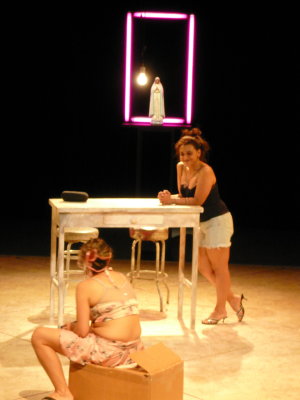
The play is performed in Spanish with English translations projected on a screen behind and above the actors. The set is minimal: a table, two beat-up stools, a statute of the Virgin surrounded by a neon frame, and a bucket and a mop that the older woman furiously uses to clean the floor of her apartment. Is she scrubbing away the past, her sins, the younger woman's intrusion, or does she want a really clean floor?

LEGOM's play is traveling through the United States as part of the Performing Americas Project of the National Performance Network (NPN). According to the NPN website, the NPN "provides support for established and emerging artists in dance, music, theater, performance art, puppetry, and spoken word. It serves as the developmental rung on the ladder for emerging contemporary performing artists because it provides rare or first-time touring opportunities. NPN also plays a critical role for mid-career and established artists who continue to create new work and to tour on the network because it offers a wealth of opportunities at a time when support is diminishing. Equally important, NPN connects artists with progressive presenters, arts organizations, and communities across the country."

I saw the play on Valentine's Day -- not exactly the type of romantic comedy one would expect on the holiday of love, but then, why not? Is there a "right time" for this type of theater? I think the answer is - whenever you get the chance.

Later.

Thursday, February 14, 2008

More News from Poet and Pulitzer Nominee, Margo Tamez

Please take some time to read about the land struggle that is currently underway, and not being covered by mainstream media. Margo Tamez, author of Naked Wanting and Raven Eye, wants readers to know about the struggle between the Department of Homeland Security and native peoples on the issue of border rights.

Border struggle article, here.

For background on Margo, her poetry, and her commitments, read my conversation with her, here.


Lisa Alvarado

Palabra Pura News -- New Latino Poetry on Tour

Palabra Pura, Chicago's home for cutting edge, innovative Latino poetry is evolving in exciting ways, with its 2008 calendar of stellar talent solidly in place. While still basing itself at the California Clipper, Palabra Pura will begin to also hold events at Latino venues throughout the city. This month, join nationally know poet and performer, Tim Z. Hernandez and Chicago actor, poet and activist, Stephanie Gentry-Fernandez.

Wednesday,
February 20th. 8 pm
Decima Musa Restaurant
1901 S. Loomis St.
Chicago, IL

About the poets:
Tim Z. Hernandez is a writer and performer originally from central California. His writing and performance texts have appeared in numerous anthologies and publications, and his performances featured at prestigious venues across the nation, including: LA’s Getty Center Museum, The Loft Literary Center in Minneapolis, Stanford University, and the Jack Kerouac School of Disembodied Poetics. In the past, he has been commissioned by major groups such as the United Way of Greater Los Angeles to write and perform his original plays on issues of homelessness and poverty. Currently, he’s working in tandem with Poets & Writers Inc, and California Center for the Book, offering bilingual poetry workshops across the United States.

He is the recipient of several notable awards including: 2006 American Book Award for his debut collection of poetry Skin Tax, San Francisco Foundation’s James Duval Phelan Award, a Best Solo Production Award for his one man show, Diaries of a Macho, and the Zora Neal Hurston Award for writers of color dedicated to their communities.
In the interest of artistic development, Hernandez’s focus is on excavating stories that bring to light the limitless potential of the human capacity, stories of physical and metaphysical journeys, with special attention to marginalized populations. When he’s not busy teaching creative writing and performance, he’s touring the country, collaborating with his word-music-theater collective, Brown Lotus, and offering workshops to Universities, arts groups, cultural centers, foundations, and libraries. Tim holds a B.A. in Writing & Literature from Naropa University, the first accredited Buddhist School in the west.

Currently, he resides in Boulder, Colorado with his wife and two daughters.

What People Are Saying About Tim Z. Hernandez

"Tim Hernandez is one of the finest and most exciting new talents to emerge from the new generation of Latino writers!”- Bloomsbury Review, Ray Gonzalez

“It’s too reductionistic to call Tim Hernandez a performance poet…though his voice and rhythms surely benefit from the energy behind a microphone, the complexity of his ideas merit the slower pace study made possible through the written pages of Skin Tax.” - El Paso Times Book Review Rigoberto Gonzalez

“Tim Hernandez is a dynamic force as a writer and performer!” - Gary Soto Author of, Nickel & Dime

“Hernandez is a poet of obvious and quickly realized skills…his images are brilliant, sharp, and concise, his language spare yet rich. Poetry of the here and now, Brown Lotus is the kind of task that should have been undertaken long ago!” - Amiri Baraka, Author of, Transbluesency

“I like Tim’s boldness, his willingness to be raw and trust the content of the poem to make it real and legitimate, his words sizzle and spark with excitement, targeting with a relentless passion his desire to express what he is trying to convey.” - Jimmy Santiago Baca, Author of, A Place To Stand

“[Tim Hernandez] …represents a whole new direction in the Latino literary world!” - Juan Felipe Herrera, Author of, Notebooks of a Chile Verde Smuggler, and 187 Reasons Mexicans Can't Cross the Border

“[Skin Tax] is poetry not for delicate sensibilities, unafraid, it dares to stand out and speak of subjects commonly eschewed by other poets.” - Midwest Book Review

xxxxxxxxxxxxxxxxxxxxxxxxxxxxxxxxxxxxxxxxxxxxxxxxxxxx


Stephanie Gentry-Fernandez is a poet and performer from the South Side whose male side you may recognize from Teatro Luna's recent production of "Machos." She has a deep personal commitment to anti-oppression work and currently works at the Broadway Youth Center.

xxxxxxxxxxxxxxxxxxxxxxxxxxxxxxxxxxxxxxxxxxxxxxxxxxxx

Letras Latinas, The Wind Shifts and a National Tour!


Letras Latinas, The Guild Complex, and the University of Arizona Press
are proud to present

The Wind Shifts: New Latino Poetry ON TOUR

“In the hour of extremes, long live these brave wordsmiths of American letters.”
— Sandra Cisneros

February 23, 2008, Palm Beach, FL
@The Society of the Four Arts

Eduardo C. Corral

Kevin A. González

Sheryl Luna

May 31, 2008, Minneapolis, MN
@The Loft Literary Center

Urayoán Noel

Carl Marcum

Adela Najarro

Emmy Pérez

September 25, 2008, Seattle, WA
@Richard Hugo House

Richard Blanco

María Meléndez

Steven Cordova

Deborah Parédez


“The Wind Shifts: New Latino Poetry ON TOUR” is supported in part by the Ford Foundation, JP Morgan Chase, the Andy Warhol Foundation for the Visual Arts and Southwest Airlines through a grant from the NALAC Fund for the Arts.

Letras Latinas is the literary program of the Institute for Latino Studies at the University of Notre Dame. The Guild Complex is a community-based literary organization in Chicago.

The Wind Shifts gathers, for the first time, works by emerging Latino and Latina poets in the twenty-first century. Here readers will discover 25 new and vital voices including Naomi Ayala, Richard

Blanco, David Dominguez, Gina Franco, Sheryl Luna, and Urayoán Noel.

The writers included in this volume have published poetry in well-regarded literary magazines. Some have published chapbooks or first collections, but none had published more than one book at the time of selection. This results in a freshness that energizes the enterprise. Certainly there is poetry here that is political, but this is not a polemical book; it is a poetry book. While conscious of their roots, the artists are equally conscious of living in the contemporary world—fully engaged with the possibilities of subject and language.
The variety is tantalizing.

There are sonnets and a sestina; poems about traveling and living overseas; poems rooted in the natural world and poems embedded in suburbia; poems nourished by life on the U.S.–Mexico border and poems electrified by living in Chicago or Los Angeles or San Francisco or New York City. Some of the poetry is traditional; some is avant-garde; some is informed by traditional poetry in Spanish; some follows English forms that are hundreds of years old. There are love poems, spells that defy logic, flashes of hope, and moments of loss. In short, this is the rich and varied poetry of young, talented North American Latinos and Latinas.

xxxxxxxxxxxxxxxxxxxxxxxxxxxxxxx

ABOUT THE ANTHOLOGY

“In the hour of extremes, long live these brave wordsmiths of American letters. Hallowed be the poets when the news is diffused in the name of susto. Viva the citizens of truth. Hallelujah the devotees of language, the languished souls enamored of the syllable.” —Sandra Cisneros, author of The House on Mango Street

“The poets in this anthology seem as though they just want to write poems, not specifically Latino poems. They are much too cross-pollinated for that—we all are, if truth be told—which is what makes that synthesis possible, the marvelous marbling at the core." —Aleida Rodríguez, author of Garden of Exile

“Here it is again, the shock of the new, eager as always to unsettle the present, to reconfigure the past while redefining the future. Ah, the impetus of the young!” —Ilan Stavans

“At last, a 21st century anthology that confirms the breadth and depth and diversity of contemporary Latino/a writing. The poems in this collection defy any stereotypes about ‘Latino poetry’ and testify to the rich variousness of the American Latino/a experience. Readers—rejoice!" —Valerie Martínez, author of Absence, Luminescent and World to World

“With jagged beauty, this collection expands our consciousness: documents and honors lives often absent from American poetry. In these pages, we join souls in struggle, almas luchando." —Pat Mora

"The title of the ravishing collection of poems by 25 Latino and Latina writers can be read as an allusion to change and to the fact that poetry is a force, like wind, that knows know borders. Whether inspired by family, love, despair, poems by Rilke, or a painting by Jose Clemente Orozco, the poets gathered here are involved in the infinite possibilities of language."
— Booklist

"This is a compelling and exhilarating addition to Latino letters."— El Paso Times

Lisa Alvarado

Wednesday, February 13, 2008

Read Across America

René Colato Laínez


Read Across America celebrates the birthday of Theodor Seuss Geisel. He was an American writer and cartoonist best known for his classic children's books under the pen name Dr. Seuss, including The Cat in the Hat, Green Eggs and Ham, and How the Grinch Stole Christmas.

During Read Across America Day millions of children and young adults create posters, read books, and listen to authors. Call your local school this March 3, 2008 and be part of this national celebration. Just pick up your favorite book and you will be set to inspire many children in this wonderful day.

You can have your own celebration at home. Go to the public library, check out books, and read them with your children. These are some books that you can check out:

My Name is Gabito/ Me llamo Gabito by Monica Brown
Saturday’s Sancocho by Lelia Torres
Abuelita Full of Life/ Abuelita llena de vida by Amy Costales
Benjamin and the Word/Benjamin y la palabra by Daniel A. Olivas
I love Saturdays and Domingos by Alma Flor Ada
Nana’s Big Surprise/ Nana, ¡Qué Sorpresa! by Amada Irma Perez
Xochitl and the Flowers/ Xóchilt, la niña de las Flores by Jorge Argueta

For more information about Read Across America visit http://www.nea.org/readacross/index.html


This weekend, March 15/16, the University of San Francisco will celebrate Reading the World X. Authors Malin Alegria, Monica Brown, Reyna Grande, René Colato Laínez, Alma Flor Ada, Ashley Bryan, Sarah Ellis, Naomi Shihab Nye, Doris Orgel, Peter Sís, Leslie Tryon, Rita Williams Garcia, Laurence Yep, Jack Zipes and many more will be signing books and talking about multicultural literature.


Come celebrate a new book
by Jorge Argueta


NINGUN SER HUMANO ES INDOCUMENTADO /NO HUMAN BEING IS UNDOCUMENTED


Alfredito Flies Home / Alfredito regresa volando a su casa
Illustrated by Luis Garay
Sunday, March 2nd
Modern Times Bookstore
888 Valencia St.
San Francisco, CA 94110
Ph. 415-282-9246
3 p.m.

Book-signing and refreshments
Both English and the Spanish editions will be available.
With music by Franscisco Herrera

Francisco Herrera has been performing and writing music for children in English and Spanish for over 27 years. He has a regular music class in Spanish at Parque Niños Unidos at 23 and Folsom every Monday at 10 a.m.

“Francisco Herrera’s music brings joy to children of all cultures. Most importantly, his music brings comfort to the hearts of the immigrants.” — Jorge Argueta