Sunday, November 24, 2013

Join "La Comida" Revolution! Are You Ready?


by Amelia M.L. Montes (ameliamontes.com)

Join the food revolution!  Change is happening.  Gente are waking up and saying “no more” to processed foods, to the high carbohydrate levels (aka sugar) in sodas. I’ve been noticing more articles/conversations about alternative lifestyle nutrition, recipes galore that are delicious and lower in carbohydrates.  

Healthy eating.  YES!
In the past, there were more articles warning us about the dangers of a high, fast food diet.  Now I see more hands-on, grass-roots efforts at offering answers, not just warnings.  There are alternatives. Such efforts are not only happening in the U.S.  The Mexican government is being much more pro-active in their efforts to say “enough” to soda companies. 

If you are in Arizona December 5th and 6th, don't miss the 2013 Native American Culinary Association (NACA) Indigenous Food Symposium.  NACA is partnering with Tohono O’odham Community Action (TOCA) for this event that takes place at the Arizona-Sonora Desert Museum.  “Celebrating People, Land, and Food” is the theme. (Click here for information)

In Mexico City:  Last week the Tribunal Permanente de los Pueblos Capítulo México held a symposium entitled, “Violencia Contra el Maíz, la Soberanía alimentaria y la Autonomía.”  This symposium is one of many talks (charlas), conferences, efforts to help Mexicans take back their agriculture and nutrition. (see flyer below.)

 Also in Mexico, last month, the Mexican government proposed a steep tax onto soda drinks.  Coca-cola, PepsiCo and other companies (Femsa and Cultiba) are worried because if this proposal passes, the rest of Latin America may follow.  “The government’s argument is simple.  Mexicans consume too many fizzy drinks (on average 40% more per person than people in the United States) . . . Mexico’s mortality rates from diabetes are staggeringly high.”  But the soda companies, worried about their profits, are waging a huge lobbying effort to stop this tax.  (Click here for article.)

The month of November is “Diabetes Awareness Month.”  I’ve given two lectures in college classrooms and last week I was at The Society for the Study of Gloria Anzaldúa (SSGA) in San Antonio, Texas, and participated in the panel:  “Diabetes and Healing:  Poetry, Creative Non-Fiction, and Decolonizing Your Diet.”

In the two lectures I gave, I first asked the students if they knew someone (family member or friend) who has Diabetes.  In both classes (about 25-30 in each class), every person except one or two raised her or his hand.  In my presentation in San Antonio, I said:  “The latest CDC (Center for Disease Control) statistics reveal that for babies born in the year 2000, 1 in 3 will develop Diabetes in their lifetime and for U.S. Latinas/Latinos, the number is even higher.”

“These numbers are so alarming, and scary,” one participant told me, after our presentation.  Yes, at first it all sounds overwhelming and scary, but we can do something about it. The next step after receiving this information is to "act."  

At the panel, comida activists Luz Calvo and Catriona Esquibel showed how they are indeed doing something about it.  They have been researching and experimenting with the foods of our ancestors.  They have created a Facebook page they call:  “Decolonize Your Diet.”  Their page offers all kinds of information:  recipes, information on plant-based, MesoAmerican diets, ancestral knowledge.  (click here to view “Decolonize Your Diet”) Their Facebook page is colorful, packed with information, and also delightful-- fun!  

Left to Right:  Luz Calvo, Catriona Esquibel, Amelia Montes, Ire'ne Lara Silva
Panel for SSGA:  "Diabetes and Healing:  Poetry, Creative Non-Fiction, and Decolonizing Your Diet"

After the conference, another participant sent me an interesting article by Savannah Johnson (click here for article) which critiques the American Diabetes Association (ADA).  She writes:  “[I]t’s important to point out that no part of the ADA’s Strategic Plan includes proposals intended to help diabetics with self-acceptance or confidence.”

Self-acceptance and confidence is indeed an important component to living a healthy life WITH Diabetes.  Often, people ask me if Diabetes can be cured.  The truth can be hard to swallow:  No.  There is no cure at this time for Diabetes.  Then they tell me, with pity in their voice, “I’m so sorry.”  I usually answer, “I’m not sorry.”  And I’m not.  Diabetes has, in many ways, saved my life. 

With Diabetes, my life has changed for the better. With Diabetes, I have arrived at a more self-actualized, contented space.  The key is to embrace it.  Johnson critiques the idea that we must “fight” with Diabetes.  As she says, “’[F]ighting diabetes’ seems counterproductive.  First, there is no cure for diabetes, so it doesn’t seem useful to fight something that quite literally cannot be fought.  Second, it seems that ‘fighting diabetes’ shifts focus away from more productive efforts, such as raising awareness and supporting diabetics.” 

This brings to mind Tai Chi and methods in meditation:  slow, careful body motions that do not force “against” something, but move in harmony “with.”  I believe we are moving more harmoniously with Diabetes in order to educate and offer ways to live with the disease.

Kudos to organizations such as NACA (The Native American Culinary Association) and Chicana activists like Luz Calvo and Catriona Esquibel for their research in our ancestral foods.  Kudos for Michael Sedano who also offers us great recipes on La Bloga for healthy eating (click here).  Kudos for the poets and writers such as Ire’ne Lara Silva who are bringing awareness to us with their poetry.  (Click here for interview with Ire'ne Lara Silva.)  Also-- check out Ire'ne Lara Silva's latest publications, flesh to bone and furia (click here)!  I am also including poet, Verónica Reyes here. 

Veronica Reyes’ book of poetry, Chopper! Chopper! just came out (click here for her La Bloga “Spotlight”).  The last poem in her book is entitled, “East L.A. Poet.”  It’s a beautiful poem that highlights our ancestral foods.  She begins the poem: 

“The Mexican lime tree towers in the desert backyard blooming flowered lives”

Later in the poem, she describes “homemade nopalitos” and “100 tunas, sweet prickly pears nesting.” 

Lime agriculture was greatly reduced as sugar cane agriculture expanded in Mexico, and soon after, the first incidence of diabetes diagnosis was recorded.  Why?  Limes lower glucose levels. Cane sugar elevates glucose levels. In Veronica Reye’s poem, she places a focus not only on the lime but also the nopal.  The nopal, as well, is another ancestral plant whose properties are rich in nutrients.  Veronica Reye’s “East L.A. Poet” is nostalgic in tone.  It is also a reminder, an invitation to return to The Mexican lime tree, to the nopal—to our ancestral comidas.

I end with Ire’ne Lara Silva’s poem, “there will be singing in the morning”

there will be singing in the morning
and singing in the night singing in the days
of want and singing in the days of plenty
singing alone and singing with the ghosts
singing old songs and singing new songs we
will remember songs we haven’t heard yet
songs that haven’t been dreamt yet songs no
one has found the words for songs sung on
the road and songs sung in bed songs sung
while weeping and songs sung while waiting
songs for breath and sun and light and
moon and earth and water songs for
sustenance we will sing impossible songs
indecipherable songs songs that cannot be
heard and songs that cannot be shared
we will sing songs without words silent songs
and screaming songs songs that tremble and
songs we can embrace
song and I live in
each other’s skins song and i breathe each
other’s breath take refuge in each other
passing silver fire light between each other’s
lips hot and cold at once naming and un-
naming freeing ourselves taking wing song
and i spiraling in the sky i would like to die
singing let there be song in my throat
spilling out let my last breath be song

(first published in the online journal, Rabbit and Rose, Issue 02. Also published
in the San Antonio "Current"-- click here!)


Saturday, November 23, 2013

Latina spec lit bio, Lit festival, writers workshops, y mas


Combining themes from Melinda Palacio's post on author writing and Ernesto Hogan's post Thursday on sci-fi/magical realism, today we feature a spec-lit bio by Kathleen Alcalá.

Kathleen Alcalá
Alcalá’s words “convincingly move the reader from one reality to the other. Her craft illuminates the souls of her characters: the Mexican women who carry the universe in their hearts," says author Rudolfo Anaya. Kathleen's work takes readers to “a world where one would like to stay forever” (Ursula K. LeGuin)."

Her following bio provides a non-macho perspective to both latino and speculative literature. This is great stuff--una escritora diversifying the no-female-heroines worlds of Lord of the Rings and the Star Treks.

Science Fiction and Me
by Kathleen Alcalá

1. When I was five, I knew how to read. Outside was a vast starry sky at night, and at times, a California condor by day. It looked like a small airplane. We did not know it was one of the last, come inland to cruise the thermals. The wind blew constantly through Cajon Pass, and earthquakes reminded us how small we were. It was not a prehistoric landscape, but it was mindful of its pre-history. One night, someone showed me a snowy owl in a palm tree, well out of its territory, and another night, I watched a mole with glistening fur dig itself out of the ground.

Inside, were things I could see without difficulty – crayons and paper, postcards from my aunt, and then my aunt herself, my older sisters who came home from school speaking English. I attended a two-room schoolhouse with all grades divided between them. When I was six, I discovered the Bookmobile and checked out a set of Dr. Seuss books. My picture was in the paper, a skinny brown girl with messy braids. “I feel like I’m five, but I’m six,” read the caption. My birthday had been a few days before. The Bookmobile to Devore Heights, California, was discontinued within months due to budget cuts, and because I was one of the few users.

contains an Alcalá story
2. Shortly after, my father lost his job, and we moved into the city of San Bernardino, where he became a substitute teacher until he was hired into a regular position. I attended Eliot Elementary School. It had an entire library full of books.  After the first year or two, we did not have a librarian, but I continued to read the books, working my way across the shelf of science fiction and fantasy books from Isaac Asimov to Roger Zelazny. Here were worlds within worlds, fully realized answers to “what if” questions, such as “what if we could fly? What if people lived on Mars? What if I could go back in time and visit another civilization?”

3. When I was in sixth grade, Star Trek debuted on television. My friends and I were ecstatic. The Man from U.N.C.L.E., a spy Cold War spy series, was also on. They could hide a microphone in a pen! We giddily waited for each weekly program. Before then, television had offered live variety shows featuring people our parents’ ages, then Laugh-In, that appealed to our older brothers and sisters. But Star Trek was aimed at us, the generation that grew up with astronauts and space travel. Star Trek was canceled after two years, but revived a couple of times after that, and lives on forever in reruns.

4. My oldest sister took her first teaching job in Arlington, California, part of Riverside County. She was not used to being by herself, so I went to live with her for one year when I was twelve. She taught sixth grade at a middle school, and I was in seventh at the same school. It was a better school than the one I had been attending, for which I was grateful. My sister was invited to meet an author along with some other teachers. When I heard it was Madeline L’Engle, I tagged along. I was the only person in the group of ten or so who had read A Wrinkle in Time. If I had owned a copy, I could have gotten it signed. It is still one of my favorite books.

5. I returned to San Bernardino, where my father now taught at Franklin Junior High School. In the summers, I took summer school classes at my own school, art and home economics (required), typing and library science. A brand new city library was built next to Franklin, but nobody used it. I sometimes went and spent the evening there while my father taught adult classes. I read three or four of The Chronicles of Narnia series by C.S. Lewis, as well as books about dragons by C. S. McCafferty. My mother worried that I was learning about witchcraft.

A boy at school, whose glasses were thicker than mine, claimed to have found the best fantasy books ever, The Lord of the Rings trilogy. I read one and proclaimed it, “good, but not the best” which led to heated arguments. What made a good fantasy book to thirteen year olds? Action and adventure, of course, but also depth of character, people we cared about. Where were the girls and women? Well-imagined worlds. I got him to read another book I had found, The Valley of Joy, and he admitted it was better. But it wasn’t as long, and so did not offer the same submersive experience.

6. In high school, we tried to stay alive. We had race riots, and the police would come and Mace us. I don’t remember if I read any sf or fantasy then. Does Kurt Vonnegut count? I got in trouble for reading a book called The Centaur, by John Updike. The woman who had played Lt. Uhuru on Star Trek, one of the very first African American women in a starring role on television, came to town for some reason and signed autographs. I got that one, and hope I still have it.

7. In college, I continued to read everything I could get my hands on. I was interested in language itself, so I studied linguistics and wrote for the school paper. A Clockwork Orange was released as a movie, and I refused to see it, because I had read the book and knew it was too violent for me. I can read most things, but movies affect me at a visceral level. I am less sensitive now than I was then. I found a copy of Cien Anos de Soledad and sent it to my parents, it was so much like the family stories with which I had grown up.

8. I went to work for KNBC in Los Angeles as a production assistant in the documentary unit. We were sometimes given free passes to movie openings. I saw Star Wars from the front row of Grauman’s Chinese Theatre. It was the best sf movie I had ever seen, hands down. The experience was entirely wasted on my friend, who was unable to understand such a grand metaphor for the human condition. I had begun to write stories, but in a very realistic mode.

9. While living in Western Colorado, I spotted a small article in the Grand Junction Sentinel. There was a contest for the best science fiction story submitted to the Western Colorado Science Fiction and Fantasy Association. The prize for first place was a paid registration to a World Con that would be held in Denver later that year. ‘This one’s for me,’ I thought, and wrote “Midnight at the Lariat Lounge,” about people who come from another world to mine uranium. One of them falls in love with a human. It’s a pretty bad story, but it won first place. In order to accept the prize, I had to attend a picnic in Grand Junction. I drove around the park until I saw people in long costumes with face paint. “How did you know it was us?” someone asked. The food included blue, hard-boiled eggs pressed into square cube shapes.

10. I attended Denvercon while staying with my in-laws. A bit strange, and completely overwhelming for someone living in rural Colorado at the time. This was the first time I met a professional science fiction writer, or any living writer, for that matter, other than my aunt, who had self-published a book called I Married a Priest. I made friends with author Ed Bryant, who was later one of my instructors in Clarion West.

11. I moved to Seattle and applied to graduate school at the University of Washington. I said I was interested in science fiction. Joanna Russ taught there, and I would be able to study with her if I was accepted. I found and read one of her books. Russ, a famous feminist in the field of science fiction, was also the author of How to Suppress Women’s Writing, now in its umpteenth printing, which takes a humorous but devastating look at the excuses that have been used over the years to not publish certain work. As an afterthought, she added women of color.

11. Russ dropped a small pile of literary magazines in the middle of the table one day. “These will be the first places that publish you,” she announced to the class. I had never heard of small press publishing. I thought it was The New Yorker or nothing. I went through a directory and picked out the most obscure magazine I could find that took sf. I published my story, Midnight at the Lariat Lounge as a result. I continued publishing in small presses, including Black Ice and Calyx, a feminist press out of Oregon. People described my work as magical realism, while all I knew was that this was how stories were told in my family.

12. After receiving an M.A. in Creative Writing, I worked one year and bought my first computer with the proceeds. Daringly, I bought Microsoft Word software, new at the time. I should have bought stock.

13. I applied for and was accepted into the Clarion West Science Fiction Workshop, held in Seattle. The original Clarion was founded in 1968 at Clarion University of Pennsylvania (itself inspired by the Milford Writer's Workshop). Six weeks of writing boot camp, a different instructor each week, and one editor. All pros, all people worthy of emulation. My instructors included Ursula K. LeGuin, Samuel (Chip) Delany, Ed Bryant (as noted above) and editor Tappan King. My classmates included many sterling writers whose work you can read right now. I published Sweetheart in Isaac Asimov’s Magazine of Fantasy and Science Fiction about a year later.

This year’s class got to attend a reading by Neil Gaiman and attend a screening of Guillermo del Toro’s recent movie, Pacific Rim, with Gaiman. The workshop offers the Octavia E. Butler scholarship to writers of color. People make life-long connections by attending the workshop, but it is not for the faint of heart. In 2002, I served as an instructor.

12. Published my first book, Mrs. Vargas and the Dead Naturalist in 1992 with Calyx Books. The director and editor at the time, Margarita Donnelly, grew up in Venezuela and is perfectly bilingual. She was delighted to publish my stories, and worked hard to get it national exposure and reviews.

13. I published my first novel, Spirits of the Ordinary, with Chronicle Books. It was rejected by over twenty other publishers before Chronicle picked it up. Letter after letter went to my agent from editors who loved it, but marketing would not let them buy it for all the reasons listed in Rudy Garcia’s essays. It was not a coming of age story. It was not an immigrant’s story. It was aimed at a literary market. 

14. Ten days in the Sonoran Desert researching my second novel, The Flower in the Skull. By day, I used the libraries at the Amerind Foundation and the University of Arizona. By night, Hyakutake burned in the western sky, and coyotes (the four-footed kind) chased javelinas through the dark. The spirits of my ancestors were very much with me.

14. I published a third novel and a collection of essays. None of my work really qualifies as science fiction, but mainstream publishing does not make room for more than a couple of “ethnic” writers at a time. I have never made a living solely from my writing, but then, that is true of most writers. Science fiction helped make room for writing such as mine, another world within the world. I try to pay it forward by letting others know about these portals and windows.

15. I am writing a collection of stories that walk the edge of what editor Leslie What in the magazine Phantom Drift calls “The Genre That Dares Not Say Its Name,” What provides a dozen other names for “new fabulism”: “Slipstream . . . Magical Realism, Fabulist Fiction, Transrealism, New Weird . . . It is rooted in folk tale, religious belief, magic, surrealism, and superstition. Fabulist writing blends literary tropes with fantastic conceits, and in the process frees fiction from the limitations of realism.”

Am I a literary writer? All this, and more. - Kathleen Alcala

Kathleen is the author of a short story collection, three novels set in 19th Century Mexico and the Southwest, and a collection of essays based on family history. She received the Western States Book Award, the Governor’s Writers Award, and a Pacific Northwest Booksellers Association Book Award, and two Artist Trust Fellowships.

She has a B.A. in Linguistics from Stanford University, an M.A. in Creative Writing from the University of Washington, and a Master of Fine Arts at the University of New Orleans. Her work is often referred to as magic realism, but Kathleen considers most of it historical fiction. She does, however, have a great affinity for the story-telling techniques of magic realism and science fiction, and has been both a student and instructor in the prestigious Clarion West Science Fiction Workshop.
Kathleen's blog, website and Twitter.


10 new latino writers for 2014

La Bloga amiga Sandra Ramos O'Briant is one of ten latin@s who received the following news: "You have been selected by LatinoStories.com among the 2014 Top Ten New Latino Authors to Watch (and Read).


Texas writing workshops open

At the Raul R. Salinas Classroom, Mexican American Cultural Center, Austin, TX

Next Saturday, November 30th, as part of the Flor de Nopal Literary Festival, a Solo Playmaking workshop will be led by Natalie Goodnow, a nationally recognized theatre-maker, teaching artist, and activist from Austin. "We’ll explore a variety of approaches to generating material for solo performance – monologue, storytelling, poetry, and movement."

The Bridge Building/Border Crossing: The Poet as Nepantlera workshop will be led by poet John Fry. "Poems enter us just as we enter them when we write. During the act of composition, we’re at once both builders of bridges and crossers of borders in a way that summons us body, mind, and soul. Following the writings of Gloria Anzaldúa, in this workshop we will explore how the act of writing poems allows for us to experience a state of being-in-between. She calls this state nepantla: a threshold state, or place, between supposed opposites like here and there, male and female, right and wrong, true and false, living and dead. Open to poets of all levels."

Events for Friday, December 6th
Flor De Nopal Literary Festival 2013 Reading featuring: Daniel Chacon, ire’ne lara silva, Natalie Goodnow, Lee Francis, Liza Wolff-Francis, Lisa Marie Estus, Mónica Teresa Ortiz, John Fry, and other writers TBA. Location: Multi-Purpose Room, Mexican American Cultural Center, Austin, TX.


A million petitioners to stop climate change

Yeb Sano
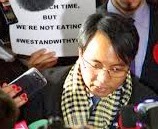
After Super Typhoon Haiyan ravaged the Philippines, Yeb Sano, Climate Commissioner for the Philippines, pleaded with the world to take immediate, drastic action to reduce climate change-causing carbon dioxide emissions in an emotional speech at the UN's climate meeting in Warsaw, Poland. He pledged to fast [hunger strike] for the two weeks of the conference. You can still add your name to the other three quarters of a million humans who already signed his petition.


Es todo, hoy,
RudyG

Friday, November 22, 2013

More Reports on the Writing Life

Melinda Palacio

November Morning at Santa Barbara Pier


Fall in Santa Barbara means you might want to keep a poncho nearby in case the temperature dips below seventy. It's warm enough for flip flops, but the touch of wind keeps your feet in long boots.  Earlier this week, I had the pleasure of visiting Magdalena Torres's Chicano Studies 121 class at Santa Barbara City College. This is one of my favorite places to present my work. Professora Torres creates a welcoming atmosphere and makes sure students have questions. What I didn't expect was how enthusiastic her students would be. She had also invited students from Sociology 109: Contemporary Social Problems, to attend. True, the students from Soc 109 get extra credit for attending my presentation, but the students mentioned how much they appreciated hearing literature and meeting an author. Torres encourages the sociology students, who seemed to be experiencing poetry and fiction for the first time, to attend other classes on Ethnic and Chicano Studies the City College. She's an avid believer in learning about social problems through literature.

Chicano Studies 121 at Santa Barbara City College

In my own classes through the MFA program at the University of Arkansas at Monticello, I make students read Chicano Literature. It's hard to believe that, in some cases, they are reading Chicano and Latino authors for the first time in their well-read life. In many ways, with the banning of our books and the elimination of Ethnic and Chicano Studies in Tucson, it's not surprising that a student wouldn't have the opportunity to read an author like Luis Urrea until adulthood or graduate school.

Speaking of Luis Alberto Urrea, I was very happy to receive my contributor's copy of the NEA's Big Read Audio Guide for Into the Beautiful North. Earlier this Summer at WWNO's studio in New Orleans, I recorded my interview about the book. The CD features Jo Reed, Cristina Arsuaga, Jeff Biggers, Melinda Palacio, Ilan Stavans, Helen Thorpe, and Luis Urrea.

The NEA's Big Read Audio Guide for Into the Beautiful North
Last month, I received a generous review from a blog, featuring the poetry scene in Boston. I had the chance of attending AWP in Boston earlier this year. Thanks to the chance encounter with the editor, How Fire Is a Story, Waiting was reviewed by Joanne DeSimone Reynolds. It's also thanks to AWP that I received a teaching position through UAM's new online MFA program.

Earlier today, I had a live google hangout with three of my students to discuss their fiction pieces. The video critique is not required and not all the students chose to participate, but the three that did enjoyed the experience and wished we had thought of the great idea earlier in the semester, instead of the last three weeks of the class. Indirectly, it was thanks to Jessica Ceballos for giving me the great idea. She had a google hangout for those who couldn't physically appear at La Palabra's Avenue 50 Studio's Bluebird Reading. This is where a social media app becomes an important literary and teaching tool.


Jessica Ceballos Scheming More Poetry Events
Also, thanks to Jessica Ceballos, I had the pleasure of reading at Beyond Baroque last Sunday, November 17 with Daniel Chacón, author of Hotel Juarez: Stories, Rooms and Loops. (I'll get to hear more from Hotel Juarez, next month in New Orleans, when Daniel Chacón reads with Jonathan Kline at Octavia Books, December 9 at 6pm). The crowd at Beyond Baroque was small, but Chacón and I agree, the energy was great. We had people attend from as far as Ventura. And thanks to the talented open mic readers, such as F.A. Salinas and Beverly Collins, the event was memorable and powerful.

Daniel Shakes Hands with Everyone at Beyond Baroque


Thursday, November 21, 2013

Chicanonautica: Chasing the Invention of Morel Across the Sci-Fi/Magic Realism Border


La Bloga headquarters informed me that someone wanted me to review a recent film of Adolfo Bioy Casares’ The Invention of Morel. Not just a blurb-like mention, but a full review. This is the result of my efforts.

Since all kinds of chingaderas are happening on the writer front for me lately, it took me a while to get to it. Once I did, I figured I’d watch the film again. Having bookmarked it, I got back on Denver Open Media site, clicked on it, and got Error loading media: file not found. It also said, Upcoming Airings 11/19 9:31am on 56, whatever that may mean.

Here, you can try it yourself.

Besides what’s on that frozen screen about Centro Universitario de Estudios Cinematográficos, Filmoteca UNAM, Ollin Studio, and Kodak, I can’t find any more about the film online. It was a short subject rather than a feature film. And I liked it.

It was black and white, and silent. This emphasized the theme of freezing time -- and people -- in a recording by giving it the look and feel of an ancient artifact. Perhaps the filmmakers were trying to evoke the steampunk sci-fi subgenre, as well as revel in obsolete cinema technique. It’s also quite poetic, more magic realism than Hollywood.

I like silent films, the way everything is so different from the way things are now -- the past filtered through rickety gadgets, so alien. I fell in love with them while seeing them deconstructed on the Fractured Flickers TV show when I was a grade-schooler back in the Ninteen-Sixties. Politically conservative Jay Ward, not only created Rocky and Bullwinkle, but pioneered postmodernism.


There are also other film versions of The Invention of Morel, but somehow they don’t get mentioned by sci-fi movie historians. Maybe because some of them are rather abstract.


Bioy Casares first published the novella in 1940. Funny, the new silent movie had me thinking that it may have been much earlier. There’s an island, a mysterious invention like so many vintage science fiction tales -- but it also reminds me of New Wave stories that J.G. Ballard wrote decades later.

Time. It gets tricky.

The Invention of Morel straddles the border between science fiction and magic realism. Science fiction, despite its relationship with science, is considered to be lowbrow, or at least low class. Magic realism is highbrow stuff that Lit professors like. Magic realism is considered “better” -- even though there aren’t magic realism sections in bookstores.

Come to think of it, in my ten-year career as a bookstore clerk, not one customer ever came in asking for magic realism.

Could Bioy Casares and Borges be considered science fiction writers? Can Chicanos dare claim them as brothers?

Born-in-the-USA Latino writers still get packaged as something exotic. Oscar Zeta Acosta was once included in an anthology of Latin American writers -- I had mixed feelings about it, he belongs with the others, but he was an American, dammit!

What if a Latino wrote the Great American Novel?

Meanwhile, this Chicanonaut doesn’t care about all the borders that carve up the planet. I’d like to blast across these borders with my homies Adolfo and Jorge Luis in a rocket-propelled extreme transformer lowrider costume-built by a barrio mad scientist. That would make one helluva movie!

Wednesday, November 20, 2013

Marisol McDonald and the Clash Bash/Marisol McDonald y la fiesta sin igual


By Monica Brown
Illustrated by Sara Palacios

  •             ISBN-13: 9780892392735
  •             Publisher: Lee & Low Books, Inc.
  •             Publication date: 9/15/2013
  •             Edition description: Bilingual
  •             Pages: 40
  •             Age range: 4 - 8 Years

From the Publisher- 

Marisol is turning eight, and it’s time to plan a birthday party that will be fabulous, marvelous, and divine. She also hopes that Abuelita, who lives far away in Peru, will be able to come to the celebration. 

At the party store, Marisol can’t decide what kind of party to have. There are so many choices, but everything in the store matches! Nothing seems right for soccer, pirate, princess, unicorn-loving Marisol. Finally she comes up with just the right idea, and when her friends arrive for her Clash Bash birthday, a big surprise awaits. But in a heartwarming turn of events, Marisol gets the biggest surprise of all—a visit from Abuelita via computer. 

In this delightful story told in English and Spanish, author Monica Brown and illustrator Sara Palacios once again bring the irrepressible Marisol McDonald to life. With her bright red hair, golden brown skin, mismatched outfits, and endearing individuality, this free-spirited Peruvian-Scottish-American girl is headed straight into the hearts of young readers everywhere. 


Marisol McDonald first adventure


 Marisol McDonald Doesn't Match / 
Marisol McDonald no combina

My name is Marisol McDonald, and I don’t match. At least, that’s what everyone tells me.
Marisol McDonald has flaming red hair and nut-brown skin. Polka dots and stripes are her favorite combination. She prefers peanut butter and jelly burritos in her lunch box. And don’t even think of asking her to choose one or the other activity at recess—she’ll just be a soccer playing pirate princess, thank you very much. To Marisol McDonald, these seemingly mismatched things make perfect sense together.
Unfortunately, they don’t always make sense to everyone else. Other people wrinkle their nose in confusion at Marisol—can’t she just be one or the other? Try as she might, in a world where everyone tries to put this biracial, Peruvian-Scottish-American girl into a box, Marisol McDonald doesn’t match. And that’s just fine with her.
A mestiza Peruvian American of European, Jewish, and Amerindian heritage, renowned author Monica Brown wrote this lively story to bring her own experience of being mismatched to life. Her buoyant prose is perfectly matched by Sara Palacios’ engaging acrylic illustrations.

Tuesday, November 19, 2013

Gluten-free Chicano. Desperado Tours Stanford. News. Aural On-line Floricanto

The Gluten-free Chicano Cooks
Michael's Famous Scalloped Potatoes 
Michael Sedano

This is party food. The Gluten-free Chicano makes two large casseroles of these potatoes for 50 guests and runs out. He makes one casserole for 15 guests and runs out.

These potatoes are delicious. These potatoes are incredibly easy to make. Mejor, these potatoes are naturally gluten-free. Read all labels to ensure against accidental contamination.

Diabetics and gente watching their blood sugar count will avoid potatoes along with breads and many other starches. Lástima. But, for those times when your body can afford an intake of deliciousness and potatoes, these potatoes hit the spot.

La Bloga friend, poet Andrea Mauk, makes a Yuca-based scallop that might be just the ticket for papa-adverse eaters. Andrea shares her recipe at Dancing Horse Media Group/Corazón en un Platillo.


Ingredients:
Half and half or whole milk.
Sharp cheddar cheese, ½ pound.
Potatoes (red, russet).
Pepper.

Preparation:
Heat oven to 375.
Non-stick spray a casserole dish.
Scrub the heck out of the potato skins, or peel the spuds.
Trim away discolored or damaged potato.
Slice or grate the cheese.


Pour a half inch of half and half or whole mike into the greased dish.
Slice the potatoes, ¼” or so.
Chop the unsliceable potato parts.

Lay two layers of sliced potato flat in the dish.
Fill the spaces with chopped papa.
Pepper the surface.


Lay cheese across the first layers of potatoes.
Lay two or more layers of sliced potato until the cheese layer is completely covered. Fill spaces with chopped papas.


Splash more half and half until the dish is less than half liquid. Add coarsely ground pepper.
Cover entire surface with grated cheese.

Place casserole dish on a cookie sheet and bake in oven for an hour and a half. The cheese topping will brown beautifully. Test for doneness when you get worried, after at least an hour's baking.
The potatoes are ready when, with the cream bubbling vigorously, a butter knife slides easily into the middle.

Let the dish sit for a few minutes before transporting to serving table to permit remaining cream to absorb into the papas.

By the way, this is puro chicano food. My definition of "chicano food" is anything I cook.


Desperado Times for Stanford Alumni Book Club

This is not a football story but one about author book tours. The author is La Bloga's Manuel Ramos, the book is Manuel's exciting noir gem, Desperado, A Mile High Noir, and the latest stop in Ramos' Desperado tour brings him to Long Beach Califas to join the Book Club of the Stanford Chicano/Latino Alumni Association of Southern California for lunch and discussion.


Desperado's urban redevelopment theme caught the readers' attention and Ramos shared a writer's-eye tour of Denver geography and its nomenclature of division into the "does", NoDo, LoDo and the like; signs of progress for some, disappointment for others. Clearly, the novel captures the time and is a product of them. Displacement and neighborhood disappearing strikes a familiar chord among Chicanas Chicanos from Denver to Palo Alto, and Longo.


Flo Ramos joined her author husband on the SoCal visit. Hers was more than the beaming spouse role. Flo joins Manuel to read together. They select a conversation between Gus and his big sister that reflects the care of siblings but more so puts the Ramos couple's happiness on display. Ramos and Ramos make a fabulous reading team.


 After discussing the tilma of Juan Diego and the head of Pancho Villa--subplots which are all in fun-- one person expressed a key critical point. The individual felt Gus--the novel's antihero--lies to readers by not disclosing elements of the novel's surprising turn as the mystery ravels into dénoument. I can't go into detail to avoid spoiling the novel's delight.

The gripe isn't a major issue. Ramos observes that all fiction involves some sort of lie. Ramos replies to the effect "never trust the narrator in noir."

The Stanford alums however, will trust to their memory of a fabulous visit with los Ramos and now will seek Ramos' other novels, recently reprinted by Northwestern University Press, and smile while they gripe in puro delight.

Book Club of the Stanford Chicano/Latino Alumni Association of Southern California
Manuel, Angelique, Margie, Flo, Manuel, Michael

News'nNotes
Texas Book Festival May Become Inclusive


La Bloga friend and floricanto veterano Gregg Barrios, whose commentary at San Antonio Express-News' web resource, My SA, helped raise a ruckus among conscientious Texas literatonti. The new literary director of the Texas Book Festival, Stef Opitz, writes Barrios over the new director's own chagrin at the festival's declivitous history.

Barrios holds Opitz and her ilk to a higher standard than accepting a mea culpa. The award-winning playwright expects visible change. Mejor, Gregg Barrios isn't beating a raza drum in this, though the exclusion of Tejano artists glares. Barrios notes,

The real issue here isn't Latino-authored books for Latinos, but diversity writ large — books and writers through which all readers can experience the richness of all Texans' stories and cultures.

Read the entire Op-Ed piece at My SA here.

Mail Bag
Notre Dame Institutes $25K Poetry Fellowship
La Bloga friend Francisco Aragón emails news of a graduate assistantship in South Bend that pays tuition--of itself a worthwhile prize--but more importantly, provides the student-poet the liquidity of a monthly paycheck for the two-year tenure of the fellowship.

The recipient will direct the Institute for Latino Studies program, Letras Latinas Writers Initiative.  Details of the program and links to apply to the university's MFA program at this link.

Mail Bag
San Antonio Seeks Nominations for Next Poet Laureate

La Bloga friend Gemini Ink emails notice that the city is accepting nominations through early January for the City of San Antonio's next laureate.

The City of San Antonio is seeking nominations for the position of Poet Laureate. The San Antonio Poet Laureate is an honorary position whose role is to promote the literary arts and literacy within the community and create a greater appreciation of the poetic arts through the reading and writing of poetry.

The two-year honor comes with a $3000 honorarium and myriad opportunities to share poetry with the city's residents.

For an application and more information, click here.


Aural On-line Floricanto

Mr. Peabody and his boy Sherman might board the way-back machine and head to New York City for the 1973 Speech Communication Association annual meeting. There, they'll run into Michael Sedano whose "multimedia" presentation introduced Chicana Chicano poetry to the field, using a combination of music, 35mm slides, and student readings. SCA is now the National Communication Association.

It was among the first appearances of raza literature before the academic descendants of Aristotle.

In the 70s, multimedia meant linking multiple Kodak slide projectors to a pulsed tape script via a programmable dissolve unit. Three projectors facilitated views made of three side-by-side frames, arrayed in one- two- or three-slide screens. The quality of slide projections surpasses that of the finest digital projector, especially the murals that were at the heart of this program's visual plan. Paul Simon was prescient, they took his Kodachrome away.

As an Assistant Professor of Speech Communication, I recruited students to "Reader's Teatro" class. I've long believed in vertical integration of expressive skills, hence that class of students studied two key elements of expression: the technology of camera, audio tape recording, projectors, dissolve units, and chicano poetry circa 1973.

Today's Aural On-line Floricanto represents the beginnings of my efforts to digitize and recreate that multimedia program using today's technologies. I'll update the visual program running the once-vibrant slides alongside their now decayed remains.

Click the control below to play Al Rosas' reading of "To Brothers Dead."

The text of this anonymous poem ran in last week's La Bloga-Tuesday Veterans Day tribute. Here's that text to read and listen:

To brothers dead crossing the rapido river…194?
in a day
in an afternoon
in a night
in years of fury
and tears
alone and far from home
away from familiar sounds
tender arms
you fell on the earth of italy
blood of mexico
blood of the northern
deserts
blood of the bitter border
spilled on earth of italy
on the earth of italy
hope of america
the vain hope of america
never realized hope of america
against a wall of teuton steel
you waded the chilling river
waters tasting of death
far from home
tasting of sudden death
left your dead on the river banks
tears of mothers on the river banks
hopes of sweethearts on the river banks
left tomorrows on the river banks
bitter yesterdays on the river banks
for a hope
vain hope

Anonymous pp 42-43 in Antonia Castañeda Shular, Tomás Ybarra-Frausto, Joseph Sommers. Literatura Chicana. Texto y Contexto. Englewood Cliffs NJ: Prentice Hall, 1972.