Showing posts with label Michael Sedano. Show all posts

Friday, August 18, 2023

Backyard Floricantos Are for Summer


Melinda Palacio, Santa Barbara Poet Laureate


 *this post is originally published in the Santa Barbara Independent 


In Thelma Reyna's backyard


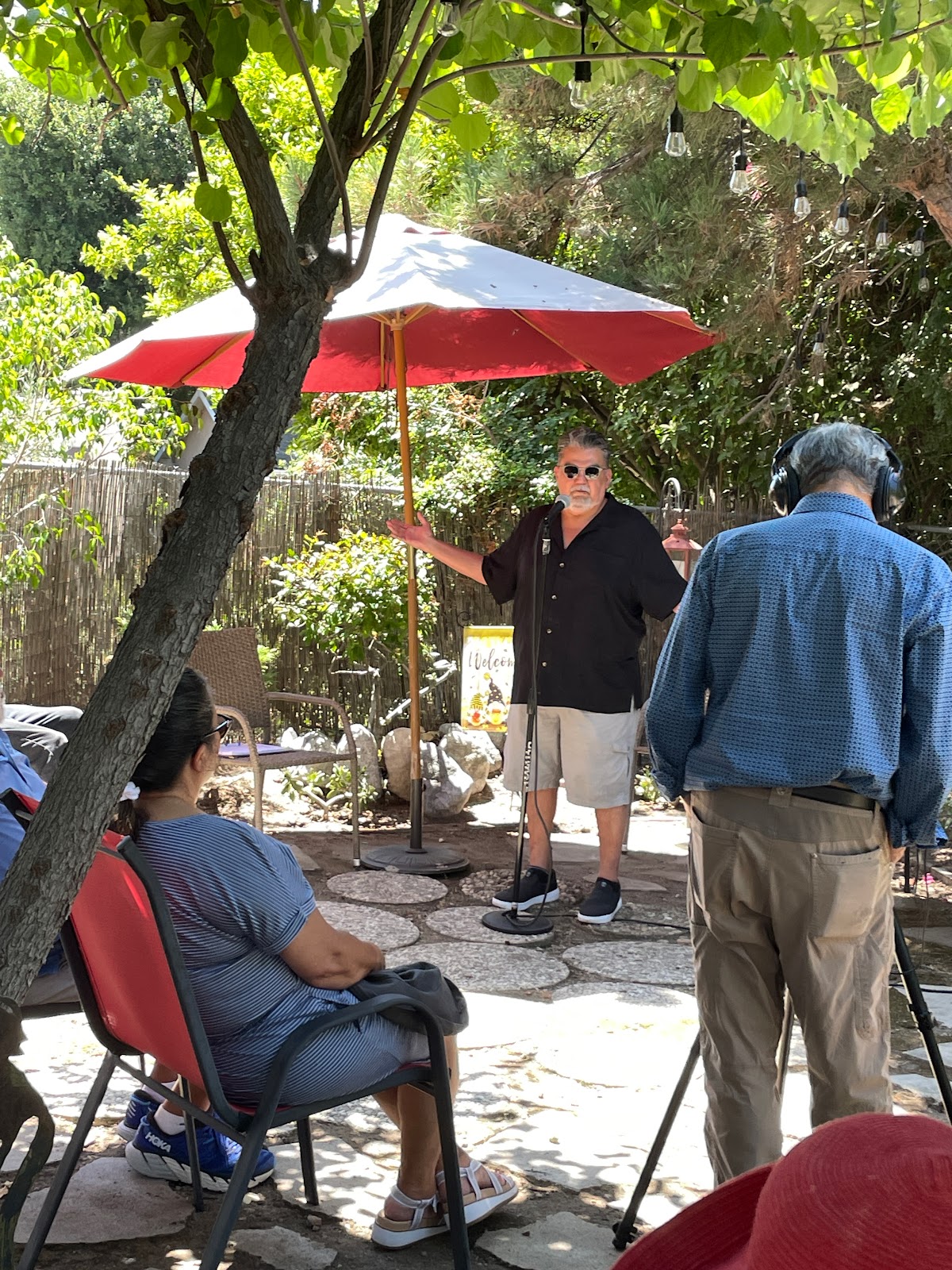
Over the past fifteen years, I’ve attended several floricanto’s at Casa Sedano, the home of Michael Sedano of La Bloga.com and Barbara (Michael’s late wife who recently lost her battle with dementia). Sedano has staked his claim as blogger and photographer to poets. He travels to poetry readings, near and far, and aims his camera in hopes of the perfect poetic pose. He photographed the first floricanto festival at USC, celebrating Chicano and Chicana poets in 1973, an event originally hosted by El Centro Chicano. USC’s Digital Library holds original films by the readings thanks to the efforts of Producer-Director Jesus Treviño and Photographer Michael Sedano.    


In 2010, Sedano organized a reunion of the original festival poets and invited several newer poets to participate. The floricanto festival of 2010 included poets who identify as Chicano, Chicana, Latino, Latina. I was lucky to be among the participants in an amazing lineup that included Juan Felipe Herrera, Alurista, Ron Arias, Vibiana Aparicio-Chamberlin, Tony Marez, and Mary Ann Pacheco, and Veronica Cunningham. 


Since then, Sedano has hosted several floricantos in his backyard with Jesus Treviño is there to film and feature the poets on Latinopia.com. Last Sunday, the tradition returned after a long, covid-hiatus. It was wonderful to gather with poet friends. There was even an appearance by famed artist Margaret Garcia, who last year was honored with a one-woman art show, Arte Para La Gente, at the Ventura County Art Museum. It was a big surprise when Margaret Garcia signed up for the open mic and sang a few verses of “Gracias a La Vida,” the Mercedes Sosa song made famous by Joan Baez. Garcia’s voice is rich with dark chocolate tones, a surprise for someone with a high speaking voice. 

Richard Vargas 

David Roth and Richard Vargas


Sunday’s gathering was in honor of Richard Vargas and his latest poetry book, leaving a tip at the Blue Moon Motel, Casa Urraca Press 2023. A seasoned poet, Vargas is on top of his game and at his strongest when writing about everyday life, his various jobs and occupations that inform his poetry, love and family. At the floricanto, Vargas is surprised by his high school friend, David Roth. Vargas says it’s a joy to be invited to read at one of Michael’s floricantos. “I feel as if I’m contributing in a small way to our culture’s traditions ad evolving art,” he said. “The camaraderie and friendship between poets and the audience makes it a very special event. 
John Martinez


For this gathering, a little flexibility is in order. Casa Sedano has been sold (his wife Barbara did not survive Covid or her battle with dementia. Michael is still in the process of moving so the reading takes a place nearby at Thelma Reyna’s beautiful backyard. Thelma Reyna is an award-winning author and publisher of Golden Foothills Press and was Poet Laureate of Altadena from 2014-2016. Thelma and I are set to open for Richard and there’s a signup sheet for an open mic. However, the order becomes jumbled because Jesus Treviño must leave early, so the show begins with the featured reader, followed by the open mic and Thelma, our hostess and featured reader. I closed us out with three poems and their companion songs. 


I’m looking forward to my set at Shoreline Park, August 17 at noon. If you come, look for the Library’s On the Go Van and the playground. 


Events:


Thursday, August 17, noon to 1pm, Poetry in the Park, 1237 Shoreline Dr., Santa Barbara. A set of poems and songs by the Poet Laureate.


Saturday, August 19, 10 am, SB Community Archives Showcase, East Side Library, Santa Barbara. Listen to a poem and hear stories, see archived photos of Santa Barbara’s East Side neighborhood. 


August 25, 6:30-8 pm, Writers Symposium, Fine Line Gallery, La Cumbre Mall. A discussion on ‘inviting the Muse’ with Dan Diamond, Janet Lucy, and Melinda Palacio, moderated by Mike Cregan, founder of La Cumbre Center for Creative Arts and award-winning author Tracy Shawn. 


Two poems by Richard Vargas:


menudo


i remember the morning

car ride to the Compton

neighborhood market

just the two of us

my dad would walk in 

carrying the empty pot and lid

set it on the counter and ask

for it to be filled with our

sunday morning breakfast

while he picked up a package

of warm corn tortillas

i checked out the colorful

piñatas and sweet-smelling 

pan dulce still warm from the oven


he would notice and buy a few 

conchas and fruit-filled empanadas

watch the smile light up my face

the drive home was slow and gentle

making sure we didn’t spill 

any of our orange-red bounty


i never cared for the oregano

but a squeeze of lemon

a spoonful of chopped onion

and a warm tortilla rolled up

in my small fist 


planted the seed 

for this poem to bloom


************************************


leaving a tip at the Blue Moon Motel 


i always take it for granted

the dusted chest of drawers and nightstands

the well-made bed with the crisp sheets

folded and tucked at each corner

sure to bring a smile to the grumpiest

of drill sergeants


the snow-white towels, the clean tub and toilet

a commendable attempt to add a little class

with that peculiar folding of the first

square of toilet paper hanging 

from the roll


rarely giving a thought to the women

who roam the hallways in the morning

knocking on doors looking for the empty

rooms ready for them to do their magic


no thought given to

the kids they raise

the bills paid late

the men who leave

and don’t come back


they pick up after all of us

oblivious strangers passing 

through on our way to a better

place than this


i leave a five-dollar bill and loose change

on the table as i check out

my small token of appreciation

for these hard scrubbing angels

doing their best to provide

a place to rest on the long

way home


Friday, April 07, 2017

La Bloga's Michael Sedano Takes to the Podium at the Homestead Museum

Melinda Palacio

Michael Sedano


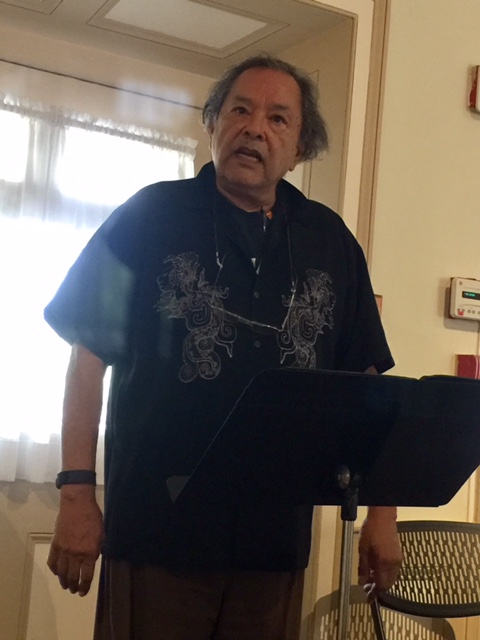
In a fun twist of roles, I had the pleasure of listening to Michael Sedano read from his work. He is usually the eye behind the camera, waiting to capture the perfect picture of a reader. He's been documenting my literary readings for several years and his portraits documenting poets and writers over the past couple of decades are archived at USC. He also coaches writers on how to read their own work. The photographs show a master, comfortable in front of the audience for Take a Detour from Route 66: Taos to L.A., a wonderful program put together by Karen Cordova and Andrea Watson of 3 Taos Press. Read more about the show on La Bloga's March post by none other than Michael Sedano.

Michael Sedano at the Homestead Museum


Michael read from his one-act play "The Feral Child of Temple City: A Horror Narrative in One Act. The dramatic and, yes, horrifying elements to the story are the first surprise. The entire show was a surprise because not everyone read work about the road, diners, or cars, stereotypical icons of Route 66. In fact, Sedano's story could be set anywhere. Lucky for the audience, it is set in Temple City on Route 66. The second surprise, which shouldn't come as a surprise at all, given the fact that Michael has offered coaching to writers on how to read their own work at the National Hispanic Cultural Center in Albuquerque, is how well he read, projecting and addressing both sides of the bifurcated audience.

Sedano Makes the Lectern Disappear 


Although my photographs, all taken on my iPhone, do not adjust well for the tricky backlighting, you can see how Michael kept his eyes off the page and on his audience. He used his facial expression and hands for dramatic emphasis, although he could have read the piece keeping his nose to lectern and it still would have held the audience's attention. Another favor he offered to the audience was a copy of the one-act play. I'm not sure if everyone received a copy, but I was fortunate to have been gifted one by the author. The nice thing about hearing a piece that's longer than a poem, is it gave me the opportunity to take several photographs and absorb the content of the writing (not an easy task). I have renewed respect for Michael who attends a vast number of performances, takes professional photographs with his camera, and then writes very thoughtfully about the works. I was especially moved by Andrea Watson's Frida dream poem, "The Poem in Which Frida Khalo Commandeers My Car and We Drive Like Bandits to L.A." The title says it all, a great poem. You had to have been there. I was so mesmerized by the poem that I did not take any pictures of Andrea reading it. I now understand why my husband Steve sometimes fails to take photos of my while I'm reading. Even though he's heard all of my poems read aloud a million times, he still gets caught up in my performance of them. I finally understand this phenomenon. As Michael said in his La Bloga post and write-up of the show, I hope this Detour to Route 66 becomes an annual spring offering.

Michael reads the dramatic conclusion to "The Feral Child of Temple City" by Michael Sedano


Andrea L. Watson and Madelyn Garner Read after Michael Sedano.

La Bloga in the House: Melinda Palacio and Michael Sedano

Saturday, October 27, 2012

Chicano reviewers and reviews of otros


Among today's thriving literary developments are the many latino literati contributing to the discourse that advances American literature, which includes ours. La Bloga was in the forefront years ago, but waves of video, prose and critique now emanate from all corners of Aztlán and elsewhere. Some evidence of these manifestations--and forgive the obvious self-promotion--are included below.

from a Texas alternative publication

This week Roberto Ontiveros of San Anto's alternative newsweekly the Current chose the Chicano fantasy, The Closet of Discarded Dreams, for his Halloween selections of "three terrifying tomes to die for." The honorific is more important than his characterizing my novel as "terrifying," so I won't speak to that. He explains, "Halloween is perhaps best handled by just being haunted by a book. Here are three recent releases that embrace the dark, and are low on snark." A further honor was that my novel was included with Carlos Fuentes' Vlad vampiro novel. Click here to read Ontiveros' column.

The Latino literary online magazine

A brother publication to La Bloga, Armando Rendón's Somos en escrito, just published a review by Roberto Haro entitled Trapped in an altered Chicano dimension. The review was done by a SF Bay-area, prolific Chicano writer whose novels range across the spectrum of human experience and grand historical backgrounds, including his new book, Alejandro’s Story. Haro's review stands out from others because his background in speculative literature brings a deeper examination of The Closet of Discarded Dreams from a writerly fantastical perspective.

Among other things, Haro says, "Garcia is a clever writer, crafting a narrative that keeps the reader engaged, wondering what will happen next to the nameless protagonist. There are moments of self-analysis that may help a reader appreciate the challenges Latinos face with institutions and the behavior of destructive groups in the larger society."

Reading Haro's words gave The Closet's author chills, making him wonder: Is the novel that good? And then realizing that, indeed, the novel does contain all that Haro describes. Go here to read what author Garcia considers to be the most penetrating review of his Chicano fantasy novel, to-date.


La Bloga's Sedano rips up The Closet

The most difficult review the nine Blogueros of this website ever face is reviewing a colleague's work. Our gente's tendency is to avoid speaking ill of our brown kindred. On the other hand, contraposed to that is the struggle to maintain a standard of authentic, literary criticism. The task is doubly difficult when attempting a solid review of another La Bloga author.

When I return from the Texas book-tour, I'll respond better to Sedano's review. If you haven't read it yet, check his Tuesday post and add that to your own read of the work. I do thank him for his largely favorable review and tolerance of a fokkin' debut novelist.

Es todo, hoy,
RudyG

Oct. 24-31, Bloguero Rudy Ch. Garcia will be reading in SAN ANTONIO at the SW Workers Union Underground Library, The Twig Book Shop and at Palo Alto College. Click here for details.
Garcia's author interview was featured on Tue. Oct 23, 7:30pm CST on Tony Diaz's Nuestra Palabra - Latino Writers Having Their Say, KPFT 90.1fm in Houston, and another can be seen this Sun. Oct. 28 on the Great Day SA daytime program, KENS5 TV in San Anto, beginning at 12:00 noon CST.

Saturday, October 20, 2012

Pedazos, fall book-tour, SoCal 1


LAX and Lotusland

Landing in L.A. for this chapter of promoting my novel The Closet of Discarded Dreams reminded me that I portrayed this city in my first published short story, LAX Confidential, in Latinos in Lotusland. I based the first segment of that story on a trip umpteen years earlier, before I'd turned serious writer. In a sense I've come full circle, setting off now to see how los angelenos would take to my biggest published work.

El tráfico and the traficantes

To accomplish that, I first had to negotiate the freeways and byways of the present-day City of Angeles. Problem was that here, negotiation wasn't integral to highway driving. True, I occasionally spotted instances of courtesy or cooperation between drivers, just rarely. 

It took two vulnerable days on the road to learn that speed limits apply only where there are residential speed bumps--and even only for self-preservation of self and one's car--and most of the time in school zones. Otherwise, 75mph is the prevailing minimum speed. I finally removed my eyes from the speedometer and relied on surrounding vehicles to inform me whether I drove too slow or fast; it was never the latter.

Denver is still a cow town. The Californios' habit of 75mph lane changes--sideways!--reinforced that. Denverites can drive at 65 or 70 but will allow full car lengths or more of space to develop between them and the auto in front. Not so in El Lay. Leave just half a car length open in front of you and the vacuum gets sucked up by the blur of another car plugging up the gap. And all the while surrounding commuters continue their 75mph flow. I suffered automotive culture shock during my time there and after returning to Denver, as well. My blood pressure elevates somewhat when I recall the experience.

Two strolls con René Colato

For an hour before a book reading René and I walked the halls and grounds of At the Mission San Fernando in Mission Hills, Califas (1797), a popular attraction less attended on a Sun. afternoon. The immaculately manicured gardens and walkways at that hour were shielded from L.A. noise and traffic, wind and sun.

The quiet stillness imparted a sense of bounty and wealth, what the ruling class Californios have always enjoyed. That the adobe, rock and native wood structures were built by the labor of Indian slaves or peones is not evident during our time there, though I might have heard the screams and moans of antepasado gente who labored to erect it all had I but stopped to listen to the wisps of history.

We traversed much of the Mission, resting on a bench where I bounced ideas off René about my next novel. An incredibly entertaining teacher, a prolific children's books author, this short, amiable, usually low-voiced ex-Salvadoreño incisively dissected components of my plot and characters and in the space of half an hour provided me sufficient guidance to run with the composition. The man's invaluable insights were something I should have had to pay hundreds of dollars for. Next time, I'm skipping workshops for just an afternoon with el Maestro Colato Laínez.

To break up the Author-Author routine, one night René Colato Laínez directed me to Universal Studios CityWalk. My novel's Closet otherworld is a contrast of unbounded horizontalness vs. a 20 ft. ceiling that continually oppresses The Chicano hero. The overall sense of CityWalk is the opposite: despite open sky above, the limited walking space for people and their numbers likewise imparts a unique crowdedness that results in similar sensations.

What struck me more about attractions like CityWalk was how they demonstrate Califas' 1% tossing loaves of bread to the masses as our distant military "lions" munch on middle-eastern "Christians." The tram ride up the hill to reach the place is free, no entry fee, nor required purchases, which is good for the millions that come every year, because a mixed drink and a soda cost us over $20. At the same time, the locale provides thousands of young people a relatively safe venue to be seen and entertained despite being unable to purchase any piece of Universal. A brilliant opiate in the midst of the opulence.

Casa Sedano

Most of what I learned in L.A. came not from conferences, but from charlando like at Michael Sedano's, out on the patio, an iced brandy in hand, an undetermined agenda on our table. What I'd expected to meet for the first time at Casa Sedano was a creature who ate author's novels and spit out frank, cutting critiques like L.A. spits out its miasma of smog. I'll tell you, gente, turns out Sedano is not as ugly in person as his La Bloga headshot would indicate. No, really.  A tough critiquer, sí, pero no tan feo.

Trapped out back of Casa Sedano, surrounded by palm trees on the left, unnaturally huge hens-n-chick succulents, a swimming pool serving as a moat in the foreground and to our right several exotic flowering shrubs that belonged in a photo of the Guatemalan Petén jungle, I had nowhere to turn when Sedan ordered me to practice my reading of The Closet on him.

Nor was escape possible as he explained the weaknesses, gaps and hokeyness indicated by my presentation. I felt as marooned as The Chicano in my novel, though more affected by the brandy and sunshine, both of which are nonexistent in my otherworld.

Eventually I accepted that I was better off without an avenue of retreat because no matter I didn't always concur with the oratory gospel-according-to-Sedano, he was right-on in nearly every example or question he raised. However imperfect my future readings prove, their better quality will be largely attributable to that patio and persona.

In part 2 tomorrow, I cover Latinopia y Jesus Treviño, the Latino Book & Family Festival, my reading at Tía Chucha's, a Siquieros mural that Sedano covered this week, y otras cositas.

Es todo, hoy,
RudyG, aka Rudy Ch. Garcia, author of The Closet of Discarded Dreams

Oct. 24-31, Garcia will be reading from his novel in Houston at the River Oaks Bookstore; in San Antonio at the SW Workers Union Underground Library, The Twig Book Shop and at Palo Alto College. Click here for details.
Garcia's author interviews can be heard on Tue. Oct 23, 7:30pm CST on Tony Diaz's Nuestra Palabra - Latino Writers Having Their Say, KPFT 90.1fm in Houston, and seen on the Great Day San Antonio daytime program, KENS5 TV in San Anto, Sun. Oct. 28 starting at noon.

Monday, May 14, 2012

Guest Columnist: Thelma Reyna Reviews Rain of Scorpions


La Bloga Guest Columnist: Thelma T. Reyna, Ph.D.

Review: Estela Portillo Trambley. Rain of Scorpions and Other Writings. Berkeley: Tonatiuh International,  1975 (First Edition)  No. of Pages: 178


         When Estela Portillo Trambley passed away at the age of 62 in 1998, we lost one of our most notable Hispanic-American literary icons. Born in El Paso, Texas, she broke significant barriers with her first book, Rain of Scorpions and Other Writings, a historic work on several fronts: It was the first collection of short stories published in the U.S.  by an American Latina; the first book by a Chicana to win an important national literary award (Premio Quinto Sol, 1972), as well as the first book written by a woman to win this prize.
Portillo Trambley did something for which not only we women authors, but all authors, should feel deeply indebted: She introduced the female voice to contemporary Latino letters and thus changed the direction and focus of this literature forever.
         Her book was immediately notable for its presence in a sea of male authors.   Modern Chicano literature began its flowering post-World War II with Jose Antonio Villareal’s Pocho (1959) and reached impressive bloom in the 1970’s, with books that are now classics—Tomás Rivera’s Y no se lo tragó la tierra  (1971); Rodolfo Anaya’s Bless Me, Ultima (1972); Rolando Hinojosa-Smith’s Estampas del Valle y otras obras (1973); and Nash Candelaria’s Memories of the Alhambra (1977). The sole woman in this historic line-up of pioneers was Estella Portillo Trambley with her Rain of Scorpions and Other Writings (1975). She was also the only woman to follow on the heels of Rivera, Anaya, and Hinojosa-Smith in winning the annual Premio Quinto Sol. And the rest, as they say, is history.
         Portillo Trambley went on to distinguish herself in a variety of genres. Her body of work includes her well-known play, The Day of the Swallows (1971); Sor Juana and Other Plays (1983); her novel Trini (1986); and her award-winning drama, Blacklight (1985). Rain of Scorpions and Other Stories (1993) was a special edition that included extensive revisions made by Portillo Trambley herself.
         The original Rain of Scorpions and Other Writings  includes nine short stories and the title piece, which is a novella. Whereas early male Chicano authors often focused on Latinos’ alienation from mainstream society, their oppression, and political/economic disenfranchisement, Portillo Trambley took on other themes. Often referred to as a feminist, she created strong women characters whose resilience and resourcefulness emanated from devotion to family, self-knowledge, community, and love. Her fellow male authors depicted how mainstream society marginalized and demeaned Latinos, but Portillo Trambley zeroed in on women of different social classes and ethnic groups to show how they all had something in common: oppression by a male-dominated society and unyielding tradition.
How these women break free of their bonds is what Portillo Trambley’s writing is all about. Her women are required to buck tradition, to invent and reinvent themselves in their own image, and—sometimes—even to commit crime. Whether they are wealthy heiresses, middle-class professionals, immigrants, poor villagers in Mexico, Spanish gypsies, Caucasians, or Indian curanderas, the women in Portillo Trambley’s stories soldier onward and find ways to escape what life has dealt them. They do it subtly, spiritually, selfishly, violently, or craftily, but they find ways to obtain freedom.
         There is the aristocratic Clotilde Romero in “The Paris Gown,” who sacrifices her reputation in a last-ditch effort to escape an arranged marriage; Nan Fletcher in “Pilgrimage,” whose husband deserts her for a younger woman, and who now, through the religious piety of her housekeeper, must find peace; Marusha, the alienated Spanish gypsy in “Duende,” whose poverty cuts through her soul as she seeks financial and career success in vain; Lela, the pagan healer in “The Burning,” whose gifts of love are rejected in ideological ignorance; and Lupe, an obese, unattractive young woman in “Rain of Scorpions,” who leads life to the fullest by embodying selflessness and wisdom.
         The boldest rebel against male oppression, Beatriz, appears in the last short story of the book, “If It Weren’t for the Honeysuckle,” set in an isolated Mexican village. Beatriz is a paradox: slender and gentle, but cunning and tough because she’s been through the fire, oppressed first by nine demanding brothers, then by Robles, a violently abusive drunkard she takes on as her common-law husband. At the mercy of men, she somehow crafts a life for herself that flourishes in the absence of men. A tireless, strong worker who loves gardening, Beatriz turns to nature for answers and for eventual redemption from the vile Robles.
         Yet Portillo Trambley, who strove to “discover...the miracle of people and a world,” as she wrote on the back cover of her book, saw beauty and goodness in men’s souls as she did in women’s. The most touching, sympathetic males in her book are not oppressive and rigid. In “The Secret Room,” Julius (Julio) Otto Vass Schleifer, a German heir in Mexico realizes that there are greater things in life—such as social justice and true love—than one’s own culture and wealth. In “Duende,” the gypsy immigrant Triano is widely known in his impoverished neighborhood as “a good listener...who melted well into life...[and] mended things and people”.  In the title novella—in  which brave, ordinary people, young and old, male and female, join forces to fight a greedy corporation’s destruction of their community and their people through unbridled pollution and deception—the male heroes solve their problems in a touching manner that forges a deeper level of community and peace in their daily lives.
         Portillo Trambley felt that Chicano writers must not limit themselves to Chicano themes and struggles. She believed that our stage is the human stage and that our characters and messages must be universal. So she wrote about the importance and power of love in our lives, the burning quest for freedom in all of us, the undeniable value of community and family, and the necessity of forging our own personal identities for the greatest meaning. She was sometimes criticized by fellow Chicano writers for taking this stance instead of joining in the militancy and advocacy of Chicanismo, but time has proven her beliefs more durable, as American Latino literature has veered further and further away from political themes toward greater universality.
        
         Unfortunately, Portillo Trambley’s work never received the attention showered on her male contemporaries, a deep disappointment to her and one she attributed to the entrenchment of discrimination against women. She once stated in 1980: “Most male teachers of Chicano literature will look at all the men before they’ll tackle me. After all, I am just a woman....we still have our closed doors and our own way of polarizing everything between men and women.”
Still, Portillo Trambley’s place in the canon of American Latino literature cannot be denied. Her incisive observations of people and of life itself are profound and elegantly stated. She delves into the souls of her characters, expressing her recurrent themes in a cadence reminiscent of verse and great speeches, replete with alliteration, repetition, metaphors, and imagery. This elevates her prose to heavenly heights at many points in her book. As some critics believe, her writing is sometimes heavy-handed with editorializing rather than allowing the story to tell itself. But experience shows us that the “firsts” of anything important are not as developed as they will eventually be. Portillo grew immensely throughout her career and inspired generations of Latinas to take up the mantle of creativity and follow in her footsteps.

__________________________________
The following sources were used for this article: Vernon E. Lattin’s & Patricia Hopkins’ “Introduction: Crafting Other Visions: Estela Portillo Trambley’s New Rain of Scorpions,” in the 1993 edition of the book; Reference Library of Hispanic America, Vol. III, ed. by Sonia G. Benson (2003); The Norton Anthology of Latino Literature, ed. by Ilan Stavans (2011).

Meet Thelma:

Thelma Reyna, a Pasadena poet and writer, author of The Heavens Weep for Us and Other Stories (2009, Outskirts Press), which has won four national awards. Her short stories, poems, essays, book reviews, and other non-fiction have been published in literary and academic journals, literature textbooks, anthologies, blogs, and regional media off and on since the 1970’s. Her first poetry chapbook, Breath & Bone (Finishing Line Press, 2011) was a semi-finalist in a national poetry chapbook competition. Dr. Reyna is an adjunct professor at California State University, Los Angeles. Her website is www.ThelmaReyna.com.

Saturday, October 29, 2011

Debra la tardita–among others–still here

by Rudy Ch. Garcia

Everything's connected, whether or not we recognize it. Some connections are obvious, some subtly disguised through our filtered interpretations of what's around us. Sometimes we need others to help remove the filters.

In response to my post last week about Debra la tardita, two of my fellow La Bloga contributors Michael Sedano and Melinda Palacio disagreed with my notion of removing myself from voter registration.

Sedano's post: "not voting though you can is letting that half of the rest of them win." My take on this is that voting for "change" in fact helped "that half of the rest of them win." Bank & mortgage co. bailouts, our new spreading wars, Guantanamo's continuation, massive legally-sanctioned arrests and deportations by that President show that "they" won. Our votes insured that, rather than our "winning." So, recent history tends not to support Sedano.

Melinda's post: "This story is important, as is your vote. We have to keep believing." I will keep believing. And I would register again when I felt there was something to vote for. Something hugely different. Not just "change" as in another President, though of a different skin color, apparently as dark on the inside as his lighter skinned predecessor. I think Debra la tardita would agree with me.

I did hear that during a non-writing time this week during her school day, she requested permission to write a letter to her dad. I don't know the letter's contents. However, the act itself--a request outside of the normal curriculum schedule--and the risky confidence of a child wanting to put her thoughts down with paper and pencil, neither of which she has mastery of, is something to believe in, draw some inspiration from.

To my same post last week, where I included my statement about Occupy my country, Esteban Chavez wrote: "Does Occupy Aztlan ring any bells? History is moving against the 1%." I do agree with Chavez's second point; his first point appears to have been bypassed by gente and people going beyond it, spreading the Occupy to more than the Southwest and Mexico. As it should be.

I watched the news this week about China moving to cover bonds for the Greek debt-crisis that the Greek people have already Occupied Greece over for some months. Apparently the international 1% seem to be willing to take write-off loses to salvage their European/Western/worldwide economic system. People in the U.S. who didn't believe the 60s and 70s anti-war protests didn't do any good to ending our invasion of Vietnam might be some of the same people who today might not think the Occupy actions have had anything to do with the 1% acting to save the existing economic system in Greece.

I'd suggest we all think again. I can't explain the Occupy movement better than anyone else, but Occupy does stand out in one obvious way: there's no list of demands. Occupy goes beyond getting rid of any current despot/tyrant/ruler/democratically elected President. It goes beyond 99% of the Greeks refusing to pay for their country's economic crisis. Beyond ending corruption or profiling of latino-looking people or just lowering a country's college-debt load before young people have gotten their first job.

By not having a list of demands, Occupy just says: ya basta. If that sounds familiar, it might be because it's been used before. Think Zapata or the Chicano Movement or thousands of other times in history. Voting wasn't usually a major strategy.

Debra la tardita's father will assumedly receive her letter sometime in Nov. Whatever she wrote probably won't include advice to her father about making sure he registers to vote. Nor would it include anything about her being ready to Occupy, though I wouldn't doubt she has the heart for it. At least, she might not be including it her letters, just yet.

Below I reprint a piece from Frontera NorteSur about Occupy Tijuana. It's followed by an appeal from Frontera so they can continue providing alternative news about what's really going on in the Southwest and Mexico. Frontera probably won't cover the return of Debra la tardita's dad, should he lose in deportation hearings.

But consider supporting Frontera, since your local newspaper and broadcasting doesn't usually cover enough of what goes on in our country. You'll want to be one of the first to know how the Occupy Tijuana/Aztlán/my country movement goes. Or comes and goes. Or maybe one day just stays. And lets working people like Debra la tardita's dad stay.

Occupy Tijuana tests rights

October 22, 2011 – Inspired by the Occupy Wall Street movement, a protest in Tijuana is shaping up to be a test between the right of citizens to assemble peacefully and the desire of authorities to maintain public order.

In the wee hours of the morning of Tuesday, October 18, dozens of state, municipal and possibly federal police officers raided Occupy Tijuana’s encampment in the border city’s Plaza Rio zone and arrested 27 people, mostly young professionals and students, for violating city ordinances like urinating in public and allegedly possessing drugs. Some of the detained individuals were then paraded in front of a judge and either slapped with fines amounting to be about $80.00 each or ordered to perform community service.

Tijuana Mayor Carlos Bustamante Anchondo later defended the police action, arguing that if protesters wanted to demonstrate they should have picked a safe place and not be in a position to physically expose themselves in public. Bustamante contended that the site of the protest encampment, a median across from Plaza Rio, was a congested, public thoroughfare. “The criticism is that (protesters) could cause an accident or worse,” Bustamante said.

The Tijuana mayor rejected contentions that excessive force was used in removing the demonstrators, adding that some of the young people camped out were consuming alcohol. However, Bustamante confirmed that he was not present at the scene of the eviction.

“We are students, lawyers, anthropologists, sociologists, artists, workers; we are the 99 percent,” the protesters said shortly after last week’s break-up of their encampment. “We are not paid killers, delinquents, bums or ninis (Mexican slang for young people who do not work or study).” Stories and video clips covering the eviction and the Occupy Tijuana movement have been posted on You Tube.

In a press statement, the non-governmental Northwest Citizen Human Rights Commission protested that Occupy Tijuana’s rights to peaceful assembly, redress of grievances and due process of law were violated by the police raid. While carrying out the eviction, some officers were hooded and did not display official identification, the Mexican human rights advocates charged. In addition to trampling on constitutional guarantees, the October 18 police raid violated international treaties, the statement asserted.

“It’s worrisome that the civil authority reacts in this way to citizen protests, inflicting an injury that is added to the climate of violence and insecurity which the country is going through,” the citizen commission said. “We don’t know the motive which prompted the authorities to repress the rights of assembly and association, but it is noteworthy that there was a convergence of the three levels of government to carry out the eviction of the demonstrators.”

The Northwest Citizen Human Rights Commission demanded a legal investigation of eviction, and called on the official human rights commissions of Mexico and Baja California to likewise probe the matter. The group also urged Baja California Governor Jose Guadalupe Osuna Millan to uphold the constitutional rights of the citizenry and punish those responsible for human rights violations. Copies of the press statement were addressed to other state and local officials, as well as to Javier Hernandez Valencia, Mexico representative for the United Nations High Commissioner on Human Rights. Heriberto Garcia, Baja California human rights ombudsman, has initiated an investigation of the October 18 incident.

Occupy Tijuana was expected to resume its protest against global economic policies and war on the weekend of October 22.

Additional sources: El Sol de Tijuana, October 22, 2011. Frontera.info, October 21, 2011. La Jornada, October 19, 2011. Article by Antonio Heras. Signonsandiego.com, October 18, 2011. Article by Sandra Dibble.

Frontera NorteSur: on-line, U.S.-Mexico border news
Center for Latin American and Border Studies
New Mexico State University
Las Cruces, NM

For a free electronic subscription email: fnsnews@nmsu.edu

Please support Frontera NorteSur

October 25, 2011 – You may know what an important role Frontera NorteSur (FNS) plays in filling the information gap during these critical times along the US-Mexico border. Whether FNS delivers stories about the drug war, immigration, Mexican politics, or the effect of the border wall on the natural environment, here you read the stories you won’t find elsewhere. FNS news service provides a unique blend of press summaries, original reporting and seasoned analysis to help you make sense of the realities of the border region during these turbulent times. Never has an independent news service been more necessary, and FNS is proud to be here.

But we can only continue this vital work with your help. Readers' tax-deductible donations have helped us overcome budgetary challenges in the past and expand the news services we offer. But now more than ever we need supporters to step up to the plate and support FNS. We know times are tough for everyone, but by donating today you can truly make a difference. With the situation along the US-Mexico border continually evolving, you cannot afford not to be informed. Donations of $75, $100, $150 or more are especially needed and appreciated. We urge you to pass this information on to anyone who might be interested in supporting the FNS project. We also welcome any serious referrals to foundations or individual donors. Every little bit will help FNS keep providing the news you need.

Please follow the easy instructions below to donate to FNS today. And thank you! We wouldn’t be here without your generous interest and support.

All best wishes,
Dr. Iñigo Garcia-Bryce, Director
& Kent Paterson, Editor, Frontera NorteSur
Center for Latin American and Border Studies,
New Mexico State University

Donating to Frontera Norte Sur on-line has never been easier. Simply go the NMSU Foundation website at: http://giving.nmsu.edu/giving.php. There you will be prompted to “Find a Giving Area/Fund” Click the button and type in Center for Latin American and Border Studies. You will then be prompted “Tell us How You Want Your Gift Applied.” Just type in: Frontera Norte Sur. You can also add a personal comment if you wish.

If you prefer to donate by mail, simply mail a check or money order to:
Dr. Dennis Prescott
Vice President for University Advancement
Box 3590, Las Cruces, NM 88003

Checks and money orders should be made payable to: New Mexico State University Foundation Inc. On the memo line of the check, in the bottom left hand corner, put: "Frontera NorteSur."

es todo, hoy,
RudyG

Saturday, August 21, 2010

Noticitas

Flor y Canto, 35 years later

In less than a month, the Festival de Flor y Canto. Yesterday • Today • Tomorrow
will take place at the University of Southern California in El Lay, Sept. 15-17.

The program delightfully promises that: "Each day comes with its own artistic delights and once-in-a-lifetime engagement with poets and writers in a small intimate setting."


Among many others, Manuel Ramos, Daniel Olivas, Olga Garcia Echeverria, and tatiana de la tierra will be reading, so La Bloga will be well represented. Sedano notes, "I have a gallery show of fotos opening on Friday."


La Bloga is very proud of Michael Sedano's instrumental role in the event and if you attend you can view the Doheny library exhibition of his photographic portraits from the historic 1973 festival.
To sign up for the newsletter, info on lodging, transportation and updated info on poets and writers who will be reading, go to this website.

And the non-Nezahualmami winner is . . .

As promised last Sat. in the second part of the Charla-Interview of Ernest Hogan,
we're giving away an autographed copy of his sci-fi novel High Aztech. Entrants had to create one of Hogan's language-twisters: either a new Spanglish term or a recombo-Náhuatl-Spanish word. Here's poetess Melinda Palacio's winning entry. Ernesto will be mailing her copy:

"Here's my attempt at a Hoganesque scrambler:

Nezahualmami, adj. masculine, meaning a man who wants to be a ruler, but acts like a baby who needs his mami and looks to his female companion as a mother figure, while acting like a little mijo and king at the same time.
Example: Young woman says to lover during an argument, 'Don't get all Nezhualmami on me.' "

Great entry; sounds like she might have even known one, once. . .

Es todo, hoy
RudyG

Saturday, December 05, 2009

News on La Bloga contributors; Call for Essays, Chica stories; & Latino poetry wanted


Over on Latino Books Examiner you can read more about La Bloga's own René Colato Laínez and his new children's book, René has two last names.

And check out Mayra Calvani's interview where Colato talks about his books, his writing habits, and his road to becoming a published author.


* * * * *

Call for essays on Latin American literaries

Got something you've always wanted to share about where La Raza Cósmica is now? Never found a home for your piece on the Latino hero Subcomandante Marcos? Now's your chance:

ANTIQUE CHILDREN, which bills itself as "a mischievious literary arts journal," is preparing a special issue for February on Latin American Writers. (When you go to the site, click on "Quarterly" to see this info.)

"We’re looking for writers to pen creative essays on Latin American Writers or review their books. You may write a piece of fiction but it must envelop one of these writers and their selected book."

The writers and books include, among many others, Jose Donoso - Hell Has No Limits; Juan Rulfo - Pedro Paramo; José Vasconcelos Calderón - The Cosmic Race; Guatemalan writer Rigoberta Menchu; and Subcomandante Marcos.

Deadline is January 20, 2010, but for details you need to click here.

You'll also find the story Kind of Blue by La Bloga's own Daniel A. Olivas there.

* * * * *

$2k Creative Nonfiction Award

If you don't mind, and in fact love the desert's searing heat, and a few cactus splines in your rump only inspire your Muse, you might be captivated by this, as I was: "A prize of $2000 will be given to enable a creative nonfiction writer to write in a desert environment. For more information, visit here.
Deadline: December 31.

* * * * *

Crafty Chica seeks sewing stories


Okay, this might be a lot more commercial than most calls-for-writers that we usually post, but the woman's got a great looking website and theoretically wants your stuff, if you're into this sort of thing:
"Kathy Cano-Murillo, a.k.a. The Crafty Chica, seeks very short—about a paragraph long--true sewing stories such as a favorite memory, a favorite book that has sewing in it, a lesson learned, etc. Selected stories will be included in her upcoming sewing book to be published by Random House. Go here to submit stories, etc. For more info on Kathy, click here.
Deadline: January 4.

* * * * *
Latino Poetry Award

And for the poet in all of you, comes this:
"The Andres Montoya Poetry Prize offers $1000 and publication by the University of Notre Dame Press for a poetry collection by a Latino poet who has not yet published a book."
Deadline: January 15. For more information, visit here.

These last two announcements are reprinted portions from Marcela Landres's website, Latinidad®.

* * * * *

Lastly, go here for an article that includes another La Bloga contributor, Michael Sedano. "It examines the pairing of a global writer like Irish writer Samuel Beckett with the cultural particularity or difference represented by a Chicano blogger like Michael Sedano."

* * * * *

If today's post sounds somewhat like I'm tooting our own horn, please don't blame the messenger.

RudyChG