Showing posts with label Pola Lopez. Show all posts

Tuesday, February 11, 2020

Living Room Floricanto Peculiar. Mural Update Particular.

Living Room Floricanto at Casa Sedano Welcomes Sergio Troncoso
Michael Sedano

Living Room Floricanto is a social movement instigated by gente who love literacy as much as they love reading Chicana Chicano writers. Join the movement in your own pad.

In Spring and Summer, Casa Sedano hosts a Backyard Floricanto. In fact, the homegrown floricanto started out as an a la brava get-together after the Pasadena Book Fair hosted its first-ever panel featuring raza writers. Before then, Casa Sedano hosted Mental Menudos with our late compañero, Magu.
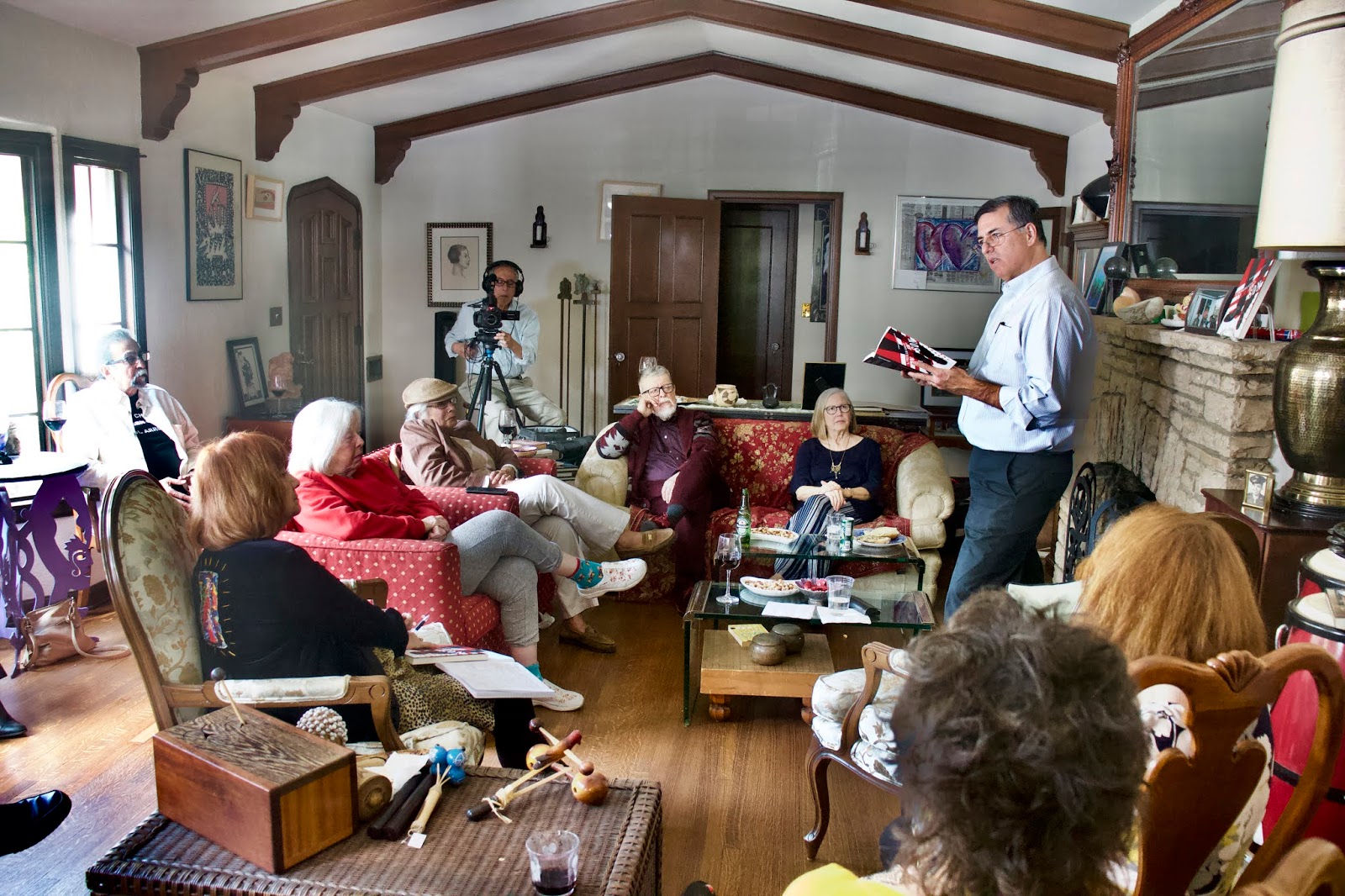


Cold or inclement weather relocates the now-regular floricanto gatherings indoors, as February’s California chill promised when Latinopia’s Jesus Treviño first proposed the gathering. Would I be interested in hosting Sergio Troncoso during his Southern California tour for his short story collection, A Peculiar Kind of Immigrant's Son? As it turns out, Saturday, February 8 was a picture-postcard perfect day of sunshine. It was still more comfortable indoors.


Casa Sedano is a spacious place that encourages small crowd events. We had a dozen friends, mostly writers and significant others, join us for a mid-day event. We broke up around 7, such a great time was had by all wish you’d been here. But sabes que? You can, you should, you oughta have your own living room floricanto.

Invite an author who’s going to be on tour in your region. Generous people, authors. They’ll work with your schedule and theirs. Sergio Troncoso, for example, chatted with Alex Espinoza and read at Los Angeles’ La Plaza de Arte y Cultura on Thursday night. This week, Troncoso is featured at the University of California, Riverside literary week. Saturday, at Casa Sedano in Pasadena, filled the calendar and put his work in front of a welcoming audience.


For authors on a book tour, a Living Room Floricanto offers a chance for a unique sharing of one’s work. It’s an enlarged conversation with abrazos. The guest of honor was on hand to greet the gente as they arrived. For the purposes of the video, I did a stand-up intro long enough for Chuy to get “B-roll” shots. I went for light-hearted in my remarks and Sergio read some serious stuff. Let’s see what editing can put together next week at Latinopia.com.

Ordinarily, Casa Sedano has the traveling writer’s guest bedroom available, but la casa is in a bit of transition right now. Authors on book tours travel on their own dime, so a spare bed or a warm spot on the floor saves out-of-pocket expense.

A public one-to-many event might feature introductions, announcements, then the author chats before reading fifteen minutes of good stuff. If you’re lucky, you get Alex to put you through your paces. Then, as time allows, a half hour of Q&A that range from desultory to good questions usually too much for this event. Living Room Floricanto provides warmly beautiful contrast. Sergio has listeners sitting next to him or just across the room leaning against a wall.


He reads the first few pages in a standup then signs copies. The author runs out of books but retrieves a new supply from the rental car. Everyone takes home an autographed copy they’ll treasure for the good writing but especially this experience. Not to be mercenary or nothing sabes, but word of mouth is the best marketing there is. We talked about raza hurting sales by sharing their books with five or six people who should buy their own copy. Autographed copies tend to stay at home, heeding Polonius’ advice.

Living room Q&A quickly wears out literary discussion in favor of getting down raza to raza and heart-to-heart with these Chicanas Chicanos. Hours pass exchanging regional histories and family conectas, this group readily switching English to Spanish or mixing, as the subject matter demands. La palomilla is in town and they're in the front room.

In California it seems everyone is from someplace else, and in this group, half of them have Texas roots. Several guests hail from Juarez or El Paso. Ysleta, Troncoso’s wicked patch of dust, is a suburb, so lots of insider chismeando and exchanges fill the conversation. Topics range from writerly discussion among the writers, laments on development messing up the old home town. That book came in for some discussion, the guests familiar with Myriam Gurba’s important work with David Bowles in the nascent #DignidadLiteraria movement.

Treviño and Latinopia provided amazingly delectable Italian sandwiches and lots of soft drinks and some notable wines. Recently-retired multi-talented Mario Guerrero brought Gruet champagne. This superb New Mexico wine has found distribution in Southern California. A small winery like this offers a model for small publishers, that is, gotta find ways to break out of the local mold and get into distribution channels.

Independent publisher Cinco Puntos titles likely have spots on independent booksellers shelves, though the direct link works for gente who buy over the internet.

Links
La Bloga-Tuesday's review of A Peculiar Kind of Immigrant's Son.
Publisher's website to order your copies.

How Soon? Sooner Than Too Late.

History happens right before your eyes along Los Angeles' Marmion Way. It's the resurrection of a living spirit--make that 169 feet of living spirit, in the restoration of Daniel Cervantes' 169-foot long mural depicting indigenous gente in native settings. 

I'm going to use "resurrection" interchangeably with "restoration," the artist's description of her labor. The wall had been put to death by tagging and city maintenance crews. The committee and the artist have brought this work back to life. That's a resurrection in the light. But that word, it has holy connotations! Yes, yes it does.

The location, on the alternative to busy Figueroa Street, makes a perfect display site given the towering original Southwest Museum Mt. Washington Campus, the original location of the Gene Autry-founded Southwest Museum of the American Indian.


La Bloga has followed the restoration since summer of 2019, when Lopez began working for the arts activist funding committee that pulled together funding from the local politician, the Los Angeles city arts commission, California's Arts grants, and other donors. Sadly, once Lopez had the project well underway, support evaporated like the blue tarp covers protecting the site disappeared within a few days of mounting.

The artist labored under open sun, no shade had been provided by the owners of the worksite. Worse, the ground provided treacherous footing from terrain displacement and trash. One night and weekend, a person who loves what Pola Lopez is doing raked the surface and leveled the worst spots. Only community support made the ground safe for a worker.

Lopez has enjoyed consistent support from Angel Guerrero, who's dedicated weeks of days to painting as directed, apprentice to the maestra. Angel, and a small number of other artists, have the skill to lend a brush. It's not a job, it's arte.


Community support has brought spiritual enrichment beyond a few dollars more, though money is really useful. Passersby honk and throw thumbs-up signals. A mother walks her babies past the site regularly, enjoying the progress. During my recent visit, Marco, a Salvadoreño, drove up and parked for a chance to talk to the artist. His son attends a local elementary school art program and Marco the dad was talking about an enrichment field trip for the kids. Imagine the insurance liability had that volunteer not been civic-minded, and some kid tripped on a dirt clod and broke a limb?

The site attracts attention from tourists and locals alike. The richly colored design and subjects create a landmark along an otherwise nondescript stretch of road. The mural fills a need no one realized was there, now it's an indispensable contribution to community unity. Taggers respect this wall.

The mural will be fully restored perhaps this week. Then Lopez has a crew spraying a protecting bonding coat, the semi-final stage of restoration. A final graffiti coat completes the entire project.


Lopez faces a funding crisis. Lopez has stocked the graffiti coating material now needs a professional installation crew to spray this vital protective coating. Here's a link to the artist's funding site. There's a spectacular photograph of the sorry state of the surface prior to Lopez' skilled recovery of this historic mural.

It's anyone's guess why the Cervantes Mural has become an orphan. The Autry's coordinator offered to share insight into the museum's abandoned role, but nothing further came from that direction. I wrote councilman Gil Cedillo an open letter (link) recently, about having a grand unveiling. Silence is golden so someone's getting rich but it's not Pola Lopez nor local cultura.

There's the pity. Here's a major cultural landmark nearing resurrection and the community's leaders turn blind eyes and deaf ears. Ask Lopez when the gran unveiling is and she stares back with a rueful smile. None she's heard of, and I figure if she hasn't heard, there is nothing planned.

I'll gather with some friends, burn sage, walk the mural, hear their stories, invite the artist to a good restaurant and toast her health. I hope the people at the next table won't shush us for raising a ruckus. We'll be the only people in LA celebrating the mural.


The business of art subscribes to the force of a contract, arte and cultura and culture be damned. The letter of the law says no more money. The law is an ass that never had to resurrect a cultural wonder and ran into cost over-runs and comes up short. 

The value of what is happening on that wall is immeasurable, not zero, but zero is what funders and cultural giants have added to their earlier generosity. 

The Autry museum, owner of the Marmion Way site, recently "undertook its major multiyear, multi-million-dollar effort" to preserve its collection. That's P.R. Its mural, its most highly visible cultural treasure and one not hidden in the museum's vaults, gets not one red cent nor indian penny more. "Take our word for it," Autry fundraisers say about their vaults filled with unrestored artifacts, "we care."

The business of art demands a piece of the action. So it goes. Fundraising costs money, sending a portion of all the gifts donated to restore the mural to the operating budget of the fundraising committee. There's no millions there, but who knows what the commission is, 30% 15%? One or five percent of that would finish the job. Not that the artist is asking. I asked Lopez about the final coat and she says that's an open issue. Now, the graffiti coating is the most critical step to protecting the mural, and it's an open issue.

It's not the business of art but the art of art at stake here. The entire raison d'etre of resurrecting this spirit is that people see its images, read the story, enjoy the color, identify the land they stand upon and its people. Ars gratia don't waste all this by not having professionals apply the graffiti coat.

The artist's funding site directly supports the restoration with no institutional overhead. Use this link to give directly to hiring professional graffiti coating experts.


Tuesday, January 05, 2016

Gluten-free Chicano Food

The Gluten-free Chicano cooks
Gluten-Free Scallop Chowder
Michael Sedano

Does Chicano food require a side of frijoles and rice and tortillas and a dollop a guacamole? No. Comida Chicana is whatever the cook prepares. Does it have to contain chile? Yes, with certain exceptions, like Chicano pankekies. After all, a day without chile is like a day without sunshine.

At a post-New Year pachanga, The Gluten-free Chicano was talking comida chicana, chile-making, and cooking in general with fabulous artist Pola Lopez. Not only is Pola among the very best Chicana painters, she's also a top-notch maker of chile: Rich with garlic and red chile, it's fabulous on a tamal, perfect as a dip on a chip.

I asked Pola, who originates from New Mexico, why the state’s enchiladas, both green and red, are wheat-bearing dangers for celiacos and other gluten-adverse gente? Pola explained her home state is the capital of roux-based food. “The French influence,” Pola says.

When I complained that corn starch was easily substitutable for wheat flour, Pola reasoned that her homebody cooks probably think the ingredient too Mexican, and it would thus fly in the face of that French influence. Tant pis, which is another way of saying chacun a son gluten habit.


I love the Land of Enchantment, except I can’t eat their enchiladas and a lot of other food owing to that roux tradition. So I’m happy as can be that I’m a Californian and unconstrained by that dommage of a tradition.

In honor of Pola Lopez’ delicious chile--she pulled her punches and didn't make it smoking hot, lástima--The Gluten-free Chicano offers this roux-based chowder.

1 Russett potato, cubed or minced.
½ Brown onion, chopped.
12 frozen medium scallops
¾ cup sharp cheddar cheese
½ cube butter
¼ cup gluten-free baking mix
3 cups boiling water
2 cups lactose-free milk
1 can creamed corn
Olive oil
Ground cayenne pepper, salt, black pepper

Make the Chowder base:
In a deep frying pan over medium flame, heat olive oil.
Stir in the onions and potato and cook until just fork tender.
Add boiling water.

I like russets because they fall apart as they cook and thicken the broth without extra work or tools.

After about ten minutes, add the frozen scallops, cover and simmer while you make the roux. I like frozen scallops in this preparation because they exude flavor as they defrost and will need ten minutes or so before they turn translucent white, during which you make the roux.


The secret:
If you know how to make a good roux, this chowder is an incredibly simple and elegant dish.

Learn to make a roux-based sauce; it is versatile. White sauce, or sauce béchamel, forms the basis of such meals as shit-on-a-shingle aka “creamed beef on toast” (serve on mashed potato for gluten-free goodness); a wondrous cheese sauce for vegetables and baked potatoes; macaroni and cheese; scalloped potatoes; enchilada sauce.

Roux:
Melt butter and a splash of olive oil in a saucepan over medium heat. The oil keeps the butter from burning, so don't skip it.

Sprinkle cayenne, salt, pepper to taste and stir into the boiling butter.

Add gluten-free flour to the boiling butter and stir until toasted light brown. I like King Arthur's Gluten-free Baking Mix, but other brands, or puro rice flour, work as well.


Sauce:
For chowder and cream sauces, use milk or half-and-half as the liquid. Gradually add liquid to the roux, stir and cook until thickened.

A thick paste forms at the first drops of milk. Stir vigorously as you slowly add all the liquid and the sauce becomes soupy. Stir from the bottom of the pan to ensure good results.

Lower the flame and stir frequently but not constantly. You can do some prep work like setting the table in-between stirrings.

In five or ten minutes the sauce will thicken until it coats the side of the pan and your whisk. Judge viscosity by eye and coating action. It should be thick enough to hold a whorl for a moment.

Stir cubed or grated cheese into the slightly thickened roux sauce. Keep stirring until all the cheese melts. The sauce continues to thicken, both from the queso and the gluten-free flour.

Combine Everything Into the Papas:
Stir in the can of creamed corn.

Stir the cheese sauce into the papa-onion-scallop broth.

Bring to a gentle boil.


Serve:
Garnish with a sprig of cilantro or parsley, or a dusting of cayenne powder or coarsely ground black pepper.

¡Provecho!

This recipe serves four, or two with leftovers for a second meal. A hearty chowder makes the perfect meal after a cold day outside turning the earth or sweeping leaves.


Next Week At La Bloga-Tuesday:
The Ten Best Poems of 2015 from La Bloga On-line Floricanto.

Monday, October 05, 2015

Un Poco De Todo


Xánath Caraza


2016 NACCS TEJAS POETRY BOOK AWARD


*Please Circulate Widely*


National Association for Chicana and Chicano Studies—Tejas Foco


Description of Award:


NACCS-Tejas invites nominations and submissions for its 2016 NACCS-Tejas Poetry Book Award. The 2016 NACCS Tejas Award for Non-Fiction Book Committee will consider any book published in 2015 in Texas or elsewhere. We welcome full-length collections of poems. We will recognize an outstanding work of poetry that best represents a significant topic related to the Mexican-American and/or Chicana/o experience in Texas. The award will be presented at the NACCS-Tejas Foco annual conference to be held at Lone Star College–Kingwood in Houston, Texas, February 18-20, 2016. There are no restrictions on the number of nominations per press or on the number of individuals—authors or readers—who can nominate a text. Books previously nominated for this award are not eligible. Nominations will be reviewed by a committee of NACCS-Tejas Foco members.


Procedure for Nominations:

Publishers or authors wishing to submit books for consideration should send a copy of the book to each of the committee members at the addresses below by the deadline of November 15, 2015. Nominations should include a submission cover letter, including the name of the author, the title of the book, press, and the date of publication.


All nominations must be received (not postmarked) by December 15, 2015.

For additional information, you may contact the Committee Chair Christopher Carmona at christophercarmona@myartelibre.com.


Committee Members


Christopher Carmona

939 W. De Soto Ave.

Alamo, TX 78516


Isaac Chavarría

608 N. Linares St.

Alton, TX 78573


Rossy Evelin Lima

700 Ciro St.

Donna, TX 78537


---------------------------------------------------------------------------------------------------


Call for Papers University of North Georgia 2016 Arts and Letters Conference
                                                
                                                  February 26-28, 2016
                                             
                                                      Culture and Place

The 2016 University of North Georgia Arts and Letters Conference will explore the intersection of culture and place. Place is more than location—it is people, it is material, it is climate, it is culture. Places are made through human practices and institutions and are specifically designed and constructed to evoke memories, trigger identities, and embody histories in material form. Thus, the creation of place assigns meaning and helps to define who we are, and often, who we are not. We must ask not just how places come to be, but how and why they are important for social processes, cultural practices, and historical change. How do these connections play out? Are culture and place best understood as two separate entities, or as two dynamically related processes that are best understood through each other?

This interdisciplinary conference will take up these questions and others concerning culture and place. We welcome proposals from all disciplines on a wide range of topics. Possible themes include (but are not limited to):
How have climate, topography, etc., intersected with culture to shape political movements and/or the histories of states?

How have culture and place intersected to produce or perpetuate forms of (intersecting) oppression?

In what ways do culture and place intersect to produce conceptions of “natural” and “normal”?

How do the intersections of culture and place affect or produce notions of objectivity and subjectivity?

What is there to discover in the intersections of culture and place in music, literature, art, science, mathematics, history, philosophy, etc.?

How do places and material forms intersect with social practices, social structures, norms, values, power and inequality?

How does material culture shape and reflect place?

What is the relationship between travel, culture, and place?

How are places made and shaped through cultural practices and cultural forms (such as tourism, development, popular culture, material culture, the environment, etc.)?

How are race, history, power, politics, memory, and culture emplaced?

A CFP will go out at a later time for an edited volume on the conference theme. Faculty, graduate students, and independent scholars are welcome.

Please submit the following

An abstract of 300-400 words
Five Key Words
A brief biography

to: http://digitalcommons.northgeorgia.edu/alconf/

by October 9th, 2015.

When submitting a proposal for a Panel, please indicate the names of all the panelists under “Presenter Information” and please upload abstracts for each panelist with a space between each.

Contact Sara Mason Sara.Mason@ung.edu or
George Wrisley George.Wrisley@ung.edu with questions.


----------------------------------------------------------------------------------------------------

 
Ayúdanos a hacer de este festival una realidad.

Cada dólar es una gran contribución.

Latino Poets NY está preparando el cuarto Festival Latinoamericano de Poesía que se celebrará en la ciudad de Nueva York desde 11 hasta 13 noviembre, 2015. Poetas de gran trayectoria y calidad literaria compartirán su poesía en escuelas, universidades, cafés y centros comunitarios y librerías. Latino Poets NY se enorgullece en anunciar que durante tres años consecutivos hemos sido capaces de mantener festivales exitosos.

LPFNY también publica la antología Festival Latinoamericano de Poesía, un libro que incluye poemas de todos los poetas participantes.

Hoy, le pedimos a ser parte de este esfuerzo. Su generosa donación hará posible continuar la promoción del uso del español a través de la lectura y la escritura de la poesía.

¡Muchas gracias!

¿Nos ayudas compartiendo esta campaña?  http://www.latinopoetsny.com/

Karla Coreas
Directora
Latino Poets NY


----------------------------------------------------------------------------------------------------


Finally, soon to be released my new bilingual book of poetry, Ocelocíhuatl (Mouthfeel Press, 2015), translated by Sandra Kingery.  Here is a sneak preview of a detail of the art for the cover by the amazing Los Ángeles artist, Pola Lopez.  More to come soon.  Viva la poesía!


Ocelocíhuatl by Xánath Caraza (Mouthfeel Press, 2015)