Showing posts with label San Antonio. Show all posts

Saturday, January 03, 2015

Some stuff Anglos taught a Chicano author

-->
In an interview, Sherman Alexie once told Bill Moyers, "I know a lot more about being white than you know about being Indian.”

Similarly, Latino authors likely know a lot more about Anglos than Anglos do about us. This regularly plays out in some Latino literature's Anglo characters. This brings to mind growing up in San Antonio decades ago, and how Anglos gradually worked their way into my life. Although mine is no template for the "Chicano lifestyle," here's how it taught me the first things I learned about Anglos.

A highway like this "improved" my 1st neighborhood
Given the decrepitude of ageing, I don't remember most of the names, but the first one was a neighborhood kid my age, maybe five. He came over regularly and taught me that playing "cowboys and Indians" was fun. Ignorant of the fact that I was part "Indian," we'd ride around the dirt yard on our stick horses, shooting at each other, falling down, and getting dirty. I sort of remember sometimes getting to be the cowboy. He taught me that some Anglos would play with me.

The next ones were female teachers, first through third grade. They were mostly nice, even if I don't remember what I learned from them. Before entering first grade, mi 'amá had already taught me to read, so I assume I picked up whatever math and writing I was supposed to learn because I kept passing to the next grade. The teachers taught me that teachers were Anglo women.

Two incidents in elementary school stick out in my mind. The first was halfway through first grade. Our teacher announced that three of us were being skipped into higher grades. This one poor white boy who could've been twelve years old--the biggest, burliest kid--was being "skipped" to third grade, which was probably still less than age-appropriate for him. I remember thinking the teacher just wanted him gone from her room. From him I learned there were Anglos were much less intelligent than me, even if they were bigger, older and meaner.

Then our teacher announced that two of us--I think the other one was named Judy--were skipping into second grade. That meant something to other kids, my parents, relatives, and the teacher, but I don't remember being impressed by this, since I didn't know what it meant.

Judy gave me another memory, of dancing. During one of those school activities everyone had to participate in, maybe May Day. Out on the playground, we were all paired up and for some reason, nerd-brain, skinny, too-tall, blond Judy got paired up with the shortest kid--a "Mexican" as we called ourselves--who was me. I faked it, going around in circles, thinking I it was supposed to be having fun. Though, not as much fun as getting to be the cowboy. From Judy, I learned Anglo girls would at times be willing to hold my hand, at least in public.

San Anto was the military's playground
Next came my uncle Jack, a military-lifer who later married my mother's sister. He was real white, tall and big, loud and always made his presence known. Whenever the couple came by our house was a treat, probably because their income was higher than most of the family. Before they had any of their own kids, Uncle Jack would take me out while he courted my aunt. The best time was a zoo visit where I got to eat lots of junk because he could afford it. He taught me the military had it much better than most people, though maybe his Anglo-ness had something to do with his good fortune.

Projects like where we lived
About my age, Mary B. didn't teach me as much as I'd have liked. In the federal projects where we lived, her family was one of the few Anglo families around. She had an older sister who was a template for juvenile delinquency, and sort of respected by all the younger kids. Whenever they let her out of juvey or prison, she'd visit with her latest tattooed boyfriend who also looked like he was on parole. They taught me there were tough, young Anglos in the world, whenever they were let out.

Marie B's were shorter than this
Mary B. could've been my first love, or at least experience, except that never happened. She was hotter than her older sister and usually wore shorts that couldn't have been cut any shorter. Neighborhood culture dictated she was unapproachable because she was white, something I didn't understand. For my only teen birthday party I can remember, I invited her and, chingau, she showed up. I danced with her at least once and that was as close to heaven or to Mary B.'s shorts that I ever got. Like Judy, she taught me Anglo girls would dance with you in public, but that my life experiences might be limited to that.

like the coach who "taught" me
There were so few Anglo kids in my junior high (middle) school, none of them would've stuck out. The gym coach, however, taught me corporal punishment and how much it hurt. I got busted doing some regular-Mexican-kid obscenity to another Mexican kid, in jest. But it wasn't funny to the teacher establishment. The board the coach used on the two of us--the "victim" of my jest was deemed guilty as me--taught me to never get caught again. That's how I learned that an Anglo's "paddle" could hit as hard as my pinche father's leather belt.

My mother snuck me into another school district so I've get a college-prep education. Thomas Jefferson was heavily Anglo, from higher incomes and taller parents, and being the shortest kid from being skipped a grade became a bigger joke; most of the kids were a foot taller than me. I learned they were much more silent around me and resembled actors on TV or commercials, with nicer clothes, make-up and styles of strutting that showed they were better than other humans.

Real pic of my high school
I had some great Anglo teachers, especially in the sciences, possibly why I later imagined studying to become a physicist. I don't remember facing prejudice from the teachers, but that might've been due to my I.Q., more than anything else.

My French teacher came straight out of an 18th century novel. She exuded European style and aloofness that I'd never seen in any "Mexican." Despite being ignored by most of the Anglo student body, I'd come to understand it wasn't that hard to get good grades, especially A's. There was only one student better than me in French class, and her grandmother was French-born.

Everybody knew your grades
Each grading period, we'd go up to the blackboard and write down every one of our grades that the French teacher dictated to us, and then figure out our average. As a private joke, through three years of French, I made it a point to totally fail one test. So, I'd stand at the board, copying down A after A, but always with one F. It was obvious what I'd done. Funny thing is, no student, much less the teacher, was ever impressed by this. It took me years to understand how difficult it was for old or young Anglos to admit when a Mexican could do better than them. And how much they didn't like being involved in my sarcasm.

I could write a book: How Chess Can Pay for Your Lunch
The only friends I had in high school were other nerds, the straight-As, headed-to-Harvard kids who sat together before school playing chess or sat at the lunch table playing chess. No other club, except for science clubs, would have them as members. I was comfortable among them, especially since the only way I ever had money to buy a Coke or breakfast was from beating them at chess.

-->
One of them--name withheld--was as fat as Fat Albert and became my best friend. With coke-bottle lenses, he was definitely smarter than me, possibly the smartest kid in the school of a thousand. Midway through, he spent a summer losing weight, getting contact lenses, and returned as New Hunk on campus, and was admitted into the exclusive club for the richest, cool Anglos. He still came around us, and I learned that if you were Anglo, you could change your outside appearance and improve your status in society.

Berkeley radicalism my best friend's parents saved him from
After we graduated, that best friend and I played tennis for the summer, until we got into a fight over a racquet, and he disappeared. I don't remember why we got in the fight, whose "fault" it was. He taught me I could have Anglo best friends, at least for a stretch. He also taught me that Anglos were sometimes smarter than me, were able to raise their societal standing, and could be accepted to schools like Univ. of Berkeley.

last time I returned to San Anto, for my novel
When his parents refused to let him go to that college, because of the student radicalism of the Berkeley Free Speech Movement, he taught me Anglos could be more fragile than me, who'd only be accepted to UT. His suicide wasn't the last thing I learned about Anglos, but it's enough, for now.

Es todo, hoy,
RudyG, a.k.a. Chicano fabulist-mextasy author Rudy Ch. Garcia, striving to put on paper some of the things I learned about Anglos. And others. And some things I never learned.

Wednesday, July 23, 2014

Macondo Public Reading


Please join us this Friday, July 25, from 7:00-9:00pm, at the historic Guadalupe theater in San Antonio Texas for a FREE PUBLIC READING by notable "MACONDISTAS" (a group of socially engaged professional writers and participants of this year's Summer Macondo Workshop) 

Confirmed readers include: San Antonio poet laureate, Laurie Ann Guerrero, former San Antonio poet laureate Carmen Tafolla, Gabriela Lemmons, Joe Jimenez, Jose B. Gonzalez, Ben Olguin, Rene Colato Lainez and more talented writers.

About The Macondo Workshops: 
The Macondo workshops started in 1995 at the kitchen table of the poet and writer Sandra Cisneros in San Antonio. These yearly workshops aimed to bring together a community of poets, novelists, journalists, performance artists, and creative writers of all genres whose work is socially engaged. Their work and talents are part of a larger task of community-building and non-violent social change. What united them was a commitment to work for under-served communities through their writing. 

With the blessing of its founder and the board of the Macondo Foundation, the Guadalupe Cultural Arts Center administers the summer Macondo workshops.


This unique environment is unlike any other literary initiative in the United States. It is premised in Cisneros’ vision to create a homeland for writers who are working in underserved communities. Macondo has fostered a vibrant and growing community of writers who view their writing as way of giving back to the community and changing lives by fostering literacy.


Saturday, March 08, 2014

Quiñones. Teen on privilege. Legacy of intolerance. New MA studies.

Sam Quiñones
New paths for a great journalist

Sam Quiñones, author of one of my favorite books, Antonio's Gun, is leaving the L.A. Times for other adventures. La Bloga wishes him well with his old and new endeavors. Read the whole story here. 


American teenager explains white privilege


If you need material to explain white privilege to an Anglo, or just want to check your own understanding of it, then check this American teenager's cartoon. She's not just a breath of fresh air; she's a windstorm leaving the cities sweet.

Artist Jamie Kapp, 19, calls herself IgnorantTeenager; she's anything but. Here's her first cartoon, but enjoy them all.


U.S. legacies of intolerance

Jimmy Franco Sr.'s post this week on LatinoPOV, The Enduring US Legacies of Discrimination and Intolerance, should be read by all. Here's a taste:

"This present-day type of systematic ethnic intolerance and governmental restrictions on specific sectors within our society are becoming somewhat reminiscent of a similar trend in 1930s fascist Germany.

"The ideological basis of our society was founded upon the four legacies of white supremacy, male dominance, class bias and religious sectarianism.

"This upsurge in ethnic hatred and divisive behavior needs to be actively confronted and not avoided nor shrugged off. Hiding our heads in the sand instead of standing up and speaking out for correct principles and norms of mutual respect and behavior only encourages these hate-spewing bullies."


A new Center for Mexican American Studies

From Juan Tejeda comes this:
"Colegas y Camaradas: On behalf of Alamo Colleges and Palo Alto College in San Antonio, Tejas, we invite you to this special Ceremonia and Grand Opening Celebration of the Palo Alto College Center for Mexican American Studies on Thursday, March 20. 

"Many colleagues have been working on this initiative for over a year and now the dream is becoming a reality. Come on out to the Southside and celebrate with us. It's free and open to the community and we'll have free food and drinks for lunch, plus some very special cantos and performances. Feel free to invite friends and familia. We give thanks for the blessing of this center and may it serve to inspire and help our children and students succeed in school and in life, for generations to come."


Denver's best Tex-Mex

During The Rick Garcia Band's performances on April 12 and 13 at Denver's Oriental Theater, you have a chance to own one of the framed posters and artwork that were displayed at Rick's Tavern!
  
Rick Garcia Band website: www.rickgarciaband.com
Oriental Theater website: www.theorientaltheater.com
Rick Garcia Band 24-hour line: (720) 855-8166


Es todo, hoy,
RudyG

Saturday, March 16, 2013

Writing Opp. Fracking and heating Aztlán. Chavez.


Conjunto Writing Opportunity
News from San Anto Guadalupe Center

Camaradas de Conjunto: We're looking for literature on Conjunto Music for publication in the 32nd Annual Tejano Conjunto Festival en San Antonio 2013 program magazine. Any literature, including poems, short stories, interviews, scholarly articles, etc., as long as it deals with some aspect of conjunto music, of any length, will be accepted for review and possible publication through March 31, 2013. Conjunto is that original American musical ensemble and style of music which was created by the Texas-Mexicans and which utilizes the button accordion and bajo sexto as its principal instruments.. E-mail the literature to Juan Tejeda no later than early April. There's a relatively short turnaround so I appreciate spreading the palabra. Hope to see you here in May. Gracias, Juan Tejeda  (juantejeda@sbcglobal.net).

The 32nd Annual Tejano Conjunto Festival en San Antonio 2013 will take place May 15–16 at the Guadalupe Theater, 1301 Guadalupe Street and May 17–19 at Rosedale Park, 303 Dartmouth. The festival will feature a Seniors Conjunto Dance; inductions into the Conjunto Music Hall of Fame; workshops on the button accordion and bajo sexto; a New Directions concert; and three days and over 36 of the very best bands in conjunto music at Rosedale Park that includes special tributes, plus food and beverage booths, accordion raffle, student recital and more.

For more information, call (210) 271-3151, or visit www.guadalupeculturalarts.org. The Guadalupe Cultural Arts Center is a 501(c)(3) non-profit organization founded in 1980 to preserve, promote and develop the arts of the Chicano/Latino/Native American peoples for all ages and backgrounds through public and educational programming in six disciplines: dance, literature, media arts, theater arts, visual arts and music.


Fracking Update for Aztlán and beyond

As an author I want my works read for centuries to come. Making certain there will be young readers around to enjoy the works is a simple matter of self-interest. That's not the only reason Global Heating and combatting fracking extraction matters, but it's one reason I feel it should be of interest to La Bloga readers.

If you're in Arizona, your might get the worst of Global Heating that fracking will exacerbate, at least, in terms of heat. Go here to read about getting rid of your estufa because you'll be able to fry your eggs on the sidewalk, as long as you like to add a lot of sand to your revueltos. Very soon.

If you think the jobs that come with fracking might benefit you or the economy, read about the advantages of being a fracking worker: My winter as a frack rat


If you're not sure whether fracking is going to be operating under your barrio or suburb, go here to read about how you'll be able to hear and feel it. And how your wells and walls may suffer just from the search for fracking sites, something you have a right to have a say-so about.

Throughout Aztlán and beyond, if you were hoping Obama would stop the Keystone XL Pipeline, go here to read about how your Congressional legislators are attempting to push approval of the pipeline past Obama.

If you want to do something about fracking in other parts of Atlán, go here.

Next is info about a Colorado action this coming Monday:


There will be an amendment to the budget bill next week that would force approval of the Keystone XL tar sands oil pipeline.  Most worrying, Senators’ (Mark Udall and Michael Bennet) staff say they are “undecided” on whether to stop the pipeline.
350 Colorado and our friends from across the state have written a letter to our Senators explaining why they need to stop the pipeline, and we hope you will add your name before we deliver it to their offices on Monday.

Please co-sign the letter to let our Senators know that you want them to reject any attempt to push forward the pipeline. Click here to read and add your name.
After you sign, please share it with friends and colleagues -- the more signers, the stronger our message will be.

If you're in the Denver area, join us this Monday, March 18th, for a letter delivery event to the Senators’ offices. We meet at 11:45 in Downtown Denver  to send a message in person. At this critical moment, it's important we show there are lots of us who expect nothing less than for them to reject this pipeline outright.
Details:
WHAT: No KXL letter delivery to Senators Bennet and Udall
WHEN: 11:45 AM, Monday March 18th. (we should wrap up by 2 PM)
WHERE: Meet at Senator Bennet's office, 1127 Sherman Street, Suite 150, Denver CO


Más sobre el sudamericano Chavez

Excerpts from an article by Bill Fletcher

"It was clear Chavez had phenomenal support among the poorer and the darker parts of the Venezuelan population while the opposition looked like it could have walked in from Madrid. With the combination of the social movements plus President Chavez’s support, race came to be openly discussed in Venezuela and actual steps were taken to address a very different form of white supremacy than the version with which we are familiar here in North America.

"The Bolivarian process, which is far from over, has suggested multiple levels of struggle but in every case drawing upon mass action and mass involvement.  This goes beyond huge demonstrations—as important as they may be—but more in the direction of encouraging alternative institutions as well as revitalized (or in some cases new) social movements.

"Upon the discovery of his cancer, he apologized for not having taken sufficient care of himself. I was struck by this comment for two reasons. The first was the admission that he had not been on top of his health and that he was prepared to take responsibility for that. The second reason implicit in his comment:  that it is a duty to pay attention to one’s health, to live for the struggle (as opposed to living to struggle). Neither can one so underrate one’s own role that we think that as individuals we do not matter."

BlackCommentator.com Editorial Board member and Columnist, Bill Fletcher, Jr., is a Senior Scholar with the Institute for Policy Studies, the immediate past president of TransAfricaForum, and the author of “They’re Bankrupting Us” - And Twenty Other Myths about Unions. He is also the co-author of Solidarity Divided: The Crisis in Organized Labor and a New Path toward Social Justice, which examines the crisis of organized labor in the USA.

Es todo, hoy,
RudyG

Saturday, November 17, 2012

Chicanada @ LoneStarCon. Melinda Palacio @ NHCC. Café Fresco @ Gallista Gallery


World SciFi Convention wants Chicano/mexicano programming

This past summer I ran a four-part series entitled Spic vs Spec, in which I spoke to latino participation in the U.S. spec fiction world. That world is a changin'.

Next year, one of the largest fantasy / sci-fi gatherings will be held in San Antonio, Texas. What will make it stand out is that organizers want to diversify their programming into the Spanish-speaking and mexicano world. Qué bueno!

La Bloga was recently contacted by Lone Star Con3 program organizers with the following request:

"We want to develop a Spanish Language Track to the World Science Fiction Convention. Panels might not be bilingual, but should include Spanish-speaking fans, TV shows, and unique Spanish language contributions to Science Fiction & Fantasy. We are looking for local authors from the San Antonio area to help us put together programming that would promote SF&F from Spanish language sources, who are interested in helping us develop that track along with local clubs and media."

This effort is in the beginning stages, but offers an opportunity for Chicano and mexicano spec authors and readers to enter an arena of U.S. literature that is just beginning to learn about us. It also provides us a new mechanism to take our literature to mainstream readers.

Other gente outside the San Anto area can possibly also get involved in some way. I believe there will be many opportunities and ample reason not only to attend, but to participate in enrichening this convention.

Please contact us for further info if you are interested. Note this, too: whatever is accomplished in San Anto can possibly be taken to similar conventions in the U.S. in the future. I among others are definitely interested in that. And spread the word.

LoneStarCon3, Aug. 29 - Sept. 2 2013, San Antonio, Texas, Aztlán

Melinda Palacio to read at National Hispanic Cultural Center

Award winning novelist and poet Melinda Palacio will read from and sign her new collection of poetry How Fire is a Story, Waiting at the National Hispanic Cultural Center on Saturday November 17th at 2 PM in the Salón Ortega. The event is free to the public.

According to Northwestern University Press, “Melinda Palacio’s newest poetry collection creates images that are at once heartbreaking and humorous. She tackles elemental subjects of family and childhood with the same depth and grace as that of myth making and death. As the only child of a mother who died too young, she infuses her words with longing and life, and celebrates the women who came before her. Each poem offers up the truth in a fearless and unsentimental voice.”

Melinda Palacio lives in Santa Barbara and New Orleans. Her novel Ocotillo Dreams (ASU Bilingual Press) received the Mariposa Award for Best First Book from the International Latino Book Awards. She also received the 2012 PEN Oakland-Josephine Miles Award for Excellence in Literature. She was also a finalist for the Premio Aztlán for 2011. Her poetry chap book Folsom Lockdown was the winner of Kulupi Press’ 2009 Sense of Place award. She is a contributing columnist to the Latino literature blog, La Bloga.

No doubt, her new collection of poetry explores similarly complex territory. Contact Greta Pullen at (505) 724-4752 or e-mail greta.pullen@state.nm.us.

Joe Lopez invites you to Café Fresco

Café Fresco is now open at Gallista Gallery, San Anto. We are excited about the cafe/sandwich bar re-opening at Gallista, under new management. If you're in the area, stop by and help us welcome our new cafe manager Yolanda Aravelo.
Cafe Fresco will be open Tuesday - Saturday from 7 am - 2 pm.
The Menu includes breakfast and light lunch items, such as English Muffins filled with ham, egg, and/or sausage, Buttermilk Biscuits by the dozen and half-dozen, and Hoagie sandwiches.

Enjoy local art with your coffee! - Free Wifi
Gallista Gallery, 1913 S. Flores St., San Antonio, Texas, Aztlán


Es todo, hoy,
RudyG, aka Rudy Ch. Garcia, author of The Closet of Discarded Dreams, the Chicano fantasy with a Chicano hero


Wednesday, April 11, 2012

San Antonio's Mayor Castro announces nationally renowned author Carmen Tafolla as City's inaugural Poet Laureate


On April 3, 2012, San Antonio became the first major city in Texas to appoint a Poet Laureate. Mayor Julián Castro formally announced nationally renowned author and poet Carmen Tafolla as the Poet Laureate in keeping with the SA2020 goal of turning San Antonio into “a brainpower community that is the liveliest city in the nation.” The initiative applies to the Arts & Culture as well as Education vision areas. The honorary position was created to promote the literary arts and literacy within the community as well as foster a greater appreciation of the poetic arts through the reading and writing of poetry. The Poet Laureate will serve a two-year term and will commit to a minimum of three City sponsored and selected public appearances for each year of service. 

"I can think of no one more worthy of this honor than Carmen Tafolla. She's not only an accomplished poet and educator; she is a homegrown talent who embodies the power and poignancy of art in our community. I am proud to call her San Antonio's first Poet Laureate," Mayor Julián Castro responded to the determination by the Poet Laureate selection committee. The announcement follows the Mayor’s State of the City address where he called for San Antonians to “be bold and invest in the city’s future” through education, early childhood education in particular.

The City’s Office of Cultural Affairs received 21 nominations representing 15 local poets. The selection committee was comprised of poetsfrom around the country: Francisco Aragon (San Francisco, CA), Catherine Bowman (Indiana), Cyrus Cassells (Texas), and Valerie Martinez (New Mexico). The application process opened in November 2011 and nominations were accepted until January 18, 2012. The committee review process took approximately six weeks.

Tafolla’s goal as Poet Laureate, she believes, is to bring the joy of literature into the daily lives of the people of this great pueblo, and to empower the expression of their own poetic voices in our young and old alike. She believes strongly that a multicultural dual-language education is one of the greatest gifts we can provide our children, and that effective family literacy is heavily dependent on the availability of stories and literature to which people can relate culturally and realistically. “Literacy and literature cannot be realistically separated if we hope to have an impact on all of our residents,” says Tafolla. “Powerful stories that reflect our reality reverberate inside us, and give us meaning. Literature cannot afford to be elitist or disconnected from the community.”

Her first solo collection of poetry, Curandera, was published in 1983, and gleaned her recognition as a master of “code-switching,” the art of alternating between formal and colloquial Spanish and English, as a literary technique. She has been called “a world class writer” by Alex Haley, and a “pioneer of Chicana literature” by Ana Castillo. Tafolla has published five books of poetry, including the award-winning Sonnets to Human Beings, translated into German in 1992, Spanish in 1994, and Bengali in 2006; the most recent collection, Rebozos, will be published in September 2012.


One of her most-loved children’s books is That’s Not Fair! Emma Tenayuca’s Struggle for Justice / ¡No es Justo! La lucha de Emma Tenayuca por la justicia, which tells the true and inspiring story of pecan shellers in the 1920s and 1930s in San Antonio struggling for better pay and working conditions and the young woman who became a hero for the cause. Other children’s books, including What Can you DO with a Paleta? and What Can you DO with a Rebozo?, have won the prestigious Americas Award, presented to Tafolla in 2010 at the Library of Congress, the Charlotte Zolotow, for outstanding picture book writing, and two American Library Association (ALA) Notable Children’s Books. Her latest children’s book, Fiesta Babies, was named one of the Top Ten Best Books for Babies by the Fred Rogers Corporation. These only represent a sampling of her awards.

“Truly, she reaches all segments of the population, from the academic literary experts to the kindergarteners,” Texas State Senator Leticia Van de Putte enthusiastically stated in her nomination letter for Dr. Carmen Tafolla, who serves as Writer-in-Residence for Children’s, Youth & Transformative Literature in the Department of Bicultural-Bilingual Studies under the College of Education & Human Development at the University of Texas as San Antonio. “I congratulate San Antonio for having a responsible government that supports the arts because it promotes our great city as a great place to live and raise families,” Van de Putte continued.

For more information about the San Antonio Poet Laureate Initiative,please contact Diana Hidalgo at the Office of Cultural Affairs at 210.207.6568 or e-mail at diana.hidalgo@sanantonio.gov < 
mailto:sarah.yates@sanantonio.gov>. Visit www.sahearts.com <http://www.sahearts.com> your guide toarts and culture in San Antonio.


Friday, May 20, 2011

Reading and Dancing in San Antonio, Storytelling in Denver and San Francisco, Critiquing in the Latino West

click on images for details


The reading and signing event for You Don't Have A Clue attracted an overflow crowd to the Twig Book Shop in San Antonio, TX on May 14. Sarah Cortez, Nanette Guadiano, Bertha Jacobson, Diana López and Manuel Ramos read from their respective stories, answered questions, and did interviews for a high school class working on a video project (who knows, it may show up on La Bloga one day.) Here are a few photos of the day - thanks to Bertha Jacobson and Flo Hernandez-Ramos for the use of their pics.


Weather, audience, and a great bookstore cooperated to make the event a hit


Bertha Jacobson, Manuel Ramos, Diana López, Sarah Cortez, Nanette Guadiano


Manuel Ramos, Sarah Cortez, Nanette Guadiano, Bertha Jacobson


Diana López


XXX Tejano Conjunto Festival


San Antonio without conjunto music is like a library without books - it makes no sense. Before and after the Twig event, Flo and I spent as much time as we could in Rosedale Park (Westside!) listening to some of the finest musicians in the world thrill a crowd that came to dance, cheer, stomp their feet and grito into the early morning hours. The outstanding lineup included famosos such as Los Tremendos Alacranes de David Flores, Oscar Hernández & The Tuff Band, Mingo Saldívar y Sus Tremendos Cuatro Espadas, Eva Ybarra, Max Baca y Los Texmaniacs, and The Hometown Boys, as well as younger groups just starting out who deserved a spot on the program. Special treats included bands that featured the heirs and relatives of Tony De La Rosa (Los De La Rosa Boys), and Ruben Naranjo (Ricky Naranjo y Los Gamblers) carrying on the traditions and excellence of their iconic patriarchs.

Another treat was listening to a young accordion player from the Netherlands, Dwayne Verheyden. The kid came on with Max Baca and the Texmaniacs, and those of us in the audience knew that something special was going to happen. Not just anybody gets asked to play at this festival -- you have to have something going for you that puts you above the rest, have paid your dues, or earned your chops, as they say, and so it was a bit unnerving to see the güerito strap on his Hohner squeeze box on the same stage where Flaco Jiménez, Narciso Martínez (that's him on the festival poster), Valerio Longoria, Steve Jordan, and Lydia Mendoza once wowed the crowd, where legends and myths come to life. Suffice to say no one was disappointed - the kid rocked. He more than managed to get the San Anto crowd to holler and dance and flip open their telephone video cams to record the scene.

This festival has inspired some of what I consider my best writing (read the opening chapter of The Ballad of Gato Guerrero, or listen to a reading of that chapter at this link.) San Antonio is an amazing city - not without faults like any metro area, but the gente, cultura and comida overwhelm with such good vibrations that it's easy to forget about recession, war, crime, and politics (at least for a few hours), as the accordion riffs echo in your ears, carnitas tacos drip on your fingers, and swaggering, decked-out dancers whirl under the lights.

¡Pura Chankla!


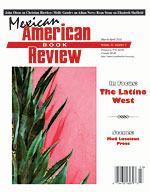
Before I forget - you ought to pick up a copy of the March/April American Book Review. This issue's theme is The Latino West and it's packed with important articles, reviews and opinion pieces written by Ricardo Gilb, Dagoberto Gilb, Yxta Maya Murray, David Dorado Romo, Josefina López, Oscar Villalon, Michael Jaime-Becerra, Sheryl Luna, Hector Cantú, Diana López, Alex Espinoza, Christine Granados, Lisa Alvarez, and Rene Perez. Several friends of La Bloga in that lineup. And the topics include Tim Z. Hernandez, Gilbert and Jaime Hernández, Alfredo Véa, Gary Soto, John Rechy, and the infamous Brando Skyhorse. Another gem from Texas - the periodical is a product of the School of Arts and Sciences of the University of Houston - Victoria.


Later.

Saturday, December 04, 2010

Trino mural & why we're losing our casas

Tribute includes Trinidad Sanchez, Jr.

A reader sent us this great website about San Anto, Tejas, that includes photos of the city's Chicano murals.
The mural in which poeta Trino was honored is identified as "Lideres de Westside". There are other website pages with cultural facets of the town, some of which are commercial.

Here's more links to it:

Los Tres Reyes dedican un corrido al barrio de San Antonio TX WestSide, en un video homenaje, para más información visitar aquí.

Los Tres Reyes dedicated a corrido about the Westside of San Antonio, TX, in a video tribute, for more information visit here.

Trino Presente!!!!!!!!!!!!!!!!!!!
________________________

Getting it put to us

The following excerpt is taken from TomDispatch and reprinted here because it's about Chicanos, mexicanos, latinos in general getting the worst of the American dream:

"We already know that it’s party time for the financial elite who gave real meaning to the phrase “economic meltdown” in 2008, that bonuses are soaring, that corporate profits for the third quarter of 2010 are beyond the stratosphere, and that the corporate chieftains and Wall Street titans of our new gilded age have, as New York Times columnist Bob Herbert wrote recently, “waged economic warfare against everybody else and are winning big time.”

"What we know far less about is the degree of the catastrophe they inflicted on the rest of us. Here’s just one story that should be front-paged in our major newspapers, but for which, at the moment, you have to turn to Dollars and Sense, a modest if intriguing economic publication. There, Jim Campen, professor emeritus of economics at the University of Massachusetts-Boston and an expert on racial discrimination in mortgage lending, has written a piece entitled, “Update on Mortgage Lending Discrimination: After a Disastrous Detour, We’re Back Where We Started.”

"It may not sound like much, but what a horror story it tells. If you were black or Latino in the 1980s or early 1990s and wanted to buy a home, the odds were that the banks had “redlined” your neighborhood and were denying you mortgage applications at “disproportionately high rates” compared to whites in similar economic circumstances. In other words, you would have a tough time becoming a homeowner.

"Then came those high-cost subprime loans whose fine print ensured that you would never be able to pay them back. In a case of “reverse redlining,” they were aggressively targeted at black and Latino neighborhoods in numbers strikingly disproportionate to white neighborhoods. Not surprisingly, when the housing bubble burst, the financial world shuddered, the economy went south, and wave after wave of foreclosures began to sweep across the country, it was black and Latino homeowners suffered the most.

"In Boston in 2006, the peak year of the subprime lending boom, Campen discovered that “49% of all home-purchase loans to blacks, and 48% of all home-purchase loans to Latinos, were high-cost loans, compared to just 11% of all loans to whites.” In the carnage that followed, he informs us, nearly 8% of black and Latino homeowners were foreclosed on, compared to 4.5% of whites. In other words, while the people TomDispatch Associate Editor Andy Kroll calls “the New Oligarchs” bought Dom Pérignon and celebrated, they had let loose the financial equivalent of a neutron bomb on nonwhite neighborhoods in America. It’s a scandal that should be at the top of the news, not in obscure magazines or at websites like this one, and it’s just a small part of the larger, distinctly un-American scandal."

by Tom Englehardt

To read the entire article regarding how American wealth is eluding almost all of us, go here.