Showing posts with label Westerns. Show all posts

Thursday, July 27, 2023

Chicanonautica: Sheriffs Amok

by Ernest Hogan

I was sure that, by now, Arizona would be ablaze with weird politics of concern to the La Bloga audience, but I was wrong. It’s kinda quiet. A certain ex-president seems to be losing his mojo. A certain election denier keeps losing court cases and blaming bizarro conspiracies.


Then I found out about the constitutional sheriffs movement, where Arizona is ground zero.


NPR did a good job of explaining the movement. In short, it consists of sheriffs across the country who believe that a county sheriff’s authority should supersede that of the federal government, including the president. They have an organization, the Constitutional Sheriffs and Peace Officers Association (CSPOA). Eight Arizona sheriffs are members, along with 300 of the nation’s 3,000 sheriffs. Resistance to mandates to stop the spread of Covid-19 gave them a boost, and they side with the election deniers and have white supremacist connections.


Their name is misleading. There is nothing in the constitution saying that sheriffs have such powers. They also are required by law to take an oath to support the constitution, like the one I had to take–the words include “preserve, protect, and defend”--to become a school janitor and work for the public library.


Yeah, the upcoming election is gonna be messy.


A problem I see is that sheriffs are go-to heroes in pop culture, not just westerns both period and contemporary, but horror, and science fiction. 


Yeah, reality is often quite different, here in Maricopa County, Az, we had Sheriff Joe Arpaio “America’s Toughest Sheriff” who ran on talking like John Wayne, and bragged about defending the border, even though it’s 30 miles away as the crow flies, and 79 to 48 depending on the route you take. 

These “constitutionals” are following his example.


To be fair, the likes of Oscar Zeta Acosta, and Hunter S. Thompson ran for sheriff with left/radical political ambitions. I also remember a guy named Tank Barbera, in L.A. County, who said he’d abolish the Sheriff's Department if elected. None of them won. Probably didn’t fit the stereotype.


This was in the Watergate years, when one of my college teachers said, “I keep expecting to see people wearing crossed ammunition belts.”

In open-carryArizona, I wouldn’t be surprised if ammo belts became fashionable.


Meanwhile, other elected officials are using unenforced, unconstitutional English Only laws to get rid of bilingual education.  


There is also a reversal of the pop culture trope, where the sheriff is a bad guy, usually backed by corrupt, rich landowners. Hmm . . .


Is the country becoming a spaghetti western? In real life you don’t get the entertaining shootout where, by the grace of the writer, the right people get killed. 


And now, the writers are on strike.


Ernest Hogan, the Father of Chicano Science Fiction, author of High Aztech, Smoking Mirror Blues, and Cortez on Jupiter has written a lot of stories this year. Stay tuned for news of where and when you will be able to read them.

Thursday, August 11, 2022

Chicanonautica: Gold, Greasers, Yaquis, and Zane Grey

by Ernest Hogan

Recently, I ran across an old western on Tubi that had me smiling and shaking my head. It was called Desert Gold, from 1936. Buster Crabbe, who also played Flash Gordon, Buck Rogers, Tarzan, Billy the Kid and other heroes was listed as the star. Here he was cast as an Indian, with a wig and full body makeup (after all, it took a dye job to make him Flash Gordon). 


As I watched it, the surprises just kept coming.


It was based on a novel by Zane Grey, who laid the foundations of the Wild West genre. Old white men still buy his books, and when they die, their families donate their collections to libraries. This is a case of a writer having an influence on society. 


Turns out Crabbe is not the star of the movie. There’s the usual white cowboy with a white silly sidekick who wisecrack through foiling bad guys (also white) who are plotting to steal land and gold from the Indians. It’s not clear if the line, “You know how these things are—it belongs to the first white man who finds it” is intended to be ironic.


Crabbe plays Moya, “Chief of an Indian Tribe” that is never named. They look kind of Navajo or Apache depending on how friendly or hostile the script required. And despite his heroic looks, he plays the victim. He’s stoic, noble, gets beat up, tied to a post and whipped, and is grateful when the hero saves him.


There’s also a mention of how the Indians are mysteriously dying out due something more like a natural blight rather than government policies.


In the end, Moya and his nameless tribe ride in and save the day like the cavalry. He even gets to shoot the villain, while the white hero gets the girl and the gold.


I got curious about the novel, so downloaded it from Gutenberg, and well, it was mind blowing. Turns out, the movie is like a toned-down, liberal makeover of the book.


Zane Grey’s original Desert Gold was published in 1913, and like many westerns of the period was set in “modern times.” The West was a place, rather than a historical period. The Mexican revolution is going on. The dashing young hero takes a job as a “border ranger” who’s job is mostly to keep “Chinese and Japs” from crossing over and trying to take over. (This was a thing back then: In the 1932 movie Border Devils, also on Tubi, and co-written by science fiction writer Murray Leinster, the villain is a Fu Manchu clone called The General.) 


The story begins in Casita, a “Greaser town” –yes, Greaser is capitalized, like Chicano–where lots of bad hombre “rebels” are causing trouble. It's explained that the reason Greasers are a problem is because their Spanish blood makes them sadistic killers. No mention is made of Native blood, or any ill effects.


We are also told that Casita has some nice Mexicans who make great food . . .


The hero falls in love with the beautiful Mercedes Castaneda, a “Spanish” girl. She is never referred to as Mexican, or Greaser. More than once, she’s described as having lovely white skin. She also shows no sign of the tendencies toward cruelty and murder said to be carried in her Spanish blood.


A Greaser gang leader also falls for Mercedes, and kidnaps her, and takes her to Moya’s village, where he’s taken over. 


Moya is identified as a Yaqui, but this time he isn’t given a name. They call him Yaqui, even after he learns a few words of English. The bandits torture him, but he doesn’t reveal the location of the gold mine. 


The hero and his sidekick rescue Mercedes and Yaqui, but in trying to escape the Greasers—who are said  to be worse than Indians—they get lost among the lava and cactus where Yaqui’s knowledge of wild herbs comes in handy, and there’s even some desert mysticism that foreshadows Edward Abbey. “Color, race, blood, breeding–what are these in the wilderness?” slips into the narrative, but then they have to go back to so-called civilization.


And Yaqui’s skill with “Aztec knifework” comes in handy.


In the end, even though he worships Mercedes as if she were a goddess,  he rides off without saying goodbye, being an inscrutable Indian.


The book is a primer for border racism. It is also the sort of thing generations of white patriarchs read for comfort and relaxation. And the attitudes and beliefs in it are alive and well in the 21st century.


Happy trails, amigos!


Ernest Hogan’s mother’s stepfather was Yaqui. She called him Daddy. He called him Grandpa.

Thursday, March 10, 2022

Chicanonautica: !Joaquin Murrieta en Siglo XXI!

by Ernest Hogan

I grew up in a house where Joaquin Murrieta was considered a hero. He would come up in conversations between my dad and grandpa. Once Grandpa asked why there weren’t movies about Joaquin Murrieta. Dad said it was because Americans considered Joaquin to be criminal and murderer. Oh, the look of shock on Grandpa’s face.


Later, in high school–this would be the early Seventies at the start of the Chicano Movement--they showed us the film of Rodolfo "Corky" Gonzales’ poem I Am Joaquin. The teachers thought it was “unnecessarily arty”--gringos just don’t get how style is important in getting across your message. I thought it was crystal clear.


Granted, knife-wielding Joaquin is a bit heavy for modern pop culture, still he is compelling. He was white-washed into a Spanish nobleman, Zorro (who in turn inspired Batman), just as Bass Reeves was made into the Lone Ranger. There’s something about daring vigilantes, be they wild westerners or postmodern superheroes.


Also, apocalyptic times call for messiahs who have to be bigger than life, and who can leap across cultures–even civilizations–with a single bound.


So maybe it’s at long last time for Joaquin to step onto the stage of global corporate multimedia pop culture, and for Chicanos to be “discovered” (remember Columbus) in the process. After all, the legend of Joaquin Murrieta is essentially the origin story of the Chicano identity. Before that there were just Mexicans and Americans, and Latinx wasn’t even a dream in a distant future. 


So with Blood and Gold: Legend of Joaquin Murrieta, Jeffrey J. Marioette and Peter Murrieta crystalize it for the 2st century, in a way that will satisfy both aficionados of gory shoot ‘em ups, and scholars of ethnic studies and California history.


It starts out with the basic revenge story that can be seen in the origin of Batman, Star Wars: A New Hope, and tons of pulp fiction and action movies. Joaquin and his bride come to California, which has been recently acquired by the U.S. of A., to pursue a better life in the Gold Rush, and they run into racism. The bride is raped and killed, and Joaquin nearly killed, but after Tres Dedos/Three Finger Jack helps him recover and gives him some Obi-Wan Kenobe type training, he goes on a vendetta, killing some of his wife’s murderers.


How many movies have you seen with that plot? But this is only the beginning of the book. Joaquin keeps seeking out the murderers, while starting a career as a bandit. The newspapers tell of a moustachioed Mexican Murderer–the origin of the stereotype.


But things are never simple and stereotypical. He develops a Robin Hood-type relationship with the “Mexicans” of California, and runs afoul of those who want to establish a white-dominated state. Joaquin learns that avenging angels don’t get to live happily ever after. The lives of messianic folk heroes tend to end in bloody sacrifices.


It’s all told in an action-packed, rip-snorting manner that tears the western, and Aztlán, away from the white supremacists. There are also a lot of historical details that make it more than a bloody spectacle. They even manage the incredible feat of staying true to Harry Love displaying the decapitated head in a jar, and have a happy ending.


I’ve got a feeling that it will be a big part of  21st century Chicano myth-making.


Ernest Hogan is the author of High Aztech, and the Father of Chicano Science Fiction. He often indulges in guerrilla mythoteching.

Friday, August 23, 2019

Summer Movies at the Santa Barbara Courthouse Tonight

Melinda Palacio


Outdoor Movies at the Courthouse


This year, Arts and Lectures has chosen the theme of Those Fabulous Fifties to feature three movies for folks to view on the lawn of the Santa Barbara Courthouse. This is one of my favorite activities. In the afternoon, you can claim a spot by leaving your blanket and chair and then make your way to the spot once it gets dark and closer to the 8:30 pm showtime. Santa Barbara is the kind of town where such an arrangement is possible. 

Last week's feature was High Noon, a Western with Gary Cooper and Grace Kelly. Gary Cooper plays a Marshall who marries a young quaker who inspires the Marshall to leave his badge behind and become a store owner with his bride. However, after the ceremony, while waiting for his replacement, the Marshall learns that the bad guys he previously put away are out of jail. His new bride wants him to flee as fast as possible, but he is set on facing them down. As far as Westerns go, this is one of the better ones. There are no stressed out horses or gratuitous  killings of Indians. And the real star of the movie, the actor that steals the show, is Mexican actress, Katy Jurado. 

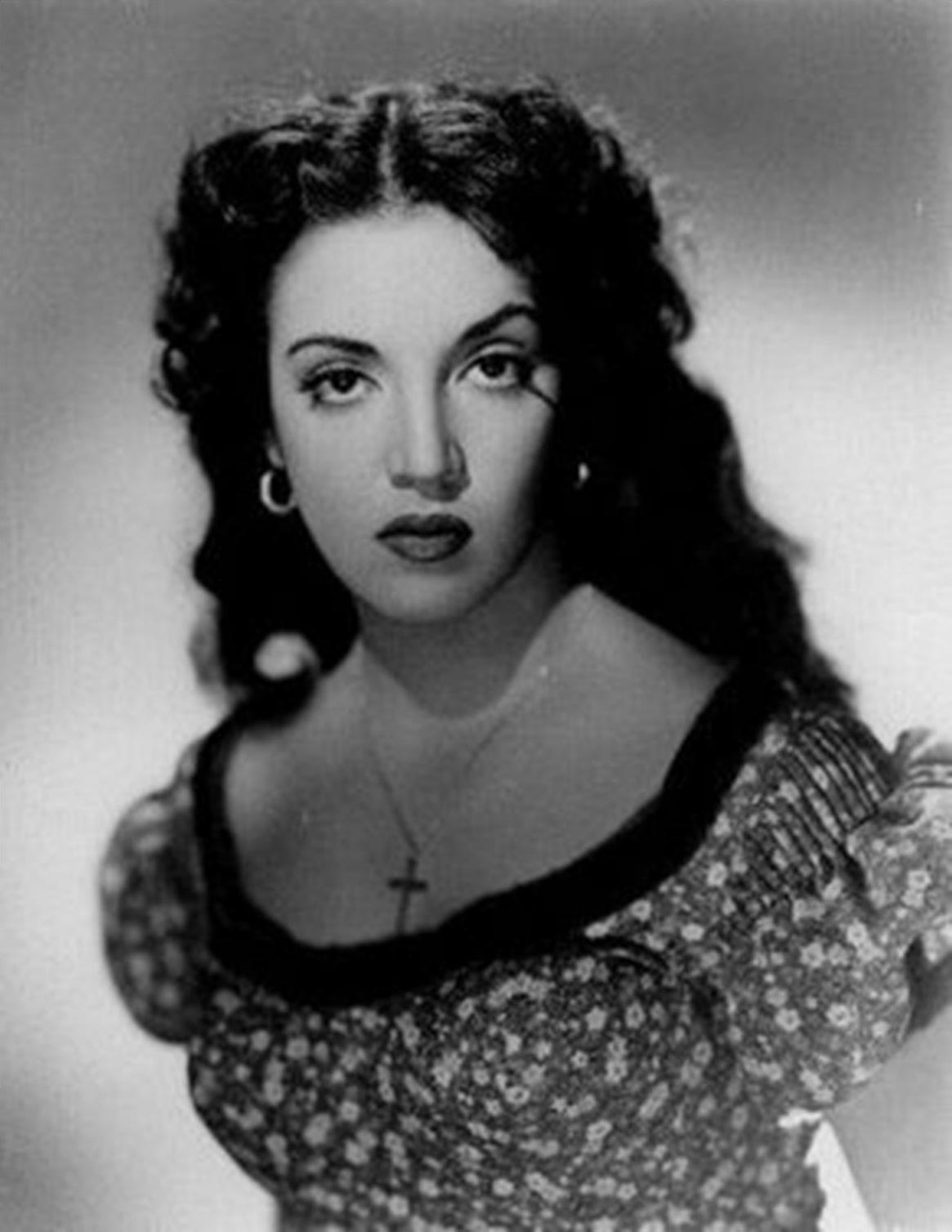
Katy Jurado 
A star of Mexico's Golden Age and a decorated Hollywood actress, Golden Globe award winner and lifetime achievement award winner. She was discovered at age 16 and made her debut in 1943. She acted with all the greats Pedro Infante, Anthony Quinn, John Wayne, Elvis Presley, Gary Cooper, Marlon Brando. Her big breakthrough role was in last week's courthouse movie, High Noon, with Gary Cooper. She teaches the naive Grace Kelly about both standing by your man and being an independent woman. I was impressed with her acting and plan to watch some of her other films, Nosotros Los Pobres with Pedro Infante, Broken Lance with Spencer Tracy, and the Man from Del Rio with Anthony Quinn are on my watch list.

Tonight's movie is Sunset Boulevard with William Holden and Gloria Swanson. The film is about a struggling screenwriter and his relationship to a former film star who wants to make a comeback. In three short weeks summer movies on the courthouse lawn are here and gone. Next week marks Labor Day weekend and the end of summer, although for Santa Barbara, the warm weather is just beginning.