Guest Columnists: Lucha Corpi and Nuria Brufau Alvira. Translation and Voice: A poet’s and writer’s views.
Michael Sedano
La Bloga is honored and excited to present this two-part series by Lucha Corpi and Nuria Brufau Alvira,
Translation and Voice: A poet’s and writer’s views. The pair examines the process of Nuria's translating Lucha's
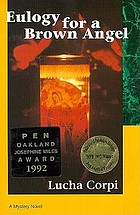
Eulogy for a Brown Angel into the 2011 Spanish novel,
Loa a un ángel de piel morena.
In
Eulogy, Corpi writes one of the best opening scenes in chicana chicano literature, a woman fleeing the police riot at Laguna Park, stumbles upon grisly infanticide. Corpi grabs the reader's attention and hurls the reader into a moral morass. The publisher notes:
Loa a un ángel de piel morena es una novela trepidante, de gran suspense, y llena de personajes diversos e interesantes. En el apogeo del movimiento chicano a favor de los derechos civiles en 1970, el cuerpo profanado de un niño pequeño yace inerte en una calle del Este de Los Ángeles, durante una de las manifestaciones socio-políticas más violentas en la historia de California. La activista política Gloria Damasco descubre el cuerpo del pequeño y, en ese instante, se enfrenta también el hecho de que su modo de percibir la realidad es un «don obscuro» que va más allá de la lógica «normal». En el transcurso de las siguientes cuarenta y ocho horas, dos personas más mueren asesinadas. Gloria no se permite sino el seguirle la pista a los asesinos hasta verlos entre rejas, así le lleve toda la vida. Cada paso en su investigación la conduce de Los Ángeles a la Bahía de San Francisco. Así mismo, la introduce en el camino de una conspiración internacional, una sangrienta venganza, y la violenta y trágica conclusión del caso en la pintoresca región vinícola de Napa, California.
In today's guest column, Lucha Corpi relates the writer’s experience in seeing her creation transformed in the hands of another, in understanding the uniquely creative writing process of translating chicanidad along with the words.
Next Tuesday, April 10, Nuria Brufau Alvira relates the translator’s experience negotiating the confluences of language, speech, cultural content, plot, and character, to fashion for Spanish language readers the same novel United States readers recognize as a classic of la literatura chicana.
La Bloga readers can order both novels via their local independent bookseller.

Lucha Corpi. Nuria Brufau Alvira.
Loa a un ángel de piel morena : una novela de misterio. Madrid: Alcala de Henares Universidad de Alcalá, Instituto Universitario de Investigación en Estudios Norteamericanos "Benjamin Franklin", 2011.
ISBN 9788481389432 8481389439
Lucha Corpi.
Eulogy for a brown angel: a mystery novel. Houston: Arte Publico Press, 1992.
ISBN 1558850503 9781558850507
Translation and Voice: A poet’s and writer’s views
From Eulogy to Loa
By Lucha Corpi
Loa a un ángel de
piel morena, Nuria Brufau Alvira’s translation into Spanish of my novel Eulogy for a Brown Angel, was released
late in 2011 by the University of Alcalá de Henares’ Instituto Franklin, to
whom I am indebted for making this possible. I was thrilled, of course, and posted
the news on my Facebook wall. Michael Sedano sent his enhorabuena to me. He commented that he was looking forward to
reading the opening scene at the National Chicano Moratorium march and riot in
the novel in Spanish. He then asked for my impressions, for my feelings when
Gloria Damasco first “spoke” to me in Spanish. I had asked myself similar
questions when I had read the first and the final drafts of Nuria Brufau
Alvira’s splendid translation of my Gloria Damasco mystery novel. Long before,
I had also assisted Catherine Rodríguez- Nieto when she translated my poetry
into English, and voice in translation became one of my concerns.
Of course, literary provocateur that he is —in the best of
ways— Michael then invited Nuria and me to write companion pieces about our
respective experiences as author and translator for La Bloga. And here we
are:
Translation and
Voice: A poet’s and writer’s views
For forty plus years, I have worked very
closely with Catherine Rodríguez-Nieto, the translator of my poetry into
English. In the process, Cathy and I have developed great respect for one
another’s arts. We have also enjoyed a wonderful lifelong friendship that was
cemented back in 1972, when she began the translation of the four poems that
constitute “Los poemas de Marina/The Marina Poems.” She agonized over the
translation of “La Chingada” into English, given that the term refers to the
native Mexican woman who was sexually used and abused by the Spanish conqueror,
and who bore his children. Catherine did a thorough search for a word or two
that would convey its true meaning in English and still meet the demands of the
poetic meter and line. Frustrated and unable to find a satisfactory solution,
she had to settle for the word “whore,” a term that by a stretch of the
imagination would be possible but offered only a minute and myopic view of the
woman La Malinche was. After decades, Catherine still looks for the turn of a
phrase that will convey the meaning of “La Chingada” and conform to my poem’s
demands, and she sighs. The translator’s work is never done.
Through my participation in the process of
translation, I have also learned a great deal about my own poetic process, my
voice, and how to improve my art as a poet. Translation tests and highlights
the strengths of a poem like nothing else, but it also exposes its weaknesses
and identifies them for the poet. If a poem is not strong enough, it won’t
withstand the process of translation, thus it won’t retain its integrity as a
whole. In some ways knowing this hasn’t affected my creative process at the
“inspiration stage,” as I still write the first draft of a poem in longhand,
and as it comes to me, whether weak or strong, fully formed or missing a part
or two. But I revise and rewrite as needed without feeling that I am stripping
off its emotional content—a notion that seems prevalent among poets when we
first begin to write poetry.
Once translated, the poem becomes a separate
entity but continues to be mine. And yet, although I speak English fairly well,
it has taken me a long time and much practice to be able to “appropriate” the
voices in the “English twins” of my poems to do an effective and affective
reading of them in public.
Working with Catherine has been such a gift
that when Cristina Crespo Palomares from Instituto Franklin asked if I would be
willing to be available to Nuria Brufau Alvira for consultations during the
translation of Eulogy into Loa, I was excited about providing Nuria
with any assistance or information she needed. My enthusiasm grew when I read
her initial comments about the story, the characters, and the major themes in
the novel. She laid out for me her ideas about the project, and the kind of
feedback and clarification she would not only need but also welcome from me. I
was immediately impressed by her professionalism, and soon we were engaged in
constructive e-dialogue across continents. We began to trust one another, and
in time this trust evolved into mutual respect and great affection.
As I had done with Catherine’s English
translations of my poems, I also read aloud Nuria’s text in Spanish chapter by
chapter as to internalize then re-appropriate each character’s distinctive
voice and manner in that language exclusively. I referred to the text in
English solely when I needed to check for the accuracy of content as it
pertained specifically to Mexican/Chicana-o culture in southwestern U. S. or to
historical or other factual data. I suggested changes to Nuria accordingly,
explaining in great detail the historical or the cultural context for any
expression or term that might be unfamiliar to her. In doing so, I became even
more aware of the fact that the translation of any literary text is truly as
creative an art as any other.
The process of translating a novel into
another language is by the mere complexity and length of the original work an
enormous and daunting task. Implicit in it is the urgency in and the pressure
on the translator to interpret accurately the culture that forms and informs
the language that gives it its voice. In the linguistic aspect the translator
must find a way to express, as faithfully yet as intelligibly as possible, what
is in the work accessible and in plain sight, as well as what is ineffable in
it. She must find a way to express that which has non-assignable meaning and is
unchangeable between two cultural-linguistic systems.
As if these tasks weren’t difficult enough,
every Latino or Chicano text is both directly and indirectly nourished by two
greatly heterogeneous cultures in the U.S. So the Spanish language that allows
one of them oral or written expression is an amalgam of several linguistic
modalities that share a common linguistic source but not a single and
homogenous culture. We Chicanas/os and Latinas/os face this linguistic reality
every day when we communicate in Spanish, a language that reflects the
diversity of Latin American cultures, while we also try to express our daily
thoughts and feelings in American English, a language in constant flux,
reflective of cultures that are already undergoing a transformation as we
speak.
No doubt this is also the reality the
translator faces, and in particular that Nuria has managed with great skill and
painstaking care to render an admirable translation of Eulogy for a Brown Angel into Loa
a un ángel de piel morena, in a language accessible to a diverse group of
Spanish-speakers anywhere in the world. Nuria has also added a glossary at the
end of the book for any and all readers who might need or want a more detailed
explanation of certain terms. Brava! Gracias, Nuria. Gracias, Michael. Gracias,
lectores.
About Lucha Corpi

Born in Jáltipan, Veracruz, México,
Lucha Corpi was nineteen when she came to Berkeley as a student wife in 1964.
Corpi is the author of two collections of poetry:
Palabras de mediodía/Noon Words and
Variaciones sobre una tempestad/Variations on a Storm (Spanish with English translations by Catherine Rodríguez Nieto), two bilingual children’s books:
Where Fireflies Dance/Ahí, donde bailan las luciérnagas and
The Triple Banana Split Boy/El niño goloso.
She is also the author of six novels, four of which feature Chicana detective Gloria Damasco:
Eulogy for a Brown Angel, Cactus Blood, Black Widow’s Wardrobe, and
Death at Solstice.
Corpi has been the recipient of numerous awards and citations, including a National Endowment for the Arts fellowship in poetry, an Oakland Cultural Arts fellowship in fiction, the PEN-Oakland Josephine Miles Award and the Multicultural Publishers Exchange Literary Award for fiction, and two International Latino Book Awards for her mystery fiction. Until 2005, she was a tenured teacher in the Oakland Public Schools Neighborhood Centers.
News&Notes
Journalist Joins Librotraficante Spirit
Political journalist Michael Collins has been my friend since the 1960s, Collins admits in his recent coverage of Tucson’s book banning evil.
Collins notes the Tucson atrocity had escaped his notice until I sent him a link to a La Bloga column. He investigated and published ten articles for his readership of political activists, covering the mentality of book banners, judge shooters, and Arizonans.
La Bloga happily reports that Collins, in his private capacity, has become a librotraficante. He’s using UPS and the United States Postal Service to smuggle banned books, a few at a time, to the John Valenzuela Youth Center, the Tucson landing site of the Librotraficante bus caravan.
 |
| Tony Diaz and Gloria Hamelitz, Director of Valenzuela Youth Center |
News&Notes
Marathon Readings of Bless Me, Ultima Filling Your Organization's Coffers
The gente putting together the Monday April 23 marathon public reading of Rudolfo Anaya’s
Bless Me, Ultima have a fabulous idea other organizations might profitably consider: recruit people to read for a few minutes and pay for the honor.
The 248 page novel—it celebrates its 40th year of publication in 2012—needs eight hours at 2 minutes a page for a cover-to-cover reading. La Bloga celebrates the publication with a week of columns the first of May.
UNM’s English Depto and Zimmerman Library will raise scholarship money through the reading.
Last week’s La Bloga has contact datos.
La Bloga On-Line Floricanto: Mixing Memory and Desire
Elena Diaz Bjorkquist, Nancy Aide Gonzalez, Jose Hernandez Diaz, Raul Sanchez, Francisco X. Alarcon
"Morning Meditation Walk" by Elena Diaz Bjorkquist
"Xilonen" by Nancy Aide Gonzalez
"Gate of the Serpent and Mirror" by Jose Hernandez Diaz
"ESL by Raul Sanchez"
"Litany for Cesar Chavez by Francisco X. Alarcon
Morning Meditation Walk
by Elena Díaz Bjorkquist ©2012
When I start my meditation walk,
The mountains around Tucson
Are blessed by sunlight
But only the promise of brightness
To come shines from behind
Rounded Aqua Caliente hill.
I walk East to where the sun rises,
To the place of the new dawn
To the place of new beginnings.
I walk East to reflect
That no matter how bad things
In life get, I can heal
And start again.
I walk East to the place of mystery
To the place of possibility
To the place of beauty.
I walk East to reclaim
The precious gift of life.
I walk East and chant
Taui, Taui, Taui, Taui.
As the sun peaks over the hill
I turn to the North,
The sun’s warmth kissing
My cold cheek.
I walk North to the place of the ancestors
To the place of mis abuelitas y abuelitos
To the place of wisdom.
I walk North to remind me
Of my roots
Of sacrifices they made
So I can be who I am.
I walk North and chant
Taui, Taui, Taui, Taui.
The sun has risen fully
And as I turn West
I feel its heat on my neck
Radiating warmth to my body.
I walk West to where the sun sets
To the place where life’s journey ends
To the graveyard of my loved ones.
I walk West to the place of letting go
To release my body’s energy
Of feelings of sorrow,
Ego, pity, fear, and hatred.
I walk West and chant
Taui, Taui, Taui, Taui.
The sun shines overhead
Warming the world,
Bathing all in its glory.
I walk South to the land of fertility
To where things sprout and grow
To where I find the child inside of me.
I walk South to nurture her
Toward the land of mis antepasados,
To pray for warmth and growth
And loving friendships.
I walk South and chant
Taui, Taui, Taui, Taui.
I arrive home
My starting place,
My ending place.
Xilonen
Nancy Aidé González
Aztec dancers
sway,
their brown faces
framed
by vibrant
feathered
headdresses.
In movement
the long plumes
appear
ready for
flight.
The vibration
of the drums
pulse
course
through
their bodies
which sway
back
forth
to the beat.
Seed pods
rattle around
their ankles,
their bare feet
touch the earth.
The elders
chant
songs that have
been sung since
before the
mountains were
created,
before the rivers
flowed through
the land.
The dancers-
men
women
teenagers
children,
wear embroidered
clothes
embellished with
polished stones,
mirrors
reflecting light
in constant movement.
Sage
and copal
waft
rising up
to the
infinite
vast
turquoise
sky.
This ceremony
is a rite of passage,
she has learned
from the elders
that she is a
contributing member
of society,
they have planted
the seeds of understanding
indigenous ways.
She is a tender
ear of corn
ripening
under the
sixth sun,
the voices
of her ancestors
have called
out to her.
She has been
given gifts of
aromatic flowers,
perfumed candles,
delectable food.
She has sat in
the sweat lodge,
experienced
spiritual refuge,
mental and
physical healing,
she has stared into the
the flame,
aglow with
the luminance
of the red hot stones,
she has asked for
guidance
wisdom
and power
from the Creator
and Mother Earth.
Los danzantes
the elders
her family
friends
los antepasados,
welcome her
into womanhood.
Xilonen is featured in Mujeres de Maiz, Flor Y Canto: Rites of Passage Issue no.10
The Gate of the Serpent of Mirrors (History of Conquest)
By José Hernández Díaz
Rise like Lions after slumber
In unvanquishable number -
Shake your chains to earth like dew
Which in sleep had fallen on you -
Ye are many - they are few.
-Percy Bysshe Shelley, The Mask of Anarchy.
Now that they have
Banned our books
In the Arizona desert,
We must take it
Upon ourselves
To learn about
The sunset:
We were once
A tree of jade
And purple grains
Were at our feet.
We were once
A thirsty jaguar
Floating in the
Sea of night.
We were once
A poem
Of pain
And rain was at
Our knees.
The midnight moon
Is full of yesterday—
Democracy is but
A dream.
If it is their iron law
To steal and scorn
And boast,
Then we must
Light our own
Blue flame
And claim it
As a ghost.
E S L
By Raul Sanchez
Remember….
the classroom full of kids with different colored skins
learning the difference between a noun and a pronoun
remember how innocently everybody used to play together
in the schoolyard?
remember—
how you shared your lunch and others shared theirs with you
now you are in high school, the faces
in your classroom full of kids with different colored skins
have changed
remember,
how it didn’t matter where you came from
and that your indigenous features were not
a subject of repugnant scrutiny and
un-requested criticism
learning
from others the “differences” between races
and why one ethnic group doesn’t get along with the others
notice that the same color hang together
like worms in compost
now
you have been ostracized because of your skin color,
your name, your features, your other language
how does that feel? You - get pushed
to the end of the line your hair pulled by others
they say
you are a greaser and a wet back, your dad
washes dishes at a Mezkin restaurant and your mother
cleans toilets at juvy hall
they mock you - playing your violin
they tell you
go back where you came from
don’t speak your Espanish language
speak English
there is no class in the classroom
only
class divisions’ ignorance and prejudice
based on racial differences. Red man, yellow man,
black, brown, white ones too
What happened to the innocence of the early years?
everyone
learns the poisoned language of snakes
they use nouns, pronouns and verbs to hurt others
with their serpent tongues bifurcated contaminated
diseased approach to the culture of hate
growing up in America
©Raul Sanchez 3-17-12
BIOS
"Morning Meditation Walk" by Elena Diaz Bjorkquist
"Xilonen" by Nancy Aide Gonzalez
"Gate of the Serpent and Mirror" by Jose Hernandez Diaz
"ESL by Raul Sanchez"
"Litany for Cesar Chavez by Francisco X. Alarcon
 |
My grandmother and great-grandmother
|
Elena Díaz Björkquist, a writer, historian, and artist from Tucson is happy to have resumed her daily two-mile walk. It’s not only good for her health but is great for generating poetry. Elena is grateful that the walk through her desert neighborhood takes her in the four directions. Her great-grandmother, Josefina Cruz Limón, called a blessing from the four directions every day of her life as a curandera and partera in Morenci, Arizona. Elena’s grandmother, Teresa Limón Díaz, didn’t follow in her mother’s footsteps to provide medical care for her town but she learned the blessing of the four directions going with her mother every day to the top of the sierras to greet the sun. Later when her sons, sons-in-law, and nephews were soldiers and sailors in WWII, she prayed the blessing at every sunrise and sunset until all came home safe from the war.
Elena is one of the poet moderators for the Facebook page “Poets Responding to SB1070.
She recently received the 2012 Arizona Commission on the Arts Bill Desmond Writing Award for excelling nonfiction writing and the 2012 Arizona Humanities Council Dan Schilling Public Humanities Scholar Award in recognition of her work to enhance public awareness and understanding of the role that the humanities play in transforming lives and strengthening communities.
Nancy Aidé González is a Chicana poet who lives near the lush grapevines in Lodi, California. She graduated from California State University, Sacramento with a Bachelor of Arts degree in English Literature in 2000. Her work has appeared in Calaveras Station Literary Journal, La Bloga, Everyday Other Things, and Mujeres De Maiz Zine. She is a participating member of Escritores del Nuevo Sol, a writing group based in Sacramento, California which honors the literary traditions of Chicano, Latino, Indigenous and Spanish-language peoples. Miss González has participated in several poetry reading events in Northern California.

José Hernández Díaz is a first-generation Chicano poet with a BA in English Literature from UC Berkeley. José has been published in The Best American Nonrequired Reading Anthology 2011, La Gente Newsmagazine of UCLA, Bombay Gin Literary Journal, In Xochitl In Kuikatl Literary Journal, The Packinghouse Review, Contratiempo, Blood Lotus Journal, among others. He has forthcoming publications in HUIZACHE Literary Magazine, The Progressive Magazine, and in the anthologies, El Norte que Viene, and Tan cerca de EE.UU. (poesía mexicana en la frontera norte). He is currently an MFA student at Antioch University Los Angeles and is fulfilling an internship with Floricanto Press as an Editor. In addition, he is an active moderator of the online group, ‘Poets Responding to SB1070,’ where he has contributed more than 30 of his own poems.

Raúl Sánchez is a Seattle Bio-Tech technician, eschatologist, colletic, prosody enthusiast, hamartiologist, translator, DJ, and cook who conducts workshops on The Day of the Dead. His most recent work is the translation of John Burgess’ Punk Poems in his book Graffito. He has been a board member of the Washington Poets Association and is a moderator for the Poets Responding to SB 1070 Facebook page.
Raúl comes from a place south where the sun shines fiercely. He lives in a place surrounded by asphalt, cement, full of rushing cars, coffee houses, fancy houses, empty houses. Where seasons shine and hide in the winter months. Where birds stop on their travel south to the land of the sun. Where blessed rain, oh! blessed rain falls. His first collection of poetry will be released in early April by Moon Path Press under the title "All Our Brown-Skinned Angels"

Francisco X. Alarcón, award winning Chicano poet and educator, is author of twelve volumes of poetry, including, From the Other Side of Night: Selected and New Poems (University of Arizona Press 2002), and Snake Poems: An Aztec Invocation (Chronicle Books 1992) His latest book is Ce•Uno•One: Poems for the New Sun (Swan Scythe Press 2010). His book of bilingual poetry for children, Animal Poems of the Iguazú (Children’s Book Press 2008), was selected as a Notable Book for a Global Society by the International Reading Association. His previous bilingual book titled Poems to Dream Together (Lee & Low Books 2005) was awarded the 2006 Jane Addams Honor Book Award. He has been a finalist nominated for Poet Laureate of California in two occasions. He teaches at the University of California, Davis.
Francisco recently participated in the First Children’s Poetry Festival in El Salvador (Nov. 8-10, 2010) and was able to visit Monseñor Oscar Arnulfo Romero’s tomb beneath the metropolitan cathedral of San Salvador. Monseñor Romero was killed saying mass in 1980 marking one of the most violent periods of the civil war in El Salvador.
He created a new Facebook page, POETS RESPONDING TO SB 1070 that is getting lots of poetry submissions and comments.
http://www.facebook.com/pages/Poets-Responding-to-SB-1070/117494558268757?ref=ts