Showing posts with label literary prizes. Show all posts

Monday, April 13, 2015

Review: Hollywood Notebook. Foto Essay: San Gabriel Valley Poetry Festival

Review: Wendy C. Ortiz. Hollywood Notebook. Los Angeles CA: Writ Large Press, 2015.

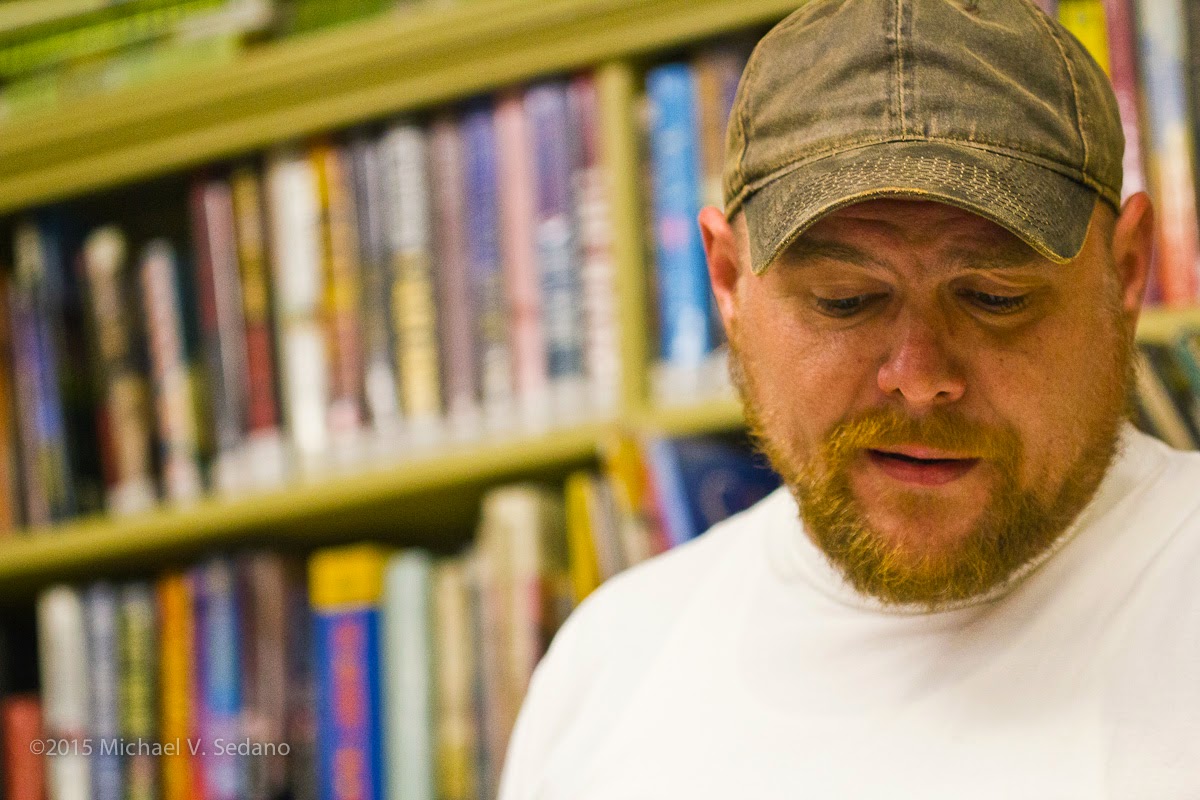
Michael Sedano


That is a journal for old and young. The young in one another’s arms, scattershot subjects, heavy drinking, fidelity and infidelities, writer’s block, and a whelming sense of ageing intellect fill this “prose poemish memoir.” Wendy C. Ortiz’ Hollywood Notebook is a coming-of-age memoir, a past passing and to come account of a writer with a day job turning the corner into her 30s.

She thinks she’s getting old and nowhere, and is writing to kick herself in the muse and make something of herself. What she’s accomplished will please even old guys like me, tattered coat upon a stick, who doesn't understand some key stuff, but who knows that people will go through multiple comings-of-age in their consciousness and Ortiz’ 30s has been her first. I look forward to when she turns forty.

Hollywood Notebook reads a lot like that sounds, a commonplace book that assembles quotidian ephemera writ large. Setting it apart are those times when Ortiz’ meanderings build to flights of fun, eloquence, purposefulness, and more. For example, writing about writing in the book’s beginning, Ortiz observes, “I go through periods where my writing feels like a deep place I want to go to again and again, like a new lover whose first name I know, never asking about the last.”

It is not a ritual for me. It is not a wet place. It’s like walking around the lip of a volcano,
my body humming with the danger, and its beauty makes me just want to step inside. When it’s
not that, it’s the shadow next to me, lightly pressing its finger to my lips; when it’s not that, it’s
the shock of a lover I think I know everything about, until s/he brings out the instruments from
the box under the bed...and I want to know this experience again and again.
Which brings me here. (“eight” 11)

“Here” is Hollywood Notebook’s cast of themes assembled into tight little chapters. Lovers cheat, get over it. Peeping into neighbors’ windows. Drinking, a lot. Not writing, so she writes about not writing.

My pantyhose make me slip in the blood muck even as I insist that I like this life I agree
to go where he wants to go and agree to the hours that keep me running and the writing sits
abandoned in a corner like a mute tortured child waiting to be noticed. (44)

There’s a sense of declivity in the writer’s voice and in events she notices. Things go around and come around, like lovers and troubled relationships, rock music, and lovers. “I am hard-wired,” she writes, “to resist monogamy.”

Journeying to Irvine for a concert with big names Peaches, Bauhaus, and Nine Inch Nails, there’s a hint of resentment that adolescents today don’t know who Peaches nor Bauhaus are. Later in the notebook, the writer remembers sitting in cheap seats at rock concerts when she was 15, sneaking in with alcohol, and having more money at 15 than at 33.

People Ortiz' age will totally get this book. For old guys, Irony abounds in not knowing, witnessing the writer's enthusiasm:

but...wow. Who was this Trent Reznor, anyway? When not staring down the amazing light show and this cut, sexy man yelling and gasping and modulating his voice all over my eardrums, I was thoroughly entertained by the crowd. I wondered at the groups and clumps of people I saw and wondered: what is it that we have in common that we’re all here tonight? The people right around us were not even familiar with Peaches or Bauhaus, so we were all in for NIN...but really, what is the connection?

Good question, I ask, who is "Trent Reznor"? Luckily, there's Google, and I connect.

The blend of memoir with sentiment might lead one to think the writer suffers a Peter Pan complex, but Wendy is all grown up. As she observes after the concert and a end-of-the-night stop for doughnuts and companionship, “It made me happy to be an adult.”

Being a collection of the everyday, Hollywood Notebook has too many highpoints even to catalog, so finding all these makes reading Hollywood Notebook its own reward. One recollection, however, I cannot let pass unnoticed. Ortiz writes about reading her own stuff in “fifteen”:

I read at World Stage in Leimert Park. I drank two beers with S. and S. in a bar around the corner beforehand. I felt my voice go sing-songy as I read, with the cadence I wrote the piece in, with the nuances of the parentheses and brackets guiding me around in little labyrinths, which was just the effect I wanted.

It was a piece the writer had been reluctant to read. She floated on air after people complimented the piece. I’m sure the oral interpretation deeply influenced their praises, even if sing-songy.

Wendy C. Ortiz’s Hollywood Notebook makes a sterling contribution to the growing list of quintessential L.A. and Hollywood stories.

Visit the book’s website for ordering details.


San Gabriel Valley Poetry Festival
“Los Angeles,” locals say they’re from, when someone asks. “LA” means Pasadena, Anaheim, San Fernando and Chatsworth


Poets from around here will tell anyone who asks, they’re from “Los Angeles,” even though they’re from one of the valleys on the other side of those coastal flats where El Lay sits. Like the San Gabriel Valley, whose 2015 San Gabriel Valley Poetry Festival continues in Pasadena with events through the end of the month.

Saturday, the Festival offered a packed room in the Santa Catalina Branch of the city’s public library. Hosted by affable Don Kingfisher Campbell, the line-up included Alexis Rhone Fancher, Joe Gardner, Elmast Kozloyan, Raundi Kai Moore-Kondo, Liz Gonzalez, Lois P. Jones, Matt Sedillo, and Mike the poet Sonksen. Seven Dhar read his Broadside Contest winner ahead of Sonksen. I arrived tardy and missed photographing Carl Stilwell billed as CaLokie.

Alexis Rhone Fancher holds her manuscript up, near eye level but 
without blocking her eye contact with her appreciative listeners.

You can view videos of each performer via the festival’s Facebook page, plus find details on remaining events.

A friendly audience encourages even uncomfortable poets to relax and work with the words to bring life into their own work. It’s an opportunity to lend aural presence to one’s expressions previously confined to print. Uniquely, reading one’s own stuff offers the only chance a writer gets to teach others how to read her or him.
Joe Gardner is trapped on the page, denying himself eye contact 
and directing his voice toward the floor rather than his audience. 

These poets have worked on their stuff. For most, they read their work effectively. Autobiographical content lends itself to dreamy readings and sentimental maunderings that these poets evade, more or less successfully. Most striking is the propensity of writers to adopt a “reader voice” so far variant from their conversational introductions that the manner shouts “poetry!” That’s what the words are supposed to do.

And what words! The day’s line-up ranges from Fancher’s noir account of a 16 year old with Uncle Kenny to Sonksen’s cadenced assemblages of places and personages that are puro El Lay. Gardner is a San Gabriel Valley poet, reading work located firmly in place with names like Dairy Valley. Kozloyan’s first piece bristles with indignation that she loads with significance. Kozloyan and Gonzalez are the only two poets to display their chap books. None were on sale.

Elmast Kozloyan reads with great animation.

As a photographer of public speakers and writers reading their own stuff, if I had my druthers, readers would not read. They would honor their art more by interpreting their expressions. Every writer made attempts to read words or passages with the emotion written and intended. Sounding natural, avoiding the artifice of the poetic voice is where they need practice.

A good portrait of a speaker shows them in mid-speech; mouth and eyes open, a dynamic posture. For that to occur, a reader needs to play to the cameras in the room. Ignoring the devices pointed their way, poets should make eye contact with both sides of the room. Saturday’s readers all worked the right side of the house and rarely looked to their left. My seats were on the left.

Raundi Kai Moore-Kondo is comfortable in the spotlight, reading, playing guitar and singing.

Dark spaces are no longer a big deal for digital cameras. High ISO sensitivity settings allow suitable exposures under wretched lighting. I used manual settings, 1/125 f/3.2 and 1/160 f/3.2. This tends to overcome conditions that make fotos taken on the same occasion look brighter or darker than others like bright colors, dark skin, white skin, standing in hot spots or hiding in shadows, holding up a white piece of paper. The speed is fast to stop motion without blurring. The aperture fuzzes out the busyness of the library stacks and architectural features.

Campbell’s videos are wonderful training aids as well as invaluable records of an important poetic event. “You had to be there,” once the lot of the spoken word no longer applies. Push a button and document the event to a file. The performance will be identical no matter the number of viewings. You can rewind and repeat sections at a mouse’s click.

Liz Gonzalez' set smiles with cultura and the poet's high comfort level
with her work and audience.

Lois P. Jones delivers from seated position, a good option for folks in the front row, 
problematic for the far rows who will crane their necks to see her.

Matt Sedillo delivers with power and works largely from memory,
allowing him to use the full technology of his body. In future, he will take
his hands out of his pockets to let him gesture freely.

Seven Dhar wins the broadside contest and gets 
to share the lyrical piece in a "command performance."

Mike The Poet Sonksen chants his stuff like pounding a drum. 
His is a virtuoso slice of oral life and puro El Lay.


Most readers were sharing new work, hence worked from letter-size paper or an electronic device. When reading from a published work, it's useful marketing to show the book.


The San Gabriel Valley poets to a woman and man need to consider an important element of beginning a reading called polarizing the audience. This means allowing the host's introduction hang there in the audience's attention. Let it sink in. 

Several poets started talking as they were striding up to the front. The informality of the setting may have encouraged them to step into the flow but a more effective technique is to step onto the stage in glow of the introduction. Find home base, stop, set your body in the scene. Sweep the house making eye contact, and only then, begin the first piece.

"Polarization" is a speaker's method of helping listeners orient themselves to change--from one poet to the next, to prepare for your change of pace, to allow the speaker to define the roles of speaker-listener: "I'm going to talk, you're going to listen." Audiences thus prepared will derive enhanced satisfaction in the experience, knowing the speaker up front is in charge.


Vote for Bloguero René


La Bloga's Wednesday columnist, children's picture book author René Colato Laínez is nominated by
Talleres de Poesia and Lunas Press to Premios Actitud El Salvador awarded by La Prensa de Los Angeles.

René writes: I am in the category “Personalidad con Actitud”. I need your vote. Please click the link. They will ask for your email address. Then they will send a code to your email address that you will need to finalize the vote. The last day to vote in April 15th. Thank you! ¡Muchas gracias!

He sido nominado a premios Actitud El Salvador otorgado por La Prensa de Los Angeles. Estoy en la categoría de Personalidad con Actitud. Necesito su voto para poder ganar. Visite el enlace para votar. Les pedirán su correo electrónico. Luego le enviaran un código a su correo electrónico que se debe agregar para poder finalizar la votación. La votaciones cierran el 15 de abril ¡Muchas gracias!

http://laprensadelosangeles.com/premiosactitud2015/perfilnominado.aspx?categoria=11#René

Thursday, November 06, 2008

Memento Mori


Studs Terkel, prize-winning author and radio broadcast personality was born Louis Terkel in New York on May 16, 1912. His father, Samuel, was a tailor and his mother, Anna (Finkel) was a seamstress. He had three brothers. The family moved to Chicago in 1922 and opened a rooming house at Ashland and Flournoy on the near West side {LISTEN}. From 1926 to 1936 they ran another rooming house, the Wells-Grand Hotel at Wells Street and Grand Avenue. Terkel credits his knowledge of the world to the tenants who gathered in the lobby of the hotel and the people who congregated in nearby Bughouse Square, a meeting place for workers, labor organizers, dissidents, the unemployed, and religious fanatics of many persuasions. In 1939 he married Ida Goldberg and had one son.

Terkel attended University of Chicago and received a law degree in 1934. He chose not to pursue a career in law. After a brief stint with the civil service in Washington D.C., he returned to Chicago and worked with the WPA Writers Project in the radio division. One day he was asked to read a script and soon found himself in radio soap operas, in other stage performances, and on a WAIT news show. After a year in the Air Force, he returned to writing radio shows and ads. He was on a sports show on WBBM and then, in 1944, he landed his own show on WENR. This was called the Wax Museum show that allowed him to express his own personality and play recordings he liked from folk music, opera, jazz, or blues. A year later he had his own television show called Stud's Place and started asking people the kind of questions that marked his later work as an interviewer.

In 1952 Terkel began working for WFMT, first with the "Studs Terkel Almanac" and the "Studs Terkel Show," primarily to play music. The interviewing came along by accident. This later became the award-winning, "The Studs Terkel Program." His first book, Giants of Jazz, was published in 1956. Ten years later his first book of oral history interviews, Division Street : America, came out. It was followed by a succession of oral history books on the 1930s Depression, World War Two, race relations, working, the American dream, and aging. His latest book, Will the Circle Be Unbroken : Reflections on Death, Rebirth, and Hunger for a Faith, was published in 2001. Terkel continued to interview people, work on his books, and made public appearances until his death. He was Distinguished Scholar-in-Residence at the Chicago Historical Society.

(Courtesy: http://studsturkel.org)

xxxxxxxxxxxxxxxxxxxxxxxx

Tony Hillerman was born in 1925, in Sacred Heart, Oklahoma. Although he was raised among the Pottawatomie and Seminole Indians and studied at an Indian boarding school, Tony Hillerman is not Native American. He attended Oklahoma State University (1943), the University of Oklahoma (B.A. 1946), and the University of New Mexico (M.A. 1966). He worked as a journalist in Texas, Oklahoma, and New Mexico (1948-63), lived in Albuquerque, and taught journalism at the University of New Mexico (1976-85).


He has written numerous mystery novels drawing on Native American culture, the most successful featuring Jim Chee and Joe Leaphorn of the Navajo Tribal Police. His many bestselling novels include Sacred Clowns, Coyote Waits, and A Thief of Time. Hillerman is a past president of the Mystery Writers of America and has received their Edgar and Grand Master awards. His other honors include the Center for the American Indian's Ambassador Award, the Silver Spur Award for best novel set in the West, and the Navajo Tribe's Special Friend Award. He lived with his wife, Marie, in Albuquerque, New Mexico.

(Courtesy: http://mysterynet.com)

Lisa Alvarado

Thursday, July 31, 2008

Noticias and End of July Goodness


I'm thrilled to announce that Teatro Luna has settled into their brand new home in beautiful Logan Square on the northwest side of Chicago! The teatro is housed in the St. Luke's Church of Logan Square - a fabulous place with a strong focus on the arts and community building. The upcoming offerings include:

- Monthly workshops, free and open to the community.
- Professional development series - sliding scale for actors, writers, directors, and designers looking to expand their skills and network.

- Writing and Performance Classes - sliding scale.

- A new Reading Series, featuring staged readings of new work by Latina/o playwrights.
Stay turned for more information and a schedule.

Teatro Luna is located at the corner of Francisco and Altgeld, just a few blocks from the Logan Square Blue Line Stop.


St. Luke's Lutheran Church of Logan Square
2649 North Francisco Avenue · Chicago, Illinois 60647

Mailing Address: PO Box 47256, Chicago, IL 60647

Check out las hermanas at the Goodman Theater's Latino Theater Festival on August 13th. You can catch a preview of our fall show
JARRED: A HOODOO COMEDY by Tanya Saracho JARRED is a hilarious look at what happens to a woman when she turns to santeria, brujeria, and hoodoo after a terrible break-up. She's got her boyfriend in a jar: now what?

For tickets visit http://.goodmantheatre.org


xxxxxxxxxxxxxxxxxxxxxxxxxxxx


xxxxxxxxxxxxxxxxxxxxxxxxxxxx


Goodman Theatre 170 N. Dearborn St. Chicago, Illinois 60601 Box Office: 312.443.3800 BoxOffice@GoodmanTheatre.org

xxxxxxxxxxxxxxxxxxxxxxxxxxxx


MADE IN CHICAGO: WORLD CLASS JAZZ AT THE JAY PRITZKER PAVILION
Chicago Afro-Latin Jazz Ensemble

Thursday, July 31: 6:30 PM
FREE!

xxxxxxxxxxxxxxxxxxxxxxxxxxxx


And from La Bloga friend, Denise Chavez


portrait by Raquel Valle-Sentíes

The Writing Women's Lives Conference in Santa Fe was a wonderful gathering of creative women. We wrote corridos with Elena Diaz Bjorkquist and Consuelo Luz set them to music. Page Lambert gave a powerful workshop on nature and place and wrote an incredible corrido about a beloved mare. Susan and Denise Abraham from El Paso also gave a talk on their young adult novels. Thank you, talented mujeres!

I completed my Corrido Cat Cycle, writing El Corrido del Gato Consentido (The Corrido of the Spoiled Cat) to my cat, Kuki. I met many new writer friends and visited with Natalie Goldberg, Sally Bingham and Anne Hillerman, also dear BBF Friends, Don Usner and Adalucia Quan and her family and a friend from NMSU days, Maria Montez Skolnik.

We had a party at my sister's
new house and Estevan Rael-Galvez, State Historian, joined us. I'm back home now and busy with Center activites and still working on my novel!!

Upcoming events to take note of:

August 8 and 9: The Way Out West Book Festival in Alpine, Texas. Featured writers are Elmer Kelton, Kinky Freedman, Benjamin Alire Saenz, Sarah Bird, Bobby and Lee Byrd, Denise Chavez and others. This is the first ever Alpine festival. It is a great setting and wonderful town. Check their website at: http://www.wowtxbookfestival.com/1.html

August 31: The John Barry Award for Fiction in Spanish has a deadline of August 31. They are looking for the best short story written in Spanish in the U.S. or Candada. Prize is $1,000.
www.johnbarryaward.com

Sept. 13 and 14: 16th of September Fiesta on the Mesilla Plaza. We will be selling books in our booth. Come and hang out as we hang out! We will need volunteers for shifts on Saturday from eight am until midnight and volunteers on Sunday from noon to 7pm with help breaking down after 7. Fiesta hours are from noon to midnight Saturday and noon to 7pm on Sunday.

Take a two hour shift and listen to great music and eat as many quesadillas
as you can and help us sell books! We had a great Cinco de Mayo booth and plan on having one as well for Dia de Los Muertos.

September 26-26: Writing From the Creative Heart, a weekend long writing workshop with Denise Chavez. Reserve your place now as the workshop is limited. Call me at 575-496-2351, for more information or email me at bbf@zianet.com Cost is $90 for BBF members and $100 for non members.

October 25: The Great Southwest Book Festival at the El Paso Public Library. Contact Mike Payan, Senior Librarian and Event Coordinator for booth and festival information at: payanmm@elpasotexas.gov

NOW: Sally Meisenhelder from Amigos de Las Mujeres has informed us that Casa Amiga in Juarez is in financial difficulty and needs help. If you know any donors or foundations that can help, please contact Amigos at: http://www.amigosdemujeres.org/

Stay tuned for a Care and Evaluation of Out of Print Book Workshop with John Randall later this fall, a reading by Jesus Tafoya and Rosario Sanmiguel in Spanish from their new books, both incredible writers from Juarez/La Frontera.

Dr. Tafoya teaches at Sul Ross University and Dr. Sanmiguel at La
Universidad Autonoma de Ciudad Juarez, also the 4th annual Tamalada/Tamal making workshop at La Cocina Restaurant in Mesilla Park. We hope to have a celebrated food writer join us. Stay tuned!

We are also working on the Pooch-athon with a reading from Cristina Garcia's new children's book, The Dog Who Loved the Moon.

Other than that, we are drying out from many rains and loving this cool weather. Hang in there, chile!

Best wishes,

Denise Chavez


Lisa Alvarado

Tuesday, July 22, 2008

Gijón Literary Prizes


Exclusive reports from Crime Fiction's international big-bash by our roving reporter.


7th day - La Semana Negra recognition

Every year La Semana Negra awards writers for their literary work. The jurors of the prizes are always fellow writers, and although the prize is not monetary, as Spanish writer and one of the winners of the Hammett award said, “It gives you prestige because it is not driven by anything else than the quality of the work. It's very transparent.”

Here is the list of categories and the 2007 winners:

The Hammett Prize to the best detective fiction novel written in Spanish given by the Asociación de Escritores Policíacos:
This award was a tie, so it’s shared between the Spanish Juan Ramón Biedma for his novel El Imán y la Brújula and the Argentinean Leonardo Oyola for Chamamé.

The Espartaco (Spartan) Prize given to the best historical novel written in Spanish was given to the Mexican writer Antonio Sarabia for his novel Troya al Atardecer.

The Memorial Silverio Cañada Prize given to the best first published detective fiction novel written in Spanish was given to the Argentinean writer Carlos Salem for his book Camino de Ida.

The Rodolfo Walsh Prize, for the best nonfiction detective book written in Spanish, was given to the Mexican writer Sanjuana Martínez for Prueba de Fe.

The Celsius 232 Prize for the best science fiction or fantasy novel was given to the Spanish writer Javier Negrete for his book Alejandro Magno y las águilas de Roma. There was a special mention by the jury to the Spanish writer José Carlos Somoza for his book La Llave del Abismo.

Also, for a short story contest, the Ateneo Obrero de Gijón Prize was given to Nacho Padilla for “Viaje al centro de una chistera” (Trip to the center of a top-hat).

The prizes were given at 10:30am on July 19th at a press conference in Gijón’s Hotel Don Manuel. The room was jam-packed with nominated writers, press, and all the staff of La Semana Negra. There was a special energy in the room, and although local television channels were present covering the prizes, everything seemed so intimate. No one except the jurors, not even Paco Taibo, II, knew who the winners were, so everyone was anxious and expectant, especially the nominees.

The winner of each category was read off by one of the jurors. They opened a white envelope and off a handwritten letter read a special message from all the jurors and then announced the winner. Every time one was read, the room was invaded by a wave of claps, yells, and hugs for the winners.

Leonardo Oyola, a winner of the Hammett Prize shed a few tears. Carlos Salem was also very moved and happy; it’s his first published novel ("Camino de ida"), and as he said when he received the prize, “Your own fellow writers are the ones who recognize your work, and that makes this prize so important.”

All the writers recognize the importance of giving each other recognition, but in the case of Sanjuana Martínez and his investigation book on the victims of Mexican Catholic pederast priests, she affirmed that the award is also “recognition of the courage of the victims, to all those who have suffered and are still suffering.”


Following is a short introduction to the winner’s books. I hope these books get translated into English soon, but if not, definitely keep a close watch for them, because Semana Negra winners have a tendency to win more literary prizes.

The Hammett Prize: Juan Ramón Biedma's El Imán y la Brújula is a political novel of Spain during 1926, an espionage plot, where extreme situations are abundant and with the end of the war of Morocco as a background.

Leonardo Oyola's Chamamé (a traditional danceable rhythm of the northeastern Argentina) is about the persecution of two asphalt pirate gangs after the theft of loot. A vibrant story about a settling of scores.

The Espartaco (Spartan) Prize: Antonio Sarabia's Troya al Atardecer is a war novel that tells the story of twin brothers who fight on opposing sides.

The Prize Memorial Silverio Cañada: In Carlos Salem's Camino de Ida, Octavio Rincón’s authoritarian woman dies during their vacation, and it’s the best thing that ever happened to him. Perplexed at the fact that his most profound wish in life has been realized and confused between this wish and his fear of becoming a suspect of her death, he embarks on a wild journey.

The Rodolfo Walsh Prize: Sanjuana Martínez's Prueba de Fe is a denunciation book against at least two prominent Catholic cardinals, Norberto Rivera Carrera and Juan Sandoval Iñiguez.

The Celsius 232 Prize: Javier Negrete's Alejandro Magno y las águilas de Roma. Alejandro didn’t die in Babilonia. The hypothesis presented in the book is that he was poisoned by his ambitious wife Roxana in connivance with Perdicas, one of the generals, but a mysterious doctor Nestor arrives just in time to neutralize the intoxication.

José Carlos Somoza's La Llave del Abismo is a futuristic thriller that evokes a shadow universe. It is also a journey through the ins and outs of faith, a reflection over what it means to kill in the name of religious beliefs, and a revelation of what is hidden behind them.

Saludos desde Gijón!
Thania Muñoz