Showing posts with label opera. Show all posts

Tuesday, November 28, 2023

Dreamy Magic at the Dot Chandler

Opera Review:  El Último Sueño de Frida y Diego. 

Michael Sedano

foto: L.A. Opera

I was mildly disappointed not attending the L.A. Opera’s production of Mozart’s Don Giovanni last month. Happily, I can make up for the lapse with another don Juan, the notorious mujeriego pot-bellied Diego Rivera in the Los Angeles Opera’s El Último Sueño de Frida y Diego.
 
A far cry from Mozart,Grammy Award-winning composer Gabriela Lena Frank and Pulitzer Prize-winning playwright Nilo Cruz put together an experience worthy of any other Grand Opera on the nation’s premiere stage for opera, but with the taste of raza and lo nuestro. Gente paid attention and throng to the production. I would not be surprised to see the run extended prior to moving up North to The City.
 
Credit for the look and feel of the stage experience goes to Stage director Lorena Maza, scenic designer Jorge Ballina, costume designer Eloise Kazan and lighting designer Victor Zapatero, all of whom son chilangos. The choreographer is Ruby Tagle, also based in Mexico City. Jeremy Frank is the chorus director.
 
Frida.
 
Diego.
 
Audiences. 
 
Especially in L.A., say the magic words “Frida” “Diego” and with the snap of credit card plastic on the counter, gente fill the plaza of the Music Center rubbing shoulders with delighted opera regulars. Those People welcome Diversity to dispel the fusty fuddy-duddy reputation of opera-goers and Grand Opera.
 
Órale, El Último Sueño de Frida y Diego is Grand Opera, and our gente flocked to the magic. 
 
Welcome to the mainstream, raza. El Último Sueño marks all manner of innovative and unique highpoints in United Statesian High Culture. The best part, this becomes the first time many people have ventured this far into the cultural heart of Anglo L.A. Aquí estamos que no?
 
Programmers at the Music Center get it right. Tickets start at fourteen bolas. If you ride the train you can walk there. 
 
At the front doors, there’s a large gold frame for selfies with a muted blue lienzo flat emblazoned with trademark logoi. People line up fifty deep for a few seconds enchanted, framed inside el marco de oro. 
foto: Irene Hernandez
L, Irene Hernandez, R, 
Helen Suquett- Krolik

The selfie set evokes the most magical vignette in the magical production  inside:  identical gold frames enfold tableaux vivants quoting classic Kahlo paintings. Only after seeing the scene will the selfie-taker realize the fulness of their interaction with the experience.
 
Sueño is sung entirely in Spanish, with English supertitles. Hispanoparlantes filling a preponderance of the 3200 seats in the Dorothy Chandler auditorium relied upon the Spanish supertitles to decipher operatic phrasing--recitative-- that tends to break single syllable words into five- or six-syllable articulations and listeners go "no one talks like that", and "what is she saying?"

The musical score provides an aural tapestry that seems fit to the emotions of the moment. No one left the theatre humming the catchy tunes because there aren't any. I was expecting a "La Llorona" melody somewhere in the "folklore-inspired score" but I recognized nothing evocative of stuff I know. Maybe Carlos Chavez devotées would recognize the notes, but it doesn't have to sound familiar to be effective. The music works and drives the action onward.
 
Úlitmo Sueño is easily the first purely cultura Mexicana libretto to play on Bunker Hill. The Opera association's literature proclaims the All-Mexican creative staff and have bent over backwards to make this an L.A. event wrapped in Mexicanismo.
 
It's an opportunity raza really should jump into with both jobs and a loan from the readycash place. Even at fourteen bucks a seat, attending the opera is not for the faint of heart. The lobby bars take a C-note for four drinks.
 
Eat before you go. But go. Mejor, save your bucks and make an event of going to the Opera, with friends. "Grand" means something, so be grande and enjoy the opera a todo dar.
 
There's magic on that huge stage. Mictlán. Real Life. An orchestra directed by Lina González-Granados provides the symphonic musica. Voices include a sizeable chorus, leads include Soprano, Mezzo-soprano, Countertenor, Baritone. No amplification, it's real Opera.
 
Gente generally don't know all the technical stuff about the opera nor this one in particular. We're here to experience.
 
foto:L.A. Opera 

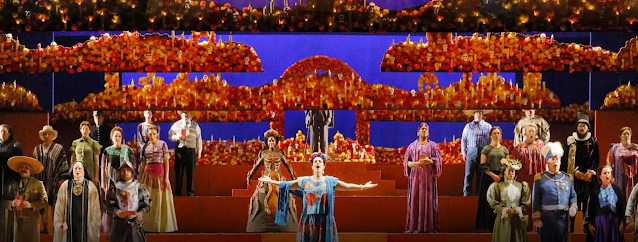
Color is the first sense the stage engages. Scenic designer Jorge Ballina keeps everything orange and warm tan colors. Warm diffused light softens every garment and line and angle in sight. The characters are dead; here is Mictlán and the setting for the first two acts. 
 
The scene offers puro magic. And more magic. Then more than enough magic so that people at intermission hope the second half will have a faster pace.
 
Still, it's imaginative and a bit rasquache how the ranks of wooden Cempasúchil winch into the air above the singers. The real world is up there with the Marigolds, Mictlan is on stage, beneath the garlands and graves. In fact, I was delighted by numerous old-fashion stage effects that eschew technology for the make-do of elegant rasquachismo like a gauze curtain and light effects.

 
The audience doesn't applaud at all the cool places like a "regular" audience would. Ni modo. The audience as a single entity are fully engaged in the slowly unfolding drama and iconography. At the end, applause and a few chifles sound the genuine appreciation of this audience. I whistled.
 
As in most operas, story doesn't matter so much as sensation, emotion, and for Sueño in particular, hero-worship. (Note: references to fat-bellied Diego aren't bashing but allusions to the libretto). Frida wears her floral headdress and in the audience, hundreds of women pay tribute to Frida by wearing floral headdresses and Puebla embroidered textiles.
 
It's a beautiful thing going on like never before at the Dot Chandler.


Michael Sedano photobombs two visitors after the matinee. Attending the performance infuses the audience with joy and a giddiness born of sharing a magical experience.
 
Plotted after Orpheus and other adventurers into the underworld, Frida returns to earth to assuage Diego's desperate longing. There's a condition, a catch: Frida can only observe, not touch. To touch is to regain the pain of being crushed by a streetcar and confined to a stiff corset much of her days.
 
She touches. Diego probably dies--Frida kills Diego--with that touch. Frida has abandoned eternal peace to gain a momentary reunion with the Love of her Life knowing she will rediscover physical agony. 
 
Frida even sings how loving Diego is more painful than being crushed by that streetcar. The audience Saturday matinee gives off a collective gasp of empathy at the brutality of the thought, and Frida's nobility comes through, her dalliances purified with her sacrifice for Love and her man.
 
That's why Story doesn't matter. You're not supposed to ask the questions that strike you while enjoying an after-Opera dinner with friends. What did Frida do to deserve having to live with agony again? Does Diego have a right to ask Frida to abandon liberation from pain to serve his selfish longing? There's nothing in it for Frida. She's following a patriarchal imperative but we're not supposed to notice. 
 
That's OK, it's only a pinche opera. El Último Sueño de Frida y Diego offers spectacle unavailable from any other experience. Going to the Opera like the rich people is an engaging social event that goes better with compañeros in the next seat. Our gente belong in places like Music Center Hill and productions like this will fill seats when we feel welcome. When we are made to feel welcome. This time around, órale, L.A. Opera, te aventáste.
 
Note:
El Último Sueño de Frida y Diego has  only six Los Angeles performances, 7:30 or 2:00 p.m., through December 9 via this link to L.A. Opera.


Tuesday, June 13, 2017

Gluten-free Cheese Souffle. On-line Floricanto. Interview with


The Gluten-free Chicano Bakes Cheese Souffle
Michael Sedano

Served with a crisp Caesar Salad, gluten-free cheese soufflé makes an elegant meal suitable for company or a special occasion. Gluten-free cheese soufflé is easily enough made that you can have cheese soufflé any day of the week.

There's no secret to a beautiful souffle. A good oven, a strong wrist, and an idea of what you're doing, all go together with good ingredients to produce satisfying results every time, from the first to the next.

Ingredients
King Arthur gluten-free flour ¾ cup
4 eggs
Extra sharp cheddar cheese – grated, 2 loosely-packed cups
Parmesan cheese dried – ¼ cup
Butter – 1 cube
Milk – 1 ½ cups
Cayenne powder
Salt
Coarsely ground black pepper
olive oil - dash

King Arthur brand has become my most relied-upon gluten-free baking mix. It's ground to fine powder, lacks the graininess of some other flours, and tastes good. Any commercial blend should be satisfactory, though for roux-making avoid any with xanthan or guar gums.

Round soufflé pan. This foto series uses a small rectangular straight-sided glass pan. When The Gluten-free Chicano grew dismayed at the possibility of a gluten-free soufflé, he gave away his glass soufflé pans.

Heat oven to 375º

Separate 4 eggs, the whites into a large mixing bowl.


Whip or beat the whites to a stiff foam. The foam holds its shape when you mound it.


Beat in the yolks with a pinch of cayenne, salt, coarsely ground black pepper.
Set aside.

Spray the baking dish with non-stick spray.
Put ¼ cup of dried parmesan in the bottom. Turn and shake to coat all four sides and bottom.
Place in a convenient place to receive the batter.


Grate cheese to make two loose-packed cups. Use a mix of flavorful cheeses for extra special dishes. Notice the thin slices in the mix. You can chop the cheese, thin slice it, or grate it. It needs to melt quickly in the near-boiling white sauce.


Make a roux cheese sauce. You want to make a volume that ¾ fills your baking dish. The cheese sauce is wonderful on steamed vegetables and baked potatoes, or diluted with cream to make a soup base. It's easy to increase quantities and make extra for later.


Put a dash of olive oil in the quart sauce pan and melt a cube of butter. It will acquire a rich brown color. Sprinkle cayenne pepper into the melted butter.


Add the ¾ cup of King Arthur gluten-free flour and a pinch of black pepper to the butter and stir until the flour completely mixes with the butter and forms a boiling foamy liquid.


Add a little milk and a thick paste forms. Keeping stirring in milk until all the roux is dissolved into the pan and the sauce is a thin, hot liquid.


Over medium flame keep stirring the pot vigorously until the sauce begins to coat the whisk and visibly thicken. If it gets too thick--it should flow easily and not clump--add more milk a splash at a time. Make enough volume to half fill the baking dish (unless you want sauce for later). Adding cheese increases the volume.

Once the sauce has thickened to pea soup consistency, add grated cheese. Stir in the cheese until it fully mixes with the roux sauce.

Stir the sauce into the beaten eggs. Work quickly to fold the whites into the thick sauce that pools in  the bottom of the bowl. Work faster. When the mixture has uniform color and consistency, pour it into the prepared baking dish.

Dust the surface lightly with parmesan cheese. In the foto, The Gluten-free Chicano spotted a stray slice of cheese and dropped it onto the batter before dusting the top. See if you can spot it on the finished crust.


Set the timer to 45 minutes and don't peek until 45 minutes.

Put the baking dish on a cookie sheet in event of a spill-over (next time, fill a bit less), slide into the middle rack of the oven, close the door and make the caesar salad, set the table, rinse utensils and bowls, have a seat and read the paper.


After 45 minutes in the hot oven, the cheese crust forms on the puffed up (souffle) flavorful and spongy body. When first out of the oven the souffle will jiggle. Let it rest a few minutes to set up.

Prepare yourself to see the puffy beauty fast deflate. Such is the nature of the souffle. Even wheat souffle collapses shortly after leaving the oven. 

The night The Gluten-free Chicano made this cheese souffle the cupboard was bare of anchovies, so a caesar salad was impossible. He served fresh tomato slices for a simple but ideal accompaniment on a small plate.


Left-over gluten-free cheese soufflé is wondrous in the morning for breakfast. Microwave on high for one minute and test the underside. Flip it if still cold and micro another half minute.

If your souffle comes out runny in the middle, put it in the microwave for two minutes and that should cook the center quickly. Otherwise, back into the oven another 15 minutes and it will be fine. Next time use a hotter oven and a higher rack.


If serving wine, champagne makes the perfect beverage. The bubbles in the wine, the air pockets in the souffle, all you need is agua con gas to finish off the metaphor. The Gluten-free Chicano has been enjoying La Croix flavored water con gas lately and it made the meal all the more delightful.

This gluten-free cheese souffle tastes as good as a wheat-bearing dish and even wheat-eaters won't know they're wolfing down seconds of this fabulous gluten-free meal.


June On-line Floricanto
Lara Gularte, Nancy Green, Martina Robles Gallegos, Sandra García Rivera, Arnoldo García

“Hanging On” By Lara Gularte
“MADRE MÍA” Por Nancy Green
“LOOK AT OUR CHILDREN” / “MIREMOS A NUESTROS NIÑOS” By Martina Robles Gallegos
“Opiate–” By Sandra García Rivera
“Quetzalcóatl, la revolución emplumada [excerpts]” By Arnoldo García


Hanging On
By Lara Gularte

The house leans toward the road.
She waits for someone to open the door
to the place where her mother was born.
No one at the window waves.

The old homestead settles in her chest.
This is where they lived,
set boundary fences, planted posts.
The well dry now, the creek diverted.
Clouds darken her memories.

She remembers where the oak tree stood,
tugs at the stump,
pulls on long roots and dank echoes.

With seeds in her pockets,
she smells the hope of rain,
and counts the seconds
between lightning and thunder,
distance narrowing.

Light strikes her and splits a sudden sky.
Rain flows through a hole inside herself,
memory glitters into clarity.

First published in “The Bitter Oleander, Vol. 20, Number 2, Autumn 2014.”


MADRE MÍA
Por Nancy Green

Nunca te olvido
Mi camino se funde con el tuyo

Tus memorias se mezclan con las mías
Tu aliento me llena de vida

Entre la noche y el día
encuentro tu sonrisa en el espejo,

en el rocio que refrezca lo vivido,
en las nubes que lloran tu partida

Me esperas con paciencia
Me cuidas de la cruel oscuridad

Me guías hacia la luz divina
Te enternece mi humilde gratitud

Me abrazas como acabada de nacer,
y así nos quedamos para siempre, Mamá


LOOK AT OUR CHILDREN
By Martina Robles Gallegos

When they look at the sky,
can they still see the moon?
Is the sun still healthy,
or will it be their demise?
Is the air that they breathe
a hello or goodbye?
Do gray clouds carry water,
or are they filled with disease?
Can they still swim in the ocean,
or will they be sentenced to death?
Are they still safe eating fruit
from the fat of the land?
Will a trip to the fields
be the last one they take?
Can they still enjoy parks
or be cut by a slide?
Are the vicious cartoons
Still poisoning their minds?
Can they trust in our leaders
or be silenced for life?
We must look at the future
we are sowing for them.

MIREMOS A NUESTROS NIÑOS
Por Martina Robles Gallegos

¿Cuando miran hacia el cielo,
aún pueden ver la luna?
¿Es saludable el sol o será el
veneno de nuestros niños?
¿Cargan agua las nubes grises
o están llenas de enfermedad?
¿Pueden nuestros niños nadar en el mar,
o serán sentenciados a muerte?
¿Pueden comer fruta aún de los campos?
¿Será una excursión a los campos
la última que toman?
¿Pueden aún gozar de los parques
sin que los corte una resbaladiza?
¿Las caricaturas violentas aún
envenenan sus mentes?
¿Pueden confiar en nuestros líderes
o serán callados por vida?
Debemos mirar el futuro
que estamos sembrando para ellos.

First published by Poets Responding to SB1070, May 19, 2017.


Opiate–
By Sandra García Rivera

a sinkhole
between fear and truth,
a short cut on a long detour
away from creation,
a distraction from hard work,
the loneliest road on a path of
self-destruction,
a frayed and withered rope bridge
dangling and destined
to dissolve,
to deter spirit from arriving
at the greatest love,
the mystery at the center
of each atom
each fingernail
in all matter light and dark,
present in all of us,
in each of us,
right now.


Quetzalcóatl, la revolución emplumada [excerpts]
By Arnoldo García

I
Quetzalcóatl
regresó
este año
de turista
y se le expiró la visa
ahora es considerado
terrorista.
500 años sin
serpientes emplumadas
500s sin cielo
terrenal
Ahora sí tenemos
un quetzalcóatl
que es una bomba Sagrada
que sólo quema
semillas
serpientes verdes
gusanitos
flores
y no humanos
ofrendas
de paz
y amor
entre los pueblos desarmados.

II
Quetzalcóatl
nació
en un hospital
sin esperar
a la partera
emergió
de su mamá
y luego luego
exigió
que cesara
el tiempo
porque ya llegó
el nuevo sol

III
Quetzalcóatl
pregunta
qué ritmo escogemos?
octubre
noviembre
cipactli
olin
ce atl
katún
qué raíz estiramos
qué color pintamos
dónde estea el centro
de la tierra
el downtown de la naturaleza
la X de xoxipili
el machete lunar
el ombligo sembrado
la esperanza
la semilla
para todas y
todos
o se marchita
nuestro tiempo?

IV
Quetzalcóatl
dice:
dónde están
los elotes explosivos
los frijoles fanáticos
el chile que chilla: "Organícense!"
los jacales de la ternura
la milpa ancestral
la montaña de agua
las malinches
verdes
aztlán guadalupana
dónde están
mis plumajes
mis lenguajes
guerrilleros
dónde
mis pueblos emplumados?

V
Quetzalcóatl
pregunta:
quién puso zapatos sobre la tierra?
quién construye un ataud de cemento
sobre las labores, la naturaleza?
quién bebe el agua de la vida
de los que no han nacido?
quién usa
los huesos,
las pieles,
las hojas
ancestrales
para gasolina?
y quién contamina las venas
con las penas industriales?
quién cortó las venas de la naturaleza
que inundaron y ahogaron
los pueblos lenguajes
las comunidades de lenguas
que con sus manos
pulieron troncos
para travesar mares estrellales.
O Aztlán, punto migrante
en la gran migración cósmica
de echar raíces
para crear tierras amplias
como corazones el tamaño de soles
ahora nosotras y nosotros
las y los que nacimos del movimiento terrenal
la comuna hecha de tierras y cielos
encontramos una tierra movil, migrante
para un pueblo migrante, cósmico
para un reino ingobernable
porque es inalterable
porque somos inalterables
el reino de la naturaleza
para desatarnos del ombligo lunar,
las cavernas del ser
el lugar de las garzas blanquísimas como el lodo
banderas móviles del viento
los corazones emplumados
con maizales

VI
Quetzalcóatl dice:
no todos los días aparezco
Hay semanas, sazones y generaciones enteras
que soy invisible
nadie me ve nadie me reconoce nadie me busca
mi existencia no califica
ni de colador de vientos
pero cuando llego a la frontera
me piden documentación
para verificar que existo
y que no soy invisible, ilegal
aparecido
mojado por la ciudadanía imperial
desplumado
deportado
desplazado
desnudo
destituido
desarmado
desesperado
nunca
derrotado
debilitado
desparramado
despachado
Quetzalcóatl
hoy es indio
vendedor ambulante
jornalero
trabajadora doméstica
madre soltera
zapatista
mam
pandillero
pistolero
preso
drogadicto
maestra de escuela secundaria
campesino
tatuajista
jaranero
migrante muerto en la frontera
todas y todos
somos
Quetzalcóatl...


Poets of Today's On-line Floricanto
“Hanging On” By Lara Gularte
“MADRE MÍA” Por Nancy Green
“LOOK AT OUR CHILDREN” / “MIREMOS A NUESTROS NIÑOS” By Martina Robles Gallegos
“Opiate–” By Sandra García Rivera
“Quetzalcóatl, la revolución emplumada [excerpts]” By Arnoldo García


Lara Gularte was featured with an interview and 18 poems in the Autumn 2014 issue of The Bitter Oleander. Her poetic work depicting her Azorean heritage is included in a book of essays called "Imaginários Luso-Americanos e Açorianos" by Vamberto Freitas. Her work can be found in The Gávea-Brown Book of Portuguese-American Poetry. Her poems have appeared in such journals as The Bitter Oleander, California Quarterly, The Clackamas Review, Evansville Review, Permafrost, The Monserrat Review, The Water-Stone Review, The Fourth River, The Santa Clara Review, and she has been published by many national and regional anthologies. Her manuscript “Kissing the Bee,” will be published by The Bitter Oleander Press in 2017. She is an assistant editor for Narrative Magazine.


Nancy  Lorenza  Green is an Afro-Chicana teaching, performing and recording artist from El Paso, Texas and Cd. Juárez, Chihuahua who uses music, creative writing, photography andpm spoken word as mediums of communication and cultural education.


Ms. Gallegos came from Mexico as a teenager and lived in Altadena and Pasadena through high school. She then moved to Oxnard and attended community college and university, getting her teaching credential.She graduated with her M.A. June 2015 after a severe stroke.Works have ap-peared in Altadena Review, Hometown Pasadena, Silver Birch Press, Spectrum, Somos en escri-to, Spirit Fire Review, Lummox, and Basta! She was named San Gabriel Valley and Altadena Anthology: Poetry Review 2017 Top Poet.
https://poetry309.wordpress.com


foto:SGR by Malia Connor
Sandra García Rivera is an award winning Nuyorican poet-chanteuse, who has captured audiences throughout the U.S., Puerto Rico, Cuba, and the U.K. as a spoken word performer and alongside Latin Jazz and Caribbean roots music legends. She has self-published two chapbooks: Divination of the Mistress, and Shoulder High, and her work has been widely published in journals, magazines, and academic publications. SGR is the Curator and Host of Lunada Literary Lounge at Galeria de la Raza in SF, and she performs regularly throughout the Bay Area as a poet, and as a vocalist-percussionist with La Mixta Criolla.


Arnoldo García is a poet, writer & revolutionary for life. After a stints as a migrant farmworker and nomadic cultural worker, he is now based in Oakland, California, where he lives with his family and works on a restorative justice initiative in Oakland public schools. Arnoldo's poem is an excerpt of a manuscript, "La revolución emplumada," on the struggles for the land, the people and the earth. Arnoldo's blog: https://artofthecommune.wordpress.com


mailbag, from San Jose, CA
Excerpt from an Interview With Suzanna Guzman About Bless Me, Ultima


Héctor Armienta's new opera Bless Me Ultima has received national press. Why do you think this project has created such interest?
Bless Me Ultima based on the masterwork by Rudolfo Anaya is the first Mexican American opera. The text, the landscape, the actors, are so recognizable to us in the Latino community. It is affirming and engaging to see, at last, ourselves on the stage singing magnificent music that tells OUR story.


What is particularly exciting in the upcoming workshop reading for Bless Me Ultima on June 17th?
Honestly it is like seeing the ultrasound of the baby! Or the trailer to next season's Game of Thrones. Or the smell of the Thanksgiving turkey in the oven! To hear this music, see the characters, be given a taste of what is to come is tantalizing and thrilling! Plus the music and purity of the young boy, Antonio, sung by a young boy, TEN years old! fills my heart so much. I can't wait!

Click here for tickets to the workshop performance in San Jose, CA

Tuesday, January 10, 2017

Review: Sci-Fi a la raza. Ultima the Opera. 11th Best Poem of 2016

Review: Matthew David Goodwin, ed. Latina/o Rising. An Anthology of Latin Science Fiction & Fantasy. San Antonio: Wings Press. 2017.  ISBN 978-1-60940-524-3

Michael Sedano

In a skillfully organized anthology, Latina/o Rising eases gently into the reader’s interest with short, softly imaginative stuff like Kathleen Alcalá’s time displacement fantasy, “The Road To Nyer,” and Pedro Zagitt’s pair of one-page fantasies. The collection races through a handful of dystopic and cybernetic futures, then reaches a climactic middle with “Caridad” about a Miami Cubanita forced to become the hive mind of her extended family.

To this point, fantasy and harmless dystopia are the stuff of smiles and reverie. There’s even a foto-novela of sorts. Editor Matthew David Goodwin then changes pace offering a couple of personal, hard-edged pieces that make for considerable discomfort owing to their intrusive failure to be escapist. But this subsides and the collection again finds its sweet spot to wrap with stories from José Older, poetry from Carl Marcum, and a story about Mexicans losing cultura and identity in a distant-future New York.

Some of these stories feel like they’re breaking the rules of fantasy and speculation. Stories can be thought-provoking, morally pointed, but a lot of fun. In Carmen Maria Machado’s “Difficult At Parties” a woman descends into insanity via eye-glazing hard core pornography. Giannina Braschi offers a pair of deeply disturbing pieces, one, a speculative essay centered around the collapse of the World Trade Center, the other an abstract playscript. Carlos Hernandez’ story about a soldier’s cheating wife, his missing legs, and their miracle baby, pierces one’s heart for hitting so close to current events. Reality and the hard facts of life are supposed to be over there, just beyond the margins of the page, outside the first word and the final period. Instead these stories impose not dystopia but ugly reality that sits there, big as life and twice as ugly in the middle of the paragraph, pounding a fist into that space between the eyes, hard. They’re not fun.

The reader takes a deep breath and turns the page to find ever more rewarding experiences. Alejandra Sanchez taps into one’s fear of something lurking in the drainpipes. “The Drain” will get the horror juices flowing with some masterfully crafted asco-inducing descriptions of warm, slimy matter enveloping a woman taking a shower. But “The Drain” is far more than a scary story. Sanchez weaves in elements of a woman’s perception of her beauty and how she presents herself in everyday life, and then domestic violence and the just desserts wrought upon an asshole woman-beater. It’s an unsettling yet satisfying story.

Wrapping up the collection are Daniel José Older’s wonderful futurist New York where the living, the dead, and the half-living compete to maintain order between their dimensions. There’s some thrilling emotion when long-dead African slaves emerge out of an entrada from the underworld. “I feel the wind of hundreds of years of pent up rage and frustration release across my face. Riley’s screaming as loud as he can beside me and we’re both laughing hysterically and crying at the same time.” So will readers.

So what makes sci-fi “latina” “latino”? The final story offers a blatant answer. A XicanaYork woman wants to explore history but by creating electronic games. Her hundred-fifty-years old abuela is worried about the future of Mexican cultura in the city, and frustrated the live-in machine exhibits more interest in carrying on grandma’s curanderisma than la nieta. In this world, identity and cultura feel the threat of technology and institutional power while a succeeding generation seeks its own way through those pressures, using cultura while adapting to what’s coming.

There’s a decidedly east coast and Caribbean lurch to the settings and characters, but for the most part decidedly raza. Gente will see themselves in these stories. Characters have brown skin, speak some Spanish or as in Junot Diaz’ story, get a hard time from friends for not speaking good Spanish, engage in word-play mixing languages. They have names like Mictan (not Mictlán but close), Jesús, Gordo (two of them, one in Ana Castillo’s New Mexico-set story and Older’s), and Paco.

These are “latina/o” stories as a result of character, setting, language, and writer. One thing the collection is not is an insider’s fiction. It’s highly accessible while providing intimate insights about the way these writers, and writers like these, see the world. For the most part, Latina/o Rising will keep any reader interested just because these are worthwhile, good stories.

I’m not a fan of the arroba as a gender marker. Does one pronounce the key title word “Latinat” or “Latinarroba”, or "Latinao," or just give up and ingloriously drop the diacritic and say “Latin”? Perhaps when Wings Press brings the book in a second edition to market they’ll yield to the insurgent use of el equis and make things even more problematic with “Latinx”. A ver.

See if you can read Latina/o Rising in one or two sittings to gain the full benefit of its stomach-churning ride that here and there gives you a fist to the face but more so wide-eyed gasps, some laughs, some primal fear, and a montón of fun.

Order Latin@ Rising from your local independent bookseller, or publisher-direct here: http://www.wingspress.com/book.cfm?book_ID=220


Bless Me, Ultima, the Opera

Rudolfo Anaya’s timeless novel, Bless Me, Ultima has entertained millions of readers and hundreds of film-goers. Today, there’s an opera in the works. Thankfully, the production will be more Giuseppe Verdi than Philip Glass. That’s the impression I have from a conversation with Héctor Armienta, who is writing the music and libretto for the 2018 debut.


Armienta is Artistic Director and General Director of San Jose California’s Opera Cultura. Opera Cultura, working with Albuquerque’s Opera Southwest and the National Hispanic Cultural Center, will premier the work as early as next January in Anaya’s hometown, Alburquerque. In addition to the opera performances, the NHCC plans an art exhibition of artworks inspired by Bless Me, Ultima, and created by New Mexico artists. The 2018 production moves in May, or in the Fall, to California.

Contemporary U.S. opera often yields musicality to favor spectacle. I’m thinking of the LA Opera’s “Akhnaten” whose singers performed in English, Ancient Egyptian, Biblical Hebrew and Akkadian in a visually stunning production that put me to sleep. To my unbridled relief, Héctor Armienta describes himself heavily influenced by late Verdi.

Armienta grew up in Los Angeles, near MacArthur Park. He completed his undergradudate work at California Institute of the Arts before moving to San Francisco to complete a Master’s at the San Francisco Conservatory of Music.

When I spoke to him via telephone he was in the final stages of the piano vocal score. This means the opera is nearly completed. The composer follows the piano vocal score with an orchestration draft. From here, the company brings in a Stage Director and musicians to workshop the piece. Composer and Stage Director consider issues as does it work dramatically, on stage with characters, musically, does it create “that important moment?”

Casting is all-important. Armienta has a strong sense of who will sing Ultima. Less certain is the young Tony. With three boys choirs in San Francisco there’s ample talent pool. Alburquerque may prove a bit more challenging in finding a Tony, though Armienta doesn’t say that.

Rudolfo Anaya and Héctor Armienta
The opera has been in development since 2013 when Armienta and Rudy Anaya met to develop the synopsis. Armienta focuses on three themes, good/evil, destiny, the natural world versus our physical world. The boy, Tony, and Ultima lead the cast, with Tenorio, Narciso, and Tony’s familia supporting.

The story contains all the essential elements in the novel: the question of Tony’s destiny, Ultima’s journey to her death, the imbalance in the order of things because of a curse. As with any book adaptation, characters and scenes will be omitted, and instead of a third person narrator, dialog will carry the story into action.

Bless Me, Ultima’s music will be neo-romantic with a modicum of modern dissonance. Musically it’s not New Mexico per se, although Armienta researched a trove of New Mexico traditional music and at least two corridos will reflect historically authentic regional song.

The National Hispanic Cultural Center, along with Opera Southwest, commissioned the opera. Multiple sources and donors are contributing as well.

Rebecca L. Avitia, Executive Director of NHCC says “We are incredibly excited about the project and its potential to bring the magic of Anaya's writings and this incredible novel into an unexpected, but important genre.”

Héctor Armienta adds, “These are our stories. We need our stories told in our community. How better to do it than with the magic of opera?”

La Bloga will report additional details as the opera of Bless Me, Ultima advances through its production phases. You can read more about the production and listen to a workshop aria here. Make reservations to attend a June 17, 2017 Bless Me, Ultima Workshop in San Jose CA by clicking here.


Tejer la Tarde is Eleventh “Best Poem of 2016”

Owing to a clerical oversight, last week’s collection of Best Poems of La Bloga On-line Floricanto 2016 shared only ten of the eleven nominated poems.

It’s a pleasure for La Bloga to join the Moderators of the Facebook poetry community Poets Responding to SB 1070: Poetry of Resistance in celebrating the work of Oralia Rodriguez and her poem, “Tejer la tarde.”


Tejer la tarde
Por Oralia Rodríguez

Montar la cadena,
de los primeros días
pespuntes a las paredes,
encontrarme en la risa
en la incertidumbre
de hilos rojizos
para bordar la tarde,
un derecho, un revés.

Buscar lo que no soy,
historias remendadas,
voces en la sangre,
una vuelta,
sobrehilar los pasos
de pájaros ciegos,
cuando la metáfora
es pecado
y el dolor es sólo
un derecho o un revés.

Los demonios deshilan
punto tras punto los miedos,
recodifican la identidad,
punzan el subconsciente,
me anudan a la soledad,
expandirme
y no encontrar
la geometría de un cuerpo,
un derecho, un revés.

Inocencia de palabras,
un punto al aire,
palabras que danzan silentes,
un derecho, un revés.

Adolecer apegos,
noches fragmentadas
que alfileres no sostienen,
códigos y puntos
para remachar
los días sin esquina
y remendar la casa de la infancia,
volver a ser niña
y no ser nombrada,
un derecho, un revés.

Fronteras trazadas al vuelo,
fragmentos de intimidad,
mariposas de caleidoscopio.
Anillar los instantes de tu sexo
al naufragio de tus muslos,
florecer en lluvia roja,
metamorfosis,
un derecho, un revés.

Trozos de tarde
para anudarlos
a la mirada,
volver, recorrer los rincones,
atar lo que me fue negado,
menguar y
gritar lo que no soy,
las palabras, los días,
el abandono.

Punto, tras punto,
remachar,
un derecho,
un revés,
un derecho,
un revés,
terminar.


Oralia Rodríguez. Originaria de Jerez Zacatecas, radica en Tijuana B.C. Estudió la Licenciatura en Informática en el Instituto Tecnológico de Tijuana, y la Licenciatura en educación Primaria en la Normal Fronteriza Tijuana. La maestría en Cultura Escrita en el Centro de Posgrado y Estudios Sor Juana, cursó el Diplomados Creación Literaria certificado por el INBA.

Se desempeña como docente. Ha participado en diferentes antologías de México y Argentina. Publicó dos cuentos infantiles ¨Lobo, Lobito¨ y ¨Murmullos en el bosque¨. El poemario ¨Habitada de nostalgia¨ para el 5º Encuentro Latinoamericano de escritores Hidalgo 2013. Y el poemario Trozos de tarde para no ser olvido de Nódulo Ediciones 2016.


Here is the full complement of 2016's Best Poems (click for link):
Canto for Francisco X. Alarcón By Juan Felipe Herrera
To the Man Sitting across from Us at the Hospital in Harlingen, Texas By César L. De León
The Pulse of a Rainbow By Kai Coggin
Geographic Dreaming or what it means to be Chicana By Odilia Galván Rodríguez
Remembering Fukushima, Nagasaki and Hiroshima By Sharon Elliott
We speak of mighty things By Jolaoso PrettyThunder
Notes on the Holy Ghost and Her Atheist Daughter By Sonia Gutiérrez
Mni Wiconi By Iris De Anda
Leaving the Candle On Overnight By Edward Vidaurre
Nochixtlán Por Guadalupe González Pérez
Tejer la Tarde Por Oralia Rodríguez