
The Klail City Death Trip series takes place in fictional Belken County in the Texas Valley, where two of the main characters in the series, Rafe Buenrostro and Jehú Malacara, are first introduced as young boys in the 1930s. The series progresses up to fairly recent times. Numerous critics and literary analysts have compared Hinosja-Smith's work favorably to other epic writers who have created a body of work about a particular group of people in a particular place, e.g., James Joyce and William Faulkner.

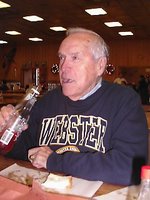
Professor Hinojosa-Smith is a prolific and admired writer who continues to write, teach, lecture and help aspiring writers even though he recently celebrated his eightieth birthday. His reputation is literally worldwide and his busy schedule often includes appearances at international writers and literary conferences. He is one of the contributors to Hit List: The Best of Latino Mystery, due any day now in the bookstores. We are honored that the good professor managed to squeeze in a few minutes for La Bloga.
____________________________________________________________________
Your impressive record of publications includes several in the mystery category, including your police procedurals, Partners in Crime (1985) and Ask A Policeman (1998), and short stories such as Nice Climate, Miami, your contribution to Hit List: The Best of Latino Mystery. What is it that draws you to this type of writing, this particular genre?
This'll be a long answer. I've read detective stories since childhood and am acquainted with the old as well as contemporary ones, however, there are two main reasons for Partners and Policeman.
After a long chat with Tomás Rivera, I finished Estampas del valle and sent it to Quinto Sol. I didn't want to write a linear novel, nor did I want a sole protagonist. Instead, I wrote of a place where every character, minor or major, would have a voice. I followed this with Klail City y sus alrededores, and it too was a fragmented novel. That, then, produced two main characters, Rafa Buenrostro and Jehú Malacara. Still bent on not writing a linear novel, these two were followed by Korean Love Songs, a novel in narrative verse. I meant to show the younger writers that the Mexican American experience was a wide one, and thus our literature would have to call for whatever genre prose fiction offered; since then, I've written an epistolary novel, a novel where dialogue predominated in the first part and with reportage in the second part, one with no narrator where the characters narrate the novel, there's one in journal or diary form, a campus novel, and so on. In brief, whatever the young writers chose to write regardless of theme. The Klail City Death Trip would show, through time, changes in that part of Texas.
During my trips to the Valley in the early 80s, I noticed an increase in violence on the Mexican side which also affected the northern bank of the Rio Grande. To show this, I chose a detective novel which calls for linearity, and this produced Partners in 85.

I followed this with the various genres mentioned earlier and thirteen years later, the violence increased along with a false economy produced by money due to the drug trade, from south to north, and the selling of weapons from north to south. This gave birth to Policeman in '98. The violence has increased and placed Mexico and the United States at odds: our country is the biggest buyer and user of drugs and Mexico, as our next door neighbor, is the principal conduit for their introduction into the United States.
I chose the procedural because I think it's more realistic: the police are not Dirty Harry types. They go about their business by interviewing, checking on what or may not be facts, and so on. So, in keeping with showing the changes of the Valley, the detective stories fit in what I set out to do: the violence called for that type of novel. The latest one, We Happy Few, shows still another genre in prose fiction: the campus novel. During this, I write essays, short stories, prepare papers for conferences, and so on.
What can you tell us about your Hit List story Nice Climate, Miami?
To leave the Klail City Death Trip for a while, I decided to write a ten chapter novel featuring Timothy Matthew O'Hara, a retired Manhattan Homicide lieutenant. An interesting background, almost a stereotype: Irish, his father and his grandfather were policemen. A widower, he was happily married for 16 years when his wife died of uterine cancer. She was the granddaughter of a retired Capo who gave his consent because the old man had known O'Hara's family and because they, as the present O'Hara, never took bribes. His marriage, however, kept him from rising about the rank of lieutenant as the old Capo predicted. After his twenty years on the force, he retires. He keeps his identity but places ads under the name of Rienzi and offers his services as a hitter. His twenty years in the Chinatown/Mulberry precinct took him all over Manhattan and I make use of this. His life, then, is a series of disposable cell phones. Independent, he won't be rushed. He plans the hits carefully, and as a former policeman he'll be hard to catch. He demands payment in advance; he'll do the occasional job for a friend, say, a madam at a high end brothel, and at one point, leaves Greenwich Village and moves across the East River to Astoria. Miami is the final chapter; however, I have three chapters to go before I finish the work. In Nice Climate, Miami, he fulfills his assignment, keeps the $20,000 the victim offered, and, earlier, having bought airline tickets to Montreal, San Francisco, New Orleans, and Miami, he flies to Miami to begin a new life, again as a hitter.
The hit man novel is yet another classification in crime fiction. I can't wait to read your contribution to this popular type of story. Maybe someone should put together an anthology of hit man stories - Latino hit man stories.
It seems that you are constantly on the go, from one literary conference to another, often in countries far from the U.S. One conference that you have attended several times is Semana Negra, the annual festival hosted by Paco Taibo II and his family in Gijón, Spain. That festival is dedicated to the “black” novel –crime, thrillers, detectives, graphic novels, and so on. Semana Negra is ten days of celebration and party where writers are treated like pop stars. How did you get involved in Semana Negra, and could such an event ever happen in the U.S.?
I was reading and lecturing at several German universities when a friend, Ricardo Bada, who lives in Cologne, told me of Semana Negra and he sent Paco Taibo my name and address. I was invited and the two of us flew to Madrid. Retired now, Ricardo worked for some thirty years for Deutsche Welle, the German shortwave station. A world-wide traveler for D.W., he is well-known and highly regarded in Europe and Latin America, and he occasionally writes for La Opinión in L.A. Once in Madrid, there's an overnight stay at the Chamartín Hotel (the meeting place before taking El tren negro north to Gijón). Paco is seemingly tireless and he is responsible for coming up with the money; you'd think this would be enough, but no: he's a writer, and I know of four novels and a biography of Ernesto Guevara, el Che, published in the ten or twelve summers I've been there. The writers come from the United States, Latin America, and all over Europe: England, France, Germany, Spain, the old USSR, and specialists in translation in foreign languages are present to help the audience. For several years, Elia Barceló and I conducted a series of creative writing seminars for young writers. Three years ago, Goran Tocilovac and I started creative writing seminars for seniors; all but one are women and most of them in their 70s. I also participate in a select three-day session with fourteen other writers and we discuss what we do. I also participate in radio and television interviews. It's an exciting conference with good company where one greets and meets old and new friends.
Would such an event take place in the United States? I don't know. I don't know who could/would raise the money for hotels, food, transportation, and so on for a worldwide conference on writers. Then there's the matter of taking care of the many contingencies that arise in any international conference. It'd be a fine occasion, but being the United States, if it were ever held, it would most likely be a one-time event. Why? Because I find that too many of our fellow citizens don't get along.
Sounds like a challenge for an enterprising literature benefactor - an international festival of writers and writing, here in the U.S.A.
In your more than thirty years as an active, consistently published writer, you must have seen various writing trends, fads and experiments. What’s your view of the current state of Latino fiction in the U.S.? What kinds of stories are popular now; who are some of the younger writers you think will be around for a while?
I know of one novel by Carlos Cisneros (he's a practicing attorney) and I believe The Case Runner is his first novel. As an attorney he could continue to write write genre novels, and this would be the paving of another avenue for younger writers to think on. There's also much activity in the young adult market and for that I can mention two: Claudia Guadalupe Martínez and René Saldaña, Jr. I don't know Patricia Santana's age but her writing is mature. Then there's Matt de la Peña who will also make contributions to our young adult literature. Anne Estevis is not a young person, but she's a young writer with a fine sense of humor.
I was at a conference where a Chicano literary critic said that Rivera, Anaya, and I represented the old school. Whatever that means. Well, Rudy is best known for Ultima, as he should be, of course, but he's also written short stories and has developed his detective series as well. I doubt the critic has read much of mine, but that's all right, any critic has the right to be wrong at the top of his voice as long as the second amendment to the Constitution gives all of us the right to do so.
He wanted us to get away from our culture and to write fantasy novels; I wonder if he would say the same about Toni Morrison, Alice Walker, and others to stop writing about the Afro-American experience. James Baldwin must be spinning in his grave, to coin a phrase to which the critic is welcomed.
Writers should write what they want to write about; if they are to harken and follow advice from nonwriters, our and all literature is in trouble.
I couldn't agree more, Rolando. We have to write what we need to write - the readers will be there.
I couldn't agree more, Rolando. We have to write what we need to write - the readers will be there.
Much of today’s Latino literature deals with the immigrant experience. Do you see that type of story finding a place in the mystery genre? Are you aware of current immigrant crime, detective, or mystery fiction?
Immigration is on the news, of course, and the robberies and murders of Mexican nationals who were killed returning home after six to nine months of hard work in the U.S. would be a workable piece of fiction. This would call for the police departments of both countries working together. This, however, is far different from the Juárez tragedies which are a part of contemporary history.
I don't consider crime fiction low brow, period. Those who do are entitled to their opinion, but an opinion is merely that, and opinions change. An opinion is different from a fact, and as Eustace Budgell wrote, "Facts are very bothersome things in that they refuse to go away."

As for those people who consider crime fiction low brow, who do and whom have they read? Orwell? Graham Greene? Evelyn Waugh? F. Scott Fitzgerald? Faulkner,Hemingway, Steinbeck, Bellow? Have they read Joan Didion, Susan Sontag, or the following crime writers, the three Scottish women: Alanna Knight, Lin Anderson, Alex Gray, or A. S. Byatt, Agatha Christie, Mignon Eberhardt, etcetera. Well, crime writers do. Why? Because the novels of those cited are well written and, as educated readers, crime writers are like sharks: they have no natural enemies. We don't set out to out do Shakespeare or Marlowe, Pérez Galdós or Cervantes, for crying out loud.To add to this, have they read Nicolas Freeling? Per Walloo and Maj Sjowall? Arthur Conan Doyle? Edgar Allan Poe?
Have they read half of those mentioned? Or are they, as I suspect, holding thumb and index finger to their noses to show superiority? They don't even know that Faulkner read crime stories as did Franklin Delano Roosevelt and John F. Kennedy.
Have they, finally, read Crime and Punishment? Now there's a crime novel for you.
As for Hit List, it's not meant solely for Hispanic readers; to write for one audience and one audience alone is not the mission of any writer.
Thank you, Professor. I sincerely appreciate your time and wisdom. It's been a pleasure - maybe we can continue the discussion one day soon over brisket at The Kreuz Market. I promise to call next time, honest.
_______________________________________________________________
LUCHA CORPI IN CONCERT
A quick note about another contributor to Hit List and a series of events that begins this weekend, March 21. The poetry of Lucha Corpi, more precisely, her poem Marina, has been set to music and will be presented in three separate concerts by the San Francisco Choral Artists in collaboration with the Early Music wind band, The Whole Noyse. The new composition Marina, by Ted Allen, uses early instruments like recorders, sackbuts, cornetts and curtals, together with mixed chorus. Includes works by Brahms, Clemens, Croft, Distler, Jannequin, Lassus and others, as well as instrument-only works.
SAN FRANCISCO: Saturday, Mar 21, 8 PM; St. Marks Lutheran Church, 1111 O’Farrell
OAKLAND: Saturday, Mar 28, 8 PM; St. Paul's Episcopal Church, 114 Montecito
PALO ALTO: Sunday, Mar 29, 4 PM; St. Mark's Episcopal Church, 600 Colorado
More information including tickets at www.sfca.org.
The new composition Marina is based on a poem cycle by poet Lucha Corpi, and explores different aspects of a native woman known to the Spanish as Marina, who aided Hernán Cortés in the 16th Century in Mexico. Also known as La Malinche, she has acquired almost mythical status over the centuries, and has been both revered and reviled.
Lucha Corpi, a poet and novelist who lives in Oakland, often explores themes of racism and justice in her works. Growing up in Mexico, she learned the story of La Malinche as a child. As an adult in Berkeley of the 1960s, she revisited the story while taking part in the Chicano Civil Rights movement and her perspective on Marina deepened. Says Corpi, “I began to appreciate La Malinche in a different context – as an intelligent, smart woman who took control of her own destiny."
Later.
Thank you, Professor. I sincerely appreciate your time and wisdom. It's been a pleasure - maybe we can continue the discussion one day soon over brisket at The Kreuz Market. I promise to call next time, honest.
_______________________________________________________________
LUCHA CORPI IN CONCERT
A quick note about another contributor to Hit List and a series of events that begins this weekend, March 21. The poetry of Lucha Corpi, more precisely, her poem Marina, has been set to music and will be presented in three separate concerts by the San Francisco Choral Artists in collaboration with the Early Music wind band, The Whole Noyse. The new composition Marina, by Ted Allen, uses early instruments like recorders, sackbuts, cornetts and curtals, together with mixed chorus. Includes works by Brahms, Clemens, Croft, Distler, Jannequin, Lassus and others, as well as instrument-only works.
SAN FRANCISCO: Saturday, Mar 21, 8 PM; St. Marks Lutheran Church, 1111 O’Farrell
OAKLAND: Saturday, Mar 28, 8 PM; St. Paul's Episcopal Church, 114 Montecito
PALO ALTO: Sunday, Mar 29, 4 PM; St. Mark's Episcopal Church, 600 Colorado
More information including tickets at www.sfca.org.
The new composition Marina is based on a poem cycle by poet Lucha Corpi, and explores different aspects of a native woman known to the Spanish as Marina, who aided Hernán Cortés in the 16th Century in Mexico. Also known as La Malinche, she has acquired almost mythical status over the centuries, and has been both revered and reviled.
Lucha Corpi, a poet and novelist who lives in Oakland, often explores themes of racism and justice in her works. Growing up in Mexico, she learned the story of La Malinche as a child. As an adult in Berkeley of the 1960s, she revisited the story while taking part in the Chicano Civil Rights movement and her perspective on Marina deepened. Says Corpi, “I began to appreciate La Malinche in a different context – as an intelligent, smart woman who took control of her own destiny."
Later.


