Monday, October 18, 2021

Reflections on Publishing My Twelfth Book, "How to Date a Flying Mexican: New and Collected Stories"


By Daniel A. Olivas

Almost 25 years ago, I started writing fiction. My first published short story appeared in the literary journal RiverSedge in 1998. In 2000, a small, now-defunct press based in Pennsylvania published my first book, The Courtship of María Rivera Peña: A Novella. I was 41 years old, married, the father of an 11-year-old boy, and well-established in my legal career with the California Attorney General’s office. That book is now out print, but it served as the foundation for ten more books—fiction, nonfiction, poetry—including two I edited. And in writing those books, I honed my storytelling skills which, in recent years, spawned a new life in playwriting.

Now a twelfth book is on the horizon. I am a man in his early sixties facing retirement in a few years. Luckily, I am still married to my law school sweetheart as we are about to celebrate 35 years of marriage. And our son is now 31, a grown many with a career and a rich life on his own. My father was called back last September, but my mother is still running circles around her grandkids and great-grandkids.

On February 1, 2022, the University of Nevada Press will publish my latest book, How to Date a Flying Mexican: New and Collected Stories. If you are a reviewer who is on NetGalley, I invite you to read the galleys.

How did this new book come to be? During the pandemic and in the wake of my father’s death, I set upon the task of reviewing almost 25 years’ worth of my short stories that had been published in various collections or as parts of novels. Our strange times seemed to call for this type of introspection and examination. I found that many of my narratives fell within the world of magic, fairy tales, fables, and dystopian futures.

This review also revealed that many of my fictions confronted—either directly or obliquely—questions of morality, justice, and self-determination while being deeply steeped in Chicano and Mexican culture. I decided to choose my favorite tales from the many scores of stories that populated my published works. I added to the mix two recent stories—one dystopian, the other magical—both of which confront the last administration’s anti-immigrant rhetoric and policies. The result is How to Date a Flying Mexican: New and Collected Stories.

We are now setting up book appearances to help bring this new book out into the world. The book launch will be at the venerable Vroman’s Bookstore on February 3, and I will be making an appearance at Skylight Books on February 26. I will also be a guest author at the Tucson Festival of Books on March 12 and 13. Other readings are being planned including one at Tía Chucha’s in spring. I hope you will be able to attend one of them. I am updating my events page as I get confirmations.

If you are a writer who has birthed at least one book, you know about the nightmares: your book gets published and when you open a copy, the pages are blank or they are in complete disarray with pages missing and words filled with typos. I am currently having those nightmares.

But no matter. I am blessed that a wonderful press has agreed to publish my work. I will do everything I can to bring it into the world with all of my energy, hard work, and love. I hope you will come along for the ride.


Friday, October 15, 2021

Cafecito Con, the New Podcast Celebrates Womanhood at All Stages

Melinda Palacio 

Cafecito. The drink that says ‘let me share some words of wisdom with a comadre.’ At least, that’s what it says for Delila Vasquez and Rosa Martin Munoz, two women who have started the podcast, Cafecito Con. The format is simple, yet brilliant, a conversation about womanhood for women by women. Delila, 57, and Rosa, 31 developed the podcast idea in July. The show is live on a Thursday and a replay can be heard the following week on YouTube. Delila was excited to bring in a younger woman who could be her daughter, to cohost the show. The two teamed up to create a space for women to navigate the world of womanhood and to give each other tips for achieving their goals, dreams, and a strong sense of self. The topics of casual conversation cover the issues of Who Are You, Why Do You Do What You Do, Who Are Your Influences, and What Are the Symbols of Your Faith? The questions allow for the sharing of a cup of love and the stories of Latina women and how they navigate life. 


Delila has held many jobs in education and within the Catholic Church. One of her prior jobs was the Executive Director of the Catholic Association of Latino Leaders. I first met Delila through Reyna Grande, when she helped one year with the International Latino Book and Author Festival in Los Angeles. In fact, Reyna Grande is this week’s guest. Listeners around the globe can hear the podcast on YouTube next week. After sampling some of the previous shows, I was impressed by the passion that Delila and Rosa bring to the table. They speak to all of their guests as if they were old friends or familia. 


Both Delila and Rosa put so much thought into the show, it’s refreshing to hear. The format allows women to share the essence of what makes them unique, allowing a wonderful exchange that I’m sure helps listeners grow. Women need to hear from different women at different stages of their lives to help them “build joy” as one of the guests mentioned. 


While their logo may be a high heel inside a coffee cup, the program is really about the different shoes women inhabit. Rather than think about hats or occupation, the shoe stands for how women express their comfort, needs, and wishes in the different spaces they inhabit. I was very impressed with the interaction between Delila, Rosa, and Reyna. I’m excited to hear more shows. The current formula is an audio conversation on the Clubhouse App. Reruns can be found on their Facebook page by pressing watch video and on YouTube. The co-hosts call themselves an intergenerational duo and there’s something magical about dynamics of their age differences. While the two are at different points in their lives, they are equally passionate about learning how to be the best form of themselves. They both want to reclaim a space to celebrate womanhood. Take a listen to this informative and inspirational podcast. 

Thursday, October 14, 2021

New Fiction: Into the Canyon

                  by Daniel Cano                                                 

                   "and the truth is that all veterans pay with their lives. Some pay all at once, while others pay over a lifetime." (Jim Storm)                                                                                          
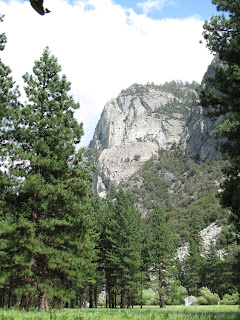
The spirit of the canyon 

        He drove from his home in Los Angeles to Fresno, turned east, and headed up Highway 180 into the Sierras. At 6,000 feet, he entered the pines, spotted the ranger station, and pulled alongside to pay the park entrance fee. The last thing he heard before lowering the radio’s volume was Saddam Hussein’s Iraqi forces had invaded Kuwait.

     She greeted him. “Good afternoon, sir.” Pretty, he thought, and young for a ranger. She said, “If you’re 65 or older….”

     “No, not quite," he said, "still got a few years to go.”

     “Are you a veteran?”

     “I am.”

     “Veterans can purchase permanent passes, good for as long as the park is here.”

     “Really. Been coming up for years and nobody’s ever told me. Thank you.”

     “Just doing my job.” She smiled and handed him the park material, newsletter and map.

     Cautiously, he slid into the line of cars heading into the forest, his radio nothing but static. There would be no more contact with the outside world for four days.

     As a college professor, he needed to keep up on the news, whether he liked it or not, and usually he didn’t, too depressing, and now, Iraq’s invasion of Kuwait. The U.S. had supported Saddam during his war with Iran in the 1980s. Old Saddam had fallen out of favor with Washington, the Iraqi leader owing the Yankee government billions of dollars in unpaid loans to fight his war, and here was, at it again.

     The saber rattling in Washington had already started. Many in this administration were hawks and wanted war, to show the president was no wimp. The 55,000 dead Americans in Vietnam teaching nobody anything, and Eisenhower’s prediction of the U.S. military industrial complex now a reality.

     He reached the dead end, and looked south towards Sequoia and the Giant Forest. No cars coming. He turned north, onto the winding two-lane asphalt road, into the thick pines, slow going for the next hour, up and down, thousand-foot cliffs in some places. Only hardened campers made the long, hazardous drive to the canyon floor, twisting and turning around curves and bends all the way down to the river.

     In 1960, the first time he visited Sequoia, he was a twelve-year-old Boy Scout. His friends and he, mostly Chicano kids from the L.A. suburbs, had spent seven days at Camp Wolverton, four days in the backcountry, on foot. They humped their supplies on wooden pack frames they built in their parents’ garages. Pack mules carried the food and cooking equipment, a precursor for what awaited most of them a few years later when they received their invitations from the draft board.

       As he drove deeper into the forest, he recalled the mountains outside Duc Pho, in Vietnam’s central highlands, the morning a sniper got Joe Sanderson, a kid from Kentucky who always made everyone laugh with his Gomer Pyle act. They’d covered him with a plastic poncho and waited for the medivac. Sanderson wouldn’t be the last guy in the squad killed. In the Rear, they smoked a lot of weed and drank bottles of whiskey to blunt the savage images.

     He kept his eyes on the road, maneuvering the curves down into the canyon. He slipped his favorite CD into the player, the Buffalo Springfield taking him right back to the 70s, when he first started camping in the Canyon with Beverly, his wife, and high school sweetheart, when music, love, and revolution were in the air, the pungent odor of the good herb everywhere and young, long-haired campers visited each other’s sites and shared coffee, beer, and tall tales of life on the road. He never mentioned the war.


The roar of the falls

     The kids were still in diapers when the young couple first brought them into the canyon. Once they grew strong enough, they’d hike past Road’s End, make a nine-mile round trip trek to Mist Falls, explore the meadows, river, and creeks then start back before the forest turned dark. For a couple of days after, they’d rest, hang around the campsite or swim in the cold, swift water of the mighty King’s.

     He lost Beverly to cancer in ’82, and he barely pulled out of his nosedive, blaming himself for her having to take the worst of his long silences and rejection of reality. He never remarried. Fellow vets taught him to cope. With family help, he guided his children through their teenage years, and watched them blossom into young adults. Occasionally, as a family, they’d still come to the canyon. His daughter preferred taking the grandkids to Knotts Berry Farm, Disneyland, and Magic Mountain, the long drive into the canyon a hardship, but he continued making the trip each year, alone, same ritual, year after year.  

     He’d come here to make difficult decisions, like the time he decided to forego a lucrative job and remain in the classroom, or when he chose not to remarry, even though he and the woman were a perfect match and the kids adored her. Something about the sounds of the river and breeze rustling the tree tops spoke to him more clearly and succinctly than family, friends, or therapists ever could. The wilderness cleared his mind, and the reality of surviving, just like in the war, on life’s bare necessities, gave him perspective.

     He drove across the bridge, the river raging beneath. He pulled into the Sheep Creek, the first campground--tradition. It was a Sunday afternoon, so he wasn’t surprised to find his favorite campsites empty. Most weekend campers vacated by 2:00 P.M. He pulled into spot number 47, under the shade of the pines and cedars, where he could hear the river, a short, five-minute walk away.

     He placed his tent beneath the thick branches of a redwood, even though he’d sleep on a comfortable air mattress in the back of his Ford Explorer. It wasn't a campsite without a tent. As he unloaded the rest of his equipment, he noticed two women, late thirties, early forties, and three children in the next campsite. One woman was striking, thin, short blonde hair and a serious expression on her face. She wore camouflage fatigues and a green t-shirt. The other had silver hair, shoulder length. She had a tanned, plain face, too young for graying hair, bright blue eyes and a large, friendly smile. She wore tight shorts and fitted blouse, her body firm and athletic.

     The campsite on the other side of him was vacant, but he knew within a few days it would be taken. His usual practice, he walked to the river and knelt on one knee beside a fallen tree that had been in the same spot for thirty years. He whispered, “Well, Beverly, here I am again, another year.”

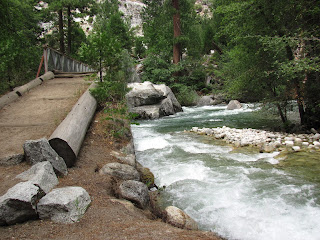
     It had rained more than usual this past winter, rare for California. The river was high, angry, and loud. He listened to the different sounds created as it tumbled past rocks, boulders, and fallen tree trunks. The more he listened, the more he heard a symphony, nature’s harmonics, mingling with the sound of the wind.

     He walked along the bank. He recognized gullies and rivulets, offshoots of the main river, an island, a fallen pine used as a footbridge, and huge boulders his kids had loved climbing in their adolescent years. After an hour, he returned to camp.

     In the canyon, evening came early. Instead of the lighting his Coleman stove, he took his hatchet and split wood to start a fire. He dropped the heavy metal grill attached to the pit over the fire and took a small sauce pan from a cardboard box and placed it on the grill.

     He opened a can of beef stew and a can of corn, poured them into the saucepan and stirred. When it all came to a boil, he moved the pot to the side of the grill and let it cool. He placed two slices of bread onto the grill and let them toast. He took a spoon from the bag of utensils, wrapped a cloth around the hot saucepan handle and ate.

     After he finished, he sat back and observed his surroundings. He recalled the times his kids had run up and down the road, Beverly’s voice warning them to watch for cars, the memories no longer painful, more matter-of-fact, like companions.

     He picked up the empty saucepan and dirty spoon, walked up a hill to a metal basin attached to the outside of the bathroom wall and washed them. He moved back down the hill, darkness closing in, lights shining in the other campsites.

     He cleared the top of the heavy wood table, organized his camping gear, and placed the food in a metal bear container. Back at the table, he reached for his cup that said, “Best Grandpa in the World.”  

     He poured about two shots of Seagram’s with a spot of water. The first drink was always the best. He swirled the liquid in his mouth and swallowed slowly, feeling the alcohol rise to tickle the nerve-endings, euphoria.

     He sat back and looked up into the shadows and stars overhead. He thought about the night Pete Saldana killed two VC, only to learn the next morning they were village women carrying jugs of water on bamboo poles. He’d always remember the look of surprise on the one woman’s face.  The captain reported them as two enemy KIA because they wore dark pajamas.

     Like erasing writing from a whiteboard, he wiped away the image. He’d already dealt with guilt or pain. He was beyond that. It was just too soon to ponder the other side. Afterall, that was one reason for camping. The outdoors always helped him remember.

     Among his group of basketball-buddies, other Vietnam vets and college educated like himself, he was of the opinion that remembering helped with the healing, and trying to forget was useless. That was just hiding the pain, like after Beverly’s funeral when he disappeared for a month.

     “You forget long enough,” said one of his veteran buddies, “you forget forever.”

     Even in those early days when his kids laughed and fired-up marshmallows in the campfire, they saw a beautiful glowing fire and heard the sounds of crackling wood. He saw muzzle flashes, sparks from grenades, and heard the cracks from M-16s and AKs. During the rare times summer rain fell in the forest and thunder roared in the canyon, he heard full-on battles and remembered exactly what the drops sounded like striking his plastic poncho.

     He finished his drink and placed the cup on the picnic table, grasped his shaving kit, soap, toothbrush, towel, and made his way back up the hill to the bathroom to wash. He returned to the fire, doused it with water from a plastic bucket, and with an entrenching tool, he tossed dirt over smoldering embers. He climbed into the back of the Explorer, dropped onto the thick mattress and waited for sleep, which came quickly, unlike home, where he struggled with the night.


When the river speaks

     He woke early, the sun still hiding behind the tall canyon walls. He split a few logs, put them into the firepit, and got a good fire going to warm him. He poured water into the same small saucepan from the night before—keeping it simple. He placed the small metal pot, its bottom burned, at the edge of the grill. The flames rose, darkening the sides of the pan.

     He put two teaspoons of instant coffee into a cup, poured in the hot water, and watched it bubble. He took a milk carton from the ice chest and dropped a little into his coffee until the black liquid turned light brown. He spilled in exactly one spoonful of sugar and stirred. He first sip raced through his body. Yellow rays shone through the trees.

     By the time he was on his second cup, he heard commotion from the campsite next to him. The youngest child, a girl about five, was crying. The blonde woman, a bandana tied around her hair, tried consoling the child. No good. The other children, a boy and a girl, hollering, ran around the campsite chasing each other. They scaled a large bolder. The silver-haired woman, calmly, herded the kids to the picnic table, sat them down, and gave them each a bowl of cereal, the kids arguing over who got to read the back of the cereal box.

     She nodded at him when she saw him watching. He smiled and raised his coffee cup. She returned his smile.

     Once the kids had settled down, the silver-haired woman walked towards him. She stopped at the edge of his campsite. He said good morning to her. She returned the greeting and told him she envied his quiet. He said his children were grown, his daughter with her own toddlers. "I started early."

     “Lucky you,” she answered. “I started late. I should have been like you.” She laughed.

     “It goes by fast, enjoy it.”

     They let the words linger.

     Instinctively, he offered her a cup of coffee, and a little quiet. Surprising him, she asked if he’d wait, give her a few minutes.

     When she returned, she said, “My friend said she’d watch the kids. I can use the escape.”

     He opened a folding chair for her. He wasn’t sure what to say as he made her coffee. “It isn’t Starbuck’s, but I enjoy it, the simplicity, you know,” he said. “It’s the reason I’m here.”

     She took the cup from him and thanked him.

     The words came easily.

     She and the other woman were friends since high school. They lived in Redondo Beach and had gone to Redondo High. Her friend’s husband encouraged the two of them to take the kids, get away for a few days, and rest. “Not so sure we’re getting much rest, though.” 

     They both laughed.

     When she laughed, wrinkles formed at the corners of her eyes and mouth, brightening her blue eyes. She had full eyebrows and long lashes, smooth, clear skin and no makeup.

     She told him the boy was her son, twelve. She finalized her divorce five years after her son was born. He wanted to ask why she divorced but knew better. As if reading his thoughts, she offered, “He wasn’t the marrying type, even in his 30s, I still had hope. He couldn’t settle down. Anyway, I figured this little outing would give my son and me some quality time.”

     “I married young,” he said. “My daughter has two little ones. My son just finished college.” He didn’t wait for her to ask. He said, “My wife died a few years back after a bout with cancer.”

     “My god, I’m so sorry,” she uttered.

     “It’s been a long time.” He sighed. “I won’t lie. It was hard at first, but I managed.”

     The morning air was still. He could hear voices, slight echoes, coming from the other campsites.

     She was direct. “My ex-husband never wanted to be tied down. In the early days, he’d call from Montana, or Wyoming, or some interesting place telling me he wanted to make it work. I believed him. I’d take him back. Then, he’d take off again, with guys or girls, it didn’t matter. He told me I needed to accept him as he was. He comes from money, always spending it on one project or another, never on us. He’s gone through most of his inheritance, but when his parents die, he’ll come into a whole lot more.”

     “So, I guess we’ve both had our challenges.”

     She laughed. “Like the proverbial roller coaster.”

     “Where’s your ex now?”

     “Alaska, last I heard. Either way, he’s out of the picture. He writes my son on occasion, promises to visit but never does, unless he needs something from me, if you know what I mean. He still tries to beg. I learned the hard way.”

     “Tough, uh?”

     She looked over her shoulder to her campsite. “Hey, maybe we can talk tonight when things quiet down.” She looked at the thick tome on his picnic table. “Anthology of English Literature…looks like some intense reading.”

     He smiled, “I call it my heavy-lifting. I teach college.”

     “A professor?”

     “Not the khaki-tweed type. Please call me Ray. Yeah, come by if you’re up to it.”

     “We’ll see how it pans out. I’m Marion.”

     They both stood and shook hands.
                                                                                   

A different voice 

.
     The night moved in fast. Once he finished his dinner, washed dishes, and cleaned up the table, he walked to the bathroom and gave himself a sponge bath. He settled in under a lantern and read the anthology, trying to figure how he would make Henry James’ story, “The Real Thing,” interesting to today’s students, who struggled with James’ language and ideas. The story was about illusion and reality, and which was the real thing.

     He recalled reading a study where baby birds were trained to accept food from wooden beaks rather than their mother’s beaks. In the experiment, the baby birds knew the wooden beaks carried more food than the mothers’, so the baby birds rejected their mother’s food and relied solely on food from the wooden beaks. They accepted illusion over reality.

     By 9:00 PM, Ray sat at the table reading. He saw the shine of a flashlight coming through the narrow footpath leading to his campsite. Marion stepped out of the darkness into the light of his fire, her face bright, and friendly. “I’m back.”

     Normally, he liked his solitude. He avoided strangers, playing host, and having to think of something intelligent or entertaining to say. As a teacher, words were his tools, and like any laborer, he tired of his job and needed to put away all the tools, but not tonight.

     “Hello, welcome,” he answered. “Get the kids to bed alright?”

     “Yeah, yeah. Hey, I really hope I’m not bothering you. I mean I see you’ve got your book open and all.”    

     He pointed to a folding chair near the table. “Just reading a story I haven’t read in years. You’re actually giving me some down time.”

     “That’s good, right?”

     “It is.”

     “Can I ask how you prepare, like, I mean, is there a process you follow? Good teachers make it look so easy.”

     He could tell she was genuinely interested.  “It’s a good question. Most jobs, I’d guess, you pretty much follow a manual, or a system that’s already prescribed. I research then read a story many, many times. I try not to lecture but listen to the students.”

     She chuckled, “Oh right, tell me about it. I could write insurance policies blindfolded.” She reached for the anthology. “Do you mind?”

     “No, no. Be my guest.”

     “’The Real Thing,’ Henry James.” Her eyes settled on the words, “A painter is sketching a woman who wants to work as his model. She and her husband are from the upper classes and think they are perfect for his painting, a portrait of a royal couple. They’ve fallen on hard times and need money. In this scene, the narrator, an illustrator, is sketching her with a pencil, kind of trying her out.”

     Marion shifted the book so the lantern’s light brightened the page. Surrounded by darkness, she read, her voice falling into a slow, steady rhythm, stopping at each punctuation mark. She came to the passage, “’She sat with great intensity, giving the whole of her mind to it, and was capable of remaining for an hour almost as motionless as if she were before a photographer’s lens.’”

     When she stopped reading, Ray said. “Go on, please.”

     Trance-like, Marion continued reading, her soft voice rising, an echo in the night. “’I could see she had been photographed often, but somehow the very habit that made her good for that purpose unfitted her for mine.’” Marion turned her blue eyes towards Ray who remained silent, his lips barely touching. He saw a look of consternation cross her tan face.

     “Marion,” he said, “Are you alright?”

     She blinked. “Yeah, I, uh, think so. Should I keep going?”

     Her voice made the words breathe and gave Ray an entirely different take on the story. “Yeah, please.”

     She read, “’At first, I was extremely pleased with her lady-like air…. But after a few times, I began to find her insurmountably stiff; doing what I would with it, my drawing looked like a photograph or a copy of a photograph.”

     Marion’s voice lilted in the air. The fire in the background crackled. Her eyes met Ray’s. Tears welled. “Is that me,” she asked, “the woman in the story, artificial?”

     Her question stumped him. All he could answer was, “That’s all of us, the woman and the man.”

     “I don’t understand.”

     He spoke slowly. “Well, it’s like we go through life always searching for who we really are, not who people say we are, or who we think we are. Maybe illusion is more powerful than reality.”

     An hour passed. As the fire dimmed, she rose from the chair and sat next to him at the table, her arms and thighs lightly touching his. She felt nice. As they talked about the story and about their lives and the people in them, she slid down and sat on the ground, leaning her shoulders into his legs, for support.  

     Their dialogue was interspersed with brief silences. She raised her eyes and looked deeply into his. He returned the gaze. The fire illuminated her face below her nose, brightening her full lips. They stayed that way, talking and listening until the last embers of the fire died.

     She rose, the constellations lighting the night. She said, as they both stood looking at each other, “The couple in the story, they were royalty, the real thing, but the artist couldn’t capture it, them. Then, the cleaning woman comes in to model, and he turns her into a princess.”

     Ray thought for a moment, and answered, “That’s right. The real thing.”

     They stood but feet apart. Marion said, “Oh, it’s late. I should be getting back.” She placed both hands in his. Their fingers fit neatly together. She moved closer to him, her eyes on his. They remained that way for a moment, quiet. She offered a quick hug, and she thanked him for a beautiful evening. He did the same.

     She turned on the flashlight and made her way back to her campsite. She called in a low voice, as if asking a question, “I will see you tomorrow?”

     He smiled.

     The next morning, he woke early, before the sun rose and broke camp, making sure he left the site as clean as he had found it. Few campers stirred as he drove up the road, alongside the river, and out of the canyon.

Wednesday, October 13, 2021

23rd International Latino Book Awards Virtual Ceremony


PROGRAM

23rd International Latino Book Awards Virtual Ceremony


SATURDAY OCTOBER 16, 2021 / Sábado 16 de Octubre


1pm PST, 4pm ET: 

Children, Youth, & Young Adult 

Para Niños, Jóvenes, y Jóvenes Adultos

https://www.latinobookawards.org


4pm PST, 7pm ET: 

Nonfiction Book Awards

No-ficción

https://www.latinobookawards.org


SUNDAY  OCTOBER 17, 2021 / Domingo 17 de Octubre


1pm PST, 4pm ET: 

Poetry, Translation, Design, Mariposa, eBooks & Audiobooks, Portuguese, Themed Book, & Marketing Book Awards

Poesía, Traducción, Diseño, Mariposa, libros electrónicos y audiolibros, Portugués, Temáticos, y Promoción

https://www.latinobookawards.org


4pm PST, 7pm ET: 

Fiction Book Awards

Ficción

https://www.latinobookawards.org


Tuesday, October 12, 2021

Antepenultimate Tuesdays In Octobers

Michael Sedano, The Gluten-free Chicano

California's on-again, off-again Fall hits with a vengeance like clockwork every October. That was true back on October's antepenultimate Tuesday in 2016, and, with global warming, I hope it's not truer this year, the vengeance part. 

Here, in Pasadena, most people put on a sweater or sweatshirt until the sun burns through the overcast, then it's afternoons of playeras and chanclas. Coverup again around sundown, when it's time for a hearty dinner. Something savory, not heavy, good for you. And, of course, gluten-free.

A savory fish soup is just what the calendar and el tiempo and el clima and El Gluten-free Chicano call for. Here's an updated recipe for Caldo de Pescado from October 11, 2016. Back then, el Gluten-free Chicas Patas enjoyed Frito Lascano's annual La Pelada and stocked-up on roasted rajas. Social isolation put the kibosh on peladas. Hatch chiles, however, have found a niche in local grocery stores. Truth be told, any "large green chile" will be just right. Some people, and restaurants, serve a bell pepper-only caldo.


The Gluten-free Chicano Cooks 
Caldo de Pescado: Naturally Gluten-free


Skies darken earlier as Fall wanes into Winter, and with dropping temperatures, a steaming bowl of caldo de pescado hits all the right spots for dinner or lunch. In fact, if you make a big pot, you can have dinner and lunch, maybe even breakfast of this richly seasoned hearty preparation. 

Ingredients 
Cabbage 
Carrots 
Red potatoes 
Celery 
Onion 
Garlic - 3 dientes 
Bell pepper
Hatch chile
Helotes or corn kernels 
Canned tomatoes 
Tomato juice
Frozen cod filets 
Limones 
Cilantro, Salt, pepper, powdered coriander, bay leaves, olive oil, water. 

My kitchen stocks these ingredients in partially used quantities. I had the nub end of a celery, half a cabbage, most of a big red onion, and half a red bell pepper. I used another whole bell pepper because half isn't enough. 

The Gluten-free Chicano seeks value and finds it in bulk frozen cod at the grocer. One filet per person, let it defrost for a couple hours until soft enough to cut into spoon-size chunks. A partially-frozen filet slices into easily spooned cubes.

I like the cabbage cocido style, so slice half a head into four wedges. 

If using fresh corn, clean and break in half. For this preparation I had a jar of Niblets Corn (half a can) in the icebox and used that to good advantage. 

Get an edge on your knife with a steel, then carefully chop everything except the cabbage into spoon-size pieces. 

Add the root of the celery, the top of carrots, the tops of bell peppers. After cooking their flavor into the broth, pull them out and feed to the hens. La Chickenada loves them.
Pour a scant helping of olive oil into your soup pot and get it hot. 

Add the chopped vegetables and cook on medium heat for a few minutes. 

Add the fish and stir it into the cooking vegetables. 

Add as much chopped Hatch rajas as you need, based upon the hotness of the flesh and your diners' palates. You want the soup to be lip-smacking picoso but not so much that those of a different palate won’t enjoy the meal. You can offer powdered cayenne or dried chilitos, along with the lemons and onions and cilantro as the standard condiments.
I had half a mason jar of whole peeled tomatoes, so I added them—the equivalent of 3/4 of a 28 oz can of whole peeled tomatoes. I rinsed the jar and added the water. 

Add a cup and a half of tomato juice then enough water to fill the pot ¾ full. The vegetables exude liquid, too, so leave room. 

Add the dry spices and cilantro. I didn't have fresh cilantro so used some dried coriander. Stir in three small bay leaves, scantly generous salt, several pinches of coarsely ground black peppercorns.
Place the cabbage and helotes on top, bring to a happy boil, then cover and lower the flame to small simmer. Leave it on the fire for an hour or until the cabbage is soft enough to pierce easily with a fork. 

As this caldo slowly simmers your entire home fills with the aroma of puro love. Preparing this caldo is a lot of work, and all those ingredients combine to form a lusciously enticing perfume that reflects your labor. 

Speaking of love, The Gluten-free Chicano is using his mother's 1941 cocido/menudo pot.
Scoop heaping mounds of the vegetable and fish into a bowl, add as much liquid as you want. In the fotos below, I doubled the liquid before serving.
Serve with fresh lime or lemon halves to squeeze into the savory broth. This is excitingly filling without being heavy. That means you don't have to serve quesadillas, nor tortillas, for that matter. A tort, however, is useful to push food onto the soup spoon. 

¡Provecho!

Monday, October 11, 2021

Hispanic Heritage Month / El Mes de la Herencia Hispana

Hispanic Heritage Month / El Mes de la Herencia Hispana

By Johnson County Arts & Heritage Center


Join the Johnson County Arts & Heritage Center for a lovely evening in celebration of National Hispanic Heritage Month! From Mexican traders and laborers, to recent Central and South American immigrants, the Kansas City region has deep Latino history. Today, the Latino community is Johnson County’s fastest growing population. National Hispanic Heritage Month is a time to honor the cultures and contributions of Latino Americans across the United States. 

Wednesday, October 13 from 6 - 8 PM
Johnson County Arts and Heritage Center
8788 Metcalf Avenue, Overland Park, KS 66212

The event includes live performances from Mariachi Estrella, Iskay, Jessica Ayala, and Capulli Iskali. 


Enjoy refreshments from Carmen’ns Cocina II, El Pulgarcito, Paleterías Tropicana, and Tango Bites, a presentation from Hispanic Leadership Lowrider Bike Club, a poetry reading from internationally acclaimed poet Xánath Caraza, an info booth from El Centro, as well as a viewing of an Aztec Codex from the Special Collections and Archive at UMKC. 

Event is hosted by Johnson County Arts & Heritage Center, Johnson County Museum, Johnson County Park & Recreation District, Hispanic Leadership Lowrider Bike Club, and El Centro.

This event is FREE and open to the public. No registration required. There is something for everyone!


¡Únase al Centro de Arte y Herencia del Condado de Johnson para disfrutar de una agradable velada en celebración del Mes Nacional de la Herencia Hispana! Desde comerciantes y trabajadores mexicanos, e inmigrantes recientes de Centro y Sudamérica, la región de Kansas City tiene una profunda historia Latina. Hoy en día, la comunidad Latina es la población de más rápido crecimiento del condado de Johnson. El Mes Nacional de la Herencia Hispana es un momento para honrar las culturas y contribuciones de los Latinoamericanos en los Estados Unidos.

Miércoles 13 de octubre de 6 a 8 p.m.
Johnson County Arts & Heritage Center
8788 Metcalf Avenue, Overland Park, KS 66212

El evento incluye presentaciones en vivo de Mariachi Estrella, Iskay, Jessica Ayala y Capulli Iskali.


Disfrute de un refrigerio de Carmen’ns Cocina II, El Pulgarcito, Paleterías Tropicana y Tango Bites, una presentación del Hispanic Leadership Lowrider Bike Club, una lectura de poesía de la poeta internacionalmente aclamada Xánath Caraza, un puesto de información de El Centro así como una visualización de un Códice Azteca de las Colecciones Especiales y Archivos en UMKC.

El evento es organizado por Johnson County Arts & Heritage Center, Johnson County Museum, Johnson County Park & Recreation District, Hispanic Leadership Lowrider Bike Club, and El Centro.

Este evento es gratis y abierto al público. No es necesario registrarse. ¡Hay algo para todos!


Wednesday, October 13 from 6 - 8 PM. See the set times below.

6pm Mariachi Estrella KC

6:30pm Iskay

7pm Mariachi Estrella KC 2nd set

7:30pm Poetry reading from Xánath Caraza followed by a performance from Jessica Ayala

7:45pm Closing performance from Calpulli Iskali

We hope to see you there! There is something for everyone at this event! 6pm-8pm and FREE to the public! THIS Wednesday evening at the Johnson County Arts & Heritage Center.


Friday, October 08, 2021

New Books


Hard to believe but we are in the last quarter of 2021, which means, among other things, new book announcements for fall and winter. It's as though publishers are suddenly waking up as they shrug off the pandemic doldrums and reveal fresh literary options. Here's a handful, from an old school master (Mario Vargas Llosa) to a Latinx bodice ripper to a Chicano whodunit by the ever-clever Martin Limón. As usual, something for everyone.

_________________________


A Lot Like Adiós
Alexis Daria
Avon - September, 2021

[from the publisher]
After burning out in her corporate marketing career, Michelle Amato has built a thriving freelance business as a graphic designer. So what if her love life is nonexistent? She’s perfectly fine being the black sheep of her marriage-obsessed Puerto Rican-Italian family. Besides, the only guy who ever made her want happily-ever-after disappeared thirteen years ago.

Gabriel Aguilar left the Bronx at eighteen to escape his parents’ demanding expectations, but it also meant saying goodbye to Michelle, his best friend and longtime crush. Now, he’s the successful co-owner of LA’s hottest celebrity gym, with an investor who insists on opening a New York City location. It’s the last place Gabe wants to go, but when Michelle is unexpectedly brought on board to spearhead the new marketing campaign, everything Gabe’s been running from catches up with him.

Michelle is torn between holding Gabe at arm’s length or picking up right where they left off—in her bed. As they work on the campaign, old feelings resurface, and their reunion takes a sexy turn. Facing mounting pressure from their families—who think they’re dating—and growing uncertainty about their futures, can they resolve their past mistakes, or is it only a matter of time before Gabe says adiós again?

_____________________________


Obed Silva
Farrar, Straus and Giroux - December 7

[from the publisher]
Weaving between the preparations for his father's funeral and memories of life on both sides of the U.S.–Mexico border, Obed Silva chronicles his father's lifelong battle with alcoholism and the havoc it wreaked on his family. Silva and his mother had come north across the border to escape his father’s violent, drunken rages. His father had followed and danced dangerously in and out of the family’s life until he was arrested and deported back to Mexico, where he drank himself to death, one Carta Blanca at a time, at the age of forty-eight.

Told with a wry cynicism, a profane, profound anger, an antic, brutally honest voice, and a hard-won classical frame of reference, Silva channels the heartbreak of mourning while wrestling with the resentment and frustration caused by addiction. The Death of My Father the Pope is a fluid and dynamic combination of memoir and an examination of the power of language—and the introduction of a unique and powerful literary voice.


____________________________


Martin Limón
Soho Press - November 16

[from the publisher]
Tasked with covering up a tabloid report about high-ranking officers, US Army CID Agents George Sueño and Ernie Bascom discover a dark web of systemic issues that have potentially fatal consequences.

South Korea, 1970s: Sergeant First Class Cecil B. Harvey, a senior NCO in charge of 8th Army’s classified documents, has long been a friend (willing or unwilling) to Sergeants George Sueño and Ernie Bascom. So when he goes missing with a top-secret document that even a glance at could get an officer court-martialed, Sueño and Bascom take it upon themselves to find him.

Meanwhile, Overseas Observer reporter Katie Byrd Worthington is back to make life difficult for top Army brass. When she lands in a Korean jail cell, Sueño and Bascom are sent to get her out—and negotiate against the publication of an incriminating story about the mistreatment of women in the military that could land important officials in hot water.

______________________________


Harsh Times
Mario Vargas Llosa - Translated by 
Adrian Nathan West
Farrar, Straus and Giroux - November 23

[from the publisher]
Guatemala, 1954. The military coup perpetrated by Carlos Castillo Armas and supported by the CIA topples the government of Jacobo Árbenz. Behind this violent act is a lie passed off as truth, which forever changes the development of Latin America: the accusation by the Eisenhower administration that Árbenz encouraged the spread of Soviet Communism in the Americas. Harsh Times is a story of international conspiracies and conflicting interests in the time of the Cold War, the echoes of which are still felt today.

In this thrilling novel, Mario Vargas Llosa fuses reality with two fictions: that of the narrator, who freely re-creates characters and situations, and the one designed by those who would control the politics and the economy of a continent by manipulating its history.

Harsh Times is a gripping, revealing novel that directly confronts recent history. No one is better suited to tell this riveting story than Vargas Llosa, and there is no form better for it than his deeply textured fiction. Not since The Feast of the Goat, his classic novel of the downfall of Trujillo’s regime in the Dominican Republic, has Vargas Llosa combined politics, characters, and suspense so unforgettably.

Later.

_________________________

Manuel Ramos writes crime fiction.  His latest is Angels in the Wind.