Showing posts with label autobiography. Show all posts

Tuesday, May 17, 2022

I'm confessing that I lived, and loved, and made music.

Review:  Rubén Funkahuatl Guevara. Confessions of a Radical Chicano Doo-Wop Singer. Berkeley: UCPress, 2018.

Michael Sedano

It’s 1974, a Mexican American musician whose Chicano Studies classes have imbued him with an Edenic vision of his Mexicano and Amerindian raices, travels to Guadalajara thinking he’ll be embraced by his gente. A random street corner encounter shakes him to those raices: a Mexicano laughs that Chicanos have no culture.


Here is the pivotal moment in Ruben Funkahuatl Guevara’s life story. That random Mexican is right. Chicano literary production consisted in the novels Chicano and Bless Me, Ultima, and everyone in C/S classes reads Rudy Acuña’s canonical textbook, Occupied America.
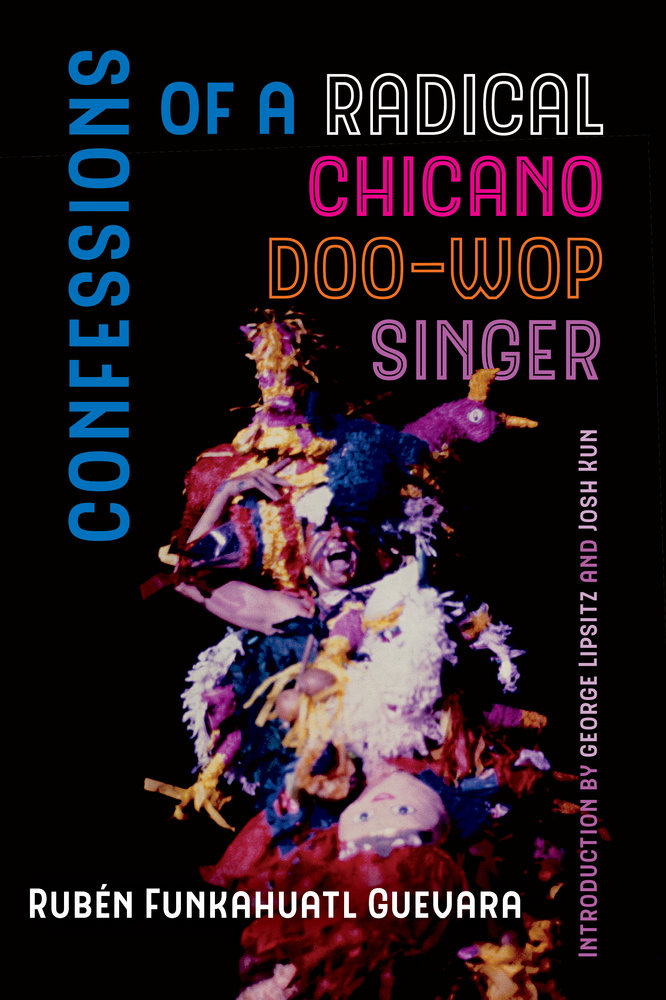
 

In a dramatic scene—part memoir, part magical realism—the 32-year old unemployed (again) and broke (again) musician climbs a pyramid, throws out his arms, and proclaims his affirmation of all things Chicano. The namesake of the recently defunct band, Ruben and the Jets, decides he will be a Chicano culture sculptor to help fashion what had not yet emerged. 


Dramatic as the scene plays, it’s one of numerous career and relationship zeniths and restarts Readers come to expect from Confessions of a Radical Chicano Doo-Wop Singer (link). Success and optimism become catchphrases, “I was on my way again,” “I was twenty-eight, and on my way again.”


Funkahuatl is the artist’s way of decolonizing his name. He likes his name, Rubén, and doesn’t want to change it like his early monikers. Funk stands for his Unitedstatesian identity blended into something Mexicano, -huatl.


Guevara calls his aesthetic “radical” for his adventurous presentations and liberation attitude. 


But Guevara’s old, so old he was there at the origins, the roots, of the LA music scene. Before he was Funkahuatl—his “pre-Chicano period”—Guevara played as J.P. Moby on the television dance program, Shindig. He’s 22 years old and he’s making music with Bo Diddley on teevee. He puts a move on Tina Turner when Ike’s not on set. He’s clubbing in Hollywood and there’s a group on stage whose singer is like an intense James Dean. It’s the Doors before they were kicking down doors. Then there was some group whose guitarist plays with his teeth--Jimi Hendrix still getting experienced.


Music fans will enjoy a raft of anecdotes about pop music industry luminaries and down-and-dirty heartache of the business of music and record-making. Confessions won’t inform someone’s lust for glittery slices of fantasy, nor ample details of Guevara's rich sex life, nor details of his three, or is it four, marriages? 


While there are serious personal details, these are confessions of a doo-wop singer, not a social worker. But the very best anecdote in the book comes out of left field at readers with a social work twist.


“Don’t give up your day job,” comrades will taunt performers. It’s a reminder that musicians rarely make a living from music. “I was living in my van again,” Guevara writes repeatedly. He works factotum jobs. Working in vinyl distribution, he finds it ironic to be shipping out his records to people who make money off them. He doesn’t. At one point, Guevara settles down from a national tour making music and bringing down the house. Back in LA, out of work, and he takes a job delivering Chicken Delight.


A friend points the poet toward teaching institutionalized boys. Thinking he’ll put in the 8 month contract, he works 16 years. In 1999, he takes a full-time job teaching 8-10 year olds. It’s the hardest work he’s ever done, he says. He changed some kids’ lives, like a sculptor que no?, adding to, or taking away, the shape of a kid's future.


The poet was doing cultural sculpture with those damaged kids. For instance, his wonderful anecdote of reading a Neruda love poem in Spanish to students. The reader, a beautiful woman, interprets effectively and the class expresses their feelings. Some had never heard a poem read in their own language. 


“I got to a young man who I knew couldn’t speak very well and rarely tried. I had known him for several years and was impressed with the images he would draw during class. I hadn’t intended to ask for his response, but something inside said to ask anyway. He put his pencil down and slowly said in Spanish, “Love is bittersweet. Love heals and scars. Love is life.” The nurses were astounded. He had never spoken that coherently before. That was one of the greatest poems I’ve ever heard.”


Readers don’t come to biography with literary expectations, but that’s a radical difference in Confessions: it’s a hybrid with poetry ending some chapters. For example, a student dies in a drive-by and the teacher writes a poem to read before the funeral. The chapter details the story. Having that poem after that narrative offers satisfying closure, no better illustration of "see what I mean?" than how a literary insertion affects each reader. 


The book observes a chronological sequence (first line: “I came into the world on fire”), but with editing and organizing, each chapter holds together on its own. There are no plot threads forcing a sequential reading. A reader will enjoy cherry-picking the work. If the Punk era is of interest, start reading there. If the Shindig years bring happy tears, read there. Read the chapters with women's names. There’s an Index for topical or research-driven readers of this 300 page memoir.


One of the totally un-radical features of the radical singer’s book is the old-fashioned ultra-traditional proscription against Spanish linguistic equality. Every Spanish expression gets italicized, and almost always with appositional translation into English. For criminy sakes, UC Press, we are Chicanos. It’s simply gratuitous that you translate stuff we’re supposed to know. 


Appositional translation gets insulting at times, for example “watching her make gorditas, fat little tortillas, and the way her hands would go slap, pat, slap, pat, slap to the masa cornmeal to shape them.” 


Italics and translating are not only old-fashioned, it’s a publisher’s way of saying to readers, “you’re not Chicano enough to make it through elementary Español, Spanish, in our text, pendejo, so here’s a translation”


Damn, Rubén, que gacho. Otherwise, this is a damn fine autobiography, and thanks for the music, ese. 


Tuesday, February 12, 2019

From a work in progress...Birth of the First Child

Michael Sedano

The left arm is back after two months pinned to my side. A "separated shoulder" stopped me cold just as I neared the end of a big project I began back in July. It was incredibly frustrating.

Today, as I'm getting back to speed, I'll share what I was doing until I fell head over heels and tasted cement.

Over the summer of 2018 I had the pleasure of meeting regularly with Esteban Torres with the goal of writing an As-Told-To YA autobiography. My goal was to finish it in January. Last month.

When I went looking for autobiographies for raza boys I found Cesar Chavez and a raft of athletes. Torres and I weren't looking to portray heroism or great moments like striking out the side in the ninth inning of some baseball game. That's not what I want to write. And Torres' story demands telling (such as when he got Chavez together with the Mexican worker federations).

Autobiography, literature generally, creates a rhetorical process--Identification. Learn by reading, or "Literature as equipment for living," Kenneth Burke wrote, saying that literature should "size up a situation" for a reader so everyday life comes easier, and all those  situations and decisions add up to big things on purpose.

Esteban Torres' career makes it difficult to avoid being awestruck at "the first" or "the only" status. The vato graduated from Garfield, goes straight into the Army and finds himself patrolling the Iron Curtain. He comes home, falls in love, joins the UFW in the middle of the Red Scare.

The Chicano gets elected Shop Steward at the Chrysler Plant in Maywood. Next, Walter Reuther sends Torres to organize South America when Detroit starts building cars there. Torres organizes South America.

Then Torres goes public sector. Esteban Torres becomes the United States Ambassador to UNESCO and moves his familia to Paris. Jimmy Carter brings Torres back from Europe to work in the White House. 

Out of a job with Reagan's win, Torres comes home. He closes down the toxic BKK landfill in Covina and rides that to Congress. Backtrack to the movimiento years; Torres and the Union start LULAC. Torres fails to incorporate the City of East Los Angeles. By the way, the police riot during the Chicano Moratorium interrupted a permitted event. Torres is the one who paid the fees and signed for the permit.

A Chicano does all this, from Garfield High School to walking with Jimmy Carter in the Rose Gardeen to sitting down to talk with Nelson Mandela, puro wow. Torres sat as Speaker Pro Tem of the House of Representatives, third in line to replace a vacant executive.

Some young man carbuncular assigned to read an autobiography in tenth grade English needs to know about this life. Not because Esteban Torres had all those salaried titles when no one else did, but because Chicanos and Chicanas from East Los belong in those roles. 

Being the First is an index of delay and systemic shortcoming, not a beneficence bestowed upon a First or Only tipo tipa. This storyteller's endeavor is not to pound a kid over the head with this.  Exposing Torres' magnificent attainments as those of a commoner is the point, for the Firsts and the Onlies of the world. 

Interestingly enough, so many Firsts and Onlies in the world confess to a notion of "imposter syndrome." For any reader, Torres' biography informs an affirming perception of belonging and being qualified for challenges.

And the point of all this for a YA reader, for a boy in his adolescence especially? I ponder, what did I need to read when I was a kid that woulda been my Burkean literature as equipment for living? Torres and I talk our way toward those questions. A great life like the one being lived by Esteban Torres is made up of everyday experiences every boy goes through, will live through, will size up and make choices.

Esteban and I, we converse. I'm an inveterate talker but restrain myself. So is he.

Esteban recounts events and I listen. We focus on beginnings--early "firsts" because everyone has firsts, many of them a kid doesn't notice, doesn't put them together right away. Torres' career has so much adult significance but I focus upon his experiences nearer those of his YA reader. Here, for example, is Esteban Torres' reflection on a man's first pregnancy and birth.

Torres has been attending Art Center on the GI Bill and is heading to Madison Avenue to jump feet-first into the dog-eat-dog advertising game. His fiancée talks sense to him

Instead of a walk-up cold water New York flat, Arcy and I found a rental behind a larger house in East L.A. It was to be the first of many addresses with a half in it, like 1243 ½ Ford Street, until we could buy our first house to raise our family.

When I hear a man say, “My wife is pregnant,” I want to correct the attitude behind the statement. No matter how much help your wife receives from her mother and sisters, a wife cannot go through the pregnancy without the constant involvement of her husband. “We are pregnant” is the only accurate statement.

We read a popular book on babies written by Dr. Spock. Today, as soon as they learn they’re pregnant, couples read a book like The First 12 Months of Life, and because Dr. Spock’s book is still in print, many parents read both. 

All responsible parents-to-be should read-up on what to expect during pregnancy. It’s not just the mother and the baby, there are new demands and expectations in store for the father-to-be. Gathering as much information as a man can, makes him well prepared to be a good father.

All around, people offer advice and consejos and myth and emotion. Reading offers the author’s cool, observer’s voice. That voice of fact can buffer the intensity of a wife’s experience, the husband’s responses. Day by day, a pregnant couple bears it together, but each in their separate ways.

In the morning, I go off to Chrysler for ten hours absence, surrounded by co-workers. Arcy has those ten hours alone, until she has someone to talk to.

But of course, she can only distill her nine hours into a few minutes. Words, nor tears, just don’t do enough to fill the empty hours. I’d come in the door, and no matter the soot covering me from the grimiest day in the pit, Arcy needed me, I needed Arcy, we needed each other’s abrazos.

Thankfully, Dr. Spock prepares a family for some of these trials. You live the parts the book leaves out, and you're on your own. Then things happen and it's like it says in the book. Like ganas. The book tells about how a mother’s body drives the need for ingredients in strange food combinations like ice cream and pickles. Try patas en vinagre and a pink concha. Fortunately, the panaderia is next door to the carniceria, and they’re a short walk from the house.

How will you know when it’s time? The book and our doctor told us in detail, because “when the water breaks” doesn’t mean a lot if you’ve never experienced the onset of labor. My mother and grandmother reassured us, “you’ll know and if you can’t tell, Arcy will.”

I put fifty cents worth of Ethyl in the tank the day before, so I was ready when Arcy told me to warm up the Dodge. I took a deep breath and helped Arcy into the back seat where she could stretch out and get comfortable. Her labor pains had not begun.

I’d planned the route, Arcy and I had driven it. Just like practice. I drove straight out Sixth to Alameda, up to College, turned left. I exhaled with relief when French Hospital came into view. I drove around back to the Maternity entrance. Nurses wheeled Arcy into the hospital and I found a seat with a couple of other guys and that was it for us fathers. Sit around and wait.

I stood outside the newborn nursery at the window separating me from Carmen Torres. Nowadays, the dad can be right there helping with delivery, the mom and baby not surrounded by strangers.

The nurse brought Carmen to the window. My daughter is red-faced and her skin all splotchy. Sleek black hair peeks out from the knit cap. Her little eyebrows are dainty like her mother’s. I am in love in an entirely new sense of that word, love. My body feels like it's swelling up and bursting with something I know even though I've never felt like this before.

Staring into that baby’s shiny black pupils an enormous weight settles on my shoulder and I accept it eagerly. “For the rest of your life, baby girl, I will take care of you,” I say to myself. And thinking it, saying the words to myself, that “enormous weight” evaporates. I understand with perfect clarity in that moment. My responsibilities to this little girl and her mother are no burden.

Being a father offers me the challenge of my lifetime, one every father can take on himself, whatever his means and ability. It’s the challenge I see for myself in this tiny girl’s curling fingers, of providing a home, nurturing her, and making the world a better place.

Thursday, May 29, 2008

Demetria Martínez: Walking the Walk


DEMETRIA MARTINEZ


La Bloga readers were encouraged to buy and be moved by Demetria's phenomenal book, Confessions of A Berlitz Tape Chicana. The reasons why are here. Social activist, journalist, esayist and port, we were lucky to catch up with her recently, and this is our conversation.....


Your life is very much bound up in social action. How would you describe to role of the writer,
of the poet as it relates to the body politic?

Poets are citizens first, lucky enough to be literate, and therefore part of a global elite. That brings with it a special responsibility, and that is to help bring forth voices that are silenced. Our gift--the imagination-- allows us, if we choose, to write out of a place of empathy for those who are suffer--often as a result of our nation's own policies (NAFTA for example) and those of massive corporations.


We are also compelled to imagine a world that is healed, made whole. What would that look like? I think the poet Martin Espada is a good model of poet as prophet--denouncing evil, and proclaiming a new vision. Personally, I draw great energy from my work on behalf of women immigrants, great energy from activists who carry on despite it all. And so they appear in my work--I'm writing a collection of short stories about three women activists living in Albuquerque. We need to draw close to such visionaries--the activists, the community organizers--or our work can grow stale.


Obviously what happened to me 20 years ago solidified my commitment to immigrant issues: I was charged with conspiracy to transport Salvadoran refugees into the U.S.--and faced a possible 25 years in prison. In fact, I was accompanying church workers who were transporting refugees as part of the Sanctuary Movement---I did this as a reporter. I was acquitted on First Amendment grounds. The whole affair gave me the opportunity to speak around the country--not only about reporters' rights, but about the U.S. subsidizing of El Salvador's death squads. So a blessing emerged from the pain and fear.


Speaking of body...Your work also seems to return to female presence. Who are sources of inspiration for you? How do you feel being a woman informs your work.

Grace Paley, the great short story writer who passed away last year, is my role model. She wrote about the every day lives of women. And she was an activist. Some writers teach one how to write. But, if you're lucky, you will encounter that person who teaches you not only how to write but how to live. Grace was one of those people.


In 'Confessions' you're very opposed to the 'romance' people people associate with mental illness, especially your own bipolar issue. Can you talk about that external projection of others, about your own response to it.


It's important to tell the brutal truth about bipolar disorder. Manic states very quickly turn into irritability, anger, paranoia and worse. The great American novel that you started to write on a napkin at a coffee house is illegible; when you regain your wits, you're lucky if you can remember what the great idea was all about. Harmony and balance make production possible--and for the long haul. The only side effect I've had from my medicine is mental health. It feels great to be alive, to write, to be involved in the world.


How do you feel your own spirituality today is reconciled with the Catholicism of your youth?


I center myself every day,, sometimes several times a day, with prayer, something as simple as a Hail Mary. And I recently attending a novena, a praying of the rosary, that my parish held for peace and disarmament. It's important as a writer and an activist to learn to cultivate silence. Catholicism gives me the tools for that. Obviously I disagree with many of the church doctrines (women priests, gay rights, etc). But that will change.


What 's been on your plate recently in terms of your writing?


I've finished my first children's book, co-authored with a friend, Rosalee Montoya-Read. What a joy it was to collaborate! Writing is so solitary. And I continue work on a collection of short stories, the working title of which is What Saves Us.


Where would you like to see yourself ten years from now?


I'd like to become a terrific gardener (I've just started my first one recently). I'd like to learn more about traditional remedios. And soup, I love making soup but there is much room for improvement. Somewhere in there I'd like to write a novella, and a book of poetry in Spanish.

Tell us something not in the official bio.

I missed my calling as a doctor. My poor friends are always getting diagnosed (even if they feel fine) and offered unsolicited advice on how to improve their health. Chile cures colds and flu. In Boston once, I couldn't get any chile and I felt a cold coming on. So I ordered a bowl of clam chowder, a large side of Jalapenos and tabasco sauce. I mixed it all together and I was well in twelve hours.

Lisa Alvarado