Showing posts with label essay. Show all posts

Friday, July 18, 2025

Wondering What My Mother Would Be Like at Age 76


Earlier this month. I attended Gunpowder Press’s release of their new anthology: Women in a Golden State: California Poets at 60 and Beyond. Since 2025 commemorates the 175th anniversary of California’s statehood, the anthology features 175 California writers. My mother, Blanca Estela Palacio, would have been the same age as many of the women represented in the collection. December 5, she would be 76. For the world, she is forever immortalized at age 44. I am older than she was the last time I saw her alive, but not old enough to contribute to this anthology. The collection gives me an insight into what her life concerns would be as an aging Baby Boomer. Many favorite people and poets are included in this impressive poetry collection, a few micro essays are also tucked in.


As a child, I remember thinking that my mom was an exceptional women who had grown up with the best music. I was the oddball teenager who preferred her parents’ music and dances to her own generation’s. My mother was proud of the fact that she was a Baby Boomer, the generation of children born to parents who lived through World War Two, who protested the Vietnam War, who marched for peace, women’s rights, civil rights, and affirmative action.

Blanca Estela and Melinda Palacio


While my mother was born in Texas, she is very much a California girl. California is where she grew up, became a teacher, an activist, and a single mother who also took care of her parents and siblings during her short life. Because I keep aging and my mother does not, I often wonder what her life would be like now. I become wistful around women who have the opportunity for mother-daughter dates. There’s so much about my life in Santa Barbara that I wish I could have shared with my mother. We often took summer road trips from Los Angeles to San Francisco and on several occasions visited my uncle who was stationed at Vandenberg Airforce Base in Lompoc, but we never stopped in Santa Barbara. I don’t think my mom knew the town existed. Solvang was our usual stopping point. To this day, I have no explanation as to why we never stopped in Santa Barbara. I know she would have loved Santa Barbara, given that she enjoyed Solvang’s small town charm.


Ten years after my mother passed, I met a mother traveling with her adult daughter. I was so happy for the two of them. I told them how lucky they were. Mother and daughter Lucy agreed. They had the same round face and blue eyes. It still puts a smile on my face to think of the two women sharing an aisle on the airplane with twenty-year old younger me. While I can no longer travel with my mother, we sure shared some fun travels together to Hawaii, Mexico, and Europe. In reading Women In a Golden State, I see my mother in so many of the poems. Sharon Langley’s poem, I Saw My Mom Today, reminds me that I only need to look in the mirror see my mother: “Purse. Pucker, now pose./That’s her smile for sure./I saw my mom today.”


Thanks to Gunpowder Press editors Diana Raab and Chryss Yost, there’s a collection of 175 poems that share the concerns of Women in a Golden State and the anthology my mother would be included in if she were a living poet. 


*This article also appears in the Santa Barbara Independent


Friday, September 20, 2019

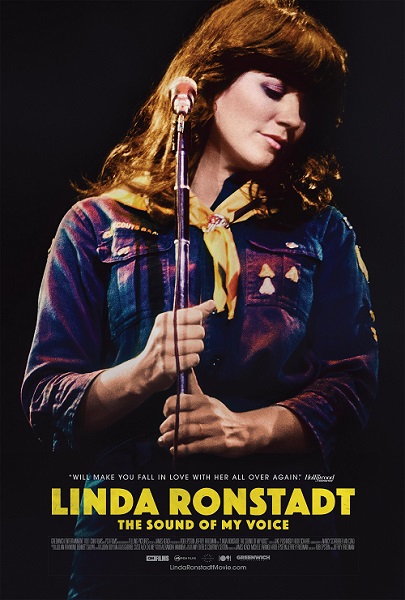
Linda Ronstadt: The Sound of My Voice

Melinda Palacio


Linda Ronstadt Tribeca Film Festival
Linda Ronstadt: The Sound of My Voice


On Wednesday, I went to see the documentary, Linda Ronstadt: The Sound of My Voice. I can’t say enough good things about this film. The only shortcoming might be the shortness of clips of her singing. However, longer samples of her songs would turn the ninety-five minute run time into something too long for one sitting. For a fan such as my late grandmother, a longer film would be welcome. Linda Ronstadt’s music was the soundtrack of my childhood. Sometimes, my grandmother would play her albums on repeat the entire day. She never tired of Linda. 

As a female pioneer and rockstar queen, Linda Ronstadt was versatile enough to own every single genre of music. She is the only woman with 5 platinum albums and one year she appeared at the top of the carts in Pop, R&B, and Country, all at the same time. Her voracious variety in musical taste, echoed the smorgasbord of music in my grandmother’s house in Huntington Park, where I grew up. Before Ronstadt’s double platinum album, Canciones de Mi Padre, my grandmother had no idea Ronstadt was Mexican. She simply loved her voice and enjoyed all her hits, but she especially loved the album that spoke to her in her language. 

The documentary shows Ronstadt’s determination to produce the album of songs in Spanish for herself. Not being fluent in Spanish didn’t stop her. Linda enlisted Rubén Blades to help her with her Spanish diction. The success of the album silenced the record company naysayers. 

Yet, for all her determination and success, Linda was lonely and insecure. Another saying comes to mind, It’s lonely at the top.  I was surprised to learn that with all of her success, awards, and a voice that was liquid gold, she doubted herself. Although I can relate to her insecurities, it’s hard to understand the feeling in someone who is so talented. During the film, I kept waiting for the moment in the film when there is a fall from grace or when the hit records hit a dry spell, but she had a stellar career. Every time she ran into roadblocks, she insisted on knocking them down. She proceeded with her vision, and never failed to produce an award-winning album. 
Of course the absolute heartbreak of the film is the ending and seeing that she has lost her vocal range (and most of her voice) to Parkinson’s, a disease her mother also had. Music is such an important part of her life. To have been one of the greatest singers and to have the gift taken away is devastating and tragic. The testament to her grit is how she is able to share the heartbreak with the world. One can’t help but admire her. 


The few months I wasn’t able to walk after I broke my leg left me yearning to do more than hobble. I couldn’t wait to skip, run, dance, sprint again. The ordeal was a tough lesson in humility. When I hurt my arm in yoga, I couldn’t play guitar and I became agitated with thoughts that I might have to give up something I loved. The old saying about not appreciating what you have until you no longer have it is the toughest lesson. I was lucky to recover from my injuries. Linda Ronstadt graciously shares how hard it is to lose the thing she loves the most: singing with her family. What courage and grace it takes to share such a vulnerable moment with the world. 

Saturday, May 09, 2015

How a first grandson made me think and feel


I have two children, both of whom took care of themselves, even when they got in trouble. Nothing major, though. They graduated top of their high school, scholarships to great schools, received their B.A.s. The daughter completed her M.A. secured good jobs, her own home and a future of her making. The son will finish his M.A. this year, married a great woman, and the two of them just had my first grandkid. Whether there are more doesn't matter. One is great.

Before: son and his wife
Although, it took him over 50 hrs. of labor to agree to leave his mother's womb. Will that make him a "mama's boy?" I don't know, nor do I care one way or the other. He will be shaped and nurtured by his father and mother. That's sufficient.

50 hrs. of labor. From the ruido I've heard through three births, males should share that experience.
A high school sex-ed where kids had to watch 50 hrs. of labor might lead to a lot fewer unwanted births, bastards, as we call them. Whatever the origin of that term, the intention was children with two adult parents responsible for the rearing. A good thing.

Sex-ed classes of 50 hrs. of labor might prove positive for some girls. Or not. But it might be more entertaining than the zero-effective Just Say No, Not These Thighs.

Nor might it drive down the hormones of some boys. Better perhaps to try what one TV show did:
"As part of a stunt for their show, Storm and Zeno were hooked up to a machine with electrodes stuck to their abdomens to simulate labor pains. And just like the real thing, the cramping of the 'contractions' got stronger, longer and closer together.
"The average labor lasts 12 to 14 hours, but Storm and Zeno only lasted two hours."

Nahua movement glyph to watch over him
Historically, the Catholic Church is responsible for billions, or more, children born out of wedlock, without the support of two loving parents, born into relative poverty as their first obstacle in life. The Catholic "sacredness" of life precludes contraception, like a woman's right to abortion. So, in fact what's sacred is making babies, of whatever lineage. As long as any church holds sway with Chicanos, Latinos and others, multitudes are locked into cycles that include poverty, and not only financial poverty. Also, a poverty of self-responsibility and parental modeling.

My new grandson is "luckier" than that. His parents smarter, more responsible. As my daughter will be. And many other sons and daughters. And even though there are too many of our species on this planet, at least many grandkids will be born who learned from the errors of their generations. So, change can come.

50 hrs. of labor. An abuelo during labor is as useful as a diaper. There's nothing to be done, nor much of any way to contribute. It's really up to the parents. Moral support--sure. Physically going to the car for something--sure. Getting on the phone to deliver messages--maybe. Otherwise, abuelos serve by only standing and waiting and assuming their presence is somehow valuable to someone. It's in the job description, at least for that day(s).

50 hrs. of labor. Sounds like damn good extra rationale for considering adoptions.

azteca cradle illustration
Adoptions, in many cases, of grandkids born out of wedlock. Or orphans, many of whom are collateral products of American wars, American drugs or American guns. Somewhere on the Internet there are statistics of how many adoptable kids my country is responsible for this year or day. And that's not including those within our borders.

Orphaned Palestinians. Orphaned Mexican, Salvadoran and Guatemalan grandkids. How many there are, I don't know. I do know what my country is financing in Israel and Gaza. I can hear it from the lips of Israeli soldiers who helped produce those orphans.

I don't feel it's a negative or sad thing to think of such children during the 50 hrs. of labor while First Grandchild was searching for a way out. I'm privileged to be sitting in a new, modern hospital in a richer country than most grandkids will open their eyes to. My grandkid will have more such privileges, though he will not have it easy. But he'll learn. Things like, #BlackNBrownNRedLivesMatter.

Imbedded raw turquoise ojo; half set, unstained walnut
I'm making my interpretation of a neo-azteca cradle for whenever New Grandkid comes over. Of salvaged or recycled walnut, cedar and ipe wood. No nails, screw or metal, only glue, dowels and rope, tung oil stain. Because of the Catholic Church-sanctioned destruction of native art, I know little of what cradles in Tenochtítlan looked like, vaguely something like this drawing. I imagine the rest.

I'm imbedding raw turquoise in the headboard knot-hole, an ojo to watch over Grandkid while I head to the frig to get him another Negra Modelo. Of course, to cool him in summer, not to drink. Yet.

brecas on cedar siderails
The side rails have brecas painted on them. The footboard he'll be able to see has an ollin-motion glyph, bracketed by a lizard and monkey, symbolic animals to encourage his love of other creatures. The cradle is a work of love--loving to work with wood and natural elements. Grandkid and I don't know each other well enough to determine much more than that, yet.

on ipe wood footboard

Almost 50 hrs. after birth, Grandkid has no name. Actually, his parents decided that even the sex would be unknown until birth. I love that. So few precious things in life to savor that our technology attempts to rob us of.

Turns out, my guess about the birthdate won the pool that I'll have to share with … Cinco, as I have called him, given that he had no name. Cinco, as in my guess that he'd be born a week late, on Cinco de Mayo. [It was the Siete, instead.] Now I'll need to get a new cat or dog and name it Cinco, to break my tendency to endow Grandkid with a numerical nickname.

50 hrs. of labor, but my grandson is not special. "Laborious," sure. Precious, certainly. Beautiful? Like art and literature, where beauty is in the eye of the beholder or the reader or audience, in the case of baby-beauty, it's in the eye of the relatives.

Humans must have at least two genetic propensities. One for any baby, because it's defenseless and of our species. Another, for babies related to us and bearing some resemblance to our clan or tribe. The second feels like the more ingrained, to me. Moral dilemma: having to choose between saving only one of two babies, you save the one with your color hair and eye shape. Naturally.

Yesterday, I saw and held and talked and discussed life with Grandkid for the first time. Skin like his parents. Hair like a gorilla. Invisible eyebrows. Eyes, black as ebony, tinged like the deepest waters off Cozumel. Beauty was not what I hoped for, which is why there's no photo here of Grandkid. Only a video could capture what's important.

Instead, Grandkid quickly showed the same alertness my kids were born with, not that I know whether his mother seemed that way at birth. Focusing on things above him, intensely savoring something about them, steadying his gaze, finding his bearings. Maybe wishing Strange Abuelo with flashing camera would go the fk away. Smiling a couple of times. Like he understood his new position of dominance.

After: she could probably do another 50
50 hrs. of labor. That I can't describe as regrettable, given the results. Mother forgive me, but it was natural, that's all.

I'm thinking: one can adopt kids, so why not grandkids? Forget how "beautiful" they might look. Better they have the capacity to understand this world that I oftentimes don't. That they reverse our direction heading toward global-warmed extinction. That they're lucky enough to find parents like these ready to catch them. And maybe an abuelo nearby, willing to stand-in. And cuddle him before nestling him like some hummingbird egg, into a neo-azteca cradle. Whenever it's completed.

Es todo,
RudyG, hoy, just another abuelo

Saturday, February 14, 2015

Love in other, stranger places


We're losing many things because we've lost the wisdom of how to love them. Our species gets wrapped up in itself, narrowing its perspective around times like Valentine's Day. We retreat into our "one couple = love," "my family = love" and beyond that, we withdraw our connection to the rest of what there is to love in the world. As if it mattered less, especially on this one day.

An addiction to corporate control decides where we put much of our love. We love convenience, cars and clutter, and so we buy, spray and land-fill corporate waste all over the planet. We aid in pumping polluting profits into the atmosphere, deluding ourselves that we deserve, earned that right, somehow. And waste hard-earned money on plastic bags, bottles and bargains that float their way into our oceans, as if loving how we live matters more than whether every place is livable.

Our lack of love is losing….

Monarch butterflies
Without them, how can we can teach children not to catch or injure them? Or teach them to let the monarchs fly free and, yes, chase them around gardens. Children need monarchs more than monarchs need them. Talk to a kid about not pulling the wings off a butterfly. And plant native milkweed everywhere. That would be love.

Water
Fresh, clean snow-melt or rainfall heading for the oceans. Some of us older people can remember what that tasted like. The plastic flavor in bottled water, even from a French spring, is not the same. You must go into the wilderness for the old purity. Places that we're also not loving enough. For your sake, filter your home's piped-in water. And for the kids' sake, fight every polluting of the aquifers. That would be love.

Air
That smells clean. Some rural people still breathe air that purifies our bloodstream and lungs, though even out there our lack of love sullies that purity. Air was not meant to give us asthma, coughs and more regulations. It was meant to circulate so we could love breathing it. Pull over on your next car trip and really smell the stuff. And think about what you could so your grandkids and theirs will have the chance to do more than read about it in ancient history books. That would be love.

Bees
It's called colony collapse disorder, but it's our collapsed love that's threatened, too. We can more imagine loving a music idol than a single bee or a hive of them. And more important than all the pollination that might no longer continue, will be all the buzzing of billions of insects that might disappear. Worse than how we'll starve without them will be how much lonelier we will feel in the universe without their presence. Put bee barns and hives in your garden. And put Roundup on your never-buy/use-again list. That would be love.

Trees
We've forgotten the ancients' love of grand trees. For the sake of softer paper wiping our tushes, stacked-up apartment buildings, and destructive development that we believe in when we cash out our homes, or so we can add to the politicians' discretionary money, we are losing our love of trees. Old growth pine, ancient redwoods, and rain forest giants falling under corporate saws. We let them because we believe that love of a tree is relevant only to children's fairy tales. Plant new trees. And also save an old one from a developer. That would be loving.

Group conversation
We love talking about ourselves, the latest movie we saw, CD we bought and trendy place we shredded our wallets at. Intimate, close-knit and family-oriented has replaced a love of groups, because we don't love the idiots at work, the road-ragers, corrupt politicians and mass shooters. Once upon a time we sat around campfires outside our cave homes and teepees and talked. Whatever we talked about apparently was meaningful enough for us to survive. Find a place and time to talk to more than one or two people, at length. And talk deeply, long enough to learn what they need help with. It might feel strange to revive a love of Man. And Woman.

Democratic decisions
Some of us love a leader because he's not white. Even if he's abusedly deported more dark people than any Anglo leader before him. And supported military intervention as much as any gun-lover ever. What little he's done that's within the realm of love, will be remembered. Forgetting that we should love democracy more than blindly follow leaders shouldn't be what we're remembered for. There are better legacies of our love. Like relearning how a meeting could operate democratically. Teaching ourselves that consensus makes us more loveable than idolatry. That would be a love refound.

Hands-on, manual labor, arts and crafts
We love our IPad, Pods and phones. So much, that rudely talking to them in front of others is accepted behavior. And we've become too civilized to stoop to manual labor, get ourselves dirty or create something with our hands, because we reached the technological superiority of 3-D printers. We lost our love of putting our love into a chunk of salvaged wood, drawing, painting and pasting. Stuff that we loved doing as children. Instead of electronics, gift a child a pen and pad. Better yet, pick some up in your hands, use them, until you start wondering why you ever gave them up. You could find more to love in yourself.

Whistling and singing
Our ability to make sounds like birds and put our words to music were acquired gifts few species could manipulate. Now, so many of us don't know how to whistle or ever sing aloud, alone, much less with a group. It's almost unimaginable, outside of being in an audience that we likely paid to be part of. Especially in this country, how much quieter it must seem to the other species that they only hear our songs coming from churches and elementary schools. Teach a kid to whistle to the dog, to get someone's attention, or to accompany their favorite song.

Better yet, have a drink, sit out on the patio and sing along with your favorite song or band. Your voice won't make the air any cleaner. The neighbors will think you're just drunk. But you might make the monarchs and bees wonder whether you're bringing us back from the brink. But a lot more bits of all these other kinds of love could clean up a planet. We'd all love for our kids to remember that.

That's my Valentine for you, hoy,
RudyG, a.k.a. Chicano fabulist mextasy author Rudy Ch. Garcia, looking for love in the stranger places

Wednesday, December 24, 2008

Happy Poinsettias


Copyright © by René Colato Laínez


“Today you can make a Christmas card,” said Mrs. Allen, my ESL teacher.

“What is Cris-más?" I asked her.

“¡Navidad!” chanted Carlos and Josue behind me.

I turned around. There they were making funny faces at me. They always did that when I asked the teacher a “dumb” question.

“I can do a tarjeta de Navidad,” I said, and got a pencil and piece of white construction paper. I folded the paper in half. “I know what to do,” I said to myself.

I drew a circle and added long pointed petals around it. I colored the flower with my red marker. I drew two other pascuas and a candle on the card. Looking at my pascuas, I remembered my Mamá and I collecting pascuas in San Salvador.

We did not have a garden but Mamá needed the pascuas to take them to la Virgen de Guadalupe the next day, on December 12th. Mamá promised las pascuas to la Virgen. She was coming to the USA the following month and those pascuas were very important for her. La Virgen would help her on her way to the USA, and she would also protect my brothers, Papá and I who had to stay behind in El Salvador. But she would need to find the pascuas and take them to the Basílica de Guadalupe in San Salvador. Where could we find the pascuas? At el mercado for sure, but we did not have money.

“Let’s go to a rich person's house,” Mamá said. “It is December and for sure they will have some pascuas.”

We climbed down the flight of stairs, crossed the broken bridge, passed some cardboard houses and el mercado. Then we took a bus to Colonia Escalón. In an hour, we were in front of a rico's house. We looked through the iron gate and saw pascuas plants.

“This house looks so pipirisnais, very elegant,” Mamá said. “I am afraid to even knock.”

Soon some dogs were barking at us and a lady peeked through a window.

“¿Qué quieren? Go away or I will call the police,” she cried.

“Vámonos,” Mamá said. “I told you.”

I said, “We need some pascuas to take it to la Virgen de Guadalupe. My mom made a promise and wants to take some pascuas tomorrow to la basilica.”

The woman ran to the gate. “If it is for la Virgen, take as many as you want,” she said.

So, the following morning we took las pascuas to la Virgen. My mother prayed at the altar and asked for protection for her and her children.

“René, René!” Mrs. Allen said touching my shoulder. “Pay attention.”

I jumped from my seat and Carlos and Josue giggled. “René is on the moon!” they chanted together.

“Mrs. Allen, look!” I showed her my card.

“You need to write something inside,” she said.

I rubbed my head. “What should I write? Feliz Navidad? But it must be in English.” I knew that feliz was happy, so I wrote “Happy Christmas.”

Carlos and Josue looked at my card and made dumb faces. “That’s wrong! It is not Happy Christmas. It is Merry Christmas.”

“Mary Christmas! You are crazy. It cannot be María Navidad.”

“No es Mary like María. It is Merry Christmas.”

“Marry Christmas! La Navidad no se va a casar. It is not getting married,” I told them, as the bell rang.

“Believe us!” Carlos and Josue told me on the playground.

I shook my head. I had been in trouble before for listening to Carlos and Josue. When I met them on the first day on the school bus, they wanted to teach me how to say, “Me llamo René” in English.

“You have to say ‘Me llamo René,’ many times today. You better practice,” they said.

“Repeat,” they told me. “I am dumb René.”

“Eso está difícil,” I said, and started to repeat after them.

When we arrived at school, they patted me on my back. “You will learn English very fast with us,” they said.

On my first day of school I was the dumb René. Now Carlos and Josue were lairs, and I did not believe anything they said.

But what if Happy Christmas was not right? Well, I had another option. I could write, “Felices fiestas, Happy parties.” But parties did not sound good. It was not a party like a birthday party. It was an important fiesta. Then I had a great idea. I could write, “Felices pascuas.”


Everyone said "Felices pascuas" at midnight on Christmas Eve in El Salvador.

“Felices pascuas,” and then a kiss.

“Felices pascuas,” and a big hug.

“Felices pascuas,” and a gift from el padrino.

Yes, Felices pascuas, while the midnight sky looked so bright with so many fireworks, when the booming sounds did not scare anybody because everyone knew they were cuetes and not bullets from guns or rifles. I ran to my desk to write “Felices pascuas”.

I wrote “Happy” on the card. “How do I write pascuas?” I asked myself.

I looked at Carlos and Josue. For sure not ask them, for they might say pascuas was a pair of stinky chanclas or an old underwear. I looked in my English/Spanish dictionary but pascua was not in there. Should I write “Happy Flowers?” But flowers were flores and not pascuas. I went to my teacher’s desk to ask her for her fat English/ Spanish dictionary.

“Good for you René, you can take it,” she answered.

Soon enough I had a long word in front of me--poinsettia--a long and strange name for pascua. But I was happy because I had found my word!

I wrote with different colors, “Happy Poinsettias for my teacher Mrs. Allen.”

Then I walked to her desk and told her, “It is for you, Teacher.” She opened it and gave me a hug. “This is the way we say 'Feliz Navidad' in El Salvador--Felices pascuas,” I told her.

“René, you have worked so hard today, and you are right: pascuas are poinsettias,” she said and took a big Santa Claus sticker from her treasure box. “This is for you.”

Carlos and Josue stood up and said at once, “Happy poinsettias, Teacher. Happy poinsettias.”

When the school bell rang, Mrs. Allen told me, “Don’t go yet. Do you know who José Feliciano is?”

I nodded. “He is a singer, un cantante.”

“Yes, he is! Have you heard his Christmas song?”

I shook my head.

She smiled and opened a drawer. “Let’s listen to this song.”

Mrs. Allen played the song, and José Feliciano’s voice filled the classroom. I started singing with Mrs. Allen:

“Feliz Navidad, Feliz Navidad,
Prospero Año y Felicidad.
I wanna wish you a Merry Christmas,
I wanna wish you a Merry Christmas
from the bottom of my heart."

“Merry Christmas,” I said to Mrs. Allen.

“Merry Christmas, René,” she said. “You can take the tape home and learn the song. Tomorrow you can teach it to all the students. We will sing it for the Christmas show.”

“Yes, Teacher,” I told her, and ran to catch the school bus.

I waved to the bus driver to stop and sat down behind Carlos and Josue. They started to tease me, but I did not listen. I had extra homework to do, to teach the song to Mamá and Papá and also to my brothers in El Salvador. I would call them and say, “I know a song in English. Listen.”

They would be very proud of me!


Happy Poinsettias to all the La Bloga readers. That’s another way to say Feliz Navidad.


Thursday, June 05, 2008

Art Is Not Business!!!!

I've been thinking a lot about art-making, about ownership of art and the internet. One of the things I love about the 'net, and here I mean NON-PROFIT blogging, non-profit journals, etc., is the way in which it frees the creation and analysis of culture from corporate control. It unchains creatvity and criticism from the side of the elite, snatches it from the dominant culture and puts it in the hands of everyday people. It is incredibly democratic, populist, and as such, subversive.

I remember in graduate school catching high holy hell for my love of sampling, of the ways that hip hop artists take from the past and fuse it into something else. (And yes, Virginia, where there's a buck to be made, I wholeheartedly support recording artists, visual artists and writers getting their due.) But there is something about participatory culture, communal creation that keeps grabbing people by the throat, blurring the boundaries, something irresistible.

A while back I read a book that made me think about art as commodity, art as communal property and here are my thoughts about the book and its ideas.


"Fan fiction is a way of the culture repairing the damage done in a system where contemporary myths are owned by corporations instead of owned by the folk." --- Henry Jenkins


"Get a life," William Shatner told Star Trek fans. Yet, in Textual Poachers, Henry Jenkins makes the case that fans already have a "life," one that gleans from popular culture, then revisions and redrafts its ownership into something akin to new mythology. Further, it is a consumer-driven culture, one outside the control of the corporate universe. I was initially drawn to this book in its exposition, when I read Jenkins' repudiation of fans as cultural dupes, social misfits, mindless TV and movie junkies. Jenkins, Director of the MIT Comparative Media Studies Program at MIT, author of: Textual Poachers, Fans, Bloggers, and Gamers, Convergence Culture: Where Old and New Media Collide, makes a well-argued case than fans are active participants in a burgeoning underground of cultural consumerism as "owners."

These owners are skillfully producing new genres, i.e., fan fic, as well as being a kind of nomadic poacher, constructing mythology, alternative social communities, and cultural representation.
Having attended fan conventions, corresponded with fans via websites and Listservs, he offers an insider's perspective. Approaching this as an ethnographic study, Jenkins is able to identify major areas of fan interest (Star Trek, Beauty and the Beast, Alien Nation, etc.)

Given the date of publishing, Jenkins did not have access to the blowup in fandom that occurred after the first two seasons of the X-FIles, when it moved from cult favorite to cultural phenomena, to say nothing of the fandoms surrounding today's cult hits, Battlestar Gallactica, Lost, Heroes.


In addition, he describes the fan community as initially white and female. Although now, more and more men and people of color are swelling the ranks of fanfic, and there seems to be gender and racial parity in the blogging community. Further, according to Jenkins, fan groupings contain more working-class and middle class people than other "art" related constituencies.
He goes on to say some more intriguing things.

That the fan community sees itself in opposition to the capitalist control of culture, choosing to create what he terms meta-stories. Meta-stories are the online writing of non-industry people, based on television shows and movies. Through these meta-stories or fan fic, fans clearly express alternative "ownership," and in fact, have begun to impact the original "producers." For example, Jenkins reports that several studios monitor fan websites in order to gauge trends when considering television or movie sequels.


In addition, fic writers push the envelop for what themes their favorite icons now contain. Fic writing has dealt with: alternative endings/or plot extensions of film and televison series, explicit sexuality, queer-oriented alternate plots, gender roles, and the construct of emerging literary genres, etc. And we have only to look at the surge of interfacing today between "hard" network broadcasting, pod casts, film and TV episode downloads with alternate content, to see a major shift in how pop culture, already underway full steam, is experienced.

As a fan (X-Files) and fic writer myself, I found it a useful delineation of a fiercely loyal, now international, subculture of renegade consumers of culture. Everyday people are becoming outlaw storytellers, seizing modern-day archetypes and making them our own.

Lisa Alvarado

Thursday, May 29, 2008

Demetria Martínez: Walking the Walk


DEMETRIA MARTINEZ


La Bloga readers were encouraged to buy and be moved by Demetria's phenomenal book, Confessions of A Berlitz Tape Chicana. The reasons why are here. Social activist, journalist, esayist and port, we were lucky to catch up with her recently, and this is our conversation.....


Your life is very much bound up in social action. How would you describe to role of the writer,
of the poet as it relates to the body politic?

Poets are citizens first, lucky enough to be literate, and therefore part of a global elite. That brings with it a special responsibility, and that is to help bring forth voices that are silenced. Our gift--the imagination-- allows us, if we choose, to write out of a place of empathy for those who are suffer--often as a result of our nation's own policies (NAFTA for example) and those of massive corporations.


We are also compelled to imagine a world that is healed, made whole. What would that look like? I think the poet Martin Espada is a good model of poet as prophet--denouncing evil, and proclaiming a new vision. Personally, I draw great energy from my work on behalf of women immigrants, great energy from activists who carry on despite it all. And so they appear in my work--I'm writing a collection of short stories about three women activists living in Albuquerque. We need to draw close to such visionaries--the activists, the community organizers--or our work can grow stale.


Obviously what happened to me 20 years ago solidified my commitment to immigrant issues: I was charged with conspiracy to transport Salvadoran refugees into the U.S.--and faced a possible 25 years in prison. In fact, I was accompanying church workers who were transporting refugees as part of the Sanctuary Movement---I did this as a reporter. I was acquitted on First Amendment grounds. The whole affair gave me the opportunity to speak around the country--not only about reporters' rights, but about the U.S. subsidizing of El Salvador's death squads. So a blessing emerged from the pain and fear.


Speaking of body...Your work also seems to return to female presence. Who are sources of inspiration for you? How do you feel being a woman informs your work.

Grace Paley, the great short story writer who passed away last year, is my role model. She wrote about the every day lives of women. And she was an activist. Some writers teach one how to write. But, if you're lucky, you will encounter that person who teaches you not only how to write but how to live. Grace was one of those people.


In 'Confessions' you're very opposed to the 'romance' people people associate with mental illness, especially your own bipolar issue. Can you talk about that external projection of others, about your own response to it.


It's important to tell the brutal truth about bipolar disorder. Manic states very quickly turn into irritability, anger, paranoia and worse. The great American novel that you started to write on a napkin at a coffee house is illegible; when you regain your wits, you're lucky if you can remember what the great idea was all about. Harmony and balance make production possible--and for the long haul. The only side effect I've had from my medicine is mental health. It feels great to be alive, to write, to be involved in the world.


How do you feel your own spirituality today is reconciled with the Catholicism of your youth?


I center myself every day,, sometimes several times a day, with prayer, something as simple as a Hail Mary. And I recently attending a novena, a praying of the rosary, that my parish held for peace and disarmament. It's important as a writer and an activist to learn to cultivate silence. Catholicism gives me the tools for that. Obviously I disagree with many of the church doctrines (women priests, gay rights, etc). But that will change.


What 's been on your plate recently in terms of your writing?


I've finished my first children's book, co-authored with a friend, Rosalee Montoya-Read. What a joy it was to collaborate! Writing is so solitary. And I continue work on a collection of short stories, the working title of which is What Saves Us.


Where would you like to see yourself ten years from now?


I'd like to become a terrific gardener (I've just started my first one recently). I'd like to learn more about traditional remedios. And soup, I love making soup but there is much room for improvement. Somewhere in there I'd like to write a novella, and a book of poetry in Spanish.

Tell us something not in the official bio.

I missed my calling as a doctor. My poor friends are always getting diagnosed (even if they feel fine) and offered unsolicited advice on how to improve their health. Chile cures colds and flu. In Boston once, I couldn't get any chile and I felt a cold coming on. So I ordered a bowl of clam chowder, a large side of Jalapenos and tabasco sauce. I mixed it all together and I was well in twelve hours.

Lisa Alvarado

Thursday, May 08, 2008

My Mother, Lost and Found


La Perdida

It’s winter Mamí, and I’m thinking of you. Not Mother’s Day, and not your birthday --- on an icy, white, nameless day in the heart of winter. Through the cold that seems like it will never end, my thoughts turn to you and that memory --- the last happy time.


We’re in Geneva, near the Wisconsin border, tobogganing, with abuelo and silent, angry Daddy. I’m four, I think, and you are kneeling in the snow, your hair in a French braid, your fur coat billowing around you as the wind blows. I’m in my blue snow suit, chubby and smiling, and loving you, loving you so very much. How could I know that you would soon start to leave me by degrees?


Each time I remember the snow, your beautiful face, I ache.
I want you. I want a woman. Only a woman. This longing is about the hunger only a woman can feed. I want what I want. I want what I can’t have. I let a woman hold me. It is something. It is never enough.

It was about a year ago, on a spring day like a lot of spring days in Chicago; the sky, overcast, the color of slate, the color of mourning doves. The wind was blowing cool and damp, making me shiver. I was standing in Queen of Heaven Cemetery, looking down at a mound of dirt, an unmarked grave. It was where Rita Alvarado, my mother was buried. So much had happened between us, so much said and unsaid. I laid down on top of the dirt and opened my arms to try to hold her one last time.

People have asked me how would I describe my relationship with her. I tell them this. A little girl and her mother are flying on an airplane, when something happens and the plane starts careening toward the ground. In a rush, the mother searches for a parachute and finds only one. Placing it on the girl, she carries her to the open hatch. The child wails and screams, begging her mother not to let go. But the mother, with infinite love, takes that last step, and releases her daughter to the open sky, to the world, to her future.

Everything I am today is because my mother gave me a parachute.

My mother was a woman who spoke little of the past, and when I became a teenager I became more curious about her life before she got married. I’d asked her to tell me the story of how she named me. (In 1956, the year I was born, Lisa was not a popular name.) To my surprise, she told me that it came from Club De Lisa, a popular jazz club on the south side. (I’ve come to find out that it had a national reputation, and was a hub for cool jazz.)


After some prodding, I found out that she had a very different life then. I only knew her as an unhappy housewife, someone who doted over me when I was little, but disappeared into alcoholism and drug addiction before I was 12. She told me a story of a completely different woman, a model with the Pat Stevens Agency, who made all the rounds at the chic clubs, dated musicians, and was a former print ad model for Maybelline mascara and eyebrow pencils.

One day, after what she thought was her best shoot, the art director told her that it was too bad --that this was as far as she would ever go because she was so Mexican-looking. (The ads only featured a tight shot of her eyes, avoiding her strong Indio nose, and were altered to make her skin seem lighter).

Little details about my childhood seem to make more sense. I remember her crying after making a princess costume for me...she’d cut down her only good suit...silk shantung, which I found out after the revelation was one of the last vestiges of her modeling days. I had access to some more of her life, her true life, the one she in which she was happy before it all went to hell.


It didn't change her limited choices, didn’t change how an abusive marriage trapped her and eroded her soul. Knowledge here, did not mean freedom, either for her or for me.


I was never able to save her.


I am looking for you, mother,
looking for you everywhere.
In the corridors of dreams, windowless, empty.
I look for the door that will lead me to you.
I look, but I never find it.
I am looking for you, mother.
On these hard streets and cracked sidewalks,

I run past carnicerías, babies dressed for bautizos,
family parties in back yards.
But you are never there.
I am looking for you, mother.
I play Billie Holliday just like you did.
I
think if I close my eyes
and wait long enough;
I will smell your perfume and you will finally be here.
But you never come.
Doctors took you away.

You took yourself away
with pieces of paper
neatly lettered
with milligrams and the proper dose.
They help you forget that once you were
almost celebrated
almost called beautiful
by people who thought
it was a shame
that you were so Mexican looking.
So you give the man the paper and he gives you the pills.
The pills help you.
The pills have stolen you from me.

I am looking for you, mother

A woman kisses my hand,
I think it is you.
A woman holds me,
I think it is you.
My lover tells me he thinks I am beautiful.
Not almost.
I think about you.

I wonder if I will ever find you.

I wonder if you will ever kiss me.

I wonder if you will ever hold me or tell me I am beautiful.
I wonder if you’ll ever know
that I wrote this for you.

Thursday, May 01, 2008

From the Tips of my Fingers to the Tips of My Toes


This is about my hands and feet. Actually it's about work and its remnants, about being working-class, Chicana, about going where you don't belong, or where you think you don't belong, or no matter where you go there is always some part of you on the outside, watching, seeing what gets played out, wondering how you fit in, what you need to do. This has been the story of my life, even in childhood. Is it a requisite for me becoming a writer? I think in a way it is.


I no longer have a job. That in and of itself puts me in line with millions of people in this country who aren't experiencing a slow-down, they're experiencing a screeching halt. Karmically, was it time to go? Yes, but you can't eat new opportunities for growth, and there's not really much in the storehouse.
This has been both a blessing and one of those opportunities I just mentioned.

Since finishing graduate school I'd been trying to get work as an editor or as a teacher. (The decision to seek something more meaningful, I also realize, is not one that millions of people even have a chance to consider.) What I had to acknowledge was that the search while at one level was intense, it wasn't intense enough. Better put, there was a piece of me that held on, even though I was unhappy.

Circumstances came together a couple of weeks ago to relieve me of my complacency. What does this have to do with hands and feet?
What no longer having my job has meant is that I had to stop hiding, that I had to step up and step out, that I had to make myself more visible, and I had to face that the part of me that wanted to stay back, stay hidden. Part of what's been required in this job search is to start attending networking events, that in my mind 'people from the other side' populate. What I mean here, is that in my mind, these are the 'happy shiny people' with homes (which I don't have) and cars, (which I don't have), and retirement funds. (Again, I think you already know what I'm going to write here.) Never mind that those folks have mortgages and debt lines and feel sorrow and loss and joy, too.

But back to the hands and feet issue. What I've been experiencing is a sense of shame. Shame that the tips of my fingers and the soles of my feet are calloused from a life where I worked on assembly lines, cleaned other people's houses, cared for sick patients. Dressed to the nines, smile and firm handshake in place, passing out those smart business cards, part of me feels I will be found out before the canapes are done circulating.

And it never escapes me that I am served by Mexicanos y Mexicanas, like me, and not like me and that somehow I am also standing, watching and knowing that I am supposed to write this and not forget.

xxxxxxxxxxxxxxxxxxxxxxxxxxxxxxxxxxxxxxx


FROM JUAN FELIPE HERRERA:


Gente, JFH continues to rock the house with his national tour of his tour de force, 187 Reasons Why Mexican Can't Cross The Border. Take a look here at pics from his odyssey.


GREAT EVENTS IN AZTLAN DEL NORTE (CHICAGO)


SER'S ANNUAL BENEFIT -- MANY SERVICES FOR CHICAGO FAMILIAS


ART AND ARTMAKING IN THE HANDS OF YOUNG PEOPLE, WHAT A CONCEPT!


A LA VIDA RAISES MONEY TO FIGHT LEUKEMIA


PLUS, TEATRO EN CHICAGO!!!!!!!!


AND FINALLY, A PERSONAL DELIGHT:

Last Saturday, I was lucky enough to have lunch with a fantastic writer that I interviewed a while ago, Ulises Silva, who brought his companion and fellow writer, Angela. They were funny, warm and engaging, and we discussed the state of Latino literature, what is and isn't canon, indy presses and his upcoming release: Inventing Vazquez. They were in town to do location research for the novel and I was the beneficiary.
For those of you unfamiliar with his work, let me direct you here.

Lisa Alvarado