Showing posts with label boxing. Show all posts

Tuesday, March 08, 2016

Poetry Road Trip. Guest Reviewer. Honoree Nominations.

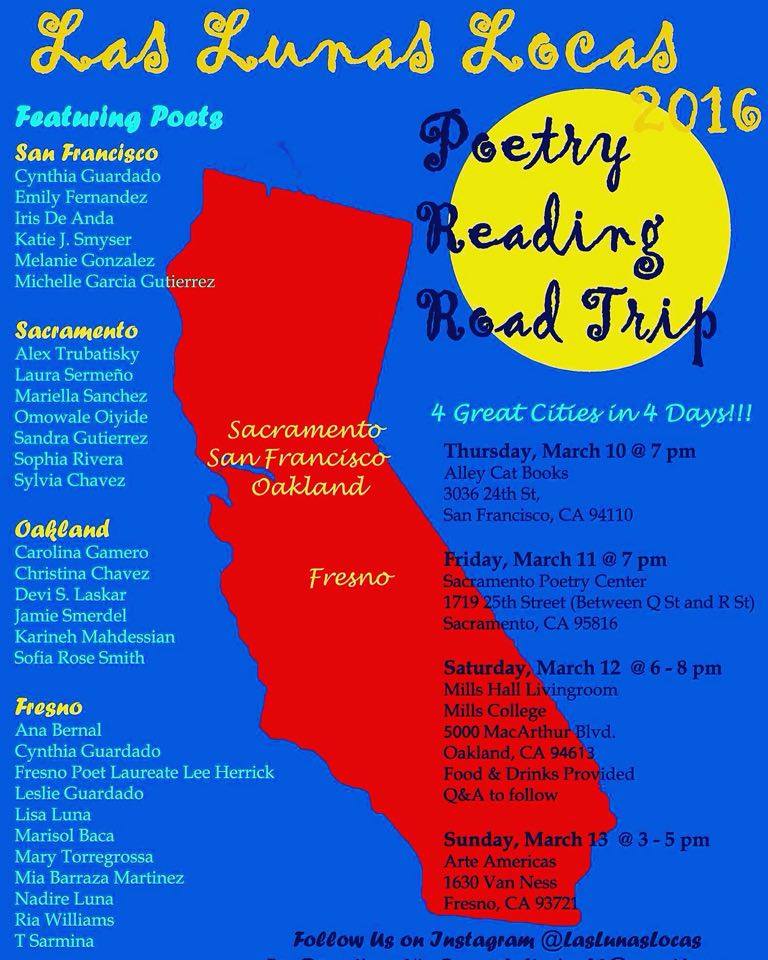
30 Poets, Four Cities, This Week
Michael Sedano


Billing themselves as Las Lunas Locas, thirty women from Los Angeles begin a caravan Thursday, driving from Los Angeles to San Francisco to launch a four-city poetry tour with readings also in Sacramento, Oakland, and Fresno.

Save the date! If you're in the neighborhood, the readings will offer memorable work in a unique peripatetic ambiente.

Six of the women held a fund raiser in El Sereno's popular Holy Grounds Coffee and Tea shop. What a genuine delight to see old friends and enjoy sparkling conversation with gente I've heard read at Avenue 50 Studio, and meeting others for the first time. The conversation and amistad were free. For a donation, a poet would create a poem on a now-ancient manual typewriter.


Organizer Karineh Mahdessian had asked if I wanted a formalist work. I'd raised the formalist issue at a free verse-dominated La Palabra reading the previous week. I answered not exactly; I wanted something "in the style of Jesus" in as much as we were standing on Holy Grounds.

Indefatigable Karineh Mahdessian, poet, emcee, and poetry activist.

Melanie González was at the machine and took my offhand remark as a prompt. She rolled a sheet into the platen and began composing on-the-fly. Using mostly two fingers and striking the keys hard  like a percussion instrument until the fingers began to bleed a bit, almost, Melanie worked swiftly and confidently.

Iris de Anda's typing machine misbehaved and didn't move the inked ribbon. Melanie pulled the poem off the machine and read it aloud before presenting it to me. I complained I couldn't read the wondrous work. Iris checked it out then rendered the machine first aid. 

Iris and Melanie doing CPR on the portable typewriter.

Melanie rolled the paper back into the machine and re-typed the poem on the original document. I got two gems for the small donation. The palimpsest contains the faint impressions of the original running vertically, with the final edition reading top-to-bottom.


in the style of jesus
down on beaudry
the glue sniffers
and the rucas meet
at loreto high
with the eloteros and
tamaleros walk by
while the cholas
and freaks
wait to be crucified
in the style of jesus
arms
spread out 
like wings
sangre 
on the concrete
there is no heaven
here there is hell
and everyone is living
in the style of jesus 
with their tijuana bibles


Melanie Gonzáles reading "in the style of jesus"

I am saving this wonderful piece in my collection of libros cartoneros. Next time Las Lunas Locas hold another fund-raiser, I'm taking more money. These poets are founts of creativity and energy and are certain to create masterpiece after masterpiece, sparkling gems like the poets themselves.

Gente in Northern California and the central valley metropolis of Fresno can look forward to hearing Melanie at selected venues, or Karineh, or Iris, or one of the six spirits working the fundraiser. For sure, audiences will totally dig some combination of the thirty making the week-long caravan in the service of poetry and the Muse.

Emily Fernandez, Melanie González, Laura Sermeño,
Karineh Mahdessian, 
Carolina Gamero, Iris de Anda.


Guest Reviewer: Hugo Cesar Garcia 

Gene Aguilera. Mexican American Boxing in Los Angeles. Mt. Pleasant, SC: Arcadia Press, 2014. ISBN: 9781467130899

In 125 pages, 155 photos, 15 posters and souvenir programs, and one map, author Gene Aguilera captures the colorful, flamboyant and wonderful world of Mexican American boxing in Los Angeles starting with hard drinking, hard hitting Aurelio Herrera in 1895 and ending with 10-time champion Oscar De La Hoya in the nineteen nineties.

Photos capture epic ring battles but also offer candid snap shots of boxers, some very well known, others a revelation to the casual boxing fan, as well as interesting tidbits about their personal lives.

Unexpected treats: El Chicano band's singer Ersi Arvizu of Sabor a Mi fame as a professional boxer at age 18; singer/actor Frank Sinatra in Cisco Andrade’s corner;  icon Marylyn Monroe with the original Golden Boy, Art Aragon, who bobs and weaves throughout the book.

Captions, some of them quite deep, not only indicate the records of renowned champions Mando Ramos, Danny Little Red  Lopez, Carlos Palomino, Oscar De La Hoya, Raul Rojas, Genaro Chicanito Hernandez, and Bobby Chacon, but also provide interesting details about their careers and lives, as well as those of celebrated contenders Enrique Bolaños, Art Aragon, Armando Muñiz, Ernie Indian Red Lopez and Ignacio Keeny Teran, revealing the demons and circumstances that denied them the titles their skills in the ring merited.

Action-packed bouts featuring fierce light weight Mexican and Mexican American fighters attracted not only ordinary Latinos but Hollywood celebrities, because of promoters Aileen Eaton, Hap Navarro and Don Fraser; managers Howie Steindler and Benny Georgino; Joe and Dan Goossen; matchmakers George Parnassus and Don Chargin.

Beginning at Jack Doyle’s Vernon Arena at 38th and Santa Fe in the 30s, Cal Working’s Hollywood Legion Stadium and Wrigley Field in the 40s, the neighborhood rivalries and international duels of these light weight warriors moved on to the fabled Olympic Auditorium at 18th and Grand, the LA Sports Arena, The Fabulous Forum, plus Las Vegas and to other continents with brilliant smaller weight champions and contenders.

The retirement of Olympic Gold Medalist and 10 time world champ in six weight divisions Oscar De La Hoya marks the end of this informative book.

Author Aguilera modestly admits he never meant to pen the definitive pictorial history of Mexican American Boxing in Los Angeles, but Mexican American Boxing in Los Angeles is a pretty good one for long-time boxing fans, and new ones as well.


About the reviewer
Hugo Cesar Garcia, a long-time boxing fan, covered boxing at the Olympic Auditorium for Eastern Group Publications, whose circulation area served the eastern and central parts of the Los Angeles basin.

Garcia is currently working on his first novel Hueso, about Spanish language media, immigration, and police abuse. The novel''s action moves from Cd. Juarez to Los Angeles at the height of the narco wars.


2016 Award of Excellence Nominations Wide Open


Who has not read a list of notable raza and wondered who picked them, or why so-and-so was omitted? Austin, Texas' The Emma S. Barrientos Mexican American Cultural Center invites everyone to get into the process of naming 2016 outstanding raza creators of the cultural arts for the Austin region of the country.

The centro announces six categories are open for nomination, including self-nomination"

THE ARTS: Those working in any medium including visual arts, dance, music, literature, theatre, film, performing arts and history.

PATRONAGE: Those who have made significant contributions or donations in support of the Latino cultural arts, and who have provided in-kind and non-financial support in the Latino cultural arts.

SERVICE: Those who have exhibited outstanding service as a volunteer and/or employee in the Latino cultural arts.

EMERGING ARTIST: Those who have shown innovative and exceptional accomplishments in the Latino cultural arts.

LIFETIME ACHIEVEMENT or POSTHUMOUS: Those who have demonstrated years of passion and dedication in the Latino cultural arts.

ARTS EDUCATOR: Those that educate our community about Latino cultural arts.

Nominations close Wednesday, March 21st at 11:59 p.m. (CST).

Read the award descriptions, criteria and eligibility requirements, and download the nomination form, at the ESB-MACC website.


Tuesday, April 06, 2010

2010 Festival de Flor y Canto Launch; Review: Jimmy Santiago Baca, A Glass of Water.

Michael Sedano


Visions and Voices: The Arts and Humanities Initiative at the University of Southern California has awarded a grant funding 2010 Festival de Flor y Canto to Barbara Robinson, USC Libraries Curator of the Boeckmann Center Collection for Iberian and Latin American Studies, and Maria Elena Martinez, Associate Professor of Latin American History and American Studies and Ethnicity.

As chronicled in La Bloga over the past two years, Tuesday Bloguero Michael Sedano has been organizing this reunion of the landmark first Festival de Flor y Canto held in 1973 at USC. Dozens of poets, writers, and academics shared work at the 1973 event. Of these, thirty-nine presentations were preserved on videotape, including one musician and three teatros.

Sedano has focused his reunion efforts on the videotaped artists from 1973. Sadly, José Montoya and Roberto Vargas presentations are absent from both UC Riverside and Texas A&M Kingsville libraries. Those are the only known repositories of the 1973 videos. Contacted to date--most of whom will be appearing at 2010 Festival de Flor y Canto, September 15, 16, 17--are Alejandro Murguía, Alurista, Avelardo Valdez, E. A. Mares, Elias Hruska, Enrique La Madrid, Estevan Arellano, Frank Sifuentes, Javier Pacheco, José Montoya, Juan Contreras, Juan Felipe Herrera, Olivia Castellano, Roberto Vargas, Rolando Hinojosa-Smith, Ron Arias, Teresa Palomo Acosta, Tomás Atencio, Veronica Cunningham, Vibiana Chamberlin. In addition, Marco Antonio Dominguez, a 1973 poet not videotaped, will read, perhaps accompanied by his son, an MFA candidate at UTEP. Remote hope exists that José Montoya and Richard Montoya will also present a father-son reading.

A number of 1973 readers have died, including Oscar Zeta Acosta, Lynne Romero, Omar Salinas, raúlrsalinas, Mario Suarez, Marcela Trujillo, Ricardo Sánchez, Tomás Rivera, QEPD. Honoring these deceased luminaries, 2010 Festival de Flor y Canto's program includes ¡Presente! a program of memorial readings performed by actors or friends of the late artists.

A number of contemporary poets have submitted materials for consideration and inclusion in 2010 Festival de Flor y Canto. Numerous invitations have been accepted, with others pending. Based on preliminary responses to the Call for Artists, the three-day event will provide a full schedule blending the reunion voices, many of today's established Chicana Chicano Latina Latino poets, and up-and-coming newer voices.

In addition, Francisco Aragón and University of Notre Dame's Letras Latinas, is co-sponsoring with 2010 Festival de Flor y Canto a program featuring three poets including Diana Garcia, Emmy Pérez, and Maria Melendez.

2010 Festival de Flor y Canto also includes the opening of a semester-long photographic exhibit of Sedano's photography from 1973, together with the debut of the digitized video recordings of the original festival. Doheny Memorial Library's Digital Library Initiative will allow world-wide access to the historic, nearly lost, 1973 performances, as well as those documented during 2010 Festival de Flor y Canto.

The 1973 anthology, Festival de Flor y Canto, (Los Angeles : University of Southern California Press, 1976. ISBN: 0884740315 and 9780884740315 ) edited by Alurista et al, will have a companion multimedia volume, 2010 Festival de Flor y Canto, within a short period following the completion of the September event at USC. Publishers interested in the project contact msedano.

2010 Festival de Flor y Canto will be celebrated at Doheny Memorial Library on the USC campus on September 15, 16, 17, 2010. La Bloga will post developments, schedules, attendance details, as these are defined.

The Call for Artists for 1973 readers--whether or not in the videotaped collection--as well as contemporary poets and writers, is at Read! Raza. Open Call closes in mid-April. Institutions wishing to sponsor a panel of readers will contact Michael Sedano.

Visions and Voices: The Arts and Humanities Initiative is a year-long program featuring outstanding arts presentations that reaffirm the University of Southern California's Core Values. The grant is a singular honor marking the University's ongoing commitment to Chicana Chicano students, arts, and culture.


Review: Jimmy Santiago Baca. A Glass of Water. NY: Grove, 2009.
ISBN-13: 978-0-8021-1922-3

Michael Sedano


A murdered singer, her stroke victim widower, a major league pot dealer, a Chicano Muhammad Ali, a love-smitten urban Latina grad student, a background cast of migrant farmworkers and Anglo landowners, Time.

This is the cast of Jimmy Santiago Baca’s novel, A Glass of Water. As such, the cast fulfills the canonical demands of some Chicano literature: the romance of el campo, downtrodden farmworkers, angry organizers, oppressive bosses. Santiago plays out threads of these characters in unexpected ways, and, as such, A Glass of Water is not just another Chicano farmworker novel.

Baca refuses to allow his story to follow a pedestrian mold. This begins with that title, which offers a bit of a mystery, as in the classic half full hall empty conundrum. Does murder demand retribution, and, if left to fester unavenged, does it exert its own vengeance more terrible than death or imprisonment? Is eye for an eye murder justified, the actors vindicated for their actions? With such concepts at hand, Baca grows the canonical notion of Justice beyond a raza-specific agon to encompass more generalized ideas about carnalismo, hubris, renascence. Readers will be pleased to discover such complexities woven into a cloth of Chicanismo.

Time looms in the plot as an almost tangible character. Baca plays with sequence in chaptering the story, flashing back to earlier events to wrap context around ongoing outcomes. The novel begins with the voice of a dead singer, brutally murdered, leaving behind her bereaved husband and two barely mothered boys. When the novel closes, one of the few spiritual acts the mother conducted for her youngest develops into the agency that pulls him out of his mindlessly self-destructive path and points him right. All this time, he's been waiting for his mother's invisible hand to guide him.

Casimiro, the dead woman’s husband, knows the land, crop, workers. He’s tired, sick of the fields but knows nothing else so he puts in his time, tormented by the memory of a murdered wife while haunted by memory of a man he himself murdered unjustly years ago back in Mexico. Felled by a stroke, Casimiro can only impotently pass time, remembering his dead wife, the man he killed, and observing his older son pick up where Dad left off, with a twist.

Lorenzo, the older son, takes over as majordomo of the Anglo’s ranch. He not only husbands the land but becomes a paternalistic boss to the Mexicano and Chicano laborers. He mounts teevees in the packing shed so the women can watch their telenovelas while they sort and pack chiles; installs basketball courts and baseball fields so the kids can organize their time through sports; brings in literacy tutors to give the next generation a better chance. The twist is the money comes not from savings and hard work but from increasingly large marijuana deals. A duffle bag of weed becomes a truckload becomes a tankertruck filled with top leaf; fancy customers flying in from across the country to turn their deals.

Middle class Chicana from San Diego, Carmen comes out to the Texas / New Mexico fields to conduct field research. At first, she flirts with the smitten younger son, Vito, but soon relations up with Lorenzo. For the Chicana grad student with options, hers is a life choice. Blending field research with worker organizing and roping in Lorenzo, she takes the money from the dope deals willingly, to buy the trappings of advancement for her gente. Her efforts to organize the workers meet with frustration and excuses. Workers, in fear of losing a paycheck plus getting hauled away by ICE, don’t buy Carmen’s political philosophies.

Vito knows the leverage of the Anglo landowner. Not from having ICE sicced on him, but exiled nonetheless. The landowner’s son and a pal want to see Carmen strut her nalgas for them. Vito punches out their lights for their salaciousness. Casimiro has a choice: banish the boy or abandon his own livelihood.

Vito’s exile to New Mexico becomes his felix culpa. Dismantling a bloodied crumpled car he discovers a pair of boxing gloves. The gloves, and Vito’s mouth, launch him on a career from free-for-all bare knuckle brawls to a pay-per-view shot at a championship belt. Baca does a skillful job giving readers just enough ring action to keep them turning the page. Vito’s mouth riles the crowd and his fists are equal to the taunts. Vito’s chief shortcoming is lack of discipline. He nearly throws it all away for no discernible reason when a twist of fate—he spots his mother’s killer’s boots—brings him back to Lorenzo and Carmen. The fellow has it coming—he raped the dead mother years ago on her journey north—and the brothers' slaughter of the rapist wraps the Time and Justice motifs into a tidy package. They get away with it. Right place at the right time serendipity appears to answer life’s most pressing exigencies. Absent those, there’s Casimiro, paralyzed helpless, watching and observing.

Baca washes his hands of canonical thematics, his farmworker motif illustrating worker resistance to persuasion rather than crafting a romanticized huelga producing justice and higher wages through collective resistance. Lorenzo, Vito’s and Carmen’s involvement with one another illustrates a more compelling truth. Individual decisions produce wealth and lifestyle improvement, whereas collective action illuminates a path not much further than just beyond one’s lips.

As A Glass of Water concludes, Lorenzo and Vito are are out there tilling their own fields, purchased by dint of their own labor and serendipity. Carmen brings her daughter and a cold glass of water to slake the brothers' thirst. If it’s half empty or half full doesn’t matter, they'll soon drain it and be left with an empty vessel and more rows to how. And so it goes.


2010 Festival de Flor y Canto fulfills a dream for me. It's a pleasure to announce its realization today, this first Tuesday of April 2010, a Tuesday like any other Tuesday, except You Are Here. Thank you for visiting La Bloga. See you next week.

mvs


La Bloga welcomes your comments on this and all columns. Click the comments counter below to add your observations. La Bloga welcomes guest columnists. If you have a book review, an extended commentary on something you've read here at La Bloga, a literary, arts or cultural event to report, or something from your writer's notebook, click here to discuss being our guest.