Showing posts with label chicana literature. Show all posts

Friday, August 25, 2017

No Longer Taunted by My Six Eyes

Melinda Palacio

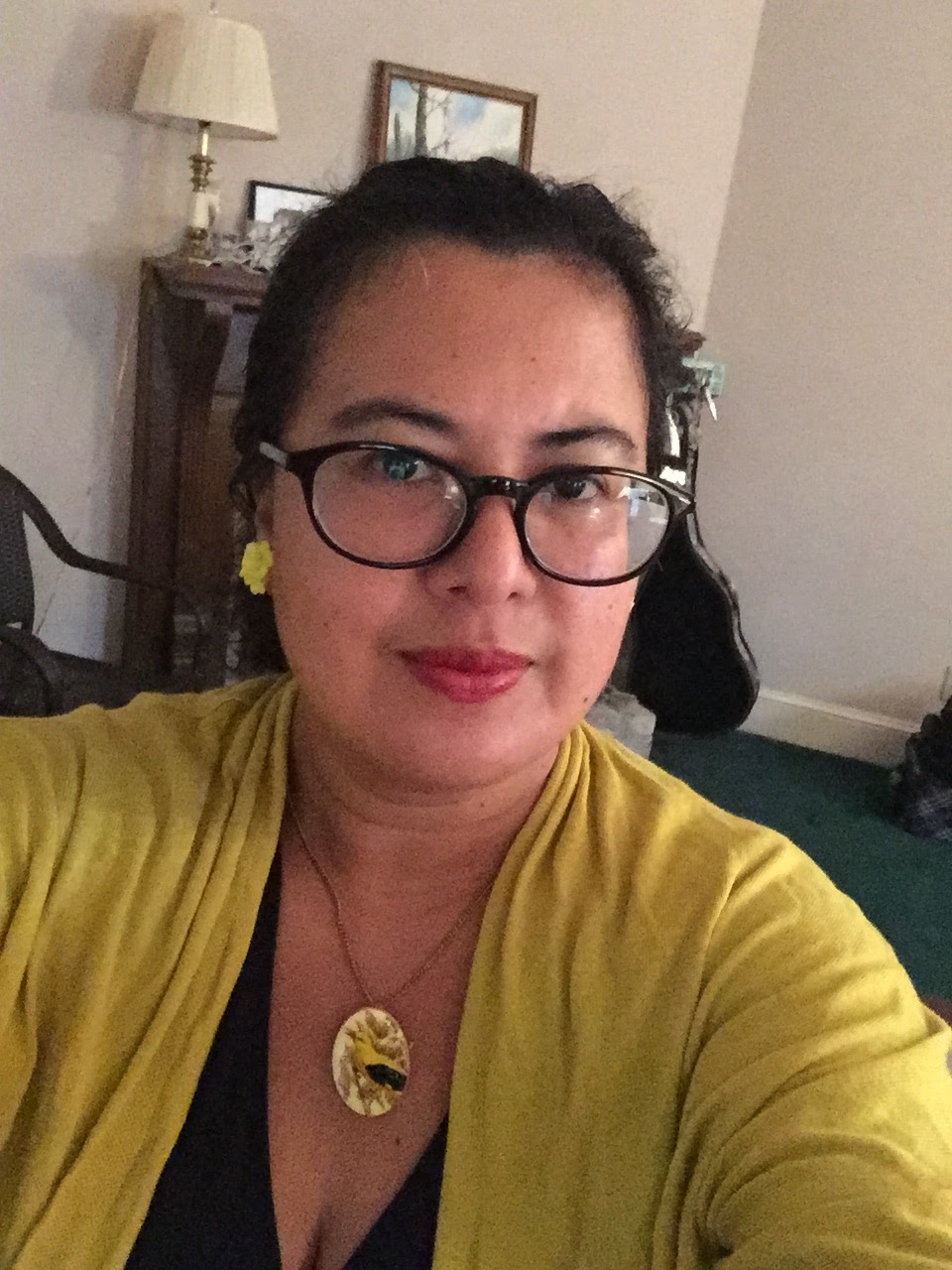
Selfie with Glasses


As a nerdy kid, the casual taunt of "four eyes" didn't bother me much. Glasses were a welcomed alternative to fuzzy vision and flinching every time a spherical object sped towards my face. I was ten years old when someone realized I needed glasses. Before my age reached double digits, I went through life seeing only what was at the end of my outstretched arm. Nearsightedness was a plus because I could read books in bed and study people's body language up close. Even though I couldn't see the chalkboard, I was a pretty good student who coasted on a good memory and an innate desire to please. I always sat at the front of the classroom and was quick to raise my hand even though I was very shy on the playground. 
            I remember the day my teacher at Middleton Elementary in Huntington Park finally figured out I couldn't see. She held a large laminated chart up with houses and trees, statistics was the lesson. My teacher at Middleton Elementary, Mrs. Schaeffer called on me to ask how many houses were in the first column. It was my last year before Junior High School and everything was odd about that day, especially the fact that the teacher had to call on me (when other students call you school girl and goody two shoes, the teacher doesn't have to work as hard) and that I had stayed quiet and didn't offer an answer. The teacher talked and pointed to her blurry chart, then pointed back at me. Everything she said sounded garbled like the teacher's voice in the Peanuts' movies. When I said I didn't know the answer, she got mad and sent me to the principal's office. She probably thought I was making fun of her. Her reaction was as surprising to me as mine was to her. It seems as if teachers often were angry when their supposed "good" students veered from expectation. It reminds me of the time I was punished for becoming emotional the first time I heard an orchestra play at school. I started sobbing when the cellist played her solo. The kids seated all around me turned to point at me and giggled while I was in tears because the music was so beautiful. My teacher sent me out of the auditorium and I missed the rest of the performance.

            Fast forward a few decades and the child is now a middle-aged woman who still wears glasses and who is still moved to tears by live music, especially the cello. This year, I must wear bifocals to adjust for print that is as close as my phone and as far away as a street sign. I have several friends who admit they need bifocals, but are afraid they will not be able to adjust to the varying magnifications. I suppose I am lucky that my brain can make the adjustments automatically and that I can also wear multifocal contact lenses. I'm just as eager to see all things near and far as I was when I received my first pair of spectacles. The best part of being a woman of a certain age who wears glasses is that instead of being called four eyes or six eyes (thank you bifocals), that I often receive compliments on my current frames. Perhaps, it helps that I chose frames that are very similar to the glasses Diana Prince wears in the new Wonder Woman movie.

Tuesday, October 18, 2016

Review: Gruesome Murders Grotesque Padres. Arias launches Wetback. ChimMaya at 11.


Review: Maria Nieto. The Water of Life Remains in the Dead. Mountain View, CA: Floricanto Press, 2016. ISBN 9781888205596

Michael Sedano

When a reader picks up a book one of the first impulses is to riffle the pages for a sense of layout and design. That’s what initially put me off reading Maria Nieto’s edge-of-the-seat murder novel, The Water of Life Remains in the Dead. It seems the publishers, Floricanto and Berkeley Press, used a generous amount of white space and a large font, giving me the impression the novel had a YA reader in mind.

Wrong.

The Water of Life Remains in the Dead presents a seriously adult plot about murder, sex with babies, clerical corruption, rotten people. It’s a novel populated with stomach-turning characters and a concluding irony about the passage of time.

It’s 1970. The story opens in mid-action with a truckload of mutilated bodies and an LA Times reporter having survived a murderous LAPD detective. The detective had been running a child sex ring, the reporter and her friends have barely escaped his clutches, and the murderer an apparent suicide.

Alejandra Marisol is the Times investigator whose instincts tell her there’s more to the crimes, that the mystery doesn’t begin and end with the dead pig.

Marisol is hot for the Chicano coroner, Armand Gomez, and he’s hot for her. They will consummate their heat, thought mostly off-stage. A sick tía, eagerly helpful sidekicks, an inexplicably hostile detective, and one good cop, round out the cast of allies.

The title becomes an irony as the action wraps. The coroner’s prima, Olivia, is a Caltech researcher experimenting with DNA as forensic evidence. “We are what we drink,” Olivia explains. Olivia analyzes bone and teeth from the dead guys, noting the water we drink contains a pair of isotopes of oxygen. Measuring the ratios and comparing those to geographic distribution can point to the places the dead were raised and where they’ve lived recently. “So you see, as sure as a rock turns to dust, the water of life remains in the dead.”

Because it’s 1970, the arch criminal in the novel’s final pages laughs in Marisol’s face. DNA evidence isn’t allowed in court. The water of life remains in the dead and the dead remain with no justice. Of course, today DNA evidence frees wrongfully convicted people with some regularity.

But that’s at the end. As the plot thickens Nieto raises holy hell involving high-level Catholic church honchos, including the Cardinal, whom the author christens McCrudden in a nod to Cardinal McIntyre, and his trusted financial adviser, Monsignor Crowe, who should eat some. Sex, baby stealing, imputed perversion, and real estate fraud circle around the cassocks.

The Water of Life Remains in the Dead is a Los Angeles book, where the city’s landmarks play useful roles in advancing the story or developing atmosphere. A dinner from Rocky’s Shrimp Boat coaxes the remembered feel of greasy wax paper mixed with the aroma of breaded seafood. Nieto crafts a nice homage to Acosta’s Revolt of the Cockroach People in her description of the Christmas eve mass at St. Basil’s church that opens Zeta’s novel. The opulence of the Biltmore hotel provides the background of a climactic confrontation with McCrudden and Crowe, where they cop out to sins of the flesh but excuse them away, leaving the detective-reporter frustrated and defeated. And taken captive.

Tracking the clerical clues leads Alejandra to a white-suited land developer whose presence in the film Water & Power--set in the same era--looms with the same kind of menace Nieto gives the tycoon. Sadly, the Richard Montoya film is little-known so perhaps the parallel is less homage and more this reader’s memory. But, like the film, this book deserves attention for its devotion to the city of La, and its unyielding perspective on corruption over Chavez Ravine.

That the action moves along swiftly is as it should be. When Alejandra is tied to a chair and a demon puts his lips to her bloody mouth, the plot comes to a screaming, satisfying climax that readers will laugh at for its ostentatiousness.

That big print that initially misled me into thinking The Water of Life Remains in the Dead a YA read, really is useful to aging eyes. Italicizing Spanish as if it is a foreign language is not at all useful. The story is a wonderful addition to LA literature. The intrepid reporter, Alejandra Marisol, makes an excellent addition to the small roster of Chicanas and Latinas in crime fiction--Gloria Damasco, Romilia Chacón, Inez Leon, Lupe Solano, Ivon Villa.

All in all, The Water of Life Remains in the Dead feels like Maria Nieto has the makings of an extended series of Chicana crime novels in store for readers. Adelante, mujer.


Ron Arias Launches The Wetback and Other Stories


The invitation made a lot of sense. Come to a remote location in the Cahuenga Pass in the mid-afternoon, get home before dark. Motivated perhaps by the fact that Arias travels by public transit, I welcome the sensible timing. Because I don't suffer late hours well, I miss a lot of wonderful events.

Once I get there I welcome the sylvan ambience, the sunny skies, the fabulous hors d’oeuvres--many gluten-free--the scintillating company, and the host’s eye-popping art collection. All in all, a perfect afternoon to launch an author’s capstone fiction collection.

A.P. Gonzalez welcomes guests and introduces the reading
La Bloga will review the collection in a coming column. Today’s take is a foto-ése of the delightful afternoon reading in A.P. Gonzalez and Andrew Potwora’s packed living room.


Intially, my wife and I find patio seating where we join UC Merced’s Manuel M. Martin-Rodriguez and his wife, Virginia. Martin is excited at news UC Merced has launched an ambitious growth project to expand enrollment by 10,000 after 2020.

As it developed, Manuel had written about Arias’ work and is part of today's reading. Manuel and Virginia were houseguests of Joan and Ron Arias, allowing the Ariases to avoid the vagaries of public transit.

Manuel M. Martin-Rodriguez, a Chicano Literature scholar, introduces Ron Arias
For the reading, Arias takes a stool at the closed end of the spacious living room. Light streaming in from the author’s right side creates interesting illumination, particularly when Arias does an encore reading from his manuscript notebook.


Arias’ raspy voice and animated style engage and delight his audience and he holds their rapt attention through a full reading of the nine-page Canine Cool. As Arias reads the story about sculpted clay dogs with attitude, my mind flashes on the seminal Chicano artist Magu’s sculptures of a perro with attitude. It doubles my pleasure when Arias tells the house he was thinking of Magu when he worked on the story, and points me out as someone who knew Magu. Appropriately, Sunday following the Saturday reading was Magu’s 76th birthday. QEPD.

The Wetback and Other Stories marks Arias’ return to fiction after a career in non-fiction reporting from across the globe for People Magazine. The book brings together fourteen previously published stories, along with two new pieces. Arte Publico Press publishes The Wetback and Other Stories. You can order the collection directly from the publisher’s website, as well as have your local brick and mortar bookseller stock copies for you and your friends.

Here’s a podcast of Arias discussing the collection https://itunes.apple.com/us/podcast/larb-radio-hour/id998390884?mt=2

Joan Arias and J.P. Gonzalez listen

ChimMaya Celebrates Eleventh Year with Blockbuster Exhibition

Say the phrase, “East Los Angeles” and it evokes notions of a heartland of Chicanismo. Few places represent that idea better than ChimMaya Gallery.

La Bloga discovered the gallery in July 2009, when La Bloga-Tuesday observed, “Today, I'm happy to introduce ChimMaya, a spot of entrepreneurial genius located in eastern East Los Angeles. ChimMaya has the distinction of being one of those rare eastside galleries to have gotten some ink from the Los AngelesTimes. Felicidades, ChimMaya.

A vibrant centro cultural, ChimMaya has hosted writers like Ana Castillo, collector Cheech Marin, and politician Richard Alatorre. Fine art, however, remains the gallery's special métier as ChimMaya has grown and enlarged its place in the art world. Along with Avenue 50 Studio, ChimMaya represents the best in Southern California arte.

Entry gallery offers itself, a turn to the left, or onward to three more spaces
Its annual Frida show celebrates the iconic Mexicana with densely packed galleries and encouraging sales. Even after all these years of Frida fandom, serious art collectors as well as people exploring their first acquisitions want a piece of Frida.

But ChimMaya is more than the annual Frida show. Month-in, month-out the gallery brings in work from a solid list of accomplished raza artists. Steven Acevedo, the gallery’s artistic director, has a keen eye for talent and he regularly welcomes emerging artists to display work in one of the four distinct spaces within the gallery.

Be sure to visit ChimMaya on Facebook, or the gallery’s space on the world wide web for a generous sampling of the artists and work displayed at ChimMaya Gallery.

Rick Ortega and Mario Trillo with" Man of Maravilla"(Charcoal and Conte on Paper (20x24)


Walking into ChimMaya presents a world of temptation. Whether to turn left into the small alcove space, linger in the room where Cici Segura Gonzales’ 8 foot codex demands eyes, or continue through into the center gallery then another alcove and the final indoor space.

I head toward the outdoor garden for a drink of ice water when Rick Ortega spots me and gives me an abrazo. We walk together into the final room where Ortega’s pencil drawing of dapper Mario Trillo commands the view. Mario is in the area and I impose on the artist and his subject to pose for a doppelgänger portrait.


In the main salon, a striking portrait of a young woman encircled by multicolored pupae dominates the far wall. I do not know the artist, Ariel Vargassal, but that is quickly remedied and Ariel is happy to talk about his work and pose for a portrait with his portrait.

The main gallery has a comfortable sitting area and people congregate to be near it, and the restrooms. Mario Guerrero and Mario Trillo relax beneath another Ariel Vargassal portrait, a stark white background, a living chambered nautilus, a reclining figure.


Glass artist Jaime Guerrero chats with Joe Bravo. Joe is a grandfather and offers his observations to Jaime, whose daughter at four months has begun crawling. Joe is the innovative tortilla artist, though he’s stepped back from the medium and only recently showed his paintings on a tortilla again.

Jaime Guerrero, new dad. Joe Bravo, experienced grandfather

As I prepare to wrap up my visit—my wife acquired a Frida purse from the ChimMaya boutique—I stop to talk with Ceci Segura-Gonzales. Her eight foot panel features the ancient raices of Mexican history, Olmec head, Toltec stele, and screaming tribal gente converging on a grotesque naked tiny-penised Donald Trump. A jaguar opens its jaws to swallow the cowering Trump, who stands in a pool of his own urine.


Silhouette figures that have leaped off an immigrants-crossing traffic sign to charge across the landscape, summoned to action by a mariachi trumpeter. On the opposite side, the screaming woman from Picasso’s Guernica sends her agonized calls to the skies, another clarion.

Segura tells me she was incredibly angry and started drawing with the Trump figure. She kept drawing and unrolling paper and drawing and unrolling more paper until she had devoted hundreds of hours and realized that framing the piece would be enormously expensive. She takes a deep breath and I understand there is another fifty feet of pent-in anger restrained in her fingers. The piece is titled, The Wall / Codex:"that Mexican thing." Pencil, Ink, Acrylic on Gessoed Paper (3'x8').

ChimMaya Gallery is near Atlantic and Beverly Blvd at 5283 E Beverly Blvd, Los Angeles, CA 90022


Sunday, November 15, 2015

IMANIMAN Anthology: A Call to Poets to Reflect on Gloria Anzaldúa and Transformative/Transgressive Borders


Olga García Echeverría


I both blind them with my beak nose and am their blind spot.
But I exist, we exist.
--Anzaldua
 
Sometimes when going through classifieds in literary journals, the process feels sadly like looking for a job. Can I get a witness? How many writers of color out there are guilty, like me, of weeding through the classifieds section of Poets Writers, for instance, and looking for the few ads that directly ask for work by writers of color? Or searching for those few Latina/o judges or readers who may (maybe) welcome more than a few token Spanish words in our texts?

Until I am free to write bilingually and to switch codes
without having always to translate...my tongue will be illegitimate.

--Anzaldua

These searches for pieces (reflections) of ourselves in the literary world are acts of desperation, qué no? Our desire to be visible in a world that largely renders our voices and stories invisible.
 
There are so many calls for literary work, most with a reading or submission fee. It's not in any writer's interest to send out work without first doing a little research to see if the journal or literary project is a good fit. This is not new advice for writers in general. We've heard the sob stories; it's hard being a writer. We've heard the warnings; expect rejection. We've heard the requirements; writers need to have tough skin. We also know that if we want to send out our work consistently, it's going to cost money, and this can get expensive, especially for poets/writers who don't have a lot of feria to begin with.


Yet, despite the challenges all writers face, we know there are other factors at play in the literary world. Race. Gender. Sexuality. Language. Because the publishing world continues to predominately nurture and promote White (mostly male) voices, it leaves the rest of us at a disadvantage.

When I do come across those few calls for literary work that speak to multiple parts of me, I get excited, like finding that one job ad that finally speaks to me. It makes me want to shout, "Yes! Gracias! Where do I apply?"

That's pretty much how I felt when I saw the call for IMANIMAN, an anthology that asks poets to reflect on the transformative and transgressive borders via Gloria Anzaldua's work. Thanks to ire'ne lara silva and Dan Vera, who are spearheading and editing this upcoming anthology, bilingual queer poets of color and poets of consciousness who have something to say about borders in relation to Anzaldua's work have an exciting opportunity—we can submit as the hybrid beings that we are. We can braid our languages and our genres. We can tango or dance a literary cumbia or two with La Gloria.
 
We are fortunate to have ire'ne and Dan with us today at La Bloga to share a little about this exciting anthology project. Before proceeding to our short interview, here is some important information related to IMANIMAN.


THERE IS NO SUBMISSION/READING FEE
 
We invite poets to submit either:
prose/poetry hybrids of 500--2000 words OR
poetry of up to 1000 words.
DEADLINE: FEBRUARY 1, 2016

IMANIMAN: Nahuatl for ‘their soul’
We are looking for work that is sparked from the soul, the individual soul, the communal soul. We will absolutely not accept academic writing. Our hope is that contributing poets will take the opportunity to leap to unexpected places and speak to the kinds of syntheses that academic work would need an entire book to explain and justify. This is the first anthology of poets writing on and about Gloria Anzaldúa's work. We invite you to be part of this celebratory exploration.
We are looking for work that directly addresses and/or is in conversation with Gloria Anzaldúa’s work, life or conceptual ideas. The theme of this anthology is not "Why I love Gloria Anzaldúa..." or "This is how Gloria Anzaldúa changed my life..." but rather an opportunity for poets to reflect on the multiple ideas of borders/fronteras that Anzaldúa's work unleashed, and an opportunity to interrogate / complicate / personalize these concepts. Transgressive and transformative borders can be of any kind—metaphysical, artistic, gender, identity, physical, ecological, sexual, sociocultural, geopolitical, etc.

You can read the entire call for submissions on Facebook: https://www.facebook.com/groups/anzaldua/
 
You can also read the call and submit via Submittable at Split This Rock: https://splitthisrock.submittable.com/submit/bcef37d9-c401-41c4-a7cc-87b48a268d3e


Foto of Anzaldua to Welcome ire'ne and Dan

Bienvenidos ire'ne and Dan. It's wonderful to hear about your project IMANIMAN. Can you please share what inspired this upcoming anthology?

ire'ne lara silva: A few years ago, I read a short lyrical essay by Emmy Perez that stayed with me, "Healing and the Poetic Line." that was published in the anthology, A Broken Thing: Poets on the Line. And then in 2014, my last year as a CantoMundo fellow, Rosebud Ben-Oni invited me to be part of a presentation with her on the subject of the ocean. I wrote a short piece for it inspired by Perez’ form but was left wanting to flesh it out some more, particularly in reference to changing concepts of what the borderlands meant. I submitted a proposal to the 2015 El Mundo Zurdo Conference, organized by The Society for the Study of Gloria Anzaldua, that would feature five poets presenting lyrical essays with their take on the borderlands as ‘la herida abierta’ as Anzaldua famously described it. Laurie Ann Guerrero, Dan Vera, Tim Z. Hernandez, Emmy Perez, and I read our essays at the conference, hosted at UT-Austin this past May. Powerful work. Such wide-ranging topics, so much emotion, and such passionate observations. While I was still reeling from the session, Joan Pinkvoss, editor and co-founder of Aunt Lute Books (and publisher of my short story collection), approached me about the possibility of an anthology expanding on the session’s theme. I didn’t have to think twice—I said yes! right away. Dan agreed to be my co-editor shortly thereafter and here we are…

Dan, how do you feel about being part of this project?

What's really energized me about this project, aside from it jibing with a commitment to honor a scholar thinker activist whose work saved my life, is that we find ourselves at a historical moment when we most need her wisdom and clearthought. I've recently been immersed in Anzaldua's magnum opus Light in the Dark/Luz en el Oscuro, which finally came out this year, and I'm struck at how prescient and necessary her writing is, how she speaks to our challenges of forging new identities and connections among our communities.

Yes, I love her quote that states that to survive the Borderlands, we "must live sin fronteras, be a crossroads." Is this part of the purpose of the anthology? To bridge a gap of some kind?
 
Dan: Our anthology is an attempt to not only honor [Anzaldua's] visionary guide to nepantla but also a way of introducing her work to a new generation. When she writes about the need to transcend older mestizajes for newer, more honest identities, I find myself wishing her wisdom was at the heart of all of our current conversations about the present and the future. And for Anzaldua, her poetry was the beginning of her exploratory work. You see it in her writing and this call that welcomes hybridity is just an honoring of her own praxis as a scholar healer.
 
I am excited about this enthusiastic call for hybridity in your project. It feels like a celebration of the hybridity we embody as Mestizas/os. Part of the guidelines also specify "no academic essays." Personally, I felt a rush of excitement when I read this because to me this translates into freedom, but I am thinking that some may argue that Anzaldua was herself an academic and that this is a bit of a contradiction.
 
ire'ne: Anzaldua may have been an academic, but Borderlands, her most widely known work, owes much of its popularity to its accessibility to the lay person. At the same time, its rich, multi-layered poetic language lends it to repeated readings and interpretations. That’s part of what we both want for this collection—not just the accessibility but the layered nuances of poetry—we want the leaps of intuition and the wisdom garnered from the pursuit of art.
 
Well, it's refreshing to see the call encourage those layered nuances of poetry and intuition. Usually, it's the academic voice that gets privileged over the poetic. But the opposite is true here.
 
ire'ne: Speaking for myself, I am a community poet/writer. I work a bread and butter job, sometimes two, and freelance as an editor and consultant to make ends meet. Without a degree or an MFA or the ability to spend my time at residencies, I’ve still managed to devote my time and energy to writing for the last 17 years. I don’t think my lack of academic affiliation makes my contributions any less worthy. Writers come to their own voices and sensibilities and stories by many different paths. That’s what I’m interested in hearing—the insights borne from living, from being, from loving, from struggling, from the body, from the heart, from the soul itself.
 
You make it clear in the guidelines that you are not seeking work that focuses on the topic “Why I love Gloria Anzaldúa” or “This is how Gloria Anzaldúa changed my life.” Instead you are seeking work that engages “the multiple ideas of borders/fronteras that Anzaldúa's work unleashed, and an opportunity to interrogate / complicate / personalize these concepts.” Help me clarify this for writers out there who, like me, want to submit but still may have questions about what to send. Here is a list of possible submissions to give our readers concrete examples of what is submittable. Please say, "Si" or "No" to each of the possible submissions. Awkward silences will be interpreted as, "No, please re-read the guidelines."
Could a submission be a personal letter to Anzaldua about the current state of a particular border (physical, spiritual, linguistic, cross-cultural, sexual)?
 
ire'ne and Dan: Yes!
Could it involve a personal exploration of the tongue as frontera in a bilingual home?

ire'ne and Dan: Yes!
 
Could it be an essay that explains why I love Gloria?
 
ire'ne and Dan: Silence. [Please re-read the guidelines].

Could it be a poem or an essay that is spun from one of Anzaldua's passages?

ire'ne and Dan: Yes!

Could it be a poem that does not in anyway mention Anzaldua, but that clearly touches on one of her many border concepts in both format and theme?

ire'ne and Dan: Yes!

Can I write an essay or poem about how Anzaldua changed my life?

ire'ne and Dan: Silence. [Please re-read the guidelines].

The first time I ever fell in love with a woman was in college. I was 18 and also falling in love with literature at the time. Anzaldua's work was instrumental in my evolving “new consciousness” as a bisexual mujer, as someone living in an “inbetween” sexual realm that often sparked suspicion and critique from people in both straight and queer circles. Can I write about this for your anthology?

ire'ne and Dan: Sí!

Can I submit an essay/poem about the border between the living and the dead?
 
ire'ne and Dan: Yes!

It is not stated in the call for submissions, but my assumption is that the braiding of languages is permissible and that not everything has to be translated?


ire'ne and Dan: Yes!


Well, folks. There you have it--some concrete examples of what to send and what not to send. Gracias ire'ne and Dan for your time, insight, and for this wonderful project.

Here are the links once more for IMANIMAN


ire’ne lara silva lives in Austin, TX, and is the author of furia (poetry, Mouthfeel Press, 2010) which received an Honorable Mention for the 2011 International Latino Book Award and flesh to bone (short stories, Aunt Lute Books, 2013) which won the 2013 Premio Aztlan, placed 2nd for the 2014 NACCS Tejas Foco Award for Fiction, and was a finalist for Foreward Review’s Book of the Year Award in Multicultural Fiction. Saddle Road Press will be publishing her second collection of poetry, Blood Sugar Canto, in January 2016. ire’ne is the recipient of the 2014 Alfredo Cisneros del Moral Award, the Fiction Finalist for AROHO’s 2013 Gift of Freedom Award, and the 2008 recipient of the Gloria Anzaldua Milagro Award, as well as a Macondo Workshop member and CantoMundo Inaugural Fellow. She and Moises S. L. Lara are currently co-coordinators for the Flor De Nopal Literary Festival.


Dan Vera is a writer, editor, and literary historian living in Washington, DC. He's the author of two poetry collections including Speaking Wiri Wiri, the inaugural winner of the Letras Latinas/Red Hen Poetry Prize. His poetry has appeared in various journals, including Poet Lore, Notre Dame Review, Cutthroat, and Delaware Poetry Review, in addition to various anthologies, college and university curricula. He's the poetry editor for Origins Journal, co-curates the literary history site DC Writers’ Homes, and chairs the board of Split This Rock Poetry. LatinoStories.com named him a 2014 Top Ten "New" Latino Author to Watch (and Read) calling him "a talented, sophisticated poet who is a master at playing with words." For more visit


Sunday, September 20, 2015

How A Girl in Pieces Owns All The Words: A Conversation with Isabel Quintero

Olga García Echeverría

Today we have la fabulosa Isabel Quintero in the house, chismeando conmigo about writing, publishing, and her YA novel, Gabi: A Girl in PIeces.

I have so much to say about this book full of barrio sass and sazón, but honesty, I don't think I can sum up the novel better than our own poet laureate, Juan Felipe Herrera. Here is what Herrera has to say about Gabi: A Girl in Pieces:


"Meet Quintero’s high school 'fat girl' Gabi, eating and starving and fighting and writing her way through the crushing pressures of high school boy desire, religious approval and Mexican cultural taboos of 'living in sin.' A 'smiling' good 'virgin' girl or an 'ofrecida,' 'slut'? And in-between these frozen and fearful versions of womanhood, there are blurred, bloated and violated girls: straight girl with gay boy, abandoned pregnant girl with 'parading' boy, raped girl with defender girl. And quinceañeras, and familia and suspensions and carne asada and churros where the soft body stretches, boils in grease and is cut to fit the Mexican girl mouth as it burns. Reminiscent of early Chicana writers such as Evangelina Vigil and Lorna Dee Cervantes, I cannot think of any book today for young adults as voracious, bold, truthful and timely – as this one. Who is courageous enough to read this prize-winning YA novel?"

If this blurb doesn't convince you that this book is a must-read, check out the bio at the end of this bloga that highlights all the awards Quintero's novel has received since it's publication in 2014, among them the 2015 William C. Morris Award for Debut YA Novel, the 2015 Tomas Rivera Mexican American Children's Book Award, and the California Book Award Gold Medal for Young Adult.

Pues, without further ado, here's the literary wiri wiri.

Isabel, so great to have you here at La Bloga. I loved your novel Gabi: A Girl in Pieces. It's wonderful to see a young strong Latina character who navigates her senior year and so many issues via her own wits and heart. She felt very real, very believable.
 
Gracias, Olga. I really appreciate that.

I enjoyed all the parenthetical comments throughout the novel that help capture Gabi's humor and sarcasm. Me hizo reir La Gabi muchas veces. It also made me think about how as a writer you must have some of that sarcasm, attitude, subversive back-talk. Where did you get that from?

Pues, one of my things my mom always told me was que era muy hocicona. I have always questioned things, though sometimes not verbally. Growing up it always bothered me how I was expected to behave because I was a girl and what I was allowed to want and not want. And I wanted everything--sex, dating, good grades, good schools, traveling, drinking, equality, justice.

But, I was often reminded that as a girl my options were limited. My mom didn’t want me to leave home to go to college because that meant que quería libertinaje. Freedom to do what I wanted was often, for some reason, attached to sex. Which is strange, but I guess it makes sense. Maybe my mom knew deep down, that having freedom also meant having ownership of my body and that scared her, porque quién sabe qué cochinadas I’d do.

This issue of freedom and gender roles shows up in your book in various way. Yet Gabi, even in her moments of struggle, shows a lot of agency.

Believing that one is free is different from acting like one is free, and I think that’s where Gabi has a hard time, because she knows she wants to do more than fantasize about what that freedom would be. We can think freeing thoughts all the time, thoughts hurt no one. But asserting freedom, pues agarte because it will most likely disrupt someone else’s power structures, and that gets ugly and often painful.
 
Were there any scenes in the book that you struggled with?
 
The abortion section was one. Only because I wanted to make sure I didn’t throw in this thing that I feel strongly about. So I did some research to make sure it was accurate. Another was one I can’t talk about or I spoil a section of the book. And then, Tia Bertha’s change at the end. At one of the high schools I visited, Lincoln Heights, a student asked me why I had waited so long in making Tia Bertha change. The truth is, she wasn’t going to, but I was rewriting that damn ending so many times, that I began to feel bad for her and yeah, she changed.
 
That's awesome, that in your constant reworking of the ending you began to feel sorry for your character Tía Bertha and that she got transformed in the process.
 
You know, pensándolo bien, the ending was what gave me the most trouble. It always ended with that last line, but the rest was different. Originally, there was a poem about Gabi accepting herself as she was, it was too forced, and I knew it but didn’t want to change it. My publisher finally made me face the reality. Though to be honest, I am still thinking of better ways to end the book.

That's funny. I remember a visual artist telling me once that even when his art was framed and up on the wall of a museum, he kept wanting to remove the glass and add lines and color. Speaking of images, one of my favorite sections of the book was the zine On The Female Body. 
 
You know, I am not a zinester, but I like zines, and I’ve tried to put together a few, and have some half finished ones.
 

Very Cool Body Pieces in Gabi: A Girl in Pieces

How did the zine part in Gabi: A Girl in Pieces evolve?

I learned about zines from Angela Asbell, an adjunct professor and activist at CSUSB. I liked the idea and tried to do some at home but didn’t like how they turned out and tossed them. One day she had a zine day at her house and, at this point I had already been working on the poem [used in this section of the book], and I starting making a zine that would go with the poem. I thought it would be a good format, though I wasn’t sure what I wanted to do with the zine when I was done with it. When I rewrote Gabi, from verse to prose, I knew that was why I had been doing the zine, for her, and that’s where it belonged. Cinco Puntos liked the idea, and at one point the zine was supposed to be a separate component, but that was too costly.


Were there things you couldn't or didn't include in the zine because it was a YA novel?

As for content, I think I got all I wanted in there. The targeted audience is not who I worry about; young people, I think, are more open about a lot of issues. Adults are the ones who often forget what it is like to be young and create a different reality about youth; one that is free of drugs, heartache, sex, and violence. Obviously, this is not true for everyone, but I’ve encountered adults who believe that drugs, violence, and sex in a teenager's life, not only among them but as a part of their daily existence, is a new phenomenon.

Yes, I totally agree. I think it's adults who create taboos around issues. But the youth, they seem to gravitate towards work that tells it like it is. How have young readers responded to your book?


Gabi from A Girl in Pieces Has Got It Right!
You know, the response has been better than I could ever have imagined. I get a lot of, “You’re talking about my high school!” or “That sounds just like my mom or my tía!” or “Thanks for painting fat girls in a real way.” So, those responses are great. I feel really good when readers can connect to Gabi’s questioning of gender roles, especially teens who are going through some of the same issues she is going through. I feel like I’ve done my job.

Did you always know this was a YA novel you were writing?

I think I did know it was YA when I began writing the book in 2007, but it was a novel in verse back then. I had just finished reading Juan Felipe Herrera’s crashboomlove, and K.L. Going’s Fat Kid Rules the World. Those books really helped me see what YA could be, and helped me remove some biases that I had about it. So, I began writing, Photographs of a Fat Girl, which was the original title. It was a much different book then, that although a first person narrative, revolved around photographs, not a diary.

I saw on Facebook recently that you were in Tulsa, Oklahoma, doing a series of readings there at the Martin Regional Library and at high schools in the area. How was that experience?

It was my first time in Oklahoma and I had a great time. The students were receptive, especially at East Central High School. After my presentation they had great questions about the writing process, publishing and of course the book. I’ve also been to some festivals, most recently I was at the San Antonio Book Festival and I did a Literary Death Match in which Luis Alberto Urrea was a judge. Dios mio, that was something. And this weekend it will be the Brooklyn Book Festival. It’s been a wonderful journey so far.
 
You know that golden rule that we always hear as writers, “write everyday”? What's your writing process like?

Tough question. I try to write everyday. Try. But it doesn’t happen. Sometimes I do get writer’s block. Daniel Jose Older, author of Shadowshaper, posted a blog post last week about how there is a myth around writing that we have to write our thousand words or more every day to be real writers, and that sometimes makes us feel ashamed when we don’t do it. I think I agree with him.

I write when I need to write, which is almost everyday. Some days, on really good days, I can write 8-10 hours without changing clothes, eating, or talking to anyone. On really bad days though, I can’t even put together an effing sentence. But I know I’ve gone too many days without writing when I start feeling really sad and lost.
 
And when you do write. What's your process?
 
When I do write, a ver, I prefer mornings or late evenings. If in the morning, I’ll drink black coffee and maybe some sort of carb filled goodness–pan dulce, cookies or toast. I love toast. Then I eat lunch, and get back to it. In the evening, I’ll write after dinner and I’ll drink cold black coffee, iced tea, lemonade, or just water, and go until I can’t anymore. Sometimes that’s a few hours, and sometimes that’s until 2:00 am. But that’s by no means a formula I live by. I do try to get in walks somewhere in there, too. Oh, and I read my work out loud to myself too.
 
Latino writers have been negotiating the use of Spanish in the publishing world for a very long time. It's refreshing to see more books like yours that 1) include Spanish and 2) don't feel obligated to italicize or translate everything.
 
To be honest, at first I did have the words in italics, but it felt wrong. Really wrong, because not only was it confusing with inner dialogue, but it seemed to exotify something I didn’t want to exotify. It made me feel like a traitor, but I didn’t know how publishing worked, and I didn’t have the confidence to say so. Cinco Puntos asked me if I really wanted to italicize the words and I said not really, and they said good because they didn’t either. Now, I wouldn’t think about italicizing the Spanish.
 
It's great to hear that Cinco Puntos encouraged dropping the italics. Did you encounter any resistance from others in the literary world?
 
Ha. There was only one major incident where something was written that said that one of the reasons I wouldn’t win the Printz was because my lack of a glossary. Which was really irritating, because I immediately put my teacher hat on, and wanted to say, “What do we do when we don’t understand a word in a text?”

Exactly. Look it up, verdad? It's good for the brain.
 
Luckily, librarians defended the lack of a glossary. I didn’t use Spanish where I didn’t need it; I created a character who is Mexican American, and speaks Spanish, English, and Spanglish. 
 
What advice would you give women writers out there who are wanting to publish their stories, poems, or first books?
 
Write, read, submit. A lot. If you want to write, write. Know that rejection is part of game and it is not personal (usually). Know that you will get writer’s block, but you can get through it. Likewise, know when to kill your darlings–sometimes it just doesn’t work. Get involved in a writing community, it was the best thing I ever did. It has helped me grow so much as a writer and you have a support group when things don’t go well and a cheering section when they do. It means a lot.

Be true to yourself, to your own voice, to what you want to write, not what you think others want you to write or you should be writing. As women, and as women of color, it can get tough out there. There are expectations about what and how we should be writing. I have a Native writer friend, Erika Wurth, author of Crazy Horse’s Girlfriend, who cannot find a home for her second novel because she keeps getting told it’s too dark. Too dark! I don’t think men would be told this. There are still assumptions about what women should write, and what women of color should write. I remember sitting at a workshop with another friend, a poet who is half-Native and half-Mexican, who doesn’t really speak Spanish, and one of the people in the workshop told her she should use Spanish in her work to make it authentic. I was like what the hell is going on? I think we are often asked to perform our cultures and gender in stereotypical, one-dimensional ways, in ways that make people comfortable, and when we don’t, when we say, “I’m queer/I’m transgender/atheist/don’t speak Spanish/don’t live on a reservation/like Hank Williams” people get upset and question our authenticity. But I say, fuck it, haci soy aunque les duela. No somos moneditas de oro, and god forbid we try to be.

RIP Michele Serros
An important lesson you have learned post the publishing of your first book?
 
Don’t be afraid to speak up for yourself. The late great poet Michele Serros’ gave me a great piece of advice, “Your book is your baby and no one is going to care about it like you would, so you need to stand up for it.” It’s hard to do at first but we have to do it. Also, it’s a lot of work to promote your book; it’s not just fancy sandwiches and breakfast tacos at book festivals. So, be ready a hecharle ganas con las dos manos.


Gracias for your time and all your thoughtful insights, Isabel. Anything else you'd like to add?
 
Thanks for the great questions. If you want more information about my work, appearances, or other chisme, follow me on Twitter @laisabelinpieces or visit my website laisabelquintero.com


Isabel Quintero is a writer and adjunct faculty instructor. The daughter of Mexican immigrants, she was born, raised, and resides in the Inland Empire of Southern California. Isabel also sits on on the board for a non-profit literary arts organization, PoetrIE. Gabi, A Girl in Pieces from Cinco Puntos Press, her first novel, is the recipient of the 2015 William C. Morris Award for Debut YA Novel, the 2015 Tomas Rivera Mexican American Children's Book Award, the California Book Award Gold Medal for Young Adult, 2015 Paterson Prize for Books for Young People, the 2015 Peggy Miller Award for Young Adult Literature, and was named a finalist for 2015 PEN Center USA Literary Award and the 2015 Walden Award. Gabi, A Girl in Pieces has also been included on the Amelia Bloomer Project List of Recommended Feminist Reading for ages 0-18, School Library Journal's Best Books of 2014, 2015 Capitol Choices: Noteworthy Books for Children and Teens, and is one of Booklist's Best Books of 2014, among other lists. In addition to writing fiction, she also writes poetry and her work can be found or is forthcoming in Huizache, As/Us Journal, The Acentos Review, The Pacific Review, and others.


Sunday, June 14, 2015

Myriam Gurba: How Some Abuelitas Keep Their Chicana Granddaughters Still While Painting Their Portraits in Winter

Olga García Echeverría


"Abuelita carried our food home in plastic mesh bags with plaid designs. Waddling along the cemetery murals, she looked how a Mexican grandmother should, like a tropical babushka. Four feet, eleven inches of old lady. Rolls of diabetic weight held in place by a handmade dress. Silver hair cropped short by her own scissors. A yarn shawl flapping like a cape...No man would guess seeing her walk up the street that Abuelita was an artist, and no man would guess that my sister and I were subjects worthy of art. Abuelita thought we were. She turned us into creations."


The motif, el hilo, that runs through Myriam Gurba's latest collection of stories is death, and when it comes to writing about death, Gurba knows how to kill it. Yes, la muerte es triste (that's why La Llorona can't stop crying), but Gurba's stories remind us that from the mulch of the dead bloom flowers.

Ghosts colonize the pages of this book. Some of the ghosts are vain and smell of chorizo, like the misogynist abuelo who envies Juan Rulfo. There’s la abuela, the Mexican Scheherazade, who spins gruesome stories to keep her two Chicana granddaughters captivated and sitting still so that she can paint their portraits. There's 16 year old Andrew from East LA, who got his brains scrambled on concrete. There are, of course, Las Lloronas, the old school and the modern ones who undo their own motherhood. There's Nacho, a much-loved dog who was turned into a little pelt rug posthumously. There are hummingbird huevos that never hatch, and if you stare into a keyhole in one of the stories, you'll see a woman pacing, howling as she carries a little coffin in her hands. The hilo tugs and makes you read on.

If it sounds gory and dark, though, it's not. This is, after all, Death a La Queer Chicana, which is gay instead of morbid, which asks not only such important philosophical questions like "What is death?" but also "Who gives birds dyke haircuts?"
 
Although Pedro Páramo lurks in the pages of these cuentos, this isn't Juan Rulfo's Comala, where the dead are so alive that their constant “murmurings” suffocate the living. In Gurba's collection, despite the constant presence of death, the living live. It may be Guadalajara, Long Beach, Los Angeles, Mesoamerica. It may be preconquest Mexico, the 60's, 70's, 80's, 90's, 2012. It doesn't matter—the living do their thing. They get perms and ice-skate inside pyramid-shaped shopping malls. They touch their own sex and sniff, enthralled. They ditch school and eat spiced mangos on sticks. They bust their father having an affair with his secretary. They fall in love and suck on the nectar of ruins. They Facebook in the kitchen table late at night. They talk to ghosts. They photograph the dead and everything around them. They long so badly to touch Andrew's bashed-up brains. They do the Lambada at funerals with Mariachis. They embrace life/death like there's no tomorrow because there isn't; there's only right now and yesterday, yesterday, yesterday...echoing ghosts, memories that never die.

These stories, with their constant attention to fantastic and queer details, mesmerize and pull. Like those granddaughters who sat for their abuelita in winter, when the last story in the collection came to an end, all I could do was say, “Another.” Otra, Myriam. Otra.
 
 
To purchase How Some Abuelitas Keep Their Chicana Granddaughters Still While Painting Their Portraits in Winter: http://www.manicdpress.com/#painting


A native Californian, Myriam Gurba earned a BA with honors from UC Berkeley. Her first book, Dahlia Season, won the Publishing Triangle's Edmund White Award for Debut Fiction and was a Lambda Literary Award finalist. She is also the author of Wish You Were Me (Future Tense), menudo & Herb (self-published), and A White Girl Named Shaquanda (self-published). She blogs at lesbrain and often for The Rumpus and Radar Productions.


To view other blogas on Myriam the Great:
 

Sunday, March 22, 2015

Lo que trae la marea/What the Tide Brings: A Review by Donna Snyder

Xánath Caraza’s stories in Lo que trae la marea/What the Tide Brings are formed of poetry, music, and the logic of dreams. Characters encounter an intermediary between mortals and gods. The line between life and death is breached. Stories emerge from the earth’s ocean and lakes or the rain that falls from the sky, and they remind us that water is the primordial fluid from which all life emerges, yet also the source of catastrophe, destruction, and death.


Caraza credits María Miranda Maloney, the founder of El Paso’s Mouthfeel Press, for encouraging her to write this collection, a change from her earlier prize-winning poetry collections. Since 2009 Mouthfeel has published twenty-five books by writers from Mexico, Uruguay, and throughout the United States, garnering recognition and accolades for itself and its writers.

 
Originally from Mexico, Caraza lives in Kansas City and teaches at the University of Missouri. On an international level, she teaches, serves as editor of literary and academic journals, performs, and publishes work in both English and Spanish. She has won honors in Central America, Europe, and the US. In this bi-lingual collection, she wrote each piece in Spanish, and then she, Sandra Kingery, and Stephen Holland-Wempe translated them into English. Spanish is a superb language for literature, with an innate rhythm and rhyme which can translate awkwardly, losing the natural poetry. I read the English translations which are beautiful in their own right, each line fluid and graceful.

 
Caraza’s stories vibrate with the sensuality of the female body as it moves through heat, reacts to a man’s gaze, responds to the rhythms of jazz, or fills the memory of a man being subjected to torture. Her writing is redolent of jungle, copal and flesh, the pungent taste and feel of food and drink, the gratification of tactile details. Color permeates her stories -- the flora and fauna of tropical Veracruz and the valley of Anahuac, the sea and sky in their various moods, the colors of cups, drinks, food, clothes, shades of skin. In “Scofield 207,” for example, everything that populates the story possesses a specific color. “Lunch Break” contains twelve references to color in its six brief paragraphs. The writer’s eyes are a prism that breaks the world into every vibrant hue, dazzling the reader, yet along with other sensuous details the myriad colors anchor us in an earthly world even while characters move back and forth between temporal planes, between reality and dreams, fantasy, and myth, between sanity and delusion. Sensuousness is not the only point to this book, however, which addresses refugees from political oppression and other topics of seriousness and depth.


Estimada Poeta Caraza in La Bloga House
The limits of time and space do not apply to Caraza’s characters. In “Nezahualcoyotl,” a pre-Columbian king and poet of the Alcolhua culture of Mexico appears in Barcelona, Spain. As he walks with the other character, called Venus, Nezahualcoyotl recites his poetry. The apprehension of language becomes a sense impression. Venus “felt poetry exude from [his] body. That was his aroma . . . that intoxicating essence . . . .” She is filled with emotion as “verses of his poetry were assaulting her.” The poetry becomes visible on her arms, then her entire body is “tattooed in poems.” Finally, her body disappears, leaving only words.

 
Caraza provides a dazzling lesson in synesthesia, the evocation of one sort of sense impression when a different sense is stimulated. In her stories, odors are colors, poetry a tactile experience. In “The One Behind,” Caraza describes a person as being able to see not only with his eyes “but also his skin, his ears and nose.” In “Water Passes Through my House, It comes to my House to Dream,” the narrator feels “musical notes soak into her being through the pores of her skin” and memory “hits her in the chest.” A breeze is described as pearly in “First Friday in Kansas City.”


Caraza stated in an interview that her “vision concentrates on female voices, their dreams, their struggles, life in general.” A woman’s voice relates all but one of these brief. These women make their own choices. They travel to foreign countries, as has Caraza. They recognize and embrace the mythic power of Man as King, Poet, and Seer. They encounter an intermediary between mortals and gods, between life and death, and demonstrate the gap between the writer’s existence and the fictions she creates. 


In some stories, characters are found reading or writing books with titles of Caraza’s own creations, underscoring the gap between the writer’s existence and the fictions she creates. The use of such metafictive devices forces upon the reader an awareness that the writer is really a writer, creating a separate, unreal reality that is fiction. In Caraza’s case, that fictional reality is both marvelous and terrifying. Caraza’s deft use of language immerses the reader in a swirl where disbelief is willingly suspended. Characters use seashells as a tool of divination, experience the supernatural, “dissolve from this dimension to reappear on the printed page.”

 
The great Spanish writer, Federico García Lorca, first explained the aesthetics of duende, inspiration born in darkness and anguish. The power of duende, a fascination with both death and great erotic desire, suffuses Xánath Caraza’s writing. Her duende, her eroticism and repeated invocation of death, terror, and cataclysm, and the power and authenticity of her language -- all dizzy the reader, precipitating a momentary experience of the sublime. Lo que trae la marea/What the Tide Brings liberates the reader from the sorrow or mere banality of existence.


Mouthfeel Press website

La Bloga interview

Xánath Caraza website

Review in El Paso Times


La Guest Blogger Donna J Snyder
 
Believing that to give voice is an inherently political act, Donna Snyder offers free, weekly writing workshops through the Tumblewords Project which she founded in 1995. Until recently, she worked as an activist attorney on behalf of indigenous people, immigrant workers, and people with disabilities. Snyder has read her work in Alaska, Boston, New York City, Colorado, Los Angeles, and throughout Texas and New Mexico. In 2014, Chimbarazu Press released her collection Poemas ante el Catafalco: Grief and Renewal and Virgogray Press reissued her 2010 chapbook, I Am South, as a paperback book. Three Sides of the Same Moon is due from NeoPoiesis Press in 2015. She is a contributing poetry editor for Return to Mago.