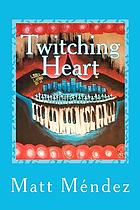
Review: Matt Méndez. Twitching Heart. Moorpark, CA: Floricanto Press, 2012.
Isbn: 9781480257023 1480257028
Michael Sedano
In ten stories making up Twitching Heart, Matt Méndez draws intimate portraits of life on the El Paso / Juarez frontera. As the title predicts, Méndez' debut on the literary fiction market presents a set of stories about heart-broken people and heart-breaking times. Méndez is a portratist, not a novelist, the short form meets his need. Yet, there’s a connectedness among characters and artifacts they own that gives a richness to the collection more akin to a novel.
Ultimately, each story stands alone, despite its allusions to incidents and characters outside this story. Méndez’ intent in the compressed space of short fiction is putting tragedy on display, not the why and wherefore of such people and decisions, even when irony and random change link them.
Méndez offers a cast of well-drawn characters and lots of darkness. As a young author, the writer doesn’t pretend to forge an illuminating ethos for his people. Instead the stories move characters through the night, show people going through the motions thinking through a fog, gente who, when they make decisions, get it all wrong.
There’s a sadness to the characters because Méndez isn’t crafting larger-than-life avatars but ordinary gente at their limit, pendejos and losers being themselves because they can’t help it, and a rare ray of light. People like this are pendejas to someone, and this fact encourages Méndez to weave elements from earlier stories into others. When these connections crop up there’s a delight in the recollection, and satisfying closure to earlier experience, a way of informing one’s understanding of characters and events in terms of those earlier stories. Like Pedro Páramo.
A copy of the novel, Pedro Páramo, belongs to a down on her luck woman in Chuy’s story. Chuy’s an open wound of a person, the opposite of his name. Disappointed in his non-athletic son, his old lady is fed up with him and he proves her right, he’s a total loser. That copy of Pedro Páramo emerges a few stories later when Perla presents it to a bartender as a letting-go of Perla’s last valuable possession. Then Perla disappears herself. Years on, Oscar--Chuy’s son the disappointment—is in the early throes of love (a seeming normal guy) and his girlfriend shoplifts that copy of Pedro Páramo.
The act shines a ray of light into their nascent relationship, as well as Twitching Heart. These guys, this generation, finds happiness, Pedro Páramo has found a loving shelf. Yet, given the tenor of some of these lives, a reader wonders if Méndez is being archly ironic in the last words of the story, Oscar and Linda drive away “partners in crime.”
The entire collection offers enough diversion to excite any reader, with its themes of parenting, manhood, and mortality. But there are a couple of unexpected bonuses. First is a piece of Iraq war fiction. Second, the author’s departures into fantasy.
A visit to the author’s website discloses Matt Méndez is an Air Force Veteran, which explains the authenticity of the bomb loader’s world in the twisted epistolary piece, “Airman”. The military is a visible element of El Paso’s streetscapes, so Méndez puts soldiers in cameo appearances, and one character is a soldier who settled in town after discharge.
Science Fiction and Imaginative Fiction readers, like resident experts blogueros Rudy Ch Garcia and Ernest Hogan, will enjoy when Méndez takes off the restraints of the ordinary and sends his guardian angel character soaring into space, or when literary El Paso becomes dystopian and pilgrims—another Perla--journey to view the last standing saguaro in the land of shrinking babies and maybe birth the last baby on earth.
Twitching Heart rewards readers of diverse interests, but the publisher makes it a chore to acquire. Floricanto Press’ catalog is hopeless. A local brick and mortar bookseller can get your copy. It’s a strong collection, so better get your copies before they all go away.
Top Books Thing
There's a bit of book fun spreading on the social media site, Facebook. The chain letter goes something like this, "don't think just list 10 books that have made a lasting impression on you, then tag ten people to list ten books..." There are all sorts of reasons I don't play Facebook games, so I haven't responded nor tagged a soul.
In fact, I'm sticking with a list I put together in La Bloga back in 2005, in a column I called "the opposite of Chicano Literature?" In 2005, Time magazine listed its top 100 novels in the English language. The list excluded all the writers of the US's hispanoparlante communities. There is no surprise there, and ni modo. Make our own lists Manuel Ramos said. And I agreed. I offered five titles then that I reiterate today.
My intent, by the by, is not "the best" but the essential, books every reader needs to know to be literate about Chicana Chicano literature.
Graciela Limon. Memories of Ana Calderon.
Benjamin Saenz. Carry Me Like Water.
Alfredo Vea. Gods Go Begging.
Alicia Gaspar de Alba. Sor Juana's Second Dream.
Ana Castillo. Peel My Love Like an Onion.
Ask, or Tag, your friends if you wish, see if they agree, how they'd expand or change my top five. Get a conversation started and there's a great chance of finding a holiday gift in the discussion.
Aural On-line Floricanto
When a group of college students at Cal State LA signed up for a Speech Class in advanced communication technology, they found the technology part fun and time-consuming, taking photographs, editing and pulsing audio tape, operating multimedia projectors.
The poetry is what brought life to their eyes. After all, technology is empty electrons without content. And poetry of the early movimiento was puro content in classic rhetorical terms from Burke to Aristotle: identification, exigence, style, delivery, ethos, pathos, logos.
Abelardo's "La Causa" is an early movimiento declaration of independence, a powerful battle protreptic or call to arms. The reader, Al Rosas, has one dysfluency that doesn't damage the impact of the reading. When your tongue trips like Al's has, don't correct yourself, keep going and the audience won't be badly distracted.
--
--
Sadly, I am unable to locate a full text version of the piece. Here is an excerpt to read as you listen.
La Causa
Abelardo Delgado
What moves you, Chicano,
to stop being polite?
Nice Chicano,
could be patted on the head
and wouldn’t bite,
how dare you tell your boss,
“Go fly a kite?”
Es la causa,
hermano
which had made me a new man.
What is this
causa
which disturbs your steady hand,
could it be an inherited
love of land
or the Indian impudence
called pride that I can’t understand?
This causa, hermano,
is charcoaled abuse
ready to burn.
What nonsense this brown power
that you claim,
what stupid demands
erupt from Will untamed,
what of your poetic submissiveness
that brought you fame?
Es la causa, hermano,
which leaves no one untouched.
Delano awaits the verdict of the nation,
Del Rio and justice
dance in wild anticipation,
El Paso and la causa
will be good for the duration.
The world's longest-established Chicana Chicano, Latina Latino literary blog.
Showing posts with label el paso. Show all posts
Tuesday, December 17, 2013
Saturday, May 14, 2011
El Paso's Segundo Barrio museum

Dancing to the soaring cumbia sounds of Frontera Bugalu, a large crowd inaugurated El Paso’s newest gem this month. The fruit of patient planners and grassroots visionaries, Museo Urbano (Urban Museum) is now a reality.
Located at 500 South Oregon Street in the heart of El Paso’s historic Segundo Barrio, the volunteer-run museum came about through the efforts of local author David Romo and historian Dr. Yolanda Leyva, as well as the dedication of University of Texas at El Paso (UTEP) students and neighborhood residents who devoted time and energy to a project aimed at preserving and popularizing their history. Museo Urbano opens new intellectual doors for understanding El Paso’s historical roots and cultural legacies, Romo told Frontera NorteSur in an interview.
“Segundo Barrio has never been declared a historic district and some of the more affluent areas in El Paso have,” Romo said. “Segundo Barrio is arguably one of the most important places of the Mexican diaspora. It is our Ellis Island.”
Nestled on the Rio Grande/Rio Bravo and facing Ciudad Juarez, Mexico, the Segundo Barrio has been the bridge between two nations. The working-class neighborhood has been the new home for multiple generations of immigrants, and has been fertile ground for political-cultural explosions like the Chicano movement of the 1960s and 1970s. And that’s just for starters.
Occupying one end of an old but still inhabited tenement, Museo Urbano contains images, words and items of a complex and ever-evolving border history.
The museum’s walls display old photos that show, among other things, an ESL class for Chinese immigrants circa 1905 and the old towers of the American Smelting and Refining Company that became the geographic guideposts to El Paso and which are now scheduled for a controversial demolishing. An electronic screen flashes pictures from the May 1911 Battle of Juarez, a crucial event in determining the course of the Mexican Revolution.
A display of traditional herbs is another addition to the museum’s treasure trove, and considerable space is devoted to the story of curandera Teresita Urrea, the well-known healer, spiritualist and community activist of the early 20th century. Museo Urbano also offers books for sale on subjects like the Mexican Revolution and the calo slang born in the streets of El Paso.
In a big way, though, Museo Urbano is merely the portal of a much bigger and living museum- the Segundo Barrio and downtown El Paso. The museum’s founders have taken the time to prepare a detailed brochure and map any member of the public can use to undertake an 18-stop walking tour of historic sites in the Segundo Barrio and adjacent downtown. Visits of possible interest include buildings that hosted early newspapers, theaters, labor organizations, hotels and Mexican revolutionary Pancho Villa’s consulate.
Museo Urbano’s description of La Patria Newspaper Press might remind readers of contemporary issues of press freedom and repression in Mexico. According to the museum, publisher Silvestre Terrazas, a fierce opponent of dictator Porfirio Diaz, was sued 150 times, imprisoned 12 times and sentenced to death by the strongman’s government.
A hundred years ago, we learn, El Paso was the nerve center of political intrigues, gunrunning operations and cross-border revolutionary causes. The museum brochure quotes the legendary journalist and international revolutionary chronicler John Reed:
“El Paso, Texas, is the Supreme Lodge of the Ancient Order of Conspirators of the World. The personnel changes from year to year, but its purpose is always the same--to destroy the existing government of Mexico…a junta is in session at all hours of the day and night-revolutionary juntas, counter-revolutionary juntas and counter-counter revolutionary juntas.”
The building that houses Museo Urbano is a historic site itself, Romo stressed, sheltering a brothel of sorts at one point and later one of the Lebanese-Mexican families which were influential in the development of the sister cities of Ciudad Juarez and El Paso. “To understand the history of a single building, you got to kind of understand the history of the world,” Romo observed.
The chair of UTEP’s history department, Dr. Yolanda Leyva collaborated with Romo in laying the groundwork for Museo Urbano. The recent Centennial commemoration of the 1910 Mexican Revolution finally “opened the door for us,” Leyva told Frontera NorteSur, and a small grant from Humanities Texas allowed the museum to begin operating.
“We need to keep this alive,” Leyva said. “Our money runs out June 15. We need to create an endowment.”
Leyva said neighborhood residents, including people who live in the same building housing Museo Urbano, have welcomed the project with enthusiasm. Inspired by the museum, local youth have painted murals on the walls surrounding the building, she said.
In celebrating a past history, the young people are making one of their own. Tears, reminiscences and joyful expressions have all surrounded the museum’s opening, Leyva added.
UTEP’s public historian recalled meeting one woman who showed off an old United Farm Workers membership card and recounted how she participated in a strike back in 1955-long before the farmworkers’ union was even founded.
Printed in the El Paso Times, a wrong starting time for the inaugural celebration actually benefited the event, Leyva added. The newspaper story listed an earlier time than was really the case, Leyva said, encouraging elderly people who tend to go to bed early to show up in the early afternoon. Consequently, Leyva said she then got a wonderful earful of new stories about the Segundo Barrio of the 1920s and 1930s.
“We wouldn’t have gotten the 80 or 90 year-olds at 5 o’clock,” Leyva chuckled, “so thank God for that mistake.” Sitting down after putting long hours at the museum’s grand opening, Leyva agreed she had experienced a “magical day.”
For Romo, Museo Urbano is far more than just a physical space where visitors can relive the past. The author of a book on El Paso’s deep relationship with the Mexican Revolution, Romo characterized the museum as a project that represents a counter-narrative to elite versions of history, a people’s history from the point of view and experiences of “los de abajo,” or those at the bottom of society.
In a wider context, El Paso’s celebration of Museo Urbano comes at precisely the same time students and educators in Arizona are waging an intense battle to keep a highly-praised Mexican-American studies program from being dismantled by state mandate.
Locally, Museo Urbano marks a triumph for the Segundo Barrio, which was slated for urban redevelopment a few years ago until protests by residents forced modifications to the city plan.
Museo Urbano, Romo said, is a concrete example of a historic preservation project that avoids the fate of places like the old Roma Hotel and Emporium Bar, which were important in Pancho Villa's El Paso adventures but nonetheless later razed to the ground. In their place, a Burger King now stands.
“Revitalization to us is problematic because a lot of the time it is ‘devitalization’,” Romo reflected. In contrast, “You can see the strength of the community, you can feel it,” he said, as groups of people-many of them young-filed through the new museum or twirled outside to the beat of Frontera Bugalu.
“We’re giving a positive vision of why our history and space are so important,” the borderland scholar summarized.
Both Leyva and Romo credited the hard work of UTEP students for making Museo Urbano possible. For now, the museum will be open to the public on Saturdays and Sundays from 10 am to 2 pm. Fundraisers and summer workshops are either in the works or already scheduled for the summer months.
Interested persons can find out more about Museo Urbano by calling the UTEP Department of History at 915-747-5508. A video is available here and the museum also maintains a Facebook page under its name or click here.
- Kent Paterson
© Frontera NorteSur: on-line, U.S.-Mexico border news
Center for Latin American and Border Studies
New Mexico State University
Las Cruces, New Mexico
For a free electronic subscription email: fnsnews@nmsu.edu
Subscribe to:
Posts (Atom)