Showing posts with label mexico city. Show all posts

Thursday, June 03, 2021

Chicanonautica: Mexico City in Shades of Noir

by Ernest Hogan


Silvia Moreno-Garcia has all my respect. She is one of the most successful Latina writers of her generation. Her knockout novel Mexican Gothic was a New York Times bestseller, and is being developed for television. Everything I've read by her is great.


She's also prolific. Her books come out so often I can't keep up with them. Please forgive me. I live under a monumental mound of books and am easily distracted.


I deliberately tried to get ahead of the game with her new one, Velvet Was the Night. I got me an electronic ARC from NetGalley. It's not coming out until August, so this is a chance for you to pre-order it to make for a grand finale for your summer reading binge. 


Yes, it's another winner.


Charging further into bestseller/big-time territory, this one leaps out of the sci-fi/fantasy/horror megagenre into the more mainstreamy noir. It transplants the genre to Mexico City, which I suppose would make it negra (that translates to black for you Spanish-impaired out there), which creates some problems. The French started calling Hollywood crime films with dark attitude noir since the Fifties. Maybe we need a new term for what’s going on now--I suggest ultraviolet: the invisible light that makes scorpions glow in the dark.


Velvet Was the Night takes the noir tradition to new places besides CDMX. It takes place back in the Seventies, the time of hippies, and commies, and gangsters getting mixed up in dirty and deadly Cold War politics. But this isn’t a literary history lesson. The real-life nightmarish situation is the background for the story of two young people: a young thug who goes by El Elvis, and a thirtyish secretary who likes American pop music, movies, and Mexican romance comics.


Yes, we have a Tarantino-esque mix of old-time pop culture along with the sex and violence.


The characters are great, and a bit larger-than-life. The setting gave me Mexico City flashbacks--I could smell the streets . . .


It’s just the thing to take you away from the dwindling pandemic and current political shuffle to deal with the new situation. And not just for the Latino lit crowd. Recommend this to your Anglo friends as a page-turning beach read.


If they like it, recommend Mexican Gothic. Also, her earlier books are being rereleased.


Who knows, maybe after a few years New York publishers will stop thinking that books by and about Latinxes won’t make money.

Wouldn’t that be something?


Ernest Hogan’s work will be in two upcoming anthologies: Nuestra Realidad Creativa / Our Creative Reality and El Porvenir, Ya! Citlalzazanilli Mexicatl: A Chicano Science Fiction Anthology.

Thursday, March 02, 2017

Chicanonautica: Witches and Vampires in Mexico City

by Ernest Hogan

Tenochtitlán, that is known to Western Civilization as Mexico City, is one of the lost (in that Gringolandia does its best to ignore its existence) metropolises of North America, is our planet's largest urban complex, was founded by the Aztecs, and is teeming with universes of mythology on streets where you find the true meaning of magic realism. I'm a bit obsessed. I wrote a book about it. I like to read books about it. The first two novels of Silvia Moreno-Garcia, “Mexican by birth, Canadian by inclination,” delighted me.


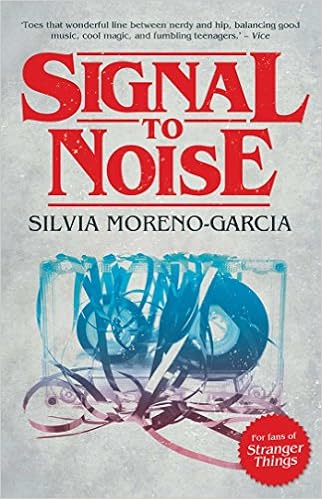
Signal to Noise, a Copper Cylinder Award winner, is about witches in Mexico City, coming of age in the Eighties and Nineties while reveling in now obsolete technology – note the iconic audio casette on the cover – and pre-corporate pop cultures, both Mexican and American. The witchcraft rings true with my own researches into the subject – Mexico/Aztlán is the Transylvania of this continent – and the book has a far more realistic feel than most other books on the subject. I wonder what a nongenre reader stumbling on it without the usual prejudices would think . . . based on a true story? Could be, in Tenochtitlán.

Certain Dark Things is one of NPR's Best Books of 2016, and is dedicated to Germán Robles, who played handsome vampires in old, black and white Mexican movies. These vampires aren't fashionable sparkling, romantic masturbation fantasies. They are an impressive, imaginative, ingenious work of world-building that includes not only Aztec-descended vampires, but diverse tribes and
species from all over the planet that can give any other fictional blood-suckers a run for their money. And they hold up when shown next to gritty, modern realities, and remind me more of walking Tenochtitlán's streets among the blind beggars, fire-eaters, and snake-charmers than watching old movies. I personally would like to see more of these characters and this world.


I highly recommend both these books, realizing that they are outside the usual white middle-class comfort zone of the New York publishing industry. They may disturb those looking for light reading, and the characters aren't “likable” suburbanites. But reading about them makes me smell Mexico City, which makes me homesick and fires the imagination.


I think that's a good thing.


And later this year, Moreno-Garcia has another book coming out, The Beautiful Ones!


Thursday, February 18, 2016

Chicanonautica: Impressions of Tenochtitlán


I probably would have never written High Aztech if I hadn't been to Mexico City, thanks to my sister Carol. It blew my mind, to use a cliché that seems to pop up a lot these days – maybe there's something in the air, or the gravity waves distorting that part of the spacetime continuum . . . I took along a sketchbook, made some notes and drawings that captured some what was happening to my mind. Here are scans of the pages, and transcriptions of my scrawled notes, with minimal corrections, and the run-on sentences intact to emphasize how I was overwhelmed by Tenochtitlán:


27Jul82 (Flying in Mexican air-space): Plane flies thru an electrical storm. Lighting is different when you're on its level or above. Flashes reveal instant landscapes of the storm-clouds. Is it more spectacular flying over Jupiter?


Later, from a decaying taxi I see this sprayed on a Mexico City wall . . . ¡PUNK!


Like a feathered serpent uncoiling in the primordial dawn – Mexico City gets up early, winds up, comes to life. By sun-up, workers are busy excavating Aztec ruins less than a mile from the Palacio Nacional. This is a city built on a city built on a city . . . onward until the 21st century. Decaying buildings spew forth people in modern business dress. An Aztec serpent face peers out of a 16th century wall. 1960s psychedelic color (long faded) art deco façades. Drivers & pedestrians slide into mad rhythms that don't allow for error. Blind people are all over, the infirm, the starving, the hustling . . . an old lady begs at the entrance to the National Cathedral, a man pantomimes hunger in front of a diner. Indians in Aztec costumes play music and dance. A man plays the accordion while his daughter holds out a tin cup. Boys in uniform hold rifles and pose for tourist's photos in front of national treasures. The concrete is cracked, flowing and organic – This city is a living thing. Murals & graffiti – History & news. Disco sucks here too. (27Jul82 Mexico City)


Top Cat, Beany & Cecil, Bozo the Clown, Little House on the Prairie and Sheriff Lobo all habla español on Mexico City T.V. We arrive a day late to witness a political demonstration. Programacion infantil. Yanqui go home. Tourists come here to look at another culture. (27Jul82)


29Jul82 – Climbed to the top of the Pyramid of the Sun . . . WHEW!


31Jul82 – The Metro & bus system of Cuidad Mexico ain't all that bad. Despite all the hassles & crowds I wish L.A. had half as efficient a rapid transit system. Everywhere (museums, streets, subways, buses) people are reading tiny Mexican comic books. On the Metro guys get on & hawk books (on buses too). Also on the Metro as a blind beggar made his way thru a car singing a little boy tried to steal a coin from his outstretched hand. Blisters erupt on my feet. Saw “The Illustrated Man” w/Spanish subtitles last night. Sipped wine while watching lighting flash behind the Palacio Nacional. Graffiti is more political than adolescent search for identity. Parts of Mexico City (and the suburbs) look like the L.A. area, except for the ancient decaying churches, the Aztec ruins in the middle of the Metro, and all the beggars, cripples, dwarves & hunchbacks – it also rains most every day in this wet season. Also young people of the same sex walk hand & hand, arm & arm around the streets, they do the same with their mothers & fathers – touching and affection don't necessarily mean sex here. Culture shock. In the Metro there's no “ladies first” politesse – when the train stops, it vomits and swallows masses of humanity, then speeds off on its merry way.


ErnestHogan's High Aztech in available in an enhanced ebook version, and a premier trade paperback edition will be coming out in April, 2016.


Saturday, February 28, 2015

Author Silvia Moreno-Garcia's strange ways


When I first learned that the Chicana spec lit author Silvia Moreno-Garcia lived and published in Canada, I wondered how Mexican she still was. I don't know much about the culture there, other than it's obviously far from Aztlán y la frontera. I read about anthologies she co-edited and about her awards: Sunburst Award, Cooper Short Fiction Competition winner, Manchester Fiction finalist. Then, I was more surprised that the setting for her full-length novel, Signal to Noise, was set even further south--in Mexico City--and described as "a literary fantasy about love, music and sorcery, set against the background of Mexico City."

Here's what some of the literary Gatekeepers say about the book:
"It's very early in the year but I can already tell this is one of the Notable Reads of 2015." - Kirkus
"Moreno-Garcia has a solid and convincing prose style, robust and subtle in all the right places... a successful debut, and a very interesting book." - Tor.com
“In a poignant, graceful coda, Moreno-Garcia brings the book full-circle, slyly subverting the expectations of a linear narrative and punctuating Meche's story with a hushed, lovely flourish. In many ways, Signal to Noise is a coming-of-age tale, but it's also the tale of what comes after — and what happens when forces beyond our control, magical or otherwise, are better left that way.” – NPR

So I read the book. It's more than a regular fantasy, and then again, it's not pure fantasy. To me, genre classifications don't do justice to a lot of our Latino writings. Even the term speculative, as in, speculative literature, is the Euro-Western worldview being imposed on what's only a half-Euro world, our Spanish half.

The witches and witchcraft in Moreno-Garcia's book would be called fantasy and speculative--or Daniel José Older's santería--even though we grew up in environments where the only speculation about witches was, who was a good or bad witch, and what they do next.

But Signal to Noise is about signal to noise (s:n), developed through literary paths of Silvia's making. For those who don't know, s:n is a tech/scientific term comparing what's understandable to what's interfering with that understanding. The less background "noise," the better. Like being in the middle of the recent Facebook exchange of insults about not reading White Male Hero Saves The World books, for a year. Too much racist, privilege-defense and male chauvinism make it difficult to find intelligible comments.

I understood and appreciated Moreno-Garcia's novel once I realized that the theme of s:n permeated the entire plot and subplots. Maybe I should say themes, plural. Here's the synopsis from her publisher, the imprint Solaris (Rebellion Publishing Ltd., England):
     "Mexico City, 1988: Long before iTunes or MP3s, you said, “I love you” with a mixtape. Meche, awkward and fifteen, has two equally unhip friends -- Sebastian and Daniela -- and a whole lot of vinyl records to keep her company. When she discovers how to cast spells using music, the future looks brighter for the trio. With help from this newfound magic, the three friends will piece together their broken families, change their status as non-entities, and maybe even find love...
     "Mexico City, 2009: Two decades after abandoning the metropolis, Meche returns for her estranged father’s funeral. It’s hard enough to cope with her family, but then she runs into Sebastian, and it revives memories from her childhood she thought she buried a long time ago. What really happened back then? What precipitated the bitter falling out with her father? And, is there any magic left?"

Don't think this some regular time-travel story. Silvia beautifully develops the s:n themes through her character Meche (a great girl-name). The plot weaves between Meche's life as a teenager and the grown-up Meche returning to DF to help bury her father.

The s:n theme is also reflected in Meche's current life and her memories of her teen years. Back and forth, down those two currents, or paths, she will run through phases of coming of age, twice. And coming to terms with her BFFs, as teens and as adults, as well as her teen and her adult love of a boy and a man. Old magic that worked and new magic that may not. The s:n of the magical pitted against reality. The s:n between teen Meche and the boy Sebastian, attempting to find their "signals" by filtering out the "noise" of teen life, growing up in Mexico City.

These are my thoughts about what Silvia accomplished, which she may see differently. She gave us a novel that explores at least two ways--possibly more--of living and reliving a teen's life. The memoirs of an adult Meche judging her teen mistakes and successes, not only with dark magic, but also with the struggle of trying to find happiness in family life that reminded me of Melinda Palacio and Reyna Grande's books.

In that sense, Signal to Noise has a feel of memoir that I know girls will love. This also crosses into genre of "teen romance" with the teasing and flirting and obsessing about the hottest guy in school, the pledges and tortures of loyalty and love between girls and guys. Yes, there is some "love story."

Teen boys will see in Sebastian, their own attempts to create more signals to girls, rather than awkwardly stumbling over the "noise" they often produce from trying to discover their male emotions. Boys, just read a female version of what you're going through and you might learn quite a bit.

This is also a book for adults--the nostalgia, oldies music of rock, jazz, R&B and more. Adults will recognize and maybe regret identifying with how they fumbled with the "other" sex, through their own teen years. And later, how they might have returned to correct some of the stupid things they did.

How the strange magic works, I'll let you discover from your own reading. Of course it's about music, and witches, and witchcraft. That will turn dark, not like horror, but as mean as some of us might have acted had we had the power.

Don't expect a La Capital setting that an Anglo author might paint. There's not much of museum visits, boat rides down Chapultepec canals, or the tourist lens. This is a Mexico City that its residents live and love in, a mysterious place to a gringo americano, but it's simply a Home, like barrios we grew and grow up in. Abject realism, centered on the characters.

What I'd love to see from Moreno-Garcia are sequels or prequels of these characters and the city DF and the magic. I want Meche to visit and stay with her bruja abuela who's sent somewhere--I'm not spoiling it--and have the abuela mentor Meche's magical abilities. I want to know how the magic ties to Aztec or other indigenous cultures. Give me más, por favor.

For the sake of getting our Latino stories published, we're supposed to follow the constrictions of genre to be a "good fit," as it's called. Latinos writers are subordinated too often by the rules of the Euro-Western worldview. It's buenísimo that Moreno-Garcia didn't shoehorn her story into one genre. And instead, let her story flow thematically, in multiple streams across time, space and teen/adult emotions.

About Silvia Moreno-Garcia:
Mexican by birth, Canadian by inclination. Silvia’s first collection, This Strange Way of Dying, was released in 2013 and was a finalist for The Sunburst Award for Excellence in Canadian Literature of the Fantastic. Her stories have also been collected in Love & Other Poisons.
She co-edited the anthologies Sword & Mythos, Historical Lovecraft, Future Lovecraft, Candle in the Attic Window and Fungi. Dead North and Fractured are solo anthologies. In 2011, She won the Carter V. Cooper/Exile Short Fiction Competition (in the Emerging Writer category) and was a finalist for the Manchester Fiction Prize.
Blog: http://www.silviamoreno-garcia.com/blog/
https://twitter.com/silviamg
https://www.facebook.com/silvia.morenogarcia

Es todo, of my "noise" today,
RudyG, a.k.a., Chicano fantasy author Rudy Ch. Garcia, known for sending his own mextasy signals

Sunday, March 09, 2014

VIVAS: Mujeres in the Mail

Olga Garcia Echeverria


Real, old-fashioned mail can brighten even the gloomiest of days. The parcel that arrives is the size of a record album, the weight of a sturdy book. It’s traveled all the way from Mexico City to Lincoln Heights. It’s littered with cool rows of orange Día de Muertos stamps and numerous black postal seals, faded and smeared. The envelope is made of brown paper bag, its edges beaten and gnawed. It's obviously been "manhandled" on both sides of the border. The calendars inside, though, are remarkably unscathed.

This is Rotmi Enciso and Ina Riaskov’s 2014 calendar project, VIVAS, where women who love women and women who love words are featured in every month of the year. The cover of the calendar is a lucha-libre-masked mujer running in a blur. She's zooming by in a white nightie, hot pink fishnet stocking, a black and gold cape, matching botas and fingerless arm-length gloves. Me gusta. Run, Lucha Libre Mujer, Run!


I open up the calendar to February. A black and white profile of an older woman stares back. There is some kind of fierceness in her face. No Botox. No airbrush. No commercial standards of youth and beauty. Yet, she’s beautiful, her skin weathered and sculptured by time--the same way wind and sun carve out the face of the earth.


When I turn to March, I see that my friends in Mexico have gifted one of my poems a page, “Vuelo.” It’s a poem close to my heart, about my maternal grandmother, who many moons ago in Mexico is said to have lost her mind. “Perdió la razón” is how the story goes. I like to envision it as a wondrous flight instead of madness. Vuela, abuelita, vuela!


In August, cumulous clouds and a poem by tatiana de la tierra greet me, “Prisionera de tu perro.” My heart warms and I laugh aloud, remembering this querida amiga, bloguera, escritora. It’s a true story, the poem. tatiana once got dumped for a dog. She was indignant when it happened. “Can you fucking believe it? A dog! A cat maybe, pero un perro comemierda?” Her revenge was to write a poem-song (with a loud barking chorus) to the ex-lover. “You don’t seem too heartbroken,” I said to her once while she was practicing the poem with a yowling gusto. She barked, and then kept on singing.

Gracias Ina and Rotmi. Your international parcel is greatly appreciated. Las mujeres en este calendario están VIVAS.


Calendario de mujeres opportunity: I have two extra VIVAS calendars to share. It's bilingual queer word and mujer visual art to hang on a wall porque every day is a good day to celebrate International Women's Day. If you'd like a calendar, email me at mariposa@datapillar.com and I'll send the first two people who respond a cool parcel in the mail.


Rotmi Enciso & Ina Riaskov: Artistas, Activistas, Femenistas,  Revolucionistas, Lesbianistas, Internacionalistas.
 
To learn more about VIVAS contact Rotmi and Ina via Producciones Y Milagros Agrupacion Femenista, A.C. proyectos.prodymil@yahoo.com or on twitter: @prodymil

Tuesday, August 04, 2009

Review: Yankee Invasion. Ignacio Solares.

Yankee Invasion

A Novel of Mexico City

By Ignacio Solares
Translated by Timothy G. Compton
Introduction by Carlos Fuentes

ISBN: 978-0-9798249-4-4


Michael Sedano

Imagine yourself a resident of Baghdad in March 2003. It is the eve of the United States invasion. You know your own military’s weakness is the perfect foil for the invader’s fabled power. Some of your men in uniform will fight fiercely, but they will surely die. You know your nation’s political leadership engenders little loyalty from a restive citizenry, so you hold no hope for massive resistance when the invaders raise their flag from the conquered rooftops. A feeling of dread begins to seep into your every waking thought. The first bombs drop, the first tanks turn the corner, and everything you feared turns out as you foresaw, only it’s worse because all these fears are real, and they’re happening to you.

Now put yourself into the same frame of mind, except the year is 1847 and you are living in Mexico City. The Yankees have already stolen Texas, the evil clown Santa Anna having held a state funeral for his dead leg, now has gone into hiding to avoid battle. Only poorly armed rasquachi soldiers stand in the way of General Scott’s invading giants. The Yankees have bombarded Veracruz. The Yankees have overwhelmed Puebla. The Yankees are in the Zócalo about to raise the stars and stripes above the Palacio Nacional.

Such parallels are inescapably part of the ambiente of Ignacio Solares’ Yankee Invasion, a Novel of Mexico City. Such is the bad P.R. the United States has earned from its many years of military adventures in foreign lands that the novel doesn’t need to make the parallels explicitly. Solares feeds the flames an anti-Yankeeism in this historical novel, so it is not a novel for “my country right or wrong my country” tipos. Solares doesn’t waste a lot of tears for Mexicanos, either. One of the key side characters, Father Jarauta, stands for fighting against the Yankees and the Mexicans who support them. Moreover, the story comes to us ten years after the treaty of Guadalupe Hidalgo has ceded half of Mexico into US control, and 1848 was a long time ago.


Solares uses the invasion as backdrop for the story of a courageous surgeon, a troubled writer, and an indictment of an inept government, then as now. We hear about war but see precious little. Much of the battle action takes place in hearsay narrative, in rumor, in newspaper reportage. And this is a good thing because readers who are Veterans of the U.S. military do not want to read about Mexicans—or anyone—killing GIs or Marines, whether from the halls of Montezuma or the banks of the Euphrates.

The medico is Dr. Urruchúa. He’s troubled that his patients die with regularity after childbirth and other procedures. He’s frustrated that a few tragos of rum are all he can offer a patient about to feel the doctor’s saw cut into an amputation. Urruchúa suspects that washing hands and instruments might alleviate virulent infection, and ruminates that hypnotism could be useful in surgery. The doctor is a genuine hero. During the battle for Mexico City, the doctor goes from hospital to hospital without food or rest tending to wounded. A grievously wounded Yankee gets as good as the doctor can give—just as Yankee medicos tend to wounded Mexicans.

Among the doctor’s closest friends is Abelardo, the frustrated writer. Dr. Urruchúa theorizes Mesmer’s treatments could reduce Abelardo’s chronic depression, not just an amputee’s. But the best the doctor can offer his friend is some pills and a sympathetic ear.

Abelardo experiences hallucinations borne of his depression. He sees colors and auras, contemplates suicide as his one sure cure, and perhaps the best way to escape the consequences of the Yankee invasion. But unlikeable Abelardo is a man of inaction, preferring to discuss politics with his other rich friends than take up arms in defense of la patria.

Abelardo’s story is at once comic and frustrating. Comedy grows from his relationship with Magdalena, his wife, and two women whom Abelardo refers to as the true loves of his life. Magdalena hectors the frustrated writer to stitch together the drawersful of newspaper clippings and scribblings, along with Dr. Urruchúa’s notes, Abelardo has collected over the years. She’s heard bits and snippets of the history throughout their married life and Magdalena’s fed up with the story’s sketchiness. She, too, wants details on the two women, daughter and mother.

This novel, in fact, is the result of Magdalena’s goading urgency. But, in the end, Magdalena refuses to accept Abelardo’s version of events. To the reader’s frustration, Abelardo acknowledges that Magdalena is probably correct, telling her that many details are pure fiction or wishful thinking. In Abelardo’s untrustworthy mind, there’s no difference. Still, history has a concrete referent for much that transpires. The U.S. did invade. Chapultepec was taken. Mexico City was occupied. The trains ran on time, as it were, from United States administrative reforms. And maybe--given its dismal leadership and powerless easily riled plebe--Mexico got what it deserved, the invasion and loss of half its former territory.

Readers will find Yankee Invasion, A Novel of Mexico City, a worthwhile endeavor because the twisted story of the two women is deliciously salacious without being dirty, because the patriotism of the troubled primera clase Abelardo is sincere and genuine, because the underlying satire of Solares’ costumbrismo takes big bites out of Mexican pride, because the narrative is fun as it swings like Abelardo’s moods between straightforward historical account to confessional first person elements when Abelardo steps out of the narrative to address his readers directly, because of its imaginative structure.

Imagine yourself in the assembled masses. The occupying authority summoned attendance to hear the victory proclamation. U.S. cavalry and infantry clean up their appearance as well as possible, a few hours removed from the bloody battle to occupy el Castillo de Chapultepc and fight their way to the seat of government. An officer reads an English language proclamation—pendejo, the people think, screw you and whatever you’re saying in your foreign language. One GI is honored to haul the U.S. flag up the pole. A shot sounds from a nearby rooftop. The sniper’s aim drops the Yankee in his tracks. The crowd explodes in frenzy, pulling invaders to the ground, beating them with brooms and hammers and stones, tearing their dirty uniforms from bleeding corpses. You’re running for your life away from the carnage when a dying Yankee grabs your ankles. In desperation you pull a knife and thrust it into the Yankee’s body again and again until you smell his last breath. It is your own personal moment of triumph. If it happened. Ni modo, there’s a novel in it.

That's the first Tuesday of August. August, my birthday month, my anniversary month! But it's a Tuesday like any other Tuesday, except You Are Here. Thank you for visiting La Bloga.

mvs

La Bloga welcomes your comments on this and every column. Click the comments counter below to share a word or more. If you have extended remarks, a review of your own--a novel, a poet, a cultural or arts event--click here to tell las blogueras los blogueros your idea.

Tuesday, July 08, 2008

Rivera Frescoes: Instauration, Restoration

Michael Sedano

Today I am sharing a series of photos shot at Mexico City's Secretaría de la Educación Publica across a span of ten years, first in 1995 and again in 2005. With some trepidation, I hope to revisit these walls in the near future to see what progress time has produced. I hesitate because once photographers were free to photograph any wall. My most recent visit to el Castillo de Chapultepec, zealous guards threatened to confiscate my camera if I so much as raised the viewfinder to my eye! Fortunately, the educators have a much friendlier actitud.

On the 1995 visit, I spent an entire morning in the Secretariat, shooting every panel possible, plus some interiors. It is a short walk from the Secretariat to el Zocalo and el Palacio Nacional, where Rivera has covered the second floor with a richness of precolumbian themed work. There, again, I took detailed images.

On my most recent visit, I reached the Secretariat late in the day and was able only to rush through a couple of interiors and cursory shots of key panels. Sadly, I didn't make the effort to track down the worst of the samples and cannot illustrate a before-and-after of the destroyed panels.


As the first pair of photos illustrates, certain of Rivera's frescoes were totally obliterated and their reappearance on the walls must be seen as instauration rather than restoration.


I did, however, have the good fortune of shooting Rivera's 1923 work, "La Feria Del Dia de los Muertos," during its ongoing restoration. The first set of images shows an artist patiently cleaning the substrate at the bottom of the mural.


I did not find a guide to ask if the damage resulted from weatherization or terremoto.


Ni modo, the work was in dishearteningly terrible shape. At bottom center, large swaths of detail have disappeared.

Have a look at the next image, at right and below. Note the figure of a woman in yellow dress in the 1995 image. Left of her all that remains is white plaster. In the close-up you can make out the artist using a point to clean off the surface in preparation for a repaint.


Notice how in 2005 all of the bottom center has been restored. Figures emerge to the left of the yellow clad woman. Now the work bench dedicates itself to work higher up, at lintel level. When I stood next to the work however, I could not make out what aspects were under repair or restoration. Study the over-under close-up and note the excellent quality of the surface.


Below see an over-under layout of close-ups showing more or less the same region. This is a set of figures at the far left of the panel, above the lintel and just to the right of the half-round clerestory of the portal. At top, the restored sections are barely noticeable. At bottom, the damage makes your heart stop.

I am working on a series of illustrated lectures on Mexico City's mural frescoes--Rivera, Siquieros, O'Gorman--and welcome leads to books and other resources. One highly informative resource I found for the Education Secretariat and the National Palace is a long out-of-print tourist manual, by R. S. Silva E., Diego Rivera's frescoes in the National Palace of Mexico, City: a descriptive guide. Mexico City : Sinalomex Editorial, 1965. I am grateful to John McDonald, a senior librarian at the Claremont Colleges Libraries, for letting me borrow the book from the Honnold Library. The title is also available at UC Berkeley. Silva points out that the personages in the Dia de los Muertos detail include actress Celia Montalban and bullfighter Juan Silveti, with the cigar.

You can click on each of the images in today's post to view the files in much larger, better detailed size. In fact, I've laid out the Rivera over-under image as a picture postcard that you can print on heavy photo stock and mail to friends. Click here for this, and other, print 'em yourself postcards from Read! Raza.