Showing posts with label mother's day. Show all posts

Tuesday, May 10, 2022

Mother's Day 2022

Michael Sedano 

Everyone in the world has a mother. Many of us know the joy of having the World's Best Mother. I know, some people didn't get to be mothered by the idealized vision of that poem by José Montoya about la Jefita, "man, she never sleeps!" But I wish they had. 
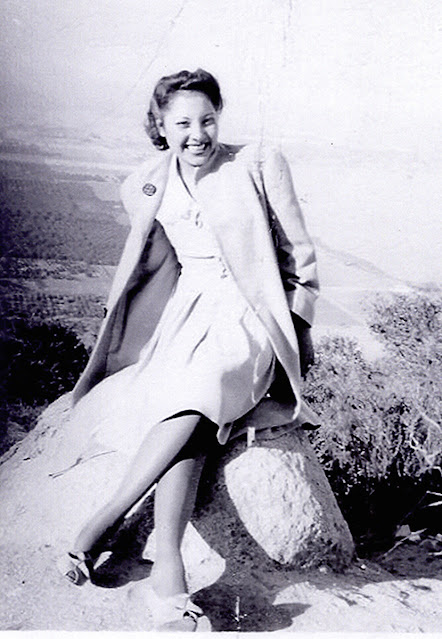
 

I wish all mamas enjoyed an idealized version of getting married to Mr. Charming, living forever-after satisfied and whole, all the days of their lives. 


There's no idealized version of what happened to the newlywed woman in the photograph. She didn't have a fabulous gown with twelve attendants in flowing satin. She ran off to Arizona, where 15 ½ isn't too young to marry the lovestruck orange picker.


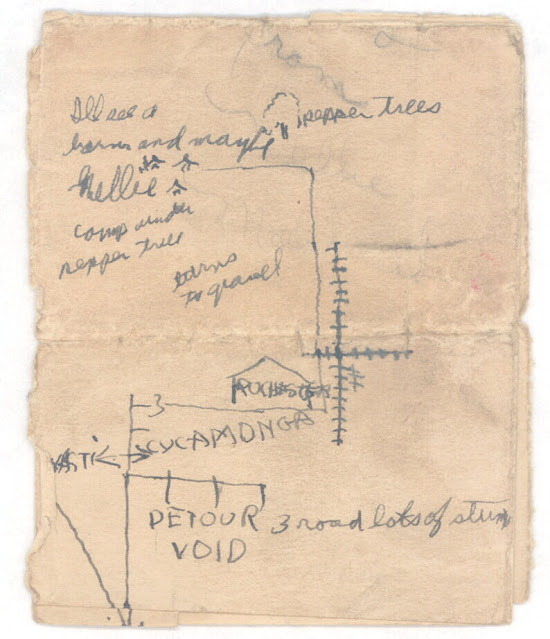
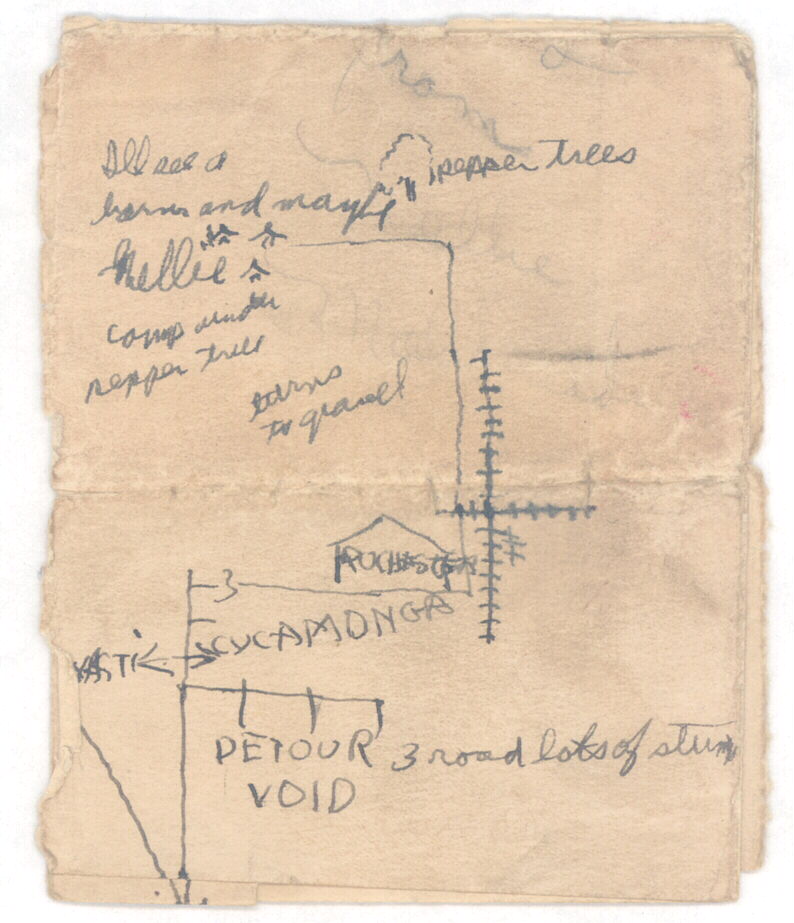
The domineering step-father would no longer tell Nellie what to do. She left home and got word to Redlands. He wrote it down, drew a map. A camp on a lonely gravel road out past the railroad tracks


"I'll see a barn and maybe Nellie

Camp under pepper tree".


They drove the Model A from Cucamonga to Yuma and spent their honeymoon night in a cane break. That was 1941.


August 1945, my father is in Germany, sweating out orders for the Japan occupation. A neighbor drives us to Community Hospital across from the Courthouse. I don’t know how we got home. Probably my second bus ride. 

During the pedo over Civil Rights and the crap we saw in Life Magazine, my mother happily related my first bus trip--in utero. 

A bus driver in Ft Knox Kentucky tells my mother to get to the back of the bus with the Colored. My mom tells the bus driver "I'm not Colored, I'm Mexican." 

Y que. We sit in front. Imagine my Mom there, all prim and proper, holding her own place in the world. 

Mother’s Day is for remembering. My Mom lay in the nursing home room, its dismal light interrupted by gathering spirits. Familia has appeared. Soundlessly I am instructed to take her home with me. 

The spirits leave an evanescent memory, reminding us. Four-year old me stands on the couch in my hand-me-down clothes hugging my mother, telling her how one day she's gonna come live with me and I will take care of her forever and ever. She smiles at a little boy’s promise and hugs me. That scene is alive in her eyes as my mother wakes, nods, agrees at long last to come live in my home to end her days.

In the silence, a question lingers.

Over recent months I'd made weekly visits to Redlands to cook, to observe the level of care she receives, to leave money. I take her to all her doctor appointments. She knows she can no longer drive and willingly accepts my insistence that I drive. I closely follow her worsening health. 

Every visit, the doctor recommends she go live with this son of hers. Every doctor gets turned down. I get turned down. Poorly cared for at home, she is hospitalized repeatedly, then into Rehab. Mom decides she doesn't need to be miserable any longer.

“What took you so long to decide?”

She looks across the featureless bed at me. I lean forward to hear over hallway noises in this awful nursing home hell. She looks away then back at me. A lifetime in four words:

“It wouldn’t be strong.”


Caption: My mother jumps with joy, inside, learning Barbara will be a mother next Fall. Cherish the thought. 1974.

Sunday, May 25, 2008

Stir, Chop, Cha-Cha-Cha

Since losing my mother thirteen years ago I find myself drawn to things that remind me of her and her rich, warm Puerto Rican cultura. The images of palm trees that seem to adorn every towel and shower curtain in home decorating departments. The energetic strains of the salsa and merengue music that float out of my car windows into the lush Vermont woods I drive through every morning and evening. And the smells of traditional Latino food that I have begun to prepare, all speak to me at a genetic level. However the cuisine brings back the strongest memories of my Puerto Rican mother and makes me long for her languid island home.

I grew up in 1960's New Jersey as the youngest of five children with a mother who was of the Peg Bracken's I Hate to Cook Cookbook generation. Any dinner that could be made in one pot and in massive quantities was her kind of meal. Though with seven mouths to feed I could hardly blame her, it made for some hideous casseroles that forced us to sit at the table until we finished eating. But every once in awhile, Mom would prepare a Puerto Rican dish. A traditional Dávila family recipe. Normally she would drag me to the supermarket with an air of "grab those instant potatoes off the shelf and get me the hell out of here." But on those occasions when she make Chili Con Carne, or Arroz Con Pollo, or, on really special occasions, Paella, she would spend hours in the produce aisle choosing just the right tomato or making a special trip to the butcher for fresh chicken. Then there would be an entire afternoon in the kitchen, crushing fresh spices with un pilón, and simmering, always something simmering on the stove, filling the entire house with the intoxicating smells of my abuela's kitchen in Bayamón, Puerto Rico.

I would quietly sit on the little footstool in the corner of the kitchen, afraid to disturb my mother's culinary dance by my presence. I couldn't rectify this “chef mother” with the rushed and harried “short order cook Mom” I was accustomed to. She would normally be bustling around at the last minute, short-tempered and wanting to get it over with, barking orders at me to set the table, or call my brothers down, or wash my hands. No, this mother would sing softly in her beautiful alto voice, melodic songs of the Caribbean, her skirt swaying back and forth as she moved between the stove and the sink, the sink and the cutting board. Intoxicated by the smells, I would eventually creep from my corner and convince my mother into feeding me spoonfuls of her creations, feeling privileged that I was getting a preview before my siblings.

Last month I made my mother's chili con carne for my family for the first time. I rarely make Puerto Rican food as I don't like to cook and all the dishes I know how to make are entirely too labor intensive. But one day, as I stared at the Goya dark red kidney beans on the shelf at the local supermarket, I decided I would conjure Mom. Though my mother's well worn pilón remained on the shelf, I used the bottled version of the traditional Sofrito, and slowly began to prepare our meal. I found myself humming as I browned the ground beef and onions, and added the tomatoes. I pictured my Grandmother's kitchen, with its black & white tiles, counters covered with technicolor vegetables and ripe tropical fruits. I heard the slow laughter of the women as they floated around the kitchen in a slow sensual dance of preparation. I smiled to myself as I found my hips swaying like those women of long ago as I moved across the kitchen.

After awhile my son Carlos came into the room, his nose in the air leading him to the stove. He peered into the pot and asked, "What's that?" with a look and tone of sheer delight. He was very surprised. Usually Dad did the cooking. I replied, "I made your grandma's Chili." "Can I taste it?" I held a spoon up to his mouth and his eyes lit up as he begged, "Can I have some more?" I was surprised at the intense satisfaction I felt in his enjoyment. I felt as though I was channeling Mom as I fed the spoonful to my son’s waiting mouth, much like she had fed me so many years ago.

That night, in the re-creation of my mother's cooking, as my mind filled with images of slow and deliberate family meals in steamy Bayamón dining rooms, I realized why she was so different when she cooked the food of her island. My siblings and I were bi-cultural by blood. Mom had become by necessity and choice, a mixture of two worlds. She married an extreme gringo, and needed to adapt to life in suburban New Jersey, but still felt the salt of the Caribbean Sea on her skin. The song of the coqui, the Puerto Rican tree frog, still echoed in her ears. And the rich tastes of a well cooked Puerto Rican meal still lingered on her tastebuds. In the daily bustle of running the household, she had taken on the pace of a harried North American 1960’s housewife, but on those special occasions when she prepared a taste of home, she reverted to the deliberate care and languid pace of her Puerto Rican island. After my Mom’s death, I was surprised to discover that I too heard the coqui in my thoughts, and yearned for the tightness of a salted skin after an afternoon swim. But most surprising, was that in recreating her culinary rituals, I could feel the same sensual pleasure I now understood my mother felt when she cooked her native food.

Elena’s Chili Con Carne

1 lb. ground beef
1 can red kidney beans
1 medium Onion
½ a fresh green pepper
1 small can tomato sauce
olive oil
fresh garlic
dried red pepper
1 tsp oregano
salt


Chop onion and green pepper, and sauté in olive oil. When soft, add tomato sauce, and garlic, red pepper and salt to taste, and 1 tsp oregano. Set aside browned veggies (sofrito).

In fat in pan, brown 1 lb. ground beef. When brown, add sofrito (browned veggies), and drained red kidney beans (save liquid). Simmer on low fire until it thickens. Add leftover liquid from beans if it gets dry. Serve over white rice.

¡Buen Provecho!


Sunday, May 11, 2008

Greetings, gentle readers. I hope you will indulge me as I share a different kind of mother’s day writing. Though its words are not flowery and its subject difficult, I believe a lot of mothers—and fathers—will relate to it, because our identity as parents is sometimes defined as much by loss as by abundance. I have only shared it once before in a reading at Vermont College, but then my tale was hidden behind a fictional character. I am sharing it today in the form it should take: the truth.

I hope it touches you, whether you relate to it or not. I hope you all have a happy Mother’s Day.


The Empty Sweater

I see it out of the corner of my eye as I dig beneath skeins of wool in the cedar chest, the red, yellow and green flecks in its deep blue deceivingly festive like confetti. I pull it out from beneath a stack of vintage knitting patterns, and for a moment pretend to not know what it is, though I’ve never really forgotten its presence beneath the rarely opened hinged top. But as I unfold the tiny sweater in my hand an invisible band around my chest tightens and my breathing comes in shallow and fast. As I hold it, there is no denying its story.

I had bought the yarn on the way to the doctor for my monthly check-up. Doing so meant letting go of my superstitions—I wouldn’t buy anything for my first child until I was seven months pregnant and a co-worker said, “Ann, you better at least buy a bassinette, or that baby won’t have a thing to sleep in!”—but I needed to feel I was doing something for him, for my second son. I hadn’t been able to feel at ease during this pregnancy; I felt like everything was just beyond my grasp, just beyond my control, and every day I was surprised and relieved when nothing went wrong. But I smiled as I held the marbled cotton yarn in my hands; I would begin the project while waiting for my appointment that afternoon.

The back of the sweater was half done when the nurse finally called me in. I eyed it peeking from my tote bag as Dr. Sampson ran the Doppler over my taut white belly, his face a neutral mask of concentration, and I wished I could hold it, be comforted by the touch of the soft yarn.

“Ann, I’m just going to ask one of the other physicians to have a listen. I’m having some trouble getting a read on the baby. It’s probably just the equipment.” But his strained smile said he didn’t think it was. The minute he was out the door I grabbed for the sweater.

As I waited, the silver needles clicked and clicked, echoing in the empty examination room, their rhythmic sway the only movement. The front left side was done by the time Dr. Sampson returned with a false-smiling physician. He didn’t seem to have any luck with the Doppler either, and as I watched him leave, I fantasized about following him out, just walking out the front door and to my car in the bright Vermont autumn sun.

“Ann, we would like to order a sonogram at the hospital, tonight,” Dr. Sampson said. “Now don’t worry, it’s probably nothing, but we just want to make sure all is well.” He patted my hand, and for a moment, just a moment, I considered slapping it away.

That evening I perched on the end of an orange Naugahyde chair in the hospital waiting room, my hands and their needle extensions moving faster, as if trying to outrun my heartbeat. Alone, surrounded by quiet floral wallpaper, I finished the right front and started on a sleeve.

Later, in radiology the night physician stood in front of me, his serious face lit only by a lamp in the corner and the blue light from the sonogram machine. I could feel his pity coming off him like heat. “I’m so sorry, Mrs. Cardinal. There’s no movement at all. It looks like he’s been gone a few days. Dr. Sampson will be here shortly, and we’re calling your husband now.”

I sat on the hard vinyl examining table, my rounded belly mockingly pushing through the opening in the faded blue gown. I expected tears. I was surprised by the numbness spreading through me, beginning at my sepulchered womb and moving outwards. I picked up my needles and finished the sleeve, the yarn trailing over my swollen breasts, my hands moving slowly, as if underwater. I continued to knit as Mike Sampson told me they would have to get the D&C scheduled, that I should go home and he would give me a sedative to help me sleep, to help me forget. I took the drugs; after all there was only my bloodstream to worry about now. I swallowed the blue pill dry as my husband drove, his grief-stricken face lit by the green glow of the dash and the flashes of light from the passing cars.

That night, at home, my eyes hazed with the Valium, I squeezed between my two-year-old son and my husband on the couch. For moments, comforted by the warmth of their skin, of their familiar company, I could almost forget. As images of blue animated Disney ants flashed across the television screen, I finished the last sleeve and placed the pieces on the coffee table just slightly apart from each other. In silence, all three of us looked at the dismembered sweater. Then Carlos asked, “You gonna put that together, Mommy?” I pulled him close and kissed his forehead, the sweet powdery smell of him filling my nostrils.

I wouldn’t sew it together until the following day in the hospital, after the bleeding started as Carlos and I walked through the brightly lit aisles of the video store, cramps doubling me over, my contracting stomach pressed against the steering wheel during the rushed drive to the hospital as I murmured comforting words over my shoulder to the child seat in the back. At the hospital my womb began to empty on its own, as Carlos was tugged away, his small face a mirror of my frightened heart.

That night, after my family went home, tired and saddened, I sat on the gurney, the hushed sounds of the night-shift nurses floating up and down the hallway, and carefully sewed shoulder to shoulder, sleeve to back. The next day when I arrived home with my small family, I snuck away from their concerned hovering to the bedroom, folded the sweater up and placed it in the chest—not on top where I would see it all the time, nor at the bottom where I might forget it entirely.

Now, as I hold it up in the light, I admire the tight stitches, noticing the beauty of the yarn and the brightness of the flecks of color against the deep blue. There had been several times when I considered giving it to a friend for their baby—it seemed so silly for it to sit empty, buried among rarely used yarn—but I never could bring myself to give it away. I wonder if I feared it was cursed, or if I simply couldn't bear to see another baby wearing it.

I fold it up carefully, and decide. I’ll save it for when my son has children of his own. I have to imagine its edges will be rounded with chubby baby flesh, its stitches stretched with movement and growth. I have to believe that one day it will be full.

Wednesday, May 30, 2007

La Vida en las Sombras


Murder, memory, loss, anguish--all the stuff of crime fiction and tragedy. It is the subject matter of novelist James Ellroy, whose literary career has garnered him praise from the national press, and whose novel, L.A. Confidential, became a critically acclaimed film. But in My Dark Places, Ellroy throws the reader an unexpected twist.

This book is about the killing of his own mother, whom Ellroy lost when he was 10. It was the single incident that propelled Ellroy through a life as an introverted child, a teen criminal, a con, a drug addict, and finally a writer. But even as Ellroy dredges his tortured life from the ashes, his mother's ghost is never far behind. He longs for her, dreams about her, and she insinuated herself into every waking moment of his life.

My Dark Places is memoir, crime story, love song and a cry in the dark. Jean Ellroy was very much like a character in a noir novel. A woman of duplicity, torn between two lives, she was subdued and distant with her son, and acted more as a disciplinarian., rather than loving mother. In her other life she was a secret alcoholic, habitually drawn to anonymous sex with violent men. One of those men killed her on June 22, 1958. It was the single experience that rent the fabric of James Ellroy's life. He spent the next 36 years both running from her ghost, and recreating her life.

As soon as he was able Ellroy disappeared into the underworld. He was his mother's son, after all. She drank, he grew up and did eight balls and speed. She hung with criminals, he became one. She picked up men in bars and had one-night stands, he met women, screwed them, dumped them and moved along. When the drugs and the sex and the crime failed, Ellroy even reconstituted himself as a sober, successful writer. Nothing healed that wound that was his mother. He desired her, despised her, finally decided to investigate the case himself, hoping in this way, to reclaim her. What happened was an odyssey of obsession, redemption, but not peace.

Despite a kind of resolution, James Ellroy will never be a peaceable being. He ends My Dark Places with these words: I can hear your voice. I can smell you and taste your breath. You're brushing against me. You're gone and I want more of you. Then he lists the name and number of the detective who is still looking for leads, still looking for the killer.

Why is this so compelling for me? I was drawn to read this book after hearing an interview with Ellroy, feeling shocked to hear him talk about the tragedy in words that were my own. My own writing about mother-loss echoes Ellroy's: I am looking for you mother, looking for you everywhere. In the corridors of dreams, windowless, empty. I look for the door that will lead me to you. I look, but I never find it.

I ran from my own childhood holocaust, escaped anyway I could. I, too, reworked, re-envisioned, and reshaped my life by writing. That wound has never completely healed. Maybe it never will, if my own intuition and Ellroy's cautionary words mean anything. But we write, we keep digging up the past, we keep afloat.

On a purely stylistic note: this is riveting writing. The book is crafted with a staccato rhythm, the use of simple, clean phrasing, and icy-hot imagery. I hope I can use it to shape a trilogy of performance I'm working on about personal and pop culture violence, Bury the Bones. Maybe Ellroy would enjoy the title.

ISBN-10: 0679762051

Lisa Alvarado

Thursday, May 10, 2007

For Rita Alvarado


It was about a year ago, on a spring day like a lot of spring days in Chicago; the sky, overcast, the color of slate, the color of mourning doves. The wind was blowing cool and damp, making me shiver. I was standing in Queen of Heaven cemetery, looking down at a mound of dirt, an unmarked grave. It was where Rita Alvarado, my mother was buried. So much had happened between us, so much said and unsaid. I laid down on top of the dirt and opened my arms to try to hold her one last time.

People have asked me how would I describe my relationship with her. I tell them this. A little girl and her mother are flying on an airplane, when something happens and the plane starts careening toward the ground. In a rush, the mother searches for a parachute and finds only one. Placing it on the girl, she carries her to the open hatch. The child wails and screams, begging her mother not to let go. But the mother, with infinite love, takes that last step, and releases her daughter to the open sky, to the world, to her future.

Everything I am today is because my mother gave me a parachute.

The following piece is my love letter.


It’s winter Mamí, and I’m thinking of you. Not Mother’s Day, and not your birthday --- on an icy, white, nameless day in the heart of winter. Through the cold that seems like it will never end, my thoughts turn to you and that memory --- the last happy time.

We’re in Geneva, near the Wisconsin border, tobogganing, with abuelo and silent, angry Daddy. I’m four, I think, and you are kneeling in the snow, your hair in a French braid, your fur coat billowing around you as the wind blows. I’m in my blue snow suit, chubby and smiling, and loving you, loving you so very much. How could I know that you would soon start to leave me by degrees?

Each time I remember the snow, your beautiful face, I ache. I want you. I want a woman. Only a woman. This longing is about the hunger only a woman can feed. I want what I want. I want what I can’t have. I let a woman hold me. It is something. It is never enough.

But I remember you taught me about stories and the power in telling them.

XXXXXXXXXXXXXXXXXXXXXXXXXXXXXXXXXXXXXX

My mother was a woman who spoke little of the past, and when I became a teenager I became more curious about her life before she got married. I'd asked her to tell me the story of how she named me. (In 1956, the year I was born, Lisa was not a popular name.) To my surprise, she told me that it came from Club De Lisa, a popular jazz club on the south side. (I've come to find out that it had a national reputation, and was a hub for cool jazz.)

After some prodding, I found out that she had a very different life then. I only knew her as an unhappy housewife, someone who doted over me when I was little, but disappeared into alcoholism and drug addiction before I was 12. She told me a story of a completely different woman, a model with the Pat Stevens Agency, who made all the rounds at the chic clubs, dated musicians, and was a former print ad model for Maybelline mascara and eyebrow pencils.

One day, after what she thought was her best shoot, the art director told her that it was too bad --that this was as far as she would ever go because she was so Mexican-looking. (The ads only featured a tight shot of her eyes, avoiding her strong Indio nose, and were altered to make her skin seem lighter).

Little details about my childhood seem to make more sense. I remember her crying after making a princess costume for me...she'd cut down her only good suit...silk shantung, which I found out after the revelation was one of the last vestiges of her modeling days. There was tobogganing with her when I was about four. She was wearing a fur coat, impossibly beautiful. It wasn't long after that the coat got destroyed...in a fight with my father, I think.

I had access to some more of her life, her true life, the one she in which she was happy before it all went to hell.

It didn't change how being a Chicana in the 50's limited her choices, didn't change how an abusive marriage trapped her and eroded her soul. Knowledge here, did not mean freedom, either for her or for me.

I was never able to save her.


I am looking for you mother

I am looking for you mother,
looking for you everywhere.
In the corridors of dreams,
windowless, empty.
I look for the door
that will lead me to you.
I look, but I never find it.

I am looking for you, mother.
On these hard streets and cracked sidewalks,
I run past carnicerías,
babies dressed for bautizos,
family parties in back yards.
But you are never there.

I am looking for you, mother.
I play Billie Holliday just like you did.
I think if I close my eyes
and wait long enough;
I will smell your perfume
and you will finally be here.
But you never come.
Doctors took you away.
You took yourself away
with pieces of paper neatly lettered
with milligrams and the proper dose.
They help you forget that once you were
almost celebrated
almost called beautiful
by people who thought it was a shame
that you were so Mexican looking.
So you give the man the paper
and he gives you the pills.
The pills help you.
The pills have stolen you from me.

I am looking for you, mother
A woman kisses my hand,
I think it is you.
A woman holds me,
I think it is you.
My lover tells me
he thinks I am beautiful.
Not almost.
I think about you.

I wonder if I will ever find you.
I wonder if you will ever kiss me.
I wonder if you will ever hold me or tell me
I am beautiful.

I wonder if you'll ever know
that I wrote this for you.

A version of this piece was broadcast on WBEZ 91.3, National Public Radio in May, 2002.


Lisa Alvarado

Saturday, May 05, 2007

Children’s Books for May

René Colato Laínez


You can find this poem in the Spanish Children's Magazine, Iguana (May-June 2007)

En el día de las madres
corto flores de colores
para la reina de corazones
que me canta lindas canciones.

En el día de las madres
preparo un gran pastel
con tres libras de sal, un poco de miel
y mucha canela como el color de mi piel.

En el día de las madres
rompo mi pequeña alcancía
para comprarle a la reina una silla
y si no me alcanza, una calcomanía.

En el día de las madres
le abriré hasta el cielo mis brazos
para darle un regalaso,
un gran beso y un abrazo.


Take a look at these books about Mother’s Day/ Día de las madres:

Antonio's Card / La Tarjeta de Antonio by Rigoberto Gonzalez. Illustrated by Cecilia Alvarez.

¿Me quieres, mamá? por Barbara Joosse. Ilustrado por Barbara Lavallee.

A Ride on Mother's Back: A Day of Baby Carrying around the World
by Emery Bernhard. Illustrated by Durga Bernhard.

Happy Mother's Day, Mami! Happy Mother's Day, Mami!
by Leslie Valdes. Illustrated by Jason Fruchter.

Siempre te querré por Robert Munsch.

Mother's Day: El Dia De Las Madres by Ana Consuelo Matiella. Illustrated by Juana Alicia.

Love You Forever by Robert Muncsh.

Mama, Do You Love Me? by Barbara Joosse. Illustrated by Barbara Lavallee.

Are You My Mother? by P.D. Eastman